







Abstract
Research alliances, like other research-practice partnerships (RPPs), aim to bridge the historic divide between educational research and practice and improve education in particular local contexts. Yet, although these demands reflect multiple and contested field-level logics, little prior research has examined the ways these logics impact the work of RPPs. This longitudinal, qualitative study explores the field-level logics that dominated the local contexts of two research alliances; how these logics shifted over time; and how research alliances responded to these shifts. Results show that field-level logics of research, practice, and community contended in both local contexts, and that alliance design, resources, and local contexts shaped research alliances’ efforts to respond to and manage shifting demands.
Keywords
May you have a strong foundation/When the winds of changes shift.
The disconnect between educational research and practice has long been a concern for both researchers and practitioners (Farley-Ripple et al., 2018). In recent years, however, the demand to close this gap has increased. Education researchers have come under increasing pressure from funders and other stakeholders to demonstrate the impact of their research on practice, while pressure on practitioners to make decisions based on evidence and research has also grown (Coburn et al., 2009; Duff et al., in press; Glazer et al., 2023; Honig & Coburn, 2008; Honig & Venkateswaran, 2012; Penuel et al., 2017). As the demand to close the research–practice gap has intensified, research–practice partnerships (RPPs) have proliferated (Coburn & Penuel, 2016; Coburn et al., 2013; Coburn & Stein, 2010; Farrell et al., 2021). Although there are different forms of RPPs with differing goals and strategies, they are typically depicted as partnerships dedicated to conducting and using research in ways that promote educational improvement in local contexts (Farrell et al., 2021). In some cases, this involves close collaboration between practitioners and researchers, whereas in other cases collaboration is less intense.
Although RPPs continue to proliferate, policymakers and researchers have increasingly questioned their effectiveness. Some stakeholders have noted the lack of evidence on partnership outcomes (Coburn & Penuel, 2016; Schneider, 2018), while others have worked to define indicators of effectiveness (see, for example, Henrick et al., 2017). Mark Schneider, the director of the Institute for Education Sciences of the U.S. Department of Education, noted that despite significant investment, “RPPs are mostly hope-based,” and that “we can’t continue to bet tens of millions of dollars each year on RPPs without a better sense of what they are doing, what they are accomplishing, and what factors are associated with their success” (2018).
Questions about organizational effectiveness, such as those raised about RPPs, often reflect deeper questions about organizational legitimacy, which we define as the perceived fit between an organization and its surrounding cultural milieu. As Suchman (1995) puts it, “legitimacy is a generalized perception or assumption that the actions of an entity are desirable, proper, or appropriate within some socially constructed system of norms, values, beliefs, and definitions” (p. 574; see also Deephouse et al., 2017; Scott, 2014). Organizations deemed legitimate are generally subject to little questioning about their “existence, functioning, and jurisdiction” (Meyer & Scott, 1983, p. 201), while a lack of legitimacy is evidenced by publicly-expressed doubts about an organization’s work (Brown, 1998; Deephouse, 1996; Meyer & Scott, 1983). In education, legitimacy encompasses the notion of technical effectiveness (e.g., learning outcomes) but can also include other cultural and social factors that have long engendered public support of schools (Meyer & Rowan, 1977).
A focus on RPP legitimacy allows us to move beyond unidimensional notions of effectiveness and instead consider the range of values and norms that are embodied in RPPs’ structures and practices, and the extent to which they align with the conceptions of effectiveness that animate RPPs’ larger social environments. In this view, understanding the challenges faced by RPPs, and their chances of long-term sustainability, requires an understanding of the ways that RPPs are designed and the degree to which their designs align with cultural and social expectations.
Toward this end, we draw on the institutional logics framework, which offers conceptual tools for understanding the social and political dynamics of organizational legitimacy in complex, pluralistic environments. The institutional logics framework maintains that societies broadly, and fields specifically, are home to multiple “logics,” each with its own set of values, vocabulary, and practices. The canonical set of societal-level logics include the state, market, profession, corporation, religion, community, and family. Friedland and Alford (1991), widely credited with ushering in this perspective, offer the following definition: Each of the most important institutional orders of contemporary Western societies has a central logic. . . . The institutional logic of capitalism is accumulation and commodification of human activity. That of the state is rationalization and the regulation of human activity by legal and bureaucratic hierarchies. That of democracy is participation and the extension of popular control over human activity. That of the family is the motivation of human activity by unconditional loyalty to its members and their reproductive needs. (pp. 247–248)
Education research has been slow to engage with advances in institutional theory (Diehl & Golann, 2023), and while some scholarship has used institutional theory to explain the proliferation of RPPs (Arce-Trigatti et al., 2018), the bulk of prior work has largely neglected, like the fish immersed in water, the institutional environments that give meaning to RPP work and that send crucial messages about their roles and responsibilities. The result is that we know little about the connections between the well-documented tensions in RPPs’ work and the larger institutional forces from which these tensions emerge.
In this longitudinal, qualitative study, we begin to fill this gap by examining one form of RPP—the research alliance—analyzing whether and how research alliances maintain their legitimacy in an institutionally contested and pluralistic field. We focus on research alliances because the research alliance maintains a predominant place among RPPs in U.S. public education (Schneider, 2018), despite the recent proliferation of “hybrid” RPPs that blur the distinction between specific forms (Arce-Trigatti et al., 2018; Farrell et al., 2021). We define a research alliance as a long-term partnership between a research partner (often, although not always, associated with a university) and a practice partner (generally an educational organization or agency such as a school district) that is dedicated to conducting and using research in mutually agreed-upon ways that often, although not exclusively, promote improvements in policy and practice.
Examining two local contexts across a 4-year period, our study explores the shifts in the logics that dominated the local contexts of two research alliances and the ways that organizational designs, resources, and local contexts shaped these alliances’ ability to manage these shifts. We focus on two research questions:
(1) What were the dominant field-level logics in the local contexts of two research alliances, and how, if at all, did these logics shift over time?
(2) How did two research alliances respond to and manage shifts in dominant field-level logics, and what factors mediated their ability to respond to these shifts?
We find that research alliances face the demands of field-level logics of research, practice, and community, each of which hold a different conception of valuable and appropriate alliance work. We further find that the logic of research was dominant in the local contexts of both alliances at the time they were established, but that over time the logics of practice and community became increasingly salient. We also argue that the interaction between alliance design, resources, and local context mediated the ability of research alliances to respond to and manage shifts in field-level logics.
Conceptualizing Research Alliances
As depicted in Figure 1, research alliances are partnerships between at least two organizations. The “research partner” is primarily responsible for producing educational research, and the “practice partner” is primarily responsible for supporting improvements in education practice. In Figure 1, we use the term “district partner,” as the practice partners in both research alliances we studied were school districts; the practice partner, however, could be any type of practice-focused educational organization or agency. Research alliances can also include other partners such as funders or community organizations, as depicted in Figure 1.
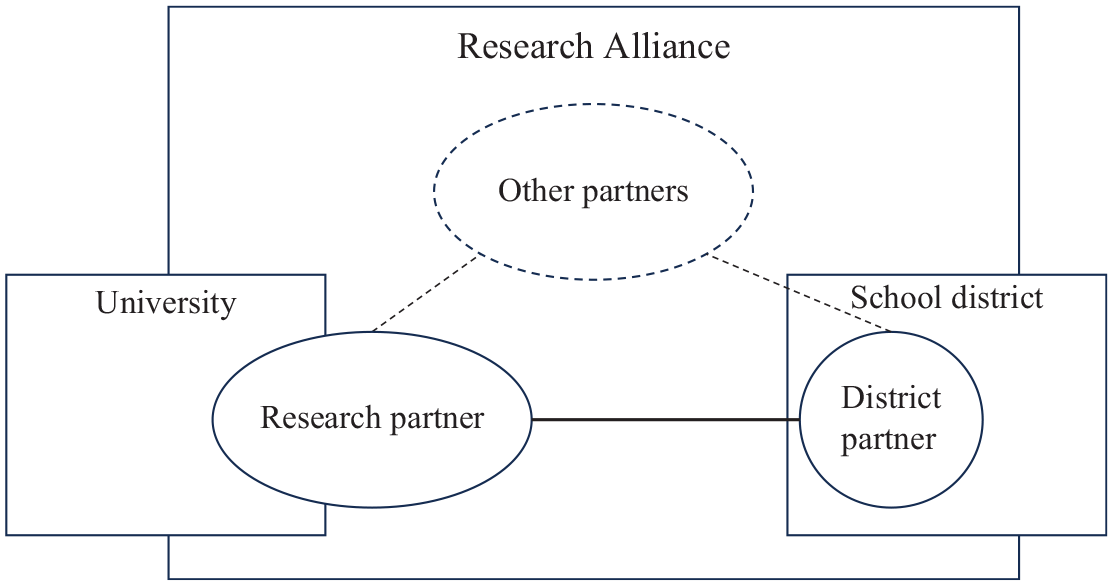
Conceptualization of Research Alliances
The research partner is often associated with a university, although the strength and nature of this association, including whether and to what extent the university is involved in the governance and management of the research partner, varies across alliances. In a district context, the practice partner is typically a subunit of individuals within the larger school district, and the relative proportion of and decision-making power afforded to that subunit within the district varies across partnerships. As Figure 1 illustrates, while the research partner often has some independence from the university, the district partner operates within the school district itself. As we demonstrate here and in other work, the relationship between the research partner and university, as well as that of the district partner and the larger district, is of considerable consequence.
The conceptualization presented in Figure 1 allows us to distinguish analytically between the partner organizations, the larger organizations associated with those partners, and the alliance (i.e., the partnership) between those organizations. Our focus on RPP legitimacy draws particular attention to research partners, in part because they are the newest and most vulnerable organizations in RPPs, which comprise a field that is itself relatively new. Unlike universities and school districts, which have been mainstays of the institutional landscape for over a century and are thus likely to persist in that landscape, questions about the legitimacy of alliance research partners could pose significant threats to their survival, and thus to the survival of research alliances themselves. Although our conceptualization of research alliances (as presented in Figure 1) is not the only possible conceptualization of research alliances, we use this conceptualization here as it is well-suited to the questions we seek to answer.
Institutional Logics
Institutional logics is an apt frame for our study because it conceptualizes the interactions among societal structures, fields, local contexts, and organizations (Friedland & Alford, 1991; Scott, 2014; Thornton et al., 2012). The central relationships of interest to our study are illustrated in Figure 2 and further elaborated in the remainder of this section.
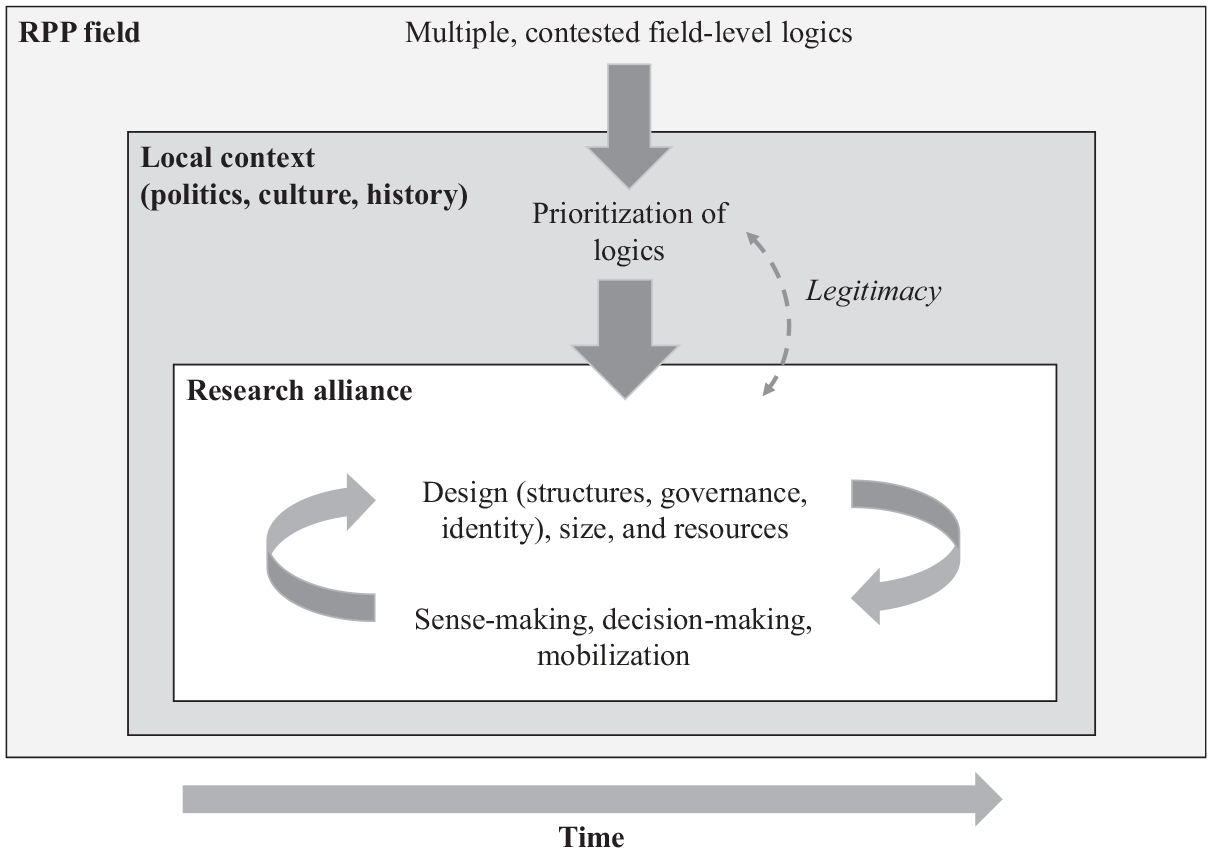
Conceptualization of Relationships Between Field-Level Logics, Local Contexts, and Research Alliances Over Time
Society-Level Logics, Field-Level Logics, and Local Contexts
Society-Level Logics
Institutional logics theorists argue that societies contain multiple, socially constructed “institutions” (Friedland & Alford, 1991; Thornton et al., 2012). Each major societal institution has its own logic, or “socially constructed, historical patterns of material practices, assumptions, values, beliefs, and rules” (Thornton & Ocasio, 1999, p. 804). The relative dominance of particular institutional logics varies over time, and logics can “peacefully coexist, compete, supersede each other, blend or hybridize, or reach a temporary ‘truce’” (Meyer & Hollerer, 2010, p. 1251). For example, while the market logic has grown increasingly dominant in many Western societies in recent decades, it has pushed aside but not eliminated the logics of state and profession (Freidson, 2001). These macro-level societal logics are then “reshaped and customized” within institutional fields (Thornton & Ocasio, 2008, p. 119).
Field-Level Logics
The institutional field is a central focus of our analysis. Defined as a “recognized area of institutional life” (DiMaggio & Powell, 1983, p. 148), institutional fields reside at the meso-level, between macro-level institutional logics (e.g., the state or family) and individual organizations. Each field is comprised of an array of regulatory bodies, service providers, support organizations, vendors, training organizations, and other entities that regularly interact. Examples of institutional fields include academic publishing, radio broadcasting, community colleges, and public schooling (Thornton et al., 2012). We conceptualize research–practice partnerships as a field within U.S. education and depict its field-level logics with the outermost rectangle of Figure 2.
A field typically includes multiple logics that inform and legitimize its practices, give cultural meaning to its work, and set the terms of competition and change (Thornton et al., 2012). The education field, vast as it is, can be understood as including public agencies (e.g., state education agencies, districts, schools), non-profit organizations (e.g., charter organizations, teacher unions, professional associations, philanthropies), and private sector firms (e.g., textbook publishers, assessment firms; Rowan, 2006; Woulfin et al., 2022). Like societal logics, the relative dominance of particular field-level logics can rise and fall over time. In the higher education publishing field, for example, a once-dominant “editorial logic”—itself derived from the societal professional logic and evidenced by commitment to professional standards and quality—was gradually eclipsed by an ascendent market logic that prioritized market share, sales, and growth (Thornton & Ocasio, 1999; Thornton, 2004; Thornton et al., 2012). As the market logic persevered, the sector was gradually transformed (Thornton, 2004; Thornton & Ocasio, 1999; Thornton et al., 2012). Variation in the dynamics of RPP field-level logics over time is depicted by the arrow at the bottom of Figure 2.
Organizations face challenges in responding to multiple logics, particularly when the field lacks an agreed-upon prioritization among those logics. In fields that lack an established hierarchy, organizations are exposed to a greater degree of competing incentives, or what Greenwood and colleagues (2011) refer to as “institutional complexity.” Institutional complexity exerts pressure on organizations, often forcing difficult compromises and complex administrative arrangements (Friedland & Alford, 1991; Kraatz & Block, 2008; Raynard & Greenwood, 2014; Thornton et al., 2012). Hospitals, for example, contend with the logics of the market, profession, and state, and thus must devote significant resources to reconciling and managing these diverse demands (Thornton & Ocasio, 2008). Similarly, universities increasingly struggle to manage the expectations of market, profession, and state logics, all of which exert their own demands (Shields & Watermeyer, 2020).
No field exemplifies institutional complexity more than U.S. K-12 education, with its combination of fragmentation and pluralism (Meyer et al., 1987; Rowan, 2006). Recent research has documented the ways that multiple and conflicting field-level logics shape the work of U.S. districts and schools (Bridwell-Mitchell & Sherer, 2017; Glazer et al., 2019; Marsh et al., 2020; Rigby, 2014; Woulfin et al., 2022; Woulfin & Weiner, 2019). Research alliances thus would appear particularly vulnerable to the competing demands, values, and expectations of multiple field-level logics. Educational research, for example, historically values contributions to scientific knowledge, academic rigor, objectivity, and independence; educational practice typically embraces knowledge resources that are directly applicable to the work of districts and schools; and local communities may prioritize contributions to the well-being of children and families, as well as practices attuned to local culture and history (Glazer et al., 2019). Each of these demands represent a field-level logic with different assumptions about what it means for an RPP to be “appropriate” and “effective.”
Local Contexts
While an institutional logics perspective situates organizational and individual behavior within larger social structures, it also accounts for agency at the individual and organizational levels. Central to this perspective is the idea that while the interinstitutional system is stable over time, the way in which organizations, fields, and individuals draw on and use institutional logics varies in ways that are informed by politics and culture. For example, while the market logic has increasingly infiltrated the education sector, it is particularly dominant in urban contexts, where a variety of political and social factors have enhanced the popularity of charter schools and parental choice (Glazer et al., 2019). Prior work has shown that local histories can be a particularly significant influence on how logics are drawn upon by local actors. Research into the political dynamics of a state-run school district, for example, documented how the region’s history of race relations shaped the use of logics by different actors (Glazer et al., 2019). As Thornton and colleagues (2012) write, “While there may be a panoply of institutional logics available, some logics will be more or less cognitively accessible to actors depending upon their experience and how they are situated in an institutional field” (p. 132). Dunn and Jones (2010) make the same point, noting that “historical events are important to understanding why particular manifestations of logics occur at a point in time” (p. 126). The local contexts of research alliances, and the ways actors in these contexts prioritize field-level logics, are depicted in the second, nested rectangle in Figure 2. The dotted arrow in Figure 2 connecting the prioritization of logics and the research alliance illustrates how legitimacy arises from the perceived alignment of research alliances with the demands of their social contexts (Deephouse et al., 2017; Scott, 2014; Suchman, 1995).
Organizational Design, Size, and Resources
Organizations play a critical role in mediating the relationship between field-level logics and individual practice. Some organizations, by their very nature, sit at boundaries of competing field-level logics and are thus exposed to their concomitant tensions and competing definitions of “appropriateness” (Goodrick & Reay, 2011; Greenwood et al., 2011). These “hybrid organizations” contend with often-competing cultural demands which, in turn, can lead to organizational “fragmentation and incoherence” and increased risk of failure (Battilana & Dorado, 2010; Besharov & Smith, 2014; Meyer & Scott, 1983; Raynard & Greenwood, 2014; Scott, 2014; Scott & Meyer, 1991). A good example of a hybrid organization is the university science department, which operates at the intersection of a field-level logic of research that values the development and open sharing of knowledge, and a market logic that values proprietary retention and commercial exploitation of scientific findings (Greenwood et al., 2011). Hospitals similarly reside at the nexus of the field-level logics of profession, state, and market which, in part, explains their extraordinarily complex administrative apparatus (Thornton & Ocasio, 2008). As described above, research alliances sit at the boundaries of educational research and practice and thus are potentially vulnerable to the challenges of such hybrid organizations. Research alliances are depicted by the innermost rectangle in Figure 2.
Structure, Governance, and Identity
Organizational design, which we define as an organization’s structure, governance, and identity (Greenwood et al., 2011) can mediate how an organization responds to field-level logics (Greenwood et al., 2011). As Greenwood and colleagues (2011) put it, “characteristics of the organization— its structure, ownership, governance, and identity—can make it particularly sensitive to certain logics and less so to others” (p. 318). Internal organizational structures can create intra-organizational communities that are aligned with different field-level logics (Greenwood et al., 2011). For example, contemporary news organizations often seek to establish “a wall” between the newsroom, which strives for objectivity and independence, and the editorial board, which offers subjective opinions on controversial topics. Large accounting firms, influenced by the logics of market and profession, similarly separate their accounting functions from their investment services. Governance determines the representation and power of intra-organizational communities, while identity aligns organizations to varying degrees with particular field-level logics (Greenwood et al., 2011). The more that an organization’s governance and identity are associated with multiple field-level logics, the more the organization will be exposed to the tensions between those logics, and the more difficult and resource-intensive it will be to respond to them (Greenwood et al., 2011). Glynn (2000), for example, found that a symphony orchestra faced significant challenges when the organization’s governance and identity included elements of both a professional artistic logic and a managerial market logic.
The education literature offers its own examples of how governance and identity mediate the relationship between logics and practice. Marsh et al. (2020), in a study of the stated values and practices of public schools in Los Angeles, found that school governance models were associated with particular logics, with autonomous schools more likely to embrace a professional logic and schools under direct district oversight more likely to embrace a bureaucratic logic. Bridwell-Mitchell and Sherer (2017) found that schools under heavy accountability pressure placed similar emphasis on the logics of market accountability, professional bureaucracy, and community sentiment, whereas teachers in school facing minimal accountability pressure drew more heavily on the logic of markets.
Size and Resources
Size and resources also shape organizational responses to field-level logics. Larger, more resourced organizations can readily redesign their structures, governance, and identities to manage the tensions between field-level logics (Greenwood et al., 2011). In addition, “size . . . provides an organization with a measure of immunity from institutional pressures, providing it with greater discretion over how, if at all, to respond to them” (Greenwood et al., p. 341). A good example can be found in the extraordinary efforts of medical schools to integrate the “logic of science” and the “logic of care,” once-competing models of practice that over time were painstakingly integrated into the medical school curriculum and licensing exams (Dunn & Jones, 2010).
Intra-Organizational Processes: Sense-Making, Decision-Making, and Mobilization
While local context and organizational design mediate the impact of field-level logics on organizations, the actual mechanisms by which logics are identified and used occur in the context of dynamic organizational processes. Sense-making, decision-making, and mobilization, depicted in the innermost rectangle of Figure 2, 1 represent three actions that organizations use to strategically leverage available logics and, in doing so, select from a range of socially legitimate organizational practices and identities. In times of relative stability, sense-making, decision-making, and mobilization can seem static or routinized, but during times of institutional uncertainty and conflict they become critical mechanisms by which organizations interpret and respond to environmental turbulence. We briefly elaborate each of these processes below; readers should note, however, that these are analytic constructs which are not isomorphic with organizational activities. For example, a particular activity, such as revising a mission statement, can entail a combination of all three processes.
Sense-making
Sense-making refers to the retrospective processes by which organizations attempt to understand changes in their environment that lead to incongruous or previously unimagined outcomes. These can involve new technologies, regulatory or legal changes, or cultural shifts. In hindsight, these shifts may appear obvious or unambiguous, but when experienced in real time they present organizational leaders with a formidable sense-making task that can unfold over an extended period of time. Peurach (2011), for example, found that when schools began leaving the network of the Comprehensive School Reform organization Success for All (SFA), organizational leaders were initially mystified, since the program had steadily increased the size of its network over the previous decade. After convening its mid-level managers from across the country, however, SFA’s executive leadership eventually realized that No Child Left Behind had transformed the market for its services from a logic of whole-school improvement to a logic of intervention (Peurach, 2011). SFA’s internal sense-making dynamics were embedded in its particular organizational structure and governance arrangement, yet, at the same time, were tied to field-level processes that were affecting other similar organizations.
Decision-making
Decision-making includes the processes “by which attention is directed to problems, and how problems are matched with solutions in decision situations” (Thornton et al., 2012, p. 133). Analytically, decision-making follows sense-making in the same way that one would expect treatment to follow diagnosis; in practice, however, treatment does not always follow diagnosis (Abbott, 1988), and decision-making does not always follow sense-making. In the SFA case noted above, leaders made numerous decisions in an effort to reverse the steady loss of schools, but only after these decisions failed to stem the decline did the organization begin to construct a new narrative that tied field-level changes (i.e., new legislation) to their shrinking network of schools (Cohen et al., 2013; Peurach, 2011). Sense-making and decision-making were not discrete sequential events but intertwined social processes that unfolded iteratively.
Mobilization
The third modality is mobilization. Mobilization refers to “the process by which collective actors acquire symbolic and material resources and motivate people towards the accomplishment of group or collective goals” (Thornton et al., 2012, p. 97). During times of stability, mobilization is often implicit, accomplished through routine hiring and induction processes, and reinforced by organizational culture. Yet, mobilization becomes more explicit and important in the face of environmental instability or intraorganizational conflict. In some cases, different groups within an organization may attempt to motivate collective action to discredit the dominant field-level logic and to press for new vocabularies and practices consistent with their agenda. As organizational leaders tamp down upstart groups, revise practices in light of new logics, or create hybrid solutions, they deploy incentives, narratives, and frames to mobilize a shared commitment to the (possibly) new organizational identity and practices (Schneiberg & Lounsbury, 2008).
Field-Level Logics, Organizational Design, and Organizational Responses
In mediating between field-level logics and individual practice, organizations sit at a complex analytic crossroads in the institutional logics framework (Figure 2). Field-level logics and organizational design interact in three central ways. First, an organization’s design reflects the dominant field-level logics in its local context at the time of its inception, an influence depicted by the downward-facing arrows in Figure 2. Second, organizational design (i.e., structure, governance, and identity) “filter” the messages of field-level logics, allowing some of these messages into the organization but blocking others (Greenwood et al., 2011). In this sense, organizational design is analogous to the cognitive “schemas” that direct individual actors’ attention to certain aspects of policy instead of others (Spillane et al., 2002; Spillane, 2004). In Figure 2, the passing of the downward-facing arrow into the research alliance illustrates this filtering of field-level logics by research alliance design. Finally, organizational design both shapes and is shaped by the sense-making, decision-making, and mobilization processes that research alliances undertake in response to field-level logics. In Figure 2, this bidirectional process is depicted by the downward- and upward-facing curved arrows. 2
In the ensuing analysis, we focus on each of these aspects of the relationship between field-level logics and research alliance design. We begin by examining how the designs of both research alliances reflected the dominant field-level logics in their local contexts at the time they were established. We then discuss how both research alliances’ designs (along with their available resources, in interaction with their local contexts) enabled or constrained their responses to shifting field-level logics. Ultimately, our analysis ties the organizational practices of research alliances to their larger social and political environments, providing a wider perspective on the interdependent and dynamic relationships that shape their work.
Methods
Sample
Data for this study come from a 4-year (2015–2019) qualitative multiple-case study (Yin, 2018) of how research alliances shaped school districts’ capacity to use research knowledge. The larger study focused on two research alliances situated in large, urban settings, which were purposefully sampled to maximize variation on a number of dimensions, including research alliance design, resources, and local context, while ensuring comparability by limiting the sample to a single type of RPP, the research alliance. The authors had no roles in or relationships with either alliance.
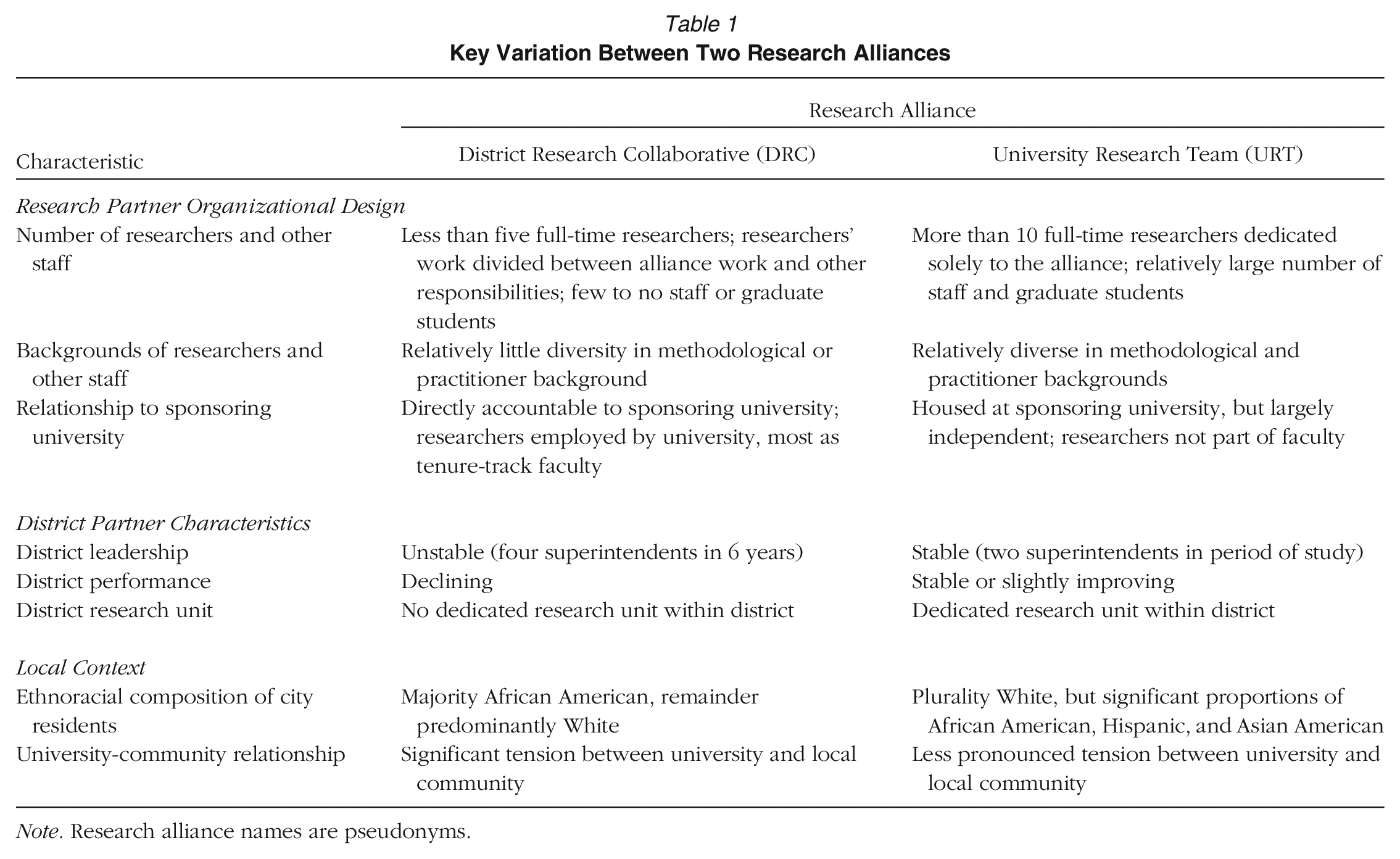
We focused our study on two research alliances: District-Research Collaborative (DRC) and University Research Team (URT; pseudonyms). Table 1 describes the key differences between the two research alliances of interest to this analysis. The research partners in the two alliances differed significantly in terms of size. The research partner in DRC was a small organization, with fewer than five staff dedicated exclusively to the work of the organization, and with researchers and staff dividing their work between DRC and other university appointments. The research partner in URT, by contrast, was a larger organization with the majority of researchers devoted solely to partnership work.
Key Variation Between Two Research Alliances
Note. Research alliance names are pseudonyms.
Another key difference between the research partners in the two alliances was the diversity of their researchers and other staff. Researchers in DRC’s research partner had relatively little diversity in terms of their methodological expertise (most focused on quantitative research using large data sets) and relatively little experience as educational practitioners (teachers or administrators) in K-12 schools; researchers in URT’s research partner, in contrast, had a broader repertoire of methodological expertise and a wider range of experience as educational practitioners in K-12 settings.
Another key design difference between the two alliances was the position of their research partners within the field, specifically the research partners’ degree of interdependence with their sponsoring universities. Researchers in DRC’s research partner were employees of the university, with most holding tenure-track faculty appointments in academic departments; the URT research partner, in contrast, was associated with, but largely independent from, its sponsoring university, and most of its researchers did not hold academic appointments.
There were also several key differences in the two alliances’ practice partners that, as we will show, shaped their exposure to field-level logics. DRC’s partner district underwent four leadership transitions in a 6-year period, four of which included our study, as well as substantial turnover among assistant superintendents and other high-level district staff. This leadership turnover created notable instability in the district and led to frequent shifts in district priorities and concerns. Student performance in the district had also been low and declining for some time. The leadership of URT’s district partner, in contrast, was relatively stable; the district had two superintendents during the period of our study, with the second seen as largely furthering the vision of the first, and student performance was generally stable or improving. In addition, URT’s district partner had a dedicated internal unit, the Research Strategy Team (RST), devoted to conducting research and engaging with outside researchers, including URT; DRC’s partner district had no comparable internal unit and, in general, lacked research capacity.
A final difference was related to the ethnic and racial composition of the two cities, Baystate and Central City (pseudonyms), and the relationship between the research partners’ sponsoring universities and city residents. While DRC’s surrounding city of Baystate was majority African American, with the remaining population almost entirely White, Central City had a plurality of White residents but significant proportions of African American, Hispanic, and Asian American residents. In addition, historic grievances between the university that housed DRC’s research partner and the Baystate African American community were a constant source of tension. Numerous stakeholders expressed the belief that the university—and White elites in Baystate more generally—had long exploited the city’s African American residents for their own interests. This tension, far less salient in Central City, proved to be a significant difference between the two local contexts that shaped each alliance’s exposure to field-level logics.
Within each site, we purposefully sampled individuals from the research partner, the district partner, and other partner organizations, including community organizations and funders, who were involved with or familiar with each partnership, in order to gather multiple perspectives on each alliance. The sample included researchers and leaders from the research partner organization, district leaders, and outside stakeholders, such as leaders of community organizations, funders, and board members. We also sampled leaders from the organizations in which the research and practice partners were situated, such as university leaders and district leaders who did not engage directly in alliance work. Ultimately, over the 4 years of our study we interviewed 38 individuals involved with or knowledgeable about DRC (six researchers that worked in the research partner organization, 25 personnel from the district, and seven outside stakeholders, including leaders of local non-profits, board members, and funders). We interviewed 32 individuals involved with or knowledgeable about URT (12 researchers, 15 district personnel, and five outside stakeholders). We interviewed key informants multiple times over the course of the study, conducting a total of 107 interviews with our 70 participants. 3
Data
Data for this analysis include semi-structured interviews, observations of meetings and dissemination events, internal memos, and documents produced by the two research alliances. Interview protocols were developed at the outset of the study and then revised in response to interim findings and evolving conditions at each site. Early interviews focused on partnership dynamics and the characteristics of the research, district, and other partners in each alliance. Follow-up interviews used research publications as memory devices and focusing instruments (Saldaña, 2016), enabling us to collect data on the processes through which research topics were determined, the dynamics of interpretation and sense-making around those studies, and the ends to which research findings were used. We focused a large portion of our early data collection on understanding the establishment of each research alliance, focusing particularly on stakeholders’ rationales for the decisions that were made during that early formative period. This enabled us to trace changes over time, both across the 4 years of our data collection and since this earlier founding period, which was described retrospectively.
In addition, we observed meetings and dissemination events. We conducted nine observations of DRC meetings and dissemination events (seven in the 2nd year of our study, two in the 3rd) and four observations of URT events (two in the 1st year and one apiece in years 3 and 4). Observers focused on issues such as the balance of authority in meetings, the manner in which research findings were shared, and structures and opportunities for meeting participants to engage with research findings. Following these observations, we conducted interviews with key participants to reflect on observed events. We also reviewed documents produced by both alliances, the majority of which were publicly available on the alliance websites. These documents provided data that informed our interview protocols and enabled us to triangulate between research reports, researchers’ views of key takeaways, and the reports of district personnel regarding their learning from the research.
Analytic Methods
Identifying Dominant Field-Level Logics
Our analysis began with an iterative process of code development, coding, memo writing, and member checking that took place alongside data collection. In the initial phase of analysis, we devised a set of deductive, a priori codes (Miles et al., 2020) that were conceptually tied to key dimensions of the study’s overarching theoretical frame. This first cycle coding (Saldaña, 2016) informed an initial set of analytic memos (Miles et al., 2020) that consolidated a working narrative and a preliminary set of findings for each research site. Comparison of site-specific memos surfaced new questions and lapses in the data, and motivated further refinements to the codebook. For example, as we became aware of the roles of community organizations, funders, and other stakeholder groups, we devised codes to identify excerpts relating to those groups. Throughout this process, our research team met to discuss and build shared interpretations of the codes and establish inter-rater reliability. To accomplish this, we collaboratively created operational definitions of each code (Miles et al., 2020), then independently coded a set of data excerpts and discussed disagreements, then revised our code definitions to reflect our shared understanding. This process gradually led to a shared interpretation of codes and agreed-upon practices for applying them to our data. In some cases, this also surfaced ambiguous or poorly conceived codes which were then further refined.
Our analysis first sought to determine the constellation of field-level logics in each local context and how (if at all) these logics had changed over time. To accomplish this, we engaged in an iterative process that alternated between deductive and inductive methods. We began by familiarizing ourselves with prior work describing the central societal-level logics that operate in Western societies; of these logics, we focused particularly on the logics of the market, profession, and community, as these logics have been found by prior work to be especially salient in U.S. education (Glazer et al., 2019; Marsh et al., 2020; Woulfin et al., 2022). With these three logics as a beginning framework, we revisited our initial analytic memos that synthesized the central findings from each research site. Using key excerpts from these memos, as well as additional data, we created a content-analytic summary table (Miles et al., 2020) and accompanying analytic memos that organized evidence in support of a set of field-level logics that spanned research sites and time. As our research team created this table and memos, we engaged in case analysis meetings (Miles et al., 2020) to discuss the emergent findings and to present both supporting and disconfirming evidence. This enabled us to arrive at a shared understanding of the central field-level logics that emerged from our data.
Through this process, we determined that three field-level logics centrally shaped the work of both alliances. We termed these the logic of research, the logic of practice, and the logic of community. These three logics are described in detail in our results.
Analyzing Changes in Dominant Field-Level Logics and Alliance Responses
To answer our first research question, which focused on changes in the dominant field-level logics in the local contexts of both research alliances, we created a content-analytic summary table (Miles et al., 2020) and a series of analytic memos that characterized the relative dominance of each field-level logic in the local context of each alliance at three separate times: first, the establishment of the alliance (which respondents described retrospectively); second, the early part of our data collection (around the midpoint of each alliance’s existence); and finally, the latter part of our data collection. In particular, we focused on the evolution of partners’ expectations for each alliance and the degree to which stakeholders both within and outside the partnership described the waxing and waning of various external pressures on the partnership. Examples include pressure from local government officials, pressure from funders, and pressure from academia. In order to align these pressures with field-level logics, we used our summary table and memos to synthesize our findings to facilitate comparisons across sites and time. We met in regular case analysis meetings (Miles et al., 2020) to discuss emergent findings and arrive at a consensus on our interpretations. Throughout this process, observation data were used to confirm or disconfirm interim conclusions.
Our second research question asked how each alliance responded to shifts in field-level logics, and what factors mediated their ability to respond to these shifts. To address this question, we created a series of summary tables and analytic memos that examined the central characteristics of the design, resources, and local context of each alliance, as well as research partners’ decision-making, sense-making, and mobilization processes. Here, we drew on excerpts related to the establishment and evolution of each alliance, including their founding, theory of action, leadership structures, formal meetings and routines for knowledge sharing, boundary spanners, agenda-setting processes, and resources. Comparing these processes across the three time periods allowed us to explore temporal change.
For each question, we grouped relevant excerpts in a manner that allowed us to strategically leverage the entirety of our data; for example, in addressing our research question about changes in field-level logics, we collected relevant excerpts across both sites, the multiple research projects engaged in by each alliance, and the entire 4 years of the study. We also conducted member checking (Merriam & Tisdell, 2016) of our key findings with personnel from research and district partners, which led to further refinement of our findings. Finally, we met regularly as a team to grapple with disconfirming evidence. For example, while we initially assumed we would find a similar pattern of shifting logics in both local contexts, data analysis revealed a more subtle evolution in logics in one of the sites that led to differing pressures on the two alliances. This, in turn, led us to collect further evidence to explain the variation we observed across the two contexts.
Results
In this section we develop and support two assertions. First, we argue that while a field-level logic of research was dominant in the local contexts of both research alliances at the time of their establishment, over the course of several years the field-level logics of practice and community became increasingly dominant, particularly in the local context of DRC. Second, we argue that the interaction between research alliance design, resources, and local context shaped both alliances’ responses to these shifts in field-level logics.
Dominant Field-Level Logics and Alliance Design
Field-Level Logic of Research
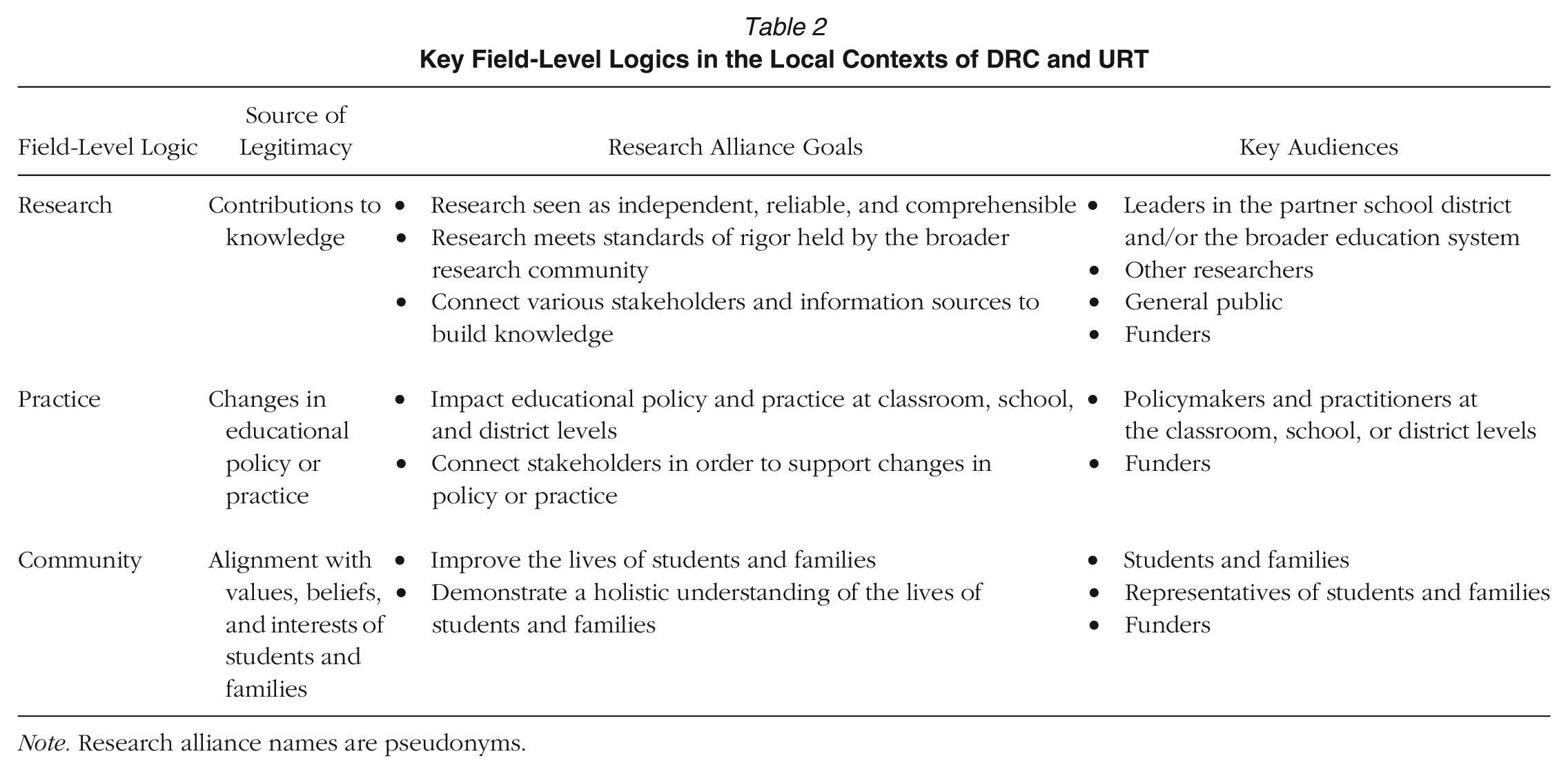
Table 2 describes the three central field-level logics that emerged from our analysis, and that were apparent, to varying degrees, in the contexts of both DRC and URT. At the time of their founding, the logic of research (Table 2, top panel) was dominant in both contexts. From this perspective, the primary responsibility of research partners was to conduct independent, rigorous, and relevant research targeted at policymakers, researchers, and the general public, but it was not the responsibility of research partners to actively solve problems highlighted by that research. The salience of the logic of research was evidenced by comments from the Baystate superintendent who, at the time of DRC’s establishment, stated that his intention in joining the partnership “was for us to get smarter, not for us to learn from researchers what we needed to do. . . . I wasn’t interested in getting a solution, I was interested in understanding what the problem was.” He further noted, “Whatever solutions emerge, they’re not going to come from research. They’re going to come from people who are wrestling with a problem.” Commitment to the logic of research could also be seen in the remarks of one of DRC’s founding funders: “It’s not [DRC researchers’] role to tell the district what to do with the numbers, but to clearly indicate what [the data] mean and what they represent.” Similar sentiments were evident among URT stakeholders and staff. For example, the director of URT’s research partner noted his satisfaction with URT research that enabled stakeholders “to argue on both sides of [a] hard problem.” The central goal of alliance research, in other words, was to provide credible evidence that others, particularly practice partners, could use in ways they deemed appropriate.
Key Field-Level Logics in the Local Contexts of DRC and URT
Note. Research alliance names are pseudonyms.
The field-level logic of research was reflected in the designs of both research alliances. Structurally, each research partner was formally associated with a research-intensive university, and was largely staffed by university-trained researchers with advanced degrees in public policy, education, or other academic fields. The mission statements of both alliances also pointed to identities closely aligned with the logic of research, as evidenced by terms such as “rigor” and “independence.” One URT researcher explained that “the big thing that we do is to conduct rigorous research on topics that matter, that are relevant to [the city’s] schools.” The logic of research was deeply embedded in DRC’s design in large part due to the research partner’s structural proximity to its host university, and the fact that researchers held appointments as tenure-track university faculty.
Field-Level Logic of Practice
We also found evidence of a logic of practice in the institutional environments of both alliances (Table 2, middle panel), although in both cases it was, at the time of their founding, a less prominent logic than the logic of research. In contrast to conceptions of alliance legitimacy within the logic of research, within the logic of practice, direct impact on district policy or practice was the central source of alliance legitimacy. That is, while research with practical implications is central to the logic of research, the use of research to solve practical problems is a focus of the logic of practice. For example, the logic of practice was apparent in Baystate district leaders’ assertion that DRC researchers should conduct “actionable” research that “people were going to be able to use.” Similarly, the logic of practice motivated URT researchers’ efforts to, in the words of one researcher, “produce something that speaks to [district practitioners] and helps them do their jobs more effectively.”
The emphasis on practice was reflected in the design of both research alliances. For example, both alliances included formal structures that facilitated interactions between research and district partners, and research partners in both alliances engaged in technical assistance work such as survey design that had little immediate research value but provided practical support for their district partners. The governance of both alliances also included representatives of their partner school districts. Finally, the mission statements of both alliances reflected identities tied to district improvement. An early DRC mission statement, for example, depicted the alliance’s purpose as “informing and improving public education,” while URT’s mission statement similarly described a focus on informing “policies and practices” in Central City schools.
At the same time, the balance between the logic of practice and the logic of research varied across the two cases. In URT, a more robust constellation of structures connected researchers with their partner school district; these included bi-weekly meetings between the research partner and the district’s Research and Strategy Team, as well as a dedicated organizational unit within the research partner, focused on communication with the district and other stakeholders. In DRC, by contrast, the connections between researchers and the school district were relatively ad hoc, informal, and contingent on personal relationships. Further, by employing tenure-track faculty, DRC’s research partner faced stronger professional incentives tied to the logic of research.
These design differences in part reflected the contrasting circumstances under which URT and DRC were established. In the URT case, the active participation of the Central City superintendent and teachers’ union contributed to a design that included formal structures connecting the research and district partners and thereby more closely aligning the alliance with the logic of practice. The establishment of DRC, however, was dominated by university researchers and local funders, with little involvement from the district, which was reflected in the absence of formal structures that facilitated researchers’ interaction with the district and, by extension, the logic of practice.
Field-Level Logic of Community
The logic of community was also apparent in the institutional environments of both research alliances (Table 2, bottom panel). Within the community logic, the values, beliefs, and interests of local students and families were the central source of alliance legitimacy. In public-facing documents, for example, DRC described one of the partnership’s key audiences as “community members,” and noted the alliance’s “diverse coalition of partners” dedicated to “improving the educational and life outcomes of children” in Baystate. The logic of community was further reflected in both research partners’ contention that local knowledge and community commitment enhanced their capacity to engage in collaborative work. For example, URT’s website and public documents highlighted researchers’ relationships with community leaders and local non-profit organizations.
The logic of community was also embedded in the design of both alliances. DRC included a local Historically Black College (HBCU) in the partnership, and seated representatives of local community groups and other organizations on its board. URT similarly constructed a board that included stakeholders from local organizations representing various community interests. The mission statements of both alliances also emphasized their commitment to improving the well-being of children and families in their respective cities.
Again, however, the logic of community found greater expression in the structures and identity of URT. URT’s research partner had a committee dedicated to maintaining equity and diversity within the organization and to conducting research that was responsive to community needs. URT’s research partner also held community convenings in which researchers shared research findings while simultaneously highlighting the voices of students, school leaders, and other community members. Beyond the inclusion of the HBCU, DRC had few structures or routines that provided a platform for the values, interests, and beliefs of students and families. In part, this may have reflected the Baystate African American community’s distrust of the university that housed DRC’s research partner. As described above, URT’s establishment also involved a wider range of local stakeholders, including local funders and community organizations, which may have also motivated the alignment of URT’s design with the demands of the community logic.
In sum, an analysis of the early years of both research alliances reveals a combination of differences and similarities. On the one hand, the logics of research, practice, and community exerted influence on both alliances in ways that were embedded in each alliance’s design. On the other hand, these similarities were offset by differences in the relative salience of the three logics. Whereas DRC’s design was predominantly informed by the logic of research, URT was designed in a way that, while still privileging research, more deliberately attended to all three logics and thus enabled a greater degree of responsiveness to their demands. As we will see, this difference would prove consequential.
Shifts in Dominant Field-Level Logics
Increased Dominance of the Logic of Practice
In both local institutional environments, the logic of practice became more prominent over the course of our study. For DRC, this shift was apparent in the starkly divergent views of two Baystate superintendents. While the first superintendent had not looked for “solutions” from their research partner and was content with research that identified problems and trends, the new superintendent exhorted DRC researchers to adopt a more hands-on approach. The change in emphasis came with demands for a different kind of research and a different role for researchers, as expressed by the new superintendent: By God, get something that’s high leverage for us. . . . if you’ve got all this time to look at our system, if you’ve got all this research prowess, I expect a little bit more around you being able to identify what the key lever is.
Local funders, once content with alliance research that others would (or would not) use, now expressed frustration with what they perceived as DRC’s lack of impact. This shift was reflected in the succinct comments of one long-time funder: “I don’t think it’s enough to just produce research,” she said.
The muscular emergence of the logic of practice meant that while it was once sufficient for DRC researchers to identify and potentially analyze problems, DRC’s research partner was now increasingly expected to help solve them. It also meant that methodological rigor and independence from the district—once central assets—were now perceived by some as shortcomings. Underscoring this point was the characterization of DRC researchers as people who, in the words of the new superintendent, “sit in their office nice and quietly, and focus on disaggregating data, building reports, getting quotes, making these glossy documents.” Another local community member similarly noted that DRC researchers were seen as “doing research on the district” instead of with the district. For DRC, then, the ascendent logic of practice brought with it the expectation that the district, not outside stakeholders or other researchers, would be the central audience for researchers’ work, and that the role of researchers was to collaborate with district officials in solving key problems of practice. As one Baystate leader put it, the expectation was now that the DRC’s research partner “roll up its sleeves, get in, and help us figure out the solutions even if it’s messy.”
Whereas the pressure on DRC researchers to align their work with the logic of practice came from both their practice partner and many funders, for URT this press came predominantly from funders. The director of URT’s research partner noted that “funders and particularly some folks on our steering committee, like the business community” were increasingly demanding evidence of URT’s impact on student outcomes. When asked for an assessment of URT late in our study, one funder described their foundation’s “lukewarm perspective of how relevant or hard-hitting the work that has come out of [URT] has been.” The perceived lack of impact on policy and practice led, in this funder’s words, to “a general sense that [URT] had not yet fulfilled its full potential.”
Despite these remarks, the shift toward the logic of practice was less pronounced in URT’s institutional environment. One reason for this was a relative lack of pressure from the district to adopt a more practice-focused approach. In part, this was due to Central City’s far greater resources and capacity and, in particular, the existence of the Research and Strategy Team, which itself engaged in research and evaluation to support program implementation and continuous improvement in the district. Thus, the work that Baystate officials implored DRC researchers to do was, at least to an extent, performed by Central City’s own research team. As the head of the Research and Strategy Team described: [The URT] is not quite a research practice partnership, where a practice partnership makes more sense for continuous improvement because you’re more embedded or there is more regular and frequent contact; you’re faster, you’re more in tune with the needs of the practitioner. But I don’t think that’s quite what they are. . . . And maybe we don’t need them to because we exist.
Thus, whereas new priorities among funders and district officials greatly ratcheted up pressure on DRC researchers to make far-reaching changes to their work, shifting expectations in URT’s environment, although present, were more muted and less consequential.
Increased Dominance of the Logic of Community
A similar set of dynamics unfolded regarding the logic of community. Whereas the logic of community gained strength in both localities, its impact was more pronounced for DRC than for URT. Baystate district leaders, funders, and other stakeholders increasingly took issue with DRC research, which they perceived as overemphasizing district problems and shortcomings while failing to acknowledge strengths and accomplishments. Within the logic of research, a focus on problems was a signal of DRC independence. Through the lens of the community logic, however, focusing on problems signaled a lack of empathy for the complex realities of district students and families. One district leader said that DRC researchers’ negative findings about district performance suggested “a posture and an ‘I gotcha’ feeling, like ‘we’re just here to show how incompetent the system is.’” Another district official spoke of “weaponizing data” in ways that targeted communities of color. The point was reiterated by a community leader who stated that “data alone without also understanding systemic challenges is insufficient.”
The growing importance of the community logic was evident in increasing references to the tensions between the university that housed DRC’s research partner and the Baystate African American community. The Baystate superintendent compared DRC researchers’ work to a “modern day Tuskegee experiment,” saying that the highlighting of poor district performance, coupled with what were perceived as tepid efforts to involve district leaders in DRC research, “just reinforced why communities of color do not trust people [from your university].” From the perspective of the community logic, DRC researchers’ focus on highlighting problems with district performance, along with its association with a predominantly White university, cast DRC researchers as outsiders whose work was misaligned with the values and interests of the city’s African American community. Few examples more clearly demonstrate the extent to which legitimacy, effectiveness, and appropriateness take on different meanings in the context of differing logics.
We also found evidence of an ascendant community logic in URT’s local context. The expansion of the community logic in the URT’s environment was apparent in the views of the leader of one large district initiative that aimed to improve outcomes for students of color, who saw the central work of the initiative as promoting culturally-relevant, “asset-based” practices that focused on “respecting and honoring and bringing the lived experiences of young people . . . in the classroom and not excluding anyone.” In contrast to Baystate leaders’ views of DRC research, however, this leader saw URT researchers as responsive to this shift in expectations, describing them as “proactive and engaged” in listening and learning about the initiative’s goals, and as willing to engage as “change agents” and advocates. Indeed, URT’s research partner revised its mission statement during this period to include language more specifically focused on equity, diversity, inclusion, and racial justice.
Responding to Shifting Demands: The Interaction of Design, Resources, and Local Context
Sense-Making
URT’s efforts to make sense of its evolving environment were aided by its capacity for sense-making and adaptation. URT’s research partner leveraged its diversity committee, leadership meetings, and regular interactions with its district partner to identify and grapple with new demands. These sense-making efforts culminated in a lengthy, organization-wide process dedicated to revising the research partner’s theory of action to better explicate the link between its work and school-level outcomes. The director of the URT research partner described this as an attempt “to figure out ways of making the case to particular prospective funders . . . that [the URT] is making a difference,” although it also transformed the organization’s own understanding of its work.
One important consequence of this process was “tempered confidence” among URT researchers and leaders that the alliance’s work could directly contribute to improved student outcomes. Forced to confront this reality, alliance leaders redefined the alliance’s value proposition as leading to “better relationships . . . between researchers and key stakeholders or decision makers” and “improved ability to produce useful evidence.” In codifying a theory of action, the research partner attempted to make sense of shifting demands that increasingly sought to hold it accountable to student learning outcomes, while also proactively defining the organization’s contribution to its partner district.
DRC’s research partner also engaged in sense-making efforts to better understand the profound changes unfolding in its environment. Central to this effort was the hiring of a consultant to help interpret the new demands and connect the research partner’s work more directly to the needs of the Baystate schools. Research partner leaders also met with increasingly dissatisfied local funders to gather feedback and discuss expectations. As one researcher noted, “it’s a continual process of figuring out what are those pieces and how are we putting them together and is that what we want to be.”
DRC researchers’ sense-making efforts, however, were attenuated by a lack of organizational structures within the partnership to support information gathering and analysis, and DRC’s research partner struggled to fully understand and respond to its rapidly changing environment. One DRC researcher described the research partner’s struggle to comprehend the new superintendent’s demands, noting researchers’ confusion about how to understand and respond to what the researcher called “pronouncements” by the Baystate superintendent about the importance of practice- and community-aligned research. Whereas URT’s research partner engaged in a lengthy process that redefined its own theory of action and that explicated the nature of its contribution, DRC’s research partner undertook no effort of similar magnitude. Moreover, the structural dependence of DRC’s research partner on its host university, and its reliance on tenure-track faculty, meant that the logic of research continued to exert outsized influence on DRC’s identity and practices.
Decision-Making
URT’s robust sense-making structures contributed to a strategic and largely effective decision-making process. Regular meetings with the district’s Research and Strategy Team enabled URT researchers to recognize the need for new types of work that better met the district’s practice-oriented needs and that departed from more traditional research. For example, as part of its evaluation of a large district initiative, URT researchers had proposed to conduct detailed case studies of several schools, which URT researchers envisioned as “deep dives” into implementation. Conversations with district leaders, however, led to the conclusion that the case studies would be too abstract and research-oriented to improve program implementation. In response, URT researchers re-conceptualized the case studies as “practitioner guides” that described the practices of selected schools and provided suggestions for reflection and implementation. While some research partner leaders expressed concern about the guides’ lack of academic rigor, district partner leaders described distributing these guides at professional development sessions for school leaders, illustrating how these guides allowed URT to better align its work with the logic of practice.
URT’s research partner also made efforts to align its work with the logic of community. For example, research leaders launched a new research stream dedicated to issues of diversity and inequality in Central City schools. A series of internal trainings and staff discussions also focused on, in the words of one researcher, “how our biases affect the way that we think about our work.” In these and other efforts, the research partner aligned its internal structures with a growing environmental emphasis on community values that expected a visible commitment to equity and social justice.
These processes were aided by the structural independence of URT’s research partner from its sponsoring university, which allowed the organization to construct a more versatile staff that included individuals with practitioner backgrounds as well as practice-oriented researchers. The director of URT’s research partner discussed the importance of assembling a staff attuned to both research and practice: We’ve been fortunate to attract a group of researchers, particularly the more senior people, who come at this with the idea that they want to inform . . . decision-makers. As opposed to an academic researcher where I think you are really required to think of your peers as the key audience for your work. . . here we want to make sure that the work is relevant and useful to people who are trying to make hard decisions. . . . I think we’ve been fortunate to attract a group of people who really see that as a responsibility.
DRC’s decision-making process was more limited, focusing largely on establishing a new governance structure, comprised of three committees, that increased community and district representation in the alliance’s governance. The district superintendent and leaders of several local HBCUs held formal positions on one committee, while an official from one HBCU became a co-director of DRC. A second committee was charged with approving DRC research projects, with the revised criteria for approval including whether the proposed research “[met] a district need.” A third committee, comprised of representatives of the district’s accountability office and leadership of the research partner, focused on sharing and interpreting research findings, exploring connections to district practice, and gathering district feedback.
The changes to DRC governance were not inconsequential, but they were limited in scope and in the extent to which they penetrated DRC’s core work. A primary limitation was again the tenure-track status of DRC’s research team. DRC researchers repeatedly expressed the dilemma of meeting the demands of tenure and promotion while conducting the practice-relevant work demanded by district leaders and funders. One DRC researcher described the challenge: The process for me towards promotion and being involved with [DRC] . . . was a bit of a dangerous game, right? The timelines on projects are much longer and sometimes uncertain. You know, there’s a lot of very interesting projects and valuable projects that we could pursue, but the timelines on them are often very, very long. As an assistant professor hoping to get promoted, that’s not all that intelligent. . . . So there’s an inherent risk to engaging in this work in all of its associated tensions and uncertainties.
While DRC’s new governance structures may have amplified the voices of district and community partners, these changes did not seem to contribute to deeper shifts in DRC research, which remained aligned with the logic of research. The new structures also did not alleviate the time constraints that confronted DRC researchers as they attempted to meet the research, teaching, and service demands of their academic positions. In contrast, URT researchers’ relative independence from an academic institution afforded them the flexibility and time to pursue practice-oriented projects such as practitioner guides.
If structural dependence on the host university was one factor that distinguished between DRC and URT researchers, access to financial resources was another. Because of its more extensive funding, URT’s research partner was able to spread its work across the divergent demands of research and practice. Financial flexibility also enabled URT’s research partner to create a new research stream devoted to diversity and equity, hire a communications team, and construct a team of researchers with more diverse methodological and practitioner backgrounds than DRC.
Differences in local context also had consequences for organizational decision-making. The Baystate district’s history of poor performance and weak professional capacity accentuated the practice and community logics along with their concomitant demands. Moreover, DRC researchers’ affiliation with a university deeply implicated in the region’s fraught history of race relations complicated its efforts to align with the logic of community. Central City, in contrast, was a higher performing, more stable district with a far greater degree of professional capacity. The differences in the two institutional environments meant that there was greater pressure on DRC researchers to meet the demands of the practice and community logics, and that its association with the logic of research more directly undermined its legitimacy.
Mobilization
As with sense-making and decision-making, the mobilization efforts within both alliances were mediated by their designs, resources, and local contexts. URT’s research partner created a leadership team dedicated to engendering support among outside stakeholders—particularly district and community leaders—and also hired a communications director, which one URT researcher described as “a game changer.” URT also mobilized stakeholders through a series of convenings that included district leaders, school-level practitioners, community members, and other stakeholders. Together, these efforts sought to coalesce various interest groups, as well as staff, around a newly defined and more inclusive mission that incorporated the logics of research, practice, and community.
DRC researchers also mobilized stakeholders and staff in response to new demands, although these efforts seemed, at least in part, intended to shore up support for traditional research. As district leaders increasingly pressured DRC’s research partner to reorient its identity and practice, research partner leaders sought to mobilize other Baystate educational organizations as partners in their work. Motivating this strategy was the notion that a broader set of organizational partners would reduce reliance on a district whose demands increasingly pressed the research partner to move beyond its traditional role and capacity. Similarly, DRC’s research partner sought to expand its network of funders to include national philanthropies and funding agencies that research leaders saw as less committed to the logic of practice. As one DRC researcher noted, “We have to do things that interest foundations or the federal government. That means sexy [research topics] are easier to sell. . . . [They are] not paying for you to be a consultant for an idiosyncratic school district.” Thus, while DRC’s new governance structure sought to engender confidence from district officials and local funders, its other mobilization efforts strengthened its alignment with the logic of research.
Here, too, DRC researchers’ status as tenure-track university faculty proved significant. While the superintendent’s critique, coupled with the growing dissatisfaction of many local funders, exerted extraordinary pressure on DRC’s research partner to change its core practices, the incentives to continue to produce traditional research were no less compelling. As one DRC researcher put it, meeting the needs of the district, funders, and the university “was like walking a tightrope.” DRC researchers were no less committed to the logics of practice and community than URT researchers, but the interaction between DRC’s design, its relatively paltry resources, and the needs and values of the local community left it in an especially precarious position.
Implications for Alliance Legitimacy
The constraints that impeded sense-making, decision-making, and mobilization for DRC researchers contributed to a growing crisis of legitimacy for the research partner and the alliance as a whole. The Baystate superintendent expressed significant doubt about the future of the district’s participation in DRC, arguing that DRC researchers needed to either “look like [the African American residents of the city]” or “be helpful.” In the language of institutional logics, DRC researchers were under pressure to conform to either the logic of community or practice. In not fully committing to either, the legitimacy of the research alliance was called into question. Further contributing to the crisis was DRC’s decision-making efforts, which were viewed as insufficient. “You can restructure until the cows come home,” the superintendent noted, “I can sit in whatever meeting you want me to sit in. But [what’s the value] if the actual core of what you are able to do . . . does not match what my most pressing need is?”
As our data collection ended, it was unclear whether DRC’s efforts to redesign its governance structures would be sufficient to bolster the alliance’s standing. Several leaders left the research organization, and DRC’s long-term survival became increasingly tenuous. The superintendent questioned the district’s need for DRC, noting that “that the ball’s in their court, and that might be a mismatch. If they are waiting for me to descend upon them with the one big study that I want them to do, that’s not going to happen.” The superintendent concluded, “I don’t need them.”
URT also faced questions about its role in meeting the demands of the logic of practice, but the partnership was not subject to the same fundamental doubts about its legitimacy. While some funders wanted URT’s research partner to develop a more coherent set of research projects organized around key themes and produce more “hard hitting” research, district leaders expressed minimal concern about URT researchers’ ability to conduct more practice-oriented research or to involve themselves more deeply in the application of research findings. The district’s relatively sanguine view of URT did not emerge from a lack of commitment to improving performance or student outcomes, but rather reflected its greater internal capacity to meet these demands. A combination of less pressure to transform its work, more extensive resources, and a more multifaceted organization capable (to an extent) of meeting a diverse set of environmental demands enabled URT researchers to gradually calibrate their work in response to shifts in local priorities and values. Questions about URT’s legitimacy hovered at the periphery of its work, but did not threaten its survival.
Discussion
One theme of this analysis is that the logics of research, practice, and community exert distinct and often conflicting pressures on research alliances. Similar to other organizations that operate in institutionally crowded fields (Thornton & Ocasio, 1999; Thornton, 2004; Thornton et al., 2012), research alliances contend with an array of disparate goals, norms, and values that can make legitimacy a tenuous proposition. While much contemporary research exhibits a commitment to the logic of practice and the belief that RPPs’ purpose is to enhance equity and improve practice (e.g., Penuel, et al., 2021), the current analysis reminds us that while the logic of practice has emerged as a central force in RPPs’ institutional environment, it has done so alongside, not in place of, other logics. The cases of DRC and URT suggest that the purpose of research alliances—and perhaps other RPPs—remains open for discussion. Whether and how the contest over the legitimate aims of RPPs varies within and across types of RPPs is a question for future research.
Our focus on the institutional environment also has implications for RPP design. Recent scholarship has examined the organizational structures, processes, and roles thought to foster successful RPPs (Coburn & Penuel, 2016; Coburn et al., 2013; Coburn & Stein, 2010; Farrell et al., 2018, 2021). Findings from prior research highlight the importance of boundary spanning roles and structures, knowledge management, communication pathways, and other design features that enhance collaboration and the potential for improvement (Farrell et al., 2018, 2019, 2021; Hopkins et al., 2019; Penuel et al., 2013). Yet, as decades of organizational theorists have shown, the efficacy of a particular organizational design is contingent on the nature of the environment and its concomitant demands (Greenwood et al., 2011). For example, while the formal ties between DRC’s research partner and its sponsoring university eventually became a liability, those same university ties were central to its decade of legitimacy during a period when a more traditional approach to research was welcomed by district officials and funders. What changed was not the university, the research organization, or the researchers, but the institutional environment in which the logic of research was deprioritized by the ascendent logics of practice and community.
URT’s design more deftly balanced the demands of all three institutional logics by splitting its attention and resources among the demands of research, community, and practice. But this strategy was not without costs. The jack-of-all-trades approach seems to have ensured the alliance’s survival, but whether survival is tantamount to success is less clear, as evidenced by continued doubts about URT’s ability to make a meaningful impact on district performance and outcomes. URT researchers satisfied the demands of the logics of research, practice, and community, but did not appear to excel at meeting any of them.
A third point is that organizational capacity is a similarly contingent concept. Of our two cases, URT had the more deep-pocketed, robustly staffed, and dynamic research partner, as evidenced by its more diverse cadre of researchers, full-time staff, and communications team. But to say that URT’s research partner was a high-capacity organization is, in part, a commentary on the relatively modest demands imposed by its environment. Recall that the Central City district did not rely on URT to design new programs, support implementation, enhance professional capacity, or in general solve its most pressing problems of practice. By the same token, DRC’s struggles and uncertain future might suggest a low-capacity research organization, but the research partner’s difficulties stemmed in large part from the needs of a resource-starved district that demanded a level of support and involvement incommensurate with past expectations and the research partner’s organizational capacity. Indeed, the notion that a small, thinly-resourced research organization could be a key partner in an educational undertaking of this magnitude speaks as much to the state of affairs in Baystate as it does to the capabilities of DRC. Design, capacity, and effectiveness, in other words, are best understood in relation to the demands of local contexts, which can vary enormously (Dunn & Jones, 2010; Thornton et al., 2012).
Conclusion
The winds of changes that have long characterized the U.S. educational environment present a seemingly inescapable dilemma for research alliances and perhaps other RPPs. In the short term, the logic of practice may continue to exert increased pressure on research alliances to demonstrate their impact on policy, practice, and even learning outcomes in their partner districts. This pressure may compel research partners to make substantial changes in their hiring practices, relationships with districts, research products, and organizational expertise. The community logic, with its current focus on racial equity, may also require research alliances to align their work more explicitly with the values, beliefs, and interests of students and families.
As this analysis has shown, however, total commitment to a single institutional logic in a notoriously contentious and dynamic field brings significant risks for new forms of hybrid organizations. Research alliances, and research partners in particular, do not enjoy the advantages of teacher colleges, accrediting agencies, or textbook companies, which are firmly entrenched in the institutional landscape of public education. A key question for funders, leaders, and other stakeholders, then, is how to manage the risk that comes with this tenuous position. One option, exemplified by URT, is for research alliances to operate as organizational Swiss Army knives, readily pivoting among competing demands without totally committing to—or perhaps excelling at—any. Another approach, embodied by DRC, is to employ a singular strategy aligned to a narrower set of goals. As we saw with DRC, however, putting all of one’s eggs in a single institutional basket brings its own risks.
While these dilemmas cannot be entirely resolved, leaders of research alliances can strategically manage them. Simply recognizing that establishing new hybrid organizations in an institutionally-contested space represents a high-risk endeavor is in itself a good start. Field-level leaders may also consider how to optimally align different types of research partners with environments that feature different capabilities, values, and needs. As we have seen, modestly-resourced research partners face serious challenges when paired with financially-strapped and professionally-weak districts operating in contentious and turbulent environments. A poor match is a recipe for failure.
For researchers, paying greater attention to the interdependence between RPPs and their institutional environments seems equally important. Perhaps one reason that RPPs have been vulnerable to the label of “hope-based” (Schneider, 2018) is that we have done little to understand the ways that these hopes arise, are contested, and shape the work of these organizations. By understanding the demands of this emergent field, we can better design and support the organizations that we ask to meet them.
Footnotes

Notes
M
J
M
D