






Abstract
We are honored to serve as the new editors of the American Educational Research Journal (AERJ), an interdisciplinary journal with a global reputation for publishing the highest quality educational scholarship. As we formally transition into this important leadership role, we would like to express our deep appreciation for the former editors—Ellen Goldring (editor-in-chief), Angela Calabrese Barton, Sean Kelly, Madeline Mavrogordato, Paul Poteat, and Peter Youngs (co-editors). Their strong leadership advanced the journal’s role in publishing scientifically rigorous, theoretically grounded, and practically relevant research with the highest standards, solidifying its reputation.
We are assuming our editorship in a time of increasing uncertainty and challenges. Indeed, there is no other time in its history that education has become more critical to addressing the global challenges we face today, including conflicts and wars, environmental disasters, the uncertain future of artificial intelligence (AI), political polarization, and threats to human rights and democracy. As an interdisciplinary, premier journal of the American Educational Research Association (AERA), AERJ has an important responsibility to publish the highest quality education research that can inform policy, leadership, teaching, and learning to address these challenges in the United States and globally.
The journal also has an ethical and moral obligation to publish research on issues that have long created social injustices and educational inequities for marginalized communities. The COVID-19 pandemic has worsened systemic inequities in income and educational opportunities globally, and there is an urgent need for the scholarly community to engage in global intercultural dialogues informed by research in diversity, equity, and inclusion (DEI) and comparative and international education (CIE).
We established an editorial team (editor-in-chief, co-editors, and associate editors), all of whom are distinguished in DEI research and/or CIE research in various disciplines and fields, including educational policy and leadership, higher education, teacher education, curriculum and instruction, educational technology, and educational psychology. The team also represents diverse methodological expertise, including critical quantitative approaches, decolonizing methodologies, ethnography, case studies, machine learning approaches, experimental and quasi-experimental methods, survey research, and measurement and statistics.
The editorial team also represents (a) diverse ethnic and racial backgrounds; (b) more than 10 countries of origin, including two international scholars in Germany and Colombia; and (3) bilingual and multilingual scholars who collectively speak more than 10 different languages. Each editorial team member brings a unique combination and intersectionality along these dimensions to the editorial process, building on their rich previous editorial, scholarly, and administrative experiences. All of us are committed to advancing research that informs educational systems, policies, and practices for equity, social justice, and human rights. This team has the expertise and capacity to elevate education research with a global reach, informed by a perspective that educational issues and social problems are not contained within national borders.
Strengths and Potentials of AERJ: Article Overview
AERJ is well known globally as one of the most prestigious interdisciplinary educational journals that advance empirical, theoretical, and methodological understandings of education, schooling, and learning, as shown by the large volume of manuscripts submitted from outside the United States. Its breadth of topics across all disciplines and subfields in education, diverse methodological and theoretical orientations, and emphasis on innovative approaches to education research have distinguished AERJ from many other journals.
To fully understand the publication trend of AERJ, we have reviewed and coded the abstracts of 490 AERJ articles published in the last decade from 2013 through 2023, focusing on the disciplinary fields, methodologies, and DEI and CIE foci as presented in Figures 1 and 2. We can see that the fields of educational policy, curriculum and instruction, higher education, and teacher education occupy more than 80% of all the articles; the remaining 20% are comprised of educational leadership, educational psychology, and other fields, including social context and methodology and measurement. We also can see that 54% of the AERJ articles applied quantitative methods, 34% qualitative, 7% mixed-methods, and 5% conceptual, historical, or legal analysis. While we value contributions from various disciplinary fields and methodologies, we encourage submissions from underrepresented areas and modes of inquiry to widen the scope of AERJ articles and strengthen our knowledge of education in the coming years.
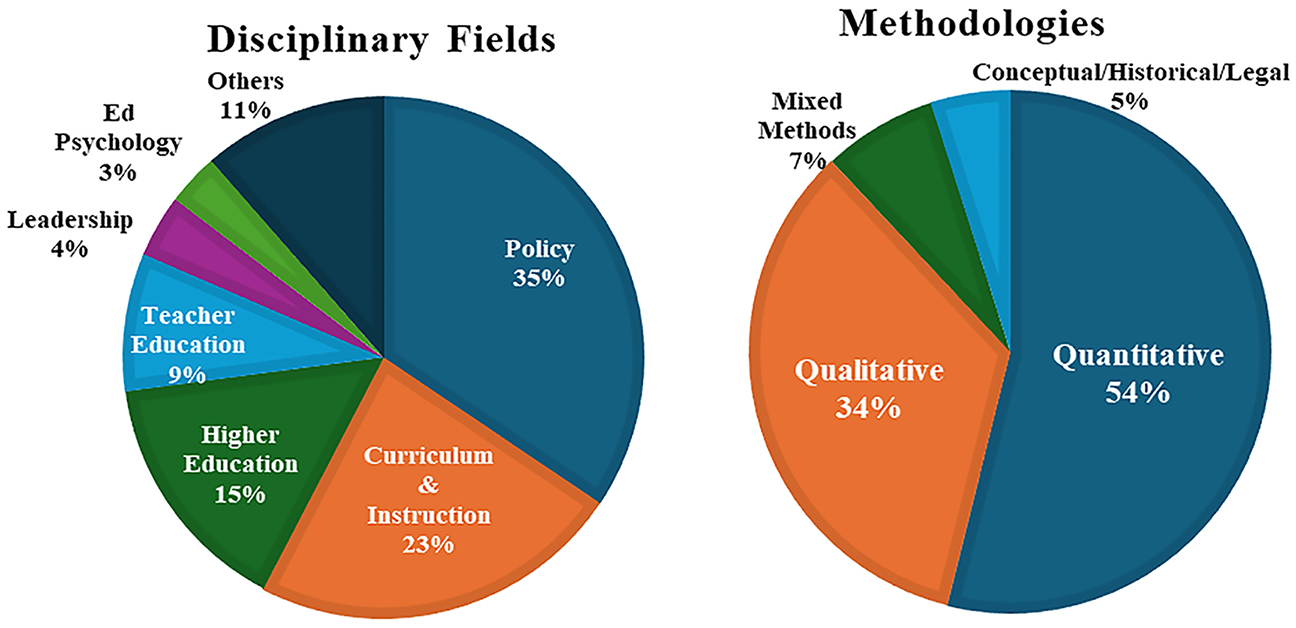
AERJ article disciplinary fields and methodologies.
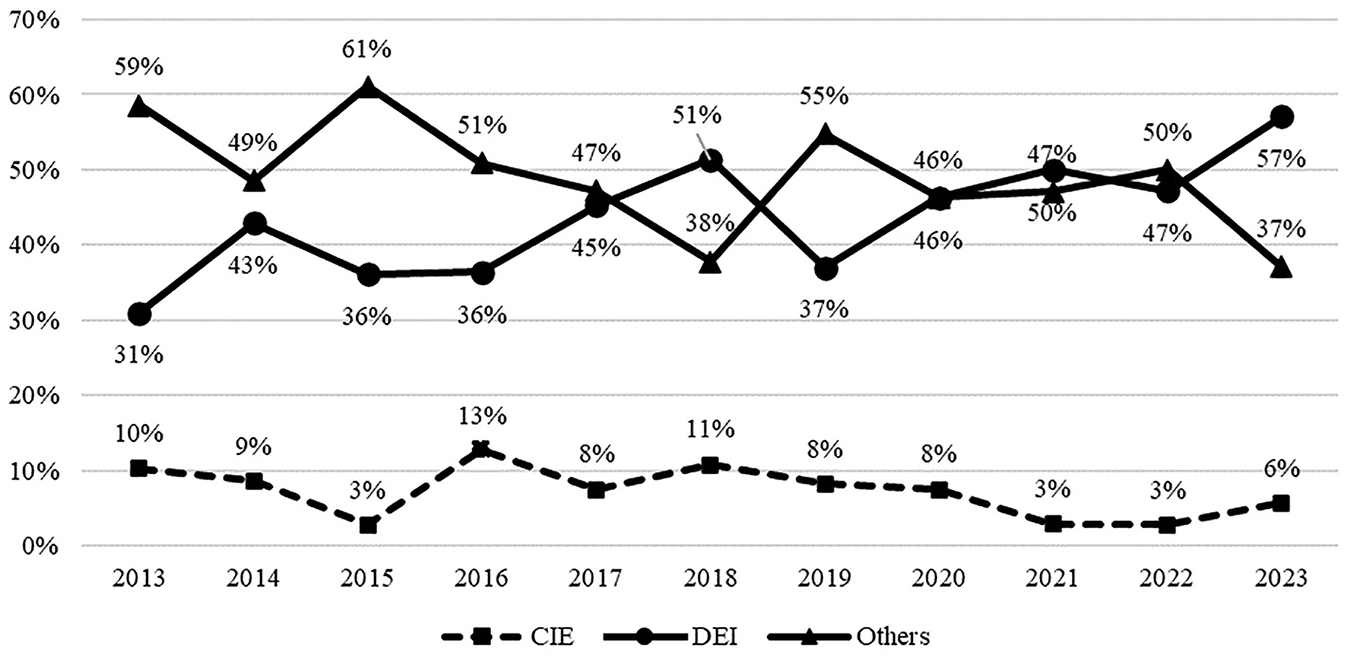
AERJ article orientation.
With our aspiration to promote global intercultural dialogues based on DEI and CIE research, we also analyzed the orientation of AERJ articles as shown in Figure 2. Articles with a DEI orientation are defined as those with a primary focus on marginalized groups of individuals and their education or concepts of equity and social justice in education. Articles with a CIE orientation studied education in countries and regions outside the United States, focusing on either a single country or region or cross-nationally with or without including the United States. As orientations, DEI and CIE can be applied to any education research topic using any theoretical framework.
We can see a growth in DEI-oriented articles with some fluctuation over the last decade from 31% (nine articles) of all articles in 2013 to 57% (20 articles) in 2023. This is a remarkable accomplishment of the preceding AERJ editorial teams during the last decade and reflects the critical importance of DEI orientation in a time of increasing political polarization affecting marginalized communities and individuals.
Among the DEI-oriented AERJ articles, we identified three types—single-group empirical studies (55%), intersectionality or multiple-group empirical studies (12%), and conceptual studies (33%). The most common foci among the single-group empirical studies are English Learners (11%), Blacks/African Americans (10%), low-socioeconomic-status groups (5%), and Latine people (5%). Intersectionality or multiple-group empirical studies focused on various social categorizations, including female Black and Latine students, Latine English learners, Black immigrants, and English learners with disabilities. The conceptual studies focused on various DEI issues such as biases, equity, inclusion, culture, hate speech, and rural issues.
When we focus on CIE-oriented articles, however, we see a different pattern. A total of 37 articles were published from 2013 through 2023 with an average of 3.4 articles per year with little increase over time. Of the 37 articles, 28 (76%) focused on a single country or region, with a total of 19 countries represented, including Australia (four articles), Germany (four articles), Hong Kong (three articles), and New Zealand (two articles). 1 The remaining nine articles (24%) had a comparative focus including secondary analyses of data from the Programme for International Student Assessment or Trends in International Mathematics and Science Study (five articles). Most of these articles (62%) were written by international scholars overseas, and the remaining articles were written by U.S. scholars (38%). Notably, 10 of the 37 articles (27%) had a DEI orientation in a country outside the United States. The DEI-oriented CIE articles addressed various important topics, including a teacher professional development project for reducing disparities between Māori and non-Māori students in New Zealand (Bishop et al., 2014), disparities in the effects of peers’ parental education on migrant students’ achievement in urban China (Kim et al., 2021), teaching Kichwa in Ecuador’s intercultural bilingual education and citizenship education (Limerick, 2023), achievement-oriented identities of girls in nonelite schools in Ghana for navigating gender-specific challenges (Nuamah, 2018), and a cluster randomized, controlled trial of nonformal remedial support and mindfulness programs for Syrian refugee children in Lebanon (Tubbs Dolan et al., 2022).
Broadening the scope of research toward a global context of pressing issues, such as migration, social disparities, climate change, and human rights and democracy, will further expand the global readership of AERJ and promote intercultural dialogues through partnerships with the editors of premier educational journals in other countries. Furthermore, increasing high-quality DEI- and CIE-oriented articles in AERJ will contribute to promoting cultural and global awareness among all education researchers and encourage them to conduct impactful research useful for addressing social and educational issues in diverse national and cultural contexts.
Future Vision
As a team of editors whose research expertise centers around CIE and/or DEI with prior journal editorial experience in various disciplinary fields, our future vision for AERJ can be explained with three focal areas: (a) increasing articles on pressing DEI issues from global perspectives, (b) focusing on the experiences and voices of marginalized individuals and communities by applying diverse research methodologies, and (c) promoting global intercultural dialogues based on cutting-edge CIE- and DEI-oriented research.
Increasing Articles on Pressing DEI Issues from Global Perspectives
Because of its international reputation and interdisciplinary nature, AERJ is well positioned to lead scholarly dialogues on pressing DEI issues on a global scale. Greater income inequality and rising global poverty rates since the COVID-19 pandemic have affected millions of children (World Bank Group, 2021). At the same time, violence against women has risen, with 45% reporting victimization and 56% feeling less safe at home (UN Women, 2021), which also resulted in traumatic experiences for their children. Women’s sexual and reproductive rights are under attack around the globe, including the United States (OECD, 2023). These are only two among many global challenges related to equity and justice.
The school system, education leaders, teachers, and community-based educators play a critical role in supporting children in contexts of poverty and threats to human rights, and more research is needed to better understand the multiple challenges faced by children, educators, and community members from global perspectives. Pressing educational topics from early childhood to the high school level include, but are not limited to, environmental justice education, education for civic participation and democracy, immigrant and refugee education, bilingual and multilingual education, children’s access to education in war-torn regions, recruitment/retention of teachers and leaders of color, crisis leadership, inclusive disciplinary approaches, culturally sustaining pedagogies, equitable access to and ethical use of AI and educational technologies, and mental health and trauma of students and educators.
At the higher-education level, important topics include equitable access and opportunity to succeed in higher education along the lines of race/ethnicity, gender, and gender/sexual identities, neurodiversity and physical diversity, immigration status, language, and country of origin; women of color leadership; and impacts of anti-DEI legislation, including banning affirmative action, equity-based policies, and DEI training. Preparing the future workforce with literacy in human–machine collaboration through AI is another global topic impacting all education sectors.
Focusing on the Experiences and Voices of Marginalized Individuals and Communities by Applying Diverse Research Methodologies
To conduct DEI-oriented research from a global perspective, it is critical that researchers first focus on the lived experiences and voices of marginalized individuals and communities in their research context. While AERJ has successfully published outstanding in-depth qualitative research on the experiences and perspectives of marginalized groups of students, educators, education leaders, and community members, these studies have been overshadowed by many years of emphasis on experimental and quasi-experimental research on “what works” for improving narrowly defined academic outcomes that attract research funding (Joyce & Cartwright, 2020).
Methodological diversity is also essential for addressing pressing national and global education issues. Critical quantitative approaches that became prominent during the last decade (Garcia et al., 2018; Sablan, 2019; Tabron & Thomas, 2023) have shifted the paradigm of positivism and post-positivism by questioning the neutrality, objectivity, and color-blindness of traditional quantitative research, by respecting study participants as knowers and experts, and by applying innovative measures to capture the intersectional and multiplicative social realities of marginalized groups. Scholars have developed measures on important constructs such as microaggression (Frank et al., 2021; Powell et al., 2022) and the Racialized Teaching Efficacy Scale/Racial Fragility Scale (Knowles & Hawkman, 2020); they have also explored the intersectionality of minoritized individuals (Jang, 2018; Van Dusen & Nissen, 2020).
Furthermore, decolonizing methodologies emphasize the centrality of the co-construction of knowledge, co-creation of relationships, and exchanging stories to establish more inclusive, humanizing, and interconnected methodologies that disrupt the systemic inequities found in Western constructs of education research (San Pedro & Kinloch, 2017; Smith, 2022; Stewart, 2019). These are two of the various powerful methodological approaches that center marginalized groups’ lived experiences and voices and advance our knowledge of and engagement in global intercultural dialogues to address pressing educational issues. AERJ’s scholarship will be further elevated when these diverse methodologies are equally emphasized alongside the traditional methodologies as important approaches to generating and sharing knowledge.
Promoting Global Intercultural Dialogues Based on Cutting-Edge DEI and CIE Research
The United Nations explains that intercultural dialogue entails the sharing of ideas and differences with the intent of developing a deeper understanding of different perspectives and practices, which fosters social cohesion and sustainable development (United Nations, n.d.). With the wealth of DEI-oriented research published in AERJ, the journal is well positioned to lead intercultural dialogues based on the latest research findings.
Such dialogues will be more powerful when we engage U.S.-based CIE scholars and scholars from other countries who can bring the wealth of diversity represented around the globe. In our interconnected global society, education scholars are impacted by global challenges regardless of which country they reside in and have engaged in scholarship to advance the knowledge for addressing these issues in various contexts. The issues we face in the United States include the long-lasting negative impacts of the COVID-19 pandemic on marginalized communities (Tai et al., 2022); the need for crisis management and leadership in education (Grissom & Condon, 2021) to cope with natural or human-caused disasters including wildfires, tornados, hurricanes, flooding, and school shootings; and violence and human rights infringement against minoritized groups including LGBTQ+ individuals, people of color, immigrants, individuals with neurodiversity and physical diversity, and women. These are also issues that scholars of other countries have long engaged with (Scott & Bajaj, 2023), as we can see in previous AERJ articles with a DEI focus in a context outside the United States.
Publishing more CIE research with a DEI focus and catalyzing expanded attention at AERA and other conferences will facilitate global intercultural dialogues on pressing educational issues. Such dialogues will also enhance the global and cultural awareness and consciousness of education researchers in the United States, further strengthening the theoretical and methodological approaches applied in U.S.-based education research. These dialogues will include learning from innovative approaches in various national contexts and generating policy recommendations to address global challenges.
Summary
In summary, we are deeply committed to broadening AERJ’s reach and influence to a global scale by publishing scientifically rigorous, theoretically grounded, and impactful research that informs policy and practice for addressing globally pressing issues in both the U.S. context and overseas. By increasing the number of DEI-focused CIE studies on high-needs topics and promoting diverse research methodologies, we hope to promote intercultural dialogues through partnerships with the editors of premier educational journals in other countries. Furthermore, increasing high-quality CIE-focused articles in AERJ also will inspire U.S.-based researchers to see pressing educational problems from a global perspective and seek solutions based on research conducted in diverse national and cultural contexts. We encourage your contributions to this future direction to make AERJ inclusive of globally inspired research that will have a lasting impact on the future of education.
Footnotes
Notes
Editor-in-Chief
M
C
F
T
M
S