






Abstract
Paraeducators are among the largest categories of public education employees and are increasingly seen as a pool of potential teachers. However, little is known about paraeducator-to-teacher transitions. Using statewide administrative data, we show that while paraeducators may be more racially/ethnically diverse than the teacher workforce, Black and Hispanic paraeducators are less likely than White paraeducators to transition into teaching. We additionally show that teachers with paraeducator experience are similarly effective to teachers without paraeducator experience. Lastly, we use simulations to show that the potential for the paraeducator-to-teacher pipeline to diversify the teaching profession may be limited unless they are highly targeted. Our results have policy design implications for efforts to expand the paraeducator-to-teacher pipeline or to diversify the teacher workforce.
Introduction
Paraeducators, also known as instructional aides or paraprofessionals, are among the largest categories of public school employees in the United States, with nearly 900,000 full-time equivalent (FTE) paraeducators employed by U.S. public schools in the fall of 2019 (Bisht et al., 2021; National Center for Education Statistics, 2019). Individuals holding these roles are often responsible for a wide range of instructional and noninstructional duties, such as providing extra support for struggling students, preparing classroom materials, and monitoring students during noninstructional times, such as recess.
Paraeducators are also among the fastest growing categories of public school employees. The number of paraeducator FTEs more than doubled between 1990 and 2018 (Bisht et al., 2021), far outpacing teacher FTE growth during that same period. Despite the relatively large growth in the number of paraeducators employed by public schools, there is an absence of research examining who works in these roles, the typical career trajectories of paraeducators, and their effects on student outcomes.
Although paraeducators may be underexamined in peer-reviewed literature, they have been the focus of increasingly popular policy initiatives aimed at addressing teacher staffing challenges and expanding the teacher pipeline. Adult Grow-Your-Own (GYO) initiatives, aimed at increasing paraeducator-to-teacher transitions, have become increasingly popular, with at least 21 states recently establishing such programs (Will, 2023), representing 40% of all GYO initiatives (Edwards & Kraft, 2025). Advocates and researchers alike have pointed to these policies as a potential opportunity to diversify the teaching profession (Carver-Thomas, 2018; Gist et al., 2019; Villegas & Clewell, 1998; Villegas & Lucas, 2004), which may have positive, although admittedly small, benefits for Black and Hispanic students (Dee, 2005; Egalite et al., 2015; Gershenson et al., 2022; Nielsen & Wolf, 2001; Redding, 2019). Relatedly, recent policy discussions have considered the potential for paraeducators in special education settings to address special education teacher staffing challenges by obtaining full certification.
Arkansas is among the states that have recently formalized such efforts through a state-level GYO initiative administered by the Division of Elementary and Secondary Education. The initiative consists of two primary pathways. The first is the Arkansas Teacher Registered Apprenticeship, which allows school support staff—including paraeducators—to earn a teaching license while remaining employed in their current role. The second is the Certified Teaching Assistant credential, an industry-recognized credential awarded to individuals who have passed the ETS ParaPro Assessment and completed at least 9 hours of college coursework toward educator licensure. Individuals who hold a Certified Teaching Assistant credential and a secondary school diploma have met the requirements for a highly qualified paraprofessional and receive preferential consideration when applying to the Arkansas Teacher Registered Apprenticeship. Examining paraeducators who transitioned into teaching prior to these formal initiatives provides an empirical foundation for understanding the potential reach and design of these programs.
Despite increased interest in the paraeducator-to-teacher pipeline and the recent influx of funds dedicated to training paraeducators, it remains unclear to what extent GYO initiatives may be able to train a substantial number of new teachers, make meaningful impacts on the diversity of the teacher workforce, or address special education staffing challenges. Furthermore, there is little evidence concerning the effectiveness of teachers with prior paraeducator experience. Understanding the capacity of the paraeducator-to-teacher pipeline and the effectiveness of teachers with prior paraeducator experience can help inform the design and potential of adult GYO initiatives, encouraging paraprofessionals to transition to teaching roles.
In this paper we use administrative data from Arkansas and provide new evidence on the existing paraeducator-to-teacher pathway. Our analysis corresponds to a timeframe when there were no GYO initiatives in place in the state, so our results are informative for policymakers and practitioners seeking to start implementing paraeducator-focused adult GYO initiatives. Specifically, we address the following research questions:
How common are paraeducator-to-teacher transitions absent dedicated GYO initiatives?
What individual (i.e., demographic traits and educational attainment) and district characteristics are predictive of paraeducators transitioning into teaching?
Are new teachers with prior paraeducator experience retained in the workforce at similar rates as other teachers?
How do teachers who were former paraeducators compare with other teachers in terms of their contributions to student academic growth?
What is the capacity of the paraeducator-to-teacher pipeline to diversify the teacher workforce?
Our results indicate that former paraeducators comprise an increasing share of newly trained Arkansas teachers. We observe that a small but significant proportion of paraeducators become teachers, especially within 2 years of entering the education workforce. Teachers who were former paraeducators are similar in terms of their contributions to students’ academic growth to teachers without paraeducator experience. However, transitions into teaching roles are more likely among White paraeducators than among Black and Hispanic paraeducators, and as a result, the capacity of the paraeducator-to-teacher pipeline to diversify the teaching workforce may be limited. Efforts to diversify the teacher workforce will require solving the existing barriers that Black and Hispanic individuals, with or without prior paraeducator experience, face in becoming a teacher.
Literature Review
Many recent initiatives targeting paraeducators are a type of adult GYO initiative 1 and aim to provide current paraeducators with the training, education, and credentialing required to become fully licensed classroom teachers. An analysis of 94 GYO initiatives found that 40% of initiatives specifically recruit existing paraeducators or other noncertified staff for teaching roles (Edwards & Kraft, 2025). The recent expansion of paraeducator-focused adult GYO initiatives (Will, 2023) may, in part, be driven by a 2021 U.S. Department of Labor rule change that allowed states to use federal funds to cover tuition, textbooks, and other expenses for aspiring teachers (Employment and Training Administration, Office of Apprenticeship, 2021).
Recent GYO initiatives targeting paraeducators generally rest on three theoretical mechanisms. First, paraeducators may have stronger community ties and contextual knowledge, potentially improving retention and effectiveness. Second, paraeducators’ greater racial/ethnic diversity may help diversify the teaching workforce. Third, their practical classroom experience may serve as effective preparation. Although these mechanisms seem plausible, limited empirical evidence exists to evaluate them, particularly regarding differential transition rates by race/ethnicity and subsequent teacher retention.
Providing more opportunities for paraeducators to enter the teaching profession may have meaningful benefits for students. Researchers have long advocated for policies to expand paraeducators’ pathways into teaching positions in order to diversify the teacher workforce (Carver-Thomas, 2018; Gist et al., 2019, 2022; Villegas & Clewell, 1998; Villegas & Lucas, 2004). For example, Villegas and Clewell (1998) argued that their greater racial/ethnic diversity relative to teachers make paraeducators an untapped pool of prospective teachers that may play a key role in diversifying the teacher workforce. Given the well-documented, though admittedly small, benefits of teacher–student race matches (Dee, 2005; Egalite et al., 2015; Gershenson et al., 2022; Nielsen & Wolf, 2001; Redding, 2019), diversifying the teacher workforce is a worthwhile policy goal.
Who Works in Paraeducator Roles?
Most recent studies examining the paraeducator workforce focus on documenting the characteristics of those in these roles. Bisht et al. (2021) used data from the National Center for Education Statistics and the American Community Survey to document the rapid growth of paraeducator positions in U.S. public schools since the early 1990s and the comparably higher levels of racial/ethnic diversity of individuals working in these roles. They also analyzed collective bargaining agreements and policy documents to characterize the career opportunities provided for paraeducators, finding that paraeducators typically have fewer learning opportunities or avenues for promotion than teachers. Documenting and quantifying the extent to which various factors, such as certification requirements, then may provide important evidence for GYO initiatives targeting paraeducators.
Theobald et al. (2023) used administrative data from Washington State to similarly document that paraeducators are more racially/ethnically diverse with increasing diversity over time. Importantly, Theobald et al. (2023) also documented elevated levels of attrition among paraeducators and raised concerns about recruiting paraeducators into teaching. They noted that paraeducators are not a limitless resource and caution that efforts to increase paraeducator-to-teacher transitions risk trading one staffing challenge for another. Similarly, Penner et al. (2023) used data from Oregon and documented how, compared with general teachers, paraprofessionals had significantly higher rates of movement across school districts as well as exits from the education workforce.
Studies examining both the growth in paraeducator positions and the distribution of paraeducators across school districts have consistently found that paraeducators tend to be concentrated in schools serving higher proportions of students with disabilities and students living in poverty (Bisht et al., 2021; Cramer et al., 2017; Theobald et al., 2023). These results indicate that paraeducators may play a significant role in staffing schools serving disadvantaged student populations.
Paraeducators and Students’ Performance
Quantitative research documenting the effects of paraeducators on students is scant but generally has found positive associations. Cramer et al. (2017) used variation in paraeducator staffing levels in Washington State and found positive and statistically significant associations with student performance in certain subjects and grade levels. Hemelt et al. (2021) used variation in state funding for specific positions to estimate plausibly causal impacts of paraeducators on student outcomes and reported consistent evidence for positive effects on academic achievement, particularly for historically disadvantaged students. In contrast, evidence from the largest U.S.-based evaluation of paraeducator impacts, a component of Tennessee's Project STAR, found little evidence of positive effects (Gerber et al., 2001). Relatedly, researchers using data from Washington State found that while teacher turnover, especially special education teacher turnover, has negative impacts on students’ academic outcomes, paraeducator turnover has no statistically significant impact (Kaler et al., 2025).
To our knowledge, only one paper has examined the effectiveness of teachers with paraeducator experience compared with new teachers without that experience. Laski (2024) examined the effectiveness of paraeducators granted provisional licenses in Mississippi and found no detectable difference in terms of student growth from teachers who entered the profession through more traditional pathways.
Paraeducators and the Teacher Workforce
As mentioned previously, there is a notable disconnect between the size of the national paraeducator workforce and the volume of research exploring these individuals’ career trajectories. Exceptions include Gist et al. (2019), who surveyed the existing literature and found consistent evidence that paraeducators face barriers not addressed by existing initiatives. These barriers included, among others, structural barriers such as certification exams and relational issues derived from their position within the school. More voluminous, by comparison, are the ways in which paraeducators have been situated within contemporaneous policy initiatives, namely GYO initiatives, as key components of solutions to perennial challenges facing the teacher pipeline. Here we explore prevailing theories for how paraeducators may expand, diversify, or address staffing challenges inside the teacher workforce.
One formulation posits that GYO programs targeting paraeducators may recruit individuals with stronger ties to the communities their districts serve and therefore may recruit teachers who are more likely to be retained or who have stronger connections to their students’ lived experiences. This theory builds on literature examining the teacher workforce that showed that teachers who grew up in or attended college near their employing district demonstrate higher retention rates (Boyd et al., 2005; Reininger, 2012). Similarly, research has suggested that teachers with prior connections to their school communities—through family ties, personal experience, or community involvement—may be better positioned to understand students’ cultural backgrounds and persist in challenging school contexts (Achinstein & Ogawa, 2011; Podolsky et al., 2016). Paraeducators, having already worked in their districts and developed relationships with colleagues and community members, may possess similar advantages.
However, the sustainability of any teacher pipeline depends critically on retention. If paraeducators exit teaching at higher rates than other teachers, the pipeline would need to produce substantially more new teachers annually to achieve similar workforce impacts. Conversely, if their prior experience and community ties translate into stronger retention, this would amplify GYO programs’ long-term workforce effects. To our knowledge, no prior research has examined whether teachers with paraeducator experience are retained at different rates than traditionally prepared teachers (RQ 3). Additionally, paraeducators’ practical classroom experience and contextual knowledge may translate into comparable or superior teaching effectiveness relative to teachers without such experience (RQ4).
A related theory for how paraeducators may shape the teacher workforce stems from long-standing differences in the racial and ethnic composition of the paraeducator and teacher workforces. In general, paraeducators are more racially/ethnically diverse than either existing teachers or the pool of prospective teachers (Bisht et al., 2021; Theobald et al., 2023; Villegas & Clewell, 1998). Given the well-documented, although admittedly modest, benefits of teacher–student racial/ethnic matching (Dee, 2005; Egalite et al., 2015; Gershenson et al., 2022), diversifying the teacher workforce is a worthwhile policy goal. Efforts to recruit new teachers from the pool of existing paraeducators therefore may increase the diversity of the teaching profession, particularly if paraeducators of color transition into teaching at similar or higher rates than White paraeducators.
Conversely, if White paraeducators are more likely than paraeducators of color to become teachers, a robust paraeducator-to-teacher pipeline may have limited impact on the diversity of the teaching profession. Understanding heterogeneity in transition rates by race/ethnicity and modeling the pipeline's capacity to diversify the workforce under different scenarios (RQ2) are therefore essential for evaluating this theoretical mechanism (RQ5).
Lastly, studies of paraeducators in multiple contexts have indicated that these individuals are more likely to work in special education roles and in high-needs schools serving larger proportions of students with disabilities and students from low-income families (Bisht et al., 2021; Cramer et al., 2017; Theobald et al., 2023). Paraeducators-turned-teachers therefore may be effective at addressing staffing challenges in these settings, particularly if this pattern reflects individuals’ preferences for or commitment to these learning environments. Recent policy discussions have specifically considered the potential for special education paraeducators to address special education teacher shortages by obtaining full certification (Fisher et al., 2022; Shelton & Cruz, 2023). However, it remains unclear whether paraeducators who work in special education settings are more likely to transition into special education teaching roles or whether transitions primarily occur into general education positions. Understanding these patterns is important for assessing whether the paraeducator-to-teacher pipeline can address subject-specific staffing challenges.
Despite growing policy interest in these theoretical mechanisms, fundamental empirical questions remain about baseline transition rates absent dedicated GYO initiatives (RQ1), equity in access to the teaching profession across racial/ethnic groups (RQ2), retention patterns (RQ3), teaching effectiveness (RQ4), and a realistic capacity to diversify the workforce (RQ5). Answering these questions is essential for designing evidence-based GYO programs and setting realistic expectations for their potential impacts.
Method
Data and Context
Arkansas offers a compelling setting to study the paraeducator workforce and paraeducator-to-teacher pipeline for several reasons. First, compared with prior studies, paraeducators in Arkansas are considerably more likely to work outside of special education settings. During the 2021–22 school year, fewer than 14% of Arkansas paraeducators worked in a special education setting compared with more than half the paraeducators in studies from Washington State (Cramer et al., 2017; Theobald et al., 2023). Arkansas then offers a different context to consider paraeducators working outside of special education, a segment of the workforce that has often been excluded from prior research that has typically focused only on paraeducators in special education settings. Second, our data cover a period prior to the implementation of a GYO program at the state level. Although such a program now exists (Arkansas Department of Education, 2022), this program and other substantially similar programs described in the preceding section do not operate by creating a new pathway but rather by expanding access to an existing pathway. Therefore, studying the paraeducator-to-teacher pipeline in Arkansas prior to the 2022–23 school year is informative for identifying barriers that such programs would need to address.
We evaluate the paraeducator-to-teacher pipeline in Arkansas using administrative data maintained by the Office for Education Policy and the Department of Education Reform at the University of Arkansas. These data cover the universe of traditional public and charter school employees for the 2013–14 through 2021–22 school years and allow us to track individuals throughout their time in the Arkansas education workforce. We identify individuals’ roles and role transitions using these longitudinal data. We define an individual as a paraeducator in an Arkansas school based on the specific job codes assigned to them.
2
Similarly, we define an individual as a teacher if they serve as a teacher of record or are a special education inclusion teacher for one or more classes. We identify four mutually exclusive employment outcomes for all paraeducators at the end of each school year (
These individual-level administrative data include demographic characteristics we use to explore heterogeneity in paraeducator-to-teacher transitions such as race/ethnicity, gender, and age. Because a bachelor's degree is required for a teaching license in Arkansas, we link paraeducator records to the universe of graduates from Arkansas postsecondary institutions from 2011 through 2021. These linked records allow us to identify which postsecondary credentials, if any, an individual held at the time they began working in the public education workforce and additional credentials earned while employed by public schools. 3 However, individuals who obtained their postsecondary credentials outside of Arkansas or before 2011 are not observed in these data. When possible, we recover postsecondary attainment for these individuals using degree status as recorded by district staff. 4
Our analysis attempts to describe barriers for paraeducators in becoming teachers. However, a potential complication of this analysis is that some individuals may meet all requirements to serve as a teacher of record and accept a paraeducator position in an attempt to “get their foot in the door” at desirable districts. Although we are able to identify any individuals who earned a postsecondary degree from an Arkansas public or private institution from 2010–11 onward, we cannot conclusively rule out the possibility that some new paraeducators completed their degrees prior to 2010–11 or from an out-of-state institution. These individuals likely would not be the primary target of a GYO program and may reduce the extent to which our results can inform policy design. To address this potential issue, we use data from the Arkansas Educator Licensure System that allow us to identify the date that an individual was first issued a teaching license. We create a binary variable that takes a value of 1 if paraeducators held a teaching license prior to September 1 of the first year they were employed in Arkansas public schools and 0 otherwise. Ultimately, only a small number of individuals hold an Arkansas teachers’ certification prior to working as a paraeducator (N = 94).
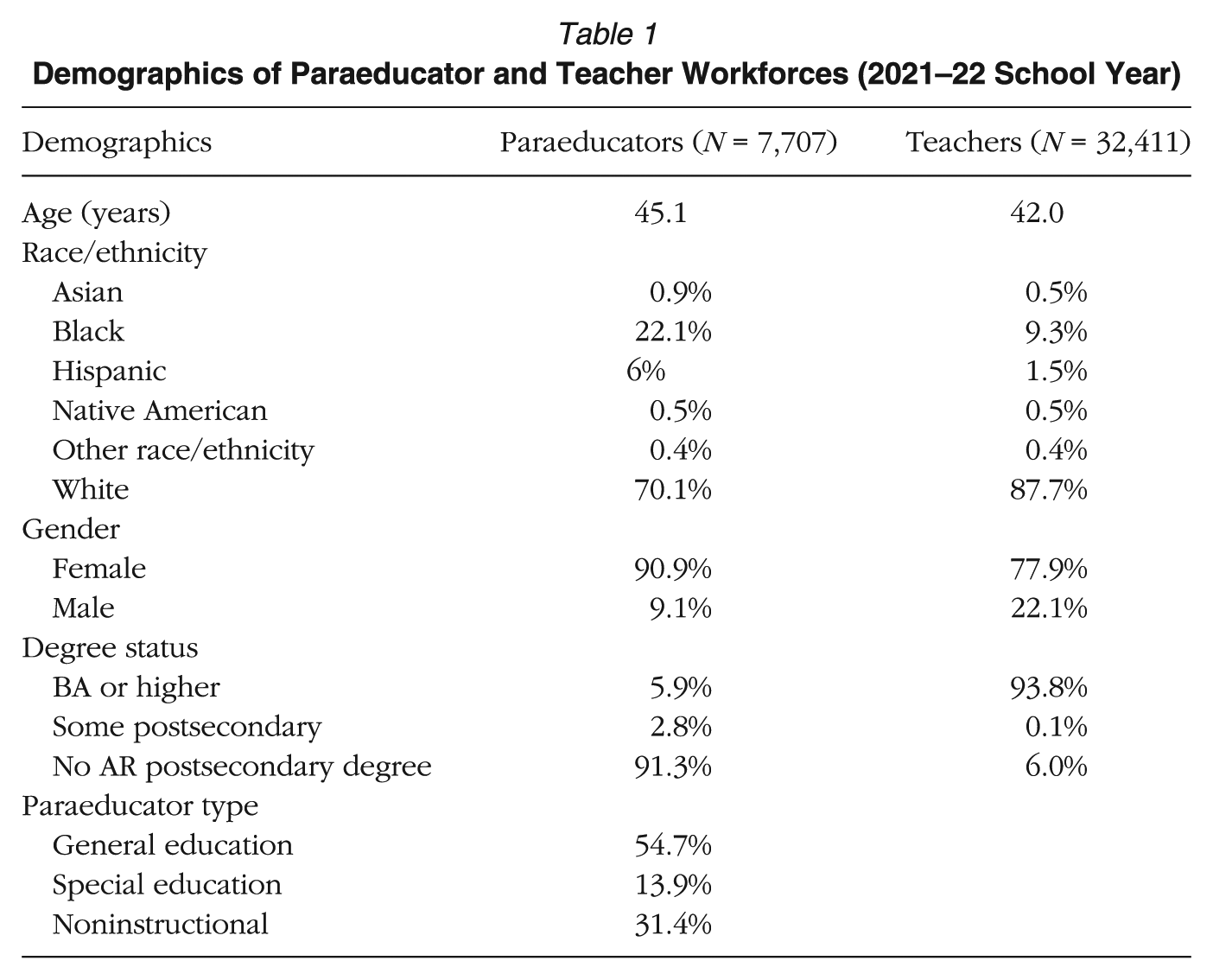
Summary statistics comparing the paraeducator and teacher workforce across these individual characteristics are presented in Table 1. In line with other studies examining the paraeducator workforce, paraeducators in Arkansas are more racially/ethnically diverse than teachers. Although fewer than 10% of teachers are Black, more than 22% of paraeducators are. Similarly, only 1.5% of teachers in Arkansas are Hispanic compared with 6% of paraeducators. However, despite paraeducators in Arkansas being more diverse than teachers, the majority (70%) are White. We also find that paraeducators are more likely than teachers to be female, 91% compared with 78%, and that paraeducators are, on average, slightly older than teachers.
Demographics of Paraeducator and Teacher Workforces (2021–22 School Year)
We merge our longitudinal individual-level data with district characteristics obtained through the Arkansas Department of Education's Data Center and the National Center for Educational Statistics’ Common Core of Data. We include demographics of students in the district (i.e., the proportion of non-White students and the proportion who qualify for free or reduced-price lunch 5 ), discipline rate, 6 average teacher experience and certification, urbanicity, and geographic region.
Additionally, we compare the effectiveness of teachers with and without experience as a paraeducator using value-added scores as provided by the Arkansas Department of Education through their partnership with the University of Arkansas's Office of Innovation for Education (OIE) from 2017–18 onward. 7 These value-added scores were estimated by the OIE by aggregating residuals after using a mixed regression model approach, controlling for up to four prior achievement scores and the student's English language proficiency level. The mixed model used by the OIE allows for scores nested within students over time (successive grade levels), random intercepts for students, and heteroskedastic error variances at each time period. Students’ scores are standardized by grade for each subject for analysis. Due to testing cancellations in the 2019–20 school year, our analysis focuses on matched value-added scores for the 2017–18, 2018–19, and 2020–21 school years.
Analytic Approach
We first explore the size of the paraeducator-to-teacher pipeline by examining the proportion of new teachers who have formerly worked as a paraeducator from the 2015–16 through the 2021–22 school years. 8 We then provide descriptive evidence of the extent to which paraeducators have transitioned into special education teaching positions, which may be informative for ongoing policy discussions. Next, we examine the prevalence of different paraeducator role transitions for 5 years following their entry into the Arkansas public education sector. We present results using descriptive visualizations that are pooled across cohort entry years and represent the proportion of paraeducators, on average, who remain working as a paraeducator, transition into another nonteaching role, become teachers, or exit the Arkansas public education workforce 1–5 years after they begin working in an Arkansas school.
We then disaggregate these trends by race/ethnicity. Given that many recent initiatives designed to recruit paraeducators into the teaching profession have a focus on teacher diversity (e.g., see Melnick, 2024), we further explore heterogeneity in these transitions depending on individual and school characteristics to assess the extent to which existing paraeducator-to-teacher pipelines recruit racially/ethnically diverse teachers.
Identifying Heterogeneity in Paraeducator Role Transitions
We explore heterogeneity in paraeducator role transitions using a multinomial-logit discrete-time hazard model following Equation (1). In this specification,

where
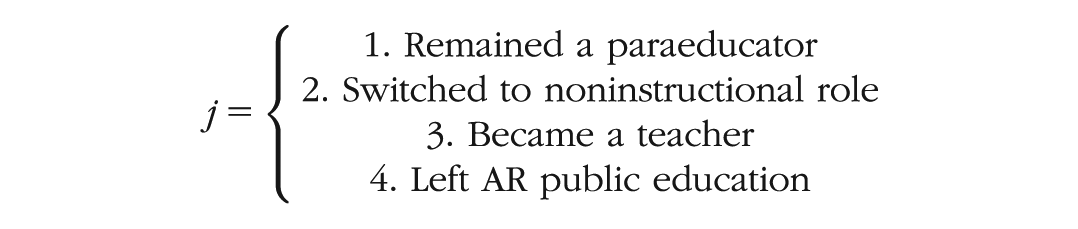
The vector
Paraeducator Transitions into Special Education Roles
In addition to being viewed as a potential pool of diverse prospective teachers, recent attention in the literature has explored the possibility that a robust paraeducator-to-teacher pipeline may be able to address special education staffing challenges (Fisher et al., 2022; Shelton & Cruz, 2023). The logic here is that a large proportion of paraeducators, relative to teachers, may work in special education settings and that these individuals may be more likely to transition into special education teaching roles. Although the proportions of paraeducators (14%) working in special education settings are considerably lower in Arkansas than in other settings, we provide descriptive evidence on how prevalent this pathway is.
First, we document the extent that paraeducators transition into special education teaching positions versus general education positions by examining the teaching assignments of paraeducators in year
Persistence in the Teaching Profession
The ability of a paraeducator-to-teacher pipeline to address staffing challenges depends, in part, on the persistence of paraeducators once they enter the teaching profession. If new teachers with prior experience as a paraeducator are substantially more likely to exit the teacher workforce than new teachers without prior experience, then a paraeducator-to-teacher pipeline may need to provide a substantially larger number of new teachers to the workforce each year to account for this greater attrition rate. Conversely, if former paraeducators are more likely to persist in the teaching workforce than other new teachers, a robust paraeducator-to-teacher pipeline may be better able to alter the composition of the teaching workforce in the medium to long term. We compare the persistence of new teachers with and without prior experience as a paraeducator using a discrete-time hazard model:

Here the probability that an individual continues teaching entering year
Comparing Classroom Effectiveness
Teacher quality is often a concern when states make policy changes to increase the new teacher supply. These concerns extend to policies targeting the paraeducator-to-teacher pipeline, such as paraeducator-focused GYO programs. One argument common among proponents of expanding paraeducator-to-teacher pipelines is that paraeducators typically begin teaching with valuable experience working with similar students in comparable district contexts. These prior experiences then may be assets that allow paraeducators turned teachers to be more effective in their initial years working as main teachers than new teachers who enter without prior experience working in schools (Gist et al., 2019).
We examine differences between the effectiveness of teachers with and without paraeducator experience by examining the distributions of value-added scores in both mathematics and English language arts (ELA) during teachers’ first, second, and third years in the classroom. We conduct a Kolmogorov–Smirnov (KS) test for the equality of distributions between each group for each subject/experience combination. A lack of statistical significance from this KS test indicates that the value-added distribution does not differ for teachers with and without paraeducator experience.
We further study the relationship between value-added score measures of teacher effectiveness and years of experience and whether we observe differences by prior paraeducator by regressing individual value-add scores as shown in Equation (3):
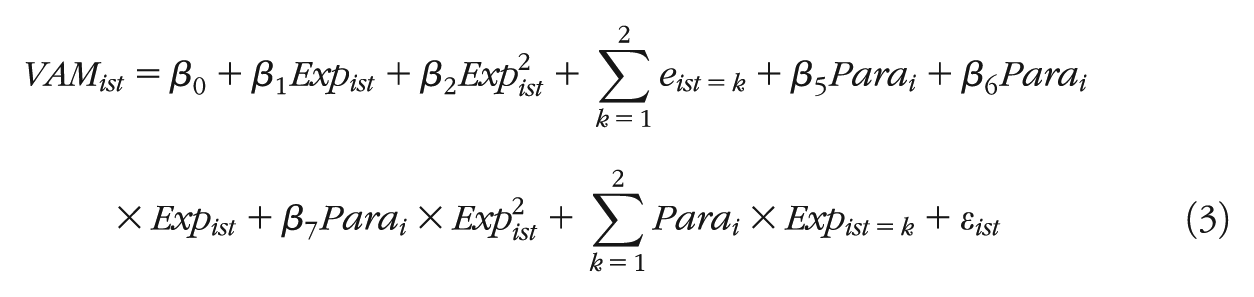
Here we follow Wiswall (2013) and allow for a flexible relationship between years of experience and teacher quality. We then regress the value-added score of teacher
Simulating Policy Impacts
In addition to prior analysis documenting job transitions and effectiveness of paraeducators, we conduct a series of Monte-Carlo-style simulations to explore the potential for a paraeducator-to-teacher pipeline to diversify the teaching profession. We focus on the potential for these GYO initiatives to diversify the Arkansas teacher workforce by encouraging Black and Hispanic paraeducators to transition into teaching. To conduct these simulations, we use a multinomial discrete-time hazard model similar to Equation (1) and obtain predicted probabilities of different labor transitions (e.g., remaining in the same role, transitioning to teaching roles, transitioning to nonteaching roles, and exiting the public school workforce) for all paraeducators and teachers employed by Arkansas public schools during the 2021–22 school year using a multinomial-logit discrete-time hazard model as specified by Equation (4).

where

Next, we study the effects of altering the estimated predicted job transition probabilities of paraeducators. Specifically, we reduce the predicted probability of remaining a paraeducator and increase the predicted probability of switching into teaching by a given value
We similarly use the predicted probabilities for teachers, 11 estimated with Equation (4), to simulate teachers’ workforce transitions out of the classroom (i.e., switching into noninstructional positions or exiting the Arkansas public education workforce). However, in contrast with paraeducators, we do not alter the predicted probabilities of teachers transitioning out of the classroom. As a result, our simulations represent the potential effect of recruiting new teachers from the pool of individuals who were likely to continue working in paraeducator roles.
After simulating these different outcomes across the range of paraeducator-to-teacher probabilities
In addition to the simulations described above, where the predicted probabilities of all paraeducators transitioning are uniformly altered, we also simulate changes to the composition of the paraeducator and teacher workforce if GYO initiatives were to specifically target paraeducators with certain observable characteristics. More specifically, we alter the predicted probabilities of Black and Hispanic paraeducators transitioning into teaching roles by some value of
To quantify the diversity of the resulting simulated teacher workforce projections, we calculate the difference in the proportion of Black and Hispanic students
13
and teachers after 5 years of simulation for all values of
Results
Paraeducators in the Arkansas Teacher Pipeline
Examining the composition of new teachers in the Arkansas workforce, we observe a consistent upward trend in the proportion of new teachers who have previously worked as a paraeducator over time. During the 2015–16 school year, ~8% of new teachers had worked as a paraeducator. By the 2021–22 school year, nearly 15% of new teachers had paraeducator experience. This trend indicates that former paraeducators comprise an increasing share of the Arkansas teacher pipeline. If considered a separate EPP, the paraeducator-to-teacher pipeline would be among the largest EPPs in the state, producing 314 new teachers during the 2021–22 school year alone. 14
Paraeducator Role Transitions
We present paraeducator role transitions for the first 5 years following entry into the education sector overall and by race/ethnicity in Figure 1. Overall, we see that after 1 year, ~20% of paraeducators leave the public education sector and ~6% of paraeducators have already switched to teaching roles. Over the subsequent 2 years relative to entry, the proportion of paraeducators who switch into teaching roles continues to increase, although at a slower pace. The proportion of paraeducators turned teachers peaks 3 years after an individual begins their career as a paraeducator and decreases in years 4 and 5 after entry due to attrition from the education sector. Five years after starting to work as a paraeducator in Arkansas schools, nearly half (47%) of paraeducators have left the Arkansas public education workforce entirely.
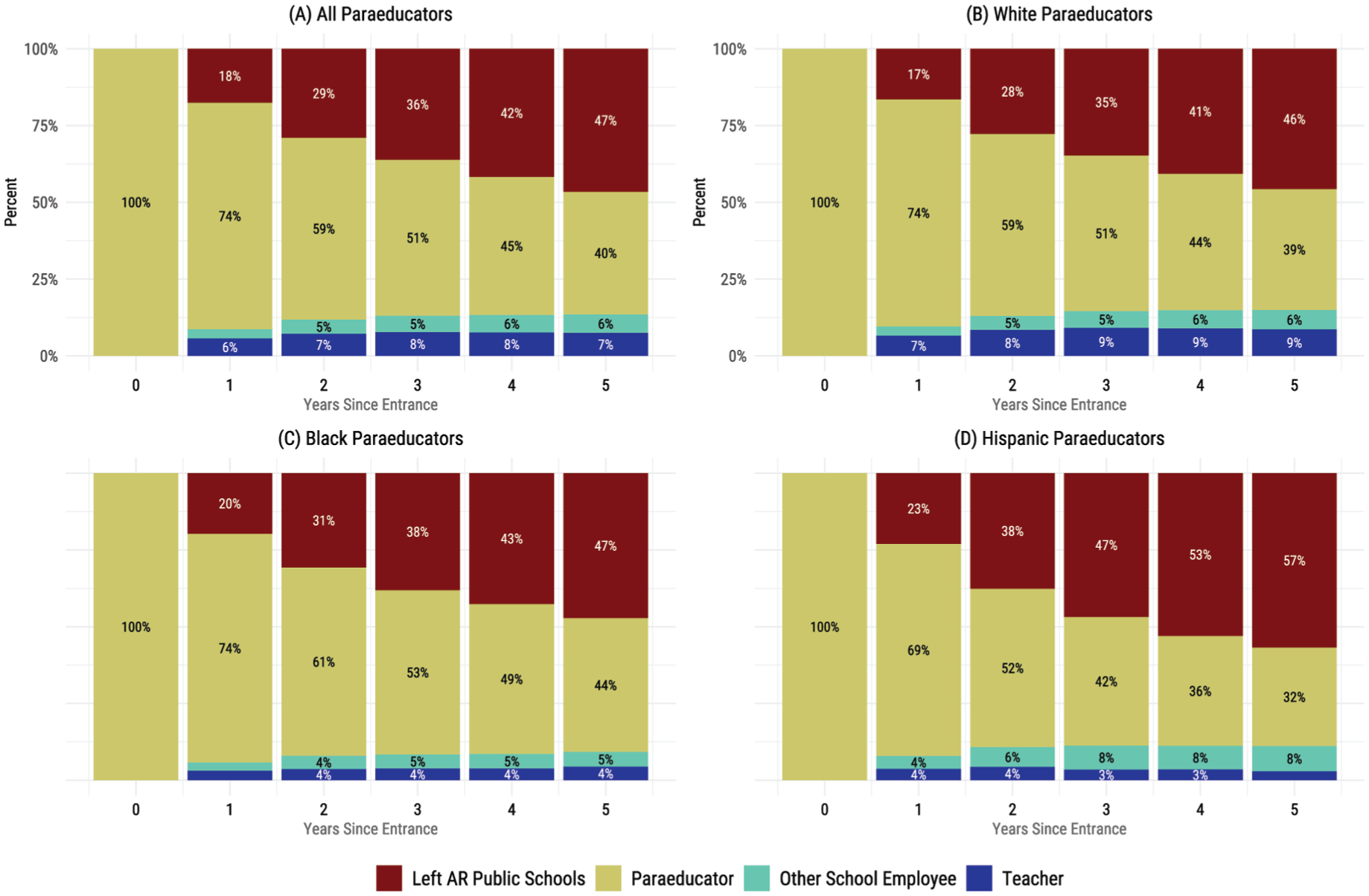
Paraeducator role transitions.
When disaggregated by an individual's race/ethnicity, two noteworthy trends appear. First, transitions into teaching roles appear to be at least twice as common among White paraeducators than among Black or Hispanic paraeducators. Three years after entering the education sector, 9% of White paraeducators have transitioned into teaching as compared with 3–4% of Black and Hispanic paraeducators. Second, while attrition from the education sector appears comparable between White and Black paraeducators, Hispanic paraeducators appear more likely to exit the Arkansas education sector entirely.
Heterogeneity in Paraeducator Transitions
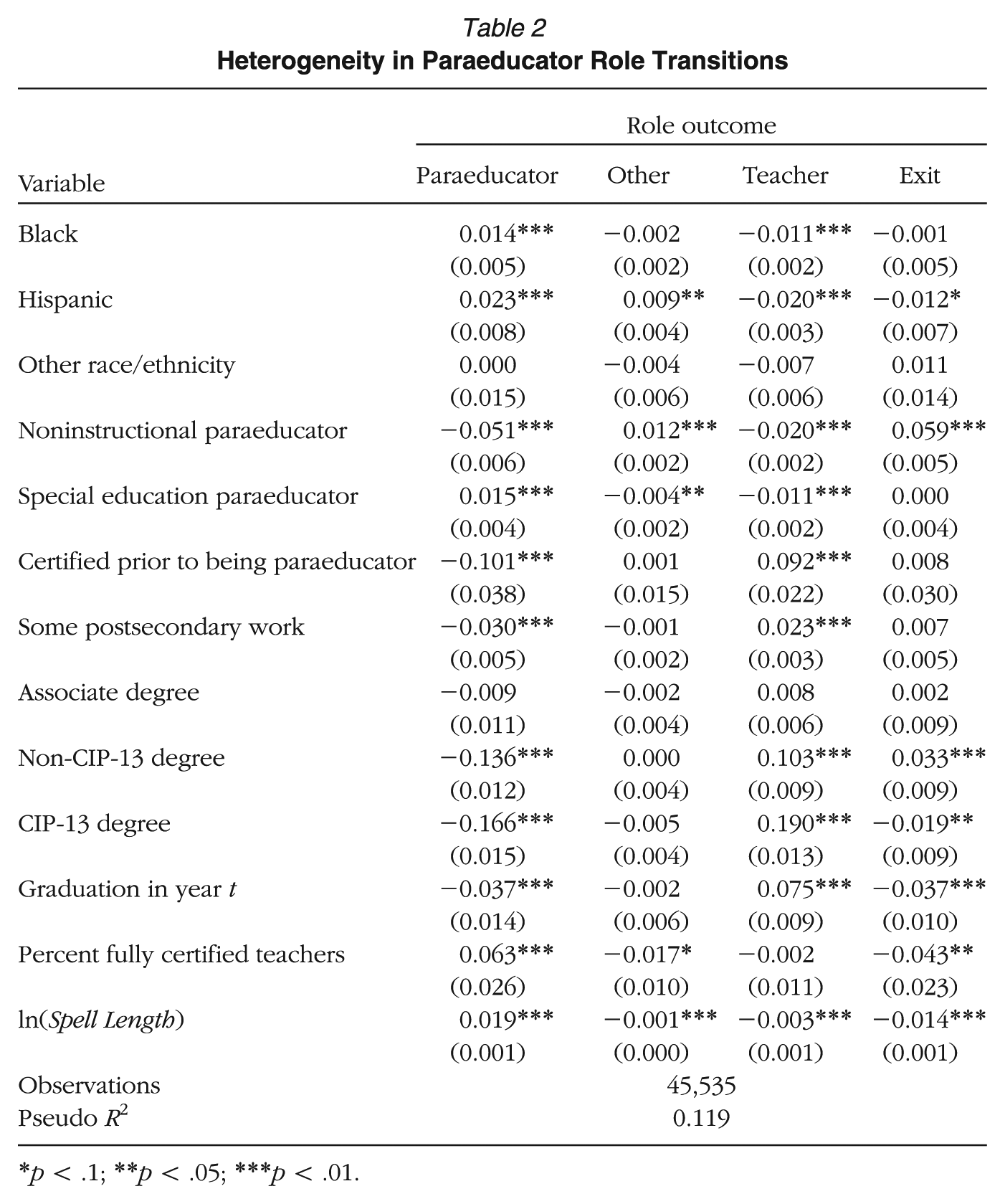
Table 2 presents the estimated marginal effects of models describing paraeducators’ job transitions following the specification in Equation (1). These results show clear and meaningful signs of heterogeneity by race/ethnicity in line with the trends presented in Figure 1. Specifically, we observe that Black and Hispanic paraeducators are 1.4 and 2.3 percentage points more likely to remain in a paraeducator role, respectively, and between 1 and 2 percentage points less likely to become teachers, all else equal. These estimates are significant at the 99% confidence level and indicate that even when controlling for an individual's education attainment, which represents an important barrier to transition, Black and Hispanic paraeducators are less likely to become teachers.
Heterogeneity in Paraeducator Role Transitions
p < .1; **p < .05; ***p < .01.
In contrast with the results presented in Figure 1, however, we observe that after controlling for other factors such as education, age, and school characteristics, Hispanic paraeducators are 1.3 percentage points less likely than White paraeducators to exit the Arkansas public education workforce. Nevertheless, this result is only marginally significant at the 90% confidence level.
We also explore the association between paraeducators’ postsecondary attainment when they begin working in an Arkansas public school and later role transitions. We find that paraeducators with some postsecondary enrollment but no earned degree are ~3 percentage points less likely to remain working as a paraeducator and 2.3 percentage points more likely to later become teachers than those with no history of enrollment at an Arkansas postsecondary institution. Although we do not observe meaningful patterns in the association between holding an associate degree and various transitions, we find that individuals who begin working as a paraeducator with a noneducation (i.e., non-CIP-13) bachelor's degree or higher are nearly 14 percentage points less likely to remain working as a paraeducator, 10 percentage points more likely to eventually become a teacher, and 3.3 percentage points more likely to exit the Arkansas public education workforce than an individual with no history of postsecondary enrollment. These estimates are significant at the 99% confidence level or higher.
Unsurprisingly, individuals who begin working as a paraeducator while holding an education-related bachelor's or higher degree (i.e., a CIP-13 degree) are 17 percentage points less likely to remain working as a paraeducator and 20 percentage points more likely to become teachers than individuals without a history of postsecondary enrollment. Similarly, individuals who begin working in a paraeducator role while holding a teacher certification are 10 percentage points less likely to remain in a paraeducator role and 9 percentage points more likely to become a teacher. These estimates are significant at the 99% confidence level and indicate that some individuals who meet the requirements for provisional or full teaching licenses begin their careers in teaching-adjacent roles. This is a phenomenon that has been documented in prior research (Goldhaber et al., 2023).
Relatedly, we observe that earning a postsecondary degree while already working as a paraeducator is associated with a 7.5 percentage point increased probability of switching to a teaching position in the following school year with corresponding decreases in the probability of remaining a paraeducator or exiting the Arkansas public education workforce. These estimates are significant at the 99% confidence level. Overall, these results suggest that getting a bachelor's degree is a major step in paraeducators’ transitions into main teaching roles.
Finally, although there were few consistent associations between school characteristics and paraeducator transitions, we observe a meaningful relationship between paraeducator role transitions and the percentage of fully certified teachers in a school. Specifically, as shown in Table 2, a 10 percentage point increase in the proportion of teachers who are fully certified within a school is associated with a 0.6 percentage point increase in the likelihood of an individual remaining in a paraeducator role and a half of a percentage point decrease in the likelihood of an individual exiting the education sector entirely. Surprisingly, we do not find any statistically significant relationship between the percentage of teachers who are fully certified and the probability of paraeducators becoming a teacher. This may indicate that schools facing staffing challenges are not actively recruiting new teachers from their existing pool of paraeducators.
Paraeducator-to-Special-Education-Teacher Transitions
In Figure 2 we examine the prevalence of paraeducators transitioning into both special and general education positions by school year. In line with our earlier observations about the growth in the number of new teachers with prior experience as a paraeducator, we observe that the total number of paraeducator-to-teacher transitions has grown substantially—nearly doubling— since the 2014–15 school year. However, across all years, the number of paraeducators who become special education teachers is a relatively small proportion of all paraeducators who become teachers. When disaggregated by paraeducator role, we observe that only 15.5% (277) of paraeducators transition into special education teaching roles over the course of our panel. Additionally, we do not observe that these transitions are concentrated in any particular districts, indicating that the prevalence of transitions from special education paraeducator to special education teacher are rare in Arkansas.
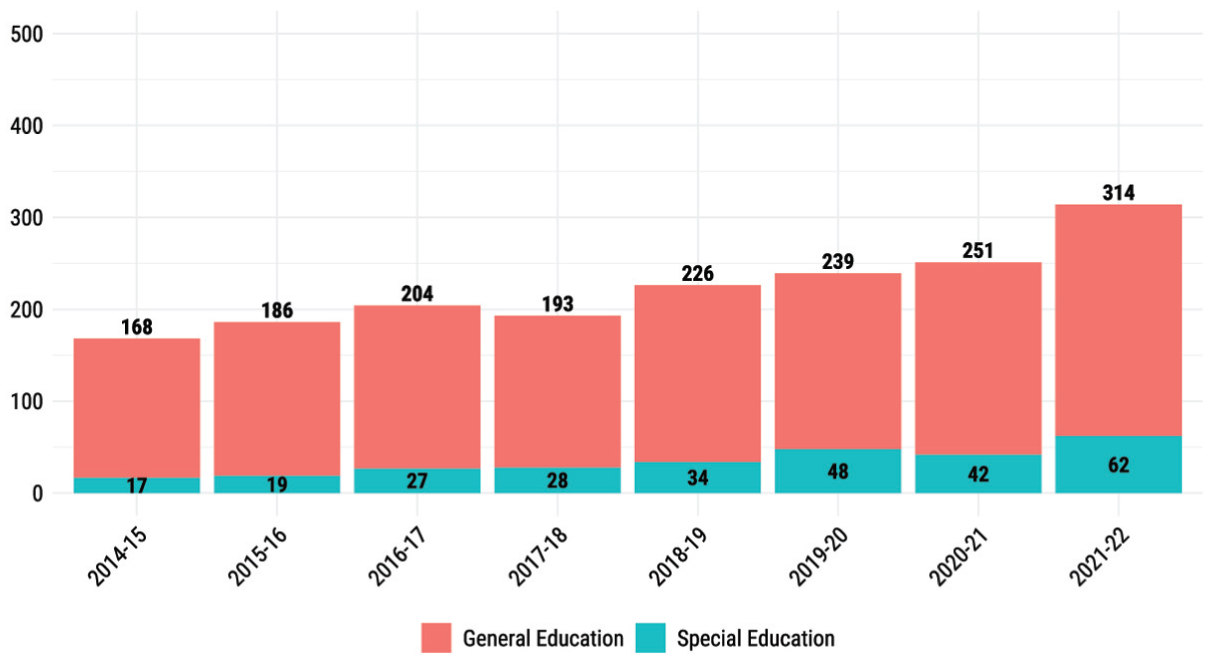
Teaching assignments of former paraeducators by year.
Persistence in the Teaching Profession
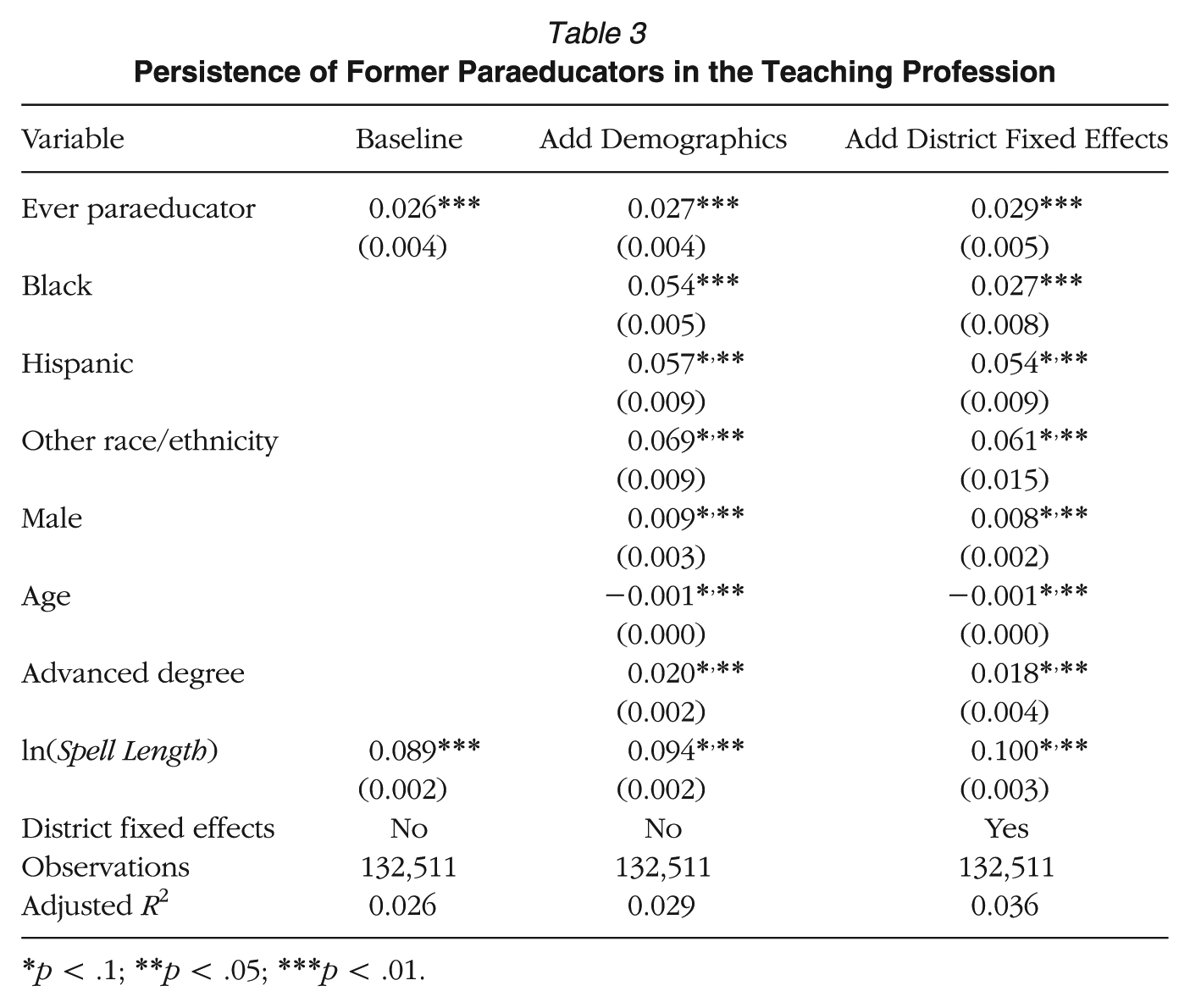
We report the results of the discrete-time hazard model specified by Equation (2) in Table 3. Across specifications, we find a statistically significant and practically meaningful relationship between having been a paraeducator prior to becoming a teacher and the likelihood of remaining in the teacher workforce. All else equal, paraeducators are ~3 percentage points more likely to remain teaching than individuals who enter the teaching profession through other pathways. Furthermore, in descriptive data visualizations (available on request), we find suggestive evidence that this difference appears after ~3 years of teaching experience and remains stable through the ninth year of teaching, indicating that the gains in persistence are concentrated in the medium to long term.
Persistence of Former Paraeducators in the Teaching Profession
*p < .1; **p < .05; ***p < .01.
Former Paraeducator Effectiveness
We compare the effectiveness of teachers both with and without prior paraeducator experience by studying the distributions of value-added scores for teachers in their first 3 years of teaching in Figure 3. This figure also presents the results of KS tests for the equality of the value-added distributions between teachers with and without prior paraeducator experience for ELA and math scores separately. Visually, it appears that paraprofessionals have an advantage in terms of value added for ELA. However, in all cases, the KS tests fail to reject the null hypothesis that the distributions of value added are statistically different for teachers with and without prior paraeducator experience.
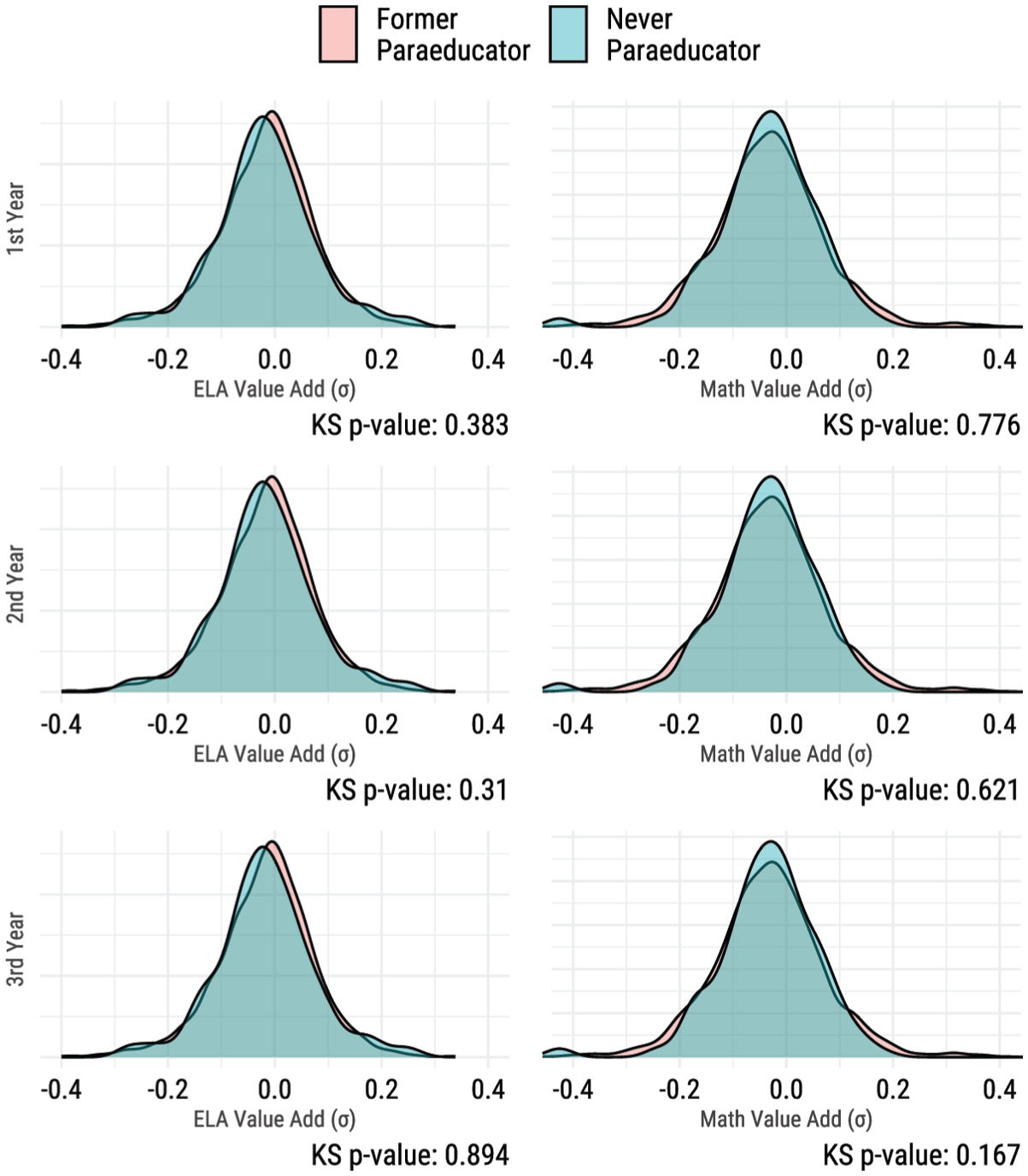
Value added of beginning teachers by prior paraeducator experience.
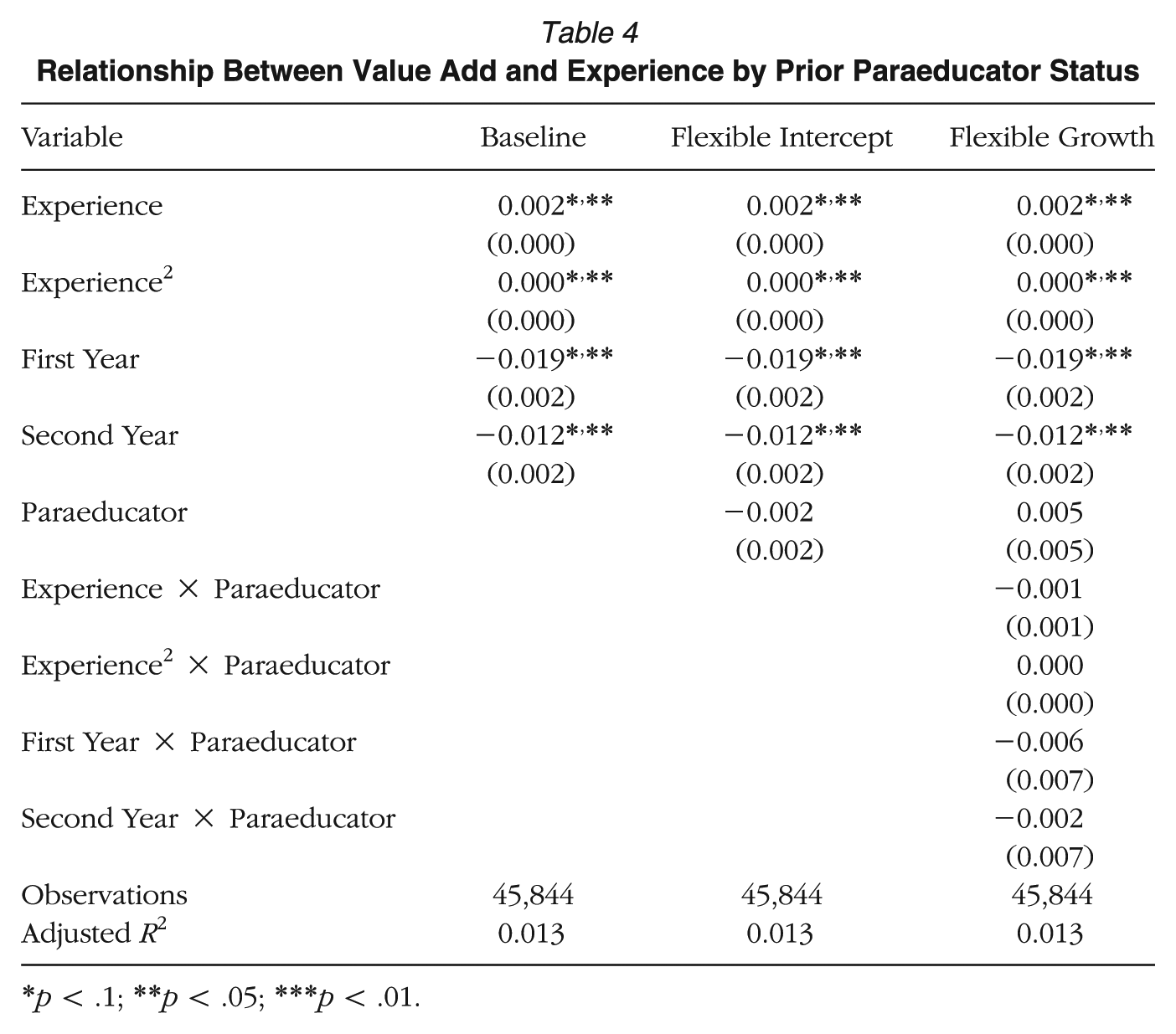
As a robustness check, we also study whether paraeducators who become teachers experience different effectiveness growth as they gain years of experience than those who come from a more traditional pathway. The results of this analysis are presented in Table 4. In line with existing research on teacher effectiveness (Wiswall, 2013), we find evidence of positive returns to teaching experience. However, we do not find evidence that teachers with paraeducator experience enter the teacher workforce with meaningfully different average value-added scores or experience different returns to experience than teachers without prior paraeducator experience.
Relationship Between Value Add and Experience by Prior Paraeducator Status
p < .1; **p < .05; ***p < .01.
Potential Impacts of GYO Initiatives
Finally, we investigate the potential for GYO initiatives to contribute to teacher diversity through the policy simulation exercise described in the preceding section. Although current initiatives in Arkansas are not focused on certain schools, policymakers may wish to target efforts to expand the paraeducator-to-teacher pipeline in schools facing staffing challenges. To inform this scenario, we perform the simulation exercise both for all public schools in Arkansas and for schools facing acute staffing challenges, which we define as districts in which >10% of teachers are not fully certified for at least half the classes they teach. In total, the sample of schools we include in this targeted scenario enroll 31% of statewide enrollment, 62% of Black and Hispanic students, and 50% of free or reduced-priced lunch–eligible students. Figure 4A shows the results of these simulated changes across all Arkansas districts, whereas Figure 4B presents results if only districts with acute staffing challenges are targeted.
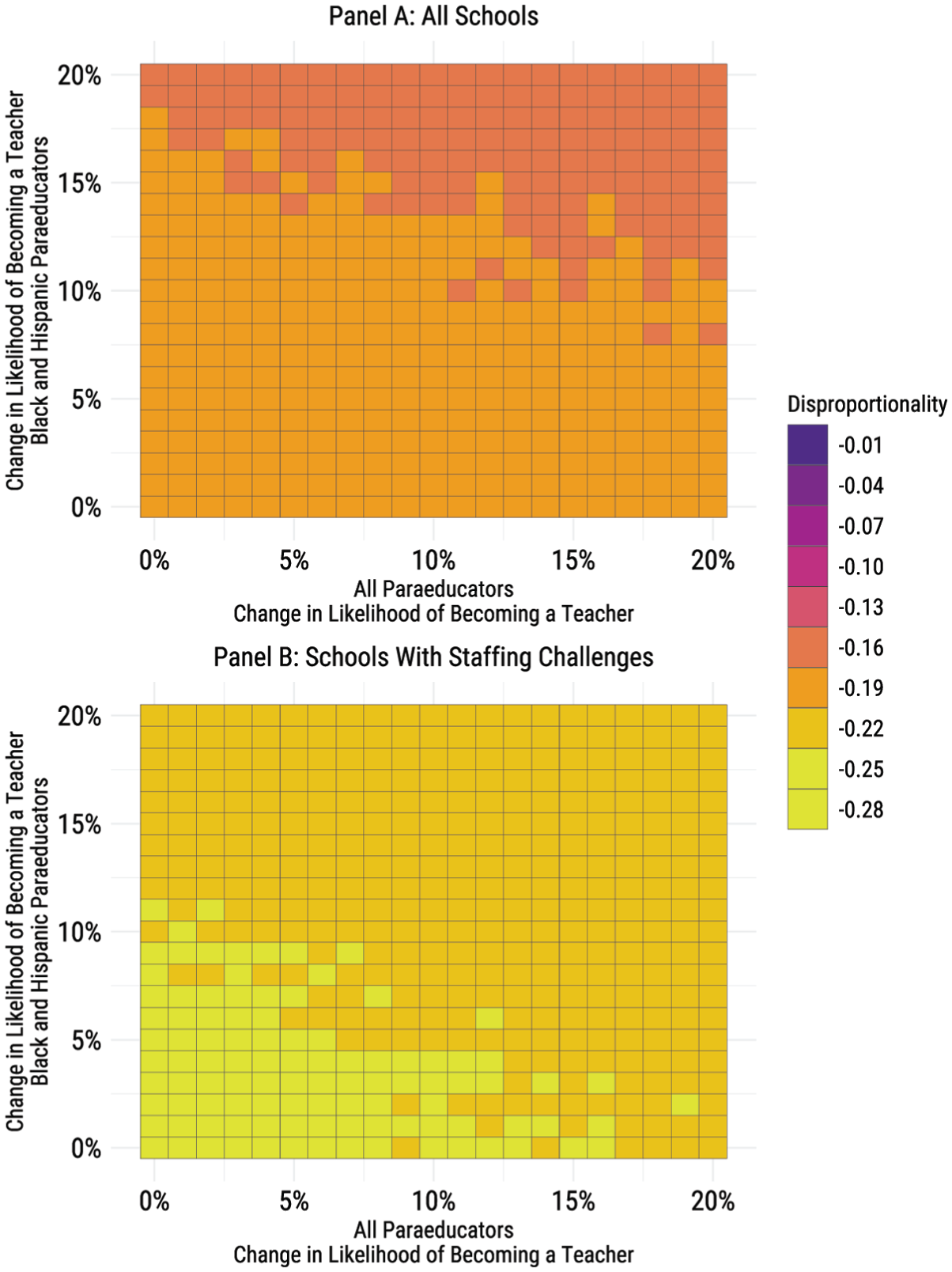
Simulated impacts of pipeline targeting on racial disproportionalities between Arkansas's teachers and students.
The bottom-left corner of Figure 4A represents simulated racial disproportionalities between Arkansas's teachers and students after 5 years if the likelihood of becoming teachers remains the same as we observe today. This scenario results in a disproportionality of −19%, indicating that teachers are nearly 20 percentage points less likely than students to be Black or Hispanic.
Moving across the x-axis corresponds to an increase in the likelihood of all paraeducators, irrespective of racial/ethnic identity, transitioning into teaching roles. Examining points along the x-axis, we find that the simulated racial disproportionality between Black and Hispanic students and teachers is unchanged at −19% for all values of increases in the probability of transitioning to teaching roles (
Moving up the y-axis, we illustrate scenarios in which we increase the rate at which Black and Hispanic paraeducators become teachers. We show that transition probabilities for Black and Hispanic paraeducators must be increased substantially to have meaningful impacts on the diversity of the Arkansas teacher workforce. Changes in the likelihood of all paraeducators transitioning into teaching (
In Figure 4B, we present results when only schools with teacher shortages are targeted. In this case, the simulated racial disproportionality measure under the “No change” scenario (i.e.,
Specifically, an increased probability of transitioning into the teaching profession for all paraeducators of ~7 percentage points and an additional increased probability of 5 percentage points for Black and Hispanic paraeducators appear sufficient to reduce the racial disproportionality in the teacher workforce by 6 percentage points to −22%. We also observe that similar gains in representation might occur with large increases in the probability of all paraeducators transitioning into teaching roles (
Together, Figures 4A and 4B indicate that while the paraeducator-to-teacher pipeline may have limited capacity to diversify the teaching workforce, larger gains in diversification may be possible if policies target schools facing staffing challenges.
Discussion
Our analyses provide valuable insights into the paraeducator-to-teacher pipeline, an understudied but sizable group of educators who are also the focus of new GYO policy initiatives throughout the United States. Using Arkansas administrative data from a period preceding implementation of state GYO initiatives, we find that paraeducators are not only more diverse than teachers but also comprise an increasing share of the Arkansas teacher pipeline.
However, consistent with prior evidence from Washington State (Theobald et al., 2023), we find relatively high levels of attrition from the public education sector among newly hired paraeducators. Despite this attrition, a small but significant proportion of paraeducators become teachers within their first 3 years of entering the public education workforce. However, paraeducators who become teachers are ~2.5 to 3 percentage points more likely to be retained in the teacher workforce. This increased retention may be beneficial for the aggregate health of the teacher workforce, but future research should explore the ways in which paraeducators’ career trajectories evolve after they enter teaching roles. In particular, new GYO initiatives and an increased focus on developing paraeducators into teachers on behalf of districts may affect the propensity of paraeducators to remain in a district after becoming fully certified teachers.
Our results also show that, on average, teachers with experience as a paraeducator exhibit similar teaching effectiveness, as measured by value added, to those without prior paraeducator experience. This suggests that paraeducators who become teachers are equally effective at improving student outcomes and therefore that recruiting from the paraeducator workforce may be a promising strategy to expand the teacher pipeline without compromising instructional quality.
Additionally, our results offer actionable insights for the design of future adult GYO initiatives. In particular, educational attainment—especially holding a bachelor's degree—is a key determinant of successful transitions from paraeducator to teacher. This represents a significant barrier that must be addressed for GYO programs to be successful. Encouragingly, Arkansas launched a statewide adult GYO initiative in the fall of 2023 that directly targets this barrier by partnering with EPPs based at in-state higher education institutions. Future research should explore the impacts of this program and provide policymakers with evidence regarding its effectiveness.
Our data also reveal that paraeducator-to-teacher transitions into special education areas are relatively rare. These findings, while potentially unique to Arkansas, are worthy of further investigation given the enthusiasm surrounding paraeducators as a potential solution to special education staffing challenges. If present in other contexts, the relatively low probability of special education paraeducators becoming special education teachers may indicate the need for more robust special education teacher recruitment. As adult GYO programs mature and scale, policymakers and program designers should consider mechanisms to better support transitions into these high-need roles, especially if addressing teacher shortages is a goal of the program.
In terms of workforce diversity, our findings suggest more modest potential. Whereas paraeducators are more diverse than current teachers, we find that White paraeducators are twice as likely to become teachers as their Black or Hispanic peers. Simulations suggest that even large increases in transition rates among Black and Hispanic paraeducators would produce only marginal changes in the overall racial composition of the teacher workforce. This is largely due to the limited racial/ethnic diversity of the existing paraeducator workforce in Arkansas. Consequently, in contexts with similarly constrained diversity among paraeducators, GYO initiatives alone may have limited capacity to reduce racial disproportionality between students and teachers.
However, our simulations also suggest that targeting GYO efforts toward schools facing acute staffing challenges—where student populations are more diverse—may yield larger gains in teachers’ racial/ethnic diversity. Such targeted strategies therefore may offer a more promising approach to improving representation in the educator workforce.
Taken together, our findings highlight both the promise and the limitations of leveraging the paraeducator workforce to address teacher shortages and diversify the educator workforce. Although a subset of paraeducators successfully transitions into teaching roles and performs comparably with their peers, structural barriers—particularly related to degree attainment and racial disparities in transition rates—limit the overall scale and equity of these transitions. As states continue to invest in adult GYO initiatives, ongoing evaluation will be critical to understanding how these programs evolve, which design features are most effective, and how they can be targeted to address subject and geographic shortages and equity goals.
Supplemental Material
sj-pdf-1-aer-10.3102_00028312261453572 – Supplemental material for Untapped Potential? Understanding the Paraeducator-to-Teacher Pipeline and Its Potential for Diversifying the Teacher Workforce
Supplemental material, sj-pdf-1-aer-10.3102_00028312261453572 for Untapped Potential? Understanding the Paraeducator-to-Teacher Pipeline and Its Potential for Diversifying the Teacher Workforce by Andrew M. Camp, Gema Zamarro and Josh B. McGee in American Educational Research Journal
Footnotes
Acknowledgements
We are grateful for our collaboration with the Office for Education Policy at the Department of Education Reform at the University of Arkansas and the Arkansas Department of Education, which made access to data possible. We are also thankful for the comments and feedback of participants of the Department of Education Reform Brown Bag Seminar series as well as the 2023 Society for Research on Educational Effectiveness and 49th Annual Association for Education Finance and Policy conferences. Additionally, we thank the four anonymous reviewers who provided helpful feedback on an earlier version of this manuscript.

Funding
The authors received no financial support for the research, authorship, and/or publication of this article.
Declaration of Conflicting Interests
The authors declared no potential conflicts of interest with respect to the research, authorship, and/or publication of this article.
Notes
A
G
J
References
Supplementary Material
Please find the following supplemental material available below.
For Open Access articles published under a Creative Commons License, all supplemental material carries the same license as the article it is associated with.
For non-Open Access articles published, all supplemental material carries a non-exclusive license, and permission requests for re-use of supplemental material or any part of supplemental material shall be sent directly to the copyright owner as specified in the copyright notice associated with the article.
