






Abstract
School rezoning often generates concerns that drive resistance to boundary changes, but how this resistance translates into voting outcomes is less understood. This study introduces a three-part concerns framework for interpreting how families publicly articulate rezoning opposition. We examined concerns as responses to disrupted expectations, as discursive constructions, and as voting processes. Thematic analysis of more than 6,000 survey comments revealed that concerns about neighborhood dynamics, transportation, and school feeder patterns dominated responses, functioning as political tools that obscured underlying demographic anxieties. Although families avoided explicit mention of race or class, analysis of voting patterns showed systematic opposition to proposals increasing school diversity. These findings demonstrate that concerns are complex political constructions, offering school leaders practical insights for navigating opposition.
Introduction
It is well understood that many families construct residential and school preferences in tandem (Cucchiara & Horvat, 2014; Freidus, 2020; Goyette et al., 2012; Hailey, 2022a; Holme, 2002; Rhodes & Warkentien, 2017). This interdependence is significant given how terms such as good schools and good neighborhoods function as racial- and class-based signifiers, casting doubt on families’ seemingly neutral preferences (Freidus & Ewing, 2022; Johnson & Shapiro, 2003). Explaining this link as “neighborhood–school structure,” Rich and Owens (2023) stated: Institutional processes (and their politicization) produce formal linkages between neighborhoods and schools, leading to interdependency in the choices families make about where to live and where to enroll their children in school (whether or not families explicitly consider both contexts simultaneously). Neighborhoods and schools thus reflect one another in resources and composition, shaping how each is valued within the distribution of local options. (p. 308)
Given the racialized and class-based ways neighborhoods and schools jointly operate, we use the term neighborhood–school structure to investigate how families resist policy changes that would disrupt the frames they constructed when choosing their neighborhood school.
According to Bell (2020 p. 918), families use “neighborhood frames” to evaluate the reputation of neighborhoods and the associated institutions within them (e.g., schools, parks, and churches). Neighborhood frames create collective or shared meanings about geographic spaces, which explains why families who buy into certain neighborhoods “for the schools” rely on these frames to guide holistic, academic, and social preferences or expectations (Bell, 2009). By extension, these frames also shape their dislike, aversion to, or indifference about certain neighborhoods and schools (Billingham & Hunt, 2016; Burgess et al., 2015; Rhodes & Warkentien, 2017). Although research has documented patterns of racial avoidance in school choice—showing how families often avoid schools with Black and Latino/a students (Evans, 2024; Johnson & Shapiro, 2003; Roda & Wells, 2013)—studies have focused largely on families’ expressed and revealed preferences (i.e., what families want in an ideal school or which schools they select; Bell, 2009; Cucchiara & Horvat, 2014; Debs et al., 2023; Hailey, 2022a; Harris & Larsen, 2023). However, scholars have started to explore different modes of expression related to families’ preferences or concerns. For example, Billingham et al. (2024) leveraged the “don’t know” survey option and open-ended feedback to probe parental preferences and assessments of school safety as a mechanism of expressed uncertainty or ambivalence. This research signals additional opportunities to analyze the discursive frames and rhetorical strategies families use to legitimate their concerns and opposition in public feedback processes. Examining how families deploy these strategies is essential for revealing how race-neutral language protects exclusionary arrangements, hindering policy interventions designed to disrupt segregation.
One segment of educational decision making that generates significant concern or opposition is school rezoning, which refers to the process of redrawing school attendance boundaries by assigning students to schools based on their residential address. School board policies usually mandate that districts rezone to address rapid student growth, over- or under-enrollment, school closure, or building utilization. Rezoning is also used as a mechanism to reduce racial/ethnic and socioeconomic segregation in schools (Castro et al., 2024; Richards, 2014; Siegel-Hawley et al., 2017); however, the legal context has significantly shaped districts’ rezoning approach. The Parents Involved (2007) 1 ruling restricted the use of students’ race and ethnicity in student assignment (McDermott et al., 2015); since then, schools increasingly have relied on so-called race-neutral policies such as rezoning to redistribute students and resources more equitably (Bierbaum & Sunderman, 2021; Castro et al., 2024). Despite scholars challenging the premise that rezoning is a race-neutral policy mechanism (Castro, Siegel-Hawley, et al., 2022; Mendez et al., 2022), rezoning studies have paid less attention to the concerns articulated during localized rezoning processes.
Rezoning resistance often has involved collective opposition against proposed boundary changes, threats to withdraw from newly assigned schools, or decisions to move neighborhoods altogether (Bartels & Donato, 2009; Castro, Parry, et al., 2022; Mendez et al., 2022; Siegel-Hawley et al., 2017). Mostly led by White and/or higher-income families, this resistance must be articulated in ways that appear legitimate to policymakers and district leaders, making concerns important political tools. This study introduces a three-part framework for interpreting rezoning concerns. First, we examined concerns as responses to disrupted expectations when rezoning threatened families’ anticipated preferences for school inputs and outcomes. Second, we analyzed concerns as discursive constructions that enable families to use neutral policy language to obscure racialized and class-based anxieties. Third, we investigated how these concerns get articulated and which concerns gained legitimacy to shape rezoning voting outcomes.
We used this framework by examining the expressed concerns of 3,673 survey respondents from a large public survey administered in 2019 during one suburban district’s rezoning process. A key aim of the rezoning effort was to reduce concentrations of poverty by redrawing attendance boundaries to lessen economic segregation. Given this policy context, we examined the cultural schemas, or neighborhood frames, that evoked concerns about altered attendance boundaries and analyzed whether those concerns masked deeper racial and class-based anxieties. As such, we examined the following research questions using qualitative data alongside thematic and descriptive analyses:
We found three dominant concerns—neighborhood dynamics, transportation, and school feeder patterns—that functioned as political tools enabling families to oppose rezoning proposals. Although demographic concerns appeared less frequently in survey responses, voting patterns revealed systematic opposition to proposals that would increase racial and socioeconomic diversity to newly assigned schools. School feeder patterns describe the typical path students follow as they move from one school level to the next within a district. However, by invoking feeder-pattern concerns and the “Not applicable (N/A)” survey option, we observed that feeder-pattern concerns allowed families to express academic anxieties about school quality and peer composition without explicitly mentioning demographics. These findings demonstrate how families articulated opposition using neutral policy language that maintained racialized and class-based advantages and derailed desegregative rezoning.
Our study makes several contributions to research on rezoning and neighborhood–school selection. Theoretically, we introduce “concerns” as a neighborhood frame mechanism that drives resistance to desegregative rezoning. Unlike studies on families’ preferences for selecting neighborhood–school structures (Billingham & Hunt, 2016; Johnson & Shapiro, 2003), we unpack the processes through which families 2 construct and articulate opposition via concerns to rezoning policies—opposition that systematically targeted schools with higher percentages of students of color. Finally, given the patterns we identified between stated concerns and voting behavior, this study makes a significant empirical contribution to the field by directly analyzing how expressed concerns translated into actual voting behavior on proposed boundary changes. It reveals that what gets articulated as legitimate concerns in public forums has real consequences for educational policy outcomes, underscoring the need to interrogate these public processes as inherently democratic or equitable.
Relevant Literature
School rezoning is a localized process of drawing and redrawing attendance boundaries (also called catchment areas or attendance zones). It is a policy tool through which local school boards reconfigure the geographic zones that determine student school assignments. The boundary-drawing process mirrors political redistricting in its potential to advantage or disadvantage certain communities systematically, which is why some researchers have referred to it as educational gerrymandering (Richards, 2014, 2017; Richards & Stroub, 2015). Rezoning can be triggered by local conditions related to new school buildings, school closure, low or over-enrollment, or increased utilization of school choice (e.g., private schools, magnets, and charters; Abel, 2012; Lazarus, 2010; Petty, 2019), making rezoning highly situational and context dependent. Despite various rezoning rationales, racial or socioeconomic balancing often emerged as a secondary driver, especially in districts experiencing rapid demographic change (Bierbaum & Sunderman, 2021; Siegel-Hawley et al., 2017). A recent systematic review concluded that researchers have largely studied rezoning as a mechanism to address racial/ethnic and socioeconomic segregation in schools, although findings from this scholarship offered mixed results about whether rezoning reduces such segregation (Castro et al., 2024).
Illustrating this tension, two large-scale spatial and quantitative studies of the gerrymandering of attendance boundaries—relying on the same dataset but using different methods—produced conflicting evidence on the relationship between school attendance zones and racial segregation. One found that irregularly shaped school attendance boundaries were linked to increased integration (e.g., school officials drew oddly shaped zones to promote diversity; Saporito & Van Riper, 2016), whereas the other concluded that irregularly shaped zones were linked to increased segregation (Richards, 2014). These and other findings have concluded that the technical process of rezoning is not neutral; rather, the methods, criteria, and priorities used in drawing boundaries determine whether segregation patterns are perpetuated or disrupted (Lazarus, 2010; Monarrez & Schönholzer, 2023; Petty, 2019; Saporito, 2017).
In related work examining student assignment plans in North Carolina, Weinstein (2016) found that as Black student enrollment increased when boundaries were redrawn, there was a decline in White families within the neighborhood catchment area. Other redistricting studies have yielded similar results (Carlson et al., 2020; Tannenbaum, 2013) as residential relocation among White families led to greater levels of residential segregation. Even when rezoning resulted in lower socioeconomic segregation, Black or other students of color often disproportionately bear the burdens of reassignment. Studying rezoning across the Washington, DC metro area, Asson (2024) found Black and Latino/a children were rezoned consistently to schools with fewer educational opportunities. Mawene and Bal (2020) also found that students of color were disproportionately disciplined at higher rates and persistently harmed by spatial othering within rezoned schools. Such disparate impacts echo well-documented historical patterns of the racialized burden of school desegregation. Through initiatives such as busing, magnet schools, or neighborhood zoning, research has indicated that Black students traveled farther at younger ages, entered hostile and racist environments, and left behind supportive, same-race teachers for classrooms where expectations were lower and learning opportunities were not culturally responsive (Chambers, 2022; Pride & Woodard, 1985; Scott & Quinn, 2014).
Patterns of disproportionate harm and racialized outcomes could be attributed to rezoning processes that failed to adopt clear, specific, and measurable rezoning priorities and criteria. Recommendations for rezoning best practices have suggested that school officials should outline rezoning nonnegotiables (Abel, 2012), enlist technical expertise from external consultants (Lazarus, 2010; Petty, 2019), and offer opportunities for public input and engagement to foster public trust and create transparency in policy development (Siegel-Hawley et al., 2017). Furthermore, given that neighborhood–school structures are highly racialized and classed entities, researchers also have emphasized the need to highlight competing values and visions among stakeholders and district leaders and clarify mechanisms that maintain educational advantage and privilege (Bartels & Donato, 2009; Castro, Parry, et al., 2022; Mendez et al., 2022). These findings underscore “the complex and often circular relationship between residential segregation and racialized school inequalities” (Freidus & Ewing, 2022, p. 764), which highlights the nexus of neighborhoods and schools informing rezoning processes.
Operationalizing Rezoning Concerns
Concerns driving rezoning resistance stem from multiple factors, but one key factor relates to demographic anxieties and community belonging (Goyette et al., 2012; Turner, 2020). Examining stakeholders’ concerns about demographic change within schools—an outcome that may accompany rezoning—Freidus (2020) explained that belonging is central to understanding families’ choices about neighborhood–school structures. These choices are guided by neighborhood frames, or the collective meanings communities attach to geographic spaces (Bell, 2020). These frames inform individuals’ perceptions of schools, resulting in families’ assessments of top- and low-status schools (Burgess et al., 2015; Holme, 2002). Schools with better inputs are assumed to be of higher quality and more likely to produce better outcomes, regardless of whether this connection exists. Neighborhood frames are also used to construct families’ sense of belonging (i.e., “to belong,” “belong in,” or “belong to”) to neighborhood–school structures (Freidus, 2020). Once families establish themselves as legitimately belonging to a neighborhood–school structure, it becomes the basis for claiming proprietary rights and entitlements. Hailey (2022b) extended this logic of belonging to include anticipated belonging, which “refers to families’ expectations of physical, emotional, and symbolic safety; inclusion; and supportive relationships in future educational contexts” (p. 880). These constructions of belonging operate as important feedback loops that reflect families’ backgrounds, values, and preferences as well as their aversions, dislikes, and concerns to justify opposition to rezoning.
When rezoning threatens carefully constructed neighborhood frames, families must find ways to articulate their opposition and legitimize their concerns that are politically feasible. This articulation is especially true for White families who have been most resistive to desegregative rezoning despite their expressed support for “abstract” diversity (Bartels & Donato, 2009; Castro, Siegel-Hawley, et al., 2022; Mendez et al., 2022; Siegel-Hawley et al., 2017). To unpack concerns, we propose and operationalize a three-part framework: (a) concerns as the expectation–disruption dynamic, (b) concerns as a discursive device, and (c) concerns as an articulation process (Figure 1).
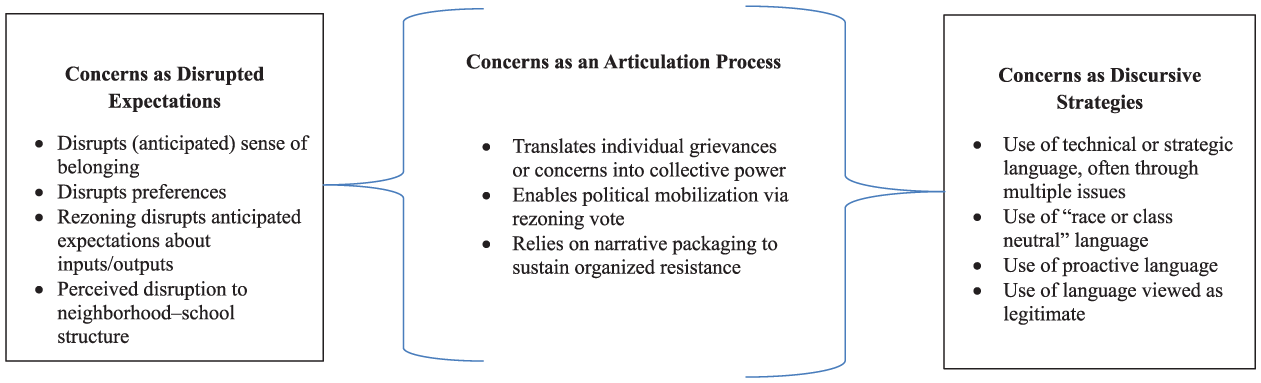
Concerns framework: Articulating rezoning opposition.
Concerns as the Expectation–Disruption Dynamic
When families select their neighborhood–school structure, they often anticipate certain inputs and outcomes associated with the school (Billingham & Hunt, 2016; Debs et al., 2023; Hailey, 2022b). Parents consider a range of school inputs, which may include curricular-based elements of classroom teaching and learning (e.g., International Baccalaureate programs; advanced-level coursework; science, technology, engineering, and mathematics offerings; and dual-language or language immersion experiences; Bell, 2009; Posey-Maddox et al., 2021). Other inputs may include teacher quality and the teaching environment (e.g., knowledge and skills of teachers, teacher turnover, professional development, student–teacher ratios, or teacher salaries) as well as school culture (Gagnon & Schneider, 2019). Families also closely scrutinize school outcomes such as student test scores, career and college placement, or graduation rates in their neighborhood–school calculations (Harris & Larsen, 2023; Holme, 2002), although such indicators are often used as proxies for school demographics rather than actual school quality (Burgess et al., 2015; Denice & Gross, 2016; Freidus & Ewing, 2022; Goyette et al., 2012). Affluent families, for example, are more likely to prioritize academic achievement over other factors, whereas lower-income families weigh proximity, extracurricular activities, and academics relatively evenly (Harris & Larsen, 2023; Rhodes & DeLuca, 2014). Some families disregard these outcomes altogether, preferring to highlight inputs such as educator diversity, resource allocation, and facility quality as their primary concerns when evaluating school assignments (Debs et al., 2023; Kimelberg, 2014; Robinson, 2022; Roda & Wells, 2013).
According to Rich and Owens (2023), local resources and demographics within the neighborhood–school structure are implicitly understood, even if families do not explicitly consider them. When rezoning disrupts the neighborhood–school link, it generates concerns because families must confront the possibility of losing the educational and social resources they believed they had secured. Indeed, prior work has emphasized that some families view rezoning as violating their economic investment in neighborhood–school packages. Mendez et al. (2022) invoked critical race theory, specifically “Whiteness as property” and “property for Whites,” to illustrate how White, affluent families saw themselves as victims of rezoning policy disruption because “their property ownership in high-value, economically and racially segregated sub-divisions reflected their hard work, careful research, and sound decision-making” (p. 145). In this manner, situational influences such as rezoning create deviations from families’ anticipated expectations and belonging, which generates concerns that may not have been articulated or captured previously by their stated preferences.
Concerns as a Discursive Device
Discursivity implies that ideas are structured and communicated within a discourse or system of thought (i.e., text, language, and social practice; Fairclough, 2011). Critical perspectives of discourse insist that language can uncover the contradictions, power structures, and meaning-making processes imbued in discourse (McCoy-Simmons et al., 2023). These processes suggest that concerns can serve simultaneously as discursive tools presenting rational opposition while obscuring racialized and class-based anxieties. Although scholars have warned that race and class are not synonymous or interchangeable dimensions of identity (Alexander & Jang, 2019), a critical discourse lens “centers race but understands that it operates in concert with other social constructs” (Dumas et al., 2016, p. 6), particularly because “race and racism are ensconced in education policy and its implementation” (p. 6). As such, coded language about “school quality,” “good schools,” or “safe neighborhoods” often mask White families’ discomfort with enrolling their children in schools with more racial or socioeconomic diversity (Freidus & Ewing, 2022; Kimelberg, 2014). These discursive phrases also function as socially acceptable proxies for racialized or class-based anxieties without explicitly invoking race or class. This is not to say that families’ concerns about school safety, for example, are irrelevant but rather that “safety” is a discursive cover that allows families to voice racialized and class-based opposition through socially acceptable language (Hailey, 2025). It is also the case that these concerns reflect families’ social positioning rather than objective school conditions (Billingham et al., 2024). Likewise, affluent families, who typically possess greater cultural capital to frame their concerns in technocratic or color- and class-evasive ways, may discursively frame concerns about “academic outcomes” and “property values” to downplay racial attitudes (Mendez et al., 2022).
These discursive covers are also historically embedded. Indeed, concerns raised decades ago about “neighborhood schools,” “transportation burdens,” and “parental choice” provided an enduring template for families to construct and express opposition to contemporary rezoning efforts (Castro et al., 2024; Delmont, 2016; Epps-Robertson, 2016). The discursive nature of these concerns plays out even when concerns are presumed to be neutral or absent. For example, proximity to school can be considered a straightforward preference, irrespective of one’s race/ethnicity or socioeconomic status. Access to transportation and distance to home, work, or childcare facilities are key considerations of many families’ selection process (Burgess et al., 2015; Harris & Larsen, 2023; Rhodes & DeLuca, 2014). However, sociologic evidence revealed that White and middle- to upper-class residents’ stated preferences for walkability and school proximity reinforce systems where neighborhood boundaries maintain social segregation (Roberto & Korver-Glenn, 2021). We argue that the discursive nature of concerns can undermine rezoning efforts aimed at reducing racial and socioeconomic segregation.
Concerns as an Articulation Process
A final view of concerns builds on the preceding sections to reveal how concerns are articulated. By articulation, we mean the process of translating individual concerns or anxieties about rezoning into political opposition through voting. This articulation process serves as a crucial bridge to understanding how disrupted expectations and discursive language get translated into public, collective votes on rezoning proposals. Evidence has indicated that the articulation process involves constructing coherent narratives that justify opposition, building coalitions with similarly affected families, and framing concerns in ways that are legitimate and politically viable (Castro et al., 2024; Mendez et al., 2022; Siegel-Hawley et al., 2017). To our knowledge, rezoning studies have yet to unpack this final component of the rezoning process—that is, how families’ concerns influence voting decisions on rezoning proposals and how this translation shapes policy outcomes.
Studies of rezoning processes have revealed why the articulation process matters for policy outcomes (Abel, 2012; Bierbaum & Sunderman, 2021; Lazarus, 2010). When school officials lack clear priorities and nonnegotiable criteria, the concerns articulated through public engagement processes can derail equitable rezoning outcomes or cause school officials to abandon rezoning aims (Richards, 2014). This articulation process does not operate equally for all families, which undermines Lazarus’s (2010) conclusion that rezoning processes should be “unbiased, evenhanded, and fair” (p. 27). White and/or higher-income families dominate rezoning processes in part because they possess greater access to discursive resources (i.e., technical language, social capital, and legal expertise), which enables them to frame their opposition in ways that appear legitimate to policymakers and district leaders (Castro et al., 2024). Communities of color also have mobilized in response to segregative rezoning, in some cases by filing lawsuits (e.g., Everett v. Pittsburgh County Board of Education, Spurlock v. Fox, and Jones v. Richmond School Board; see Siegel-Hawley et al., 2017). However, the hyperlocal interests of White families, combined with their discursive and technical resources, have often shaped the participation of communities of color in rezoning processes and the extent to which their concerns are perceived as legitimate.
Through this three-pronged framework of concerns, we offer an alternative approach to understanding rezoning opposition. Our analysis departs from existing studies that typically observe families’ preferences or their desires when selecting or ranking schools and/or neighborhoods to reveal how families’ concerns emerge from disrupted expectations about neighborhood–school structures. Although both preferences and concerns indicate value-based standpoints about neighborhood–school structures, preferences typically do not possess mobilizing and political power as concerns because preferences are often perceived as more casual or aesthetic of individual choices (e.g., preferring a new school building or preferring specific curricular offerings; Warren et al., 2011). Previous inattention to how concerns get constructed and mobilized politically has obscured a critical mechanism through which rezoning resistance operates and succeeds. As such, we argue that concerns are complex political constructions that reflect responses to disruption, discursive strategies, and articulation processes. It is a useful framework for policymakers to confront the organized political resistance that emerges when rezoning threatens existing advantages embedded in neighborhood–school structures.
District Context
The context for this study was Henrico County Public Schools (HCPS), which is a large suburban school district in central Virginia, bordering the city of Richmond’s northern, eastern, and western boundaries. The district is split across five regions or zones, which HCPS refers to as “magisterial districts”—Fairfield and Varina on the district’s east side and Brookland, Three Chopt, and Tuckahoe on the west. Although the district appeared relatively diverse (Table 1), sharp racial/ethnic and socioeconomic divisions existed across magisterial districts, which partly motivated the 2019 rezoning process.
Henrico County Demographic Profiles and Data (2019–20).
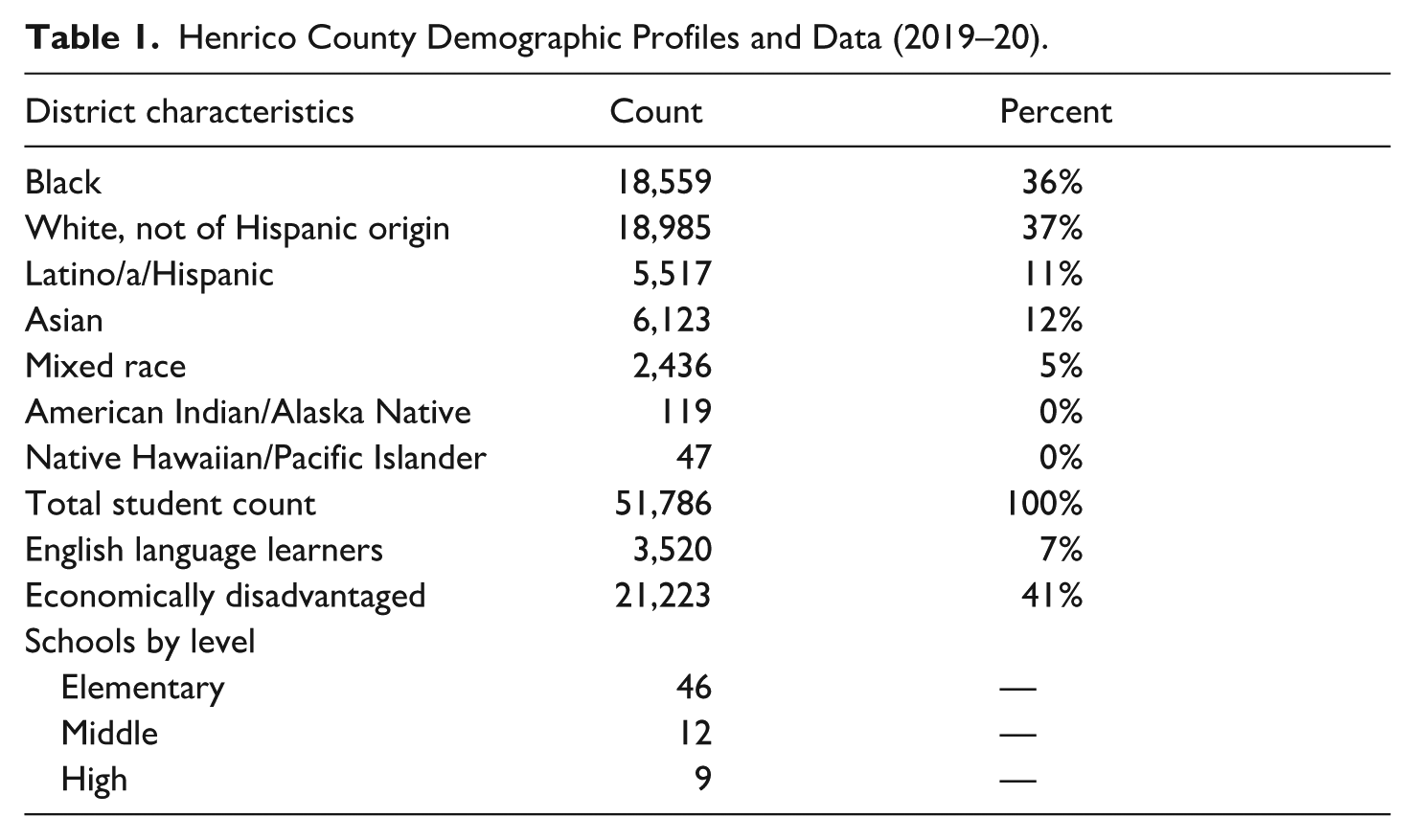
Rapid demographic growth primarily on the district’s west side spurred HCPS’s rezoning effort to address intradistrict segregation. For instance, Tuckahoe enrolled more White students (61%) and more Asian students (25%) than any other magisterial district, whereas Brookland enrolled more Black students (25%) than Three Chopt (11%) and Tuckahoe (13%) combined. Brookland also enrolled the largest population of low-income students on the west side at 15% compared with 10% low-income students in Three Chopt and 9% in Tuckahoe. Fairfield and Varina, situated on the east side, enrolled most of the district’s Black students at ~73% of total enrollment and ~30% economically disadvantaged students. However, these regions were largely excluded from the rezoning effort because the district sought to prioritize explosive growth on its west side. This omission undoubtedly raises critical questions about the district’s rezoning approach because policy interventions were mostly directed at more affluent, predominantly White areas.
Although the goal to “reduce concentrations of poverty within schools” was a district priority, other rezoning goals included (a) efficiently using all available space and planning for future county growth, (b) determining attendance boundaries for an expanded elementary school, and (c) accounting for the increased building capacity for two newly renovated high schools (Henrico County Public Schools [HCPS], 2019). These multiple rezoning rationales made it unclear whether racial and socioeconomic desegregation was a central priority. The framing of reducing concentrations of poverty also aligns with the race-neutral precedent set in the Parents Involved (2007) ruling, restricting students’ race and ethnicity in student assignment.
Despite the fact that the rezoning process was stalled by the COVID-19 pandemic and subsequent school closures, HCPS held multiple stakeholder meetings (in person and online), administered several public surveys, and shared numerous supporting documents on the district’s rezoning website to inform the process. To its credit, HCPS exercised a judicious and transparent process consistent with rezoning best practice (Lazarus, 2010), which allowed us to leverage extensive public survey feedback as primary data for this study. 3
Methods
The rezoning survey was administered at multiple time points in 2019 and sought to capture public input on proposed rezoning boundaries. All residents of HCPS could attend stakeholder meetings and participate in the electronic survey administration; however, key details about respondents’ identities (e.g., race/ethnicity, residential status, socioeconomic status, or income) were not captured, except for their assigned public elementary school and their magisterial district (i.e., Fairfield, Varina, Brookland, Three Chopt, or Tuckahoe). Because rezoning proposals did not impact Fairfield and Varina significantly, the data included fewer responses from those areas, excluding large proportions of communities of color. Finally, although some comments appeared to be from students, we assumed that most respondents were parents of children in HCPS.
The survey included multiple data points from 3,673 survey respondents. It featured six rezoning proposals with two options (option A/option B) for each school level: elementary schools (ESOA, ESOB), middle schools (MSOA, MSOB), and high schools (HSOA, HSOB). Each option proposed different attendance boundary configurations that determined which neighborhoods would be assigned to which schools. Across these proposals, respondents were asked to rate their satisfaction using a 5-point Likert scale (i.e., approve, like, neutral, dislike, or disapprove) and respond to two open-ended prompts. The first asked, “What are your thoughts/observations as they relate to Elementary/Middle/High School DRAFT Option [A/B]?” The second open-ended question asked, “If you indicated that you dislike or oppose Elementary/Middle School/High School DRAFT Option A/B, what is your primary concern?” Because respondents (N = 3,673) were asked to provide comments on each of the six proposals, the possible number of responses was 22,038. However, respondents submitted only 6,396 comments (29%), leaving most responses blank (71%), suggesting that respondents likely commented only on the proposals directly affecting them or those they opposed. Respondents then were asked to select a predetermined concern that influenced their rezoning vote or their thoughts/observations about each proposal. Concerns related to demographics, enrollment, feeder pattern, neighborhood, transportation, or N/A. HCPS did not provide definitions for these concerns, which may have resulted in narrow or broad interpretations of concerns.
Data Analysis
Data analysis occurred in three phases. Phase 1 reflected thematic analysis of a subset of the data. Then, in phase 2, we used a large language model (LLM) to confirm or disconfirm our initial, human-based analysis. Phase 3 included a descriptive analysis of rezoning votes.
Phase 1: Creating a Sample Dataset
Of the 3,673 respondents, we first created a data subset by omitting responses from participants who did not identify a geographic zone or an elementary school, which were important indicators of respondents’ initial selections of a neighborhood–school structure. This step reduced the respondent count from 3,673 to 3,385. Then we randomly selected 20% (n = 677) to curate a subsample, which included 1,382 open-ended comments across the six proposals. 4 We then extracted the data to a spreadsheet for analysis and included commenters’ magisterial districts (i.e., Fairfield, Varina, Brookland, Three Chopt, or Tuckahoe), assigned elementary school, their comments about each rezoning option, the selected concern, and their vote—whether they approved or opposed the rezoning option.
We then proceeded to analyze the subsample data qualitatively in three iterative phases. Using analytic techniques for quantizing qualitative data (Sandelowski et al., 2009), we first tabulated concerns that shaped respondents’ views of the proposed school by identifying the frequency and distribution of concerns related to each rezoning option. To yield greater qualitative insight into the neighborhood frames underlying these concerns, we relied on thematic analysis (Clarke & Braun, 2017) to clarify how families’ concerns, coupled with their open-ended responses, revealed frames guiding their opposition. We were particularly attentive to any mention of school inputs and outcomes (e.g., teaching environment, resources, school culture, or test scores) and noted these in memos, which were later thematically organized. For example, we observed that when respondents selected feeder-pattern concerns, comments often raised anxieties about families’ ability to maintain relationships. As one component of school culture (Gagnon & Schneider, 2019)—a key school quality input—we linked feeder-pattern concerns to frames about social capital embedded within neighborhood–school structures.
To elicit any subtext of racialized and class-based attitudes shaping neighborhood frames and, specifically, occurrences of race-evasive language or coded race talk (McCoy-Simmons et al., 2023), we incorporated approaches to critical discourse analysis (CDA). CDA is a methodologic technique that considers the relationship between various forms of text (e.g., language, documents, and policies) and context. CDA also helps to reveal how such texts are used to exert influence on people’s beliefs, ideologies, knowledge, and identities (Fairclough, 2011). A central feature of CDA is uncovering privilege and power as well as contradictions and ideologic tensions imbued in language (Gee, 2011). Thus, our analysis necessitated keen attention to race-evasive language embedded in concerns and comments about proposed schools. For instance, some comments included explicit references to “school demographics” or “populations of students,” whereas others were more subtle, using phrases such as “unmotivated students” to frame opposition to boundary changes. In isolation, such phrases may confer multiple meanings, but, as we discuss next, the third analytic phase revealed ways that class and race-evasive language guided respondents’ votes on rezoning proposals.
Phase 2: Analyzing the Full Dataset
In phase 2 of analysis, we leveraged an LLM, namely Claude 3.5, to verify our initial qualitative findings by analyzing respondents’ comments to the first open-ended question (i.e., “What are your thoughts/observations as they relate to Elementary/Middle/High School DRAFT Option [A/B]?”), which included 6,396 unique responses across the six proposals. Although the data included anonymous public comments, we were mindful of ethical concerns and ongoing debates about the use of a LLM in academic research (Roberts et al., 2024) yet sought innovative methods to increase efficiency when analyzing large amounts of textual data. As such, we used Claude 3.5 for its accessibility, reasoning abilities, speed, and accuracy. It enhanced our ability to analyze the entire dataset of open-ended comments, allowing us to validate or disprove the initial, human-based analysis or capture themes that may have been overlooked (Tai et al., 2024).
For data analysis with the LLM, all comments associated with each school-level option were uploaded separately and prompted to generate broad themes appearing in the data. For instance, when the LLM was prompted to summarize themes from one of the middle school options (MSOB), the LLM systematically generated seven major themes with key bullet points including (a) walking distance and transportation safety, (b) community cohesion and neighborhood splits, (c) property values and school investment, (d) natural boundaries and geographic logic, (e) school quality and performance, (f) social and emotional impact, and (g) process and planning issues (see Supplementary Table S1 in the online version of the journal). It also generated a brief two-sentence summary of the feedback and presented an option to request elaboration on any of these themes or analyze specific aspects in more detail. Results generated from each proposal provided thematic outputs consistent with our initial, human-based analysis, strengthening the reliability and validity of our findings as we compared artificial intelligence–generated outputs with themes from researchers’ memos.
Phase 3: Analysis of Rezoning Votes
Phase 3 focused on assessing how respondents’ concerns shaped acceptance for or opposition to rezoning proposals. To simplify analysis, we condensed survey options by combining votes for “approve” and “like” as one category (i.e., “Approve”) and “dislike” and “disapprove” as another category (i.e., “Oppose”) while maintaining the “neutral” option. We also disaggregated voting options across levels, geographic areas, and assigned elementary schools to discern potential patterns. For example, at the elementary level, which was used as a proxy for neighborhoods, commenters were more likely to select “neighborhood dynamics” as a concern, although approval ratings differed by each elementary option (i.e., 65% for ESOA, 41% for ESOB). When we observed strong voting opposition across select rezoning proposals, we examined voting patterns alongside school demographic data from the Virginia Department of Education (for the current and proposed school) to potentially evaluate whether race-evasive language or class-based attitudes appeared in the subsample of open-ended comments. We did not use the LLM for these complex analyses because such tools are prone to algorithmic bias and less capable of attending to subtext without adequate coding or training in issues of power central to CDA (Roberts et al., 2024; Tai et al., 2024).
Study Limitations
This study had several limitations. First, the predetermined concerns from the public engagement survey were useful proxies for respondents’ attitudes, but the survey design decontextualized respondents’ experiences. It is possible that other attributes shaped families’ neighborhood frames but were not captured by the survey’s predetermined concerns (e.g., concerns about absenteeism or educator turnover). Respondents were similarly limited by the nature of the survey questions, which asked them to comment on proposals they opposed. This inherently skewed the data and limited our ability to explain why respondents supported some rezoning proposals but rejected others.
Second, the data included key omissions. Because the survey did not collect respondents’ demographic information, we cannot make definitive claims about how individuals from different racial or socioeconomic backgrounds conceptualized neighborhood–school structures. Although the data were likely driven by a subset of White, middle- to upper-class families with particular characteristics (e.g., level of education, access to information, and English speaking), as evidenced in studies profiling dominant voices in school rezoning processes (Bartels & Donato, 2009; Castro, Parry, et al., 2022; Mendez et al., 2022; Siegel-Hawley et al., 2017), this critical omission limited our ability to establish causal relationships between respondents’ concerns and their voting decisions to their demographic characteristics. Additionally, because the rezoning effort largely excluded Fairfield and Varina on the district’s east side, which enrolled a significant portion of the district’s Black students, our data were limited in capturing Black families’ perspectives. We were therefore cautious not to render their concerns invisible when interpreting our findings.
Finally, use of an LLM in qualitative research is emergent and relies on algorithmic patterns and structures in the quality of the input data to develop results (Roberts et al., 2024). Some comments contained errors and included unstructured text that could have resulted in hallucinations—the production of inaccurate themes or conflicting information (Tai et al., 2024). However, we mitigated such errors by carefully evaluating outputs generated by the model and validating thematic outputs with our initial results from the subsample.
Findings
This study leveraged responses from a suburban school district’s rezoning survey to provide a window into families’ concerns and how they articulated opposition to rezoning. Across the subset of concerns, three main concerns—neighborhood dynamics, transportation, and school feeder patterns (Table 2)—dominated respondents’ opposition. These concerns revealed respondents’ anxieties, their core values or needs, or their anticipated discomfort about being rezoned. Although some concerns track with evidence from prior work (Castro, Siegel-Hawley, et al., 2022; Mendez et al., 2022), our findings add to scholarship by illustrating how families’ concerns functioned as political tools that influenced rezoning voting outcomes. Although we found that concerns about school enrollment and demographics were less dominant in survey and qualitative responses, voting analysis illustrated significant opposition when proposals redrew attendance boundaries to schools with greater student racial and economic diversity. These patterns suggest “discursive evasion” of class and race (McCoy-Simmons et al., 2023) because families engaged in articulation processes that enabled them to translate seemingly neutral concerns into legitimate policy opposition. We elaborate these findings in the following sections.
School Rezoning Concerns and Opposition by School-Level Options in Subsample and Full Dataset.
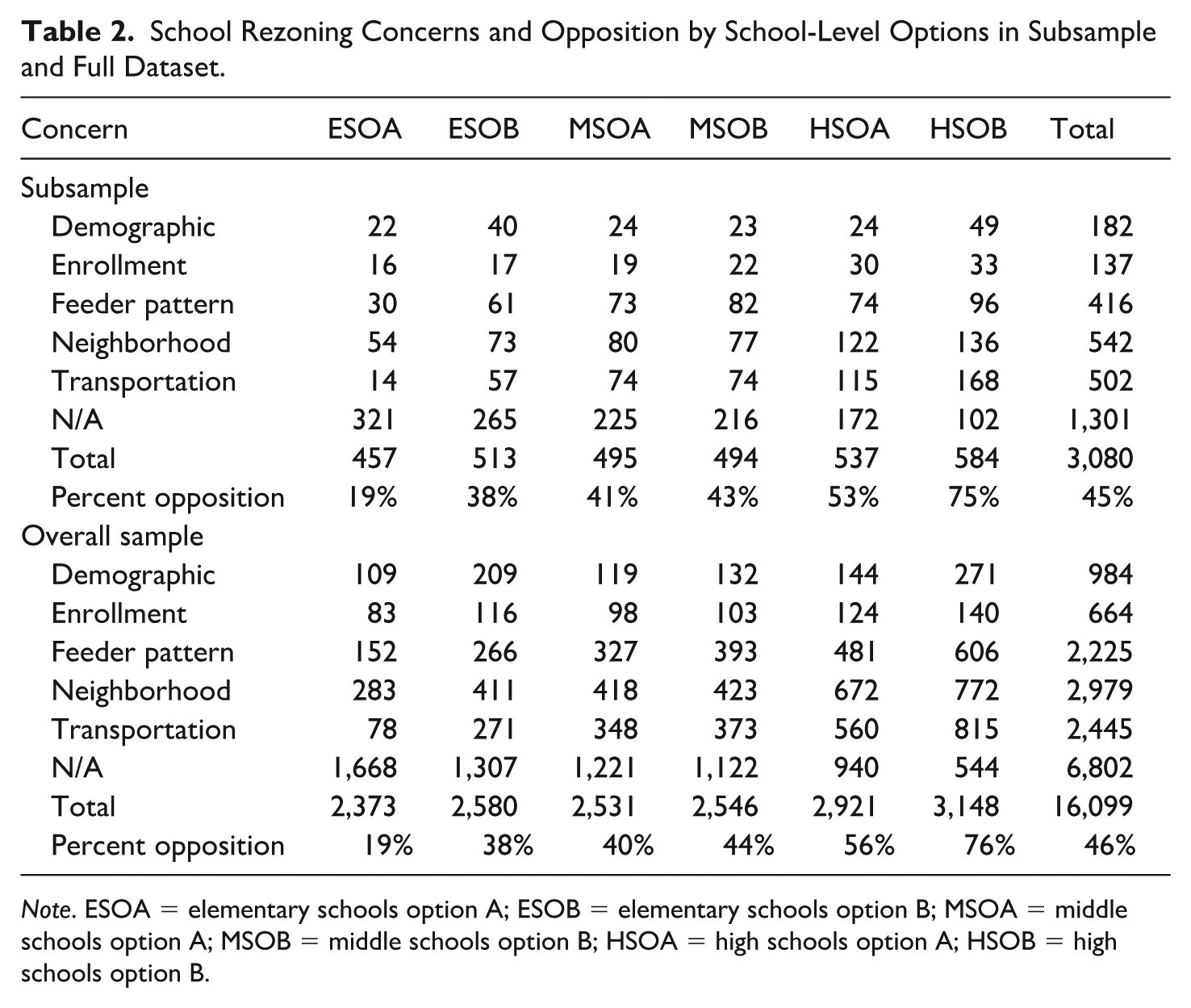
Note. ESOA = elementary schools option A; ESOB = elementary schools option B; MSOA = middle schools option A; MSOB = middle schools option B; HSOA = high schools option A; HSOB = high schools option B.
Disrupted Belonging: Ecological and Structural Interdependence of Schools and Neighborhoods
Neighborhood and School Feeder Pattern Concerns
Across all rezoning options, neighborhood concerns (n = 2,979) were identified as the main rationale for rezoning opposition, confirming the cyclic and mutually constitutive ways neighborhoods and schools are linked ecologically and structurally (Rich & Owens, 2023). It also demonstrates how neighborhood concerns emerged from disrupted expectations about belonging to the neighborhood–school structure that families established through their residential choice. Comments reflecting neighborhood concerns frequently mentioned disrupted feeder patterns (e.g., “This option splits our area and affects our neighborhood feeder pattern”) because school catchment areas are structured along multiple school levels that reinforce neighborhood–school ties (Monarrez & Schönholzer, 2023). Given this thematic overlap, we combined neighborhood and feeder-pattern concerns (n = 2,224; combined n = 5,203) because most concerns encapsulated respondents’ desires to maintain feeder-pattern bonds and relationships within their neighborhood–school structures.
Respondents’ neighborhood and feeder-pattern concerns underscored the importance of belonging as well as the deep social and personal connections facilitated within neighborhood–schools. Approximately 30% of all comments (n = 1,884) mentioned maintaining relationships and social networks under proposed options, which confirmed families’ view of relationships as a critical school input (Gagnon & Schneider, 2019). As one parent explained: Currently our kids play in social activities, are involved in Girl Scouts and Boy Scouts that are led by parents in various neighborhoods. . . . This option will separate our Boy Scout and Girl Scout troops and our community recreation swim center.
Emphasizing the neighborhood–school structure as part of their social and economic investment, another parent commented: We moved into our house specifically because of the Greenwood/Hungary Creek/Glen Allen [feeder pattern] combination. . . . A big part of schooling is developing friendships and relationships, and by dividing up elementary schools, and middle schools, you greatly limit that.
Similarly, another respondent demonstrated deep place-based belonging by stating, “We are Glen Allen people, our kids do all sports and activities in Glen Allen, why try to send them to Henrico HS when [Glen Allen] is close and all there [sic] friends attend.” Even when respondents selected N/A as a concern, notions of belonging still resonated in their comments; for example, one respondent expressed that it was “unacceptable and cruel to send Magnolia Ridge kids to Hermitage [a predominantly Black school],” further stating: “They should be continuing to head to Glen Allen [a predominantly White school]. We identify with historic Glen Allen and Glen Allen High.” These comments emphasize Freidus’s (2020) notions of belonging to, in, and with a community and how families construct place-based identities built around the neighborhood–school structure. These notions of belonging also functioned as racialized coded resistance (e.g., “Glen Allen people”) to mask their opposition to attending a predominantly Black school while advocating for neighborhood continuity and social connections.
Respondents also argued that splitting neighborhoods “would be highly disruptive and painful,” which demonstrated their views of rezoning as a threat to the neighborhood–school structure. Some respondents emphasized their home value, noting, “This will easily take $20k+ off of our home values,” whereas another commenter critiqued the option as “illogical due to the school’s proximity to the neighborhood, traffic patterns, and negative impact it’ll have on home values.” This framing of property values—a perceived “neutral” economic concern—is ostensibly linked to racialized and class-based residential segregation and further exemplifies a form of discursive evasion. Other views of disruption emphasized the downstream effects of rezoning on their children’s relationships and potential well-being: “When they [their child(ren)] become ‘the few’ entering a new school, they face considerable risk of loss of their friends, teachers, coaches, their history, their status, their confidence, their clubs, and sports.” Economic anxieties underlying neighborhood concerns enabled respondents to frame their opposition as threats to their residential investments while emphasizing the need for “a contiguous geographic zone for our neighborhoods . . . so [that] our children can maintain their friendships and maintain a consistent feeder pattern,” as one respondent stated. The fear that rezoning would fracture social networks, their investments, and their sense of belonging animated parents’ neighborhood and feeder-pattern concerns, leading to overwhelming resistance to rezoning.
Transportation Concerns: Politics of Proximity
There were 2,445 comments related to transportation concerns, which often overlapped with neighborhood and feeder-pattern concerns. The district worked with technical consultants to establish key aims about transportation and attendance zones. These aims sought to (a) define attendance zones along major roads and natural boundaries, (b) preserve contiguous geographic areas and identifiable community components, (c) comply with legal requirements for maintaining a unitary school system, and (d) prioritize walkability and transportation efficiency (HCPS, 2019). However, these aims became sites of contestation.
Transportation concerns were largely framed around objective or straightforward worries about proximity (as measured by the straight-line distance in miles between a student’s home address and school address; see Denice & Gross, 2016), longer commutes, the safety of new or student drivers, loss of walkability within neighborhood–school structures, increased traffic congestion, and transportation inefficiencies. Such concerns revealed what Pitre (2009) referred to as the “politics of proximity,” which emphasized proximity as a symbolic resource. Proximity enables “the best education possible at the public expense, the ability to determine who their child sits next to in class, high status programs and curriculum, the best teachers, and prestigious college admission” (Pitre, 2009, pp. 547–548). The politics of proximity thus highlights the power structures, inequalities, and ideologies shaping proximity as a form of exclusive accessibility and spatial capital.
Proximity to school is a straightforward attribute that many families value, regardless of identity (Burgess et al., 2015; Harris & Larsen, 2023). Therefore, it was expected that transportation concerns, particularly at the elementary and middle school levels, would emphasize “closeness.” Families approved options that “keep us with the closest middle school” while opposing those that “[are] not as close physically to our home.” Proposed changes that disrupted walkable, cohesive communities were strongly opposed and viewed as “a terrible option for our neighborhood, as it . . . changes our children’s school from one where they can walk or bike to school, [rather] than shipping them miles and miles away.” The guiding neighborhood frame was that “if a child is able to walk to a school, they should go to it.” Walkability also was valued for parents’ ease of access to schools because “parents walk to school for meetings, concerts, and sporting events.” Respondents also leveraged transportation concerns to critique the district’s rezoning priorities by highlighting the city’s strategic planning and community infrastructure investments (e.g., building sidewalks or improving roadways) and therefore argued that some rezoning options “go against the procedure guidelines.” By challenging the district’s rezoning priority to establish walking schools and maintain reasonable walking zones where feasible (HCPS, 2019), comments also possessed discursive power by highlighting proximity as an objective and rational universal preference.
However, we found that detailed attention to and emotional investment in transportation concerns were tethered to families’ economic goals and to securing resources and opportunities for their children. In this sense, they articulated their concerns to defend the premium they paid for proximity to desirable schools. This politics of proximity, coupled with feeder-pattern concerns, was evident across multiple comments: We don’t approve. Twin Oaks would be zoned for Dumbarton, which is already close to capacity. This option does not make sense for us. Also, Dumbarton is a feeder school into Hermitage High [a predominantly Black school], which we strongly oppose. We paid over half a million dollars to buy a home so that our kids could go to these schools.
Here the respondent’s insistence on maintaining the “feeder school” and their financial investments within the neighborhood–school structure confers value to associated schools.
The use of transportation concerns therefore was a catch-all way to amplify multiple issues. In such cases, transportation concerns likely served as the most rational justification for their opposition, even though no clear transportation-related issues were raised, which also can be seen in the following comment: “This [option] would put us in a much worse school district than we are in now, not only affecting our children but also our house values negatively.” In these accounts, transportation concerns extended neighborhood and feeder-pattern concerns because commenters relied on neighborhood frames emphasizing resources, relationships, or access to opportunities, although their comments foregrounded proximity.
Concerns about transportation also were more prominent at the high school level than at elementary or middle school levels (1,375 combined concerns). These concentrated concerns at the high school level were likely attributed to considerations of increased distances or travel times and safety risks for student drivers, which departs from other notions of psychological and emotional safety as described in the literature on families’ preferences (Goyette et al., 2012; Hailey, 2025; Robinson, 2022). For example, one respondent wrote with strong emotionality about a high school option that rezoned a sizable percentage of students to a school with more students of color: “I STRONGLY OPPOSE FOR SAFETY OF HIGH SCHOOL STUDENTS WITH A LONGER COMMUTE THRU HIGHER ACCIDENT AREAS.” Another commenter, rejecting the same proposal, also stated: I will have a new driver in 2 years and do not want them on I-64, which is the fastest route to Tucker High School for our neighborhood . . . [because] it is one of the busiest intersections in the county with a tremendous amount of auto accidents.
The emphasis on natural boundaries such as I-64 or, as another respondent described, “a clearly identifiable community w/o the use of any major roads or natural boundaries,” further highlights the exclusionary undertones of neighborhood frames shaping rezoning opposition. Such frames have decontextualized decades of institutionalized segregation and racism that continue to define neighborhood–school structures (Rothstein, 2017) and act as markers of social boundaries between geographic areas (Roberto & Korver-Glenn, 2021).
The frames guiding transportation concerns highlight how families deployed multiple, seemingly disconnected issues to construct their opposition. This pattern reflects the articulation process at work as transportation concerns become vehicles for expressing preferences for proximity, whereas concerns about community cohesion mask resistance to demographic change. Yet, both forms of expression function discursively by allowing families to articulate opposition without ever mentioning class or race.
Discursive Use of Demographic and Enrollment Concerns to Express Opposition
Prior studies of families’ stated and revealed preferences have indicated that school demographic characteristics shape the desirability of neighborhood–school structures (Freidus & Ewing, 2022; Holme, 2002; Johnson & Shapiro, 2003; Roda & Wells, 2013). Thus, we anticipated that survey respondents would have selected demographic (n = 984) and enrollment concerns (n = 663) at higher rates. Comments related to these concerns mostly emphasized socioeconomic status, which is likely attributed to the district’s overall goal of reducing concentrations of poverty and inadvertently subsumes race to theorizations of class (Tate, 1997). Still, Bell’s (2020) assertion that concerns can serve as racial codes remains pertinent to unpacking the mixed perspectives we identified about demographics and enrollment.
In some cases, respondents premised their opposition on notions of “diversity,” which routinely appeared in these comments (n = 122). Those who embraced diversity felt that options should “maintain diversity and feeder patterns,” especially in some neighborhoods where there was greater cultural and demographic diversity. For instance, a respondent highlighted that their neighborhood elementary school enrolled “students from 40 countries that speak 20 different languages,” whereby rezoning would disrupt the diversity within the neighborhood–school structure. Another respondent offered a similar rationale, rejecting the proposed change: “We are very interested in giving our child a richly diverse school experience, which is a reason we have enjoyed Crestview. We do not feel [that] we would get the same experience at Freeman or other Henrico schools.” Here, diversity was a neighborhood frame that supported individual-level access to diversity (i.e., their children’s exposure to diverse classmates).
However, other respondents rejected notions of diversity outright, expressing concerns about “social engineering” or too much diversity. Such views paralleled notions of diversity management, or what Turner (2020 , p. 1) described as “color-blind managerialism.” One respondent opposed a high school option to a school that predominantly served students of color because “[the zone for Tucker High School] will be too diverse a population and detracts from the idea of neighborhood schools,” whereas another justified their opposition because “a majority of Tucker is already considered economically ‘disadvantaged’ (50.1%) and non-Caucasian (69.6%).” These entanglements of race and socioeconomic status demonstrated some respondents’ racialized attitudes regarding mixing different socioeconomic groups by invoking frames of diversity as a discursive device to justify rezoning opposition.
Rezoning goals to reduce concentrations of poverty also were contested by some respondents who believed that rezoning would exacerbate economic inequality across schools. In most of these cases, respondents rejected proposals because they feared that rezoning would enable select schools to “become a high income and primarily White school” or that rezoning might exacerbate economic isolation in ways that mean that their “children are being put in a school across town that keeps the lower-income children together.” Critiquing the rezoning process, one respondent exclaimed, “This is total classism!” as they described how redistricting reinforced existing inequality by leaving boundaries for wealthy, upper-class neighborhood–school structures intact. Likewise, another respondent, commenting on elementary proposals, wrote: Your total disregard for the Northbrook neighborhood is about socioeconomics. You have allowed the wealthier Fox Hall neighborhood to stay at wealthy Deep Run and have moved the middle-class families away from Deep Run. There is very little diversity in socioeconomics at Deep Run. It is clear [that] you have penalized the Northbrook neighborhood for being middle [class], NOT upper class.
A handful of comments (~225) mentioned these enclave neighborhood–school structures, which feature schools with a population that is significantly Whiter and more affluent than the district (Henig et al., 1999). Still, some believed that the district favored privileged communities, accusing the district of “keeping the lower-income children together” rather than prioritizing educational equity. It also demonstrated some respondents’ beliefs that families in wealthy neighborhood–school structures may have exercised political power to insulate themselves from rezoning, 5 whereas others faced greater vulnerability for rezoning or were excluded altogether (such as Henrico’s east side). Although these concerns about power dynamics were limited, they revealed how the concerns framework operates to both obscure and expose power dynamics simultaneously.
Complexities of Rezoning Voting Results
Intersection of School Demographics, Academics, and Voting Patterns
Voting on proposed rezoning options provided additional insight into respondents’ opposition. Only three rezoning options (i.e., ESOA, HSOA, and HSOB) garnered more than 50% of votes. One elementary proposal, ESOA, received majority approval (65%) because parents preferred maintaining boundaries at predominantly White, higher-socioeconomic-status schools or rezoning to demographically similar schools. This pattern was exemplified by families’ near-unanimous support for staying at their current elementary school (Longan) or moving to Echo Lake, which had higher White enrollment and lower economic need. Both high school options (i.e., HSOA and HSOB) elicited majority opposition at 56% and 76%, respectively. This significant opposition was likely driven by families considering the implications of boundary changes across school levels. In other words, elementary and middle school families did not evaluate proposals in isolation but weighed how immediate rezoning decisions would affect their children’s long-term trajectories, highlighting anxieties about disrupted pathways. Across these proposals, we observed consistent patterns of opposition to proposals that redrew attendance boundaries to schools enrolling more students of color and those with economic need despite the fact that demographics and enrollment were not selected as dominant concerns. Coupling voting outcomes with analysis of open-ended responses also indicated feeder-pattern concerns (although not exclusively) and the N/A option were used as frames to address academic considerations.
Although “academics” was not a preselected survey option, ideologies of merit and individualism were nestled in frames about schools’ academic inputs and outcomes that prioritized personal merit and family advantage over collective equity. Commenters with these views resisted rezoning proposals because they believed that “moving from [their] current rated schools to lower-rated ones will affect property values and [their] children’s futures” or that reassignment would offer “no educational advantages for [their] children.” Many of these frames narrowly emphasized test scores and school accreditation or performance, whereas other key indicators of academic learning were often overlooked at schools serving more students of color. For instance, respondents pinpointed one high school’s (i.e., Tucker) lower pass rates on state tests and less access to Advanced Placement courses but neglected to consider other inputs and assets, including its International Baccalaureate program, an upgraded state-of-the-art building, technology labs, and other programmatic offerings. We also observed similar oversights about curricular offerings and assets at another high school (i.e., Hermitage). One commenter even stated: I know Hermitage is an accredited school with great kids etc. However, it does not provide the same opportunities as Glen Allen High School. The academic standards are not the same. They offer fewer AP [Advanced Placement] options. The facilities are not at the same level as Glen Allen.
Here, the commenter linked Glen Allen’s school quality to several high-status inputs (i.e., academic standards, Advanced Placement, and facilities), seemingly rejecting Hermitage despite acknowledging that it, too, is accredited and likely has a positive relational climate with “great kids.” This comment also overlooked that Hermitage also served as the district’s designated site for the Advanced Career Education Center and academic specialties in the humanities and health and human services.
Respondents also stated multiple and overlapping issues to platform their critiques about academics, which further illustrated their ideologic frames and why some respondents characterized a handful of schools as “inferior.” Referring to the schooling environment, one respondent explained, “Brookland is not adequately accredited by the State of Virginia, . . . and there are too many fights and too little class time spent learning, and discipline is terrible.” In fact, we identified intense opposition toward this school, Brookland Middle, which enrolled a student population that was 45% Black, 27% Hispanic/Latino/a, 17% White, 5% Asian, 6% two or more races, and 76% with economic need. Several commenters also expressed their opposition under the guise of N/A; one parent stated, “I disagree with zoning our neighborhood to an inferior school [Brookland Middle School] that is geographically farther away and pushes our children into a school that does not include ANY OTHER neighborhood.” Here, the N/A option, coupled with respondents’ votes, enabled families to articulate their opposition while evading any race- or class-related subtext associated with demographic and enrollment concerns.
Notably, some concerns about academic quality were not substantiated by actual school performance. For instance, a respondent rejected an elementary school option (ESOB) because they “don’t believe kids should be required to attend an inferior school.” Under this option, the “inferior” school (i.e., Dumbarton Elementary) enrolled 35% Hispanic/Latino/a, 32% Black, and 17% White students as well as 79% with economic need, which differed from the respondent’s current school (i.e., Longan Elementary) that enrolled 40% White, 19% Hispanic/Latino/a, 18% Black, 16% Asian, and 56% with economic need. Examination of state academic data from 2019 also indicated that 91% and 81% of Dumbarton students passed state standardized tests in math and science, respectively, whereas 95% and 90% of Longan students passed state standardized tests in math and science, respectively, indicating that overall performance was not drastically lower, as the comment suggested (Virginia Department of Education, n.d.). These overall patterns of heavy opposition to being rezoned to schools with higher percentages of students of color and students experiencing greater economic need reflect evidence of racialized school preferences (Billingham & Hunt, 2016; Evans, 2024; Freidus & Ewing, 2022; Mellon & Siegler, 2023).
Indeed, closer analysis of school demographics, especially at the high school level, revealed patterns of voting opposition that correlated with race and class. For instance, respondents zoned to Glen Allen, which enrolled majority White and middle- to upper-class students, generally voted to maintain current attendance boundaries or supported rezoning to high schools with similar demographics (e.g., Deep Run or Freeman). However, under the competing proposal, we observed intense opposition (HSOB; 76%) where students would be rezoned to Tucker or Hermitage––two high schools with more students of color and students with economic need. In some cases, neighborhood-level analysis of voting outcomes among respondents zoned to Crestview Elementary demonstrated almost unanimous opposition (HSOB; 98%). However, as discussed previously, some of this concentrated opposition may reflect families’ views that racial and ethnic diversity in the Crestview neighborhood–school structure was inherently beneficial to diversifying Freeman, a predominantly White high school. Although we cannot presume that respondents’ opposition was entirely motivated by race or socioeconomic differences, other neighborhood-level analyses showing consistent patterns of opposition suggest systematic preferences for maintaining existing segregative boundaries.
Respondents’ concerns about academics or school quality were likely informed by their awareness of demographic differences between schools. Explaining their opposition to a high school option (i.e., HSOA), one respondent stated: Students are accustomed to a higher-caliber education, accelerated course work, and opportunities that strengthen the skills for high-performing students. [Therefore], why would you move a student from a school with nearly 80% and 90% of graduates for Freeman and Godwin respectively being college-bound to one [Tucker High] with 65% of graduates on the same path?
The respondent continued to note, “We would be fine with Godwin [which], like Freeman, does focus on academic excellence, but we do not want our child to go to Tucker under any circumstances.” 6 Considering the similar student demographics of both high schools that differed from Tucker, rezoning resistance seems likely to have been shaped by demographic anxieties and perceptions about race and socioeconomic status. Whether this was intentional remains unclear, but our analysis of voting outcomes helps clarify how views about school demographics, coupled with academic concerns and families’ expectations for specific school inputs and outcomes, can undermine rezoning efforts for desegregation.
Discussion
This study developed and operationalized a concerns framework to examine how concerns about rezoning get constructed and articulated in ways that obscure racial and class dimensions in rezoning resistance. Whereas related literature on school preferences and school quality perceptions are derived almost exclusively from what parents desire (Freidus, 2020; Harris & Larsen, 2023), this study offered an alternative approach to unpack the frames and narratives underpinning rezoning opposition and associated voting decisions. Our three-dimensional framework illustrates how concerns function as responses to disrupted expectations, strategically constructed discursive tools, and mechanisms for collective political action against rezoning.
Findings show that concerns about neighborhood dynamics, transportation, and school feeder patterns were most prominent in one suburban district’s rezoning process. These overlapping concerns confirm Rich and Owens’s (2023) assertion that neighborhood–school structures shape families’ calculations for school and residential selection “as locally contingent arrangements.” Yet, as we demonstrated, these arrangements are subject to education policies such as rezoning that can alter the schemas families use to define school and/or neighborhood quality. Indeed, when proposed attendance boundaries decoupled schools from neighborhoods, many families rejected rezoning because they viewed it as a disruption to their anticipated benefits. These anticipated benefits included access to local amenities, resources, and the school’s perceived reputational capital, ostensibly linked to its inputs and outcomes. Although the survey did not include academic concerns as a designated option, the numerous concerns about school resources or academic quality, including school accountability, college readiness scores, availability of advanced courses, and future educational outcomes, emerged as an additional frame that enabled families to articulate their opposition.
Despite the fact that scholars have critically interrogated the notion of academic quality as a commodity or investment that could be purchased through housing choices (Bell, 2020; Diamond et al., 2021; Freidus & Ewing, 2022), many families expressed concerns about potential reassignment to “inferior schools” or those with different inputs and resources. With the expectation of receiving a superior education codified in their housing decision, respondents likely overstated concerns linked to neighborhood dynamics and feeder patterns because they had considered academic quality during their initial residential selection. This reflects a two-step social structural sorting process whereby families rule out neighborhoods based on both demographic composition and academic quality when making housing decisions (Krysan & Crowder, 2017).
How Concerns Complicate Rezoning Goals
By foregrounding rezoning concerns, findings confirm evidence that rezoning can evoke elements of opposition and resistance (Bartels & Donato, 2009; Castro, Siegel-Hawley, et al., 2022; Mendez et al., 2022; Siegel-Hawley et al., 2017). For example, neighborhood dynamics, which were closely related to feeder-pattern and transportation concerns, typically underscored fears about loss of connectivity to space and place, especially when rezoning upended families’ ability to maintain proximity or walkability. Likewise, concerns about maintaining “community cohesion” obscured resistance to demographic change while appearing to prioritize legitimate social bonds. Additionally, concerns about the impact of rezoning on resident’s property values highlight an “ideology of neighborhood selection” (Bell, 2020, p. 937) that many respondents believed should remain unchanged or, perhaps, insulated from policy shifts such as rezoning.
However, by viewing rezoning as a situationally contingent policy anchored in neighborhood–school structures (Rich & Owens, 2023), our findings extend current research in several ways. Our concerns framework indicates that respondents used a “kitchen sink” approach to articulate their concerns by deploying multiple, seemingly neutral issues to construct what they believed was viable opposition. This approach enabled respondents to evade any mention of race or class in most comments. Although some concerns about safety, especially about inexperienced drivers and lack of sidewalks, raised legitimate transportation issues about the built environment, the use of N/A as a catchall to articulate multiple, at times disconnected concerns, cast doubt on whether opposition reflected practical concerns about the rezoning policy. These N/A comments reflected a range of concerns (e.g., academics, overcrowding, home value, and student discipline), which illustrated the meaning-making processes imbued in rezoning opposition and how families cast their vote. Families’ deployment of multiple race-neutral concerns—feeder patterns, property values, and community disruption—was likely enabled by the very legal framework that required the district to pursue rezoning through ostensibly race-neutral means (i.e., to reduce concentrations of poverty). Just as Alexander and Jang (2019, p. 153) critiqued how policymakers conflate race and class—what they called “synonymization threat”—we also must recognize that policies framed as race and class neutral can produce profoundly racialized and classist impacts. The legal and policy landscape, shaped by decisions such as Parents Involved (2007), creates discursive conditions enabling both district policies and family opposition to paradoxically uphold segregation (Garces, 2020; Lewis et al., 2025).
Although it is difficult to surmise whether and to what extent respondents considered the desegregative potential of rezoning when framing their concerns, our findings highlight the individual versus collective tensions that often animate rezoning (Siegel-Hawley et al., 2017). Many comments (e.g., “sabotaging our daughter’s future”) transcended academic or transportation concerns because they revealed underlying assumptions and ideologic commitments about belongingness, deservingness and opportunity, individual merit, and equity in education. These frames conveyed locational deservingness and the material and symbolic value attached to neighborhood–school structures (Freidus, 2020; Mendez et al., 2022; Nguyen-Hoang & Yinger, 2011). When rezoning disassociated the perceived value between schools and neighborhoods, respondents were more likely to reject those proposals, which suggests that rezoning opposition functions as an additional mechanism to protect individual interest. Such findings theoretically highlight “concerns” as a particularly important discursive device in the context of policy resistance.
These tensions also centralize power dynamics within rezoning related to class/classism and race/racism despite the fact that school demographics and enrollment concerns were selected at lower rates. Yet, it is possible that respondents subsumed racialized and class-based anxieties by amplifying rationales of “natural boundaries” or transportation issues. These seemingly innocuous concerns, often sanctioned by historical patterns of residential segregation (Delmont, 2016; Rothstein, 2017), can uphold generalized racism by cementing the infrastructure for social boundaries within neighborhood–school structures (Roberto & Korver-Glenn, 2021). Although we do not make causal claims about the relationship between school demographics and the acceptance or rejection of a rezoning proposal given the limitations within the dataset, including the role of social desirability bias, findings suggest that race/ethnicity played a crucial role in rezoning opposition.
In fact, a unique advantage of examining voting patterns across the different school rezoning configurations enabled us to identify which schools drew the greatest opposition while coupling this analysis with extensive artificial intelligence–generated themes. Proposals reassigning students from mostly White, middle- and upper-income schools to schools enrolling higher percentages of students of color and students with economic need received significant opposition. These findings emphasize our use of neighborhood frames as a conceptual lens to assess rezoning opposition within neighborhood–school structures. From this vantage point, neighborhood–school structures are important institutions that “cannot be understood separately from race making and processes that instantiate racial hierarchy, as the very existence of many major institutions is bound up with racialization” (Rich & Owens, 2023, p. 952). Although all concerns and voting outcomes may not imply a racialized rejection of rezoned schools, our findings build on previous research by linking voting patterns to race/ethnicity in school preferences and school selection (Evans, 2024; Freidus, 2020; Mendez et al., 2022; Roda & Wells, 2013). This research also deepens current understanding of the discursive strategies underlying families’ opposition to rezoning and its impact on potential outcomes.
Conclusion
Our findings reveal several fundamental tensions in public feedback processes. Although positioned as neutral democratic forums, public feedback may advantage certain voices systematically while marginalizing others. These power asymmetries raise critical questions about public engagement in rezoning policies when the very participatory processes meant to guide such reforms may reproduce the inequalities they aim to address. These dynamics become heightened if school leaders and policymakers neglect discursive modes of resistance and cultural explanations guiding rezoning decision making. As such, it is necessary that school leaders attend to mechanisms—formal and informal, visible and unseen—by which individuals, or groups of individuals, influence the decision-making processes as well as the resulting policy outcomes . . . [and] the underlying tensions surrounding competing values and interests, as well as the processes and mechanism by which those tensions get resolved. (Lopez, 2003, p. 72)
As school leaders engage in rezoning best practices and processes, which include devising rezoning proposals, engaging public stakeholders, and/or articulating clear goals and metrics (Siegel-Hawley et al., 2021), they must seek to understand the discursive mechanisms and frames used to articulate rezoning opposition. Yet, understanding opposition is insufficient without interrogating how public engagement processes privilege resourced families who can mobilize race-neutral concerns to preserve segregation while marginalizing the voices of those most affected.
To this end, school leaders might deemphasize concerns by highlighting assets about rezoned schools using broader metrics (Houston & Henig, 2023). Such efforts hold some promise for desegregation via rezoning because the provision of asset-based data (e.g., student engagement, family- and community-based practices, school-based equity initiatives, and teacher satisfaction) can inform fuller notions of school quality. We also recommend that districts pay close attention to how feedback is elicited to inform rezoning processes. It is likely that attitudes toward rezoning proposals may have shifted based on survey construction and how choices were presented. Although we employed concerns as an alternative mode of unpacking rezoning opposition, such framing is inherently problematic because it elevated potential risks or consequences associated with rezoning. Because parents consider multiple dimensions of schools when making choices (Denice & Gross, 2016; Harris & Larsen, 2023), especially parents of color (Hailey, 2022a; Robinson, 2022), we recommend designing rezoning feedback surveys with broader, asset-based categories that avoid positioning rezoning options as “concerns.” This framing reinscribes narrow conceptualizations of “good” and “bad” schools, which historically have been tethered to race and socioeconomic status. Moreover, engagement processes must meaningfully include student and youth voices, especially those from marginalized communities who are rarely positioned as legitimate stakeholders in these debates (Rodriguez, 2025; Welton et al., 2022).
Finally, our analysis of rezoning concerns could be strengthened with additional empirical and theoretical work. Additional studies might include respondent demographics to identify rezoning voting patterns across different populations. Such an analysis could reveal potential disparities in rezoning participation, enabling school leaders to tap into less dominant perspectives. Other studies could theorize further about situational variation and policy implementation in neighborhood–school structures undergoing rezoning. For example, research should explore school rezoning and conceptualizations of school quality in districts with more expansive school choice systems where neighborhood–school structures are not as durable (Rich & Owens, 2023). Research also might examine rezoning processes and outcomes, especially when aimed at school desegregation, in contexts where diversity, equity, and inclusion initiatives are under attack (LoBue & Douglass, 2023). These studies could provide additional evidence on situational variation, the politics of race and equity, and the impacts of rezoning in various neighborhood–school structures.
Supplemental Material
sj-pdf-1-aer-10.3102_00028312261457764 – Supplemental material for Articulating Concerns in School Rezoning: Disrupted Expectations, Discursivity, and Voting Outcomes
Supplemental material, sj-pdf-1-aer-10.3102_00028312261457764 for Articulating Concerns in School Rezoning: Disrupted Expectations, Discursivity, and Voting Outcomes by Andrene J. Castro and Jeffrey Wooten in American Educational Research Journal
Footnotes
Acknowledgements
We thank Drs. Genevieve Siegel-Hawley, Kimberly Bridges, and Shenita E. Williams for their collaborative efforts and contribution to the larger project. We also acknowledge the anonymous reviewers for their insightful feedback.

Funding
The authors disclosed receipt of the following financial support for the research, authorship, and/or publication of this article: This research was supported by the William T. Grant Foundation (OR-201192).
Declaration of Conflicting Interests
The authors declared no potential conflicts of interest with respect to the research, authorship, and/or publication of this article.
Notes
Author Biographies
References
Supplementary Material
Please find the following supplemental material available below.
For Open Access articles published under a Creative Commons License, all supplemental material carries the same license as the article it is associated with.
For non-Open Access articles published, all supplemental material carries a non-exclusive license, and permission requests for re-use of supplemental material or any part of supplemental material shall be sent directly to the copyright owner as specified in the copyright notice associated with the article.
