






Abstract
More than three decades of mentoring research has yet to converge on a unifying definition of mentoring; this is unsurprising given the diversity of relationships classified as mentoring. This article advances beyond a definition toward a common framework for specifying mentoring models. Sixteen design elements were identified from the literature and tested through specification of two different mentoring models from higher education contexts. This framework provides researchers and practitioners with a detailed yet concise method of communicating exactly what they mean when using the word mentoring; it may also act as a useful set of prompts for educators designing new mentoring interventions.
Keywords
Introduction
In 1991, Maryann Jacobi’s critical review of the undergraduate mentoring literature lamented the lack of a common definition of mentoring, citing Wrightsman’s (1981) then decade-old concern that there is a false sense of consensus, because at a superficial level everyone “knows” what mentoring is. But closer examination indicates wide variation in operational definitions, leading to conclusions that are limited to the use of particular procedures. . . . The result is that the concept is devalued, because everyone is using it loosely, without precision, and it may become a short-term fad. (Wrightsman, 1981, pp. 3–4, in Jacobi, 1991, p. 508)
Without a clear definition, Jacobi argued, rigorous research on mentoring was not possible. More recently, Crisp and Cruz (2009) published a follow-up to Jacobi’s work, examining research up to 2007. In the 16 years of research they examined, Crisp and Cruz found: Most notably, it appears that mentoring research has made little progress in identifying and implementing a consistent definition and conceptualization of mentoring. (Crisp & Cruz, 2009, p. 526)
Definitional differences of mentoring have been the subject of three decades of mentoring research, and with good reason: a definition is the foundation of a common language for researchers and practitioners. More definitions of mentoring are unlikely to solve this problem; Jacobi counted 15 definitions in 1991, and by 2007 there were more than 50 definitions of mentoring used in the research literature (Crisp & Cruz, 2009). Rather than providing another definition to find the homogeneity in mentoring, this article proposes a design framework for specifying the heterogeneity of mentoring models.
As this article’s focus is on clarity of communications about mentoring, three terms need defining. For the purpose of this article,
A design element of mentoring represents a variable or an opportunity for a choice in the design of a mentoring model, for example: the choice of one-to-one rather than group mentoring (the cardinality element); the criteria that are used to choose mentors (the selection element); or the triggers for and consequences of ending a mentoring relationship (the termination element)
The framework proposed in this article is the combination of all of the design elements.
A mentoring model is a set of choices made against the elements in the framework.
This article proposes a framework consisting of a set of 16 such design elements that make up a mentoring model and argues that every mentoring model or intervention addresses each of these variables, either explicitly or implicitly. Each element is defined with reference to mentoring literature, and exemplified within two very different mentoring models. Use of this framework can clarify communications about mentoring for researchers and practitioners, and can also reveal implicit assumptions or omissions in the design of mentoring models.
The Need for Clarity
As discussed, Jacobi’s (1991) descriptive review of the mentoring literature in higher education and Crisp and Cruz’s (2009) follow-up both find a need for a common definition of mentoring. But in addition to the lack of a common definition of mentoring, operational definitions of mentoring are scarce in the research literature. Even when rigorous quantitative or qualitative designs are applied to mentoring, their results are of little use without a precise operational definition of what mentoring means in practice. As an example, Rodger and Tremblay’s (2003, in Crisp & Cruz, 2009) otherwise rigorous experimental study may have found that mentored students received higher grades, but as Crisp and Cruz report, their findings are of little use with the scarce information provided about the nature of mentoring.
Where operational definitions of mentoring are present, they are most often “too vague,” not “specific to the population of interest,” or “largely centered on programmatic issues” (Crisp & Cruz, 2009, p. 533) rather than on the type of assistance provided to mentees. Without a common framework to specify what we mean by “mentoring,” we risk otherwise rigorous studies being of limited utility to researchers or practitioners because they explore an underexplained phenomenon.
Attempts have been made at overarching taxonomies or design frameworks to clarify what mentoring means in practice. Unfortunately, these have been grounded in particular contexts and assumptions about mentoring. Taxonomies or frameworks that exclusively focus on the mentoring of teachers, such as Glover, Gough, Johnson, Mardle, and Taylor’s (1994) or Kajs’s (2002) have little applicability beyond the context of schools and tend to focus on a few select elements of mentoring. Kajs’s framework includes four “major components”: mentor selection, professional development for mentors and novice teachers, support team, and accountability. Unfortunately, it is built on fundamental unstated assumptions, such that mentoring is thought to be only face-to-face and dyadic. Similarly, Glover et al. (1994) claim to discuss a “taxonomy” for mentoring, which considers the “mentor,” as well as the mentee’s “subject department” and “school”; however, this is less of a taxonomy than it is an organizer for considering the impact of organizational and staff support for mentoring of preservice teachers.
Some preliminary work has been done to advance common terminology for specifying mentoring models. A typology of roles of computer-mediated communication (CMC) in mentoring was proposed by Ensher, Heun, and Blanchard (2003): CMC-only relationships that are entirely technology mediated, CMC-primary relationships that mainly happen through CMC, CMC-supplemental relationships that contain elements of CMC, and face-to-face relationships. There has been some limited use of their terminology in the literature (e.g., Headlam-Wells, Gosland, & Craig, 2006), and this has served to advance the research literature beyond a binary of “online” and “offline” mentoring. Another typology that has been the subject of study is the notion of “traditional,” “step-ahead,” and “peer” mentors (Ensher, Thomas, & Murphy, 2001). Thanks to Ensher, Thomas, and Murphy’s social exchange theory analysis, there is some knowledge of the comparative benefits of these different relationship types.
Combining these two typologies, we could move beyond “mentoring” and specifically discuss “face-to-face traditional mentoring” or “CMC-supplemental peer mentoring.” In doing so, we consider a superset of those relationships taxonomified by Glover et al. or Kajs. By adding more design elements, we could consider “one-to-one step-ahead mentoring that is non-CMC and aims to improve clinical skills” or “weakly-tied many-to-many CMC-primary peer mentoring to provide psychosocial support to beginning teachers.” This article proposes that 16 such design elements of mentoring exist; however, not all of them consist of an enumeration of options. In brief, the methodology used in the development of the framework was a 5-year process of the following:
An ongoing nonsystematic survey of the mentoring literature to understand the diversity of mentoring, with a particular focus on review studies about mentoring, and mentoring taxonomies or typologies. (Most of this literature was situated within the discipline of education, particularly teacher, adult, higher, and vocational education.)
Development of an initial framework of 20 elements, which was used to design a mentoring model implemented in 2008, in consultation with mentoring professionals
Iterative refinement of the framework based on feedback from: work-in-progress presentations by the author at national/international conferences that focus on mentoring in 2007, 2008, 2009, and 2010; use of the framework as a teaching tool in a mentoring design professional development workshop; and in-depth consultation with researchers from the disciplines of teacher education, higher education, educational technology, and human resource management. (This process led to a smaller yet more comprehensive set of 16 elements that subsume the previous 20.)
Before discussing this new framework, two different mentoring models are described so that they can be used to exemplify all 16 elements.
Two Mentoring Models
Two very different models have been chosen to demonstrate the framework: Supplemental Instruction (SI), which is a well-established peer-learning program attended by hundreds of thousands of higher education students each year (Arendale, 2002; Martin & Arendale, 1993); and the Peer Assisted Teaching Scheme (PATS), which is a relatively new mentoring scheme with university teachers as its participants (Carbone, 2012, in press; Carbone & Ceddia, 2012). The rationale for the selection of these models was as follows:
Both models are documented in the peer-reviewed research literature
Both models are supported by practitioner literature, including manuals for mentors and program coordinators
Each model has a different set of participants
SI is relatively old, whereas PATS is new
PATS is a more “traditional” formal, dyadic mentoring model that meets narrow definitions of mentoring, whereas SI does not necessarily meet all definitions of mentoring
The author has experience with both models as a mentor and has provided input in their design and adaptation across different contexts
The author has access to international experts to verify any interpretations made when specifying the models with the framework
Supplemental Instruction
Supplemental Instruction (SI) is a peer-learning program used in higher education to support students undertaking difficult, predominantly first-year courses. Supplemental Instruction Leaders (SILs) conduct regularly scheduled sessions with groups of students. The SIL is often called a mentor, the SI program is often described as a peer-mentoring program (e.g., Murray, 1999), and the attending students are often referred to as mentees. In a discussion of operational definitions of mentoring, SI is a useful example as it is specified in detail over more than 30 years of research literature (SI Staff from UMKC, 2010) and involves hundreds of thousands of students (Arendale, 2002). Key texts specifying SI include manuals (SI Staff from UMKC, 2005), a seminal research monograph (Martin & Arendale, 1993), and an annotated bibliography (SI Staff from UMKC, 2010).
Peer Assisted Teaching Scheme
The Peer Assisted Teaching Scheme (PATS) is a mentoring program that aims to improve the quality of units of study through mentoring partnerships between university teachers. Through regular meetings, completion of a workbook, and peer review of each other’s teaching, a mentor and a mentee work through a structured process of improvement. Key texts specifying PATS include a manual and workbook for participants (Carbone & Wong, 2011) as well as several peer-reviewed articles (e.g., Carbone, 2012, in press; Carbone & Ceddia, 2012).
Sixteen Mentoring Design Elements in Brief
An overview of the 16 design elements is provided below in Table 1 as an organizer and reference for a more in-depth discussion later in this article. In the table, a brief definition for each element is provided alongside references to articles identifying, discussing, or mentioning that element. A concise specification of the two example models is provided. Where interpretation was necessary, the author consulted with international experts as well as the research and practitioner literature on each model.
Summary of the Design Elements
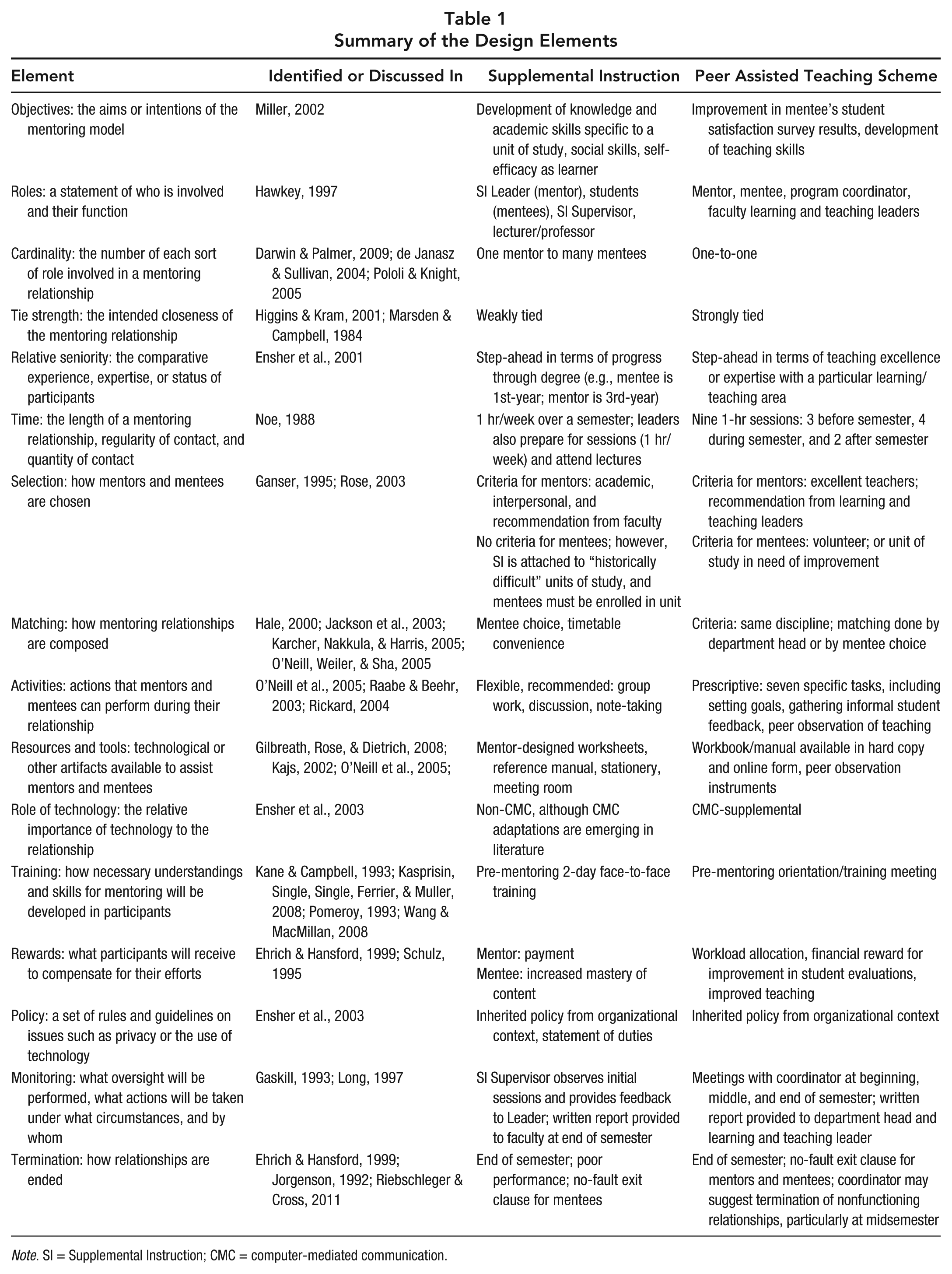
Note. SI = Supplemental Instruction; CMC = computer-mediated communication.
Sixteen Mentoring Design Elements
In this section, all 16 design elements are defined with reference to the literature and the two exemplar models. Some elements are explicitly discussed or studied in existing work, such as the role of CMC explored by Ensher et al. (2003). Other elements have been inferred from literature that mentions, but does not focus on or study, that element. Research literature has been used to identify elements that exist, but this article does not provide a comprehensive review or advice on each element.
Objectives: The Aims or Intentions of the Mentoring Model
The objectives of a mentoring model are a projected state of affairs that the model has been designed to achieve. Miller (2002) examined mentoring objectives in the higher education student mentoring literature and classified them as developmental, work related, and subject. Supplemental Instruction (SI)’s main objectives are subject-related: the development of knowledge and academic skills specific to a unit of study. Other objectives of SI are developmental: the development of social skills, self-efficacy as a learner, and motivation. Our other exemplar model, the Peer Assisted Teaching Scheme (PATS), is somewhat suited to Miller’s typology as its aims could be interpreted as subject- or work-based. Although it is situated in a higher education context, its main objective is to improve the quality of a particular unit of study (as measured by student satisfaction surveys), while also improving practice for a pair of educators. To communicate or evaluate either model requires careful consideration of its objectives.
Roles: A Statement of Who Is Involved and Their Function
Mentoring roles commonly include mentors and mentees; however, the specific responsibilities of each need elaboration to clearly communicate about mentoring (Hawkey, 1997). Within the Supplemental Instruction model, the SI Leader (SIL) is analogous to a mentoring role, and the SIL role is described in the research (Martin, Arendale, & Blanc, 1997) and professional (SI Staff from UMKC, 2005) literatures. Students who attend sessions are synonymous with mentees or protégés in this model. Others are involved in this mentoring model as well: an SI Supervisor who coordinates the program, and a number of academics who teach in the subject SI supports. Specification of their roles is necessary to understand this mentoring model. PATS also involves mentors and mentees; however, these roles are all held by faculty. In addition, there is an advocacy role within this model for faculty learning and teaching leaders, as well as a program coordinator. Both of these exemplar models contain more roles than just mentors and mentees, and the nature of even these implicit roles is different; assumptions about mentoring need to be made clear by specifying who is involved and what exactly they do.
Cardinality: The Number of Each Sort of Role Involved in a Mentoring Relationship
There is an implicit assumption that mentoring relationships are dyadic, with one mentor and one mentee (Darwin & Palmer, 2009; de Janasz & Sullivan, 2004; Pololi & Knight, 2005). A variety of other relationships are considered in the research literature which satisfy working definitions of mentoring specified by Jacobi (1991) and Crisp and Cruz (2009). Supplemental Instruction is a one-to-many model, where one mentor provides support to many mentees; PATS is dyadic (one-to-one). Some other mentoring models contain a “constellation of mentors” (Ensher et al., 2003) providing support to a single mentee (many-to-one). Assumptions about the dyadic or group nature of mentoring can confuse measurably different relationships; researchers are urged to be more specific with the cardinality of their relationships.
Tie Strength: The Intended Closeness of the Mentoring Relationship
Definitions of mentoring, such as Jacobi’s “lowest common denominator” definition, often state that mentoring is close and personal. Using the concept of tie strength (Higgins & Kram, 2001; Marsden & Campbell, 1984), these relationships are strongly tied. The dyadic mentoring relationships in PATS are closely tied. Some other mentoring models contain weakly tied relationships that are not as close. A Supplemental Instruction Leader’s relationship with their students is weakly tied and somewhat impersonal. Both models have been designed with these relationship tie strengths in mind, and to not state them explicitly may confuse two relationship types of very different closeness. Both relationships are mentoring, but the degree of closeness a PATS mentor has with his or her mentee would be very inappropriate for SI, and a PATS relationship would be unlikely to flourish with the professional distance of an SI mentoring relationship.
Relative Seniority: The Comparative Experience, Expertise, or Status of Participants
Definitions of mentoring sometimes carry assumptions about the relative seniority of a mentor compared with a mentee, such as Jacobi’s (1991) statement that “relative to their protégés, mentors show greater experience, influence, and achievement within a particular organization or environment” (p. 513). The degree of this experience can be approximated with Ensher et al.’s (2001) “traditional” and “step-ahead” classification. Traditional mentors have substantially more experience and seniority in an organization. Supplemental Instruction Leaders are step-ahead mentors to their attending students in terms of their content-matter expertise and their status as an employee of the university. PATS mentors are similarly step-ahead in terms of expertise, as they are recognised as excellent teachers (Kreber, 2002) by their departments. They may be excellent teachers in general or possess specific expertise in a component of teaching, such as the use of educational technology. There is however no requirement for them to be more senior in terms of employment status, and there have been instances of more junior faculty mentoring more senior faculty. Ensher et al. (2001) also identify a third relative status, being that of a peer mentor. Even intentionally broad definitions of mentoring can make assumptions about the relative experience of mentor and mentee; Jacobi’s does not permit peer mentors. A design element of relative experience allows for concise specificity for an aspect of mentoring that we know impacts on mentees.
Time: The Length of a Mentoring Relationship, Regularity of Contact, and Quantity of Contact
The amount of time devoted to mentoring is essential in understanding the nature of a mentoring relationship (Noe, 1988), and should not be left to assumption: clearly, the benefits drawn from an annual half-hour catch-up are different from intensive 2-hr weekly sessions. Formal mentoring models need to specify the intended amount of time, length of a relationship, and regularity of contact. Supplemental Instruction Leaders spend 1 hr per week with the students who attend a particular session; however, they are also required to attend the same lectures as their students and prepare activities for their mentoring sessions. This increases their time commitment to mentoring but does not represent greater time spent engaging with mentees. PATS is similarly structured in time, with nine hour-long meetings: three before semester; four during semester; and two post semester. Both exemplar mentoring models last one semester, with PATS also extending a few weeks after the end of semester, whereas SI ends promptly. Briefly specifying the time commitments for mentors and mentees assists readers of research to evaluate the external validity of findings and their applicability to their own context.
Selection: How Mentors and Mentees Are Chosen
Every mentoring model contains selection processes, and sometimes in research communications these are stated explicitly (Ganser, 1995; Rose, 2003). Application forms, interviews, and criteria are examples of selection processes. Supplemental Instruction has academic and interpersonal criteria for the selection of mentors, which are evaluated through a formal employment application process. PATS has a recommendation process, which includes some sort of recognition as an excellent teacher. Some models also apply selection processes to mentees. Supplemental Instruction explicitly states that it does not target specific students, so students self-select into the mentee role; however, mentoring is available to them by the choice to offer SI on a unit they are studying; this choice is made based on the unit’s reputation as “historically difficult.” PATS mentees are teachers of units of study identified as “in need of improvement,” usually by teaching evaluation instruments; however, there is also opportunity for mentees to self-select. By specifying how we choose mentors and mentees, we may reveal potential selection biases, which are necessary to investigate in rigorous research; there is evidence that some demographic groups are disproportionately relied on to provide mentoring in higher education (Griffin & Reddick, 2011).
Matching: How Mentoring Relationships Are Composed
Whether through mentee choice, mentor choice, criteria, randomness, algorithms, or a coordinator’s judgment, most mentoring models somehow match mentors and mentees (Hale, 2000; O’Neill, Weiler, & Sha, 2005). Issues of similarity and difference have been an ongoing focus of mentoring research; substantial work has been done on race and gender in particular (Griffin & Reddick, 2011; Thomas, 1990). In Supplemental Instruction, participating students choose which mentor’s sessions they will attend often based on timetabling. The only formal criteria mentioned for PATS matching is that mentor and mentee are from the same academic discipline. Matches are assigned by departmental heads or by mentee choice, so other informal personal factors or understandings might influence matches. The mentor–mentee match is of crucial significance to the success of a mentoring relationship (Jackson et al., 2003; Karcher, Nakkula, & Harris, 2005); not specifying matching mechanisms omits an important part of a mentoring model from description and analysis.
Activities: Actions That Mentors and Mentees Can Perform During Their Relationship
Different mentoring models expect mentors and mentees to engage in different activities throughout their relationship (O’Neill et al., 2005; Raabe & Beehr, 2003; Rickard, 2004). The degree of structure of these activities varies, with models like Supplemental Instruction having very specific activities that must be undertaken. Supplemental Instruction sessions are broadly expected to include group work, discussion, note-taking, and other structured activities. It explicitly excludes some other activities, most notably transmission-style teaching activities where the mentor lectures the mentees. PATS mentoring relationships are highly structured, with a series of prescribed activities: an introductory exercise, the identification of barriers to teaching improvement, goal setting, gathering and analyzing informal student feedback about teaching, peer observation of teaching, critical self-reflection, and performance planning for the future. As the benefits experienced by mentees are likely influenced by the activities they undertake, it is necessary to specify them; the two exemplar models here represent two sets of activities that are almost entirely different, yet both satisfy definitions of mentoring and lead to different outcomes.
Resources and Tools: Technological or Other Artifacts Available to Assist Mentors and Mentees
A variety of resources and tools exist to support or mediate mentoring relationships, such as software (O’Neill et al., 2005) and psychometric instruments (Gilbreath, Rose, & Dietrich, 2008), or simply just a meeting room and some stationery. Where these are required or recommended they should be specified in a model (Kajs, 2002). Clarifying the resources required to implement a model informs participants of the assistance that will be provided to them, and allows readers of research to understand what is required to implement that model. Supplemental Instruction provides leaders with, at a minimum, a reference manual, stationery, and a room to meet in. Supervisors of Supplemental Instruction programs are provided with a separate manual, which includes other tools like an instrument to fill out when observing sessions. PATS provides mentors and mentees with a workbook in online and hardcopy form, as well as its own instruments for peer observation of teaching. Other professional development resources are periodically available to PATS participants, such as prerecorded video vignettes. The presence or absence of resources in mentoring may affect the outcomes of mentoring, and may also impact on the portability of mentoring models to resource-constrained environments.
Role of Technology: The Relative Importance of Technology to the Relationship
Ensher et al.’s (2003) typology of roles of computer-mediated communication (CMC) is useful for a discussion of the role of technology in mentoring. Supplemental Instruction is a non-CMC mentoring model, as it takes place entirely in a classroom setting, although technology-mediated adaptations are emerging. PATS is a CMC-supplemental model, as face-to-face mentoring meetings and peer observation are supplemented by email and the use of an online mentoring tool. The other possibilities in this typology are CMC-primary (mostly CMC, with some face-to-face) and CMC-only (no face-to-face). Without a clear typology, much research has resorted to the more coarsely grained terms of “online” and “face-to-face” mentoring, a binary that does not explain the variability of CMC use in mentoring relationships.
Training: How Necessary Understandings and Skills for Mentoring Will Be Developed in Participants
A range of training is provided to participants in mentoring, often to mentors (Kane & Campbell, 1993; Pomeroy, 1993; Wang & MacMillan, 2008) and sometimes to mentees (Kasprisin et al., 2008). This training usually aims to improve mentoring in some way; clearly stating the nature of this training is necessary to interrogate the efficacy of a mentoring model. Online and offline training, of various durations and timings is present in the literature. Both exemplar models studied here incorporate pre-mentoring training. Supplemental Instruction implements a two-day face-to-face training program for new leaders before they commence; PATS opts for a much more brief (typically less than 2 hr) pre-mentoring orientation and introduction session. Neither model incorporates ongoing training, although this is present in some other models and often added to our example models. In specifying the mode, objectives, duration, and regularity of training, we can better compare mentoring models.
Rewards: What Participants Will Receive to Compensate for Their Efforts
Some mentoring models pay mentors; some provide other types of extrinsic rewards (Ehrich & Hansford, 1999). Much has been written about the intrinsic rewards mentoring provides to mentors and mentees (Schulz, 1995). Supplemental Instruction Leaders are paid for their time, and an emerging body of literature examines the other benefits they may receive (Couchman, 2009; Outhred & Chester, 2010; Stout & McDaniel, 2006). The intended reward for SI mentees is an increased mastery of the content of the unit, with follow-on benefits for course grades and success. The PATS model includes a recommendation that mentors and mentees get a time allocation in their workload, as well as a financial reward to mentor and mentee if certain agreed-to performance goals are met. There is also an expectation of the intrinsic reward of better, more satisfying teaching. The rewards received and expected by mentors and mentees impact on their experience and behavior in mentoring; to understand a model from a research or practice perspective, it is thus necessary to understand the rewards it provides.
Policy: A Set of Rules and Guidelines on Issues Such as Privacy or the Use of Technology
Some mentoring models have explicit, nonnegotiable policy around topics like privacy. Another approach to policy is for mentors and mentees to negotiate these sorts of issues on a per-relationship basis (Ensher et al., 2003). Where policy is neither stated nor explicitly negotiated, social norms may take its place. Both exemplar models inherit substantial policy from the organizational contexts they are implemented within, including privacy and academic integrity. Supplemental Instruction additionally has policy around the employment of the leaders and their specific duties. By specifying the policy context that mentors and mentees operate within, we may better understand how their actions and experiences are supported or constrained; clearly specified policy may also aid a reader in assessing if a model is replicable to their context.
Monitoring: What Oversight Will Be Performed, What Actions Will Be Taken Under What Circumstances, and by Whom
When a coordinator or facilitator oversees mentoring, they may impact on the experiences of mentors and mentees; indeed Long (1997) advocates careful monitoring to mitigate the “dark side” of mentoring. The need to specify monitoring was identified by Gaskill (1993), who argued this activity can be “costly in terms of time, energy, and resources” (p. 159). A Supplemental Instruction Supervisor observes the initial engagement that SILs have with their mentees, and provides them with feedback at the end of the session. This monitoring may continue, as is specified in the official documentation, although anecdotally this can be too costly for some SI programs to maintain. The PATS model includes brief meetings between the program coordinator, mentor, and mentee at the start, middle, and end of the semester. Both SI and PATS also include written reporting to department heads and faculty learning and teaching leaders, and both models include templates for how this should be presented. As another factor influencing the effectiveness of mentoring, it is crucial that we communicate how we monitor mentoring relationships and what actions we take in what circumstances.
Termination: How Relationships Are Ended
Mentoring models sometimes include formal procedures for the termination of mentoring relationships, including triggers for ending a relationship. An emerging body of work argues for attention to be paid to this phase of mentoring relationships, with Riebschleger and Cross (2011) identifying feelings of loss and grief for participants in the ending and redefinition phases of mentoring. In contrast, other models may contain no mention of how relationships might end or the consequences of a terminated relationship. Both exemplar models terminate by default after a semester of mentoring, and both also include what Jorgenson (1992, in Ehrich & Hansford, 1999) called a “no-fault exit clause” for mentees. PATS mentors may also vacate the relationship without formal consequences, and the coordinator may observe a nonfunctioning relationship and recommend that it terminate. Supplemental Instruction Leaders are subject to more regulation, and vacating a mentoring relationship may lead to other consequences due to their employment. Monitoring by their supervisor may also lead to termination of an SI mentor’s position due to poor performance. When research studies evaluate mentoring, how relationships terminate and whether or not they are included in analysis should be stated explicitly in the definition of a model.
Discussion and Conclusions
These design elements circumvent the definitional crisis outlined in reviews by Jacobi (1991) and Crisp and Cruz (2009). Rather than creating another unifying definition or standard, this article has advanced a framework for specifying the diversity of mentoring.
Researchers may benefit from this framework as a communication structure. Without such a structure, existing mentoring research often provides variable and incomplete information on the mentoring that is under consideration. This article identifies some specific choices for some elements, which may assist concise and accurate specification of models. Even if the whole set is not used, specificity is obtained from the use of selected elements. Rather than only using a broad, accepted definition of mentoring, we can now describe “one-to-one step-ahead mentoring that is non-CMC and aims to improve clinical skills” or “weakly-tied many-to-many CMC-primary peer mentoring to provide psychosocial support to beginning teachers.” Although the 16 elements subsume prior mentoring taxonomies (Glover et al., 1994) and design frameworks (Kajs, 2002), their completeness has not been proven here. Future work could expand this list to consider elements of mentoring beyond those specified in this framework.
For practitioners designing a mentoring intervention, these design elements may identify important decision points. Rather than working around assumptions about a shared understanding of mentoring, designs or proposals for mentoring can explicitly address each element. The framework could even be used in documenting informal mentoring and could assist organizations seeking to develop formal programs from emergent local practices. This article does not, however, make recommendations for each design element. Some elements have bodies of research that examine the benefits for mentors or mentees based on particular choices, such as Ensher et al.’s (2001) “Comparison of Traditional, Step-Ahead and Peer Mentoring on Proteges’ Support, Satisfaction, and Perceptions of Career Success: A Social Exchange Perspective.” Dependent on the choices made for other elements, particularly the objectives, Ensher et al.’s (2001) study could provide guidance for choices made against the relative seniority element. Practitioners may benefit from a review study that uses these design elements as a framework for understanding the effect of different choices in the mentoring design process on mentors and mentees.
Returning to Wrightsman’s (1981) concerns of a “false sense of consensus,” this article argues that consensus around the exact nature of mentoring will always be false. “Mentoring” represents a diversity of relationships across a variety of contexts. The alternative proposed here of a framework for designing, communicating, and studying mentoring may advance research beyond generically defining mentoring toward concisely specifying it.