






Abstract
The New York City Department of Education (NYC DOE) gifted-and-talented programs aim to support all students of exceptional learning potential within the public school system. Using proprietary data made available to us by the NYC DOE, we show, however, that substantial disparities exist in the rates of gifted-and-talented admission test taking, the first step in the process of accessing these more challenging educational opportunities. While Black and Latino/a students take the test for gifted-and-talented admission at substantially lower rates than their White and Asian counterparts, we find the disparity to be significantly less for those enrolled in public prekindergarten programs. We likewise find similar results when comparing other subgroups defined by students’ family, borough, and neighborhood characteristics. These results suggest that public prekindergarten gifted-and-talented attendance could have played a role in ameliorating the gaps in test taking by providing greater access to information about the gifted-and-talented programs across subgroups of students.
Keywords
During the past several years, national education policy, such as No Child Left Behind (NCLB), has focused considerable attention on improving the performance of the country’s lowest-performing students and reducing the achievement gap between subgroups of students. Recent studies based on the analysis of the National Assessment of Educational Programs (NAEP) and the National Teacher Survey (Loveless, 2008) suggest that although our nation’s lowest-achieving youngsters (those whose scores constitute the lowest 10% on NAEP) have made gains from 2000 to 2007, the performance of the nation’s top students (those whose scores constitute the highest 10% on NAEP) has languished during this same period (Farkas & Duffet, 2008; Loveless, 2008; Neal & Schanzenbach, 2010; Reback, 2008). Not only have top scorers languished overall, but as noted by Plucker, Burroughs, and Song (2010), at the top student levels, achievement gaps exist among racial/ethnic groups, which they call excellence gaps, and their existence “raises doubts about the success of federal and state governments in providing greater and more equitable educational opportunities, particularly as the proportion of minority and low-income students continues to rise” (p. 1). In a follow-up study using NAEP data, Plucker, Hardesty, and Burroughs (2013) reinforce the fact that “excellence gaps among different racial groups, high- and low-socio-economic status, different levels of English language proficiency, and gender groups have widened in the era of NCLB” (p. 14). In acknowledging the existence of achievement gaps across the academic ability spectrum, Phillips (2013) underscores the importance of closing these gaps as early as possible by noting that even “students from disadvantaged ethnic and social class backgrounds who begin elementary school with the same academic skills as their more advantaged counterparts fall behind as they move through middle and high school” (p. 17), resulting in greater “college application, enrollment, and graduation disparities” (p. 19).
Although these early and continuing disparities are the result of both in-school and out-of-school influences, Phillips (2013) notes that “African American and Latino students, and economically-disadvantaged students, are more likely than their advantaged peers to attend schools that are inferior on a wide range of dimensions” (p. 20), including teacher experience, subject matter knowledge, and challenging coursework, which are known to be related to student learning (Goldhaber & Brewer, 1997; Meyer, 1999; Phillips, 1997; Phillips & Chin, 2004; Rivkin, Hanushek, & Kain, 1998; Tach & Farkas, 2006). In the interest of equity, these findings point to the importance of designing challenging educational opportunities and academic programs within the public school sector that are designed for students from all population subgroups. One answer to fostering academic equity among high achievers is the public availability of challenging educational programs for students with exceptional ability across all ethnic and social class backgrounds.
Gifted-and-talented education programs emphasize identifying students as gifted and talented based on their learning potential through a psychometric assessment of the students’ cognitive ability and school readiness at a young age and provide such students with specialized instruction so as to enable them to be educated to their full potential (Subotnik, Olszewski-Kubilius, & Worrell, 2011). Compared to programs that select students at later grades based on their achievement to date, by identifying students early on in elementary school, gifted-and-talented programs may hold even greater promise for promoting children from all backgrounds to reach their full academic potential and for shrinking the reported disparities that exist with respect to college application, enrollment, and graduation.
As we show in this article, however, there is an equally compelling need to create a public awareness of such educational opportunities to ensure that students from all population subgroups have equitable access to them. Using a large set of proprietary data from New York City’s (NYC) gifted-and-talented programs, which are designed for students from all population subgroups who show academic promise, we identify attendance in public prekindergarten (pre-K) as an important variable that relates to test taking for NYC’s gifted-and-talented programs. In particular, we demonstrate, using rigorous methods of empirical analysis on approximately 70,000 cases, that overall, whereas Black and Latino/a students take the test for gifted-and-talented admission at substantially lower rates than their White and Asian counterparts, the gap in test-taking rates is significantly smaller for those enrolled in public pre-K programs, where there is greater access to information about the gifted-and-talented programs and its test for admission. We likewise find the same results when comparing subgroups defined by students’ family and neighborhood characteristics (e.g., students in free-lunch programs versus not, students who speak English at home versus not, students who come from recent immigrant families versus not, and students who come from neighborhoods that consist of a greater versus smaller percentage of Black and Latino/a families and of populations with college degrees or higher).
Our study contributes to the literature by uncovering this important relationship between public pre-K and gifted-and-talented test taking and by extending the work of numerous researchers in the field of gifted education (e.g., Davis, 2010; Ford, 1998; Ford, Grantham, & Whiting, 2008; Kitano, 2003; Moore, Ford, & Milner, 2005) who have urged educators to collect and analyze data to identify variables that positively and negatively influence the recruitment of culturally and linguistically diverse students for gifted education. It also extends the work of numerous preschool equity researchers who have explored enrollment in public pre-K as a potential avenue to reducing gaps in achievement by focusing not on achievement but on attendance in public pre-K as a potential avenue to reducing gaps in test-taking rates for the NYC gifted-and-talented admissions test. With respect to gaps in achievement, positive impacts of public pre-K enrollment on cognitive outcomes have been found in Boston (Weiland & Yoshikawa, 2013); in Tulsa, Oklahoma (Gormley & Phillips, 2005); in North Carolina (Ladd, Muschkin, & Dodge, 2014); and for multiple-scaled state preschool programs (Barnett, 2011). Others similarly report that investing in preschool is a good avenue toward reducing achievement gaps especially when child care quality is high (Duncan, 2003; Duncan & Magnuson, 2013). Although more recently, others have found a negative impact of public pre-K on cognitive outcomes (Lipsey, Farran, & Hofer, 2015), Raudenbush and Eschmann (2015) conclude in their recent thorough review of studies on schooling, achievement, and inequality that “there is thus good reason to speculate that concerted attempts to supply disadvantaged students with carefully designed instruction, experienced, knowledgeable teachers, and effective school organizations would amplify the capacity of schools to play an equalizing role in society” (p. 466). Because gifted-and-talented classrooms provide challenging educational opportunities and academic programs within the public school sector, they may be viewed as representing such concerted attempts to foster academic equity among students with exceptional ability. As such, a study such as ours that uniquely addresses equity in gifted-and-talented admission test-taking rates provides a new and important perspective on sources of educational inequality.
The NYC Gifted-and-Talented Programs: Scope and Diversity
The NYC Department of Education (DOE) gifted-and-talented programs for elementary school children were established in 2005. Given its size of more than 600 gifted-and-talented classrooms, it is one of the largest gifted-and-talented programs in the country and serves a diverse population across the five boroughs in NYC. Although intended to be accessible to all students regardless of their demographic, in a recent debate published in The New York Times, opponents of the gifted-and-talented programs argued that “as of 2011, roughly 70 percent of all NYC public school students were black and Latino, but more than 70 percent of kindergartners in gifted and talented programs were white or Asian” (Potter, Tipson, Hess, Hamilton, & Sacerdote, 2014). These trends show no sign of reversing in newly released NYC DOE data (Lu & Weinberg, 2015).
The vast majority of NYC DOE gifted-and-talented programs are offered within district-based schools, which are located within one of 32 school districts so as to better serve the needs of local communities. There are also five citywide gifted-and-talented schools that accept students from all boroughs. Children who are NYC residents in pre-K through second grade are eligible to participate in the gifted-and-talented admissions process for the coming school year. In order to gain a seat in a gifted-and-talented classroom, students and their parents must adhere to a process that involves a series of five steps (NYC DOE, 2015). A student’s parents must first apply for testing by completing a Request for Testing (RFT) form, either online or in person, before a deadline in November. Then the student must take the gifted-and-talented admission test, qualify for the admission standard by obtaining a score in the 90th percentile or higher, decide to apply for admission to one of the gifted-and-talented programs to which he or she is eligible, be offered a seat by the NYC DOE (if the school to which he or she applies has an opening), and decide to accept the offer. Students can retake the gifted-and-talented admissions test more than once in succeeding years (until Grade 2) as a way to seek a placement or to seek a better placement than the one to which they currently have been assigned within the set of gifted-and-talented programs.
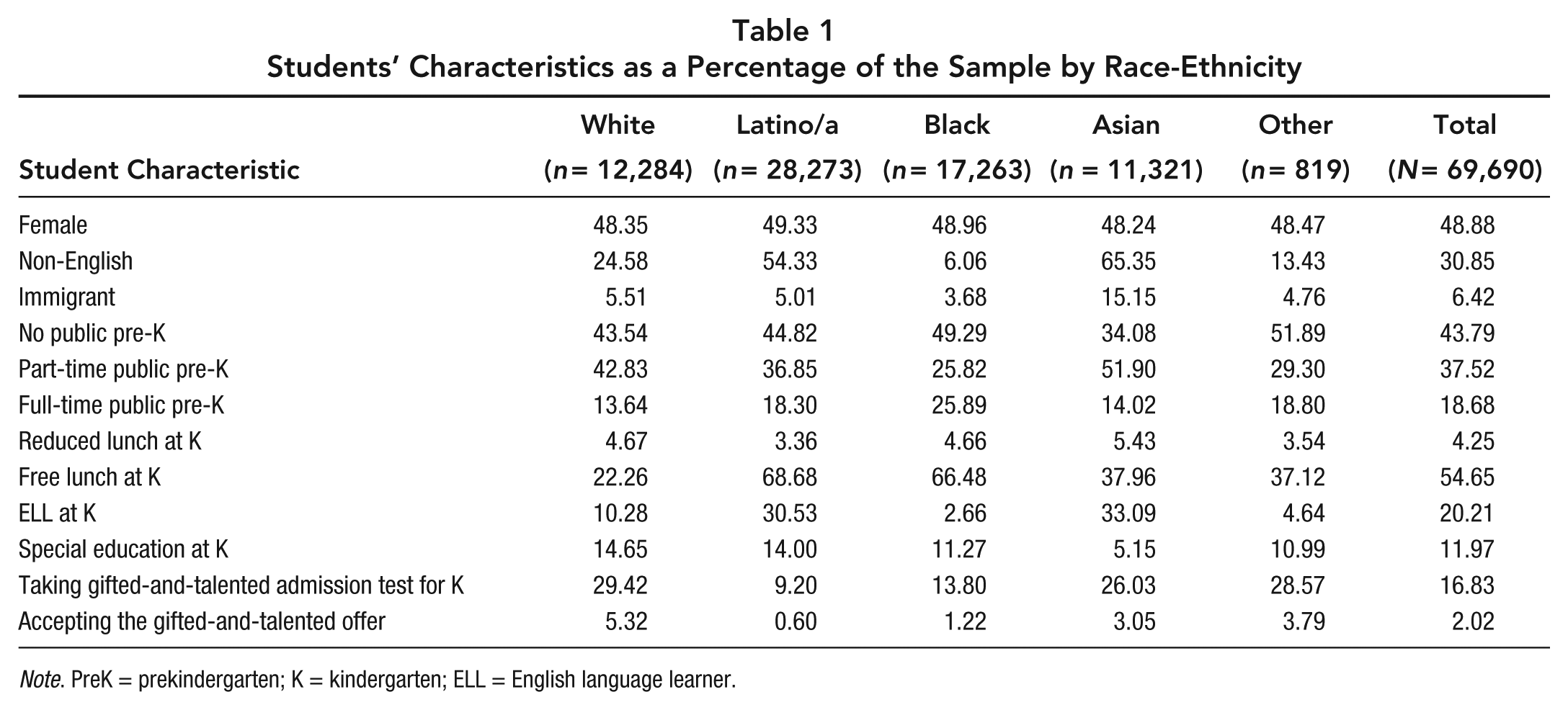
For the 2009 NYC kindergarten cohort, the cohort analyzed for this article, we found that 5.32% of White, 0.6% of Latino/a, 1.22% of Black, and 3.05% of Asian students reached the final stage and accepted an offer (see last row of Table 1). To unpack these disparities in the gifted-and-talented admission process, Figure 1 shows, by race/ethnicity, the percentage of students who advance to each of the five stages of the gifted-and-talented application and admission process for entry into kindergarten in September 2009. Specifically, the percentages are calculated using those who composed the previous stage as the denominator. From Figure 1, we observe that racial and ethnic disparities between Black and Latino/a students on the one hand, and Whites and Asians on the other, exist in nearly all five stages but are most pronounced at the earliest stages in the process (testing and qualifying). In particular, once a student qualifies as gifted and talented (i.e., he or she is ranked in the 90th percentile or higher), we observe that racial disparities at the remaining three stages are not as stark as they are at the first two stages.
Students’ Characteristics as a Percentage of the Sample by Race-Ethnicity
Note. PreK = prekindergarten; K = kindergarten; ELL = English language learner.
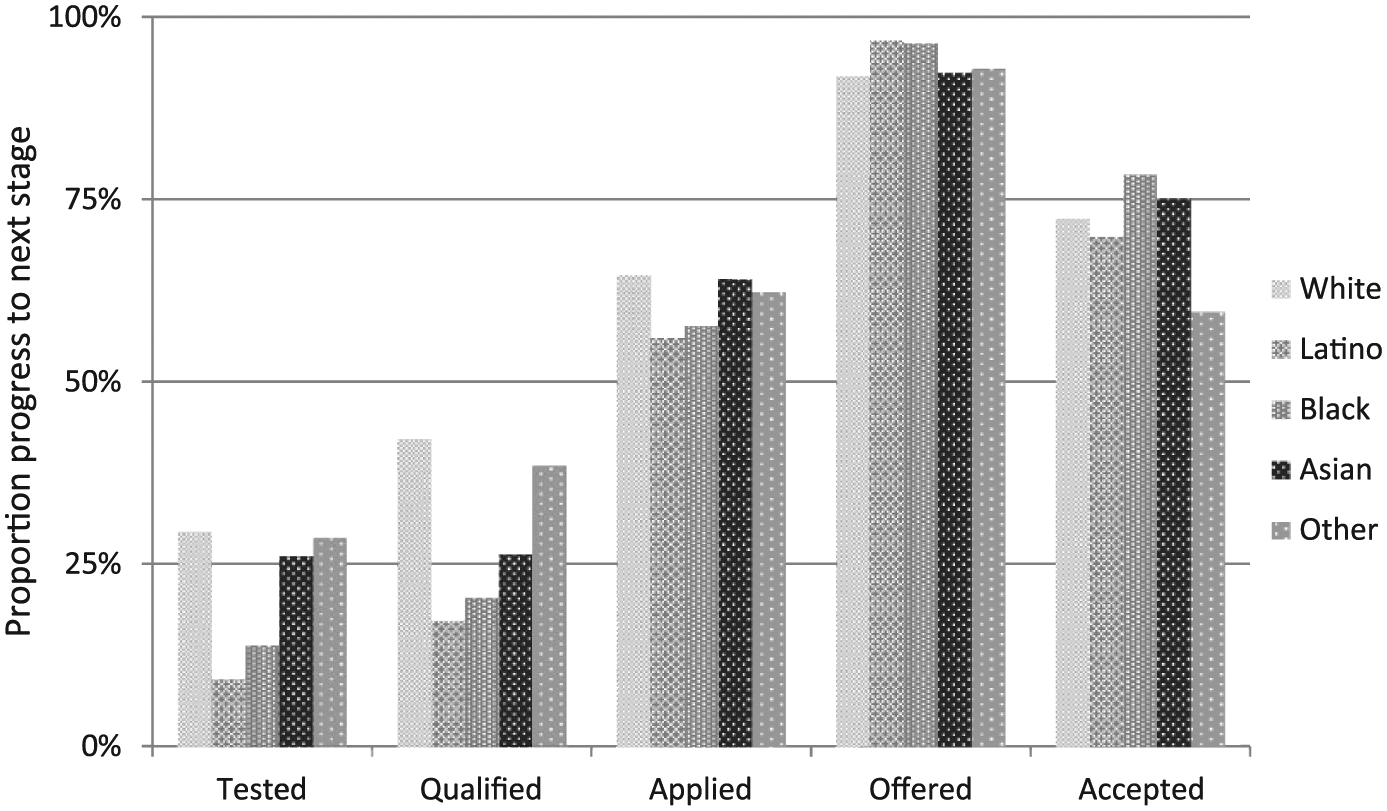
Race and ethnic disparities at each stage of the gifted-and-talented application and admission process
Because the disparities in the qualifying rate (the percentages of those who qualify; Stage 2 in Figure 1) are linked to a number of psychometric issues, including the extent to which test preparation can increase one’s test score and the extent to which current methods of identifying giftedness may be culturally biased (Ford, 1998), in this article we choose to focus on issues related to equity in the test-taking rate (the first stage of the gifted-and-talented process), where the initial racial/ethnic divide takes form, rather than on issues related to the second stage, the qualifying stage. 1 Although students may choose to apply for gifted-and-talented programs from pre-K through second grade, in this article we focus on test-taking behavior at pre-K, which is the first possible point of entry to the gifted-and-talented admissions process; only attrition seats are offered in later grades.
The Beginning of the Gifted-and-Talented Admissions Process: Access to Information
Having access to information about the gifted-and-talented admissions process and, in particular, the details regarding taking the admissions test itself, is critical if parents are to begin the application process. Accordingly, each fall, the DOE posts on its website, 1 month in advance of the deadline for applying to take the test, an invitation to parents to submit an RFT form for their children. The RFT typically is posted on the DOE’s website and circulated among the schools within the public school system. Parents must submit the RFT online, or in person at a DOE enrollment office, before the deadline. Clearly, parents who are more likely to become aware of the information provided by the DOE about its gifted-and-talented admissions process are those who are better at understanding and navigating the DOE’s system, who have greater access to the Internet and better Internet skills, and who are more involved in their children’s education. Not surprisingly, research has shown that many of these characteristics critical to the access of such information are significantly related to parents’ socioeconomic status (e.g., Grolnick, Benjet, Kurowski, & Apostoleris, 1997).
In addition to the website posting, the DOE circulates information about the gifted-and-talented programs to all public schools and those that house public pre-K programs. Accordingly, everything else being equal, one reasonable hypothesis is that parents of students enrolled in one of the NYC DOE pre-K programs, as opposed to a private pre-K program or no pre-K program at all, will have greater opportunity to become aware of the gifted-and-talented information provided by the DOE, regardless of their demographic. In 2009, approximately 56% of the students who enrolled in kindergarten in an NYC community public school participated in either full-time or part-time public pre-K program (see Table 1). If access to information is increased by virtue of being enrolled in a public pre-K program, we should expect the gifted-and-talented test-taking rate to be considerably higher among the public pre-K students than among those not enrolled in public pre-K. Another reasonable hypothesis is that the expected increase in test taking for those in public pre-K will be greater for those students who come from disadvantaged socioeconomic backgrounds because their parents, unlike those from more advantaged circumstances, typically would be less involved in their child’s school and would not, otherwise, be exposed to information about this educational opportunity.
Of course, parents also may learn about the gifted-and-talented programs and admission process through their neighbors and friends. Recent work by Reardon, Fox, and Townsend (2015) underscores the important role played by the neighborhood context in the life of a child. Driven by the real estate market and other segregation factors, NYC neighborhoods are often homogeneously clustered by socioeconomic status and racial composition (Logan & Stults, 2011). Accordingly, we also examine the association between neighborhood characteristics and students’ test-taking behavior to gain insights for developing interventions for promoting gifted-and-talented test taking in neighborhoods identified to have low test-taking rates.
Goals
Using a proprietary set of data made available to us by the NYC DOE under a nondisclosure agreement, the goals of this article are (a) to describe as main effects the differential rate of test taking of NYC subpopulations defined by race, socioeconomic status, and other salient variables and (b) to examine the set of two-way interactions of all the predictors with public pre-K attendance to show the extent to which attendance in public pre-K moderates the difference between key population subgroups in terms of test-taking rates for kindergarten gifted-and-talented programs. In particular, we show that the difference between key population subgroups in terms of test-taking rates for kindergarten gifted-and-talented programs diminishes for those who attend public pre-K programs compared to those who do not. Among other factors, our results point to the importance of mechanisms for providing information about educational opportunities to parents and guardians to ensure that their children have equitable access to them. To our knowledge, this is the first study that examines within an equity context the relationship between public pre-K and test taking for gifted-and-talented admission in the United States.
Because our analytic sample is based on the cohort of students who were born in 2004 and who attended kindergarten in one of the NYC DOE traditional community public schools in 2009, it represents the population of families that look to the NYC traditional public school system for the education of their children and for whom the gifted-and-talented programs initially were designed to serve. Because our analyses are limited to those who have chosen to enroll in one of the NYC DOE traditional community public schools, we attempt to generalize our findings not to all children born in NYC in 2004 but rather only to the subset who chose to enroll in kindergarten in one of the NYC DOE traditional community public schools in 2009. As will be described in more detail in a later section of this article, that subset therefore excludes those who chose to attend kindergarten in a private, independent, or charter (as opposed to a traditional public) school regardless of whether or not they took the gifted-and-talented admission test during their pre-K year.
Data
The NYC DOE enrollment records of public elementary students for the year 2009 are the primary source of data analyzed in this article. These records contain detailed student information regarding enrollment status and demographics. They also include for each academic year whether a student receives free lunch, is classified as an English language learner (ELL), and receives special education services. In addition, each student’s residence information (at the census tract level) is linked to sociodemographic records compiled from the 2010 census data (U.S. Census, 2010). By defining a student’s neighborhood in terms of the census tract in which a student resides, we have access to a number of neighborhood characteristics, including racial composition, percentage of college graduates, and percentage of households receiving public housing assistance. Finally, information about students’ gifted-and-talented test taking and test scores are accessed from separate NYC DOE gifted-and-talented test files. Students who apply and enroll in the NYC DOE public schools are each assigned a unique student ID, which is the key variable used to link these gifted-and-talented testing data files with the set of enrollment records described earlier.
Our analytical sample consists of 69,960 students who were born in 2004 and who were actively enrolled in 2009 in a traditional community public school kindergarten classroom. 2 Students in this sample include those who tested for gifted-and-talented admission and successfully obtained a seat in one of the gifted-and-talented kindergarten classrooms in a district school or in one of the five citywide gifted-and-talented schools (2.6%), those who tested for gifted-and-talented admission but eventually enrolled in one of the general education classrooms in the district community schools (14.6%), and those who did not test for gifted-and-talented admission during the pre-K year and enrolled in one of the general education classrooms in the district community schools (83.2%).
As noted earlier, our analytical sample is selected to represent the population of families who look to the NYC traditional public school system for the education of their children and for whom the gifted-and-talented programs initially were designed to serve. There are likely to be some families in our sample, especially among those whose children enrolled in a gifted-and-talented classroom, who might have enrolled in a private school, independent school, and/or a charter school (as opposed to a traditional public school) had they not been granted a seat in one of the gifted-and-talented programs. Although we are unable to identify these children individually, conservative estimates based on separate analyses of gifted-and-talented test scores and school choice (Lu & Weinberg, 2015) suggest that this group accounts for no more than a very small percentage of the students in our analytical sample who took the gifted-and-talented test. As a result, the inclusion of this group of students is likely to have little impact on the primary goals of this article, which are to understand how test-taking behavior varies as a function of public pre-K attendance and other key predictors of interest for the population of students enrolled in kindergarten in either an NYC DOE gifted-and-talented classroom or general education classroom in a district community public school.
Key Student Characteristics
Table 1 contains descriptive summaries of key student variables by race/ethnicity in the analytical sample. According to Table 1, the student body represented by these data are racially/ethnically diverse, with 40.41% Latino/a, 24.68% Black, 17.56% White, 16.18% Asian, and 1.17% Other. The percentage of females remains reasonably constant across racial/ethnic groups at approximately 49%. Among the 30.85% from non-English-speaking families, the largest percentages of non-English-speaking families are Asian (65.35%) and Latino/a (54.33%), with Blacks having the lowest percentage at 6.06%. 3 Overall, only 6.42% of the students from the working sample are from recent immigrant families. 4 Among Asian families, the percentage of immigrants is the highest (15.15%). Although one might expect there to be a moderate to strong tendency for non-English-speaking households to consist of recent immigrants, and a correspondingly high correlation between these two variables, given the cultural diversity of NYC, these two variables are only minimally correlated (r = .19) for our data. 5
As shown in Table 1, in 2008, 37.52% of the students in the sample attended part-time pre-K programs, and 18.68% attended full-time pre-K programs, with Black and Latino/a students having the largest attendance rates in full-time pre-K. 6 Traditionally, receiving reduced-price or free lunch in public school has been considered as a proxy for socioeconomic status. In our sample, and according to Table 1, overall, 54.65% received free lunch in kindergarten, and 4.25% received reduced-price lunch in kindergarten. 7 A breakdown by race indicates that approximately two thirds of the Latino/a students in our sample and likewise approximately two thirds of the Blacks in our sample received free lunch in kindergarten, suggesting that these groups have relatively high rates of poverty compared to Whites and Asians.
In the literature of gifted education, researchers refer to students who are gifted but also require special services as twice exceptional (Brody & Mills, 1997). Accordingly, in addition to the student variables already discussed, we also examine the gifted-and-talented test-taking rates among those who are classified as in need of special education service. 8 Shown in Table 1, we see that in our sample with respect to special education, White and Latino/a students are most likely to receive such services in kindergarten (at 14.65% and 14.00%, respectively), with Asians being least likely (5.15%). Another variable we consider is whether a student is an ELL. Given that Asian and Latino/a students are those most likely to be from non-English-speaking families, it is not surprising that these students are most likely to be classified as ELLs in kindergarten (r = .63). And finally, with respect to test taking, we note that overall, 16.83% (approximately 12,000) of our working sample took the admissions test for entry into a kindergarten gifted-and-talented program, of which 29.42% are White, 9.2% are Latino/a, 13.8% are Black, and 26.03% are Asian.
Key Neighborhood Characteristics
As noted earlier in this article, NYC is divided into 32 local community school districts within its five boroughs: Manhattan, Bronx, Brooklyn, Queens, and Staten Island. In the context of the gifted-and-talented programs, the district programs serve the children who are residents of their own community school districts. As a result, with respect to gifted-and-talented programs at least, community school districts are important units for the organization and implementation of programs within the NYC public school system. We further control for the socioeconomic and racial composition of neighborhoods and, in particular, the percentage of college graduates, percentage receiving public housing assistance, percentage Black, and percentage Latino/a at the zip code level.
Method
A series of logistic regression analyses was used to address the two major goals of our study: (a) to describe as main effects the differential rate of test-taking of NYC population subgroups defined by individual and neighborhood characteristics and (b) to examine the set of two-way interactions of all the predictors with public pre-K attendance to show the extent to which attendance in public pre-K moderates the difference between key population subgroups in terms of test-taking rates for kindergarten gifted-and-talented admission. The binary outcome variable for these analyses is whether a student in the pre-K year took the gifted-and-talented admission test for kindergarten entry. In addition to individual and neighborhood characteristics, we include random effects for school districts and fixed effects for boroughs in which the schools districts are located to account for heterogeneity at the district and borough levels. Because our models include both fixed and random effects, we use mixed-effects logistic regression (the xtmelogit command in Stata 12). We consider covariates in terms of both main effects related to gifted-and-talented test taking for kindergarten, which are reported in the first column of Table 2, and as a series of two-way interaction effects involving participation in public pre-K. In particular, we test the coefficients of the covariates to determine whether they vary by students’ participation in public pre-K. Because students may attend either full- or part-time public pre-K, the variable pre-K in our analyses consists of three categories (no pre-K, part-time pre-K, and full-time pre-K). The results of the two-way interactions are reported in the second to fourth columns of Table 2. Although it is often customary to bypass an interpretation of main effects in the presence of interactions, we believe that because this is the first time these data will be subject to public scrutiny, it is important to identify and discuss the extent to which disparities (main effects) exist in test-taking rates for kindergarten gifted-and-talented admission between key population subgroups. Accordingly, results related to main effects are presented first, followed by results related to two-way interactions involving public pre-K attendance.
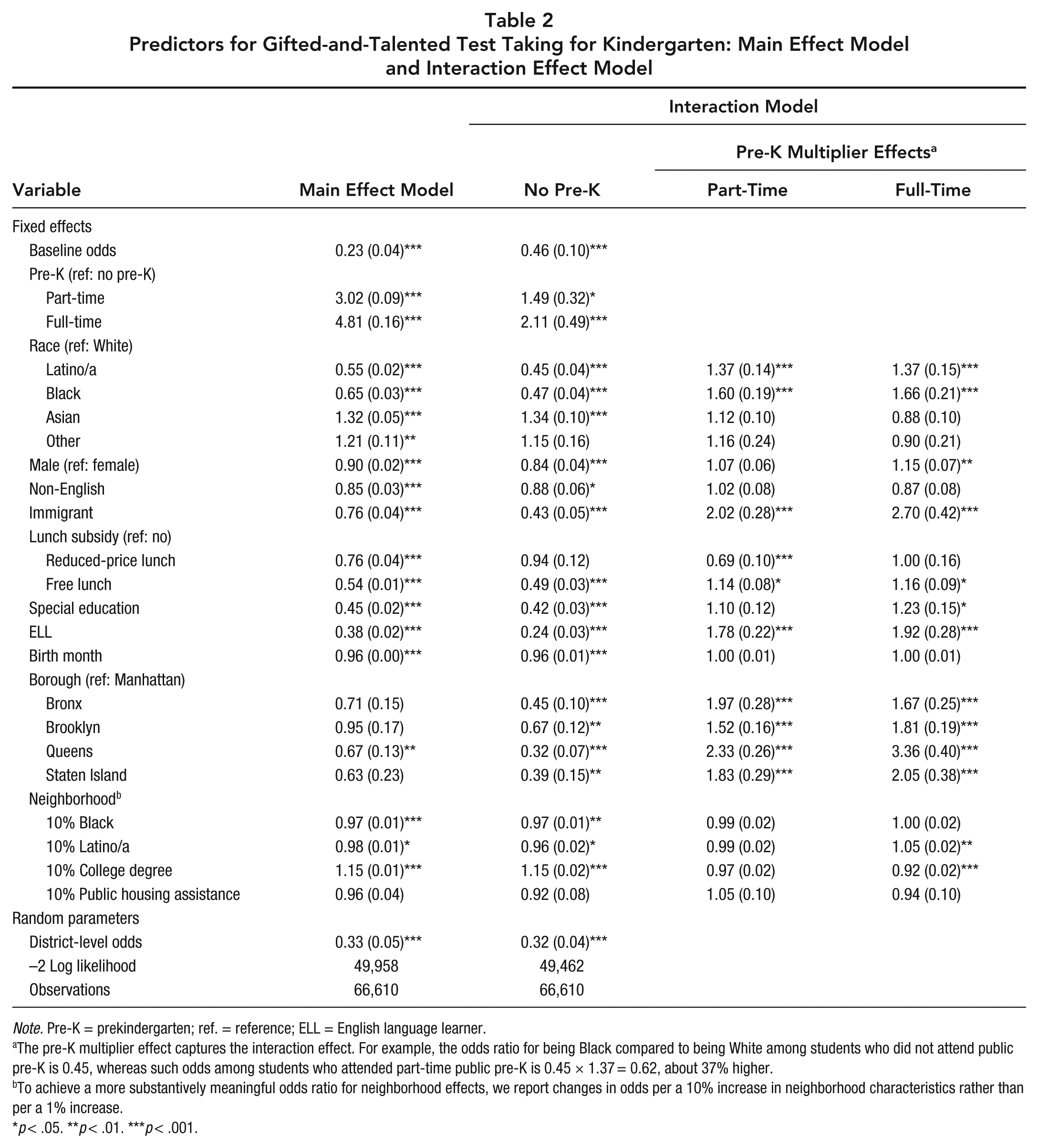
Predictors for Gifted-and-Talented Test Taking for Kindergarten: Main Effect Model and Interaction Effect Model
Note. Pre-K = prekindergarten; ref. = reference; ELL = English language learner.
The pre-K multiplier effect captures the interaction effect. For example, the odds ratio for being Black compared to being White among students who did not attend public pre-K is 0.45, whereas such odds among students who attended part-time public pre-K is 0.45 × 1.37 = 0.62, about 37% higher.
To achieve a more substantively meaningful odds ratio for neighborhood effects, we report changes in odds per a 10% increase in neighborhood characteristics rather than per a 1% increase.
p < .05. **p < .01. ***p < .001.
In a logistic regression analysis, the likelihood of taking the test is modeled in terms of the odds of taking the test. 9 After controlling for all other predictors in the model, the coefficient corresponding to each predictor is reported in terms of an odds ratio, or (odds ratio – 1) × 100%, the percentage change in the odds of taking the test when the value of that explanatory value increases by one unit in the metric of that explanatory variable. The level of significance for all tests has been set at 5%.
Results
Main Effects
The first column of Table 2 contains the results related to our main effects model, indicating the magnitude and nature of disparities in test-taking rates as a function of student, borough, and neighborhood characteristics. We find, as a signal result, that after controlling for students’ individual, borough, and neighborhood characteristics, students attending public pre-K programs are significantly more likely to take the gifted-and-talented test than those who did not. Specifically, we find that compared to students who did not attend any public pre-K, the odds of taking the test are 4.8 times higher for students who attended full-time public pre-K programs and 3 times higher for students who attended part-time public pre-K.
We find also that the odds of taking the test for kindergarten gifted-and-talented admission varies significantly by students’ sociodemographic status. In particular, compared to White students (our reference group), Latino/a students are 45% less likely to take the gifted-and-talented test for kindergarten; Black students are 35% less likely; and Asian students, by contrast, are 32% more likely. Male students are 10% less likely than female students to take the test. In addition, students coming from non-English-speaking backgrounds are 15% less likely than those with English-speaking backgrounds to take the test; those from recent immigrant families are 24% less likely to take the test; and those who receive free lunch, a proxy for income being at poverty levels, are 46% less likely to take the test. Children designated as in need of special education and ELLs are, respectively, 55% and 62% less likely to take the gifted-and-talented test for kindergarten. With respect to birth month, for each month younger, students are 3.7% less likely to take the test, implying that the youngest students are 40% less likely to take the test than the oldest students in the same birth cohort.
Even after accounting for disparities associated with individual characteristics, the sociodemographic characteristics of the neighborhoods in which students reside also are significantly associated with students’ test taking. For every 10% increase in the composition of Blacks in the neighborhood (census tract), the odds of taking the test for a student is 3% lower. 10 For every 10% increase in the composition of Latino/a families in the neighborhood, the odds of taking the test for a student is 2% lower. For every 10% increase in the number of neighbors who receive public housing assistance, the odds of taking the test for a student decreases by 4%. By contrast, for every 10% increase in the number of neighbors with college degrees, the odds of taking the test for a student increases by 15%.
Test-taking rates also vary significantly across the five boroughs even after controlling for individual and neighborhood characteristics. Students who live in Manhattan have the highest test-taking rate, followed by Brooklyn, the Bronx, Queens, and Staten Island. The test-taking rates also vary at the school district level, as shown by the significant variance term of the district random effect included as the last term in this model. 11
In summary, all the covariates we consider in the main effect model are significant predictors of students’ test taking for gifted-and-talented kindergarten entry. Among all covariates, whether a student attends a public pre-K program is the strongest predictor of whether the student takes the gifted-and-talented test. The length of daily exposure to pre-K also matters: Full-time pre-K students have an even higher test-taking rate than part-time pre-K students. It is important to note, however, that regardless of the nature of pre-K participation, students’ socioeconomic and other individual characteristics contribute to the substantial disparities observed in test taking.
Two-Way Interaction Effects With PreK
In this section, we address whether participation in pre-K moderates the disparities in gifted-and-talented test taking for kindergarten by subgroup. Results in terms of the odds ratios and statistical significance of the two-way interactions of pre-K with the other covariates in the model are presented in the second to fourth columns of Table 2. As we note, there are significant interactions between public pre-K and race, gender, recent immigrant, free lunch, special education, and ELL status. Moreover, we also see significant interaction effects between pre-K and boroughs and certain neighborhood characteristics (such as percentage Latino/a and percentage college graduates). In Figure 2, we illustrate the interaction effect on test taking between each covariate and pre-K in separate panels. In each panel, we compare the “gap,” namely, the percentage change in the odds of test taking, resulting from a one-unit change in that covariate among three separate groups of students: those with no, part-time, and full-time pre-K participation. For example, among those who did not attend public pre-K, the odds of taking the test for Latino/a students is 55% lower than for White students; the Latino/a–White test-taking gap narrows significantly to 40% among those who attended either full-time or part-time pre-K programs. Likewise, the Black–White test-taking gap is narrower for those who attended pre-K versus those who did not, from 53% among students who did not attend public pre-K to 25% among those who attended part-time pre-K to 22% among those who attended full-time pre-K. By contrast, the Asian–White test-taking gap does not differ significantly across levels of public pre-K participation.
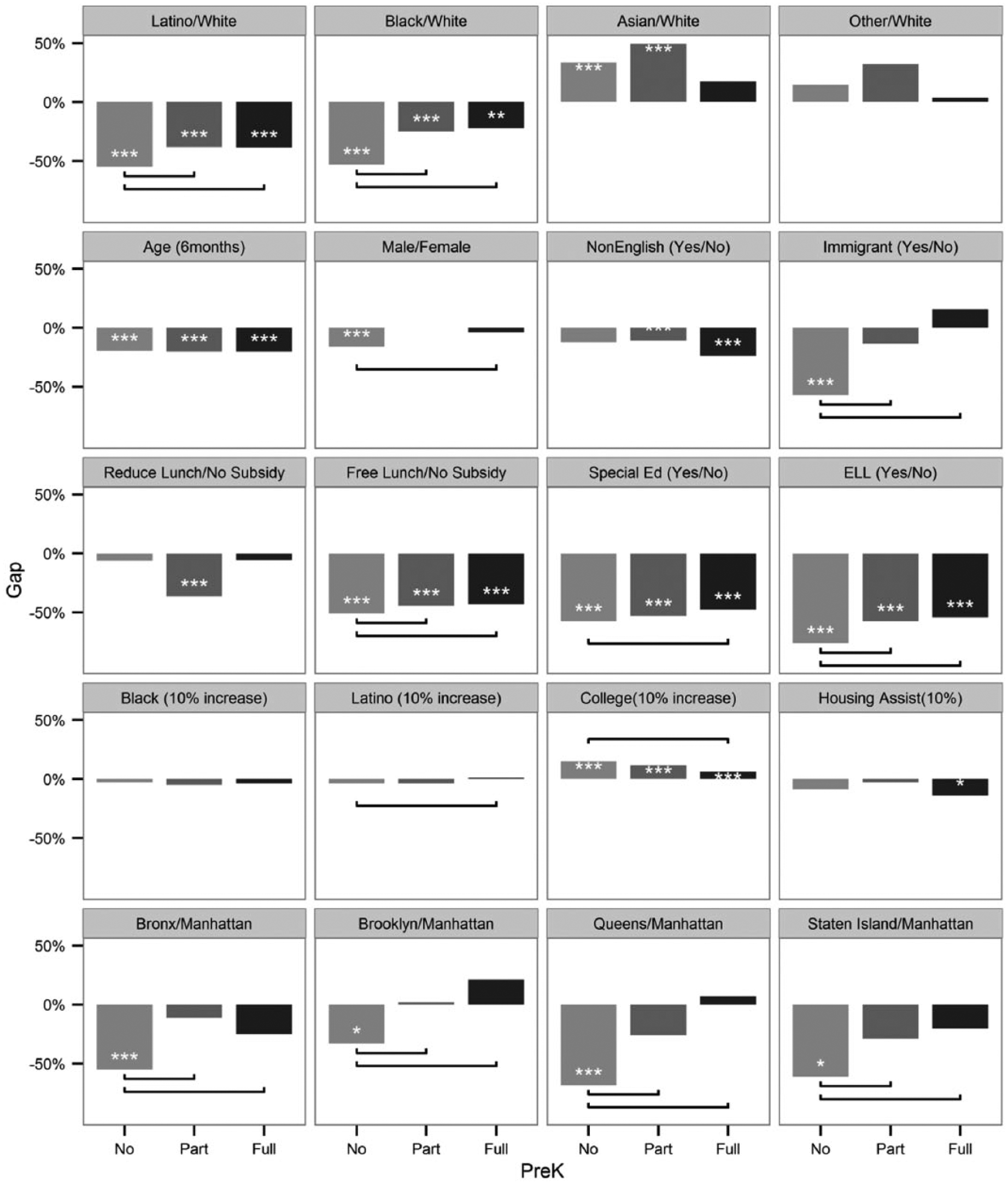
Two-way interaction effects between prekindergarten and each of the other predictor variables on test taking for a gifted-and-talented kindergarten class
For students who did not attend public pre-K, the odds of taking the test for males is 16% lower than for females. Yet, for students who attended public pre-K programs, including both part-time and full-time programs, the gender difference in test taking disappears.
Attendance in public pre-K also has a large effect in leveling the test-taking gap between students whose families are recent immigrants and those who are not. Among those who did not attend public pre-K, the odds of taking the test for students from immigrant families is 57% lower than for those who are not from immigrant families. By contrast, for those who attended part-time public pre-K, the test-taking rate of immigrant students is no longer significantly lower than for nonimmigrant students, and for those who attended full-time public pre-K, albeit nonsignificant, the direction of difference appears even to be reversed.
For students who do not attend public pre-K, those who receive free lunch are 49% less likely to take the gifted-and-talented test than those who do not receive free lunch. Attendance in public part-time pre-K increases the odds of test taking for those who receive free lunch by 13.5%, and attendance in full-time pre-K increases the odds of test taking by 16.3%.
Attending full-time public pre-K appears to reduce the test-taking gap with respect to special education; the pattern is more pronounced with respect to ELL status. Without public pre-K, the odds of taking the test for ELL students is 76% below that of non-ELL students, whereas for those who attended full-time public pre-K, the gap reduces to 54% and by a similar magnitude among part-time pre-K students.
Our results indicate as well that pre-K programs help to lessen the disparities in test taking among the five boroughs. For children who do not attend public pre-K, controlling for their individual and neighborhood characteristics, the test-taking rates are much lower in the outer boroughs (Bronx, Brooklyn, Queens, and Staten Island) than in Manhattan. Attendance in public pre-K, both part-time and full-time, appears to eliminate these differences in test-taking rates across boroughs (the F test for borough variation among full-time public pre-K, p = .077; among part-time public pre-K, p = .212; yet among nonpublic pre-K, p < .001). Controlling for all other variables in the model, public pre-K attendance moderates the effect of one’s neighborhood on test taking. In particular, although overall, students who live in a neighborhood with a higher concentration of Latino/a families are less likely to take the gifted-and-talented admission test, this is not the case for students in these neighborhoods who also attend full-time public pre-K.
There also are variables whose associations with test taking are not moderated by pre-K attendance. For example, younger students are less likely to take the gifted-and-talented test than older students, and their rates of test taking appear not to vary by whether or not they attend public pre-K. Analogously, students who come from non-English-speaking backgrounds are less likely to take the gifted-and-talented test, and their rates of test taking appear not to vary by whether or not they attend public pre-K.
Discussion
Given the reported existence and even widening of excellence gaps, and the call for interventions that aim to close these gaps as early as possible, we focus in this article on gifted-and-talented test taking during the pre-K year as the first step in securing a seat in one of the NYC DOE kindergarten gifted-and-talented programs. Because approaches for identifying children with high potential have been known to overlook students from disadvantaged families (Card & Giuliano, 2015; Elhoweris, Mutua, Alsheikh, & Holloway, 2005), Card and Giuliano (2015) recently studied a newly adopted universal screening program in one school district for its third-grade gifted-and-talented programs and found that universal screening increased the representation of economically disadvantaged and minority students in this district’s gifted-and-talented programs. In particular, “with no change in the minimum standards for gifted status, the screening program led to a 180% increase in the gifted rate among all disadvantaged students, with a 130% increase for Latino students and an 80% increase for black students” (Card & Giuliano, 2015, p. 20). The authors conclude that the underrepresentation of poor and minority students in gifted education “appears to be caused by the failure of the traditional parent/teacher referral system to identify high-ability disadvantaged students” (Card & Giuliano, 2015, p. 21). Like Card and Giuliano, we focus on the process of identifying students for gifted-and-talented programs. Unlike Card and Giuliano, however, we focus on a much earlier stage in a child’s development, at pre-K, and our analyses are not confined to a single school district. Rather, we consider all students who were born in 2004 and who were actively enrolled in 2009 in an NYC community public school kindergarten classroom. As there is no universal screening program in NYC for admission to a gifted-and-talented program, we study the NYC DOE gifted-and-talented test for admission and focus on the substantial disparities in test taking for kindergarten entry that exist across subpopulations of students who are enrolled in a public NYC DOE district school kindergarten class. We show, most importantly, that attendance in pre-K is associated with a reduction in the gap in test taking between disadvantaged and nondisadvantaged children. That is, not only do we find that students who attend a public pre-K program, either part- or full-time, have a significantly higher chance of taking the gifted-and-talented admissions test in pre-K, regardless of their demographic backgrounds, but we also find that attendance in public pre-K plays an important role in helping to reduce the disparities in test taking for gifted-and-talented admission that are evident between many subpopulations. As an alternative to universal screening, our study suggests that attendance in public pre-K, whether part-time or full-time, is effective in increasing the equality of access to the type of challenging educational opportunities referred to by Raudenbush and Eschmann (2015) and may be effective in increasing the representation of underrepresented minorities in the NYC DOE gifted-and-talented programs.
In addition to this important finding, we find that younger children and boys are less likely to take the test at pre-K, suggesting that some disparities in test taking may be attributed to parental beliefs regarding how ready their children are to take the test during the pre-K year. Also, we find that a student’s race-ethnicity; free-lunch, immigrant, special education, and ELL status; and resident neighborhood are factors that relate to test taking, challenging the notion that these programs are accessible to all subpopulations of students in an equitable manner. Finally, and not surprisingly, we find variations as well in test-taking rates across school districts and boroughs in which students reside.
To ensure that our findings are not subject to large bias due to model misspecification of the observed covariates, although it is beyond the scope of this article to report these results here, we note that we conducted extensive robustness checks on matched samples of students with and without public pre-K exposure (Lu & Weinberg, 2015). 12 In particular, we borrowed the idea of covariate balance within the causal inference framework (Rubin, 1973) to implement a genetic matching algorithm (Diamond & Sekhon, 2013; Sekhon, 2011) to create matched samples of students with and without public pre-K exposure based not only on the covariates used in the logistic regression analysis but also on students’ home addresses. Results from these matched samples agree with those from the logistic regression analyses; namely, gifted-and-talented test-taking rates were significantly higher for the pre-K group than for the non-pre-K group. It is worth noting that matching based on students’ home addresses strengthens our findings by further controlling for additional unobserved factors, including the quality of the students’ zoned schools and the distance and travel time to and from schools.
Although our results are robust given the observed set of covariates, suggesting that attendance in public pre-K per se is an effective mechanism for forging a path to equity, the causal interpretation of attending pre-K on gifted-and-talented admission test taking must be made with caution. First, as noted earlier in this article, it is possible that the characteristics of parents of children who attended public pre-K are different from those whose children did not attend public pre-K. In particular, the former group potentially could be more engaged in their children’s educational outcomes and more motivated to seek out and secure educational opportunities for them offered by the DOE, including public pre-K, leading to this group’s increased rate of testing for a kindergarten class. We propose that in the future, a carefully designed randomization study be undertaken to demonstrate that the observed strong relationship between pre-K attendance and gifted-and-talented test taking is indeed a causal one. Fieldwork that involves interviewing parents and teachers at public pre-K also will be important for more fully understanding the mechanisms through which public pre-K attendance promotes test taking for the gifted-and-talented programs.
Because the NYC DOE gifted-and-talented programs were recently established in 2005, it is also possible that given that our analyses are based on data from the year 2009, not long after the programs were established, that the public pre-K programs were an important source of gifted-and-talented program information dissemination, especially for those students from disadvantaged family backgrounds whose parents were not engaged in the school system and who would not otherwise have been exposed to this information. One could expect that with the passage of time, access to information about the gifted-and-talented programs could be less centrally located within public pre-K programs but would be available through parents’ conversations with friends and neighbors at playgrounds and other community centers and through the experiences of their children’s older siblings. Accordingly, one could hypothesize the strong public pre-K effect reported in this article to remain significant but with a diminished effect size across time. We plan to test this hypothesis once more recent NYC DOE data become available.
In addition to providing information about the gifted-and-talented programs, including its test-taking requirements and deadlines, public pre-K programs in NYC have allowed students to take the gifted-and-talented test during school hours, whereas students in nonpublic pre-K programs must take the gifted-and-talented test on weekends in other than their pre-K school venues. As a step toward further equity, the NYC DOE may want to consider making testing for the gifted-and-talented programs for students in nonpublic pre-K programs as easy as it does for its students in public pre-K. Furthermore, given that our results suggest that attending public schools might help to promote information access to gifted-and-talented programs, the DOE may want to consider creating more gifted-and-talented seats/classes in later grades beyond kindergarten as another measure to improve equity to access.
Finally, in addition to teachers and others within a student’s educational community, health professionals, including pediatricians and other health/human care service workers, should be encouraged to identify children who appear to be academically gifted and to suggest to teachers, parents, guardians, and other school professionals that they be recommended for testing. With respect to particular population subgroups, the fact that children with non-English-speaking backgrounds were found to be less likely to take the gifted-and-talented test, and to not have their rates of test taking vary by whether or not they attended public pre-K, suggests that the NYC DOE may want to consider providing better ways of communicating information about the gifted-and-talented test, particularly with this group in mind. Beyond attendance in public pre-K and a consideration of individual-level characteristics, using geographic units/census tract information, we have identified those school districts and boroughs that have particularly low gifted-and-talented test-taking rates. These findings can be useful in designing more effective targeted campaigns to disseminate information about gifted-and-talented programs and the requirements associated with testing for it.