







Abstract
As COVID-19 cases continue to increase across the country, there is a concern about the extent to which this pandemic will affect students. Since March 2020, schools transitioned to a distance-learning format, which unintentionally forced parents into new teaching roles as proxy educators. In this brief, we explore the association between distance learning and the mental health of proxy educators. We find that parents with children who struggled with distance learning experienced elevated mental distress. Given the relationship between teacher burnout and student outcomes, we argue the importance of supporting parents during this time to improve students’ schooling.
Keywords
In March 2020, schools across the nation closed their doors and switched to a distant learning format in response to the COVID-19 public health crisis. 1 We have seen instances where districts continued schooling through online platforms, paper assignments, or a combination of both, in an effort to maintain normalcy. Although the world continues to grapple with the COVID-19 pandemic, there are factors within education that have been overlooked. Specifically, parents have become proxy educators and are potentially struggling. Since the transition to remote learning, proxy educators have been expected to retain teaching knowledge, teach individualized content, assess the emotional needs of students, and so on—all in addition to their existing responsibilities. 2
Research has demonstrated a relationship between teacher burnout (i.e., mental health distress) and student academic outcomes, indicating that as teacher stress levels increase, student learning becomes less effective (McLean and Connor, 2015; Oberle and Schonert-Reichl, 2016). Teachers who experience burnout are also more likely to leave the profession (Chambers Mack et al., 2019). Conversely, proxy educators do not have the option to abdicate their teaching responsibilities. This suggests that burnout among proxy educators may have greater adverse effects on their child’s academic success.
In this brief, we investigate the extent to which distance learning is correlated with parents’ mental health, the new proxy educators. To explore this relationship, we collected and analyzed multiwave panel data from the National Panel Study of Coronavirus pandemic (NPSC-19), a nationally representative survey of 3,338 households administered in March and April during the pandemic. We provide recommendations for educators, families, researchers, and stakeholders to assist schooling efforts for families disrupted by COVID-19.
The NPSC-19 surveys symptoms of anxiety and depression following the Patient Health Questionnaire (PHQ-9) and General Anxiety Disorder (GAD-7) (Kroenke et al., 2001; Spitzer et al., 2006). Specifically, respondents reported feelings of anxiousness and worry, outlined in the GAD-7, as well as feelings of depression, pleasure, and quality of sleep, outlined in the PHQ-9. Although the NPSC-19 does not contain a complete GAD-7 or PHQ-9, the literature has shown these measures to be valid, reliable, and widely applied in surveys such as the Behavioral Risk Factor Surveillance System. Given this limitation, we use all of the NPSC-19 mental health items to calculate quasi GAD-7 and PHQ-9 scores. These quasi measures are standardized, using the z-score to facilitate interpretability. We evaluate the standardized quasi GAD-7 and PHQ-9 scores in an ordinary least squares model explained by parental, student, household, and state-level characteristics.
The primary independent variable indicates whether a parent, as the proxy educator, reported that their child(ren) struggled with distance learning. Specifically, the NPSC-19 asks “Have any of the children in your household struggled with their schoolwork via distance learning?” Roughly 51% of eligible survey respondents indicated that at least one of their children was struggling with distance learning.
The results presented in Table 1, columns 1 through 6, show that parents with children who struggled with distance learning experienced elevated symptoms of mental health distress. These disparities are shown to be independent of educational and demographic characteristics. Parents whose children are struggling with distance learning reported symptoms of anxiety that were roughly 0.45 standard deviations higher than that of parents whose children were not struggling. We see a similar result for depression—approximately 0.45 standard deviations higher.
Distance Learning and Parental Mental Health
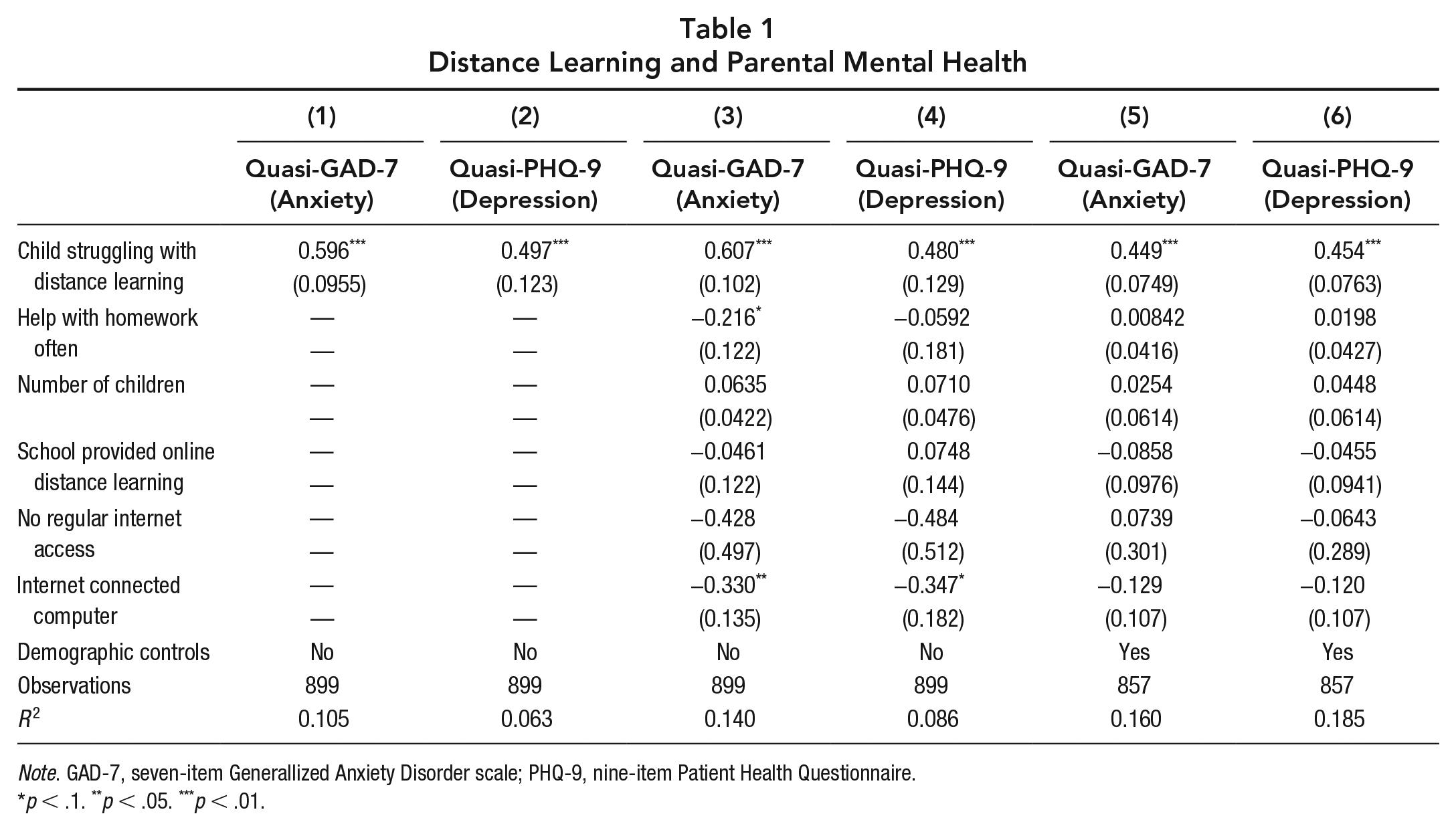
Note. GAD-7, seven-item Generallized Anxiety Disorder scale; PHQ-9, nine-item Patient Health Questionnaire.
p < .1. **p < .05. ***p < .01.
To examine potential mitigating factors between mental health and difficulties with distance learning, we plot the fitted values across different independent variables. Figure 1 shows that the disparity in mental health distress related to difficulties with distance learning, is independent of potential confounding variables (e.g., individual or household covariates). We show a detrimental relationship between a child’s difficulty with distance learning and parental mental health distress through our descriptive empirical analysis. We present a further discussion of our empirical approach and limitations in the online appendix (available on the journal website).
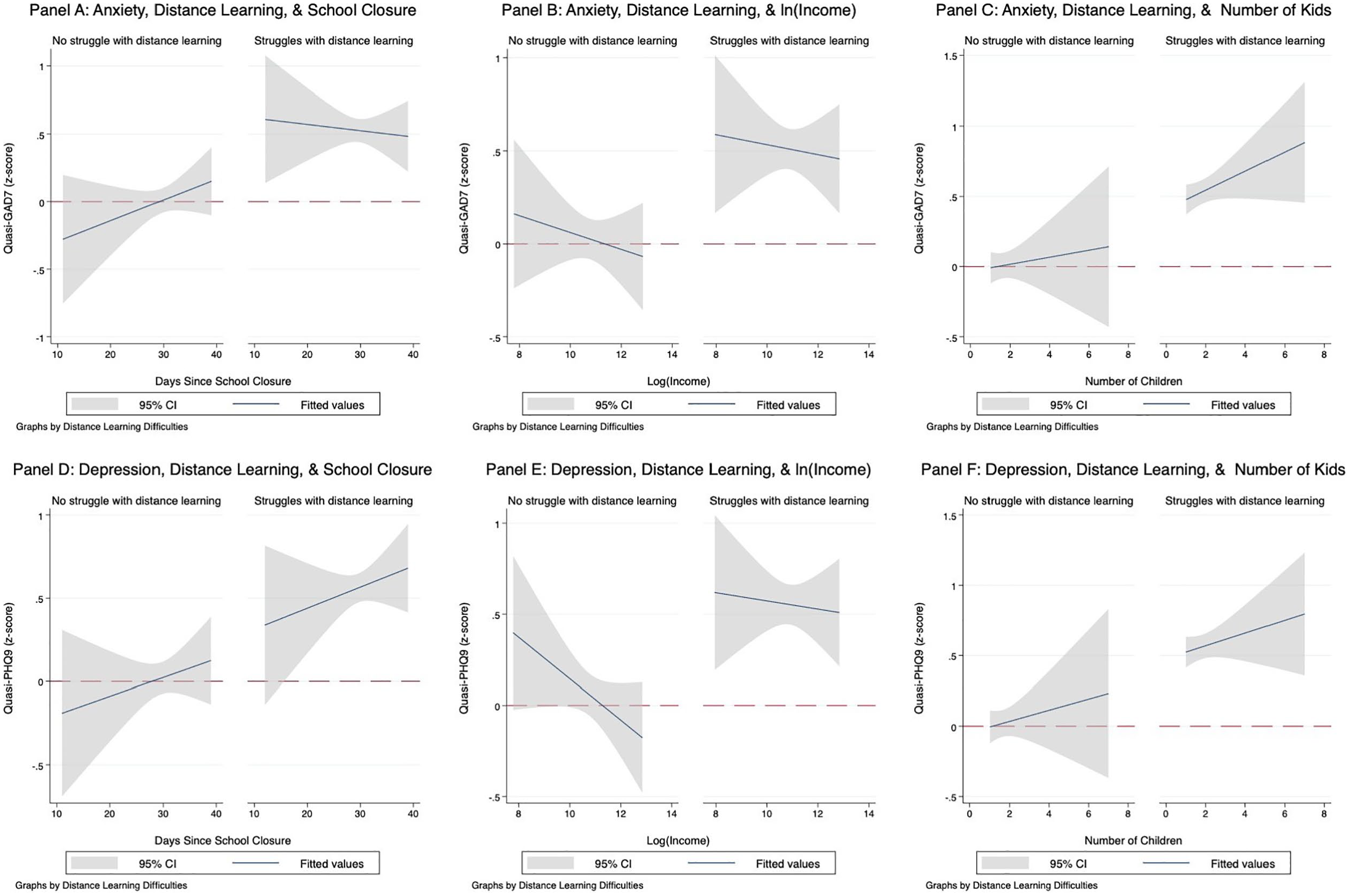
Distance learning and parental mental health distress. Note. This figure plots fitted values and 95% confidence intervals of our mental health measures across the different variables listed. GAD-7, seven-item Generallized Anxiety Disorder scale; PHQ-9, nine-item Patient Health Questionnaire.
It is not clear as to when schools will return to normal. Students will likely rely on some aspect of distant learning for the unforeseeable future. Our findings show that parents, as proxy educators, experience heightened levels of mental health distress when their child struggles to adapt to a distance learning pedagogy. Research shows that stressful learning environments tend to stifle students’ academic abilities, making it imperative to address both students’ and parents’ emotional needs throughout this period (Zhang and Sapp, 2008). Long-term and continued stressors may be the new normal, and parents could likely face longer elevated periods of stress and mental health disruptions.
As of October 15, 2020, the United States accumulated over 8 million confirmed cases and 218,000 deaths related to COVID-19. 3 The growing number of cases throughout the United States signals that we are far from ending this public health crisis. 4 The evidence provided in this brief emphasizes that both parents and students require assistance beyond teaching materials. Unknowingly, parents have transitioned into teaching roles as proxy educators, but in most cases, without any training. As such, schools could use this period to build a relationship with proxy educators through a series of consistent check-ins to discuss how their children cope with distant learning and if supplemental learning resources are needed to adequately support their students. Besides improving distance learning via pedagogical interventions, schools and policymakers may also want to consider mental health resources for proxy educators. Traditionally, schools provide mental health counseling for students; however, this unique crisis may require additional mental health resources for parents, as the proxy educators. Students’ academic success ultimately relies on the parents’ emotional health during this fragile time, which sets the learning environment for their children.
Supplemental Material
sj-pdf-1-edr-10.3102_0013189X20978806 – Supplemental material for Distance Learning and Parental Mental Health During COVID-19
Supplemental material, sj-pdf-1-edr-10.3102_0013189X20978806 for Distance Learning and Parental Mental Health During COVID-19 by Cassandra R. Davis, Jevay Grooms, Alberto Ortega, Joaquin Alfredo-Angel Rubalcaba and Edward Vargas in Educational Researcher
Footnotes

Notes
Authors
References
Supplementary Material
Please find the following supplemental material available below.
For Open Access articles published under a Creative Commons License, all supplemental material carries the same license as the article it is associated with.
For non-Open Access articles published, all supplemental material carries a non-exclusive license, and permission requests for re-use of supplemental material or any part of supplemental material shall be sent directly to the copyright owner as specified in the copyright notice associated with the article.
