







Abstract
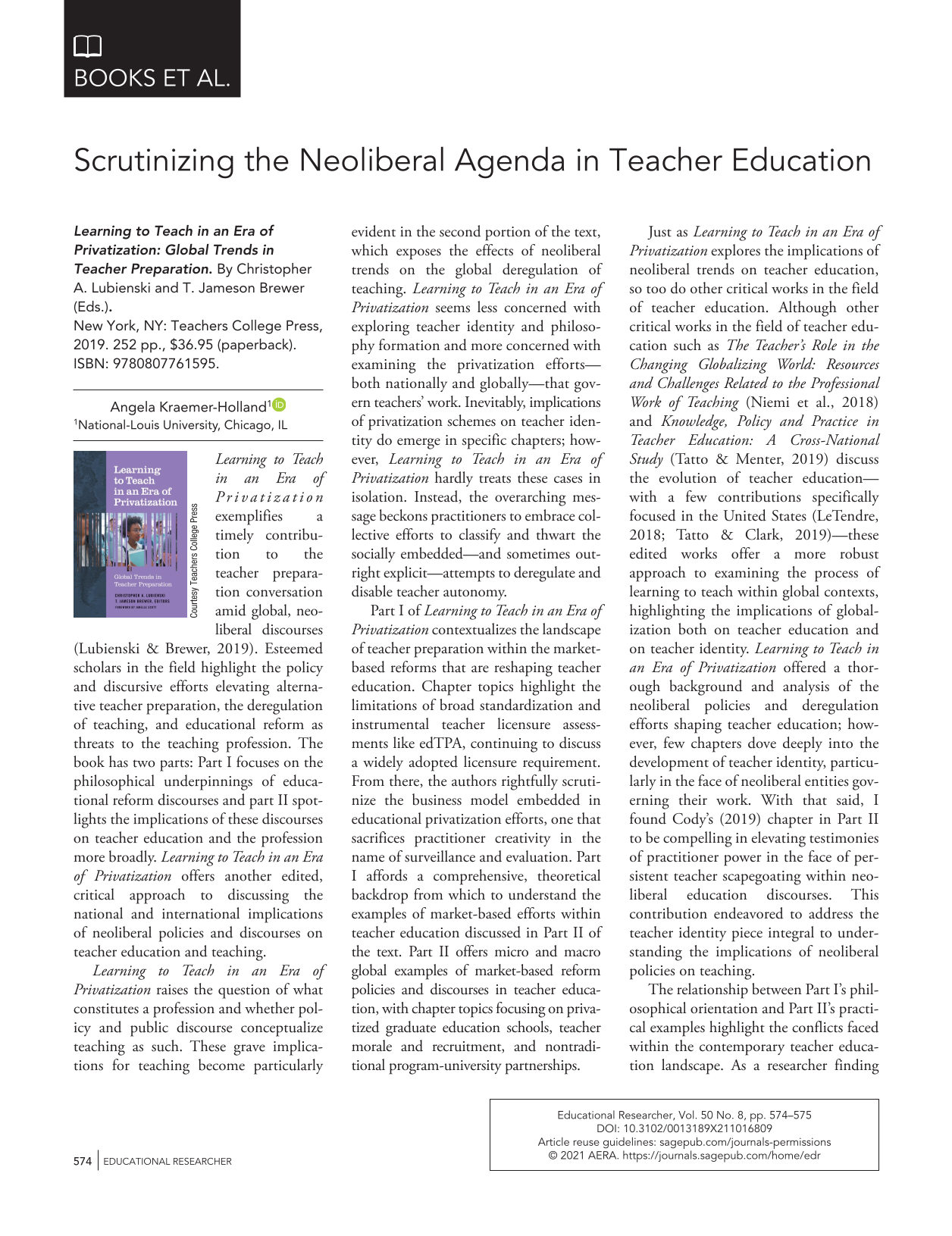

Learning to Teach in an Era of Privatization exemplifies a timely contribution to the teacher preparation conversation amid global, neoliberal discourses (Lubienski & Brewer, 2019). Esteemed scholars in the field highlight the policy and discursive efforts elevating alternative teacher preparation, the deregulation of teaching, and educational reform as threats to the teaching profession. The book has two parts: Part I focuses on the philosophical underpinnings of educational reform discourses and part II spotlights the implications of these discourses on teacher education and the profession more broadly. Learning to Teach in an Era of Privatization offers another edited, critical approach to discussing the national and international implications of neoliberal policies and discourses on teacher education and teaching.
Learning to Teach in an Era of Privatization raises the question of what constitutes a profession and whether policy and public discourse conceptualize teaching as such. These grave implications for teaching become particularly evident in the second portion of the text, which exposes the effects of neoliberal trends on the global deregulation of teaching. Learning to Teach in an Era of Privatization seems less concerned with exploring teacher identity and philosophy formation and more concerned with examining the privatization efforts—both nationally and globally—that govern teachers’ work. Inevitably, implications of privatization schemes on teacher identity do emerge in specific chapters; however, Learning to Teach in an Era of Privatization hardly treats these cases in isolation. Instead, the overarching message beckons practitioners to embrace collective efforts to classify and thwart the socially embedded—and sometimes outright explicit—attempts to deregulate and disable teacher autonomy.
Part I of Learning to Teach in an Era of Privatization contextualizes the landscape of teacher preparation within the market-based reforms that are reshaping teacher education. Chapter topics highlight the limitations of broad standardization and instrumental teacher licensure assessments like edTPA, continuing to discuss a widely adopted licensure requirement. From there, the authors rightfully scrutinize the business model embedded in educational privatization efforts, one that sacrifices practitioner creativity in the name of surveillance and evaluation. Part I affords a comprehensive, theoretical backdrop from which to understand the examples of market-based efforts within teacher education discussed in Part II of the text. Part II offers micro and macro global examples of market-based reform policies and discourses in teacher education, with chapter topics focusing on privatized graduate education schools, teacher morale and recruitment, and nontraditional program-university partnerships.
Just as Learning to Teach in an Era of Privatization explores the implications of neoliberal trends on teacher education, so too do other critical works in the field of teacher education. Although other critical works in the field of teacher education such as The Teacher’s Role in the Changing Globalizing World: Resources and Challenges Related to the Professional Work of Teaching (Niemi et al., 2018) and Knowledge, Policy and Practice in Teacher Education: A Cross-National Study (Tatto & Menter, 2019) discuss the evolution of teacher education—with a few contributions specifically focused in the United States (LeTendre, 2018; Tatto & Clark, 2019)—these edited works offer a more robust approach to examining the process of learning to teach within global contexts, highlighting the implications of globalization both on teacher education and on teacher identity. Learning to Teach in an Era of Privatization offered a thorough background and analysis of the neoliberal policies and deregulation efforts shaping teacher education; however, few chapters dove deeply into the development of teacher identity, particularly in the face of neoliberal entities governing their work. With that said, I found Cody’s (2019) chapter in Part II to be compelling in elevating testimonies of practitioner power in the face of persistent teacher scapegoating within neoliberal education discourses. This contribution endeavored to address the teacher identity piece integral to understanding the implications of neoliberal policies on teaching.
The relationship between Part I’s philosophical orientation and Part II’s practical examples highlight the conflicts faced within the contemporary teacher education landscape. As a researcher finding her footing within the conversations focused on the implications of neoliberal reform discourses on teacher education, I found the chapters in Learning to Teach in an Era of Privatization, although varied in methodology, location, and approach, to be accessible and robust in findings and analysis. Additionally, Learning to Teach in an Era of Privatization would make for a valuable read for education policymakers, as it provides a comprehensive overview of the impact of instrumental educational reforms on teaching and teacher education.
