







Abstract
What is the social, emotional, and academic impact of attending school remotely rather than in person? We address this issue using survey data collected from N = 6,576 high school students in a large, diverse school district that allowed families to choose either format in fall 2020. Controlling for baseline measures of well-being collected 1 month before the onset of the COVID-19 pandemic as well as demographics, high school students who attended school remotely reported lower levels of social, emotional, and academic well-being (effect size [ES] = 0.10, 0.08, and 0.07 standard deviations, respectively) than classmates who attended school in person—differences that were consistent across gender, race and ethnicity, and socioeconomic status subgroups but significantly wider among 10th–12th graders than ninth graders.
Keywords
How does attending school remotely influence the well-being of high school students? In early spring 2020, the COVID-19 pandemic forced almost every school district in the United States to disrupt regular instruction. As the pandemic continues, many districts continue to confront difficult policy decisions about whether and how to offer instruction in person or remotely.
The projected impact of these structural changes on objective measures of academic progress, such as standardized achievement tests, particularly for students from lower socioeconomic status households, is nothing short of catastrophic (Kuhfeld et al., 2020). However, very little is known about the impact of taking classes remotely (i.e., in physical isolation from teachers and peers) on the subjective experience of high school students—and, in particular, the quality of their social relationships, their positive and negative emotions, and various aspects of their academic engagement (Wang & Peck, 2013).
This issue is especially urgent in light of significant increases in anxiety and depression in recent years among U.S. adolescents even prior to the pandemic (Substance Abuse and Mental Health Services Administration, 2018). Moreover, between April and October 2020, the proportion of emergency room visits for mental health–related issues by 12- to 17-year-olds increased by 31% compared with this same period in 2019 (Leeb et al., 2020), likely due to increases in anxiety, compulsive internet use, and social isolation, as well as diminished access to school-based mental health services, all of which are likely to be exacerbated by remote learning (Singh et al., 2020).
In this investigation, we capitalized on longitudinal survey data collected from high school students in a large and demographically diverse school district about 1 month before the pandemic and again in fall 2020, when families in this district were offered the choice of remote versus in-person options. Parents and students, not teachers, made this decision for the marking period; day-by-day changes were not allowed, preventing crossover between remote and in-person schooling in our sample. Although this was not a random-assignment experiment, we were able to compare students who attended school remotely versus in person while controlling for prepandemic measures of well-being as well as a rich set of demographic and performance covariates from official school records.
The school district in which these data were collected was part of Character Lab Research Network, a national consortium of school partners committed to advancing scientific insights that help children thrive. The analytic sample included N = 6,576 high school students who completed the Character Lab Student Thriving Index, a self-report questionnaire assessing various aspects of well-being and daily routines, via school-owned computers during class time at two time points: Prepandemic data (Time 1) were collected between February 3 and February 21, 2020, when students were in Grades 8 through 11, and mid-pandemic (Time 2) data were collected between October 12 and 28, 2020, when students were in Grades 9 through 12. At Time 2, n = 4,202 students attended school remotely and n = 2,374 students attended school in person.
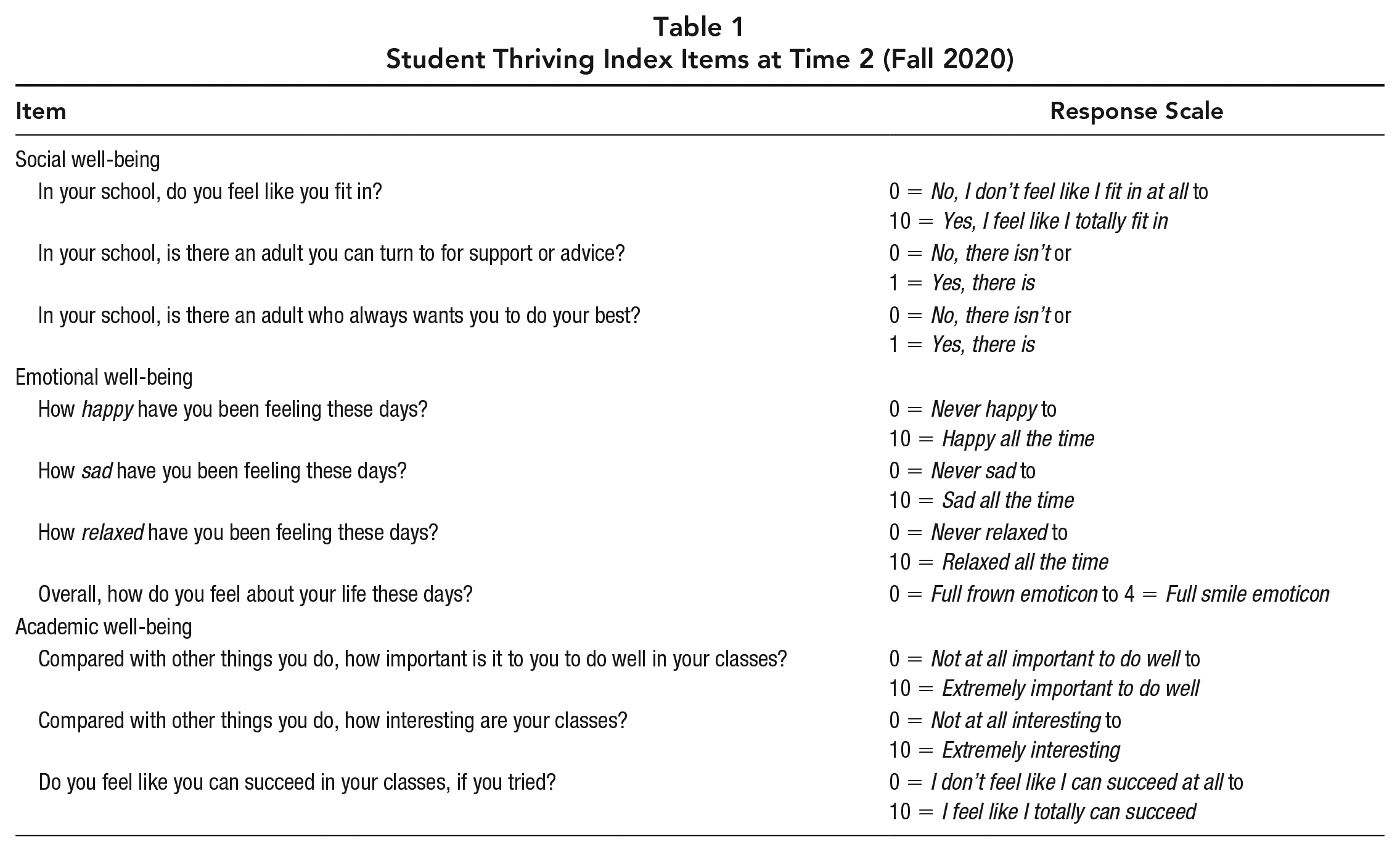
To increase reliability, we aggregated individual survey items to create three composite scores assessing social, emotional, and academic well-being, respectively; see Table 1, and, in addition, see Supporting Online Material (available on the journal website) for details. We then estimated ordinary least squares models that regressed the social, emotional, and academic well-being outcomes at Time 2 on the corresponding survey data collected at Time 1; remote versus in-person schooling status; as well as covariates including gender, race/ethnicity, grade level, free and reduced-price lunch status, English language learner status, special education status, overall grade point average, grade point average in core classes, home language, and school. Controlling for these factors was important because, as shown in Supplemental Table S2 (available on the journal website), there were baseline differences between students attending school remotely versus in person. Specifically, in-person schooling was more likely for students who were male, White, in ninth grade, ineligible for free or reduced-price meals, English-speaking at home, earning lower report card grades, or higher in social well-being. See Supporting Online Material (available on the journal website) for details, including comparisons between remote and in-person learners at baseline, complete results from regression models, reliability statistics, item-level comparisons, regression models including interaction terms, details on nonresponse weights, and robustness tests.
Student Thriving Index Items at Time 2 (Fall 2020)
As shown in Figure 1, the magnitude of the remote versus in-person thriving gap was effect size (ES) = 0.10 (p < .001), 0.08 (p < .001), and 0.07 (p < .05) standard deviations for social, emotional, and academic well-being, respectively. In other words, students who attended school remotely experienced significantly lower levels of well-being whether indexed socially (e.g., feeling like they fit in, having positive relationships with adults in their school community), emotionally (e.g., feeling good about life overall, feeling relaxed and happy vs. feeling sad), or academically (e.g., finding classes interesting and believing they could succeed in their classes). Differences in well-being were comparable across gender, race/ethnicity, and socioeconomic status.
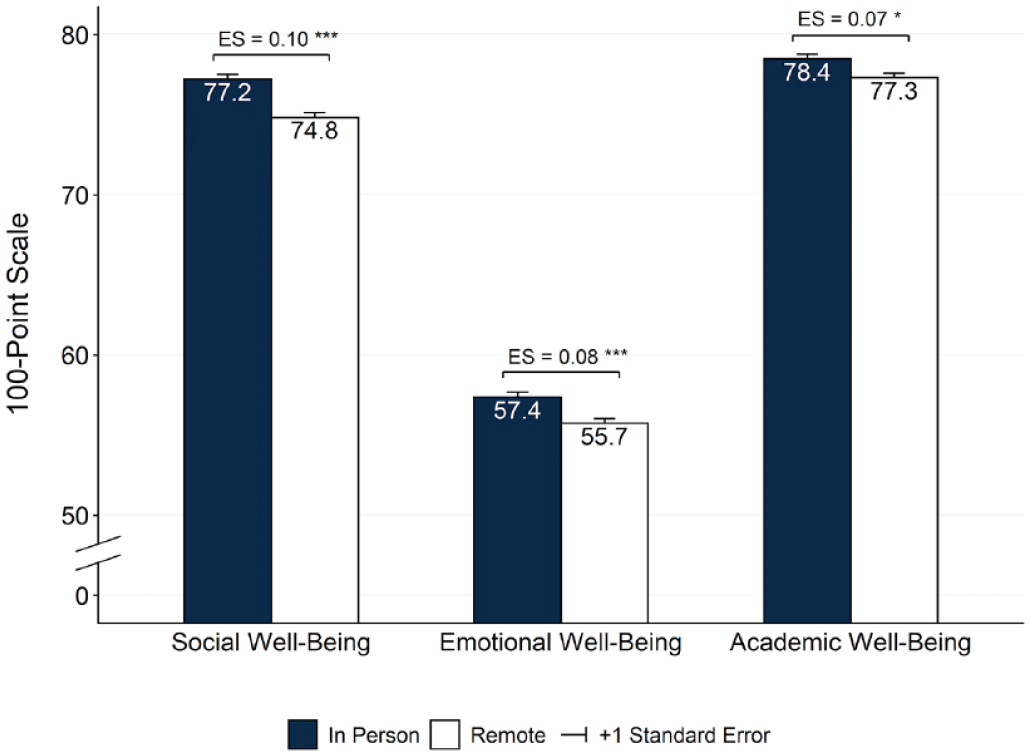
Social, emotional, and academic well-being is higher for students attending school in person versus remotely.
The most consistent moderator of the thriving gap was grade level. Observed differences were driven primarily by students in Grades 10 to 12; for ninth-grade students, differences in well-being were smaller and failed to reach statistical significance. 1 We suggest three different, but compatible, interpretations. First, the need to maintain intimate relationships with peers increases in late adolescence (Poulin & Chan, 2010), so perhaps older students are more vulnerable to the social isolation associated with attending school remotely. Alternatively, it may be that ninth-grade students, because they had never experienced high school in person prior to the pandemic, are less prone to missing their classmates and teachers. Finally, the transition to high school presents social, emotional, and academic challenges and opportunities that, for the ninth graders in our sample, may have overshadowed the consequences of remote versus in-person schooling.
Several limitations of the current investigation are worth noting. First and foremost, because students were not randomly assigned to remote versus in-person schooling, we cannot draw strong causal inferences. Although we controlled for demographics, report card grades, and baseline measures of well-being prior to the pandemic, it is impossible to rule out the possibility of unmeasured confounds that influence well-being as well as choice of schooling modality. Second, the brief self-report measures of well-being used in this investigation highlight the need for additional research using a more comprehensive and, ideally, multimethod approach—including, for example, parent, teacher, and peer ratings of student well-being. Third, we made minor adjustments to the well-being measure at Time 2 (e.g., changing the response options for seven items from 5-point Likert-type scales to 11-point scales; changing the response options for two items from 7-point Likert-type scales to binary yes/no scales—see Supporting Online Material [available on the journal website] for details). A replication study would ideally use identical measures at all time points. Fourth, the external validity of these findings is limited. We do not know whether the thriving gap we observed among public high school students who opted into completing surveys in this study generalizes to other types of schools, for example, or to older or younger students. Finally, the group differences we observe do not exclude the possibility that some students may not be adversely affected by remote instruction and that others may actually benefit from it. Future studies that identify these groups of students, and factors that distinguish them from their peers, would be valuable.
Supplemental Material
sj-pdf-1-edr-10.3102_0013189X211031551 – Supplemental material for Students Attending School Remotely Suffer Socially, Emotionally, and Academically
Supplemental material, sj-pdf-1-edr-10.3102_0013189X211031551 for Students Attending School Remotely Suffer Socially, Emotionally, and Academically by Angela L. Duckworth, Tim Kautz, Amy Defnet, Emma Satlof-Bedrick, Sean Talamas, Benjamin Lira and Laurence Steinberg in Educational Researcher
Footnotes

Notes
Authors
References
Supplementary Material
Please find the following supplemental material available below.
For Open Access articles published under a Creative Commons License, all supplemental material carries the same license as the article it is associated with.
For non-Open Access articles published, all supplemental material carries a non-exclusive license, and permission requests for re-use of supplemental material or any part of supplemental material shall be sent directly to the copyright owner as specified in the copyright notice associated with the article.
