







Abstract
Curricular standards have the potential to elevate dominant ideology at the expense of marginalized perspectives. Recently, dominant narratives of police as a community benefit have been passionately challenged in the public sphere. Through a critical discourse analysis of social studies content standards of 50 states, we evaluate which narratives about law enforcement are reinforced in K–12 curricula. While police in marginalized communities are widely viewed as illegitimate, implicated in a long history of violence, and embedded in structures of oppression, we find that in social studies standards, they are conveyed as the opposite. The police are legitimate, only momentarily violent, and a functional institution abstracted from oppressive systems. We discuss the implications of this curricular dissonance for marginalized communities.
Police in the United States have long enjoyed more public confidence than nearly all other social institutions, regularly outranking churches, the Supreme Court, public schools, and the presidency, among others in polling data (Gallup, n.d.). However, this sentiment is not shared evenly across communities. Gaps in perceptions of police are particularly wide between Black and White Americans. In public polling, for example, Best and Rogers (2020) report that while 87% of Black respondents believed that police officers were more likely to use force against Black people, just 49% of White respondents agreed. While the massive 2020 uprisings over the police murder of George Floyd briefly moved White people closer to Black public sentiment about law enforcement practices, wide gulfs still remain.
Diversions in orientations to the police by race have a long, robust history. Early iterations of police patrols in the 18th and 19th centuries served dominant interests by controlling subjugated groups—runaway slaves in southern states (Reichel, 1988) and burgeoning immigrant populations in the North (Vitale, 2017). Police aggression against Black Americans in the century that followed ensured the maintenance of segregationist practices like Jim Crow laws in the south and “sundown towns” across the nation (Loewen, 2018). Police forces were consistently employed to stifle movements for civil rights like organized boycotts, school walkouts, and the Black Panther Party (Simon et al., 2016; Taylor, 2018). The long history of oppressive law enforcement has been the focus of the Black Lives Matter movement aimed at defending Black people from pervasive violence at the hands of police officers. Today, movements to defund the police in communities and schools have risen to prominence in the national discourse. Given the treatment of Black and Brown communities by law enforcement and the positive perceptions of police among White people in the United States, the question to police, “Who do you protect, who do you serve?” (Schenwar et al., 2016) is deeply significant.
In spite of this sordid history, why are police viewed by so many as an unquestioned force for good? While certainly the answers to this question are myriad, people’s understandings of policing—its historical and present-day iterations—are important predictors of how they view the institution of law enforcement. Since much historical and sociological understanding emerges in K–12 schooling, an important question is “What, if anything, are students expected to learn about the history and institution of policing in their social studies 1 classrooms?” “Is what people of color learn about police from their parents and communities reinforced in official social studies curricula?” Or, alternatively, “Does K–12 curricula serve a legitimizing function that reinforces dominant, favorable perspectives on policing largely held among White America?”
Through a critical discourse analysis of state curricula, we argue that social studies content standards about law enforcement are thin and convey a distorted vision of policing misaligned with the experiences of marginalized communities. For many in communities of color, law enforcement is an illegitimate, persistent presence that is embedded in larger systems of oppression. State social studies standards largely present law enforcement as the opposite. Police are wholly legitimate, only momentarily visible, and abstracted from systems of racism and social oppression. In what follows, after a brief overview on the social science of policing in the United States, we analyze history and social studies standards for the extent to which they offer opportunities for holistic engagement with the history of law enforcement and its current role in U.S. society. In so doing, we caution that inadequate K–12 engagement with policing can stifle productive conversations about its legitimacy as an institution and leave students ill-prepared to democratically negotiate tensions of law enforcement in their communities.
Policing in the United States
The role of the police in U.S. history is deeply fraught. They are a persistent presence at the center of processes that have shaped a turbulent American story. They were complicit in the country’s original sin—the theft of Black bodies for the abhorrent system of chattel slavery that was maintained through patrols of enslaved people across the southern states (Reichel, 1988). They have been a steady presence amid the country’s continual struggle to live up to its lofty ideals and to ensure basic human rights and dignity to all of its citizens. With respect to movements for equality among communities of color, police have long been stationed on the opposing side. In short, leveraging the historical record and sociological accounts of policing in the United States, we argue here that the police as an institution have undermined their own legitimacy in urban neighborhoods, have throughout history used the persistent threat of violence to control marginalized communities, and have served as a key cog in machines of oppression that have served to perpetuate the logic of slavery long after the “peculiar institution” had been formally abolished.
Illegitimacy of Police in Urban Communities
There exists a long history of police mistrust among communities of color (Bayley & Mendelsohn, 1968; Brunson & Wade, 2019; Holmes, 1998). In Black communities, this communal frustration has been monumentalized in song—from the soft crooning of Jim Jackson who sang “Bye Bye, Policeman” in 1928 to the unapologetic, turntable-accompanied shouts of “Fuck the Police” by N.W.A. in the late 1980s (Sullivan, 2020). Tyler et al. (2014) find that the perceived illegitimacy of police is facilitated by the extent to which police interactions are perceived to be unfair or unlawful. Such perceptions, unfortunately, are justifiably widespread. Aggressive “stop and frisk” practices in New York City led to arrests in less than 6% of stops; they turned up guns in just 0.15% of stops; and most stops were of questionable legality (Fagan, 2010). For many young men, police stops are a frustratingly “regular routine” (Jones, 2014). These ecologies of mistrust undermine public willingness to cooperate with police investigations (Brunson & Wade, 2019) and perpetuate the simmering tensions between city officers and those who they have sworn to “serve and protect.” A collection of essays edited by Camp and Heatherton (2016) makes the case that police aggression has been expanding amid “broken-windows” police tactics that punish citizens of urban neighborhoods for municipal neglect and urban disinvestment. Police in urban neighborhoods delegitimized themselves through persistent harassment of community members of color.
Policing as a Persistent Violent Presence in Marginalized Communities
Further undermining the legitimacy of police among marginalized communities is the long history of violence against residents. The early 1900s were replete with reports of police attacking—and even killing—Black citizens with scant repercussions (Hawkins & Thomas, 2013). When White mobs attacked Black or Latinx communities, police officers often supported White violence or turned a blind eye (Escobar, 1999; Muhammad, 2019). Police brutality was a means by which to subdue organizing in New York by the Communist Party and the Nation of Islam (Taylor, 2018). During the Civil Rights Movement, Americans watched as TV cameras in Selma and Birmingham showed police dogs and firehoses being used to overpower Black protesters (Donovan & Scherer, 1992). The Chicano Movement protests in Los Angeles saw similar flareups of police brutality against communities of color (Escobar, 1999). The Black Panthers and Brown Berets—collectively, a wing of the Civil Rights Movement that adopted more militant posturing—saw resisting police violence as central to their efforts for social equality (Correa, 2011). Police brutality has been widely reported in native communities (Perry, 2006). Trauma related to law enforcement is also disproportionately experienced among people with disabilities, the LGBTQ community, people experiencing houselessness, and sex workers (American Public Health Association, 2018). Violent interactions with police among marginalized communities are long-standing and widespread.
Police brutality is not a momentary aberration. Any interaction with law enforcement carries with it the threat of state-sanctioned brutality, and the disproportionate application of police violence to communities of color undermines conceptions of law enforcement as committed to an inclusive vision of public safety. Thus, the recent incidents of police brutality—of Michael Brown, of Breonna Taylor, of Adam Toledo, and of uncountable others—are not isolated incidents but the latest chapter in a long history of police violence against people of color.
Law Enforcement as a Core Component of Structural Oppression
The symbolism of slave patrols as one of the first organized police forces in the United States is lost on few scholars of criminal justice. From their outset, law enforcement was deployed as a means of social control targeted explicitly at marginalized groups in the south (Reichel, 1988), the north (Vitale, 2017), and western Chinatowns (Ma, 2014). In the mid-20th century, the Nixon administration expanded policing in the United States to prosecute an ostensible “War on Drugs.” Despite messaging around drug abuse and public health, the expansion of police power was primarily motivated by a desire to control groups deemed a threat to the social order (Baum, 2016). The War on Drugs expanded during the Reagan administration, targeting marginalized communities with uniquely punitive sentencing practices for crack cocaine, a less-expensive drug used more often by people of color. This policy won the president favor with suburban Whites fearful of imagined Black criminality (Alexander, 2010). The “tough on crime” political ideology eventually made its way to the Democratic side of the political spectrum, culminating in the 1994 crime bill during the Clinton administration. Thus, seemingly by design, the United States has incarcerated more people per capita than any country in the world (Wagner & Sawyer, 2018), amassing a vast network of prisons teeming with Black and Brown bodies—marginalized, brutalized, and locked away.
In response to perceptions of illegitimacy, violence, and racism within the institution of policing, movements for police abolition have emerged among activists and scholars. Seigel (2017), for example, argues that the liberal expectation that police might reform themselves of their racism is a “magnetically seductive” fantasy. In contrast, she suggests, in spite of perceived improvements in U.S. policing throughout history, “The victories were pyrrhic . . . racism shifted and camouflaged itself anew” (p. 482). McDowell and Fernandez (2018) assert that transformative efforts to “disband, disempower, and disarm” the police must be forceful, uncompromising, and tied to a larger project of undoing the “racial capitalist order” in the United States. In scholarship on schools, researchers have also articulated how educators might work toward abolition of the institution of policing and the carceral state both within their campuses and beyond them, and how many have fallen short in doing so (Meiners, 2011; Shange, 2019; Turner & Beneke, 2020). The existence of these radical conversations on policing in schools suggests the possibility for students to engage in “speculative civic literacy” in their classrooms (Mirra & Garcia, 2020), “restorying” dominant narratives of policing and imagining new political realities for public safety. While abolitionist conversations are at the forefront of activist and intellectual discourse about the police and schools, we shall address here how opportunities to challenge the institution of policing appear, if at all, in what students are expected to learn in their classrooms.
History Standards, Democracy, and the Invisibility of Marginalized Narratives
What of these entanglements of policing, illegitimacy, violence, and oppression are K–12 students in the United States expected to understand? Given the well-established function of curricula to reinforce dominant narratives of U.S. history, might we be concerned about portrayals of police that silence the concerns of communities of color regarding law enforcement in their communities? Given the urgency of police violence within these communities, an interrogation of what students are ostensibly learning about the institution of law enforcement is warranted.
State social studies content standards offer essential data for this inquiry. The teaching and learning of history in any state are directed by its content standards. They are what students are supposed to know and do after each grade level of instruction. Teachers generally see state standards frameworks as useful tools, persisting through challenges to ensure their successful implementation (Desimone et al., 2019; Porter et al., 2015). Social studies standards exist across all 50 states, and they influence multiple stages of student learning: from textbooks, to instructional materials, to assessment (Fogo, 2015). These standards are particularly important in the context of democracy. Social studies courses provide students an opportunity to discuss diverse and controversial topics that prepare them to be civically engaged adults (Hess, 2004). Social studies represent a core of the “democratic mission” of K–12 schooling (Kahne & Westheimer, 2003). State-adopted social studies standards are consequential and have a substantial and directive impact on classroom teaching and democratic practices.
State social studies standards, meanwhile, have been challenged by critical scholars who assert that they render invisible marginalized histories and perpetuate a story of a homogenous America that never really was (de los Ríos et al., 2015). Official curricula represent a dominant ideology (Apple, 2000) and marginalize the narratives of communities of color (Sleeter, 2002). The prevalence of race and racism in the story of the United States is often opaque and distorted in social studies curricula (Vasquez Heilig et al., 2012). In the creation of the content standards, the political motivations of those who are appointed to committees that author standards are often obscured in public discourse (Fogo, 2015). Thus, social studies standards are disguised as apolitical but represent the perspective of powerful political actors (de los Ríos et al., 2015). They prioritize a false notion of consensus over conflict (Jay, 2003) and, in so doing, subject students to a hidden curriculum that prioritizes compliance over practicing democratic skill and understanding multiple perspectives (Martinson, 2003).
While social studies instruction is often hotly contested in the public sphere (e.g., The 1619 Project and former President Trump’s “patriotic education”), most state history standards themselves are perceived as above the political fray and have undergone less interrogation in popular discourses. However, educational institutions, even within the seeming innocuousness of curriculum and pedagogy, are indelibly tied to systems of oppression like policing and incarceration (Vaught, 2017). Systems of control and cultural subtraction through curriculum produce what Sojoyner (2016) terms enclosure, a manifestation of the school-prison nexus that denies flourishing among Black youth. He writes, “Perhaps more important than visceral forms of discipline (that is, suspensions and expulsions), the pedagogy, curriculum and economics of Black education are central to the maintenance of the enclosure process” (p. 149). The tendency in content standards to frame the dominant group’s interests as universal can have profound implications for teaching and learning about police in schools and can shape how students engage with their communities into adulthood.
Method: Critical Discourse Analysis of Standards Documents
Methodological Rationale
To answer the guiding research question “What, if anything, are students expected to learn about the history and institution of policing in their social science classrooms?” we turn to the content standards documents themselves. As noted above, the standards are the baseline of what students learn in their social studies classrooms, and though some teachers may veer from them, they represent an institutionalized expectation that is widely understood across schools. Here, we present a document analysis of academic standards to illuminate narratives of policing that prevail in the curricular guidance offered to K–12 teachers.
Document analysis methods offer a focused, systematic approach to abstracting meaning from printed and electronic material (Corbin & Strauss, 2008). Bowen (2009) notes that the stability of documents as a source of data allows for an iterative analysis of content and themes and “broad coverage” of a phenomenon. State standards represent significant discussions about teaching and learning and are long-standing, institutionalized documents. They are broad, covering the entirety of the United States. In trying to understand what students learn about policing, centering our analysis on the documents themselves relies on the stability of the documents, their breadth, and their centrality to teaching and learning in schools.
Also, analyzing these documents with a lens on law enforcement necessitates a critical approach. The question of policing rests on the axis of societal power. As such, the document analysis we present here adopts a critical lens attuned to the power dynamics that shape social phenomena. We engaged the standards documents through critical discourse analysis. Critical discourse analysis is the study of “dialectical relations” (Fairclough, 2013), which analyzes the interplay between structural forces and societal relationships. A key function of critical discourse analysis is its intersection with urgent social problems that will be better understood through an examination of institutional discourse (van Dijk, 1993). Critical discourse analysis can be particularly important in the analysis of police narratives presented to children, whereby stories can “untell” uncomfortable realities in marginalized neighborhoods (Sciurba & Jenkins, 2019). Prominent educational discourses can reinforce dominant ideologies (i.e., those of the White middle class) in ways that have very real consequences for marginalized people engaging in their communities. Critical discourse analysis is an essential lens through which to view social studies curricular standards, whose language represents a discursive enterprise that can reify oppressive structures and shape individual lives.
Data and Analysis
For the purpose of this study, our analysis of standards was limited to the core social studies courses that are offered in every state: state/local history, U.S. history, world history, government, and economics. Social studies can cover a wide range of disciplines, but courses are offered idiosyncratically in U.S. states. As such, courses identified as elective in social studies (i.e., sociology, psychology, ethnic studies, among others) were excluded because they are generally not part of the mandatory core curriculum required for all students. In conducting the analysis, we first downloaded all publicly available K–12 state adopted standards from official state education websites of all 50 states. The size of the documents varied greatly; some documents were less than 20 pages and others were more than 500. These documents can all be accessed by way of the URLs presented in the supplemental appendix (available on the journal website). After downloading the documents, we extracted relevant information using a two-step coding process. We began with “in vivo” coding (Saldaña, 2013) of standards for potential engagement with policing and communities of color. In a second round of coding, we examined the standards that were connected to policing through critical discourse analysis, looking at language as a means of social stratification whereby power is constantly produced and reproduced by official discourse. During both rounds of coding, we wrote memos to revise codes and met to develop potential themes of analysis. In each round, the standards were split in half between the researchers, and we switched between rounds to ensure that each set of standards was looked at once by both authors.
In the first round of coding, a variety of in vivo codes emerged that were directly or indirectly connected to policing. These included “Police,” “Law enforcement,” “Prison,” “Crime,” “Incarceration,” “Civil Rights,” “Justice,” “War on Drugs,” and, in some circumstances, “law.” Also, given the significance of the Nixon, Reagan, and Clinton administrations to the expansion of policing and incarceration, we also noted when those presidents appeared in the standards. The second, “critical” round of coding tied the language of the standards more directly to questions of social stratification. This round aimed to illuminate power dynamics. Specifically, we recoded standards from the in vivo coding process to capture how the standards about police—and standards with possible connections to policing—reinforced or undermined dominant ideology. For example, codes like “legitimation of policing,” “silence on role of police,” “brutality in historical moments,” and “functionalist visions of law and law enforcement” emerged in this process. The ways in which the standards legitimate police power and reinforce dominant ideology can silence marginalized voices and debilitate movements to resist police oppression in urban communities. The methods sought to make visible the ways in which content standards implicitly reinforce structures of law enforcement that have long served to marginalize racially minoritized groups in the United States.
Findings: Police and the Standards
With few exceptions, state history and social studies standards present the police in a fashion antithetical to the ways in which they are perceived among marginalized communities. By and large, students in K–12 contexts are expected to learn that police are legitimate, police violence occurs only in brief historical moments, and the police are a functional structure, abstracted from larger systems of oppression. Here, we summarize the trends across the state standards, drawing on specific examples from individual states to illustrate these patterns.
Police as Legitimate
In most states, the only explicit mentions of police in the content standards occurs between kindergarten and third grade. The police are presented as a helpful archetype—a force for good that serves the community. They are described as a “service” in 21 states. They have “authority” in nine states. Some specific calls are made for students to “respect” that authority. They are “helpers” of the community in four states. For example, the Indiana standards call on students to “give examples of people who are community helpers and leaders and describe how they help us.” The police, along with parents, teachers, principals, and bus drivers are offered as examples of these “community helpers.” Nineteen states, meanwhile, make no mention of “police” or “law enforcement.” Table 1 summarizes the standards across 50 states, identifying the grade in which “police” or “law enforcement” is mentioned and key descriptive terms included in the standard. Thus, most states’ standards legitimize policing to young children as an objectively positive force in the community, and many others ignore the institution entirely. Either approach—support or silence—reifies dominant visions of law enforcement in the United States.
“Police” and “Law Enforcement” in State Social Studies Standards
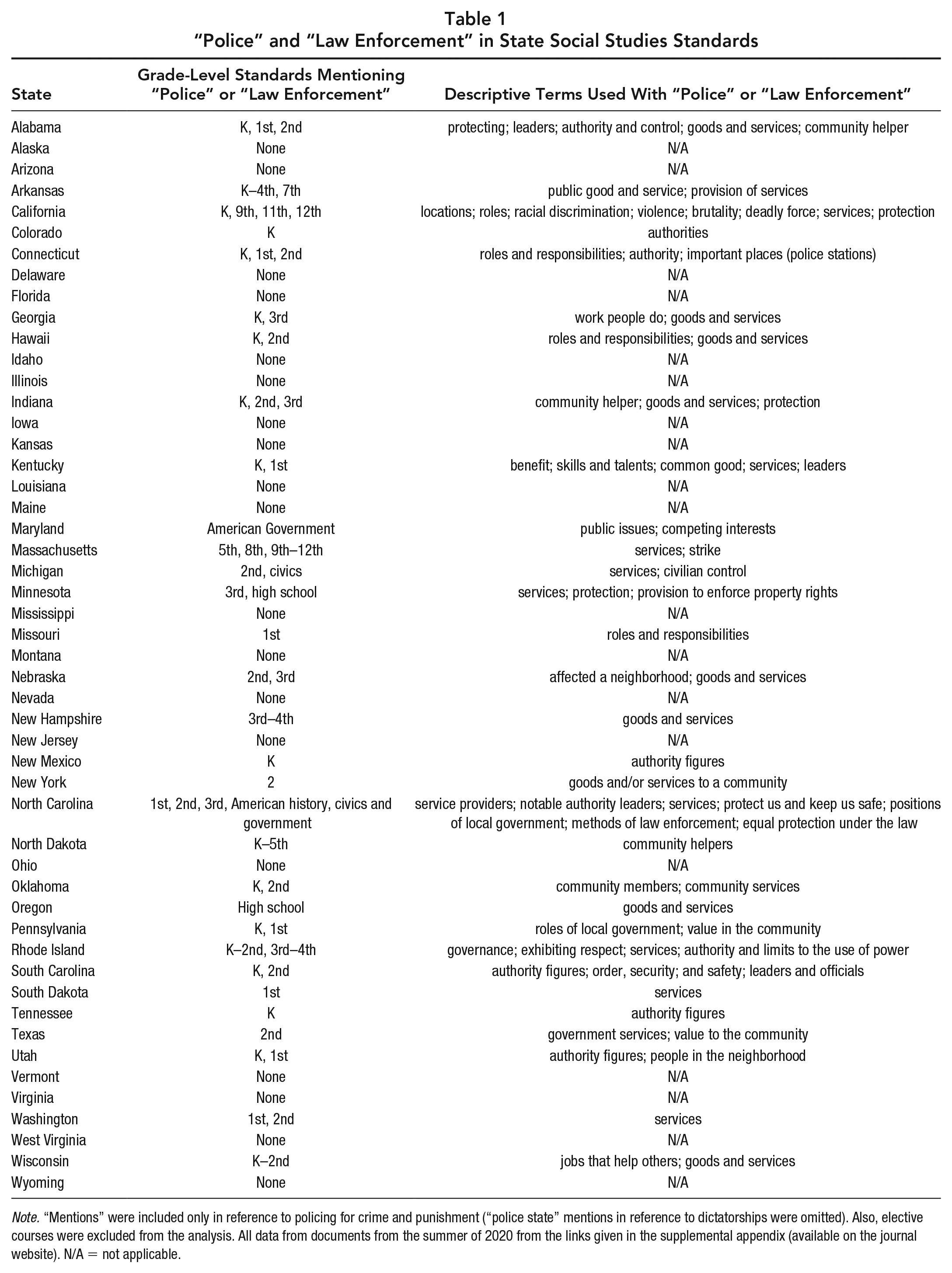
Note. “Mentions” were included only in reference to policing for crime and punishment (“police state” mentions in reference to dictatorships were omitted). Also, elective courses were excluded from the analysis. All data from documents from the summer of 2020 from the links given in the supplemental appendix (available on the journal website). N/A = not applicable.
Importantly, after the validation of the police that generally happens before third grade, only four states’ standards explicitly revisit the police as an institution in later grades in a new way. Few of these revisits are certain to offer a substantive opportunity for students to interrogate police legitimacy. For example, Massachusetts encourages teachers of later grades to discuss the Boston Police Strike, a bit of local history that might highlight the police as a necessary force whose absence produces disorder (Russell, 2005). California, alternatively, offers a robust opportunity to revisit policing, encouraging teachers to discuss police collusion with violent actors during the “Zoot Suit Riots” in the 1940s and as a “catalyst for the [Civil Rights] Movement” in the 1960s. Also, North Carolina’s standards discuss under a standard heading of “police methods” that “a failure to ensure equal protection under the law . . . often leads to challenges to social order and the protection of the freedom and civil rights of people.” While the standards in California and North Carolina briefly invite teachers to guide students to a critical analysis of policing, the states’ voluminous sets of standards (over 500 pages each), render uncertain whether teachers will take the time to attend meaningfully to this subtopic. Only Maryland’s standards’ emphasis on the “competing interests” surrounding law enforcement in a high school government course might allow for a substantive investigation into diverse perspectives on the policing of urban communities.
Police Violence in Historical Moments
Emerging occasionally in the standards documents are historical moments or perspectives involving police violence against communities of color. These standards do not mention policing explicitly, but coverage of the event or perspective in question might compel a teacher to interrogate law enforcement’s treatment of marginalized groups. For example, 13 standards mention the protests in Selma or Birmingham, where the nation bore witness to televised instances of police violence against civil rights advocates. Occasionally, the standards mention a local uprising during the Civil Rights Movement spurred by police mistreatment, like the Orangeburg Massacre in South Carolina or the “civil unrest” in Detroit in the Michigan state standards. However, police oppression is treated in the standards as a momentary historical memory rather than an ongoing condition. Seldom do standards present opportunities at different timepoints for discussions of the persistence of police oppression. Occasionally, this confinement of police brutality to the dustbin of history is made explicit. The New York standards, for example, emphasize that civil rights leaders “eventually brought about equality under the law.” Ironically, this standard was published in 2014 in the midst of “stop-and-frisk” practices that targeted Black and Latino men. These moments in history that illuminate brief tensions with law enforcement present these conflicts as vestiges of a distant past that has since been overcome.
Additionally, in discussions of movements for civil rights, mid-20th century movements that resisted police brutality are often framed on the fringes of, or, in some cases, contrary to, mainstream efforts. Most state standards that discuss the Civil Rights Movement emphasize integrationist efforts like sit-ins and boycotts, making no mention of movements against police brutality. Twelve of the standards, though, briefly mention the Black Panthers or Stokely Carmichael, both of whom spoke forcefully against police oppression in urban communities. Often implicitly, and occasionally explicitly, these ideologies are said to be in conflict with more mainstream leaders of civil rights. North Carolina includes the Black Panther Party in a section of “conflict and compromise” and emphasizes its strategic differences with other groups. In Texas, students are expected to “compare and contrast the approach taken by the Black Panthers with the nonviolent approach of Martin Luther King Jr.” Florida encourages students to weigh “violent” against “nonviolent” approaches to social advocacy. These lopsided, dichotomous visions of the Civil Rights Movement—elevating the “violent against the nonviolent” and couching brief mentions of police resistance movements within vast descriptions of integrationism—present frustrations about policing as radical, contrarian ideologies rather than widely shared realities for Americans of color.
Policing and Law as Functional Structures, Abstracted From Systems of Oppression
The “rule of law” is a common refrain in social studies state standards documents. Treated almost as gospel (indeed, a South Carolina elective standard links law to a biblical foundation), the rule of law is framed for students as the core of U.S democracy. It is a “guiding” principle” or an “essential principle” of democracy; it is a “necessity”; and it is connected to the “common good.” Colorado asks students to choose between “rule of law” and “rule of man” as a more effective political practice, presenting rule of law as the antithesis of tyranny. All state standards include processes of lawmaking, and many encourage teachers to describe criminal justice processes. Multiple states ask students to differentiate between civil and criminal law. A few go considerably deeper into a functionalist vision of the practice of law. Nevada, for example, asks students to, “examine the structure of the U.S. justice system with special attention to due process protections, legal rights, and the judicial process in criminal and civil cases.” The approach elevates a vision of law and its enforcement as a system with clear rules, untainted by racial or class prejudice.
Far less attention has been directed at the ways in which law has marginalized communities of color. Occasionally, and most often only in passing, standards may elevate the ways laws have been unequally applied to marginalized groups. Kansas’s standards stand alone among the 50 states in their direct encouragement to “recognize and describe unfairness and injustice” in laws. Only six states include in a content standard space for a teacher to interrogate the War on Drugs and its impact on the policing of marginalized communities. Maryland, for example, in a section about Ronald Reagan emphasizes the “impact of the ‘War on Drugs’ on policing and mass incarceration.” We found none that discuss Bill Clinton’s “three-strikes” policy. Given the explosion of the prison population in the latter half of the 20th century, these silences obscure the fact that the United States arrests and imprisons more of its citizens per capita than any other nation in the world.
Discussion
Within marginalized communities, police are often viewed as illegitimate, perpetually violent, and a powerful component of systems of oppression. In state social studies standards however, law enforcement is rendered legitimate, its violence is isolated in a distant past, and it is a functional entity, abstracted from larger systems of oppression. This narrative is conveyed in history course expectations from elementary school to high school graduation. After perhaps learning briefly about police before the fourth grade as helpers and respected authority figures, students see only sporadic—if any—instances of police violence against communities of color. After being taught to see police as righteous enforcers of the law, they learn of the “rule of law” as foundational to our democracy, functioning neatly to ensure a just society. This narrative conveys police as at the center of democratic ideals, a functional algorithm in a system programmed for fairness and equality. This framing is profoundly at odds with the experiences of marginalized communities.
Nineteen state standards documents do not mention the police. In the absence of explicit guidance with respect to discussing law enforcement, teachers may avoid conversations about policing entirely. These silences, in the context of social discourse that serves to normalize policing (Seigel, 2017) may further harden dominant ideologies of law enforcement within and beyond school campuses. In public schools—spaces ripe for learning about democratic deliberation and practicing citizenship (Kahne & Westheimer, 2003; Mirra & Garcia, 2020)—controversial discussions can prepare students to advocate for their communities. Given the salience of police and policing to the well-being of communities, the absence of these conversations in K–12 schooling suggests that students will be inadequately prepared to question dominant ideologies and to engage democratically around urgent questions of communal import.
Thus, we are left with graduates of U.S. secondary schools whose views about police are informed by narratives of a virtuous system of law enforcement, marred only briefly by momentary lapses into police brutality. They are inadequately prepared to engage democratically on important questions of how we police our communities. While recent police killings have offered vivid counternarratives, dominant ideologies remain entrenched across the United States. Indeed, political energy to “defund the police” may dissipate as soon as the latest high-profile police killing fades from the top of the public consciousness (Akinnibi et al., 2021). Institutionalized by curricular standards that render invisible the experiences of marginalized groups, one-sided images of policing among the majority of Americans will likely remain unchallenged.
In addition, this framing of policing is part of a larger story of education in which curricula ignore or contradict the realities of communities of color. Students whose experiences are made invisible in K–12 classrooms are thrust into a perpetual cognitive dissonance that often goes unreconciled through graduation (Paris, 2012). A teacher who informs their students that the police are “helpers” may be contradicting a Black parent who teaches their children to avoid potentially fatal police interactions. Teaching in a manner incongruent with student home cultures has the potential to reify educational stratifications.
As such, we call on scholars, educators, and educational policymakers to carefully consider their role in the framing and perpetuation of police violence and oppression within communities of color. These considerations may manifest in a variety of reforms. For example, states might revise state standards to elevate narratives of marginalized communities. Civics/government courses in particular might provide robust opportunities for conversations about policing. Alternatively, school leaders may implement new social studies requirements like ethnic studies or sociology as courses for all students to investigate inequities and engage the social realities of subordinated groups. Ethnic studies offers a space for a critical approach to civic learning that might elevate questions of race and policing (Kwon & de los Ríos, 2019). Also, in Chicago, a program of reparations for police brutality against the Black community included curriculum for Chicago students that urged them to investigate an era of police violence in the city (Baker, 2019). Whatever approach is taken, we urge schools to bring conversations of the policing of marginalized communities to the forefront of social studies curricula—offering a fuller picture of a process deeply entrenched in marginalized communities but only cursorily understood by White Americans.
Supplemental Material
sj-pdf-1-edr-10.3102_0013189X211045073 – Supplemental material for Police as “Helpers”: Social Studies Content Standards and Dominant Narratives of Law Enforcement
Supplemental material, sj-pdf-1-edr-10.3102_0013189X211045073 for Police as “Helpers”: Social Studies Content Standards and Dominant Narratives of Law Enforcement by Suneal Kolluri and Kimberly Young in Educational Researcher
Footnotes

Notes
Authors
References
Supplementary Material
Please find the following supplemental material available below.
For Open Access articles published under a Creative Commons License, all supplemental material carries the same license as the article it is associated with.
For non-Open Access articles published, all supplemental material carries a non-exclusive license, and permission requests for re-use of supplemental material or any part of supplemental material shall be sent directly to the copyright owner as specified in the copyright notice associated with the article.
