







Abstract
Studies of early-career teachers in the 1970s–1990s find that one-quarter to one-half of teachers who left the classroom eventually returned and that returning was associated with teachers’ gender and their child-rearing responsibilities. However, much has changed in the last forty years. Women are more likely to continue to participate in the labor force after having children, and teacher labor markets have been impacted by federal policy (e.g., No Child Left Behind, Race to the Top) and the Great Recession. Using data from the National Longitudinal Survey of Youth 1997 (NLSY97), I find that only one-fifth of teachers who exited the profession from 2000–2019 returned. This is a substantially lower rate of return compared to similar work using a previous cohort of teachers from NLSY79. Furthermore, I do not find evidence that teacher reentry is associated with gender or child-rearing status. These findings have implications for teacher labor markets, as reentering teachers can expand the pool of experienced teachers.
Keywords
Reentry is a critical issue for teacher labor markets because reentering teachers expand teacher supply. Existing research on the topic uses data from the 1970s–1990s and finds that one-quarter to one-half of early-career teachers who exit the classroom eventually return (Beaudin, 1995; DeAngelis, 2013; Grissom & Reininger, 2012). Research on reentry is often based on theories that suggest teaching is a family-friendly profession because it allows women to leave and reenter the workforce with limited professional or financial penalties (Flyer & Rosen, 1997). Grissom and Reininger (2012) use data from the 1979 cohort of the National Longitudinal Survey of Youth (NLSY79) and find: (1) nearly half of teachers who exited the classroom between 1980 and 2004 eventually returned; (2) women were more likely to reenter than men; and (3) women with young children at home were less likely to reenter compared to women with school-age children.
There is reason to believe that teacher reentry behavior has changed over time. Compared to 40 years ago, women are more likely to continue working after having children; 62% of mothers with a child under the age of three participated in the workforce in 2019 compared to 42% in 1980 (U.S. Department of Labor, 2021). Teacher labor markets have also changed. The No Child Left Behind Act mandated that teachers be fully certified and hold a B.A. in the subject they are teaching, raising the barriers to entry, the costs to leaving, and the costs to teachers who needed further credentials. During the Great Recession, the number of teaching jobs declined 4% (Evans et al., 2019), and teachers who left the profession (voluntarily or involuntarily) may not have had the opportunity to return to the classroom because of widespread reductions in the teaching force. The proliferation of teacher evaluations in the 2010s during the Race to the Top era has also been associated with significantly higher turnover, especially for lower-performing teachers who may be less likely to return (Rodriguez et al., 2020).
Given these changes, I revisit Grissom and Reininger’s (2012) analysis of teacher reentry using data from the 1997 cohort of the National Longitudinal Survey of Youth (NLSY97). I find that teachers in this more recent NLSY cohort (2000–2019) were less likely to return to the classroom after exiting, and I find no evidence that return was associated with gender or childrearing status.
Data & Sample
I use survival analysis 1 to model time to reentry for teachers using data from the 1997 cohort of the National Longitudinal Survey of Youth (NLSY97), a nationally representative sample of people born between 1980 and 1984. I identify 529 individuals employed as teachers for at least 1 week between 2000 and 2019, 2 332 of whom exited teaching for at least 1 year. 3 Because I allow teachers who exited and reentered multiple times to appear more than once, I identify a total of 370 teaching spells ending in an exit. Of these 370 spells, only 72—19% of all exit spells—returned to teaching.
Key Findings
My final analytical sample consists of 325 teachers who exited between 2000 and 2019.4 Using survival analysis, I estimate that about half of all teachers who ultimately reenter do so within the first 5 years, with all teachers who return doing so by their 11th year out of the classroom (see Figure 1).
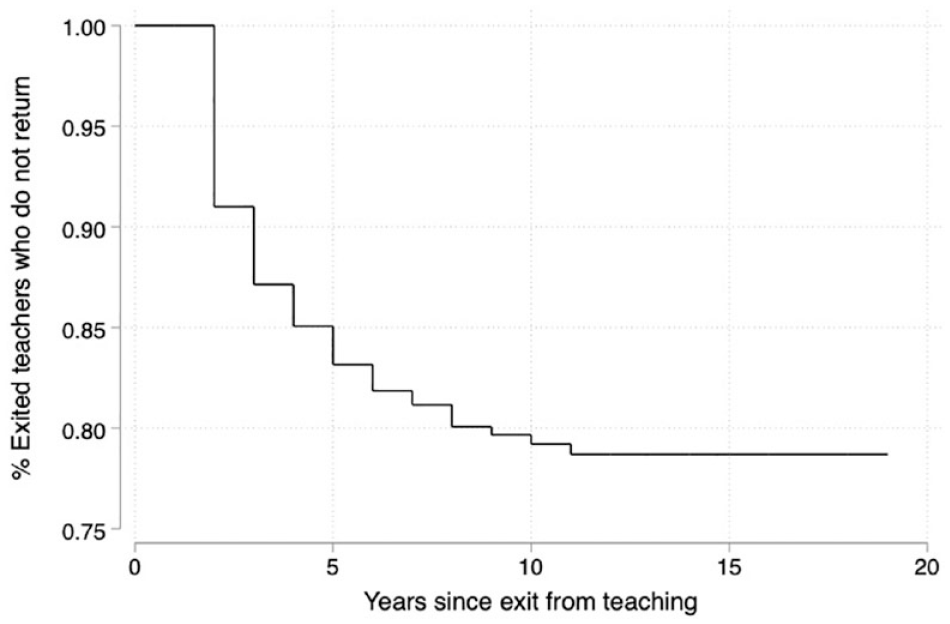
Kaplan-Meier survival function: Time to reentry for exiting teachers (n = 332).
I do not find evidence that teachers’ reentry patterns are related to gender or childrearing. Following Grissom and Reininger (2012), I model teachers’ time away from the profession as a function of personal, work, and family characteristics (Table 1). Model 1 includes personal characteristics such as gender, marital status, and age. The primary variable of interest—whether a teacher is female—is not significant at conventional levels. Model 2 adds covariates related to teachers’ work experiences (hourly income, part-time status, years of teaching experience, and a binary indicator for whether the exit took place before or after the Great Recession), and model 3 includes the number and ages of teachers’ children. Holding the covariates in these models constant, the relationship between teacher reentry and childrearing status remains statistically insignificant (p>.10). Notably, most of the variables that were significant in Grissom and Reininger’s analysis (2012) are not significant using the more recent cohort of NLSY; the only variables associated with return are an indicator for whether teachers have exited and reentered the profession previously and an indicator for part-time status (p< .10).
Cox Regression of Time to Reentry (All Exiting Teachers)
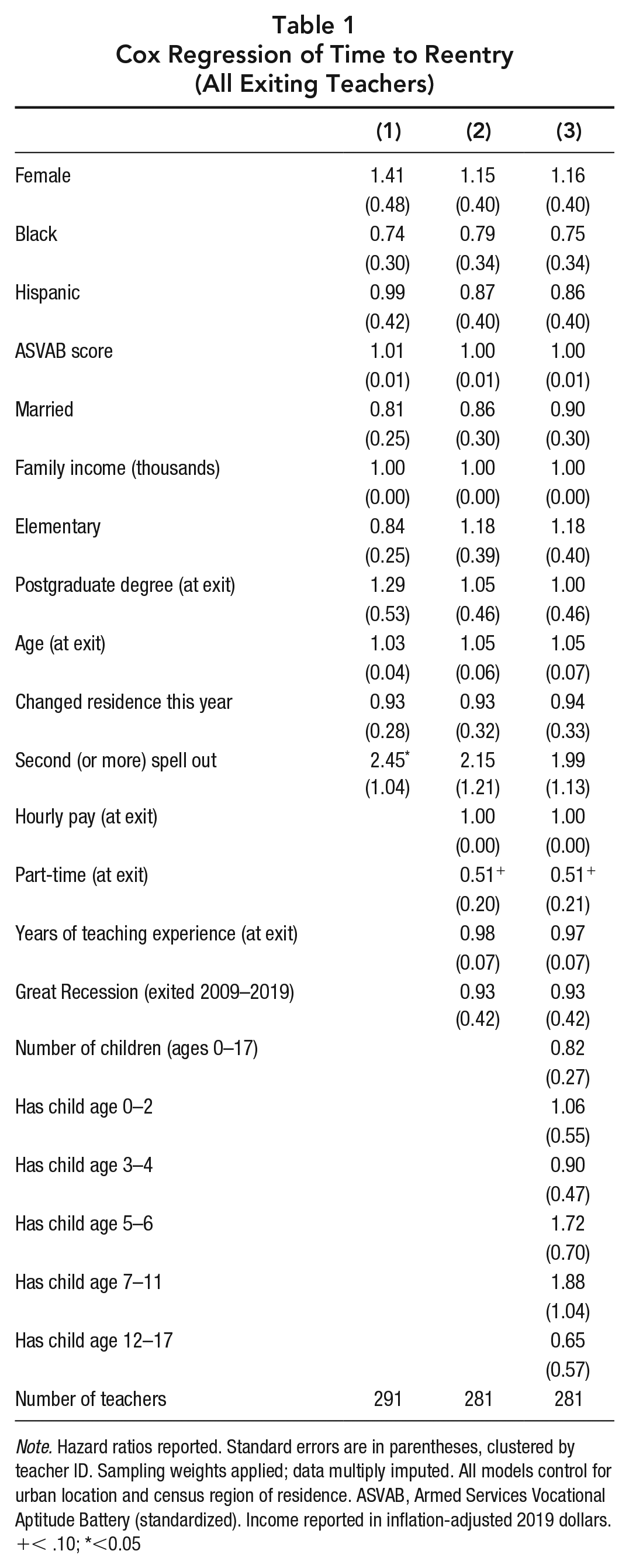
Note. Hazard ratios reported. Standard errors are in parentheses, clustered by teacher ID. Sampling weights applied; data multiply imputed. All models control for urban location and census region of residence. ASVAB, Armed Services Vocational Aptitude Battery (standardized). Income reported in inflation-adjusted 2019 dollars.
< .10; *<0.05
Conclusion
The results presented here suggest that teacher exit and reentry behavior is different today than it was in the past. Previous work by Grissom and Reininger (2012) finds that from 1980 to 2004, women—especially those with school-age children—were more likely to reenter the classroom. Revisiting this question using data from 2000 to 2019, I do not find evidence of a relationship between reentry and gender or childrearing status. This shift may reflect broader changes in society for working women as well as changes to teacher labor markets (e.g., credentialing, accountability, the Great Recession).
Importantly, I find substantially lower rates of reentry for teachers who exit compared to previous findings. While Grissom and Reininger (2012) estimate that about one-half of exiting teachers returned between 1980 and 2004, I estimate that only one-fifth of exiting teachers returned between 2000 and 2019. Given the positive relationship between teacher experience and effectiveness (Papay & Kraft, 2015), the profession may be losing more effective teachers without the hope of attracting them back. Further work should investigate why teachers are not returning to the classroom and how experienced teachers can be incentivized to return. Results from this study raise questions about the drivers of teacher exit and reentry such as the occupational opportunities available to former teachers. This includes the sectors they enter, their wages and benefits compared to teaching, and their long-term personal and professional goals.
Supplemental Material
sj-pdf-1-edr-10.3102_0013189X221122746 – Supplemental material for Has “Who Comes Back” Changed? Teacher Reentry 2000–2019
Supplemental material, sj-pdf-1-edr-10.3102_0013189X221122746 for Has “Who Comes Back” Changed? Teacher Reentry 2000–2019 by Anna Moyer in Educational Researcher
Footnotes

Notes
Author
References
Supplementary Material
Please find the following supplemental material available below.
For Open Access articles published under a Creative Commons License, all supplemental material carries the same license as the article it is associated with.
For non-Open Access articles published, all supplemental material carries a non-exclusive license, and permission requests for re-use of supplemental material or any part of supplemental material shall be sent directly to the copyright owner as specified in the copyright notice associated with the article.
