







Abstract
This article documents the expansion of corporate-sponsored tuition benefit (CSTB) programs from the managerial class to America’s low-wage workers and considers how the goals and design of CSTB programs square with those of college access programs. Because CSTBs simultaneously have the goals of college access, employee retention, and return on investment, I focus on variation in program components, including which workers are eligible, where benefits can be used, and what performance requirements exist to get and maintain the benefit award. I use ideal-type analysis to offer a typology of CSTBs found among large low-wage employers and outline potential research directions that can support college attainment, social mobility, and well-being for the low-wage workforce enrolled in CSTB programs.
In 2014, Starbucks made waves in both business and higher education when it announced the Starbucks College Achievement Plan (SCAP), an exclusive collaboration with Arizona State University through which employees received full-tuition coverage and access to online undergraduate programs. By the spring of 2022, SCAP had over 20,000 participants, and over 8,500 employees had earned college degrees (Nietzel, 2022). Target, Amazon, and other large corporations —together employing millions of U.S. workers—likewise have implemented corporate-sponsored tuition benefit (CSTB) programs with ranging levels of support for their employees.
These corporate investments are notable because they largely were introduced after the Obama administration made Section 127 of the Internal Revenue Code permanent in 2012, which for several decades had allowed employers to provide up to $5,250 of tax-free education assistance to each employee per year. 1 As large low-wage employers 2 responded to these tax incentives, CSTBs significantly expanded access to higher education for America’s 53 million low-wage workers, who comprise 44% of the total workforce. Seventy-eight percent of these low-wage workers have not completed a college degree (Ross & Bateman, 2019), underscoring the impact the expansion of employer-sponsored tuition benefit programs could have on the postsecondary attainment of millions of Americans.
I contribute to the field’s understanding of these new players in college access by reviewing research on the goals and design of employer-sponsored education assistance programs and considering how they square with the goals and design of college access programs. I then provide a descriptive overview of CSTB programs for low-wage workers among their 50 largest employers—corporations that have the financial resources to initiate these programs and thereby facilitate college access for a large swath of low-wage workers (National Employment Law Project [NELP], 2012). Because CSTBs simultaneously have the goals of college access, employee retention, and return on investment, I focus on variation in program components, including which workers are eligible, where benefits can be used, and what performance requirements exist to get and maintain the benefit award. I use ideal-type analysis (Stapley et al., 2022) to offer a typology of CSTBs and conclude by outlining potential research directions that can support college attainment, social mobility, and well-being for the low-wage workforce.
Background and Literature Review
The U.S. Low-Wage Workforce
The Brookings Institute defines low-wage workers as those earning less than two-thirds of the median full-time male worker wage (Ross & Bateman, 2019). This group earns an average hourly wage of $10.22 and an annual median wage of $17,950 and is composed of a diverse group of adults. Although many may assume low-wage workers are primarily young adults working summer or part-time jobs in the fast-food industry, just 24% of low-income workers are ages 18 to 24; the vast majority are over 25, with 28% being in the 25 to 34 age range (Ross & Bateman, 2019). The low-wage workforce is majority women (54%), and there is an overrepresentation of Hispanic or Latina/o/x and African American or Black adults (25% and 15%, respectively). Low-wage workers are also more likely to have profile characteristics associated with economic vulnerability: 6% report having a disability, 29% care for children, 30% are below 150% of the federal poverty line, and 26% are the sole earners in their families (Ross & Bateman, 2019).
Low-wage workers are concentrated in the service sector. The Bureau of Labor Statistics (2021) reported that 70% of those earning the minimum wage or less were employed in service occupations, and further analysis shows the low-wage workforce is mostly concentrated in just 10 occupations, the largest being retail sales (8%). Other large categories include food preparation (5%), building cleaning and pest control (5%), and food and beverage service (4%; Ross & Bateman, 2019). Those under 35 years old are substantially more likely to be in these retail and food service occupations.
Mobility and Opportunity for Low-Wage Workers
Prospects for upward socioeconomic mobility for low-wage workers have weakened over time. Just half of low-wage workers earn higher wages after 4 years, and overall, mobility rates out of low-wage work into higher wage work has declined since the 1990s (Schultz, 2019). Mobility and opportunities for promotion within internal labor markets have also declined (Schultz, 2019). Nevertheless, low-wage work outgrew middle-wage work between the 1980s and the 2010s (Dwyer & Wright, 2019), meaning Americans have been more likely to enter into low-wage employment in recent decades.
College degrees remain important for upward economic mobility (Creusere et al., 2019; Mountjoy, 2022), yet the majority (78%) of low-wage workers ages 18 to 65 have not completed college, and just 12% were enrolled in college while working (Ross & Bateman, 2019). Among the roughly 13 million 18- to 24-year-olds in the low-wage workforce, just 15% had completed a college credential, 30% were enrolled in school, and 55% were not enrolled in any schooling at all.
Barriers to Higher Education
Low-wage workers face a number of barriers to pursuing higher education. First among these is the reality that college costs have far outpaced wage growth (Carnevale et al., 2021). These increases have disproportionately burdened low-income students, for whom college net prices are on average 66% of family income (Dachelet, 2018). Given mostly stagnant state financial support for higher education and only modest increases in the Pell grant, the burden of paying for college has increasingly shifted toward families and individuals (National Education Association, 2022).
Additional barriers for low-income students include access to childcare (Navarro-Cruz et al., 2023), gaps in academic preparedness and college readiness (e.g., Duncheon, 2021), limited college knowledge and other information asymmetries (Page & Scott-Clayton, 2016), and geographical inequities in college access (Dache-Gerbino, 2018). Low-wage workers also contend with the practical challenges of working while enrolled. Researchers studying the lives of low-wage workers in the service sector have described how their employment is defined by poor working conditions, precarity, and unpredictability (e.g., Lambert et al., 2019). For example, The Harvard Shift Project 3 has tracked the scheduling practices and well-being of workers in the service sector using survey data from thousands of retail workers employed at large firms. They have shown how instability resulting from scheduling unpredictability is associated with financial instability, psychological distress, poor sleep quality, and unhappiness (Amorim & Schneider, 2022; Schneider & Harknett, 2019). Scheduling unpredictability may also make it challenging to enroll in college, particularly if courses are unavailable at convenient times or shifting work hours make it difficult to attend a regularly scheduled course.
Despite these barriers, there is what Goyette (2008) calls an “entrenchment of the ‘college-for-all’ norm” (p. 462) that may lead low-income youth and adults (Cottom, 2017; Rosenbaum, 2001) to maintain the belief that going to college is necessary and possible. Indeed, researchers have described how low-wage, part-time work “interferes with teenagers’ educational trajectories” (Ray, 2017, p. 9) and how despite the need to work, they pursue college as an “identity project” (DeLuca et al., 2017). Thus, low-wage workers of all ages may be at a period in their life where they might seriously consider enrolling or reenrolling in higher education.
College Access Programs for Low-Income Students
These barriers and opportunities underscore why college access and financial aid programs have been critical in increasing access to higher education for students from low-income and underresourced backgrounds. These programs have sought to tackle a range of barriers to college access and are delivered through such interventions as “promise” programs, college readiness programs, and efforts to reduce information barriers. A full review of all college access programs and their features is not within the scope of this article, but in sum, these programs have components aimed at reducing financial constraints, reducing informational asymmetries, and providing mentoring and coaching that facilitate college enrollment and success (Page & Scott-Clayton, 2016).
What is relevant to this study of corporate-sponsored tuition benefit programs for low-wage workers is the fact that these programs vary in program components, including eligibility criteria and requirements to maintain benefits. A review of 289 promise programs by Perna and Leigh (2018) found that award sponsor, award structure, type of institution where award can be used, and eligibility criteria were the key differentiating characteristics of promise programs. More specifically, college access programs may vary according to what financial support is included and how aid is distributed, for example, as first or last dollar awards, and what portion of tuition and fees is covered. Other programs may provide a more comprehensive array of financial support in the form of funds for books and transportation. Some programs also include requirements for participants to meet with coaches and advisors, with the belief that frequent, intrusive, and/or personalized contact improve students’ psychosocial outcomes (e.g., mattering and sense of belonging) and are essential for program success (Melguizo et al., 2021).
Employer-Sponsored Training and Benefits
Unlike college scholarship, financial aid, or college promise programs, employer-sponsored college benefit programs add a unique dimension to the college access program literature—employer expectations. Like employer-sponsored training, tuition benefit programs can be considered as a unique form of human capital investment. Firms subsidize the educational attainment and skill development of their employees to increase worker productivity, leadership, and talent (“upskilling”). Employers may also offer these benefits to attract and retain workers with a suite of competitive benefits and to improve worker morale. Accordingly, research shows corporations that offer tuition assistance programs have lower employee turnover (Benson et al., 2004; Cappelli, 2004). A study of Walmart’s Live Better U program found increased employee retention, promotion, and performance ratings among program participants (Glover, 2021). In contrast, a study of the U.S. Navy found that the introduction of tuition assistance programs reduced the likelihood that beneficiaries remained in the Navy by 16.5 percentage points (Buddin & Kapur, 2005).
One important consideration of employer-sponsored training and investment in human capital is the distinction between general and specific training (Acemoglu & Pischke, 1998; Becker, 1964; Loewenstein & Spletzer, 1999). Firms might not be interested in investing in the human capital of their workers through such programs as tuition benefits because the general skills acquired through a college education are transferable. If they make this investment, there is potential for employees to leave and for other firms to subsequently capture the benefits of workers’ increased skills. Some employer-sponsored training and tuition benefit programs are therefore limited to firm-specific training where employees acquire skills that are explicitly beneficial to the employer (e.g., business management).
Research on the benefits of general versus specific training, as provided via tuition benefit programs, is somewhat mixed. Analysis of a tuition assistance program for off-duty U.S. Navy personnel suggests that employers receive a return (e.g., increased retention) not just for firm-specific training but also for employer-financed general training (Garcia et al., 2002). Manchester (2012) showed that retention effects of a tuition reimbursement program at an academic institution were due to workers gaining firm-specific skills through employer-sponsored education. At the same time, employees using tuition reimbursement in fields unrelated to their jobs reported they were more likely to consider leaving their current roles and organizations (Pattie et al., 2006).
Irrespective of employer motivation, employees stand to benefit from tuition programs. Bednar and Gicheva (2013) found full-time graduate enrollment in public institutions among 24- to 30-year-old employed college graduates increased by about 8% in years when the tuition reimbursement tax exemption was available. Another study found changes to tax incentives for employer-sponsored assistance increased students’ options, with notable shifts in enrollment toward more open-access and for-profit institutions (Gilpin & Kofoed, 2020). Although Tran and Smith (2017) observed that less than 5% of community college students used employer assistance to support their studies, students who did receive this aid had significantly higher likelihood of persistence and retention after 3 years of follow-up.
Tuition Benefits for Low-Wage Workers
The research base also shows education benefits have largely been a perk for specific types of workers, such as the professional and managerial class or U.S. military servicemembers (Cappelli, 2004; U.S. Department of Education, 1999). The expansion of these benefits beyond the managerial class to frontline, low-wage workers suggests a potential shift or expansion in corporate needs, priorities, and values and may be a response to significant labor market trends. Indeed, competition in the low-wage market has increased since the COVID-19 pandemic (Autor et al., 2023), meaning employers may have had to offer additional benefits to recruit and retain low-wage workers. Because CSTBs are simultaneously college access and employee retention programs, it is important to understand the design of these programs. These dual goals may influence program design, including which workers are eligible, what requirements exist to get and maintain the benefit award, and what postsecondary opportunities are available. Although there has been much attention paid to the design features of college access policies and programs, including promise programs (Perna & Leigh, 2018), state financial aid programs (Custer & Akaeze, 2021), and college transition and support programs (Hallett et al., 2020), there is less research on the features of CSTB programs. Given these programs have recently expanded to include low-wage workers, I examine the characteristics and components of these programs with the goal of understanding how they are shaping and reshaping college access in the United States.
Data and Methods
I drew from the existing literature to construct a schema that captured the differentiating characteristics of CSTBs. Characteristics from the college access literature (e.g., Perna & Leigh, 2018) include access/eligibility, benefit structures, and academic requirements. Characteristics derived from the economics and human resource management literature include type of training (e.g., general vs. skill-specific), timing of the training within the employment relationship (e.g., early vs. later benefit start date; Waddoups, 2012), and employer performance requirements (Benson et al., 2004; Cappelli, 2004; Garcia et al., 2002).
I then reviewed company websites and press releases for information about CSTBs in the 50 largest low-wage employers compiled by NELP (2012). My focus on the top 50 low-wage employers in 2012 is intentional. At the time, 66% of all U.S. low-wage workers were employed in larger corporations with over 100 employees, and of the 50 largest employers, most were in strong financial positions; 75% had higher revenues than they did before the 2008 recession (NELP, 2012). As described previously, 2012 was also when the Obama administration made Section 127 of the Internal Revenue Code permanent, allowing employers to provide up to $5,250 of tax-free education assistance to their employees. CSTBs announced thereafter among these large employers of the low-wage workforce may reflect direct responses to this legislation and offer insight into how large, trend-setting corporations with national presence played a role in changing college opportunity for low-income workers.
The review of program requirements among these 50 large low-wage employers resulted in additional program features unique to CSTBs that I added to my schema, such as the presence of exclusive postsecondary partnerships (e.g., Arizona State University), whether these institutions were for-profit institutions, partnerships with intermediary organizations to administer the benefit program, instructional mode (e.g., online only), and additional performance requirements. The final schema allowed me to describe and compare differences across CSTBs and facilitated the development of a typology using ideal-type analysis (Stapley et al., 2022), which is described further in the following.
Findings
Of the 50 largest low-wage employers, 20 corporations (40%), reflecting a total of 22 employers, adopted a CSTB program between 2012 and 2023 (Yum! Inc. includes KFC, Taco Bell, and Pizza Hut, each with its own CSTB). At the time of writing, these 22 employers collectively employed over 4.5 million workers in over 100,000 locations. Their growth over time is depicted in Figure 1. Table 1 shows the 22 CSTBs and their differentiating characteristics.
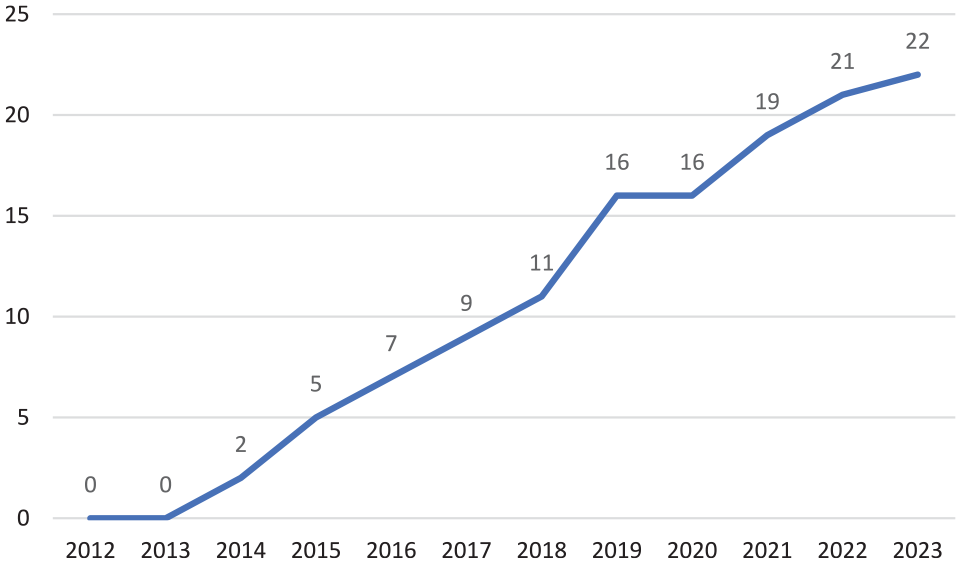
Total number of corporate-sponsored tuition benefit programs in the top 50 low-wage employers (National Employment Law Center, 2012).
Characteristics of Corporate-Sponsored Tuition Benefit Programs for Low-Wage Workers Among the 50 Largest Low-Wage Employers
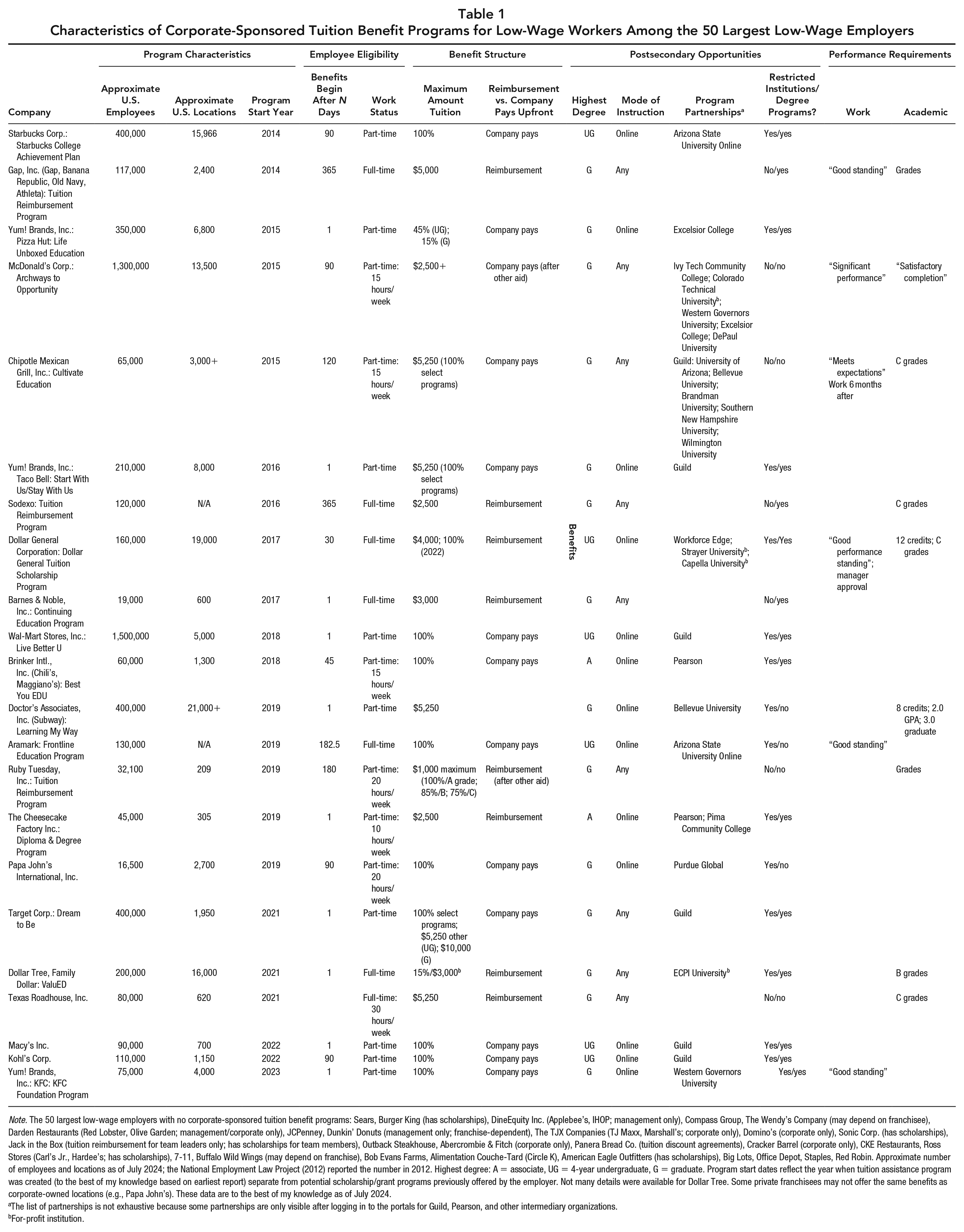
Note. The 50 largest low-wage employers with no corporate-sponsored tuition benefit programs: Sears, Burger King (has scholarships), DineEquity Inc. (Applebee’s, IHOP; management only), Compass Group, The Wendy’s Company (may depend on franchisee), Darden Restaurants (Red Lobster, Olive Garden; management/corporate only), JCPenney, Dunkin’ Donuts (management only; franchise-dependent), The TJX Companies (TJ Maxx, Marshall’s; corporate only), Domino’s (corporate only), Sonic Corp. (has scholarships), Jack in the Box (tuition reimbursement for team leaders only; has scholarships for team members), Outback Steakhouse, Abercrombie & Fitch (corporate only), Panera Bread Co. (tuition discount agreements), Cracker Barrel (corporate only), CKE Restaurants, Ross Stores (Carl’s Jr., Hardee’s; has scholarships), 7-11, Buffalo Wild Wings (may depend on franchise), Bob Evans Farms, Alimentation Couche-Tard (Circle K), American Eagle Outfitters (has scholarships), Big Lots, Office Depot, Staples, Red Robin. Approximate number of employees and locations as of July 2024; the National Employment Law Project (2012) reported the number in 2012. Highest degree: A = associate, UG = 4-year undergraduate, G = graduate. Program start dates reflect the year when tuition assistance program was created (to the best of my knowledge based on earliest report) separate from potential scholarship/grant programs previously offered by the employer. Not many details were available for Dollar Tree. Some private franchisees may not offer the same benefits as corporate-owned locations (e.g., Papa John’s). These data are to the best of my knowledge as of July 2024.
The list of partnerships is not exhaustive because some partnerships are only visible after logging in to the portals for Guild, Pearson, and other intermediary organizations.
For-profit institution.
Eligibility
Employees become eligible after their first day in 10 out of 21 (48%) CSTB programs for which I could find information. However, others required longer work tenures, such as Gap Inc., which extended benefits after 1 year of employment. Only full-time employees were eligible for tuition benefits in seven (32%) programs, and the rest appeared to be available to all part-time/hourly workers (some specifically excluded seasonal/temporary workers). Some specified minimum weekly work-hour requirements, ranging from 10 to 30 hours per week.
Benefits
Corporations varied in their college benefit structures and restrictions. Eleven (50%) CSTBs emphasized their “debt-free” education, offering to cover 100% of the cost of enrollment in select institutions/programs. Four CSTBs had benefits capped at $5,250, the maximum tax exemption. Other benefits ranged from $1,000 to $10,000 or a percentage of tuition. Ruby Tuesday made reimbursements based on grades earned (e.g., 75% for Cs). Although most covered tuition and fees only, nine (41%) also provided textbook support.
Out of 21 companies with available information, 13 (62%) paid tuition bills upfront, a best practice in the college access literature, and the rest used a reimbursement model. Some, like McDonald’s and Walmart, specifically mentioned that payments would be applied after other scholarships and grants were accounted for.
Postsecondary Opportunities
CSTBs often had stipulations about where benefits could be used. Employees of The Cheesecake Factory and Chili’s can only pursue associate’s degrees at partner 2-year colleges. Six (27%) CSTBs can only be used to pursue bachelor’s degrees. Fourteen (64%) can be applied up to the graduate level. With respect to instructional delivery, 13 (59%) CSTBs restrict their employees to enrollment in online programs.
Seventeen (77%) had exclusive postsecondary partnerships or a third-party provider. For example, KFC’s CSTB is through Western Governors University, and Dollar General partners with Bellevue University. Notably, six (27%) of the CSTBs were facilitated by Guild Education, a public benefit corporation bridging education and employment.
These partnerships may explain the prevalence of program and field of study restrictions across CSTBs. Fifteen (68%) CSTBs restrict the set of postsecondary institutions employees can attend. Fifteen (68%) have restrictions on eligible areas of study, with many only providing benefits for enrollment in programs related to employees’ work functions, such as management, human resources, or cybersecurity.
Performance Requirements
Six programs (27%) articulated employee performance requirements (e.g., KFC’s “good standing”) to maintain the award. Nine programs (41%) had academic performance requirements (e.g., Subway’s 2.0 GPA requirement). Two CSTBs (Subway and Dollar General) also had minimum credit-hour enrollment requirements. Not meeting performance requirements could result in losing the award or even needing to reimburse the company’s costs.
Other Features
Although I focused on consistently identifiable program components, other program features stood out. Two programs extended benefits to employees’ family members (Subway and Dollar General), and many advertised free coaching, tutoring, and advising services. Employers often also provided support for English language learners and GED completion as part of broader efforts to support employee development and wellness.
Toward a Typology of CSTBs
I then used ideal-type analysis, a method for constructing typologies from qualitative data, to group these CSTBs around common program features (Stapley et al., 2022). Pioneered by sociologist Max Weber (1904), an ideal type is “a description derived from observations of an empirical reality or a social phenomenon” (Stapley et al., 2022). Ideal type identification is useful for taking the initial steps in the analysis of new or understudied social phenomena (Swedberg, 2018).
I followed the seven-step procedure outlined in Stapley et al. (2022) to generate the typology. These are as follows (with researcher activities noted): (1) data familiarization (I collected CSTB data), (2) case reconstructions (I described each program and organized features into Table 2), (3) construction of ideal types (I systematically compared and contrasted each case to identify patterns in the data set, resulting in unique types), (4) identifying optimal cases (I selected the case that most closely illustrated each ideal type), (5) ideal-type descriptions (I generated a description that comprehensively illustrates each group), (6) credibility check (an independent researcher regrouped the cases into ideal types based on the descriptions), and (7) making comparisons (I summarized similarities and differences between and within groups).
Ideal-Type Analysis of Corporate-Sponsored Tuition Benefit (CSTB) Programs Among 50 Largest Low-Wage Employers
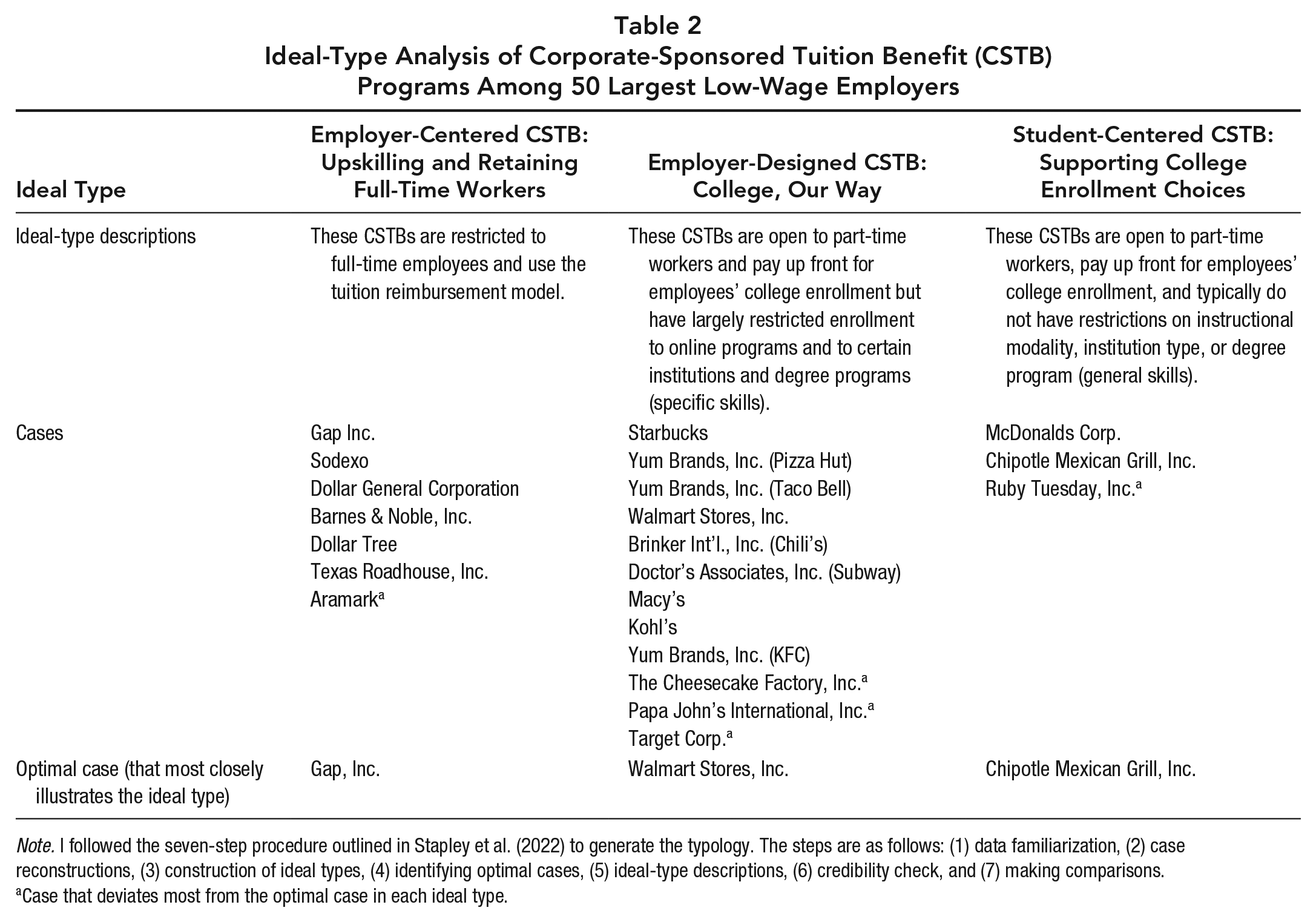
Note. I followed the seven-step procedure outlined in Stapley et al. (2022) to generate the typology. The steps are as follows: (1) data familiarization, (2) case reconstructions, (3) construction of ideal types, (4) identifying optimal cases, (5) ideal-type descriptions, (6) credibility check, and (7) making comparisons.
Case that deviates most from the optimal case in each ideal type.
Three ideal types emerged as I compared program characteristics across cases. These are distinguished primarily by employment eligibility requirements (full- vs. part-time), benefit structure (reimbursement vs. company sponsorship), and enrollment restrictions (online only; limited fields of study). The three ideal types are shown in Table 2 and presented on a range of most restrictive (and therefore more employer-centered) to least restrictive (and therefore more student-centered).
Employer-Centered CSTB: Upskilling and Retaining Full-Time Workers
These CSTBs were restricted to full-time employees and used the tuition reimbursement model. I see these as primarily beneficial to the employer who seeks to retain and upskill full-time employees while also making it somewhat costly for the employee to participate (n = 7).
Employer-Designed CSTB: College, Our Way
These CSTBs were offered to part-time employees. The company sponsored college enrollment upfront but restricted students to online-only programs and typically had restrictions on institutions and degree programs in which students could enroll (e.g., supporting specific training; n = 12). I see these as intending to offer opportunities for upskilling to part-time employees in areas that will ultimately serve the employer.
Student-Centered CSTB: Supporting College Enrollment Choices
These CSTBs were offered to part-time employees, and the company sponsored college enrollment upfront. There were few restrictions on instructional modality and eligible degree programs (e.g., permitting general training; n = 3). I see these as the most student-centered because they offer the most choice to students while also being accessible to most employees.
Discussion
Changes to the U.S. tax code in 2012 appear to have kickstarted the expansion of CSTB programs to U.S. workers in the low-wage workforce. Although none of the 50 largest employers of low-wage workers had a CSTB program in 2012, 22 of them had announced CSTBs by 2024, promising varying levels of support for the pursuit of postsecondary credentials for their employees. My ideal-type analysis reveals inherent tensions in the designs of these programs, as these corporations sought to balance employer needs with the goals of college access. The resulting typology of CSTBs describes three distinct types of programs and offers an important initial tool for exploring this new and understudied social phenomena.
Considering these observations, I call on scholars to develop a research agenda that further investigates CSTBs and their impact on educational opportunity and outcomes, long-term career trajectories and socioeconomic mobility, and overall quality of life for low-wage workers, including nonpecuniary outcomes. To start, future research should ask, “What is the impact of these programs on college access and attainment?” For example, in one of the few publicly available reports on CSTBs, in this case, Walmart’s Live Better U program, Glover (2021) observed relatively low participation rates since the program’s founding in 2018. Of Walmart’s 1.5 million employees, only about 30,000 were enrolled in the Live Better U program by 2021. Researchers should therefore examine how these programs are collectively moving the needle on college attainment at a broader scale and whether they are helping low-wage workers achieve upward mobility and reducing social inequality. These investigations, like previous research, can draw on data from national longitudinal studies, such as the National Postsecondary Student Aid Study, Beginning Postsecondary Study, and the National Longitudinal Survey of Youth (e.g., Faulk & Wang, 2014; Gilpin & Kofoed, 2020; Tran & Smith, 2017), and specifically try to identify participants of CSTBs in the low-wage workforce. Because corporations themselves may have the best data on CSTB participation and outcomes, they should consider working with education researchers to examine program effectiveness using proprietary data.
Another important research question is “What program characteristics help or hinder college enrollment and attainment for low-wage workers?” The typology of CSTB programs highlights the key differentiating characteristics of CSTB programs and can help guide research on the implications of these differences for workers’ opportunities and experiences. For example, because many of the CSTB programs have been designed to include both work expectations and academic requirements, researchers should examine why some workers do or do not take advantage of these programs and among those who do, how they navigate the complexity and challenge of work-school-life balance (e.g., Gagnon & Packard, 2012). This research could also explore the role of performance requirements in both the classroom and the workplace and in shaping participant experiences (e.g., Do managers use benefits as leverage to exploit employees?). My exploration shows that restricting benefit use to online-only programs may be one way employers are trying to support low-wage workers with unpredictable schedules, yet online programs have been shown to reduce the likelihood of college student success and progress (Bettinger et al., 2017; Ortagus et al., 2024). Some corporations also have partnerships with intermediary organizations (e.g., Guild) that administer the benefit programs, and my review of program features revealed these third-party providers tended to also offer coaching and advising to students as a part of their services. This is significant because personalized case management approaches have been shown to significantly improve persistence and degree completion, especially among low-income community college students (Evans et al., 2020). These and other CSTB program components invite further inquiry because they may add insight to the broader understanding of how to facilitate college enrollment and success for CSTB participants and low-income students in general.
Although this ideal-type analysis resulted in three unique types based on employee eligibility, benefit structures, and program restrictions, additional research on CSTB program components may lead to the identification of alternative ideal types, such as those that are aimed at employee recruitment (e.g., offering benefits on Day 1) or those that are particularly generous (e.g., providing 100% coverage). Table 1 also notes whether college-related benefits were available in corporations that did not offer a CSTB, such as college scholarships (e.g., Burger King, Sonic Corp.) and tuition benefits for those in management roles (e.g., Dunkin’ Donuts, Jack in the Box). Research can also examine how these approaches increase college opportunity for employees.
I also recognize the advent of these CSTBs for low-wage workers occurred during a time when college costs and affordability, free college, student loan debt relief, and the value of college were central topics in national discourse. This phenomenon invites scholarship that examines how private corporations are stepping in where public investment has fallen short. At the same time, CSTBs exist in tandem with other state and federal support for higher education, such as financial aid programs and traditional college access programs. Although I noted the financial benefit structure of each program in Table 1 (e.g., McDonald’s Archways to Opportunity provides a last dollar award after other financial aid is applied), future research can explore how private CSTBs operate in concert with public programs to facilitate college opportunity. Research could also compare the effectiveness of CSTBs with that of traditional college access programs.
Corporate messaging and the public pronouncements that ushered in CSTB programs also warrant critical discourse analysis. A cynical take on the rise of CSTBs among these large low-wage employers is that companies are using these programs to craft a positive social identity that distracts or counteracts their questionable records on wages and working conditions. Yet they are providing access to postsecondary education to millions of workers, some of whom might otherwise have limited opportunity and resources to pursue higher education. Thus, although low-wage labor has been described as a “trap” that keeps women and girls in poverty (Freeman & Dodson, 2022) and an obstacle to education for low-income youth of color (Ray, 2017), CSTB programs may also be transforming these places of employment into sites of increased possibility. Scholarship should therefore investigate how CSTBs for low-wage workers might both perpetuate and mitigate systemic inequities, especially among underserved and underresourced communities.
Researchers should also scrutinize the partnerships undergirding many CSTBs. I observed that some of the CSTBs have exclusive partnerships with for-profit institutions (e.g., Dollar Tree, Dollar General), which are potentially more accessible for low-wage workers but have low completion rates and have been described as predatory (Cottom, 2017; Deming et al., 2013). Furthermore, my schema of CSTB program characteristics revealed the outsize role of intermediary organizations (e.g., Guild) that are establishing and administering benefit programs between corporations and institutions of higher education (Fain, 2019). Additional research on these partnerships and how they originated and proliferated can draw inspiration and analytical insight from scholarship that has examined the role of external organizations (e.g., funders, education technology companies) in shaping education and education policy (e.g., Haddad, 2021; McCambly, 2024; McCambly & Colyvas, 2023; Nichols & Dixon-Román, 2024). Such critical scholarship might offer deeper insights into these linkages between private enterprise and higher education.
Conclusion
There has been significant and steady expansion of corporate-sponsored tuition benefits to America’s low-wage workers. This has provided access to higher education, but questions about whether they have increased college completion and for whom remain. Despite their promise, I also recognize that 60% of corporations did not provide employer-sponsored education assistance even after federal tax incentives were made permanent, and some programs have changed over time (e.g., Taco Bell announced Tacos & Tuition, a partnership with another provider, InStride, in 2025). Researchers must also simultaneously consider how significant shifts in the low-wage labor market due to changes in the minimum wage, increasing automation, changing consumer culture, and closures of several retailers and chains are now affecting not only employment opportunities but now also access to higher education for individuals at the margin of college and low-wage work.
