







Abstract
Although math motivation is positively associated with math achievement, the pattern reverses at the country level such that societies with higher motivational levels show lower achievement. This motivation-achievement paradox has puzzled researchers, and existing explanations have failed to fully account for the phenomenon. We advance and test a cultural explanation of the paradox using two large-scale studies. Both studies found that long-term orientation was negatively associated with country-level motivational factors but positively associated with national achievement (i.e., confounded the relationship between country-level motivation and achievement). When controlling for long-term orientation, the negative association between country-level motivation and achievement became nonsignificant. Our research highlights the importance of national culture, particularly long-term orientation, in shaping students’ motivational process and academic performance.
Keywords
Two motivational questions play fundamental roles in explaining students’ achievement-related performance: “Can I do this task?” and “Do I want to do the task, and why?” (Eccles & Wigfield, 2002). These two questions reflect individuals’ beliefs in their competencies (i.e., self-concept) and their beliefs about the value they attach to engaging in the task (i.e., task values), respectively. Recent meta-analytic reviews have found that students’ mathematics self-concept (r = .57) and task values (r = .50) were moderately correlated with mathematics achievement (Jansen et al., 2022; Moller et al., 2020), and those relationships are stronger than those observed for many other important correlates, such as cognitive ability and socioeconomic status (SES; Barroso et al., 2021; Chen & Li, 2014; Sirin, 2005).
Despite the strong positive association between motivation and achievement at the individual level, the opposite pattern emerges at the country level: Countries with higher levels of motivation have lower levels of achievement. This phenomenon is referred to as the “motivation-achievement paradox.” Researchers have consistently found negative correlations between country-level motivational factors (including math self-concept, intrinsic value, and utility value) and math achievement across different international large-scale assessments (ILSAs), indicating that the paradox is a robust, worldwide phenomenon (for details, see Supplemental Text in the supplemental materials available on the journal website; Mullis et al., 2016; OECD, 2016; Shen & Tam, 2008; Van de Gaer et al., 2012).
Existing Explanations of Motivation-Achievement Paradox
Previous research has mainly attempted to explain the motivation-achievement paradox from a measurement perspective or a social comparison perspective.
From the measurement perspective, researchers attribute the paradox to national differences in survey responses regarding scale usage. There is evidence that systematic national differences in response style exist, such as extreme versus midpoint response style, and overclaiming (respondents’ tendency toward self-enhancement independent of one’s ability; Chen et al., 1995; Cheung et al., 2018; Stigler et al., 1985). After adjusting for country-level response style, the motivation-achievement paradox became attenuated but did not disappear (He & Van de Vijver, 2016; Mullis et al., 2016). Thus, differences in response style alone cannot fully explain the motivation-achievement paradox.
The social comparison perspective explains the paradox based on the frame-of-reference effect (Van de Gaer et al., 2012). The frame-of-reference effect posits that students tend to perceive academic ability by comparing their own achievement with the achievement of their counterparts in the same school/class. Consequently, school-/class-level achievement has a negative effect on individual academic self-concept (Guo et al., 2018; Marsh & Hau, 2003; Parker et al., 2018). In a similar vein, researchers argue that students from higher performing countries tend to compare their achievement to peers who also perform well (within and beyond their immediate environment), which lowers their self-concept (Marsh et al., 2018). This social comparison explanation, however, faces challenges as well. Although social comparison processes clearly affect students’ self-concept within schools and classrooms, this is because students know their direct peers’ performance levels. It seems unlikely that students can accurately compare themselves with peers from their entire country because they typically lack direct awareness of national averages of achievement. Furthermore, the frame-of-reference explanation primarily concerns students’ self-concept and is less relevant to explaining negative correlations between country-level achievement and task values.
Culture as a Plausible Explanation
Given that the motivation-achievement paradox is found across different large-scale international assessments and is not entirely explained by national response style or social comparison processes, there is a need for alternative explanations. In this research, we investigate whether culture is a plausible explanation for the motivation-achievement paradox.
Past studies have hinted at the potential role of national culture in explaining the motivation-achievement paradox (for details, see M. Chen & Hastedt, 2022; He & Van de Vijver, 2016; Marsh et al., 2018; Mullis et al., 2016). After analyzing 20 years of Trends in International Mathematics and Science Study (TIMSS) results, Mullis and colleagues (2016) summarized that the motivation-achievement paradox is particularly prominent in East Asia and suspected that “East Asian TIMSS participants may share cultural values — for example, a hesitancy to declare that one ‘usually does well’ at any school subject — influencing the students’ responses.” (Similar assumptions have been made in other work; e.g., M. Chen & Hastedt, 2022; He & Van de Vijver, 2016; Marsh et al., 2018). However, these explanations have not been empirically tested, especially within a robust, multilevel statistical framework.
To our knowledge, the present study is the first to directly examine whether national cultural dimensions—operationalized through Hofstede et al. (2010) framework—can account for the paradox across countries using multilevel structural equation modeling and data from two major ILSAs (Programme for International Student Assessment [PISA] from 2012 and TIMSS from 2019). By doing so, we move beyond prior speculation and provide systematic, cross-national evidence that cultural values help explain the motivation-achievement paradox.
There are two underlying assumptions of the hypothesis that national culture could explain the motivation-achievement paradox. First, national culture influences both academic motivation and achievement. Second, to account for the negative relationship between country-level motivation and achievement, the effects of national culture on motivation and achievement must be in the opposite directions (see Figure 1). Specifically, if national culture has a positive influence on achievement, it should have a negative influence on motivation, thereby nullifying or at least reducing the observed motivation-achievement paradox. Methodologically, the cultural explanation of the paradox suggests that national culture is a confounder (“a variable related to two factors of interest that falsely obscures or accentuates the relationship between them”; Meinert, 1986, p. 285) for the motivation-achievement paradox.
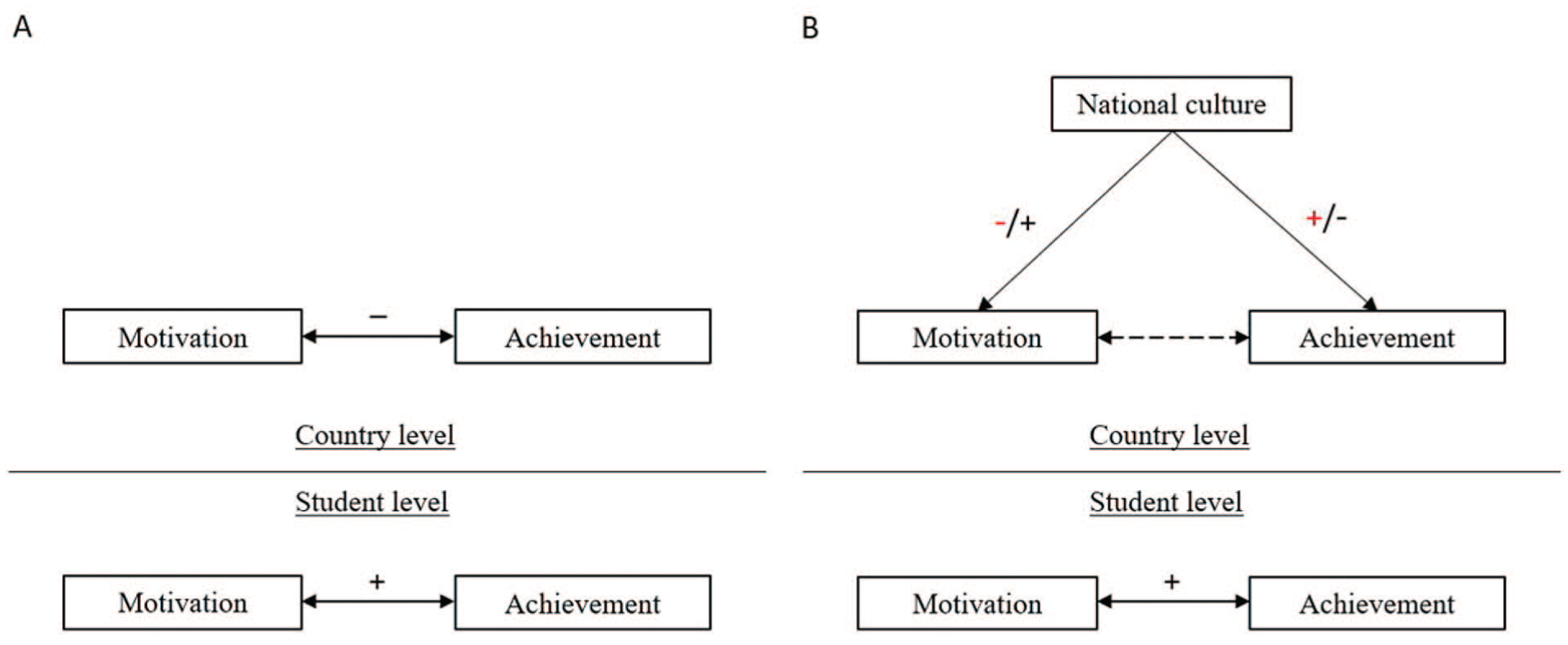
The hypothesized model.
Extant literature has provided evidence that national culture influences students’ academic performance. Hofstede et al. (2010) analyzed TIMSS 1999 and 2007 datasets and found that long-term orientation (i.e., the extent to which the society focuses on future-oriented values, e.g., perseverance and thrift) positively predicted national math achievement (for similar findings, also see Hu et al., 2018; Minkov, 2008). In contrast, uncertainty avoidance (i.e., the degree to which members of the society feel uncomfortable with ambiguity and uncertainty) was found to be negatively associated with academic performance (He et al., 2016).
Empirical studies examining the relations between national culture and student motivation, however, have been relatively scarce (King & McInerney, 2014). Recent studies showed that long-term orientation and other cultural dimensions (e.g., individualism-collectivism, uncertainty avoidance) were associated with students’ math anxiety and goal orientation in school learning (Guo et al., 2023; Lau et al., 2022). Although these studies provide initial insights into cultural effects on motivation, few studies have examined other motivational constructs, such as self-concept and task values, even though these are considered key determinants of academic performance and attainment (Eccles & Wigfield, 2002). Despite the lack of empirical evidence, descriptively, students in East Asian countries/regions (e.g., Hong Kong, Japan, Singapore, and South Korea) were found to achieve extraordinary academic performance but strikingly below-average self-concept and task values in ILSAs (Mullis et al., 2016; OECD, 2016). Given the well-documented impact of national culture on achievement, scholars suspected that shared cultural values might also influence motivation constructs (Mullis et al., 2016).
The Current Study
In light of these preliminary findings in the literature, the current study seeks to examine whether national culture contributes to the motivation-achievement paradox. Figure 1a depicts the motivation-achievement paradox: At the student level, motivation and achievement are positively associated; at the country level, however, motivation and achievement are negatively associated. Figure 1b further illustrates our hypothesis regarding how national culture can account for the motivation-achievement paradox. Specifically, we hypothesize that national culture is associated with both country-level math motivation (i.e., self-concept, intrinsic value, and utility value) and math achievement; importantly, the effects of national culture are expected to be in opposite directions, which accounts for the motivation-achievement paradox.
To represent national culture, we employed Hofstede et al. (2010) cultural dimensions—power distance, masculinity versus femininity (hereafter, “masculinity”), uncertainty avoidance, individualism versus collectivism (hereafter, “individualism”), and long- versus short-term orientation (hereafter, “long-term orientation”). We selected these dimensions for two reasons. First, Hofstede’s cultural framework has been widely used and extensively validated in education research contexts. Second, extant research has confirmed their associations with student math achievement and motivation (e.g., Chiu & Xihua, 2008; Guo et al., 2022; He et al., 2016; Hofstede et al., 2010; Hu et al., 2018).
Methods
Participants
The main data were from the PISA 2012 and TIMSS 2019 databases, both of which used a complex two-stage sampling method to ensure the samples were nationally representative in each participating country/region (Mullis et al., 2016; OECD, 2013). Additionally, data on national culture of uncertainty avoidance, individualism, and long-term orientation were obtained from Hofstede et al. (2010) database; data on national gross domestic product (GDP) per capita purchasing power parity (PPP) were from the International Monetary Fund (https://www.imf.org/external/datamapper).
To combine the databases, only those countries and regions participating in the PISA 2012 and/or TIMSS 2019 and with available data on cultural values and GDP per capita were included. As a result, 423,553 15-year-old students from 16,521 schools in 53 countries/regions and 199,646 eighth graders from 6,742 schools in 33 countries/regions were retained for the PISA 2012 and TIMSS 2019 analyses, respectively.
Measures
For the PISA 2012 sample, student math achievement was derived from the PISA math test, which assessed “an individual’s capacity to formulate, employ, and interpret mathematics in a variety of contexts” (OECD, 2013, p. 17). PISA provides five plausible values (PVs) of math achievement for each student, which were included in the analysis simultaneously.
Motivational factors for PISA 2012 were selected from the student contextual questionnaire. All motivational items were based on a 4-point Likert scale ranging from strongly disagree to strongly agree. All responses were recoded so that higher scores represented higher values on the underlying constructs. Math self-concept measured students’ perception of their competencies in math (e.g., “I learn mathematics quickly”). Both intrinsic and utility values were considered in this study. The math interest scale assessing the enjoyment students gain from learning math was used to represent intrinsic value (e.g., “I enjoy reading about mathematics”), and the instrumental motivation for math scale assessing how learning math fits into students’ future plans and objectives was used as a measure of utility value (e.g., “I will learn many things in mathematics that will help me get a job”).
Student math achievement for TIMSS 2019 was derived from the TIMSS math assessment, which is designed to measure student math competence in both subject matter and thinking processes. Five PVs of math achievement provided by TIMSS were all included in our analysis. The students confident in math scale (nine items; e.g., “I usually do well in mathematics”), students like learning math scale (nine items; e.g., “I enjoy learning mathematics”), and students value math scale (nine items; e.g., “I think learning mathematics will help me in my daily life”) derived from the TIMSS 2019 contextual questionnaire were used to represent self-concept, intrinsic value, and utility value, respectively.
National culture was operationalized based on the cultural dimensions from Hofstede et al. (2010) database, which include power distance (the extent to which the less powerful people within a society expect and accept that power is distributed unequally), individualism (the extent to which the society places priority on personal goals over the goals of collectives), masculinity (the distribution of dominant values between females and males), uncertainty avoidance (the extent to which people of the society feel uncomfortable with ambiguity and uncertainty), and long-term orientation (the extent to which the society focuses on future-oriented values). In this study, higher scores reflected stronger endorsement of each respective dimension.
Three covariates were included in the analysis: student gender, family SES, and national economic development. Student gender (0 = female; 1 = male) and family SES were selected from the PISA 2012/TIMSS 2019 contextual questionnaires, and log-transformed GDP per capita PPP from the International Monetary Fund (https://www.imf.org/external/datamapper) was used to represent national economic development.
Data Analysis
Because the PISA and TIMSS data have a complex structure with students nested within schools and clustered into countries/regions, three-level multilevel modeling was employed in our analysis. Specifically, we applied multilevel structural equation modeling (MSEM; Preacher et al., 2010), which offers several advantages for appropriately testing relationships at different hierarchical levels. MSEM partitions the variance of achievement and motivational variables at different levels (individual, school, and country/region) and allows for testing structural relationships simultaneously at each level. Critically, we employed a latent aggregation approach rather than manifest aggregation. In conventional multilevel modeling, country-level constructs are typically created by simply averaging individual-level scores within countries, which can introduce substantial sampling error. This sampling error can bias parameter estimates, particularly for between-group relationships. The latent aggregation approach in MSEM explicitly models this sampling error by treating country-level constructs as latent variables indicated by their individual-level components, thereby producing statistically appropriate estimates of country-level associations (Lüdtke et al., 2008). Mplus (Version 7; Muthén & Muthén, 2012) was used in the analysis with the robust maximum likelihood estimator. Multilevel mediation analyses based on the approach by Krull and MacKinnon (2001) were specifically employed to test whether national culture serves as a confounder explaining the country-level motivation-achievement relationship.
Multiple imputation was used to handle student-level missing data, with 10 data sets imputed. To account for the five PVs of student math achievement, each PV was paired with two imputed data sets. Each imputed data set was analyzed separately, and then the results were combined using Rubin’s (1987) strategy to produce unbiased parameter estimates and standard errors. All continuous variables (i.e., uncertainty avoidance, individualism, long-term orientation, self-concept, intrinsic value, utility value, and math achievement) were z-scored (M = 0, SD = 1) to obtain the standardized regression effects.
Results
By leveraging PISA 2012 data that involved 423,553 15-year-old adolescents from 16,521 schools of 53 countries/regions, we first examined whether the motivation-achievement paradox in math remained after controlling for both country- and individual-level covariates (i.e., GDP per capita, gender, and family SES) in three-level multilevel models. At the national level, all of the motivational factors had negative associations with achievement (self-concept: β = −0.286, SE = 0.143, 95% confidence interval [CI] = [–0.567, –0.006]; intrinsic value: β = −0.348, SE = 0.165, 95% CI = [–0.672, –0.023]; utility value: β = −0.424, SE = 0.122, 95% CI = [–0.663, –0.184]). Conversely, at the individual level, three math motivational factors all positively predicted math achievement (self-concept: β = 0.344, SE = 0.012, 95% CI = [0.322, 0.367]; intrinsic value: β = 0.176, SE = 0.009, 95% CI = [0.159, 0.193]; utility value: β = 0.143, SE = 0.009, 95% CI = [0.126, 0.160]).
Given the existence of the motivation-achievement paradox, we further investigated whether national culture was associated with math motivation and achievement—a prerequisite for examining culture as a confounder between country-level achievement and motivation. We conducted partial correlational analyses to examine the relations between Hofstede’s national cultural dimensions (power distance, uncertainty avoidance, masculinity, individualism, and long-term orientation) and country-level math motivation and achievement, controlling for country- and individual-level covariates (i.e., GDP per capita, gender, and family SES). The results (Table 1) showed that individualism was negatively correlated with intrinsic value (r = −.362, p = .008). Uncertainty avoidance had negative correlations with math achievement (r = −.310, p = .024), intrinsic value (r = −.436, p = .001), and utility value (r = −.403, p = .003). Long-term orientation was positively correlated with math achievement (r = .585, p < .001) but negatively correlated with all three motivational factors (self-concept: r = −.484, p < .001; intrinsic value: r = −.339, p = .013; and utility value: r = −.606, p < .001). All other correlations between national culture and achievement and motivation were nonsignificant. Because power distance and masculinity were not correlated with any motivational factors and achievement, they were excluded from further analyses.
Correlation Matrix Between National Culture and Students’ Achievement and Motivational Variables
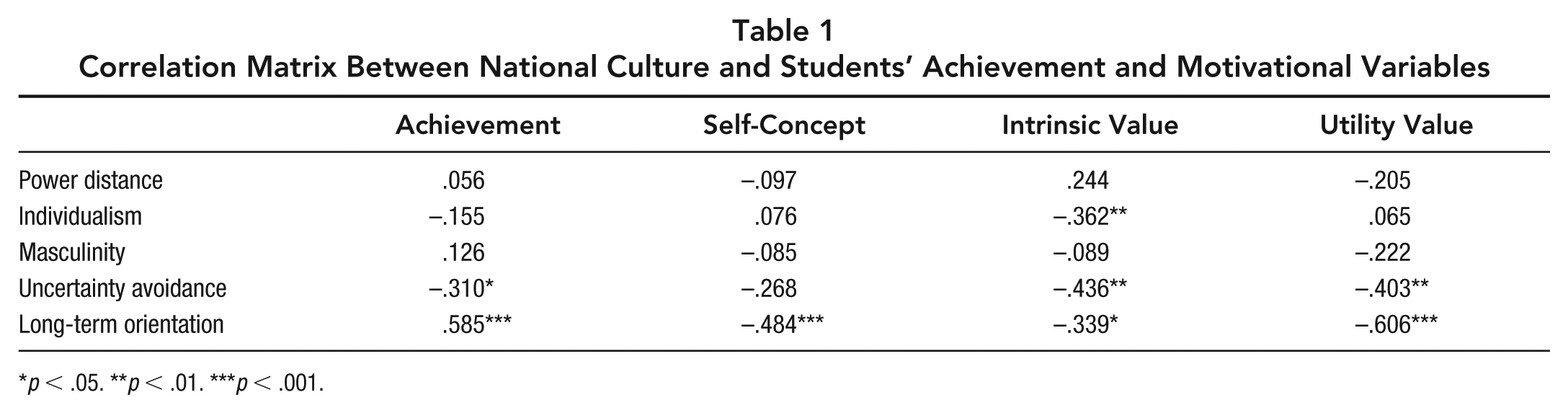
p < .05. **p < .01. ***p < .001.
Next, we fitted multilevel models for math achievement, self-concept, intrinsic value, and utility value separately to test the relations between national culture and achievement motivation. In these models, each dependent variable was regressed on uncertainty avoidance, individualism, and long-term orientation, controlling for country- and individual-level covariates (see Table 2). Results showed that individualism (β = −0.015, SE = 0.108, 95% CI = [–0.226, 0.196]) or uncertainty avoidance (β = −0.247, SE = 0.146, 95% CI = [–0.532, 0.039]) had no associations with math achievement, whereas long-term orientation positively predicted math achievement (β = 0.508, SE = 0.095, 95% CI = [0.323, 0.693]). Individualism had no associations with self-concept (β = −0.234, SE = 0.129, 95% CI = [–0.488, 0.019]), whereas uncertainty avoidance (β = −0.499, SE = 0.107, 95% CI = [–0.708, –0.290]) and long-term orientation (β = −0.420, SE = 0.119, 95% CI = [–0.654, –0.186]) both negatively predicted self-concept. The three cultural factors all negatively predicted intrinsic value (individualism: β = −0.469, SE = 0.093, 95% CI = [–0.651, –0.287]; uncertainty avoidance: β = −0.437, SE = 0.099, 95% CI = [–0.632, –0.243]; long-term orientation: β = −0.390, SE = 0.094, 95% CI = [–0.576, –0.205]). For utility value, uncertainty avoidance (β = −0.417, SE = 0.107, 95% CI = [–0.626, –0.208]) and long-term orientation (β = −0.579, SE = 0.076, 95% CI = [–0.728, –0.430]) negatively predicted utility value, whereas individualism was not significantly associated (β = −0.102, SE = 0.116, 95% CI = [–0.329, 0.126]).
Results of Multilevel Analysis Predicting Achievement and Motivational Variables Using PISA 2012 Data
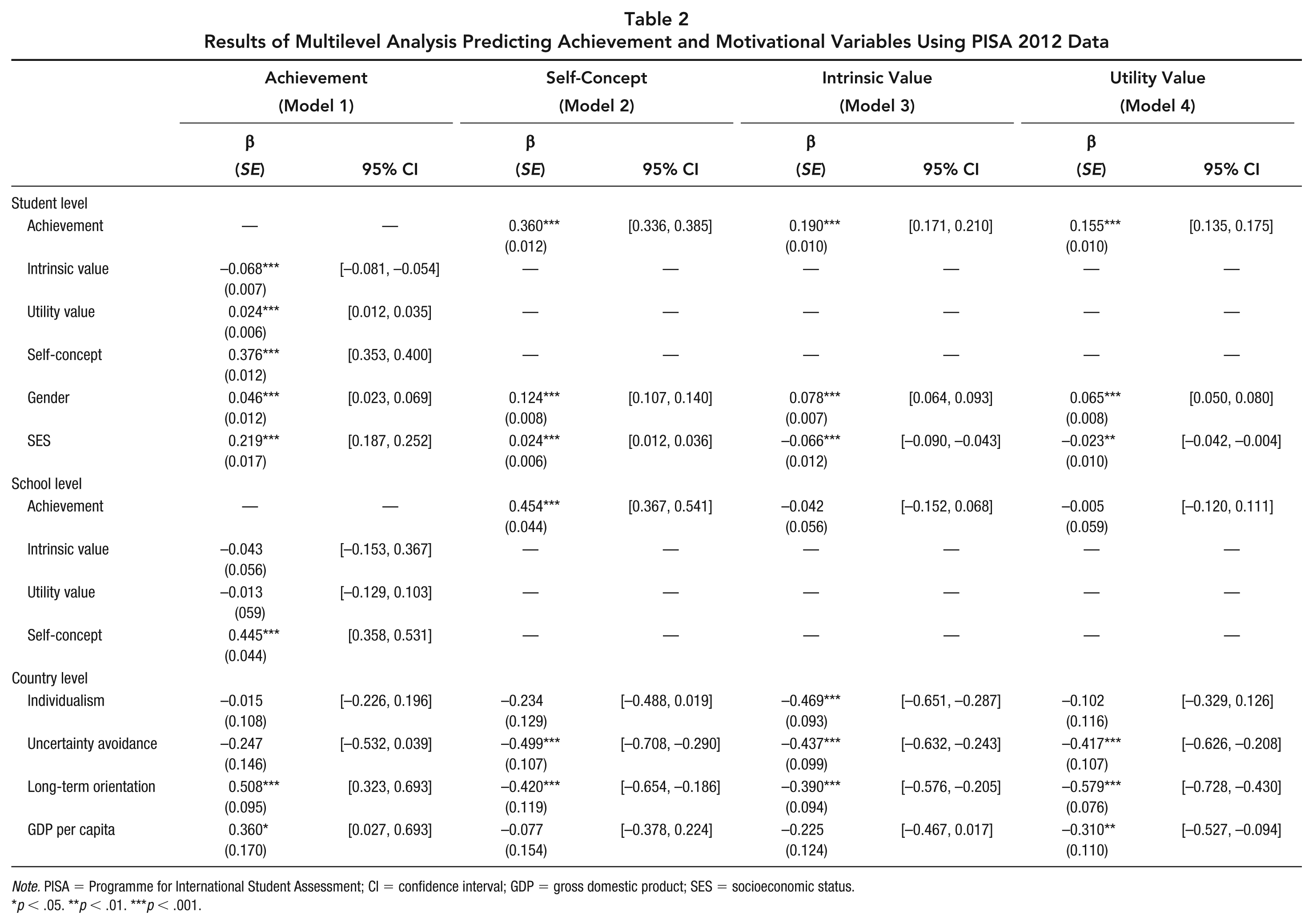
Note. PISA = Programme for International Student Assessment; CI = confidence interval; GDP = gross domestic product; SES = socioeconomic status.
p < .05. **p < .01. ***p < .001.
To summarize, long-term orientation was the only cultural dimension that had statistically significant associations with motivational factors and achievement. Importantly, the associations were in the opposite direction—long-term orientation was negatively associated with motivation but positively associated with achievement. Therefore, long-term orientation met the criteria required for serving as a potential confounder of the motivation-achievement paradox, which was further examined in the next step.
To examine this further, we first included long-term orientation as an additional predictor in the models where the three math motivational factors were used to predict math achievement (Tables S1–S3, available on the journal website). After adding long-term orientation to these models (controlling again for all previous covariates), the associations between country-level math motivational factors and achievement disappeared (self-concept: β = −0.096, SE = 0.124, 95% CI = [–0.340, 0.147]; intrinsic value: β = −0.158, SE = 0.145, 95% CI = [–0.443, 0.126]; utility value: β = −0.166, SE = 0.149, 95% CI = [–0.459, 0.127]). This indicates that long-term orientation is a potential confounder associated with the motivation-achievement paradox.
To provide a stringent test of confounding biases, we conducted additional multilevel mediation modeling where long-term orientation was treated as a mediator because the test of confounder bias is statistically equivalent to the test of mediation (MacKinnon et al., 2000). The mediation analyses (Table 3) showed statistically significant confounder bias (statistically equivalent to the indirect effects in multilevel mediation analysis) of long-term orientation on the relations between country-level motivation and achievement (self-concept, Table 3, Model 1: β = −0.196, SE = 0.078, 95% CI = [–0.349, –0.044]; intrinsic value, Table 3, Model 2: β = −0.187, SE = 0.074, 95% CI = [–0.332, –0.042]; utility value, Table 3, Model 3: β = −0.250, SE = 0.095, 95% CI = [–0.436, –0.063]). Full results of the multilevel mediation analysis are shown in Tables S1 through S3, available on the journal website.
Results of Multilevel Mediation Analysis Predicting Achievement Using PISA 2012 Data
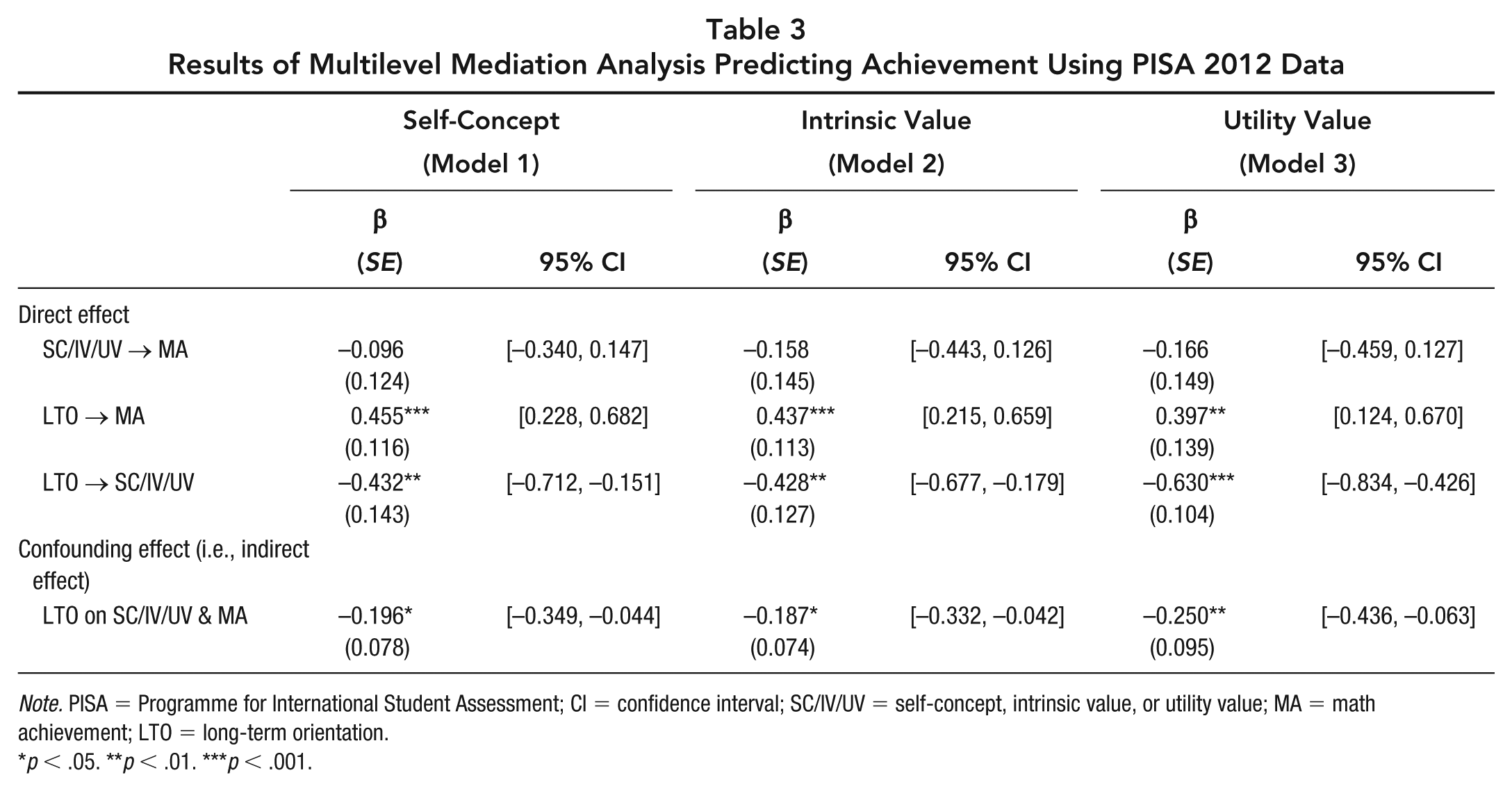
Note. PISA = Programme for International Student Assessment; CI = confidence interval; SC/IV/UV = self-concept, intrinsic value, or utility value; MA = math achievement; LTO = long-term orientation.
p < .05. **p < .01. ***p < .001.
Replication Study With TIMSS 2019 Data
To test the robustness of our findings, a replication study was conducted using the TIMSS 2019 data set (Grade 8 students). A total of 199,646 eighth graders from 6,742 schools in 33 countries/regions were involved in this study. Results of multilevel models predicting math achievement and motivation with national culture are shown in Table S4, available on the journal website. Results showed that neither individualism (β = −0.048, SE = 0.101, 95% CI = [–0.246, 0.149]) nor uncertainty avoidance (β = −0.177, SE = 0.115, 95% CI = [–0.403, 0.049]) showed an association with math achievement, whereas long-term orientation was positively related to math achievement (β = 0.706, SE = 0.114, 95% CI = [0.484, 0.929]). Regarding motivational factors, individualism and uncertainty avoidance showed no associations with self-concept (individualism: β = 0.106, SE = 0.126, 95% CI = [–0.141, 0.353]; uncertainty avoidance: β = −0.030, SE = 0.180, 95% CI = [–0.383, 0.322]), and long-term orientation negatively predicted self-concept (β = −0.604, SE = 0.108, 95% CI = [–0.815, –0.393]). Individualism and long-term orientation both negatively predicted intrinsic value (individualism: β = −0.356, SE = 0.102, 95% CI = [–0.556, –0.155]; long-term orientation: β = −0.366, SE = 0.116, 95% CI = [–0.593, –0.139]), and uncertainty avoidance had no association with intrinsic value (β = −0.271, SE = 0.140, 95% CI = [–0.546, 0.003]). For utility value, both individualism and uncertainty avoidance had no association with utility value (individualism: β = −0.131, SE = 0.101, 95% CI = [–0.328, 0.067]; uncertainty avoidance: β = −0.092, SE = 0.148, 95% CI = [–0.383, 0.198]), whereas long-term orientation negatively predicted utility value (β = −0.667, SE = 0.092, 95% CI = [–0.846, –0.488]).
When we controlled for long-term orientation, the negative association between country-level motivation and achievement became nonsignificant (self-concept: β = −0.214, SE = 0.147, 95% CI = [–0.502, 0.073]; intrinsic value: β = −0.034, SE = 0.152, 95% CI = [–0.332, 0.264]; utility value: β = −0.202, SE = 0.233, 95% CI = [–0.658, 0.254]). Results of confounding analyses for self-concept, intrinsic value, and utility value are shown in Table S5 (available on the journal website) in Models 1, 2, and 3, respectively. Long-term orientation significantly confounded the relations between country-level motivational factors and achievement (self-concept: β = −0.374, SE = 0.120, 95% CI = [–0.610, –0.138]; intrinsic value: β = −0.349, SE = 0.113, 95% CI = [–0.570, –0.127]; and utility value: β = −0.419, SE = 0.158, 95% CI = [–0.729, –0.109]). Therefore, the findings again supported the proposition that long-term orientation was a confounding factor statistically associated with the seemingly paradoxical relationship (for details, see Tables S6–S8, available on the journal website).
Discussion
The aim of this study was to examine whether national culture can explain the motivation-achievement paradox in math. Analyses of the PISA 2012 data set with 53 countries/regions revealed a paradoxical, negative relationship between motivational factors and academic performance at the country level. Importantly, we identified national long-term orientation as a key cultural factor associated with this paradox: It negatively predicted country-level math motivation (i.e., self-concept, intrinsic value, and utility value) while positively predicting country-level math achievement. Furthermore, we replicated these findings using the TIMSS 2019 data set (Grade 8 students from 33 countries/regions), confirming the robustness of our results across student populations, time points, and international student assessment frameworks.
This study has several methodological strengths. First, we leveraged multiple large-scale and nationally representative samples from 73 countries/regions, comprising 889,400 students (for details, see Table S9, available on the journal website). Second and relatedly, we demonstrated the robustness of our findings by replicating findings across diverse populations (15-year-olds, Grade 8 students) and across data collected independently by different ILSA organizations. Third, we tackled the motivation-achievement paradox through the test of potential confounder bias of national culture. Specifically, the use of multilevel mediation analysis (statistically equivalent to multilevel confounding tests) allows for quantifying the size of the confounding effects, monitoring the structural relationships at different levels, controlling for lower-level covariates, and producing more accurate estimations (Krull & MacKinnon, 2001). Altogether, these methodological strengths underscore the reliability and robustness of our findings.
Our findings have important theoretical contributions and practical implications. First, we contribute to cross-cultural psychology and education by providing empirical evidence regarding critical educational outcomes associated with national culture—student academic motivation and achievement. In line with previous studies (e.g., Hofstede et al., 2010; Hu et al., 2018), we found long-term orientation was positively related to country-level achievement in mathematics. However, we also provided novel evidence suggesting national cultural associations with math motivation dimensions. For instance, individualism had a negative association with intrinsic value. A plausible reason might be that students from individualistic societies tend to “express one’s internal needs, rights, and capacities and to withstand undue social pressure” (Markus & Kitayama, 1991, p. 240). Meanwhile, math learning seems unlikely to be an internal incentive and more socially desired, which could be supported by the fact that students’ math intrinsic value decreases during childhood and adolescence worldwide (Gottfried et al., 2007). Thus, compared to students from collectivistic societies, those from individualistic countries/regions might value other things or other subjects more than math learning. In addition, uncertainty avoidance negatively predicted both intrinsic value and utility value. This may be because in societies with higher uncertainty avoidance, safety or security is likely to be prioritized over other needs (Hofstede et al., 2010), and higher level needs (e.g., cognitive needs) are accorded lower priority. Importantly, our analyses consistently found long-term orientation was negatively associated with students’ math motivation. The negative associations between long-term orientation and all three types of motivation—including utility value—may suggest that in highly long-term-oriented cultures, academic effort is often perceived as a normative duty rather than a personally meaningful investment. Even when students recognize the long-term usefulness of math, their endorsement may reflect external obligation rather than internal value. As such, their self-reported utility value may be lower not because they do not see its usefulness but because their motivational framing emphasizes compliance and sacrifice rather than agency and autonomy. An alternative explanation might be that highly long-term-oriented societies place more emphasis on future-oriented values (e.g., perseverance), within which, students tend to study hard to achieve academic success at the expense of pleasurable learning experience, contributing to their relatively low motivational values and beliefs (Leung, 2001). Together, the findings suggest that national culture is associated with students’ motivational process.
Second, we reveal the important role of national culture in the motivation-achievement paradox. Moving beyond previously dominant explanations (response style and frame-of-reference comparisons), our results demonstrate that the paradox is partially due to opposing associations of long-term orientation with country-average math motivation and achievement. This opposite relation might be explained by the fact that long-term-oriented societies foreground the virtues of planning, investing in the future, and delaying gratification (Hofstede, 2001). In long-term-oriented societies, a student may not really enjoy learning math (low intrinsic value) and see himself/herself as good at math (low self-concept) but still work hard to achieve because this is what is needed to succeed in the future. However, in a more present-oriented (short-term oriented) culture, a student tends to rely on high levels of inner motivational beliefs (e.g., high self-concept and value) to achieve in math. Thus, cultural differences in long-term orientation contribute substantially to the paradoxical relationship observed at the national level.
These insights have specific implications for policymakers and educators. When seeking to borrow educational practices from other high-performing countries (i.e., transferring practices from one society to another, aimed at improving the educational systems in the later society), educational policy and practice should take national cultural contexts seriously (Steiner-Khamsi, 2004). Rather than simply importing strategies and practices, each nation should evaluate its own unique educational and cultural characteristics carefully for promoting culturally appropriate student motivation and performance. Furthermore, although some research suggests the effectiveness of culturally sensitive educational interventions, such as cultural priming (Oyserman & Lee, 2008), a beneficial avenue could be examining whether the manipulation of students’ cultural values contributes to improving their achievement and motivational profiles.
This study has several limitations. First, although Hofstede’s cultural typology was employed in this study, it has been critiqued for not considering the flexible, changing, and sometimes hybrid nature of culture (e.g., McSweeney, 2002) and for being nonspecific to education (Signorini et al., 2009). Future research might consider alternative or complementary models of culture (e.g., Gelfand et al., 2011; Nisbett & Miyamoto, 2005; Schwartz, 1994) to capture more nuanced and dynamic cultural influences on education outcomes. Second, sample bias may have existed in this study because PISA and TIMSS data comprised relatively fewer developing countries (especially African countries; see Figures S1 and S2, available on the journal website). Thus, caution should be exercised when using the findings to explain the situation in countries not included in this study. Third, although this study demonstrates the explanatory value of national cultural dimensions in explaining the motivation-achievement paradox in math, it falls short of examining cultural values at the individual level due to data set constraints. Future research could incorporate individual-level measures of values (e.g., Schwartz, 1994) to explore intracultural variation and provide further insights into the role of values in students’ learning. Fourth, PISA and TIMSS databases lack the direct measures for disentangling cultural values from national differences in response scale usage preferences. Future ILSAs may benefit from using newer methodological tools, including advances in natural language processing, to detect and adjust for national scale usage preference in surveys. Last, although our analyses reveal robust associations between national cultural dimensions and the motivation-achievement paradox, the cross-sectional and secondary nature of the ILSA data limits our ability to make definitive causal inferences. Although cultural values are generally considered stable societal characteristics, it remains possible that reciprocal or bidirectional relationships with education outcomes evolve over time. To better understand the underlying mechanisms and test causal pathways, future research should employ longitudinal designs, experimental methods, or quasi-experimental approaches (e.g., instrumental variables) and consider incorporating historical cultural data to assess temporal dynamics.
To conclude, by leveraging the PISA 2012 data set involving 423,553 15-year-old adolescents from 53 societies and the TIMSS 2019 data set involving 199,646 Grade 8 students from 33 societies, this study demonstrated that national culture—specifically long-term orientation—significantly accounts for (i.e., confounds) the paradoxical country-level negative relationship between math motivation and achievement. Overall, this study illustrates the explanatory power of national cultural dimensions as critical factors in global education phenomena and emphasizes the importance of national contexts for shaping student and motivational processes and academic performance worldwide.
Supplemental Material
sj-pdf-1-edr-10.3102_0013189X251370677 – Supplemental material for A Cultural Explanation of Motivation-Achievement Paradox in Math
Supplemental material, sj-pdf-1-edr-10.3102_0013189X251370677 for A Cultural Explanation of Motivation-Achievement Paradox in Math by Xiang Hu, Jiesi Guo, Ronnel B. King and Frederick K. S. Leung in Educational Researcher
Footnotes

Notes
Authors
References
Supplementary Material
Please find the following supplemental material available below.
For Open Access articles published under a Creative Commons License, all supplemental material carries the same license as the article it is associated with.
For non-Open Access articles published, all supplemental material carries a non-exclusive license, and permission requests for re-use of supplemental material or any part of supplemental material shall be sent directly to the copyright owner as specified in the copyright notice associated with the article.
