







Abstract
Under federal law, the families of students classified as English learners (ELs) have the right to waive EL services. When students waive services, they typically are no longer enrolled in a stand-alone class period for learning English. Drawing on statewide, longitudinal, student-level data from Michigan, Oregon, and Texas, we found substantial variation in the prevalence of students who waived EL services across states but substantial similarities in the characteristics of students who waived services, with students in special education, students who were not economically disadvantaged, and students enrolled in EL services for many years being more likely to waive services.
Keywords
One in 10 students in U.S. K–12 public schools is classified as an English learner (EL; National Center for Education Statistics, 2024). Local education agencies (LEAs) must provide EL-classified students with opportunities to develop English proficiency and learn academic content (U.S. Department of Education [USED], 2017). Federal law has long required that LEAs allow parents of EL-classified students to waive EL services (e.g., Every Student Succeeds Act [ESSA], 2015), but we know little about the prevalence and characteristics of students whose families waive these services. Parent agency over their children’s education is a long-standing principle of U.S. education policy (Cutler, 2000), and families might choose to waive EL services if they felt services were not meeting their children’s needs. EL services take a variety of forms but may include a stand-alone class period dedicated to learning English (e.g., English language development [ELD]). When students’ families waive EL services, students are no longer enrolled in this course and may have space in their schedule for a different course. EL services may be delivered via other structures, such as coteaching models or bilingual program models, where waiving services would not necessarily lead to a change in students’ schedules.
Current language in ESSA (2015) requires that LEAs must notify parents of EL-classified students about information related to their child’s EL status, such as their child’s level of English language proficiency (ELP). In addition, ESSA stipulates that LEAs must notify parents of their right to waive EL services. Parents must initiate this action, and LEAs “may not recommend that a parent opt a child out of EL programs or services for any reason” (USED, 2017, p. 1).
Little research about the prevalence of waiving EL services or the characteristics of students whose families waive services has occurred. The limited research that does exist treats waiving services as a predictor in other analyses (e.g., Oh & Mancilla-Martinez, 2024), focuses on waiving in early elementary grades (e.g., de la Torre et al., 2021), or involves a small qualitative sample (Brooks, 2023). For example, using Tennessee data, Oh and Mancilla-Martinez (2024) found that students whose families waived EL services were more likely to be identified for special education services across grades K through 8. However, their outcome of interest was special education participation, they used waiver status as a predictor, and their sample did not include high schoolers. To expand this literature, we compare the prevalence of waiving EL services and the characteristics of students whose families waived services during the high school grades across three states: Oregon, Texas, and Michigan.
Given the nascent state of knowledge about students whose families waive EL services, we began by simply tabulating the percentage of those waiving EL services across the three states, overall and by key student characteristics. We then conducted multilevel modeling to test the significance of the relationship between student characteristics and waiving EL services. In these models, a binary indicator for waiving EL services in a given year was the outcome, with time points (Level 1) nested within students (Level 2) nested within schools (Level 3). (For details about data and methods, see supplementary material available on the journal website.)
We focused our analysis on high school for three reasons. First, the high school grades were where we saw the highest prevalence of waiving. Second, waiving EL services may potentially impact students’ graduation outcomes, so understanding who waives services in high school is of particular interest. Third, limited prior quantitative research has directly examined the characteristics of students whose families waive EL services during high school. Drawing on longitudinal, student-level administrative data from three states, this study also is the first to compare waiver rates across states, enabling exploration of how the prevalence of waiving connects to differences in state policy contexts. Thus, this study significantly expands our knowledge about the prevalence and characteristics of students whose families waive EL services.
Results
We found substantial variation in the prevalence of waiving EL services across states. Across observations of EL-classified students in high school, the percentage of students whose families waived EL services was 2.1% in Michigan, 4.7% in Texas, and 14.3% in Oregon. In Oregon, the percentage of students whose families waived services increased substantially across students’ years in high school, from 9.3% in ninth grade to 26.3% in students’ fourth year of high school. However, in Michigan and Texas, the percentages remained much more stable (see Figure 1).
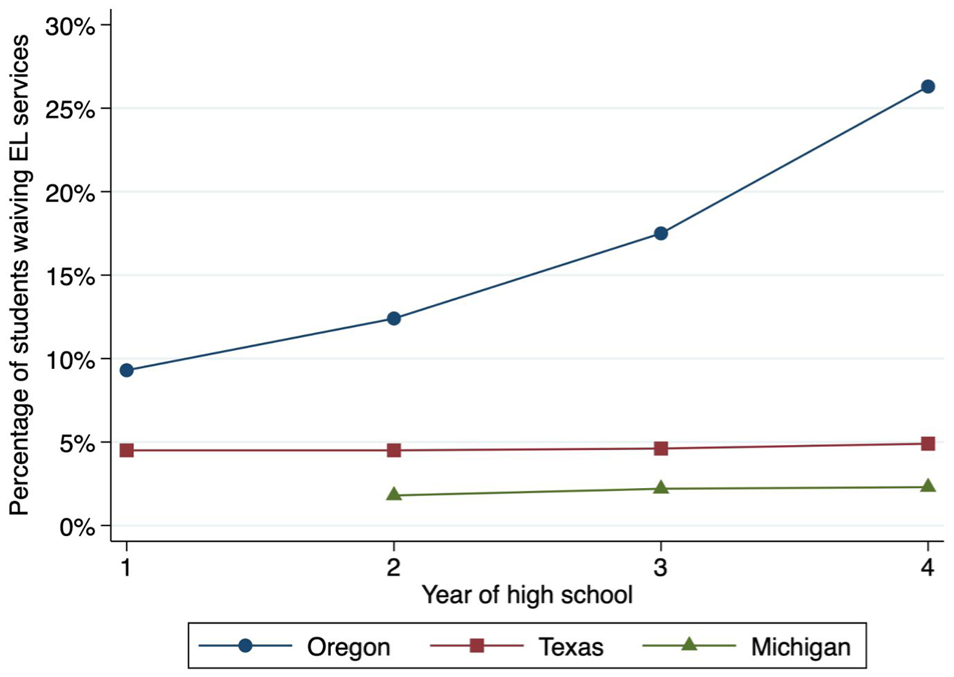
Percentage of English learner students waiving English learner services, by state and year in high school.
Despite differences in the prevalence of waiving EL services across states, there were notable similarities in the characteristics of students whose families waived services. In all three states, (families of) students in special education, students considered long-term English learners (LTELs; who had received EL services for 7 or more years), and students who were not economically disadvantaged were more likely to waive services. Results of multilevel logistic regression models controlling for a wide variety of factors indicated that these differences were statistically significant in seven out of nine cases, as indicated by superscripts in Table 1 (for full model results, see Table S2, available on the journal website).
Percentage of Total English Learner (EL) Student Observations Waiving EL Services, by Student-Level Factors
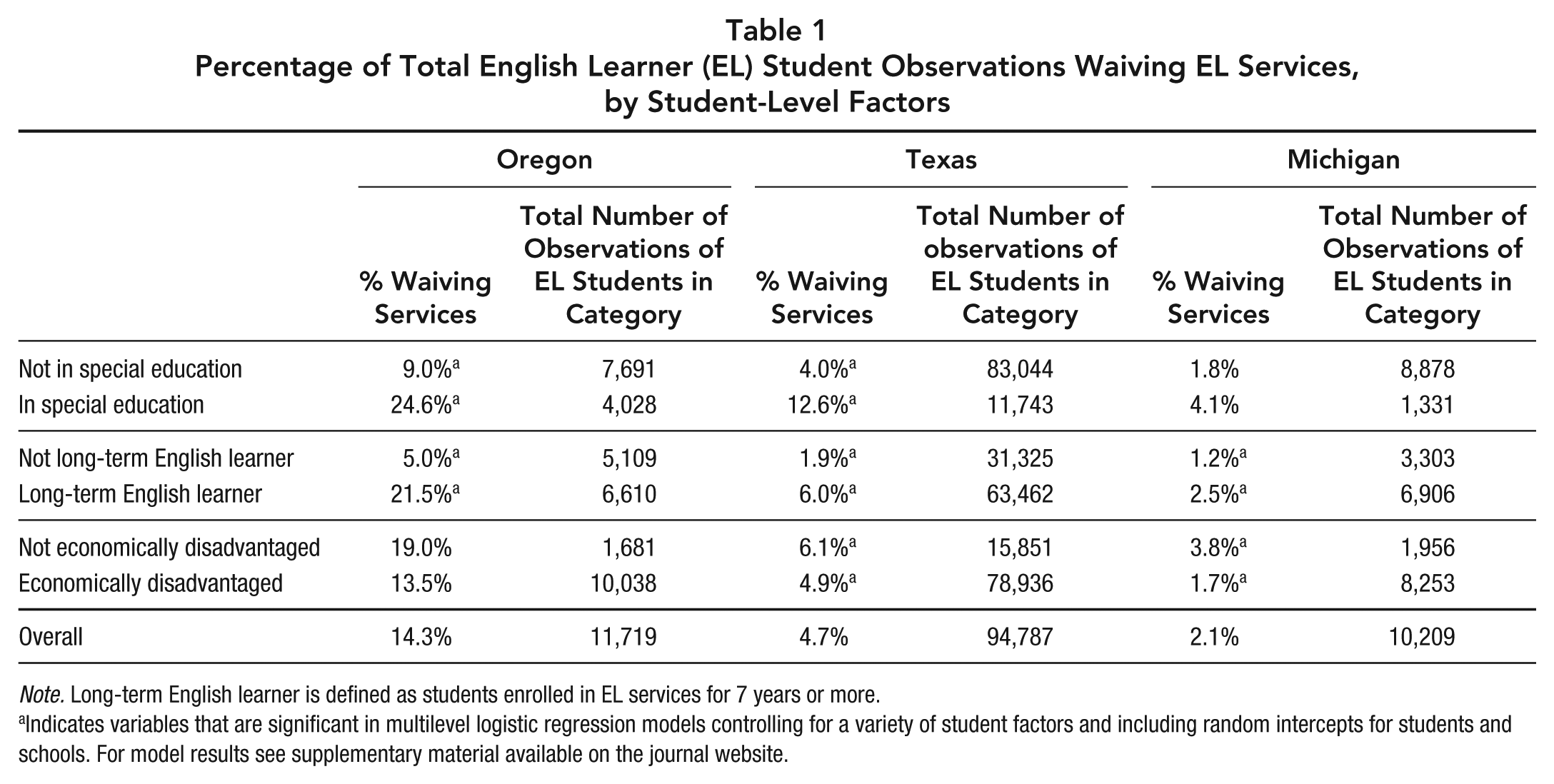
Note. Long-term English learner is defined as students enrolled in EL services for 7 years or more.
Indicates variables that are significant in multilevel logistic regression models controlling for a variety of student factors and including random intercepts for students and schools. For model results see supplementary material available on the journal website.
Discussion
Variation in the prevalence of waiving services across states may be related to differences in the state policy landscape for EL-classified students. In Oregon during this time period, EL services at the high school level typically consisted of a stand-alone ELD class period. Specifically, 77% of students in our sample not waiving EL services were enrolled in a stand-alone ELD course, and ELD classes did not carry graduation credit in Oregon. Thus, students’ families may have been increasingly likely to waive EL services as 12th grade approached to meet graduation requirements. By contrast, in Michigan during this time, ELD was often provided via pullout support, and only 12% of students were enrolled in stand-alone ELD courses. In Texas, nearly half of students were enrolled in content-based ELD courses that carried graduation credit. Thus, differences in the ways EL services were structured and the way graduation credits were awarded may have created less incentive to waive services in Michigan and Texas than in Oregon. 1
Patterns in the characteristics of students whose families waived EL services suggest that a variety of other structural issues may also be at play. Families who are not economically disadvantaged might have increased navigational capital (Yosso, 2005) and as a result might be more aware of the option of waiving services and more comfortable exercising this option. Despite the fact that federal law requires education agencies to provide EL services and special education services to students who qualify for both (USED & U.S. Department of Justice, 2015), special education services sometimes supersede EL services (e.g., Kangas, 2018), and waiving EL services may be one mechanism through which this occurs (Oh & Mancilla-Martinez, 2024). Similarly, prior research has suggested that students considered LTELs are often not well served by current ELD curriculum, and some students considered LTELs may be opting out of services they perceive as not meeting their needs (Brooks, 2023). In addition, sizable proportions of LTELs also have a disability (31% in Oregon, 11% in Michigan, and 12% in Texas), and the needs of this group merit particular attention.
Results of multilevel logistic regression models also indicated significant variation in students waiving EL services across schools, particularly in Michigan (see supplementary material available on the journal website). This aligns with prior research that EL-classified students may face a variety of structural barriers to accessing grade-level content courses at the school level (e.g., Kanno, 2021), with some schools providing less restrictive coursetaking pathways for EL-classified students (Estrada, 2014). Future research should explore school-level factors associated with waiving EL services.
There are a variety of additional implications of these findings for research, policy, and practice. First, research is needed to determine the prevalence and characteristics of students whose families waive EL services in other contexts. Second, families are likely waiving EL services because they think students’ opportunities and outcomes will improve without these services. More research is needed comparing opportunities and outcomes for students whose families have and have not waived EL services. Finally, research about EL-classified students should account for whether students’ families waived EL services. Students whose families waive EL services remain classified as ELs and take state ELP assessments each year (USED, 2017). Thus, students whose families have waived EL services are still included in the EL group for federally required reporting and accountability (USED, 2015) and are still flagged as ELs in administrative data used by researchers. Research that uses regression discontinuity designs to examine the effect of EL reclassification on student outcomes without accounting for waiving may be misleading because if students’ families waived services, there was no change in condition resulting from reclassification. Waiving EL services represents an important and understudied way in which students and their families can impact their educational trajectories, and much more research on this topic is needed.
Supplemental Material
sj-pdf-1-edr-10.3102_0013189X251372538 – Supplemental material for Waiving English Learner Services: Prevalence and Student Characteristics
Supplemental material, sj-pdf-1-edr-10.3102_0013189X251372538 for Waiving English Learner Services: Prevalence and Student Characteristics by Karen D. Thompson, Janette D. Avelar, Coleen Carlson, Paulina A. Kulesz, Kristin E. Black, Ilana M. Umansky, Michael J. Kieffer and David J. Francis in Educational Researcher
Footnotes
ORCID IDs

Notes
Authors
References
Supplementary Material
Please find the following supplemental material available below.
For Open Access articles published under a Creative Commons License, all supplemental material carries the same license as the article it is associated with.
For non-Open Access articles published, all supplemental material carries a non-exclusive license, and permission requests for re-use of supplemental material or any part of supplemental material shall be sent directly to the copyright owner as specified in the copyright notice associated with the article.
