







Abstract
Fenwick asserts that the failure to integrate Black principals and teachers into desegregating public schools remains the unfulfilled promise of Brown and has resulted in four traumas that continue to stymie the nation’s progress toward the conjoined goals of racial justice and educational equity. Brown was not intended to simply mean that African American and White students were to be educated side by side in order to achieve integrated schools. Often overlooked, many legal decisions subsequent to Brown asserted that the criterion for knowing that integration was achieved was the racial integration of district and school leadership and the teaching force.
Keywords
Since Black principals tend to be more qualified than White principals with respect to degree and certification status, it is necessary for those who appoint principals to provide data that would explain why the discrepancy between Black and White principal [appointments] exist[s].
I learned details about the academic rigor, cultural excellence, and strength of segregated African American public schools from my parents. I grew up in very fortunate circumstances with extraordinary parents who taught my four brothers and me the most comprehensive lessons about African American history (ones that we never learned in the private, majority-White K–12 schools we attended). Both of my parents and all of my grandparents attended segregated all-African American schools. My mom attended the stellar Sumner High School in Kansas City, Kansas, and my dad the famed Paul Lawrence Dunbar High School in Washington, D.C. I grew up hearing stories about their schools as they teasingly debated who had the best African American teachers. From their segregated all-African American public schools, my parents, grandmother, aunts and uncles went on to attain bachelor’s and master’s degrees as well as DDS and MD degrees – from historically Black colleges/universities (HBCUs) and top-tier graduate and professional schools.
My dad would often proclaim to anyone listening: My French teacher graduated from Dunbar High School, then graduated Radcliffe College cum laude in 1918, and earned her master’s degree in French at The Sorbonne (a reference to Mary Hundley, profiled in The Dunbar Story 1870-1955; Hundley, 1965). My mom, not to be outdone, would reply: My high school biology teachers graduated from Howard University and Fisk University and earned PhDs at the University of Chicago and Harvard University. This was a common conversational parry in our home, the subtext of which was that my parents’ education and socialization were superior to (ours) their children’s (who attended integrated private schools where we were among the very few African American children and had no African American principals and teachers). Although they (and their segregation-era African American friends) shared fond memories about their schools, my parents never supported segregation policies. They despised racism, its enabling laws and policies, and the ignorance and violence it reproduced. They viewed segregation as an assault on African American people’s humanity and intelligence and a violent abridgement of their rights as American citizens. On this matter, my dad often quoted noted historian Dr. John Hope Franklin (2005): “Living in a world restricted by laws defining race, as well as creating obstacles, disadvantages, and even superstitions regarding race, challenged my capacity for survival. For ninety years I have witnessed countless men and women likewise meet this challenge (p. 3).”
My parents’ experiences with segregated society and schooling profoundly shape(d) my perspectives as a scholar. What I learned from them, no textbooks (from kindergarten through my doctoral studies) taught. So my desire to correct the research record about segregation-era African American principals and teachers in my research comes from a place of (long) knowing. This led to my research focus (beginning in 1993) on the African American principal and teacher pipelines and diversity in the nation’s educator workforce. When I conducted library research, I was seeking to learn more about what I already knew existed. And what I knew about the African American community was edifying, consequential, uplifting, and true!
I titled my lecture, “Otherwise Qualified: The Untold Story of Brown and African American Educators’ Professional Superiority.” It is divided into four sections: “A Theory of Cultural Elision,” “The Intention of Brown,” “The Myth of African American Professional Inferiority and Its Relationship to the Recent Affirmative Action Decision,” and “Three Traumas: Recommendations for a Way Forward.”
A Theory of Cultural Elision
The history, research, and commentary about African American people is plagued by what I label the “theory of cultural elision.” I define the theory of cultural elision as an operative lens leading to the purposeful disregard, unseeing, and incomprehension of anything consequentially positive, self-determinative, or superior about African Americans. In the telling of history, the conduct of research, and the phrasing of social commentary, application of this operative lens results in valorizing White males and promoting Whiteness as normative and positive. To the contrary, anything consequentially positive or superlative about African Americans is reflexively left out—as if it simply could not be so. If, on the odd chance, African American excellence is acknowledged, it is usually tied to a single African American who is then exceptionalized in the research, history, and social commentary.
In recent years, this theory of cultural elision played out in news stories about President Barack Obama’s appointment to the Harvard Law Review during his days as a law student there. News accounts exceptionalized Obama for this achievement. To be sure, Obama was the first African American president of the Review and had served as one of the editors in years prior. However, the telling of his ascension to the Review’s presidency led many in the press to conclude, erroneously, that there had been no African American men who were editors of the Review prior to Obama.
In fact, the first African American member of the Harvard Law Review was Charles Hamilton Houston, who served as an editor in 1921. (Incidentally, that same year, Jasper A. Atkins became the first African American elected to the Yale Law Review.) Houston was a graduate of the all-African American Paul Lawrence Dunbar High School in Washington, D.C., and a Phi Beta Kappa graduate of Amherst College, where he was valedictorian of his class. He earned his law degree cum laude from Harvard University in 1923. Arguably, Charles Hamilton Houston was the principal intellectual force behind the strategy and litigation leading to Brown (Brown v. Board of Education, 1954). Houston was followed by two other African American editors of the Review—William Henry Hastie (another Dunbar High School graduate) and William T. Coleman, who served as Law Review editors in 1930 and 1946, respectively (“The First Black President of the Harvard Law Review,” 2000).
In the dominant myth-histories, African American principals and teachers who were discarded with African American schools were inferior and shabby relics of a Jim Crow era. But what does it mean to recognize that these displaced African American educators were, in fact, superior in their academic credentials, professional licensure rates and levels, attitudinal commitment to democratic ideals, consistent activism against the ideology of racism, and experience with integrated society?
The focus of my research (and most recent book, Jim Crow’s Pink Slip; Fenwick, 2022) is on the displaced African American educators’ academic credentials. It is the first book to fully excavate and reclaim this history. I view the focus on credentials as essential because they stand as evidence against the ubiquitous lie of African American intellectual inferiority. Rather than confirming African American incapacity, these educators’ credentials affirmed their equality (and superiority) and self-agency. Their credentials affirm their determination not to be stymied by all the odds stacked against them in the Jim Crow South and to maneuver this evil system to their and their communities’ uplift and advantage. And the story about how they earned their credentials (in the late 1800s and early 1900s) is one that flies in the face of traditional narratives about African American educational attainment—especially prior to 1954.
The primary (but not exclusive) evidentiary base for Jim Crow’s Pink Slip (2022) is the 1971 U.S. Senate Select Committee Hearings on the displacement of Black principals (U.S Congress, 1971). I still wonder how and why the prolific citations of the 1971 Senate hearings—which from beginning to end focus almost exclusively on the exceptional credentials of displaced African American educators—have not been subject to presentation in the hundreds of research articles, books, newspaper accounts, and other narratives about desegregation. It is as if the segregationists’ assertions about African American schools and the professionals who inhabited them have been substantiated—without evidence or in direct contradiction to the evidence.
This is the untold story of African American educators who were powerful models of intellectual authority and who sought, fought for, and gained exceptional academic credentials as part of their personal and communal fight for unfettered equality and full citizenship in American society. Their fight was against a life and future abridged by the ubiquitous insult that they, as African Americans, were intellectually or in any other way inferior.
Well, this is their story: the story of a collective who used education to push against the oppressive arc of “race madness” and second-class citizenship.
The Intention of Brown
We are living with histories that we do not know. June 15, 1971. That was the day that the 1954 Brown decision outlawing racial segregation in public schools was narrowly operationalized as African American-White student ratios, integration busing, and pairing and clustering of schools for racial balance. However, Brown was not intended to simply mean that African American and White students were to be educated side by side in order to achieve integrated schools. Brown and many legal decisions subsequent to it (especially Singleton [1969, 1971], Bradley [1965], Green [1968], and Lee [1968]) demanded that public schools integrate wholly, meaning that their administrative ranks (superintendents, principals, and other district leadership), faculty, and student bodies were to become integrated. Not just the student bodies. The failure to integrate school personnel was and remains the unfulfilled promise of Brown. I believe that many of the inadequacies of our PK–12 schools are traceable to this failure.
As early as 1952, National Association for the Advancement of Colored People (NAACP) attorney Thurgood Marshall feared that if Brown was successful, African American principals and teachers would be illegally forced from their jobs as educators, leaving newly desegregating school systems with an all-White educator corps. So prior to Brown, Marshall established the NAACP’s Teacher Information and Security Department to raise funds to assist African American educators with litigating cases that would later ensue from their illegal firings, dismissals, and demotions by White segregationist school boards and superintendents in the 17 border and Southern states operating racially segregated public schools (Davis, 1956).
Brown also did not mean that all-African American segregated schools were to be closed and that all-White segregated schools were to remain open and become the near singular recipient of African American students. But that is what was orchestrated to happen by White segregationists who used state laws and public tax dollars to resist the new law of the land.
At the time, racial discrimination in state laws, violence, and intimidation resulted in few African Americans being registered to vote in border and Southern states. With African Americans denied their most basic right as a citizen in a democracy—the right to vote, Whites maintained control over all state and local elected and appointed offices, policy formulations and implementation, and budget allocations and expenditures.
In their rush to stop rather than fulfill Brown’s mandate, White elected and appointed officials and political bodies (school boards, superintendents, state legislatures, and governors) initiated a massive resistance strategy that supported the firings, dismissals, and demotions of 100,000 African American principals and teachers between 1952 and the late 1970s. (Earlier research has cited 30,000 to 38,000 educators, but updates to the timeline and available displacement data show far more damage.)
Prior to Brown, in the 17 dual-system states, 35% to 50% of principals and teachers were African American (National Education Association [NEA], 1965). Today, there is no state that approaches these percentages. In fact, fewer than 7% of the nation’s 3.2 million teachers, 11% of the nation’s 90,000 principals, and fewer than 3% of the nation’s nearly 14,000 superintendents are African American (National Center for Education Statistics [NCES], 2019). The underrepresentation of African Americans in the nation’s educator workforce is tied to massive (White) resistance to Brown. Despite the damage to the pipeline, African Americans remain the nation’s most academically credentialed educators. As teachers, principals, and superintendents, they are more likely than their White peers to hold master’s and doctoral degrees and have more years of professional experience when they ascend the ranks of school and district leadership.
In Jim Crow’s Pink Slip (Fenwick, 2022), an analysis of NCES (2019) data shows that when the academic credentials of Black women, Black men, White women, and White men who serve as principals and teachers are compared to one another, Black women and Black men come out on top. Among Black female principals, nearly 50% hold a degree higher than a master’s degree. Slightly more than 40% of Black male principals hold a degree higher than a master’s degree. White female principals follow Black men, with 38.2% holding a degree higher than a master’s degree. White male principals are the least academically credentialed in comparison with all groups, with 35.8% holding a degree higher than a master’s degree. The similar pattern holds for teachers. Table 1 (Percentage distribution of public school principals and teachers by race/sex and highest degree earned) summarizes these findings. Despite being the least credentialed educators, White men represent nearly 70% of school district superintendencies and central office directorships, which control district expenditures and lead implementation of curricular and other district policies.
Percentage Distribution of Public School Principals and Teachers by Race/Sex and Highest Degree Earned
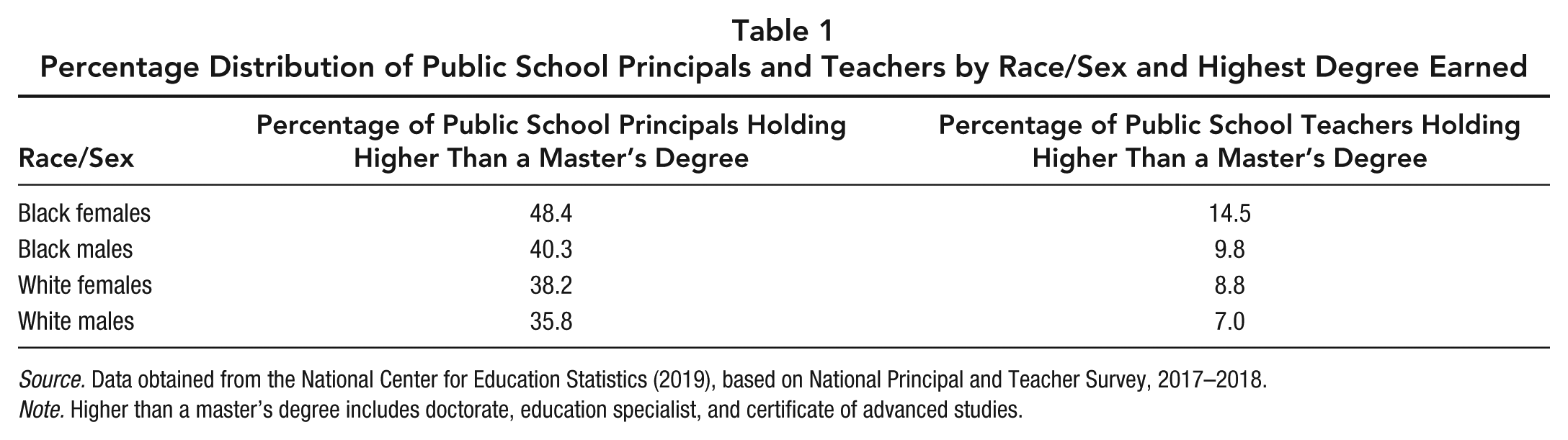
Source. Data obtained from the National Center for Education Statistics (2019), based on National Principal and Teacher Survey, 2017–2018.
Note. Higher than a master’s degree includes doctorate, education specialist, and certificate of advanced studies.
The Myth of Black Professional Inferiority and Its Relationship to the Recent Affirmative Action Decision
In a riveting account shared with the Senate Select Committee, a Georgia educator, Dr. Bettie M. Smith, explained to the U.S. Senate hearing on the displacement of Black principals committee chair (then-Senator Walter Mondale) why the illegal displacement of African American principals constituted a painful and unfair loss of talent to the nation’s schools. Like most of her African American peers, Smith was well educated, with a bachelor’s degree from Historically Black College and University (HBCU) Tennessee State University and master’s and doctoral degrees from New York University. As secretary of the Georgia Council of Secondary School Principals (an African American educator association), Smith told the Committee that she had seen the organization’s membership dwindle from 190 in 1969 to six in 1970 (U.S. Congress, 1971).
Dr. Bettie M. Smith was not alone. She was in all respects the rule and not the exception (U.S. Office of Education, 1972). To provide some evidence of this, Table 2 summarizes the names, years of service, and academic credentials of the presidents of the American Teachers Association (ATA)—the all-African American teachers association—for the years 1900 to 1951. ATA’s presidents were an academically credentialed, professionally accomplished, and activist group (Gilmore, 2008). They mirrored the distinguished achievements of the organization’s rank-and-file members. More than half of ATA’s presidents who held office between 1910 and 1951 had earned undergraduate or graduate degrees (some as early as the 1800s) from nationally prominent institutions, such as Brown University, Columbia University, Harvard University, the University of Chicago, the University of Pennsylvania, and New York University.
American Teacher Association (ATA) Presidents, Years of Service, and Academic Credentials, 1910-1936
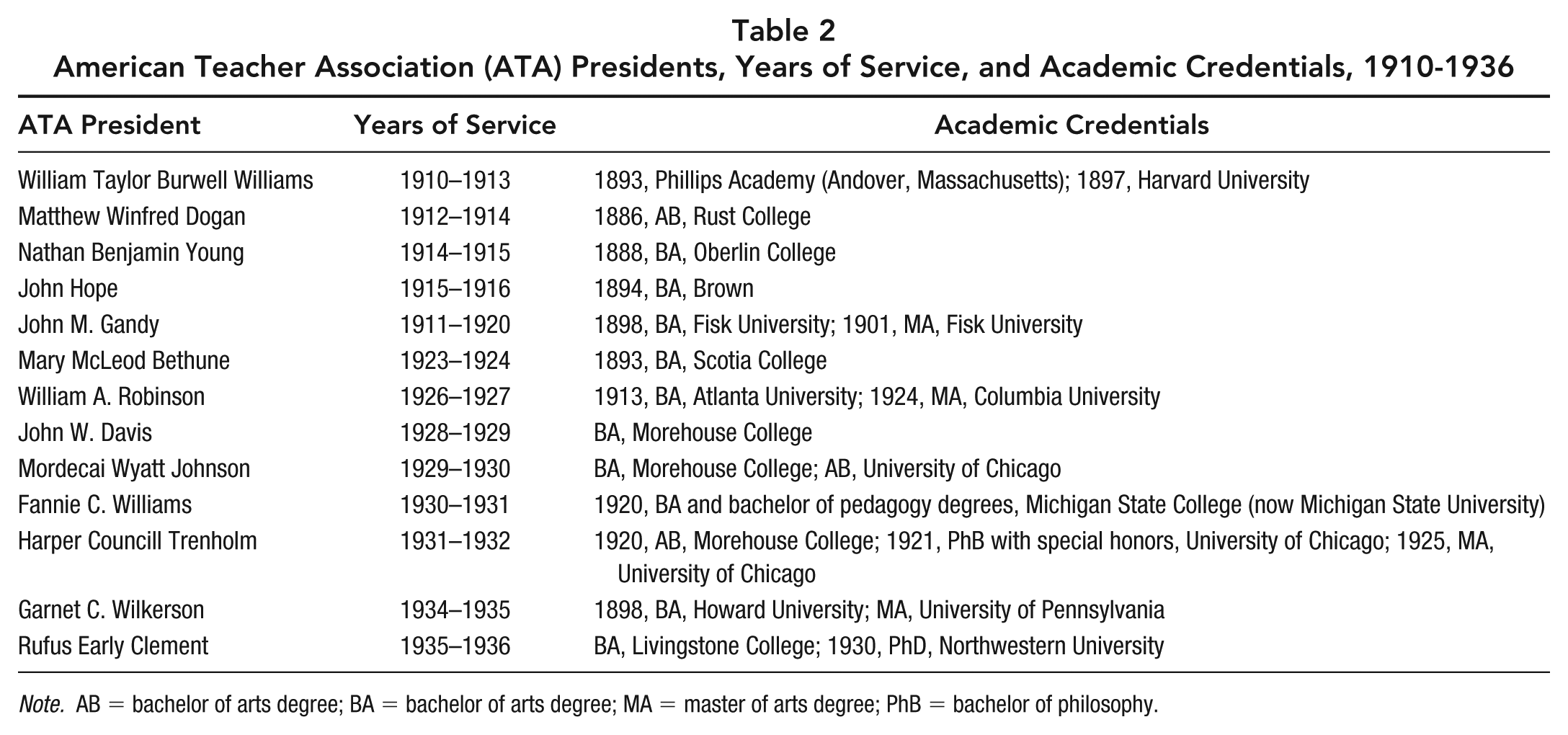
Note. AB = bachelor of arts degree; BA = bachelor of arts degree; MA = master of arts degree; PhB = bachelor of philosophy.
Despite her exceptional academic credentials and professional success as a principal, Dr. Bettie Smith was summarily fired and replaced by a less qualified White male all in the name of (massive resistance to) school desegregation. She was one of 100,000.
In the 17 dual-system states, African American people were taxpaying citizens of their home states but barred by state law from attending their state’s public and private colleges and universities (for undergraduate, graduate, and professional school education), which were White-restricted.
As I document in Chapter 2 of Jim Crow’s Pink Slip (Fenwick, 2022), state legislatures created and codified “Negro tuition scholarships” in an attempt to skirt the 14th Amendment rights of African American people and maintain their segregationist hold on public colleges and universities (Jackson, 1944). In 1938, Figure 1 (Maryland General Assembly, 1935) shows that Maryland’s state law (at the time) indicated that the “Negro tuition scholarship provides professional or other scholarships for negroes otherwise qualified for admission to the University of Maryland” (p.1071). That was the exact language of the state law—“negroes otherwise qualified”—and the associated budget appropriation language stated that the funds were “for [instances where] the State of Maryland provides opportunities for white students and for which it does not provide opportunities for negro students” (Maryland Session Laws, 1937).
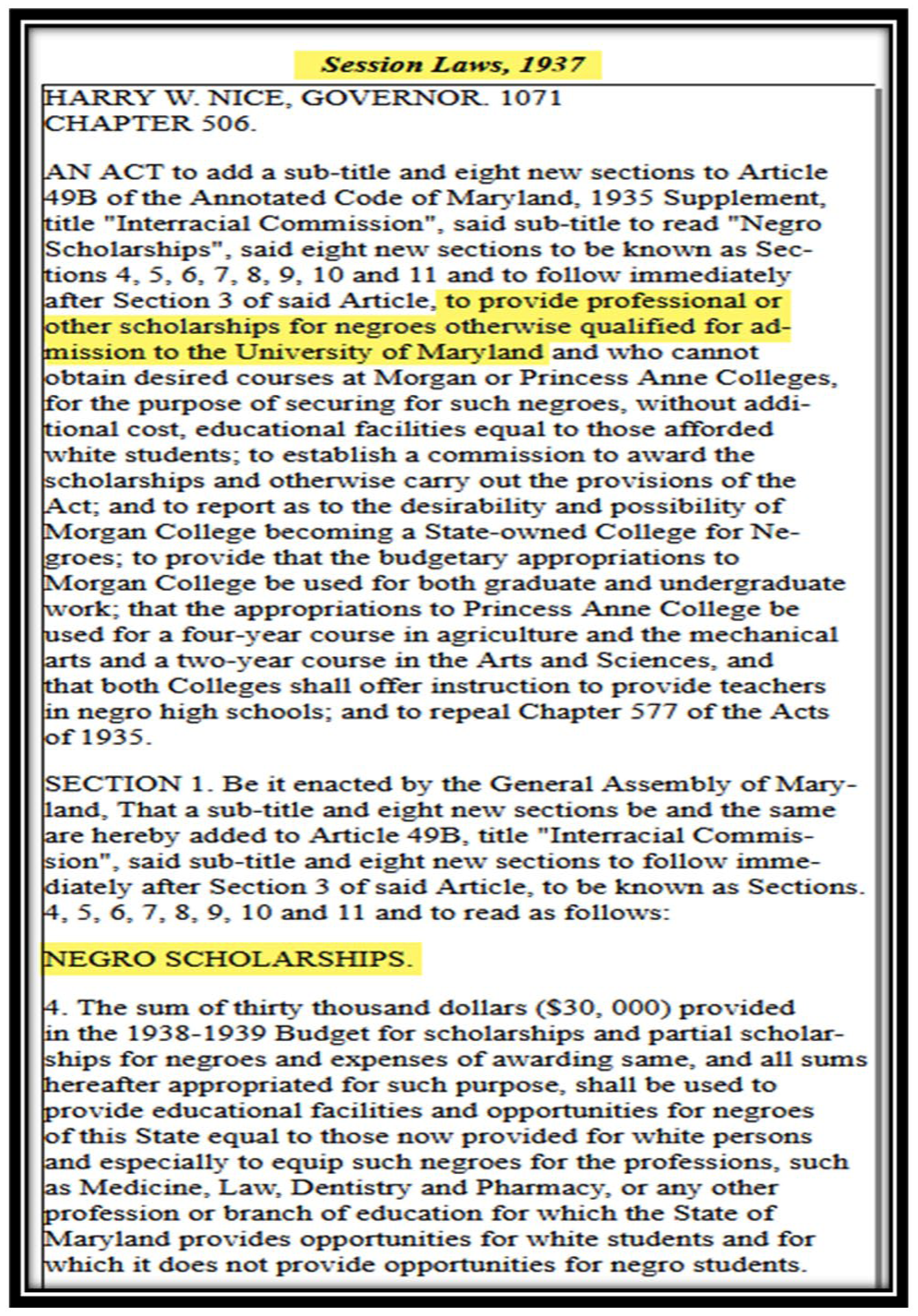
Annotated code of Maryland Session Laws (1937), negro scholarships.
I call the trek by African American educators (to graduate school and back to their home states) an “academic migration” because it did not result in an exodus from the border and Southern states. They returned to their home states and continued serving as principals and teachers in segregated all-African American public schools. As part of their community leadership (before and after their academic migration), these educators led voting rights campaigns and established NAACP chapters (often at great risk to their and their families’ safety). Despite their superior academic credentials, exceptional leadership as principals and teachers, and civic activism, 100,000 African American principals and teachers were summarily fired, dismissed, and demoted between 1952 and the late 1970s as backlash to Brown. This is the origin of the contemporary underrepresentation of African Americans in the educator workforce.
Do the Supreme Court justices who joined the majority opinion in Students for Fair Admissions v Harvard/University of North Carolina, Chapel Hill (2023) know or care about this history and its infliction of continuing trauma on African American citizens’ aspirations and delay toward our nation’s highest ideals of egalitarianism and equal treatment under the law? Do they know or care that in at least 17 states, the state wielded the hand prohibiting qualified African American citizens from admission to undergraduate programs at the University of North Carolina at Chapel Hill for 171 years of its 234 years of existence? The years that states prohibited otherwise qualified African Americans far outnumber the years admission has been anemically opened to African American citizens.
These principals’ and teachers’ academic migration made a difference in terms of the quality of all-African American segregated schools. As one example (of the many all-African American segregated schools), the 1926 roster of Sumner High School faculty indicated that 41% of the all-African American faculty held master’s degrees, including three from the University of Chicago. 935, the percentage had grown to 61% with master’s degrees, including three faculty who earned master’s degrees from the University of Chicago, two from Columbia University, and one from Harvard University. Notably, with the integration of the school’s faculty in 1968 to include more White teachers, the percentage of faculty members with a master’s degree fell below its 1926 level to 35% (Bonner et al., 2011). Figure 2 shows a photo of the African American faculty of Sumner High School in 1919 (Sumner High School Records, n.d.).
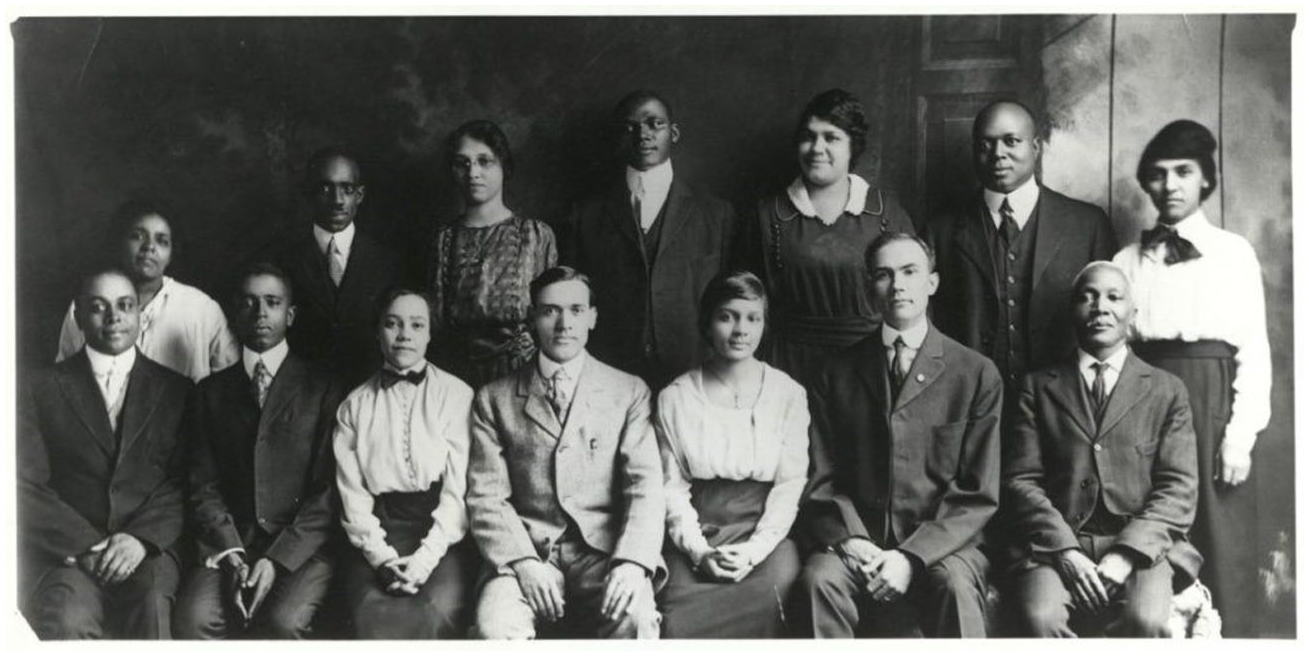
Sumner High School faculty (Kansas City, Kansas), 1919.
The mass closure of African American schools and influx of African American students into previously all-White segregated schools led to an increased need for principals and teachers in desegregating schools. But with African American principals and teachers illegally pushed out of school systems, White superintendents and school boards found themselves in a quandary: Who was going to lead the schools and teach the swelling numbers of students? Pressed by the need to hire more educators, they manufactured principal and teacher shortages, turning almost exclusively to Whites outside the education profession, vacating state requirements for education degrees and teacher licensure, and creating fast tracks into the classroom through emergency certification. In (White) massive resistance to Brown, we find the origins of alternative licensure and the Black male educator shortage.
It is unlikely that the generations of African American principals and teacher who were illegally displaced would trust contemporary school reform models such as vouchers, school choice, and charter schools. After all, these were among the very mechanisms that they experienced during the decades-long stalling of Brown’s progress that were used as part of the plan to annihilate their careers. The combined deliberate underpayment of Black principals and teachers and differentiated pay scales for Black and white educators, amended state constitutions, statewide school closings to avoid desegregation, suspension of tax levies for public schools, redirection of state tax dollars to Whites’ “school choice” vouchers and segregation academies (Southern Regional Education Board [SREB], 1971), the establishment of segregated classrooms and academic tracking, and rampant, illegal school district hiring practices that purposely eliminated Black principals and teachers from being hired into desegregating school systems—all of these factors were deliberate, directed means to a disinvestment in the education of Black students.
Three Enduring Traumas and Recommendations for a Way Forward
The annihilation of African American principals and teachers was traumatic. The first trauma was economic. Before the Brown decision in 1954, nearly half of all African American professionals were teachers, compared to fewer than 25% of White professionals. Over time, desegregation left African American educators nearly $1 billion poorer from income loss due to firings, demotions, dismissals, and nonhires. White hires happened at the economic expense of African American educators, resulting in White economic gains that continue to today.
The second trauma was equally distressing: namely, the damage done to school systems because of the loss of high-caliber leadership. Proven African American leaders were replaced on a near one-to-one basis with Whites who held lesser or no qualifications. The assault on the professional identity and stature of African American educators ensured that the “desegregated” school system would be held captive by the same Jim Crow power structure that had fought vehemently against desegregation for decades.
The third trauma was the unkindest cut of all. If schooling is about the children, as all the sentimental slogans profess, African American children did not seem to count. Pushed into hostile “integrated” schools without African American models of intellectual authority (in their teachers) and leadership authority (in their principals) who could also serve as guides and protectors, African American students’ socialization and education suffered and continues to suffer.
Why are we still struggling to mark real progress in education? Since the arrival of African American students in previously all-White schools after Brown, education policies and practices have almost exclusively been informed by White social scientists, psychometricians, educational leaders, local elected officials, philanthropists, and their acolytes. These individuals have no deep-tissue knowledge about African American history, culture, and achievements. Without this essential knowledge, in the face of pervasive negative social commentary about Blacks, and under the influence of foundational racism in the biological and social sciences that shapes education research and psychometrics, White powerbrokers believed and actively reproduced deficit perspectives about Blacks. Their erroneous perspectives made (and continue to make) their way into policies; federal, state, and philanthropic funding streams; and intervention programs. Rarely have any of these mechanisms taken aim at root causes of disparities. So the disparities remain. And when the disparities remain, Black and other communities of color are viewed as “beyond intervention.”
The harm is not just about the decimation of African American principals and teachers and the subsequent underrepresentation of African American in the nation’s educator workforce. The harm is about what was amplified with the loss of African American educators.
Recommendations
The question is, what can be done at this point? Following are three (of the nine) recommendations discussed in Jim Crow’s Pink Slip (Fenwick, 2022).
Tell the history and refute the myths about the origin of the underrepresentation of African American principals and teachers in the educator workforce. Use this history to redirect policy and program remedies to the underrepresentation of African Americans in the educator workforce.
Examine how the transfer of African American principal and teacher jobs to Whites and nonhires of African Americans educators (from 1952 to the late 1970s) affected/affects the Black-White wealth gap. Remedy this gap.
Invest in teacher, principal, and superintendent preparation programs at HBCUs, Hispanic-serving institutions (HSIs) and Tribal Colleges/Universities (TCUs). In comparison to Traditionally White institutions (TWIs), these institutions produce an outsized percentage of educators of color (Fenwick, 2000, 2022; Irvine and Fenwick, 2011).
Conclusion
Racial equity and educational equity are conjoined goals. It is unlikely that one will be achieved without the other. Whatever progress we may mark as we go forward, we will be left with these unfortunate and aching questions: Had these generations of African American principals and teachers been integrated into schools after Brown, how might the nation, its schools, and its students have benefited? What could these remarkable professionals and citizens have accomplished with America’s schools if they had not been purged just at the time the nation needed them to help define Brown and its implementation? It is difficult to untangle the damage done from any progress made. What is sure: This is the legacy our public schools and our nation’s children live with and must overcome.
These are but a very few names of the 100,000 Black principals and teachers whom our nation lost. We owe each of them recognition and a debt of gratitude…
W. H. Harris of Goshen, AL
A. O. E. Martin of Austin, TX
James L. Collins of Northpointe, AL
Harlan Powell of Corsicana, TX
Mary Preyer of Eufaula, AL
L. F. Chaney of Waco, TX
Virgil Coleman of Elba, AL
Carlean Meriem Fowler of Dallas, TX
S. A. Meeks of Stuttgart, AK
Gladiola Hughley of Turrell, AK
Willa B. Cole of Camden, AL
William Keaton of Arkadelphia, AK
Laron Tucker of Hermitage, AK
Calvin Cunningham of Eudora, AK
W. N. Porter of Erwin, NC
Jewel Butler of Texarkana, AK
Margaret LeGrande of Wimot, AK
Ruby McMarray of Hensley, AK
E. S. Bishop of Alcorn County, MS
Spencer Durante of Reidsville, NC
Marian Funderburk of Chesterfield, SC
Dr. Ira Bryant of Houston, TX.
Thank you for the immense honor and privilege of sharing this untold story of African American principal and teacher leadership. I attempted to tell these principals’ and teachers’ story as they would tell it!