







Abstract
Although YouTube is widely used worldwide, little is known about how pre-K–12 teachers employ it for instructional purposes. This article reports findings from a national survey of U.S. pre-K–12 teachers (N = 393) on their instructional use of YouTube. Nearly three-quarters of respondents reported using the platform as a classroom resource, with almost half doing so at least daily or weekly. On average, teachers devoted 17.9% of instructional time to watching videos, often alongside lectures, group work, and independent practice. These findings underscore YouTube’s important role in supporting instruction and enhancing teachers’ content knowledge.
Second only to Google Search, YouTube is the world’s most visited website, attracting more than 47 billion monthly visits (Semrush, 2025). From independent journalism to home repair tutorials, many people turn to YouTube for information, resources, and community. YouTube is also used in educational contexts, with U.S. states and universities partnering with content creators such as PragerU Kids and Crash Course, for example. Concurrent with states and universities partnering with content creators, YouTube has emerged as a key resource for teachers, serving as both a repository of instructional materials and a platform for expanding content knowledge (Fyfield, 2022; Tosh et al., 2020). Yet little is known about whether or how frequently teachers use YouTube content (Fyfield, 2022).
What we do know suggests a mixed picture regarding the quality and effectiveness of educational YouTube material. Some teachers express concerns about the credibility of YouTube materials (Fyfield, 2022), whereas others turn to the platform to address topics—particularly controversial ones—that they feel less prepared or comfortable teaching themselves (Miles et al., 2024). Studies have explored teachers’ use of YouTube in contexts other than in the United States, including Australia and Spain (Fyfield, 2022; Pattier, 2021). Although other work has examined how U.S. teachers engage with a single channel (Miles et al., 2024), little is known about the extent to which U.S. teachers rely on YouTube as an instructional resource.
How U.S.-based teachers use YouTube is a notable gap given the platform’s scope and lack of editorial oversight (Fyfield et al., 2021). As such, our research seeks to answer the following questions using data from the first national U.S. survey of pre-K–12 teachers on YouTube use:
Research Question 1: How frequently do U.S. pre-K–12 teachers utilize video content from YouTube for instructional purposes?
Research Question 2: How do teachers use videos in their instruction—primarily for whole-class viewing, individual student viewing on devices, or both?
Methods
Survey Instrument
Guided by prior research on teacher YouTube use (Fyfield, 2022; Miles et al., 2024), we developed a 22-item survey to examine pre-K–12 teachers’ use of YouTube as an instructional resource. Think-aloud interviews were conducted with three teachers, and four expert reviews informed revisions to strengthen clarity, relevance, and construct validity.
Recruitment
To administer the survey and to recruit participants, we used Centiment, a third-party organization specializing in panel-based research, to recruit participants and administer our Qualtrics survey. Centiment maintains a diverse respondent pool through social media and partner networks and uses screening data to ensure alignment with target demographics (Reuther, n.d.). To minimize selection bias, participants were informed only of the survey length and compensation before starting the survey. In accordance with our institutional review board, 1 participants were allowed to withdraw their consent after reviewing the questions. Centiment employs quality control measures—including fraud scoring, digital fingerprinting, and ReCaptcha—to safeguard data integrity (Reuther, n.d.).
Sample Description
A total of 409 U.S. pre-K–12 teachers completed the survey. We excluded 16 responses for consecutive invariant answering, 2 yielding an analytic sample of 393 educators from 46 states. Three chi-square goodness-of-fit tests were conducted to assess how well our sample matched U.S. national teacher workforce demographics with respect to years of experience, regional population (by state divisions), and school type (i.e., public, private, and charter). Results revealed no significant differences in years of experience or school type. Results for regional differences revealed underrepresentation of teachers from the South: West South Central division and overrepresentation from the West: Mountain and Northeast: Middle Atlantic divisions. For an in-depth analysis of sample representativeness, see the supplementary material available on the journal website.
Data Analysis
For this brief, we analyzed responses to four questions on participants’ frequency of YouTube use. The results of the first two questions were analyzed using the total population as the denominator. Data from the third and fourth questions are presented only for respondents who reported using YouTube instructional videos.
Limitations
Although this survey is the first of its kind to not rely on convenience or snowball sampling, both in the United States and globally, to assess teachers’ use of YouTube, our study is limited by nonrandom selection and self-report bias. Although our chi-square goodness-of-fit tests demonstrated generally strong representation of national demographics across school type and years of experience, regional discrepancies existed. Moreover, teachers who are members of the Centiment panel may not be representative of U.S. teachers as a whole. Such factors may limit the overall generalizability of these results. Additionally, as with most surveys, these results are self-reported by teachers and do not necessarily reflect the exact frequency of YouTube use or the watch time of instructional videos. Future observational research should be conducted to determine how often and to what extent teachers are relying on YouTube videos and instructional videos more broadly to support instruction. Lastly, this study is cross-sectional and makes no claims regarding causation or longitudinal trends.
Findings
Research Question 1
Of the respondents, 76.5% (n = 301) reported having used YouTube as an instructional resource. Nearly one-half (48.1%, n = 189) of teachers reported using videos from at least one YouTube channel on a daily or weekly basis. Additionally, 20.1% (n = 79) reported monthly use, 5.6% (n = 22) quarterly use, and 2.8% (n = 11) only once or twice per year. Figure 1 presents the distribution of usage frequency. Because teachers reported the frequency at which they used individual channels rather than how often they used YouTube as a whole and the average number of channels used across the whole sample was 2.3, some respondents’ total YouTube use may have exceeded the frequencies shown in Figure 1. For information on the number of channels teachers used, see the supplementary material available on the journal website.
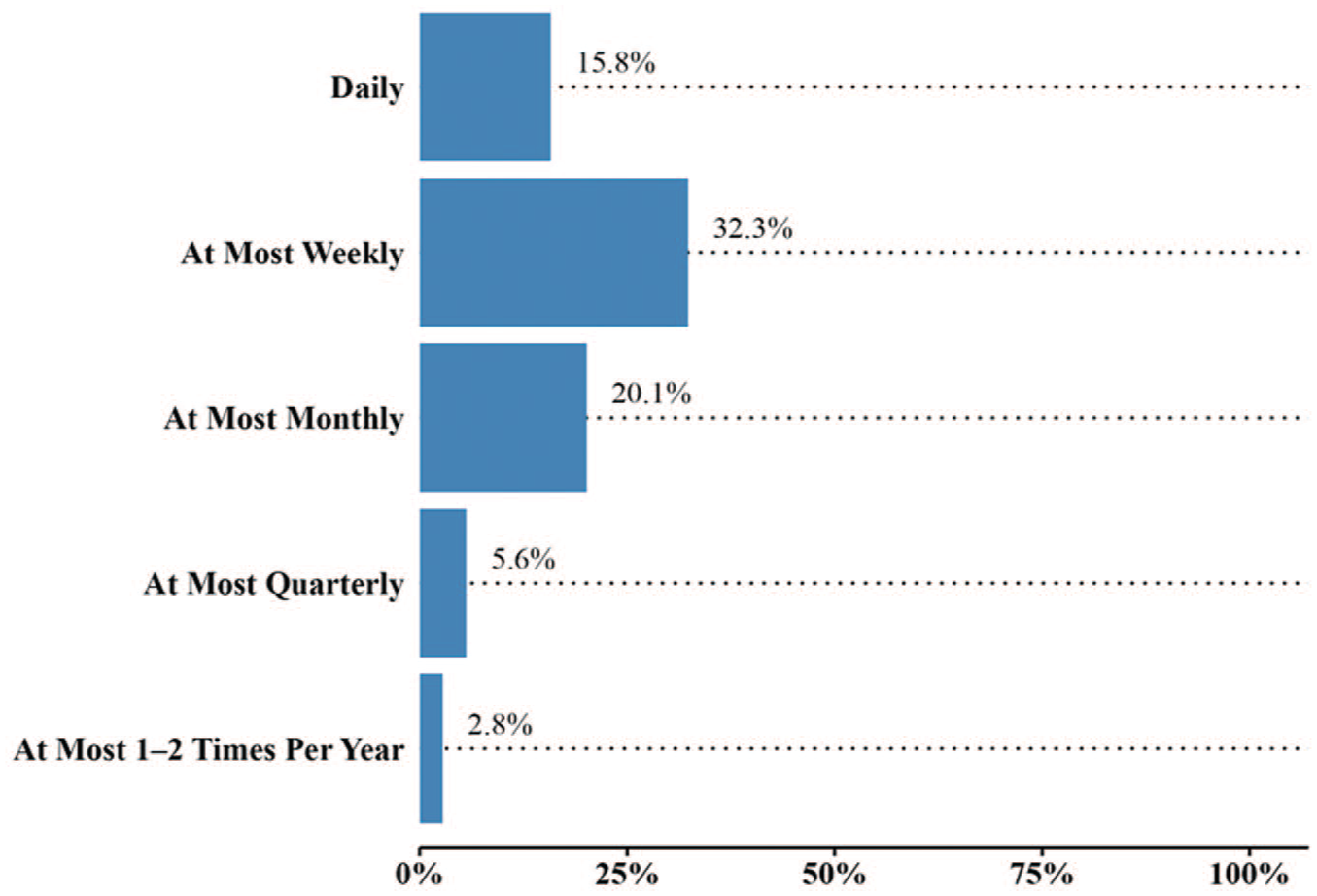
Frequency of use of at least one YouTube channel.
Among teachers who reported using YouTube as an instructional resource, the average proportion of instructional time spent showing videos was 17.9% (SD = 13.4%, Mdn = 15%). This was slightly less than the time allocated to independent work (M = 22.9%, SD = 13.4%, Mdn = 20%) and group work (M = 20.8%, SD = 15.1%, Mdn = 20%). Figure 2 illustrates the distributions of these proportions of teachers’ time spent using YouTube.
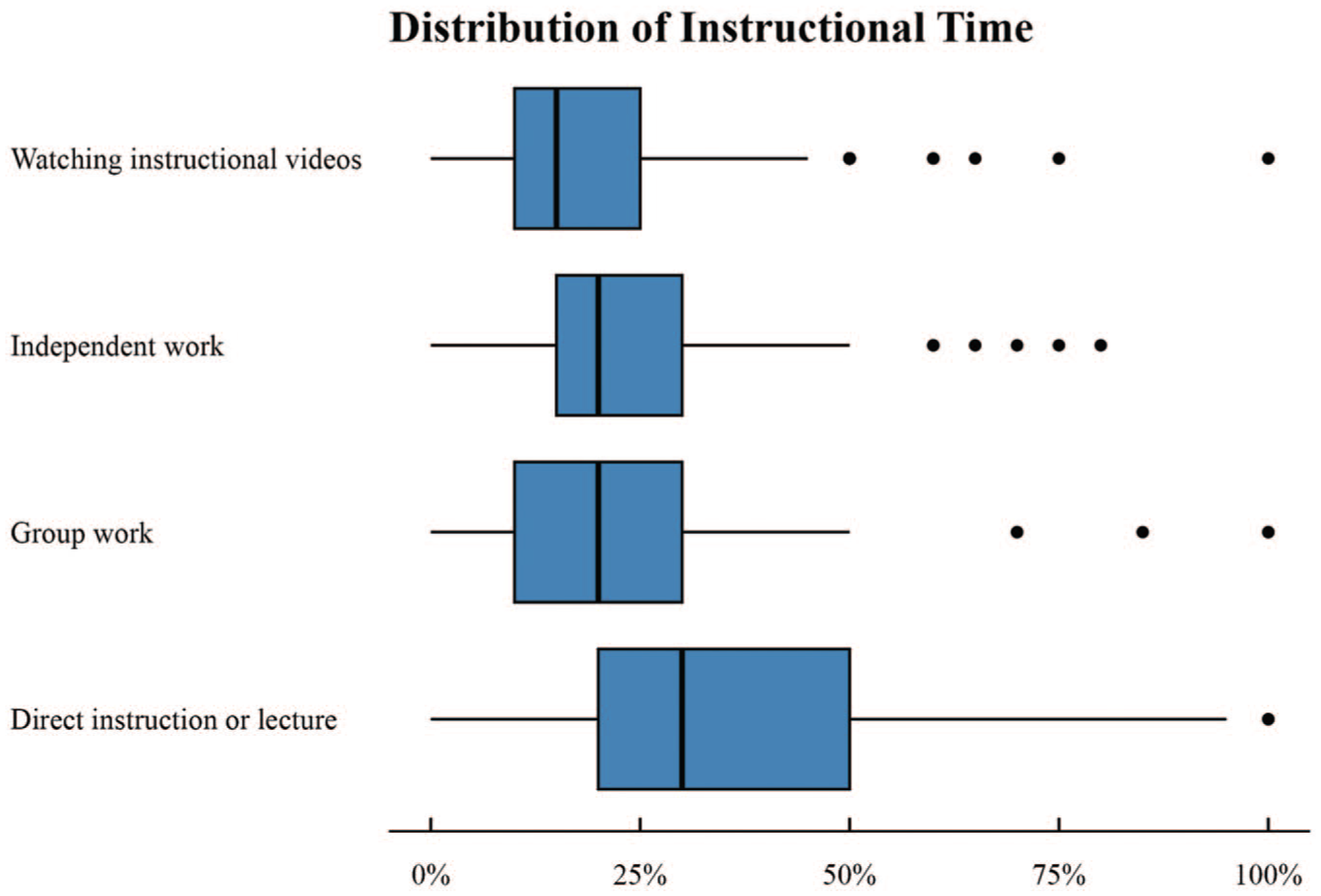
Teachers’ self-reported distribution of instructional time.
Research Question 2
Teachers reported using YouTube in different ways. Almost two-thirds (62.8%, n = 189) indicated that they played the video for the whole class (i.e., controlling the playback), 7.3% (n = 22) reported that students watched the videos on their own devices, and 29.9% (n = 90) used a mix of both methods.
Discussion
Nearly three-quarters of our sample used YouTube content, with roughly half doing so on a daily or weekly basis. This finding mirrors and extends previous survey findings on YouTube video use by teachers in Spain (Pattier, 2021) and Miles et al.’s (2024) study of the popular Crash Course YouTube channel among social studies teachers. Although previous survey studies (Miles et al., 2024; Pattier, 2021) and qualitative research (Fyfield, 2022; Fyfield et al., 2021) have examined how teachers use YouTube videos for instruction, they relied on smaller sample sizes and convenience and snowball sampling, in which teachers were recruited with prior knowledge of the study’s purpose.
This is the first study at a larger scale that surveyed teachers in any global context without relying on convenience or snowball sampling. Although not perfectly geographically representative of U.S. teachers, our findings provide strong evidence that YouTube videos are widely used by many teachers. Additionally, although research such as Tosh et al. (2020) found that a high percentage of English language arts and mathematics teachers used YouTube in the classroom, our findings uniquely shed light on its use relative to other instructional methods, such as direct instruction and group work. Although our sample reported spending an average of 17.9% of instructional time on watching instructional videos, it is unclear what impact this use has on student academic outcomes. Future research should be conducted assessing how using instructional videos impacts student learning and how teachers may best facilitate student engagement with these resources.
Widespread teacher YouTube uptake underscores the need for education researchers to pay closer attention to teachers’ use of such digital resources, including their content quality, alignment with standards, and potential ideological framing (see Finlayson, 2022). Individual viewing of video content by students, typically outside of class, has previously received some attention in research on the “flipped learning” approach (e.g., Bakla & Mehdiyev, 2022) but was uncommon among teachers in our sample. Thus, research is needed to understand the impacts of using videos as a shared focal point rather than for individual viewing. The substantial instructional time respondents devoted to video-based learning suggests a diminishing role of textbooks and other traditional curricular resources as primary sources of official knowledge. We think this makes it critical for scholars to critically examine the diverse media students encounter in formal educational settings. Attending to these shifts can help educators and policymakers make more informed decisions about selecting and integrating video resources to support equitable and rigorous learning.
Supplemental Material
sj-docx-1-edr-10.3102_0013189X261457604 – Supplemental material for Teachers’ Instructional Use of YouTube: A National Survey
Supplemental material, sj-docx-1-edr-10.3102_0013189X261457604 for Teachers’ Instructional Use of YouTube: A National Survey by Cody Pritchard, Jeffrey P. Carpenter and Joshua M. Rosenberg in Educational Researcher
Footnotes

Notes
Authors
References
Supplementary Material
Please find the following supplemental material available below.
For Open Access articles published under a Creative Commons License, all supplemental material carries the same license as the article it is associated with.
For non-Open Access articles published, all supplemental material carries a non-exclusive license, and permission requests for re-use of supplemental material or any part of supplemental material shall be sent directly to the copyright owner as specified in the copyright notice associated with the article.
