






Abstract
In this review/essay article, the author argues that education researchers and educators should attend to visual elements in classrooms as ambient identity cues to allow for socio-spatial belonging among minoritized students. The author proposes the application of critical race aesthetics to notice, challenge, and change inequitable ambient cues that (re)create oppression and privilege. The author presents case vignettes from research with elementary STEM teachers and Black and Brown students to illustrate the role of images in meaning-making of STEM spaces. The author offers methods to apply the lens of critical race aesthetics to teacher and school leader education to improve equity. The author discusses implications for education research in terms of advancing applied theories and equity effort.
Keywords
Consideration of factors that affect belonging among racially minoritized students has increased substantially in recent years. Some research has pointed to the need to decolonize curriculum and pedagogy (e.g., Shahjahan et al., 2022). This is, of course critical, but it does not fully address the entirety of youths’ experiences in schools. A critical factor that has been largely overlooked is that of the physical environment. That is, what do students see when they are in the classroom? How and why do they derive meaning from what they see? What messages are conveyed by the classroom and instructional materials beyond what is explicitly stated or written? These are critical questions because just as curricula and pedagogy are important to belonging, so too are classroom design and use of instructional media, posters, videos, books, and other objects in classrooms. To understand the influence of such objects, it is critical to understand the role that aesthetics play in perpetuating White privilege and oppression.
In the following sections, I argue for the importance of considering ambient identity cues to promote socio-spatial belonging among minoritized students. My argument is grounded in the sociocultural theory of identity (Nasir et al., 2020; Penuel & Wertsch, 1995) and critical race aesthetics (James, 2013; Peterson & Eaton, 2019; Taylor, 2019). I also describe how critical race aesthetics can be applied to notice and change inequitable ambient cues that (re)create privilege and oppression. I then share insights from research in which I studied how teachers and racially minoritized students made sense of visual elements in classroom materials. I conclude with implications for the application of critical race aesthetics in educating teachers and school leaders to notice inequity and scholarly implications advancing applied theories.
Socio-Spatial Belonging
Before arguing for the importance of images in school for minoritized students, I explain why space matters. In sharing her childhood story, hooks (1997) noted her fear of walking by a White neighborhood: “Even when empty or vacant, those porches seemed to say ‘danger,’ ‘you do not belong here,’ ‘you are not safe.’” (p. 33). Space from which we sense exclusion can cause negative reactions. Questioning where we belong is existential (Kuusisto-Arponen, 2011). Such questioning is inseperable from (un)relating space to our own identities. If hooks were White, those porches may not have seemed excluding, for example.
Belonging in this article refers to socio-spatial belonging. “Places are far from neutral or empty containers” (Dwyer & Jones, 2000, p. 217). Space in schools is no exception. Sense of socio-spatial belonging is closely associated with identity (de)formation (Kuusisto-Arponen, 2011). In their criticism of white socio-spatial epistemology, Dwyer and Jones (2000) noted distance as “the simultaneous creation of hierarchically ordered status and spaces” and questioned, “If there is no difference between us, is there so much distance between us?” (p. 213).
Specifically, when it comes to STEM, distance between racially or ethnically minoritized populations and non-Hispanic White populations is far. The former make up a lot less of the science and engineering labor force (Black or African American = 8%, Hispanic or Latino = 8%, and non-Hispanic White = 61%; National Science Foundation, 2023). Among those in the STEM workforce, the former earn a lot less than the latter (National Science Foundation, 2024). One of the many factors behind this inequitable distance is that Black and Brown students are less likely to earn STEM degrees than White and Asian students (Fry et al., 2021). I argue that such distance is maintained in school from early ages through multiple means that subtly limit sense of socio-spatial belonging in STEM among Black and Brown students. For example, whiteness-centered text in K–8 curricula and whiteness in science classrooms has been criticized (e.g., Le & Matias, 2019).
In this article, I focus on images as one particular means that maintains distance between racially or ethnically minoritized populations outside of STEM space and non-Hispanic White populations inside of STEM space. For example, through science lab images in a series of classroom videos (e.g., Generation Genius, n.d.) depicting a White scientist in a lab coat to whom youth of color only listen, territorial boundaries are communicated to mark the division between those who belong in science and those who do not. But teachers, unintentionally, endorse such images of White scientists to students by repeatedly showing these kinds of materials in which nobody other than White (often predominantly male) scientists does the most intelligent work.
Images carry symbolic meaning of places (Kuusisto-Arponen, 2011). When visualizing a spacesuit, many would think of an astronaut on the moon or floating in space. As Bar (2004) described, “We see the world in scenes, where visual objects occur in rich surroundings, often embedded in a typical context [italics added] with other related objects” (p. 617). Students who were exposed to images such as the science lab images containing territorial boundaries about science, for example, may visualize a White scientist in a lab coat when thinking of a science lab. Abundant research has shown that children tend to draw White males wearing a lab coat and eyeglasses when asked to draw a scientist (e.g., Thomson et al., 2019).
I argue distance is maintained by/through these kinds of images in school that delineate who belong to STEM space or not, often in hidden ways so that those who are excluded do not even get to notice. I define socio-spatial belonging as a construct that pertains to one’s sense of connection to a specific space in consideration of social factors such as race, ethnicity, gender, and culture embedded in the place (Kuusisto-Arponen, 2011; Wong, 2024). I include not only physical dimensions but also digital dimensions within the scope of space. When a digital space, such as a science lab from a video series, is projected in a physical classroom, the physical space is mixed with a digital space. In fact, recent literature on spatial belonging includes virtual and hybrid dimensions in the definition of spatiality (e.g., Wong, 2024). I also include conceptual space, such as concepts of science labs, nanoengineering shops, and computer progammers’ offices. This conceptual space is similar to Bar’s (2004) notion about a visual world that dictates predictions about what should be in the visual world. Without seeing a physical or digital space in front of our eyes, whether we perceive belonging in the space depends on our concept of the space; that is, whether we think we can be a typical part of the space determines sense or absence of belonging.
Ambient Identity Cues
As I stated, images in school matter to socio-spatial belonging. In this section, I further explain why they matter as ambient identity cues. Ambient identity cues are elements in the place from which people can draw meaning about their fit in the place (Cheryan et al., 2009). When people notice ambient identity cues, they consider whether the cues indicate a match with their own identity. When no such match is found, individuals sense absence of belonging (Cheryan et al., 2009). For example, posters of Thomas Edison and Albert Einstein in a classroom are ambient cues that can allow Black students to disassociate themselves from science, regardless of the actual intention of the display.
Few studies examine ambient identity cues in education (Cheryan et al., 2009; Davis & Blikstein, 2020; Murphy et al., 2007); those that do largely focus on gender equity in undergraduate STEM contexts. Ambient cues have been studied more outside of education research, such as in political segregation (Motyl et al., 2020). One critical commonality in these studies is that the impact of ambient cues depends on participants’ sensemaking of the cues that were determined as per their identities. For example, when participants evaluated neighborhoods they were considering for housing, they perceived ambient cues, such as the presence of ethnic restaurants or churches, in the community differently depending on whether they identified as liberals or conservatives (Motyl et al., 2020). The impact of wall posters was different according to gender identities among undergraduates; that is, in a computer science context, posters featuring Star Wars or Star Trek versus nature or art influenced the sense of belonging among female undergraduates but not among male undergraduates (Cheryan et al., 2009). Female undergraduates majoring in math, science, or engineering noticed and reacted to gender unbalance in a male-dominant video, but male counterparts did not (Murphy et al., 2007).
A few studies have examined the impact of STEM-related materials on STEM identity development during K–12 years through retrospective surveys. Although a time-lagged effect of STEM media exposure on STEM identity formation was observed (Chen et al., 2023; Dou et al., 2019), the nature of the media (e.g., protagonist scientists) was not investigated. They had no particular focus on racial equity. In a study in which the majority of participants were racially minoritized students (Kricorian et al., 2020), participants noted that racial and gender identity matching professionals in STEM media would encourage minoritized children’s STEM identity development. However, racial and gender minority STEM professionals scarcely appear in media (Kricorian et al., 2020). Research analyzing who appeared in STEM-related materials and what they do revealed stereotyped images of more White male STEM professionals than others (e.g., Aladé et al., 2021). Impacts of such stereotyped media are not just through informal encounters but also through formal education. For example, in Tripp et al. (2024), participants shared their extensive media exposures to stereotypical scientists in their middle school (e.g., watching Bill Nye the Science Guy every day in the science classroom) and primarily referenced White male scientists, such as Albert Einstein and Bill Nye.
Although these studies do not show the impact of STEM-related materials on STEM identity development at the full range individually, they collectively depict the impact. Media also impact career aspirations because children are “especially susceptible to media messages, which can shape a child’s attitudes and beliefs about themselves and their society” (Levine et al., 2021, p. 548). Nonetheless, these studies did not look into the mechanism explaining why media materials impact STEM identity development, as in this article applying the construct of ambient identity cues and socio-spatial belonging with a critical lens to further attend to what of the materials are impactful to minoritized students. Analyzing images as ambient identity cues for minoritized students in this article is unique and critical to understand the mechanism for the role of images in maintaining not only underrepresentation but also misrepresentation of racial and gender minorities in STEM.
Theoretical Grounding
Sociocultural Theory of Identity
The sociocultural theory of identity (Nasir et al., 2020; Penuel & Wertsch, 1995) explains how resources in schools interact with students and influence their identity formation. Identity is not “situated within the individual” but situated in social and cultural contexts (Nasir et al., 2020, p. xxv). One’s identity develops through engagement with material, relational, and ideational identity resources (Nasir & Cooks, 2009). For example, racial identity and science identity of Black students are formed within the cultures in which they interact; while learning science, the presence of posters of only White scientists can become material identity resources that speak to Black students about who they are (not) and what they can(not) do as well as who they can(not) become and what they will (not) be able to do (Nasir & Cooks, 2009; Pinkard et al., 2017). As such, materials are identity resources that communicate who belongs to the space containing the materials (e.g., classroom), the discipline being taught (e.g., science identity), and the group interacting with the materials (e.g., class).
Although literature on ambient cues (Cheryan et al., 2009; Davis & Blikstein, 2020; Murphy et al., 2007) does not discuss the functions of ambient cues in sociocultural identity formation and the sociocultural theory of identity (Nasir et al., 2020; Penuel & Wertsch, 1995) does not explicitly describe ambient cues as part of identity resources, I connect both lines of literatures to argue that images serve as ambient cues for identity formation especially among racially minoritized students.
Critical Race Aesthetics: Notice, Challenge, and Change Unjust Practice of Power Through Ambient Cues
Critical race aesthetics is a theory grounded in critical philosophy of race and aesthetics (James, 2013; Mills, 2020; Ngo, 2019; Peterson & Eaton, 2019; Taylor, 2019). Critical race aesthetics recognizes the need to analyze, reveal, critique, challenge, and change aesthetics that create oppression and privilege (James, 2013; Mirzoeff, 2011; Ortega, 2019; Taylor, 2019). Although the term critical race aesthetics was recently proposed, the work that it represents has a long tradition (Taylor, 2019). The goal of critical race aesthetics is to critically examine and interpret “aesthetic objects and practices that served as important sites of race-based injustice” and combat “racialized identity formation” and injustice (Peterson & Eaton, 2019, p. 364). To my knowledge, the theory has not been applied to education research, other than my current work with teachers and teacher educators, but it is aligned with observations in education research, as Ladson-Billings (1998) pointed out: Our conceptions of race, even in a postmodern and/or postcolonial world, are more embedded and fixed than in a previous age. However, this embeddedness or “fixed-ness” has required new language and constructions of race so that denotations are submerged and hidden in ways that are offensive though without identification. (p. 9)
The value of critical race aesthetics in education research is that the theory not only highlights “the right to look,” which is “not about merely seeing,” and guides to where to look and how to critique but also prompts challenge and change (Mirzoeff, 2011, p. 473). Change must be pursued to battle the oppression and privilege that unjust aesthetics create that Ortega (2017) described: Visuality is the complex of information, images, and ideas that aims at conferring authority to the visualizer—it is what creates the norm, what authorizes how things ought to be, how they ought to look. The operations of visuality aim at classifying and categorizing, separating groups, and, most importantly, at normalizing such separation at the level of the aesthetic. Visuality constructs the real. (p. 157)
I argued earlier that the science lab images (e.g., Generation Genius, n.d.) signal a territorial boundary distancing Black and Brown students from science. Through the lens of critical race aesthetics, the embeddedness about which Ladson-Billings (1998) warned becomes visible in the science lab images. What is embededed and fixed here are hidden denotations that are offensive to Black and Brown people: “They merely listen to White scientists now and onward.” This embeddedness seperates Black and Brown students from the fields of STEM and is used for “normalizing such separation” (Ortega, 2017, p. 157).
Racial Literacy
Guinier (2004) proposed racial literacy to develop “the capacity to decipher the durable racial grammar that structures racialized hierarchies and frames the narrative of our republic” (p. 100). Another scholar who originated the concept of racial literacy—Twine (2004)—argued the need for and function of racial literacy in identifying “symbolic and systematic racism” (p. 887).
Racial literacy literature is leveraged in this article to contextualize the application of critical race aesthetics toward expansive implications. To elaborate, first, a distinctive contribution of racial equity effort in this article is viewing ambient identity cues through the lens of critical race aesthetics. Ambient identity cues are not necessarily race-based given the gender-based literature on ambient identity cues in education (e.g., Cheryan et al., 2009), other than my work with colleagues (Kim et al., 2024, 2025). But the construct of ambient identity cues offers two unique enablers: the facts that (a) the meaning of visual objects is perspectival and (b) the meaning-making of the minority in the space should be attended to in ensuring their sense of belonging. Integrated with critical race aesthetics, ambient cues in STEM environments are attended from the viewpoint of Black and Brown students (who are the minority in the STEM fields), and the hidden denotations of race-based injustice become seeable. Although “unconscious and subtle forms of racism” are mentioned in Rogers and Mosley (2008, p. 110) and other racial literacy literature (Sealey-Ruiz & Greene, 2015; Twine, 2004, 2016), the provision of the lens grounded in ambient identity cues and critical race aesthetics visualizes the invisible forms of power, privilege, and oppression into concretized forms of aesthetics.
For example, the interruption component of Sealey-Ruiz’s (2021) racial literacy model can be abstract to many researchers and educators, including preservice and inexperienced teachers, especially about the methods of interrupting, for instance, “what they [teachers] believe about Black and Brown children in terms of their abilities” (p. 289). When the lens from this article reveals unjust visual elements as in a classroom video (e.g., Generation Genius, n.d.), methods of interruption become less abstract. Teachers who endorse such a video are asked to reimagine decolonial aesthetics in the video, and in so doing, they examine their beliefs about Black and Brown children and adults through aesthetics analysis. This teacher education example is from one recent study (Kim et al., 2025) in which preservice teachers who were not able to notice racial bias in materials (e.g., Generation Genius, n.d.) were scaffolded to work to notice, criticize, and counter unjust aesthetics. Visibility through critical race aesthetics is concrete and therby empathizable and powerful.
Racial literacy literature guides the field in application of the lens grounded in critical race aesthetics and ambient identity cues in multiple dimensions. Given racial literacy education for children (e.g., de los Ríos, 2017; Rogers & Mosley, 2006), I propose that the dimensions include not only teacher education but also youth education, but with a particular focus on critical race analysis of aesthetics in materials and actions for change, such as restorying and fixing aesthetics. I offer that the lens be called critical aesthetics literacy and used to elaborate the concept of racial literacy by classifying multiple (interrelated) forms of racial literacy, such as visual, textual, technological, political, epistemological, and educational forms. This possibility is further discussed later in this article.
Application of Critical Race Aesthetics Lens to Education Research: Case Vignettes
Vignettes are used as cases in this section to walk through reasoning for my arguments for why ambient identity cues are important to identify and apply critical race aesthetics to decipher oppression embedded in materials. I selected two sets of materials (i.e., storybook images and science lab images) from two independent but mutually related studies: one with elementary STEM teachers and the other with racially and ethnically minoritized students (Kim et al., 2024, under review). The former was conducted in elementary STEM classrooms as part of a larger project codesigning equitable STEM classrooms, and the latter was conducted in a research lab outside of elementary schools to remove the possibility of revealing minoritized students’ identities to the schools. Although vignettes often simulate real situations (Skilling & Stylianides, 2020), vignettes here are real occurrences captured from both studies.
Storybook images were from a book (Funk, 2018) displayed in the STEM classrooms as a featured book. In it, a Black girl character, Pearl, programs her robot to build a sandcastle. In the images on the first two pages that begin the story, a White male adult wearing eyeglasses is reading a newspaper about his lookalike computer programmer, and a Black female adult wearing sunglasses is sunbathing on a beach. Science lab images were from the video series (e.g., Generation Genius, n.d.) frequently shown in the STEM classrooms. In the science lab, a White male scientist wearing eyeglasses and a lab coat speaks with intelligence, and children of color (who regard the lab as his) listen to him often after their uninformed clueless actions.
Case Vignette 1: Inequitable Ambient Identity Cues Unnoticed by Elementary Teachers
The sociocultural theory of identity suggests that ambient cues in the storybook images could help with (computer science) disciplinary identity formation among Black girls but likely only temporarily. This is because these cues are aligned with who they are now and what they can do now without showing a potential future self that they can project in relation to disciplinary identity. The adult Black woman sunbathes with no expressed intention to participate in programming. These ambient cues are material identity resources for Black girls that create a discrepancy between who they are and who they can become in terms of disciplinary identity (Nasir & Cooks, 2009; Pinkard et al., 2017). The criticism is not about sunbathing, which is a natural activity on a beach, but about failing to include ambient cues that are also for Black girls’ future disciplinary identity formation.
Once critical race aesthetics is applied, privilege and oppression embedded in ambient cues become visible. Although the book appears to invite Black girls to computer science, closer examination of ambient cues shows that the only other character doing anything related to computer science is an adult White male, who is relaxing on the beach reading a newspaper about computer programming. This man is an ambient cue that indicates who belongs in programming careers: The man leisurely engages in computer science, whereas the next pages of the book show the Black girl struggling but eventually succeeding to program the robot.
When two STEM teachers were asked about the book display, both praised the book. When prompted, they realized that they had not noticed the White man, but both said their students must have because their students usually point out seemingly minor details from books and videos. I argue that the detail is neither minor nor neutral because this aesthetic can serve to separate and oppress (Mirzoeff, 2011). The image of the White man silently speaks that computer science is still a discipline dominated largely by White men. The image contains unnecessary whiteness in the aesthetic representation of knowledge (Ortega, 2017) and in so doing, sets boundaries of the computer science discipline in terms of race and gender and depicts adult Pearl in the future outside of the discipline. Some may argue that one cannot ascribe this meaning if that was not the author’s intended message. Still, Ortega (2017) argued, “This might not have been the intended message; harm might not have been the motivation. Yet images carry invisible words with them, and those words are read and understood by some and not others” (p. 158).
Sensemaking of the potentially inequitable ambient cues through a lens of critical race aesthetics is especially important in that it reveals problems in both abstractness (e.g., the discipline of computer science) and concreteness (e.g., what computer science looks like and does). James (2013) noted: The aesthetic is a particularly charged point of transfer between the “abstract” and “concrete” aspects of systematic privilege and oppression. . . . Systems of social organization (e.g., patriarchy) use the aesthetic to determine the boundaries of society (what it is we have in common that constitutes us as a group) and who counts as a credible, authoritative member of society. (pp. 103–104)
In essence, critical race aesthetics helps to uncover that space of computer science embedded in the storybook images can wound Black girls’ sense of socio-spatial belonging even though the Black girl was portrayed as a computer programming learner. Although the beach itself (a physical space) does not seem to say “You do not belong here” (hooks, 1997, p. 33) to Black girls, another space (a conceptual space of computer science) in these images seems to say so. Similarly to Bar’s (2004) notion, Black girls’ experience with the visual world of computer science from the storybook images, along with many other similar experiences, guide Black girls’ prediction about who should be in the world of computer science. These kinds of visual experiences through inequitable ambient identity cues perpetuate the distance in STEM that I argued earlier between racially or ethnically minoritized populations and non-Hispanic White populations.
Case Vignette 2: Inequitable Ambient Identity Cues Noticed by Elementary Students
Some may wonder if these ambient cues, such as the White man and the newspaper, would be noticed by students. In the study conducted with Black and Brown elementary children, children indeed noticed them. During artifact-based interviews, they were invited to share meanings that they made out of ambient cues in visual materials, including the science video series (e.g., Generation Genius, n.d.) and the featured book (Funk, 2018). They were asked such questions as “What do you see in this image? What is interesting to you? Which character is your favorite and why? Who else would you like to have in this image?”
Children noticed the White men first in both materials. For example, one fifth-grade Latino participant pointed out the White man in the storybook images first, and said: “He’s laying on the beach under an umbrella reading his newspaper. . . . Oh, wait [looking into the newspaper portion closely and reading aloud] programmer fixes bug. Must be into science or something, or like coding.” Reading the newspaper was a focal point to him. He compared the man and woman characters to each other only in terms of whether they were “reading a newspaper.” Children’s interpretation was more of a description of what they were noticing than an evaluation from a critical lens, which seems natural among elementary students who had never learned to analyze images through critical perspectives.
Nonetheless, they seemed accustomed to normalized whiteness in influential scientist roles. For example, one second-grade Black female participant pointed out the White scientist in the science lab images as her favorite because “He is very cool and [she stressed with changes in her intonation] he kind of looks like a science teacher.” The fifth-grade Latino participant said that the White man in the storybook images was his favorite character because of “what he’s doing” (i.e., reading the newspaper about programming). He also said that the White scientist in the science video series was his favorite among all characters in the video series “because he’s funny and he teaches me [italics added].” This comment is noteworthy given that his STEM teacher was the one who taught him the relevant content to the video series in the classroom. Students did not have access to the video series for self-study. When asked about whom he imagined could be added to the video, he answered his STEM teacher. When invited to explain why, he articulated that his STEM teacher can be the second teacher who teaches when the White scientist is sick because his STEM teacher knows some content but the White scientist knows “everything about STEM.” Whiteness, perceiving the White scientist as one with superior knowledge (power and privilege), seems to be too natural for the participant to imagine that his STEM teacher, a Latina with an engineering degree and work experience as an engineer, takes up the space of the White scientist.
This fifth-grade Latino participant noted his interest and investment in STEM in the following comments: “I like science and stuff,” “I like to program,” and “I spend a lot of time doing math homework.” He also expressed his desire to take a computer apart and look inside. However, when asked to imagine that he has a job in the future with an office for himself, he imagined having a soccer ball in his office. When prompted to further envision his future office, he listed desks, chairs, and a whiteboard without mentioning any particular STEM-related objects. He mentioned that some people do STEM better than others and he just does not want to do it [STEM] as a career.
In sum, critical ambient identity cues were noticed by Black and Brown children, but they expressed no hesitation in accepting (only) White scientists’ belonging in the space of science or computer science. I construe that these inequitable ambient identity cues are part of their meaning-making of STEM spaces.
These children’s noticing of ambient cues contrasts to the STEM teachers, who did not notice those cues until I pointed them out. Imagine children repeatedly seeing the same vein of ambient cues throughout their K–12 schooling. There may be no effect on the children whose identities are aligned with such ambient cues, as reported in gender-based studies (e.g., Cheryan et al., 2009). But minoritized students whose identities are not aligned with those ambient cues that create oppression and privilege could disassociate themselves due to the boundaries that such cues set. Absence of social-spatial belonging can lead to “the fear, being scared to walk to” the field and workplace (hooks, 1997, p. 33). Inequitable ambient cues are deeply problematic because “the aesthetic is the primary medium in which privilege is maintained” (James, 2013, p. 103). Moreover, these can create “false narratives about Black girls and women in STEM” as Nkrumah (2021) argued, “Black women in STEM struggle more socially than academically to belong because of the way both are represented in the media” (p. 1336).
These kinds of ambient cues can have subtle but impactful influence on behaviors, also as shown in subliminal persuasion research. For example, after seeing food advertisements that promoted snacking, both children and adults consumed more snacks even though they did not pay special attention to the advertisement (Harris et al., 2009). Motivation and behaviors can occur without conscious awareness and will (Custers & Aarts, 2010). Subliminal persuasion was found to be effective when goal-relevant information was presented (Strahan et al., 2002). When tempted to give up on pathways to becoming a computer scientist, for example, students of color could actually do so after seeing ambient cues over and over that promoted white privilege and oppression.
Teacher and School Leader Learning of Critical Race Aesthetics
The lens of critical race aesthetics helps one to notice inequitable ambient cues in relation to the racial, gender, and disciplinary identities of minoritized students but also urges one to challenge and change use of aesthetics in maintaining unjust power imbalance and setting a privileged territory (see Figure 1). Challenging and changing aesthetics should be central to efforts of education researchers and educators to create belongingness among minoritized students.
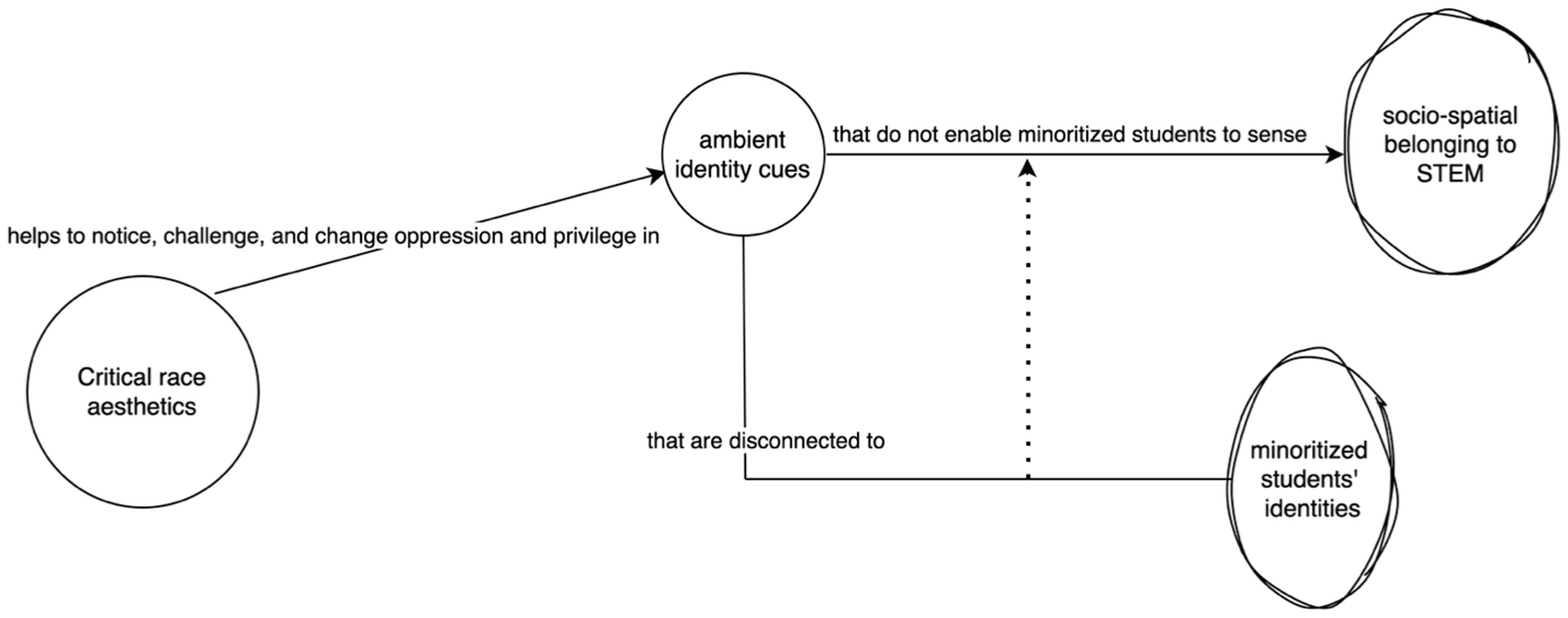
Simplified illustration of how the lens of critical race aesthetics can be used.
The issue of fostering equitable ambient identity cues is not all on the classroom teacher. For example, school districts often purchase subscriptions to video series and books, as was the case in the study (Kim et al., 2024) mentioned earlier. Administrators such as curriculum directors make decisions on these purchases, often in consultation with a teacher committee. Teachers may have the autonomy to choose to use these resources or not but by themselves have little say over which resources are purchased. And if they do not use the resources they are provided, then they would need to locate and pay for alternative resources, which is difficult to impossible given the demands on teachers’ time and often lack of funds. Still, teachers can advocate with relevant teacher committees or administrators for the district to acquire more equitable resources. But it is even more important that school leaders be aware of the impact of ambient identity cues in identity formation among minoritized students; their crucial role in equity has long been acknowledged (e.g., Skrla et al., 2004).
To attend to (in)equitable ambient cues, school leaders and teachers should learn to use critical race aesthetics to notice systemic inequity (re)produced through materials. Concrete, empathizable, and powerful visibility should be leveraged in their learning. However, it is unlikely that they can easily locate equitable resources given the prevalent underrepresentation and misrepresentation of Black and Brown populations in STEM materials (e.g., Aladé et al., 2021). This makes racial literacy education crucial. For example, racially literate teachers can teach students to “question, engage [with, and] reflect” on assumptions in curriculums (Sealey-Ruiz, 2021, p. 286). This way, Black and Brown students learn to “successfully navigate stereotype-laden interactions” (Harper, 2015, p. 648).
Implications for Education Research
Knowledge about ambient cues in the background elaborates understanding of the contexts with which students interact during their identity formation, which advances sociocultural theories of identity. Applications of critical race aesthetics, which is interdisciplinary and has been used in many disciplines (e.g., literatures, theater, art history, and film studies) except for education yet, can advance the theory through challenge and change inequitable aesthetics in education.
I proposed earlier that the lens in this article, grounded in the construct of ambient identity cues and theory of critical race aesthetics, be named critical aesthetics literacy when considering the broader application of racial literacy. This could lead to achieving an expansive research agenda that includes issues related not only to critical race aesthetics but also to racial literacy with a more comprehensive outlook. For example, a research question related to critical race aesthetics that asked “How do school policymakers make meaning of aesthetics around race, privilege, and oppression in STEM curriculum materials?” could be elaborated with another question related to racial literacy, such as “How do they leverage racial literacy resources such as ‘racial vocabularies’ (Twine, 2004, p. 884) and ‘historical literacy’ (Sealey-Ruiz, 2021, p. 287) in meaning-making of aesthetics?”
Although educational policy is beyond the scope of this article, future research involving critical policy analysis, as in Tabron et al. (2024), but with an emphasis on ambient identity cues could be of interest to some education researchers.
Concluding Remarks
Uncovering ambient identity cues in visual elements is a transformative approach to improving racial equity. Knowledge of visual elements in schools as ambient identity cues can change the landscape of educational practice with an unprecedented equity lens. For example, equity audits in public schools could include reviews of ambient visual elements to see if Black and Brown students are excluded. Critical race aesthetics can also be applied to contexts beyond classroom teaching but to improve equity in education in, for example, policy work, book illustration, multimedia creation, social media, and museums.
Footnotes

Notes
Author
CHANMIN KIM, PhD, is professor of learning, design, and technology at the Pennsylvania State University, 310B Keller Building, University Park, PA 16802;