






Abstract
This study combines state-level teacher survey data with administrative records for Indiana students in Grades 3 through 8 to examine the association between math teaching anxiety and student math achievement. We find that students from underserved backgrounds, including those from low-income, Black, and Hispanic families, are more likely to be assigned to teachers who report higher levels of math teaching anxiety. Student fixed-effects models show that math teaching anxiety is associated with lower student math achievement, with stronger negative associations for female students, English language learners, lower-achieving students, and Hispanic and Asian students. These findings point to unequal access to high-quality teachers and suggest that certain groups of students are more vulnerable to math teaching anxiety.
Many individuals experience math anxiety, which refers to feelings of fear, worry, and tension when engaging with math (Ashcraft, 2002; Dowker et al., 2016; Maloney & Beilock, 2012). Teachers are no exception (Kelly & Tomhave, 1985; Ramirez, Hooper et al., 2018). A recent survey from a nationally representative sample of math education professors reports that half of their preservice teacher students experience math anxiety (Schwartz, 2023). For decades, scholars and education commentators have raised concerns about math anxiety among teachers and its potential implications for students’ mathematics learning experiences and outcomes (Dutton, 1951; Martinez, 1987; Wood, 1988).
Although a small but growing body of research examines associations between teachers’ general math anxiety and student achievement, empirical evidence on math teaching anxiety and student outcomes remains limited. General math anxiety and math teaching anxiety are closely related but conceptually distinct constructs (Brown et al., 2011; Ganley et al., 2019). Teachers with higher general math anxiety tend to report greater math teaching anxiety, but the two do not fully overlap. For example, some teachers with low general math anxiety report elevated math teaching anxiety, whereas others with high general math anxiety report relatively low levels (Ganley et al., 2019).
In this study, we focus on math teaching anxiety, a construct that may play an important role in students’ math learning experiences. We conceptualize math teaching anxiety as a context-specific dimension of broader math anxiety while recognizing substantial conceptual and empirical overlap between these constructs. Some studies have examined teachers’ general math anxiety in relation to student achievement (Beilock et al., 2010; Ramirez, Hooper et al., 2018), while others have focused on disparities in teacher quality across student populations (Clotfelter et al., 2023; Goldhaber et al., 2015). However, no studies have directly investigated which students are more likely to be taught by teachers who experience math teaching anxiety or how this anxiety is associated with student achievement while accounting for important controls. Because math teaching anxiety is specific to instructional contexts and is more closely tied to classroom practice than general math anxiety, it is particularly relevant for understanding students’ learning experiences and outcomes.
Studies suggest that teacher general math anxiety is associated with lower student math achievement (Beilock et al., 2010; Ramirez, Hooper, et al., 2018), yet it remains unclear whether math teaching anxiety is linked to student math learning. Math teaching anxiety is closely related to general math anxiety both conceptually and empirically, and prior studies have documented strong correlations between the two constructs. Nevertheless, focusing on anxiety in an instructional context may provide more direct insight into how teachers’ affect shapes student learning. Moreover, although some student subgroups stereotyped as having weaker math skills—such as female and Black students—may be particularly sensitive to teacher math anxiety (Maloney et al., 2013), it is unknown whether associations between math teaching anxiety and student achievement vary across student subgroups.
This study addresses these gaps using data on Indiana students in Grades 3 through 8 and their teachers, drawn from the School Effectiveness in Indiana (SEI) teacher survey and administrative records from the Indiana Department of Education (IDOE). We link SEI teacher-level data to IDOE student-level administrative records from the 2010–2011 through 2016–2017 academic years. Math teaching anxiety is measured only in the 2016–2017 SEI survey, whereas student-level variables, including math achievement, are measured annually. Accordingly, our analyses assume that math teaching anxiety remains relatively stable over time (Beilock et al., 2010; Pelegrina et al., 2026). We conduct supplementary analyses to assess the plausibility of this assumption, and the results support the robustness of our findings (see Note 2 and online Appendix Tables A1 and A2).
All teachers in our sample teach mathematics, although elementary teachers are more likely than middle school teachers to teach multiple other subjects, often in self-contained classrooms. We first examine which teacher characteristics are associated with higher levels of math teaching anxiety and which student characteristics are associated with being assigned to teachers with high math teaching anxiety. Next, using student fixed-effects models, we estimate the association between math teaching anxiety and student math achievement. We also examine whether and to what extent this association varies across student subgroups, including gender, race/ethnicity, eligibility for free or reduced-price lunch (FRL), English language learner (ELL) status, individualized education program (IEP) status, and prior math achievement. Prior research suggests that the association between teacher math anxiety and student math achievement may be stronger for certain students, including females (Beilock et al., 2010). Examining these heterogeneous associations can provide a deeper understanding of how math teaching anxiety is differentially associated with student learning across student characteristics.
Math Teaching Anxiety and Student Achievement
A small number of empirical studies examine the association between teacher general math anxiety and student math achievement. Using data from 17 female elementary school teachers and their students (52 boys and 65 girls), Beilock and colleagues (2010) found that teacher math anxiety is associated with lower math achievement among girls but not boys, after controlling for baseline achievement. Given that the majority of U.S. teachers—particularly in elementary schools—are female, these findings offer important implications for understanding how math teaching anxiety may be related to female students’ math development and highlight the need for future studies with larger samples. Although these findings are based on general math anxiety rather than math teaching anxiety, they provide tentative useful insights into the association between math teaching anxiety and student learning.
Using a sample of elementary school teachers (N = 692), Hadley and Dorward (2011) showed that teacher general math anxiety is positively correlated with anxiety about teaching mathematics and that higher levels of math teaching anxiety—but not general math anxiety—are correlated with lower student math achievement. Although Hadley and Dorward distinguished between general math anxiety and math teaching anxiety, they focused solely on correlational associations without controls and did not examine whether these relationships vary across student subgroups, such as gender or race/ethnicity.
Ramirez, Hooper, and colleagues (2018) extended this research line by using data from 60 secondary school teachers and about 1,600 students. They showed that teacher math anxiety is associated with ninth graders’ math achievement, controlling for eighth-grade math achievement, and further revealed that a teacher’s mindset and teaching strategy mediate the association between teacher math anxiety and lower student achievement. Additionally, math-anxious teachers are more likely to hold fixed mindsets and rely on less effective instructional practices, which may hinder students’ math learning. Although these findings offer important insights, they do not focus on math teaching anxiety or employ student fixed effects to account for all time-invariant differences between students. Thus, examining the association between math teaching anxiety and student achievement as well as whether this relationship varies across student subgroups remains an important area for research.
Social cognitive theory provides a useful framework for understanding how math teaching anxiety may negatively affect student learning as it emphasizes that teachers shape student learning not only through instructional content but also through the emotional and motivational climate they create in the classroom (Schunk & Usher, 2012). Teachers’ enthusiasm, confidence, and positive beliefs about mathematics can foster student interest, engagement, and persistence, whereas teacher anxiety may reduce students’ motivation, focus, and willingness to take on challenging tasks (Frenzel et al., 2021; Keller et al., 2016; König, 2021). From this perspective, math teaching anxiety can be associated with student achievement directly and indirectly through both classroom interactions and their perceptions of competence and interest in mathematics.
Teacher expectation theory helps illuminate pathways linking math teaching anxiety to student achievement. High teacher expectations play a critical role in supporting student learning (Brophy, 1983; Wang et al., 2018), yet research shows that teachers with higher levels of math anxiety tend to hold lower expectations for their students (Mizala et al., 2015). When teachers experience anxiety about mathematics, they may implicitly project their own difficulties onto students, leading them to avoid challenging content and rely on simplified instructional approaches. These lower expectations may be particularly pronounced for students who are stereotyped as having weaker math skills, such as girls or underserved racial/ethnic groups. Over time, reduced expectations and instructional rigor can limit students’ opportunities to engage with cognitively demanding material, thereby constraining their academic growth (Timmermans et al., 2018). Math teaching anxiety may be related to aspects of instructional quality; teacher expectation theory provides a plausible mechanism linking math teaching anxiety to diminished student learning outcomes.
A body of research provides empirical evidence that teachers’ attitudes toward mathematics and mathematics teaching are associated with instructional practices, time spent on math, and teaching efficacy. For example, Trice and Ogden (1986) showed that teachers with higher general math anxiety spend less time on math instruction, while Ramirez, Hooper et al. (2018) found that math-anxious teachers are less likely to engage in conceptually rich instruction and instead rely on less effective teaching strategies. Studies of preservice teachers further indicate that higher math anxiety is linked to lower confidence in teaching mathematics and reduced mathematics teaching self-efficacy (Bursal & Paznokas, 2006; Swars et al., 2006). Although these studies primarily focus on general math anxiety rather than math teaching anxiety, their findings offer valuable insights into potential mechanisms through which math teaching anxiety can be associated with student achievement.
Concerns about teacher math anxiety in the United States stem partly from its potential cyclical nature (Beilock et al., 2010). Factors such as limited math skills contribute (Ramirez, Shaw et al., 2018), yet socioenvironmental influences, particularly negative classroom emotions such as worry, stress, and embarrassment, are also key drivers (Brady & Bowd, 2005; Mainali & Spalding, 2025; Ramirez, Shaw et al., 2018). Teachers with math anxiety may inadvertently convey discomfort with math, shaping students’ experiences and attitudes (Beilock et al., 2010), and students who internalize these experiences may carry elevated math anxiety into adulthood (Ashcraft, 2002; Dowker et al., 2016). Although direct evidence of such a cycle among teachers is limited, this possibility raises important questions about the long-term implications of both teacher math anxiety and math teaching anxiety in mathematics education.
Our study advances understanding of math teaching anxiety in three main ways. First, using data from Grades 3 through 8, we examine which teachers report higher levels of math teaching anxiety and which students are more likely to have these teachers. This addresses a gap in prior research on unequal access to effective teachers, which has not specifically considered math teaching anxiety (Kalogrides & Loeb, 2013; Lai et al., 2021). Second, we estimate the association between math teaching anxiety and student math achievement using student fixed-effects models. By focusing specifically on math teaching anxiety and comparing students’ achievement across years with different teachers, this approach treats students as their own controls, thereby reducing bias. Finally, using a large, state-representative data set, we examine heterogeneity in this association across student subgroups, including gender, race/ethnicity, and prior achievement. We assess whether this association differs across student subgroups, including those often stereotyped as having lower math skills (Maloney et al., 2013). Our study addresses the following research questions:
Data
This study uses two data sets to investigate the association between math teaching anxiety and student math achievement. The first data source is the School Effectiveness in Indiana (SEI) study, which collected state-representative data from approximately 5,000 teachers across 600 schools during the 2016–2017 school year. The SEI study surveyed up to 10 teachers per school to capture school conditions related to effectiveness and collected rich information on teacher characteristics, including teachers’ self-reported levels of math teaching anxiety. We use these data to construct our measure of math teaching anxiety.
The second data source is from the Indiana Department of Education (IDOE), covering the 2010–2011 to 2016–2017 academic years. IDOE data include student characteristics (e.g., gender, race/ethnicity) and teacher characteristics (e.g., teaching experience, educational attainment). 1 We used scores from the Indiana Statewide Testing for Educational Progress-Plus (ISTEP+), a state-mandated annual assessment, to measure student math achievement. We standardized ISTEP+ scores by grade and year to have a mean of 0 and a standard deviation of 1, allowing for comparisons across grades and years. ISTEP+ assessment is administered annually in all state-certified schools and aligns with state standards, with an emphasis on foundational skills such as arithmetic and algebra. Prior research suggests that teachers with higher math anxiety tend to rely more on traditional, procedural instruction, including rote learning (Boyd et al., 2014; Harper & Daane, 1998; Ramirez, Hooper et al., 2018). Because ISTEP+ primarily assesses foundational skills rather than deeper conceptual understanding, such as strategic thinking and reasoning (Indiana State Board of Education, 2016), this assessment format may be less sensitive to instructional differences associated with math teaching anxiety. Consequently, our results may underestimate the negative association between math teaching anxiety and student achievement. Based on the assumption that math anxiety remains stable over time (Beilock et al., 2010; Pelegrina et al., 2026), 2 we merged the IDOE student data with math teaching anxiety data from the 2016–2017 SEI survey using unique teacher IDs.
Our analytic data set includes 3,259 unique teachers and 105,520 unique students, comprising 256,461 student-year observations. This sample represents approximately 10% of all teachers who teach mathematics in Grades 3 through 8 in Indiana. In the analytic sample, 76% of students are White, and 41% are eligible for FRL. Among teachers, 84% are female, and 96% are White. As shown in Table 1, students and teachers in our analytic sample resemble those of the full population of students and teachers in Indiana schools, although some differences exist. White students are overrepresented in our sample (76% vs. 70%), whereas Black students (7% vs. 12%) and FRL-eligible students (41% vs. 50%) are underrepresented. Teachers in our sample are also less likely to hold a graduate degree (37% vs. 44%). These differences may limit the generalizability of our findings.
Descriptive Statistics.
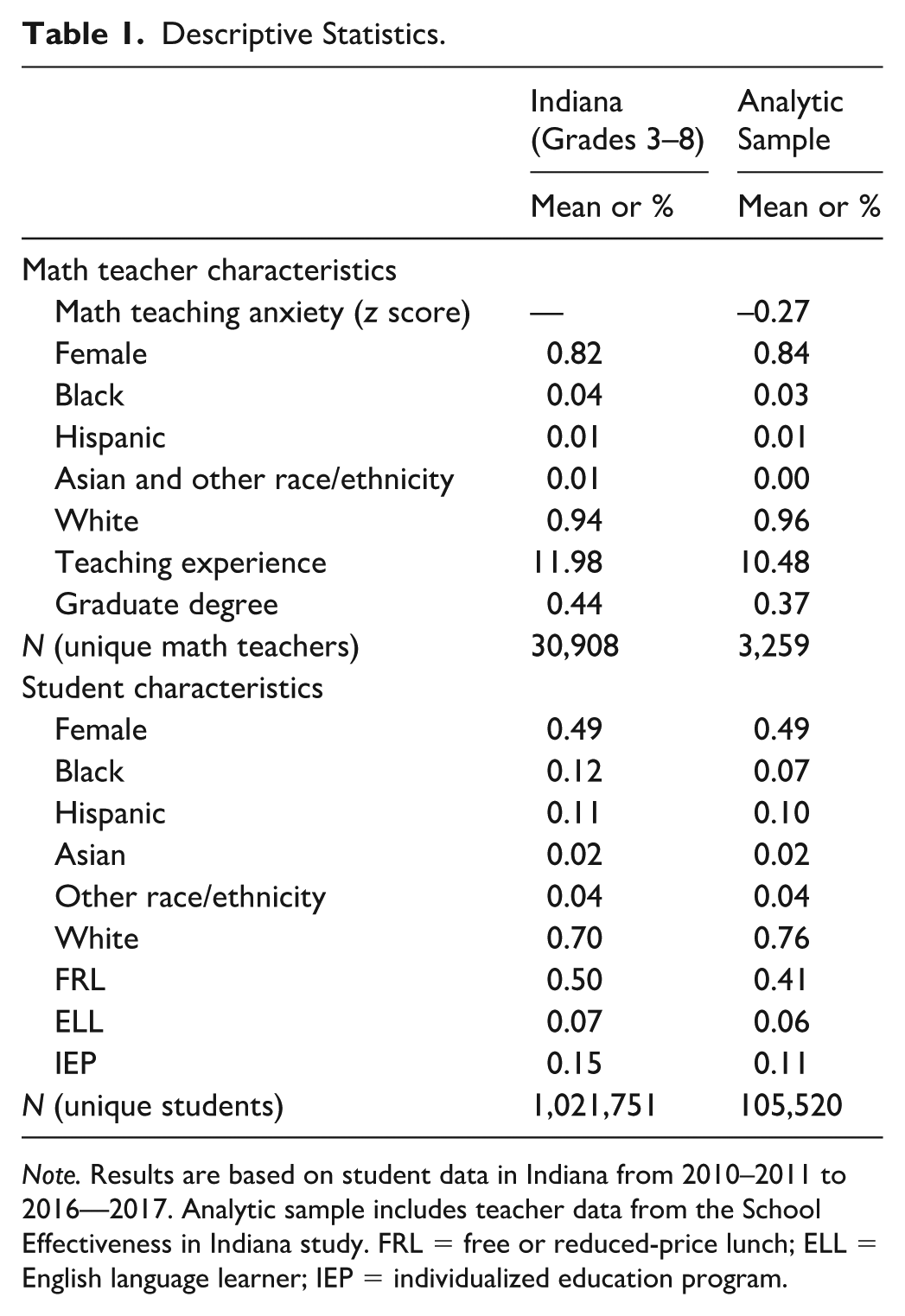
Note. Results are based on student data in Indiana from 2010–2011 to 2016—2017. Analytic sample includes teacher data from the School Effectiveness in Indiana study. FRL = free or reduced-price lunch; ELL = English language learner; IEP = individualized education program.
We measure math teaching anxiety using responses to four survey questions from the SEI study: (a) “Teaching mathematics does not intimidate me at all” (reverse-coded); (b) “If I taught in a team with a teacher partner, I’d like to have another teacher teaching mathematics”; (c) “Of all the subjects, mathematics is the one I worry about teaching”; and (d) “I would be willing to teach math exclusively” (reverse-coded). Responses were rated on a 6-point Likert scale ranging from 1 (strongly disagree) to 6 (strongly agree). The mean responses for the four items are 2.01, 2.31, 2.14, and 2.53, respectively. 3
To assess construct validity, we conducted a confirmatory factor analysis of the four-item scale. Model fit was strong (Comparative fit index = .988; Tucker-Lewis index = .964), and the scale demonstrated strong internal consistency (Cronbach’s α = .84). Although root mean square error of approximation (.099) is at the upper boundary of acceptable fit, it can be inflated in models with few items and limited degrees of freedom. Given the strong incremental fit indices and the parsimonious structure, we consider overall fit acceptable.
We initially included an item capturing general math performance (“I generally do better in mathematics courses than other courses,” reverse-coded). Although its inclusion yielded a similar level of internal consistency (Cronbach’s α = .85), we excluded this item because it does not directly reflect teaching-related anxiety. Our final measure is grounded in prior literature on anxiety related to teaching mathematics and instructional beliefs (Enochs et al., 2000; Peker, 2016). We constructed the composite by averaging the four items and standardizing the score for ease of interpretation.
Identification Strategy
We begin by examining how teacher and student characteristics are associated with math teaching anxiety. Using ordinary least squares regression, we estimate models to identify these associations. We first conduct bivariate analyses to explore teacher characteristics and math teaching anxiety. Our model specifications are as follows:

In Equation 1,
To examine how student characteristics are related to exposure to teachers with varying levels of math teaching anxiety, we estimate the following model:

In Equation 2,
Next, we estimate the association between math teaching anxiety and student math achievement. Our identification strategy relies on student fixed effects, which help reduce bias by controlling for both observable and unobservable time-invariant differences between students.
Student fixed effects allow us to compare the same students’ outcomes across years when they are taught by teachers with different levels of math teaching anxiety. This approach has been widely used to examine the role of teacher assignment in student outcomes, including student-teacher demographic matching and repeated student-teacher pairings, as a way to account for nonrandom student-teacher sorting (Dee, 2005; Gershenson et al., 2016; Hwang et al., 2021). Nevertheless, student fixed effects cannot fully eliminate all sources of bias because time-varying unobserved factors—such as changes in student motivation, family circumstances, or school environments—may be correlated with both teacher assignment and student outcomes. The primary analytic strategy takes the following form:

In Equation 3, Yijsgt denotes math achievement for student i, taught by teacher j in school s, grade g, and year t.
πirepresents student fixed effects, which control for all time-invariant student characteristics and thus reduce bias arising from stable differences across students. However, student fixed effects cannot account for unobserved time-varying factors. If such factors are correlated with teacher assignment or student achievement, our estimates may remain biased. We also include school fixed effects (
To investigate whether the associations between math teaching anxiety and student math achievement vary across student subgroups, we add interaction terms between
Results
Teacher Characteristics and Math Teaching Anxiety
We begin by examining the relationship between teacher characteristics and math teaching anxiety. Table 2 shows that certain teacher characteristics are associated with higher levels of math teaching anxiety. Specifically, Table 2, Column 1 indicates that female teachers report higher math teaching anxiety than their male counterparts, while teachers with graduate degrees report lower anxiety compared with those without graduate degrees. Additionally, teaching higher grades is associated with lower levels of math teaching anxiety. Given the nonlinear relationship between teacher effectiveness and experience (Kini & Podolsky, 2016), we compare novice teachers with mid-career and long-term teachers. Compared with teachers with 1 to 3 years of experience, those with 4 to 6 years of experience do not differ in their levels of anxiety, whereas teachers with 7 or more years of experience report significantly lower math teaching anxiety. We also find that Black teachers report higher levels of math teaching anxiety than White teachers.
Teacher Characteristics and Math Teaching Anxiety.
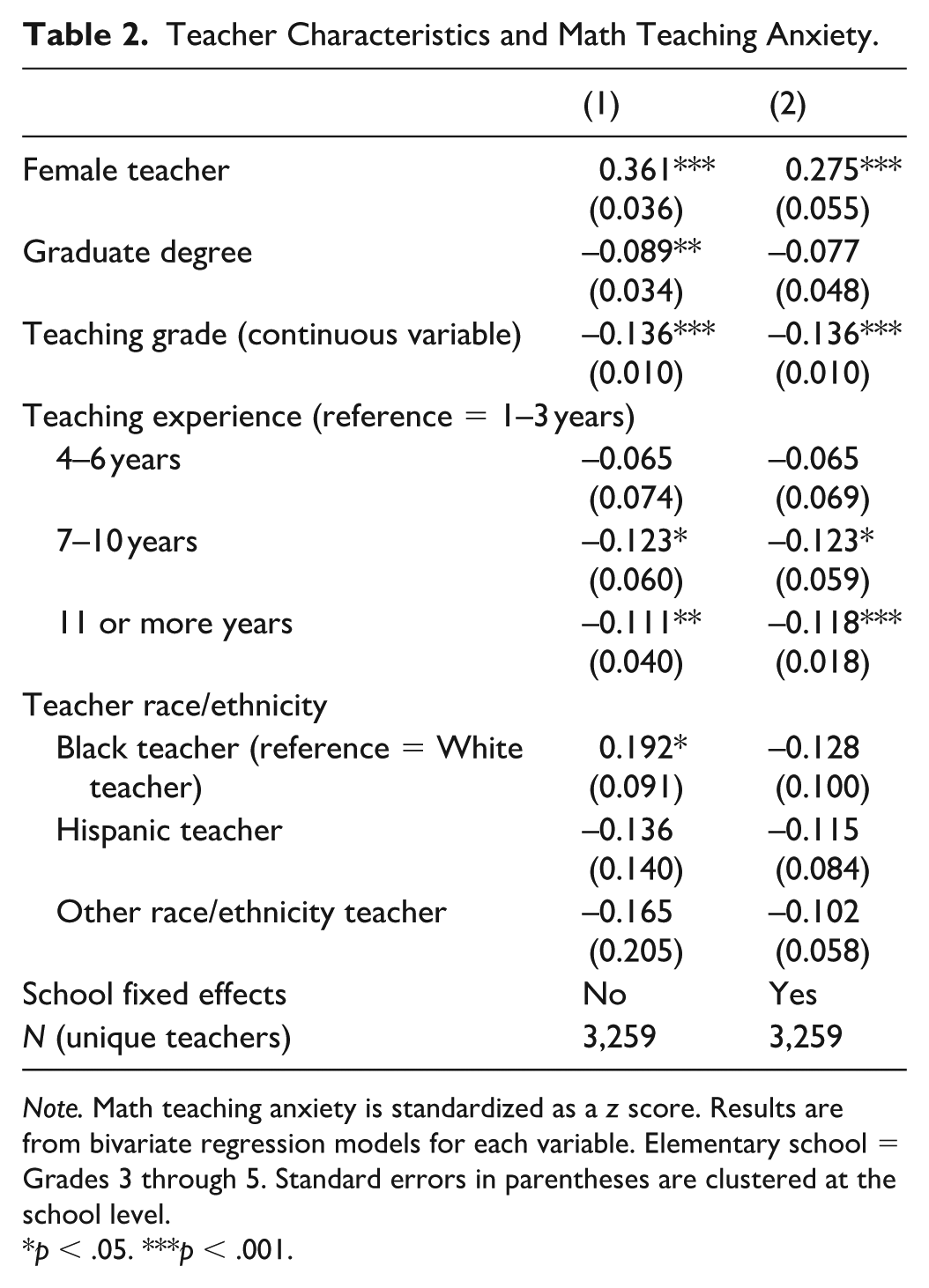
Note. Math teaching anxiety is standardized as a z score. Results are from bivariate regression models for each variable. Elementary school = Grades 3 through 5. Standard errors in parentheses are clustered at the school level.
p < .05. ***p < .001.
Next, we examine whether these findings hold within schools by including school fixed effects in the models (Table 2, Column 2). Female teachers continue to report higher math teaching anxiety than male teachers, and teaching higher grades remains associated with lower anxiety. Similarly, teachers with 7 or more years of experience still report lower math teaching anxiety. By contrast, the associations with holding a graduate degree and teacher race/ethnicity are no longer statistically significant once school fixed effects are included.
Student Characteristics and Math Teaching Anxiety
Table 3 presents bivariate regressions examining the association between student characteristics and teacher math teaching anxiety. Overall, we find that students from historically underserved populations tend to be assigned to teachers with higher levels of math teaching anxiety. Table 3, Column 1, which presents models without controls, shows that lower-achieving students and students who are eligible for FRL, have an IEP, and are Black, Hispanic, or from other racial/ethnic groups are more likely to be taught by teachers with higher math teaching anxiety. Given potential variability in teacher quality both within and across schools (e.g., Kalogrides & Loeb, 2013), we next examine whether these patterns persist within schools. Table 3, Column 2, which includes school fixed effects, indicates that FRL-eligible students, students with IEPs, Black students, and students from other racial/ethnic groups continue to be assigned to teachers with higher math teaching anxiety even within the same schools. By contrast, Hispanic students and prior achievement are no longer significantly associated with math teaching anxiety after accounting for between-school differences.
Student Characteristics and Teacher Math Teaching Anxiety.
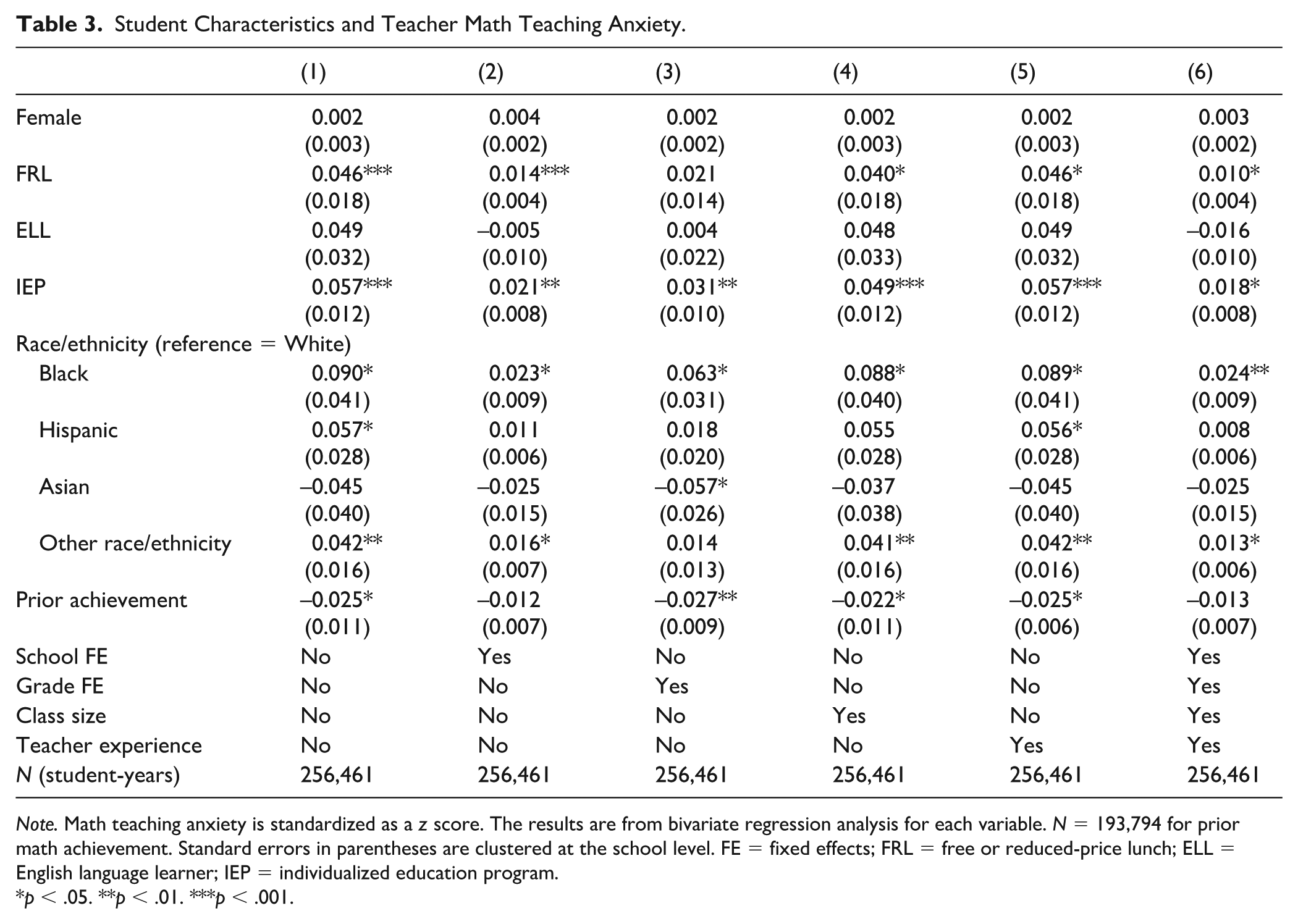
Note. Math teaching anxiety is standardized as a z score. The results are from bivariate regression analysis for each variable. N = 193,794 for prior math achievement. Standard errors in parentheses are clustered at the school level. FE = fixed effects; FRL = free or reduced-price lunch; ELL = English language learner; IEP = individualized education program.
p < .05. **p < .01. ***p < .001.
Table 3, Column 3, which includes grade fixed effects, shows that students with IEPs and Black students are assigned to teachers with higher math teaching anxiety, whereas Asian students and students with higher prior achievement are assigned to teachers with lower levels of math teaching anxiety. Table 3, Columns 4 and 5, which add controls for class size and teacher experience, indicate that these factors have little effect on disparities in exposure to teachers with higher math teaching anxiety. FRL-eligible students, students with IEPs, Black students, and lower-achieving students remain more likely to be assigned to such teachers. Table 3, Column 6 shows that even after including all student-level controls, FRL-eligible students, students with IEPs, Black students, and students from other racial/ethnic groups continue to be more likely to be assigned to teachers with higher levels of math teaching anxiety.
The Associations Between Math Teaching Anxiety and Student Math Achievement
Table 4 presents the average associations between math teaching anxiety and student math achievement. Table 4, Column 1, which includes grade and year fixed effects, shows that a 1 SD increase in math teaching anxiety is associated with a 0.079 SD decrease in student math achievement. Table 4, Column 2 adds school fixed effects, yielding a slightly smaller but still significant and negative association of 0.070 SD. Table 4, Column 3 includes additional student, teacher, and school controls and shows that math teaching anxiety is associated with a 0.062 SD decrease in student math achievement. We next control for prior math achievement (Table 4, Column 4). Across all models, math teaching anxiety is consistently negatively associated with student math achievement. Table 4, Column 4 shows that a 1 SD increase in math teaching anxiety is associated with a 0.039 SD decrease in student math achievement.
Math Teaching Anxiety and Student Math Achievement.
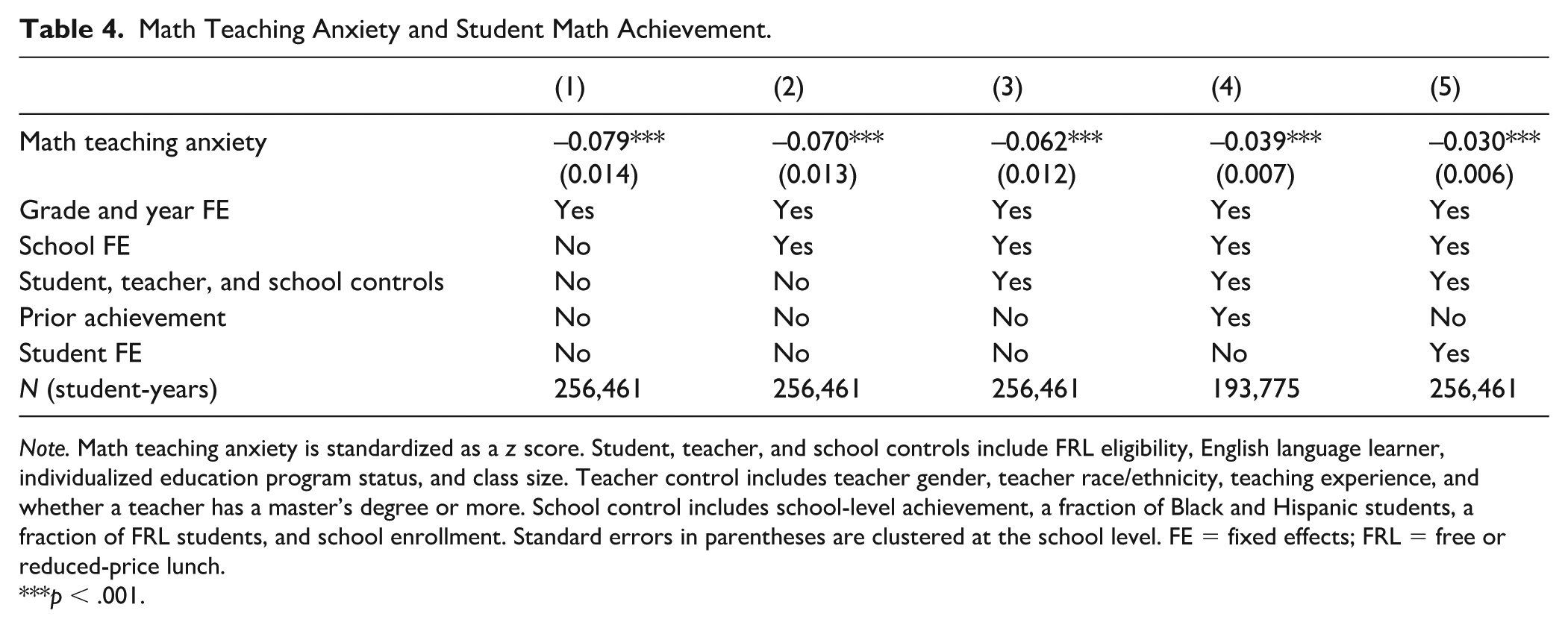
Note. Math teaching anxiety is standardized as a z score. Student, teacher, and school controls include FRL eligibility, English language learner, individualized education program status, and class size. Teacher control includes teacher gender, teacher race/ethnicity, teaching experience, and whether a teacher has a master’s degree or more. School control includes school-level achievement, a fraction of Black and Hispanic students, a fraction of FRL students, and school enrollment. Standard errors in parentheses are clustered at the school level. FE = fixed effects; FRL = free or reduced-price lunch.
p < .001.
Finally, Table 4, Column 5 presents a model with student fixed effects. Because student fixed effects control for all time-invariant differences between students, we exclude prior achievement while retaining the other covariates. The results indicate that a 1 SD increase in math teaching anxiety is associated with a 0.030 SD decrease in student math achievement. In other words, when students are taught by teachers with math teaching anxiety that is 1 SD higher, their math achievement is 0.030 SD lower. Although this is a relatively small association for a single year, repeated exposure to teachers with higher math teaching anxiety can accumulate over time. For example, having such teachers consistently from third through eighth grades is associated with a 0.18 SD lower math achievement, which represents a meaningful difference in students’ learning outcomes.
Table 5 indicates that the association between math teaching anxiety and student math achievement differs across student subgroups. The negative association is larger for female students (0.013 SD), ELL students (0.029 SD), lower-achieving students (0.017 SD), Hispanic students (0.018 SD), and Asian students (0.033 SD). These patterns suggest that math teaching anxiety is particularly pronounced for students who may face greater challenges in learning mathematics. By contrast, the association does not vary by FRL eligibility, IEP status, or student grade.
Math Teaching Anxiety and Student Math Achievement Across Student Characteristics.
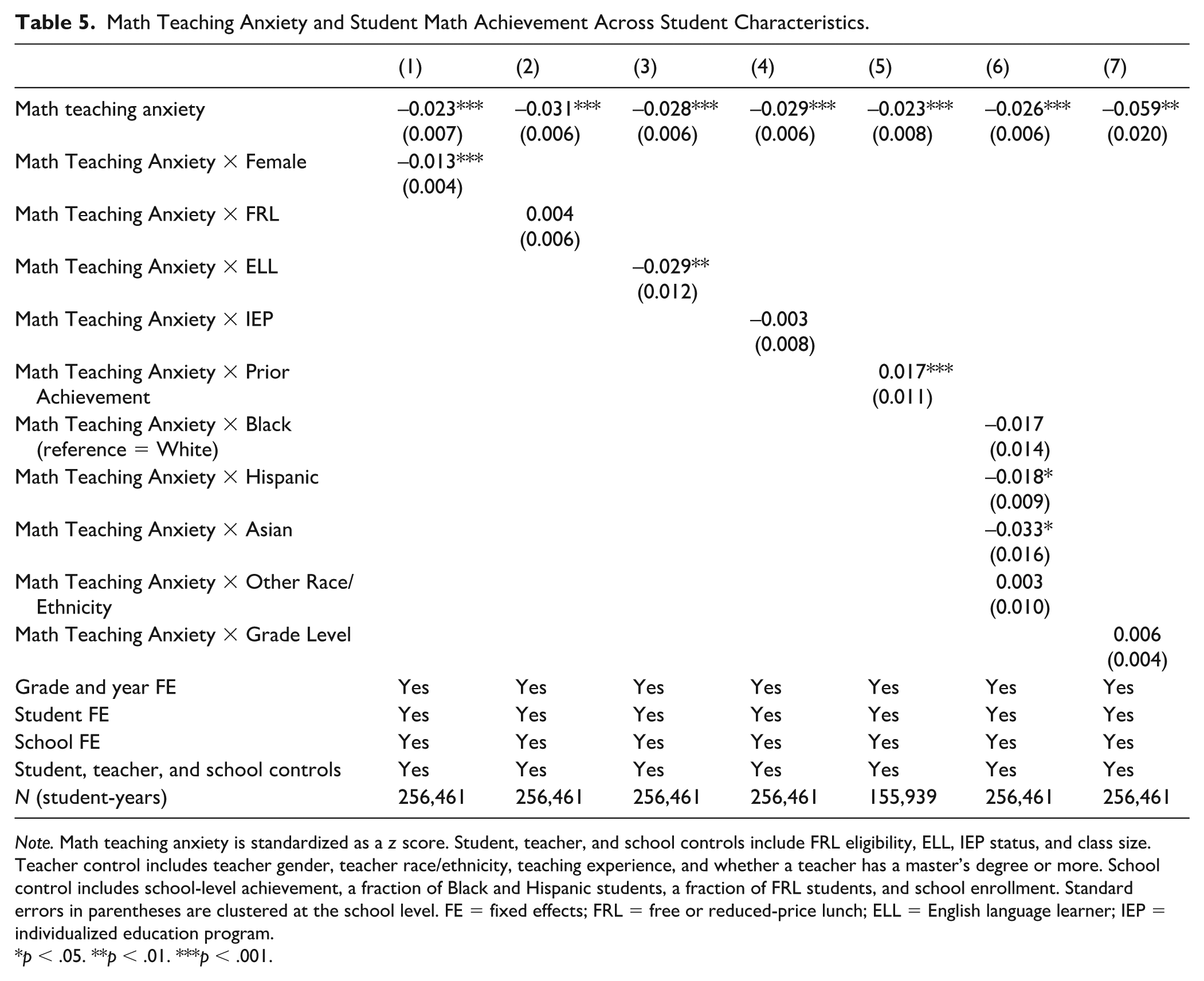
Note. Math teaching anxiety is standardized as a z score. Student, teacher, and school controls include FRL eligibility, ELL, IEP status, and class size. Teacher control includes teacher gender, teacher race/ethnicity, teaching experience, and whether a teacher has a master’s degree or more. School control includes school-level achievement, a fraction of Black and Hispanic students, a fraction of FRL students, and school enrollment. Standard errors in parentheses are clustered at the school level. FE = fixed effects; FRL = free or reduced-price lunch; ELL = English language learner; IEP = individualized education program.
p < .05. **p < .01. ***p < .001.
Alternative Model Specifications
To further explore the role of math teaching anxiety in student math achievement, we estimate additional models. Given that the influence of teachers can vary by context (e.g., Mendolia et al., 2018), we included interaction terms between math teaching anxiety and school characteristics—such as average school achievement; percentage of Black, Hispanic, and FRL students; and school enrollment—to examine whether the association varies by school context. As shown in online Appendix Table A5, we find no evidence that the association between math teaching anxiety and student achievement differs across these school characteristics. We test whether the association between math teaching anxiety and student achievement varies by teacher characteristics, including graduate degree status, class size, and teaching experience. Online Appendix Table A6 shows no differences across these factors, suggesting that the link between math teaching anxiety and student achievement is consistent across these observable teacher and school characteristics.
Given that female students may be particularly vulnerable to math teaching anxiety of female teachers (Beilock et al., 2010) and that teacher gender can shape student learning (Hwang & Fitzpatrick, 2021), we examine whether the association between math teaching anxiety and student achievement varies by both teacher and student gender. We include an interaction between math teaching anxiety and a female teacher indicator and estimate models separately for (a) all students, (b) female students, and (c) male students. Columns 1 through 3 in online Appendix Table 7 show that the association does not differ by either teacher or student gender. We find that female students appear more susceptible to math teaching anxiety than male students, yet the association for female students does not vary by whether their teacher is male or female.
Discussion
This study uses unique teacher survey data linked with administrative records from Indiana, covering 3,259 teachers and 105,520 students in Grades 3 through 8, to examine the association between teacher math teaching anxiety and student math achievement. Using student fixed-effects models, we find that higher levels of math teaching anxiety are associated with lower student math achievement. While prior studies examine teachers’ general math anxiety (Beilock et al., 2010; Ramirez, Hooper et al., 2018), we focus on anxiety in an instructional context. This construct is closely related to general math anxiety and likely captures overlapping dimensions. Accordingly, we interpret our findings within this broader domain and note that similar patterns may emerge with more general measures of math anxiety.
Math teaching anxiety may be associated with less favorable student outcomes for several reasons (Dutton, 1951; Hadley & Dorward, 2011; Karunakaran, 2020; Ramirez, Hooper et al., 2018; Wood, 1988). Teachers with higher math teaching anxiety may avoid teaching mathematics or rely on less effective instructional practices, such as rote memorization (Ramirez, Hooper et al., 2018; Schmidt & Buchmann, 1983). They may interpret students’ difficulties through the lens of their own anxiety, provide less encouragement to engage with challenging material, and offer less frequent or less effective feedback and support. These patterns may limit students’ opportunities to develop math confidence and skills and contribute to experiences of math-related stress or discomfort, potentially reinforcing math anxiety over time (Beilock et al., 2010; Ramirez, Hooper et al., 2018).
We further find that the negative association between math teaching anxiety and student achievement is stronger for certain student subgroups, including female students, ELLs, lower-achieving students, and Hispanic and Asian students. Math teaching anxiety may result in less effective instructional practices, lower teacher confidence, and less supportive student-teacher interactions. Our findings suggest that exposure to teachers with higher math teaching anxiety may have a greater adverse association for students who already tend to face challenges in developing math skills.
Our findings reveal stronger associations between math teaching anxiety and student math achievement for female students, suggesting greater vulnerability to teachers with higher math teaching anxiety. Prior work indicates that girls are more likely to adopt teacher-modeled, algorithmic strategies, which are negatively associated with higher-order problem solving (Makowski et al., 2026). If teachers with higher math teaching anxiety emphasize procedural instruction, this may disproportionately affect girls’ learning. We also show that female teachers report higher levels of math teaching anxiety compared with their male counterparts, consistent with a recent study showing gender differences in math teaching anxiety (Göçer & Özeren, 2025). Given that math anxiety can emerge early in elementary school (Szczygieł & Pieronkiewicz, 2022), identifying strategies to reduce math teaching anxiety may be especially important for fostering positive math learning experiences for young female learners.
Interestingly, our results also show that the negative association between math teaching anxiety and student achievement is stronger for Asian students, who typically exhibit high math achievement. This aligns with prior research showing that the link between math anxiety and performance is particularly pronounced among Asian students (Zhang et al., 2019). One possible explanation is that strong cultural expectations for academic success among Asian students, often described as the “model minority” stereotype (Wong et al., 1998), may increase students’ sensitivity to teachers’ expressions of math teaching anxiety (Cheryan & Bodenhausen, 2000). Further research is needed to replicate our findings and examine the mechanisms underlying this pattern.
Our results uncover that students from underserved populations—including low-income, Black, and Hispanic students—are more likely to be taught by teachers with higher math teaching anxiety. Prior research highlights substantial variation in teacher quality across student backgrounds, contributing to unequal learning opportunities (Goldhaber et al., 2015; Lai et al., 2021). Our study extends this work by showing that FRL-eligible students, students with IEPs, Black and Hispanic students, and lower-achieving students are disproportionately assigned to teachers with higher math teaching anxiety. These disparities are evident both across and within schools, highlighting persistent inequities in student learning opportunities.
Because advanced math coursetaking is strongly linked to later educational and career pathways (Long et al., 2012), disproportionate exposure to teachers with math teaching anxiety among students from underserved communities may reinforce disparities by gender, race/ethnicity, and socioeconomic status. Moreover, because math anxiety may be transmitted from teachers to students (Beilock et al., 2010), learning from math-anxious teachers may reduce students’ engagement with high-status and lucrative fields, including STEM (Maass et al., 2019; Warne et al., 2019). Our findings suggest that exposure to teachers with math teaching anxiety may undermine students’ educational and career trajectories by constraining math development.
Our findings have important implications for teacher preparation and professional development. Students majoring in elementary education report higher general math anxiety than those in other fields, including business and the physical sciences (Hembree, 1990). Both preservice and in-service elementary teachers frequently report anxiety about teaching mathematics, with preservice elementary teachers showing higher math teaching anxiety than secondary mathematics teachers (Kelly & Tomhave, 1985; Peker, 2009). This anxiety is often linked to weaker mathematical preparation and limited training (Harper & Daane, 1998). Interventions such as mathematics methods courses, field-based experiences, constructive feedback, and online instructional activities have been shown to reduce math anxiety among preservice teachers (Gresham, 2007; Mainali & Spalding, 2025). Teaching experience is also associated with lower math teaching anxiety (Hadley & Dorward, 2011), consistent with our Table 2 results. These findings suggest that math teaching anxiety should be used as a diagnostic tool to guide targeted professional support rather than for high-stakes evaluation. Strengthening math preparation and providing sustained professional development may help reduce students’ exposure to teachers with high math teaching anxiety.
Our study also has important policy implications for mathematics instruction. Teachers with high math anxiety often report negative prior math learning experiences, including embarrassment and unengaging instruction (Brady & Bowd, 2005; Mainali & Spalding, 2025). In turn, teacher math anxiety is associated with less effective instructional practices, such as an overreliance on rote memorization and discouraging classroom interactions (Boyd et al., 2014; Harper & Daane, 1998; Ramirez, Hooper et al., 2018). Promoting student-centered instructional approaches that balance academic challenge with engagement can help reduce math anxiety among both young and adult learners by fostering more positive and supportive learning environments (Atoyebi & Atoyebi, 2022; Bonesrønning et al., 2022; Ponce, 2025; Solomon et al., 2019). 5 Taken together, this evidence underscores the importance of fostering positive math learning experiences—not only in K–12 classrooms but also in teacher preparation programs.
This study advances our understanding of teacher math anxiety, yet it has several limitations. First, although student fixed effects account for time-invariant differences between students, omitted variable bias may still be present. Second, this study focuses solely on short-term math achievement, yet teachers can influence student development in both the short and long terms (Chetty et al., 2014). Examining the long-term consequences of being taught by teachers with math teaching anxiety would provide insight into the enduring influence of teacher anxiety on student educational trajectories. Third, our measure of math teaching anxiety may not fully capture the broader construct. Richer measures—including interviews, expert-informed instruments, and cognitive labs and think-aloud interviews—could improve its assessment and clarify its relationship with student learning. Fourth, although limited mathematical knowledge for teaching (MKT) may contribute to math teaching anxiety (Hill et al., 2005), we cannot test this relationship. Future research examining MKT could provide valuable insight into its sources. Finally, while our results show that associations between math teaching anxiety and student achievement are stronger for some groups, including female and Asian students, we do not identify the mechanisms underlying this heterogeneity.
Extensive evidence highlights the critical role of teachers in shaping student development (e.g., Blazar & Kraft, 2017; Darling-Hammond, 2000). However, teacher quality in the United States is not equitably distributed. Relatively advantaged students—such as those from nonpoor and White backgrounds—are more likely to be taught by high-quality teachers, while students from underserved communities often lack access to similarly skilled educators (Goldhaber et al., 2015; Kalogrides & Loeb, 2013; Lai et al., 2021). This inequality can be further exacerbated by exposure to teachers with math teaching anxiety, which may hinder math learning and contribute to persistent disparities in educational opportunities and outcomes.
Supplemental Material
sj-docx-1-edr-10.3102_0013189X261461449 – Supplemental material for An Anxious Teacher: Math Teaching Anxiety and Student Achievement
Supplemental material, sj-docx-1-edr-10.3102_0013189X261461449 for An Anxious Teacher: Math Teaching Anxiety and Student Achievement by NaYoung Hwang, Suzanne Graham and Mark Berends in Educational Researcher
Footnotes
Acknowledgements
We are grateful to the Indiana Department of Education for providing access to state administrative records and for supporting independent analyses. We are also grateful to Roberto Peñaloza, who helped organize the data. This paper was supported by Notre Dame’s Center for Research on Educational Opportunity (CREO) and the Institute of Educational Initiatives.
Authors’ Note
All opinions expressed in this article represent those of the authors and not necessarily the institutions with which they are affiliated. All errors in this article are solely the responsibility of the authors.

Funding
The authors disclosed receipt of the following financial support for the research, authorship, and/or publication of this article: This article was supported by Notre Dame’s Center for Research on Educational Opportunity and the Institute of Educational Initiatives.
Declaration of Conflicting Interests
The authors declared no potential conflicts of interest with respect to the research, authorship, and/or publication of this article.
Supplemental Material
Supplemental material for this article is available online.
Notes
Author Biographies
References
Supplementary Material
Please find the following supplemental material available below.
For Open Access articles published under a Creative Commons License, all supplemental material carries the same license as the article it is associated with.
For non-Open Access articles published, all supplemental material carries a non-exclusive license, and permission requests for re-use of supplemental material or any part of supplemental material shall be sent directly to the copyright owner as specified in the copyright notice associated with the article.
