






Abstract
Residential instability is linked to lower educational attainment, but research—particularly quantitative research—often overlooks the causes underlying residential moves and the differential effects of forced and voluntary mobility. Using longitudinal data from the Future of Families and Child Wellbeing Study, we examine how different trajectories of residential mobility shape high school completion among low-income children. We find that both forced and voluntary moves are associated with lower graduation rates. Repeated moves and moves during adolescence are also linked to lower graduation rates, while eviction-specific moves are not uniquely predictive of graduation.
Introduction
Residential mobility is associated with a range of negative consequences for students’ academic performance (Mehana & Reynolds, 2004; Rumberger, 2015). Previous research has linked such mobility, which often also results in school changes, to reductions in standardized test scores (particularly in math) and lower odds of high school graduation. These effects may be more pronounced for low-income and Black and Hispanic children (Perkins, 2017).
Not all residential moves, however, are created equal. A child leaving her home because her parents have fallen behind on rent and are being evicted experiences a different form of disruption than one who is moving because her parents purchased a house in a better neighborhood. However, with the notable exception of research on foreclosure- and eviction-related mobility (Been et al., 2011; Hepburn et al., 2025; Schwartz et al., 2017), analysts working with large-scale quantitative data can rarely account for the circumstances under which students move. As such, observed mobility effects often represent an average taken across all moves—forced and voluntary. This limits the possibility for causal identification and may confound attempts to offer a prediction of the effects of any given move on a child’s academic outcomes (Garboden et al., 2017).
In this research brief, we use data from the Future of Families and Child Wellbeing Study (FFCWS) to explore the differential effects of forced and voluntary mobility, as well as repeated mobility, on students’ likelihood of graduating from high school. Our goal is to demonstrate whether these different housing trajectories and different measures of mobility provide distinct insight into the likelihood of high school completion.
Data
The FFCWS is a longitudinal study that followed nearly 5,000 children born between 1998 and 2000 in 20 major U.S. cities through 2024. Two factors make these data well-suited to the current study. First, FFCWS was built to overrepresent low-income and non-white families, groups disproportionately vulnerable to housing precarity and educational disadvantage (Deluca et al., 2019; Graetz et al., 2023; Michelmore & Rich, 2023). Given the smaller sample sizes available in longitudinal surveys, it is helpful that FFCWS targets a population that is more likely to experience forced mobility. Second, it is the only large-scale panel dataset that we are aware of with repeated measures of economic hardship, residential mobility, forced displacement, and educational attainment across childhood and adolescence (Lundberg & Donnelly, 2019). Further description of the data and methods is provided in the supplementary materials.
We rely primarily on data collected from children’s mothers. Interviews were conducted with the focal child’s mother (and father, as available) shortly after their birth and when they were ages one, three, five, seven, and nine. Starting from when the child was 15, the FFCWS interviewed “primary caregivers” (PCGs). The mother was considered the PCG if she lived with the child at least half the time, which applied to the majority of families.
At each interview, the focal child’s mother or caregiver reported whether they had moved since the last survey wave and, if so, how many times. These data allowed us to determine whether or not children made residential moves throughout their childhood. The mother/PCG also reported whether, in the last year, they moved due to either eviction or financial hardship and whether they had been forced to live in a place not meant for regular housing (e.g., a homeless shelter, car, abandoned building). In the age 15 interview, PCGs reported whether they had made a move for one of these reasons since the age 9 interview (i.e., in the last 6 years). These data allowed us to assess whether children moved due to eviction/financial hardship or were housing insecure for 10 years between ages 0 and 15 (ages 0–1, 2–3, 4–5, 8–9, 9–15).
Following Lundberg and Donnelly (2019), we addressed nonresponse in the mobility measures by constructing lower- and upper-bound indicators of move status and type. The lower bound assumed no moves occurred prior to waves with missing data; the upper bound relied on multiple imputation under a missing-at-random assumption using the same set of covariates that we use in regressions (see supplementary materials and Table 2). We categorized children in one of three groups:
Non-movers: children whose mother/PCGs reported no residential moves through age 15.
Voluntary movers: children whose mother/PCGs reported at least one residential move by age 15 but never reported moving due to financial hardship or eviction and never reported living in a nonregular housing situation.
Forced movers: children whose mother/PCGs reported at least one move due to eviction; one move due to financial hardship; or being forced to live in nonregular housing. The questions related to forced moves were not mutually exclusive, and we take an affirmative response to any question as indication of a forced move. Within this group, we also examined a narrower subset: children whose parents specifically reported an eviction.
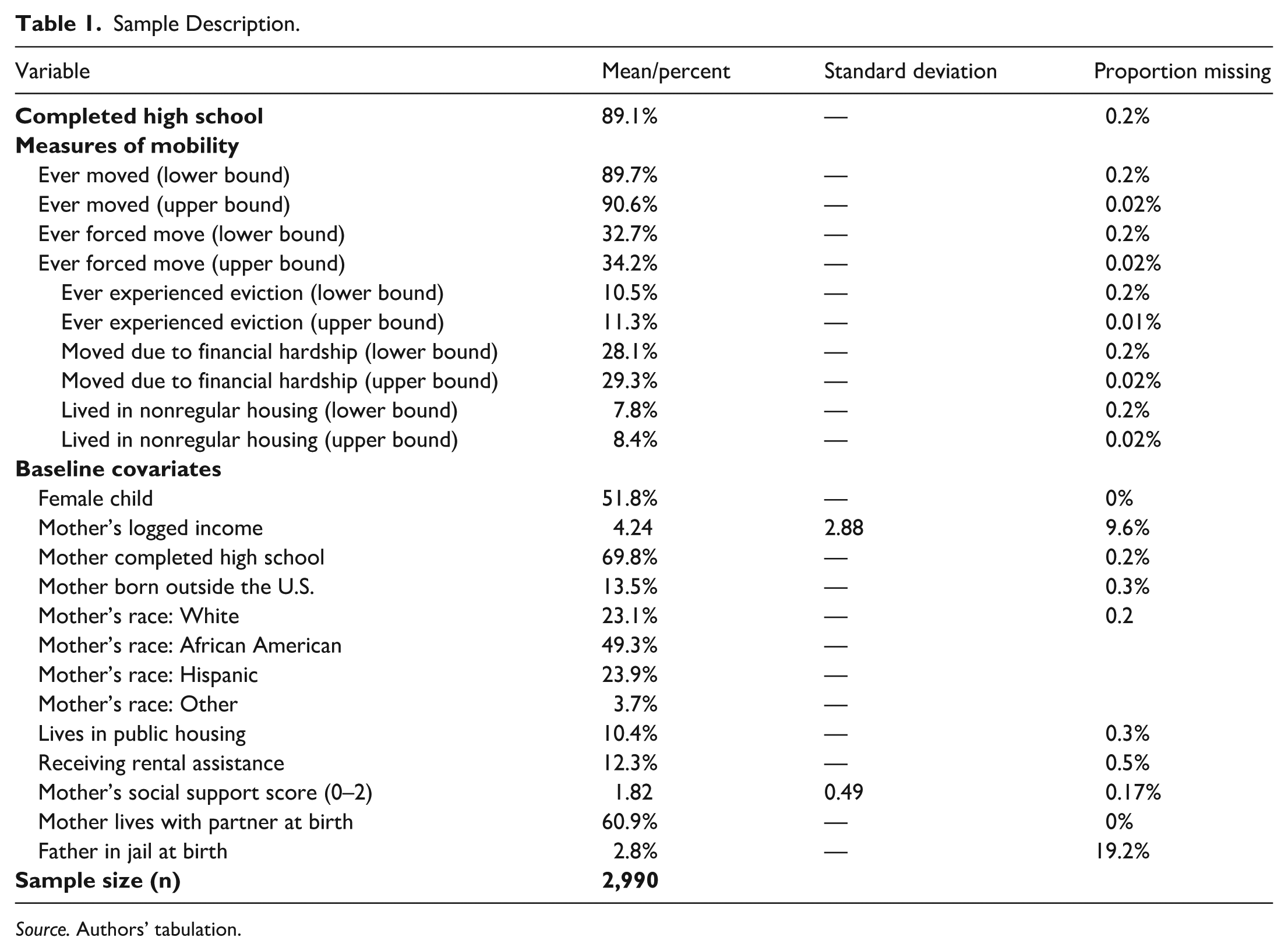
Long-term residential stability was rare for the study population. By age 15, in the lower-bound (observed) sample, 89.7% of children had experienced at least one residential move (90.6% in the upper-bound sample), with roughly one-third having experienced at least one forced move by the age of 15. Correspondingly, 10.3% of children in the lower-bound sample and 9.4% in the upper-bound sample experienced no moves (see Table 1). While respondents could provide affirmative responses to multiple mobility-related questions in the FFCWS, our coding ensured that these categories were mutually exclusive.
Sample Description.
Source. Authors’ tabulation.
Results
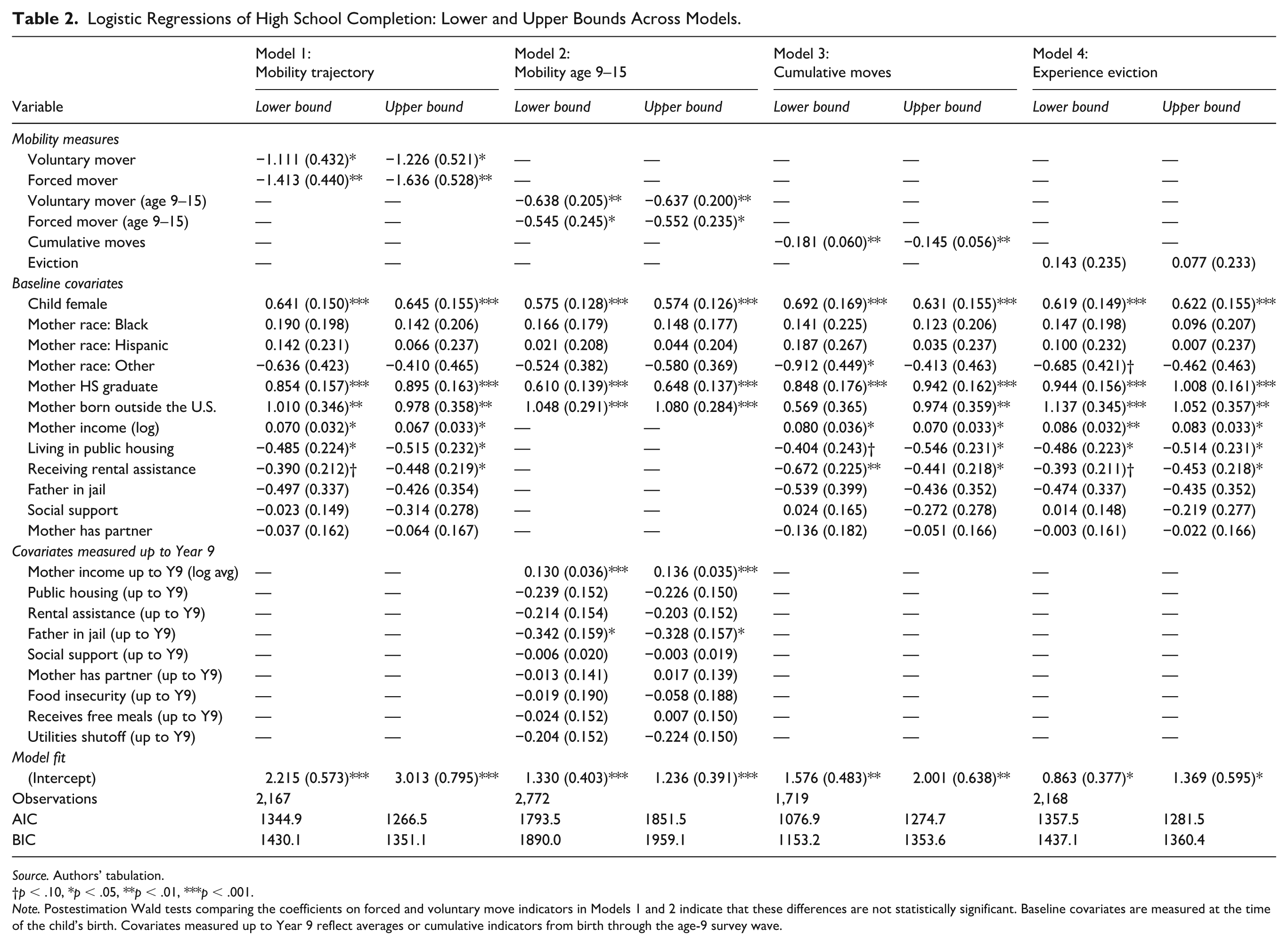
We estimated four logistic regression models predicting high school completion on the basis of student and family sociodemographic characteristics and: (1) residential move trajectory, (2) experience of residential moves between ages 9–15 (the years immediately preceding and starting high school), (3) cumulative number of residential moves to age 15, and (4) experience of eviction at any point throughout childhood and adolescence. Regressions were estimated separately for lower- and upper-bound samples. Table 2 presents the results from the four models.
Logistic Regressions of High School Completion: Lower and Upper Bounds Across Models.
Source. Authors’ tabulation.
p < .10, *p < .05, **p < .01, ***p < .001.
Note. Postestimation Wald tests comparing the coefficients on forced and voluntary move indicators in Models 1 and 2 indicate that these differences are not statistically significant. Baseline covariates are measured at the time of the child’s birth. Covariates measured up to Year 9 reflect averages or cumulative indicators from birth through the age-9 survey wave.
While the vast majority of students complete high school, Model 1 demonstrates that those who make residential moves are less likely to graduate than peers who remain stably housed throughout childhood and adolescence. Holding continuous controls at their sample means and categorical controls at their reference levels, predicted graduation rates were 97% to 98% for non-movers, 91% for voluntary movers, and 87.5 to 88% for forced movers, across lower and upper bound specifications, respectively. This pattern of lower graduation rates among mobile students also holds for moves closer to high school ages (Model 2). Both voluntary and forced moves between ages 9 and 15 are associated with significantly lower odds of graduating from high school.
Although point estimates suggest different odds of high school graduation for children who experienced at least one forced move relative to those making only voluntary moves, postestimation Wald tests comparing the coefficients on forced and voluntary mover indicators in Models 1 and 2 indicate that these differences are not statistically significant in any specifications.
Repeated residential moves (Model 3) were associated with an increased risk of failing to graduate from high school. Each additional move was associated with a 13.5%–16.6% reduction in the odds of high school completion, depending on whether lower- or upper-bound estimates were used. In contrast, we find no evidence that students who ever made moves that were reportedly eviction-related were less likely to graduate, conditional on observed covariates (Model 4).
Discussion
Our findings suggest that the timing, causes, and accumulation of residential mobility are relevant to understanding disparities in high school graduation and reinforce previous research demonstrating negative relationships between residential mobility and markers of academic achievement. Notably, however, we do not find significant differences in outcomes between students who made voluntary and forced moves. This may be the product of multiple mechanisms. First, there may simply be no disparity in outcomes to detect, or the difference may be relatively small. Second, as described in the supplementary materials, data limitations likely lead to imprecision when designating children as forced or voluntary movers, likely biasing contrasts toward a null finding. Third, it is possible that the negative effects of forced mobility are felt most acutely by those least likely to experience them (i.e., relatively better-off students). Such negative selection mechanisms have been found in previous studies analyzing the impacts of eviction (Graetz et al., 2024). If this is the case, then the composition of the FFCWS sample—skewed toward lower-income, disadvantaged children—may underestimate the disparities between voluntary and forced mobility in the general population.
Still, the findings help clarify the potential harms that accrue with residential mobility. Null findings related to eviction specifically highlight the significance of other forms of voluntary and involuntary mobility and housing insecurity. Policies that prevent involuntary displacement and mitigate the disruption of moves—regardless of cause—likely play a critical role in improving educational outcomes for vulnerable children.
Supplemental Material
sj-docx-1-edr-10.3102_0013189X261461521 – Supplemental material for Housing Instability and High School Completion: A Research Brief
Supplemental material, sj-docx-1-edr-10.3102_0013189X261461521 for Housing Instability and High School Completion: A Research Brief by Sophie Bandarkar and Peter Hepburn in Educational Researcher
Footnotes

Funding
The authors disclosed receipt of the following financial support for the research, authorship, and/or publication of this article: This work was supported by the Eviction Lab, which receives funding from the JPB, Tepper, and Gates Foundations; the Chan Zuckerberg Initiative; and Bloomberg Philanthropies.
Declaration of Conflicting Interests
The authors declared no potential conflicts of interest with respect to the research, authorship, and/or publication of this article.
Supplemental Material
Supplemental material for this article is available online.
Author Biographies
References
Supplementary Material
Please find the following supplemental material available below.
For Open Access articles published under a Creative Commons License, all supplemental material carries the same license as the article it is associated with.
For non-Open Access articles published, all supplemental material carries a non-exclusive license, and permission requests for re-use of supplemental material or any part of supplemental material shall be sent directly to the copyright owner as specified in the copyright notice associated with the article.
