






Abstract
In many states, including Massachusetts, demand for high-quality career and technical education (CTE) has grown faster than program supply, raising concerns about equitable access. Using 15 cohorts of administrative data, this brief examines how participation in high-quality CTE has changed across students’ demographic groups. While overall participation and concentration have increased, these gains are unbalanced: Female students have become better represented, while Hispanic/Latino students and English language learners (ELLs) have not. Our findings suggest that underrepresentation among Hispanic/Latino students appears tied to their school access and choice, whereas ELLs face persistent within-school barriers to concentrating in high-quality CTE pathways.
Introduction
Over the past two decades, career and technical education (CTE) has expanded offerings and gained newfound interest across the United States, as policy attention to “college and career” has supplanted “college for all.” As of 2025, over 85 percent of public-school districts offer at least one CTE course (NCES, 2024). Despite greater policy salience, many states face a pressing challenge: student demand for CTE—particularly high-quality programs such as those aligned with high-wage and high-demand sectors or offered in selective settings—has grown faster than program supply. As a result, oversubscription, unequal access, and demographic disparities have emerged as critical pressures in the system.
Massachusetts provides an informative context for studying these dynamics. The state offers a set of high-quality CTE programs (i.e., Chapter 74 approved) that exceed the standards of Perkins-only offerings, requiring at least 900 hours of immersive learning, formal partnerships with local employers, and opportunities to earn industry-recognized credentials. In Massachusetts, this distinction signals a “quality premium.” However, access to these programs remains uneven: Only about one-fifth of comprehensive high schools offer any Chapter 74 program (Yoon & Dougherty, 2026), while nearly all wall-to-wall schools face substantial oversubscription (Dougherty & Macdonald, 2019; Dougherty, 2025). These conditions make Massachusetts an ideal setting to examine how participation in high-quality CTE has shifted under capacity constraints.
We leverage 15 cohorts of administrative data and provide longitudinal evidence on (1) how participation and concentration in high-quality CTE have changed across students’ demographics and (2) how demographic differences in concentrating in this pathway evolve within the same schools and towns. This focus is motivated by the historical and recent calls to explore variation in CTE participation across student demographics (Oakes, 1983; Ecton & Dougherty, 2023) and efforts to examine and address persistent access disparities (Jacob & Ricks, 2023). This brief provides timely insight into the equity challenges in high-quality CTE programs’ supply and participation that accompany rising demand, with direct implications for the growing number of states pursuing their own program investments.
Data
We use student-level administrative data from the Massachusetts Department of Elementary and Secondary Education (DESE) for on-time graduation cohorts from 2010 through 2024. This dataset tracks 1,112,121 students from 377 comprehensive high schools and 36 wall-to-wall CTE schools. As this dataset presents a full census of public high school students in the state, it provides a robust basis for examining long-term shifts in CTE participation. The data includes student demographics, school identification, town of residence, and standardized state test scores in Grade 8, alongside detailed records of CTE participation (both Perkins-only and Chapter 74) from Grades 9 through 12.
To distinguish students who have made a substantial commitment to a high-quality CTE pathway (a proxy for Chapter 74 completion), we adopt the federal Perkins V framework to identify “concentrators.” Following Goldring et al. (2021), we define a Chapter 74 concentrator as a student who participated in a Chapter 74 program for two or more academic years.
Results
How Has High-Quality CTE Participation and Concentration Changed Across Students’ Demographics?
While the statewide share of students participating in any CTE program has remained relatively stable (Figure A1), the share participating in Chapter 74 programs (i.e., high-quality) has grown from roughly 15 to 20 percent. Given that both participation rates and the number of schools offering Perkins-only programs have declined, these patterns suggest that schools have converted existing CTE offerings to high-quality programs or are prioritizing high-quality options among their offerings. Concurrently, student participation patterns may also reflect growing demand for these more rigorous pathways. As demand increased, baseline academic achievement among students who later entered the programs has also risen, as shown in Figure A2.
If access was unconstrained, and if preferences and resources were constant across groups, trends in Chapter 74 participation and concentration for each demographic group would be expected to mirror the overall statewide increase (Figure 1-a). Instead, participation patterns differ. Notably, female students and Black/African American students show an encouraging trend: Their participation and concentration in Chapter 74 programs have grown at a rate exceeding overall statewide growth, signaling an improvement in relative representation.
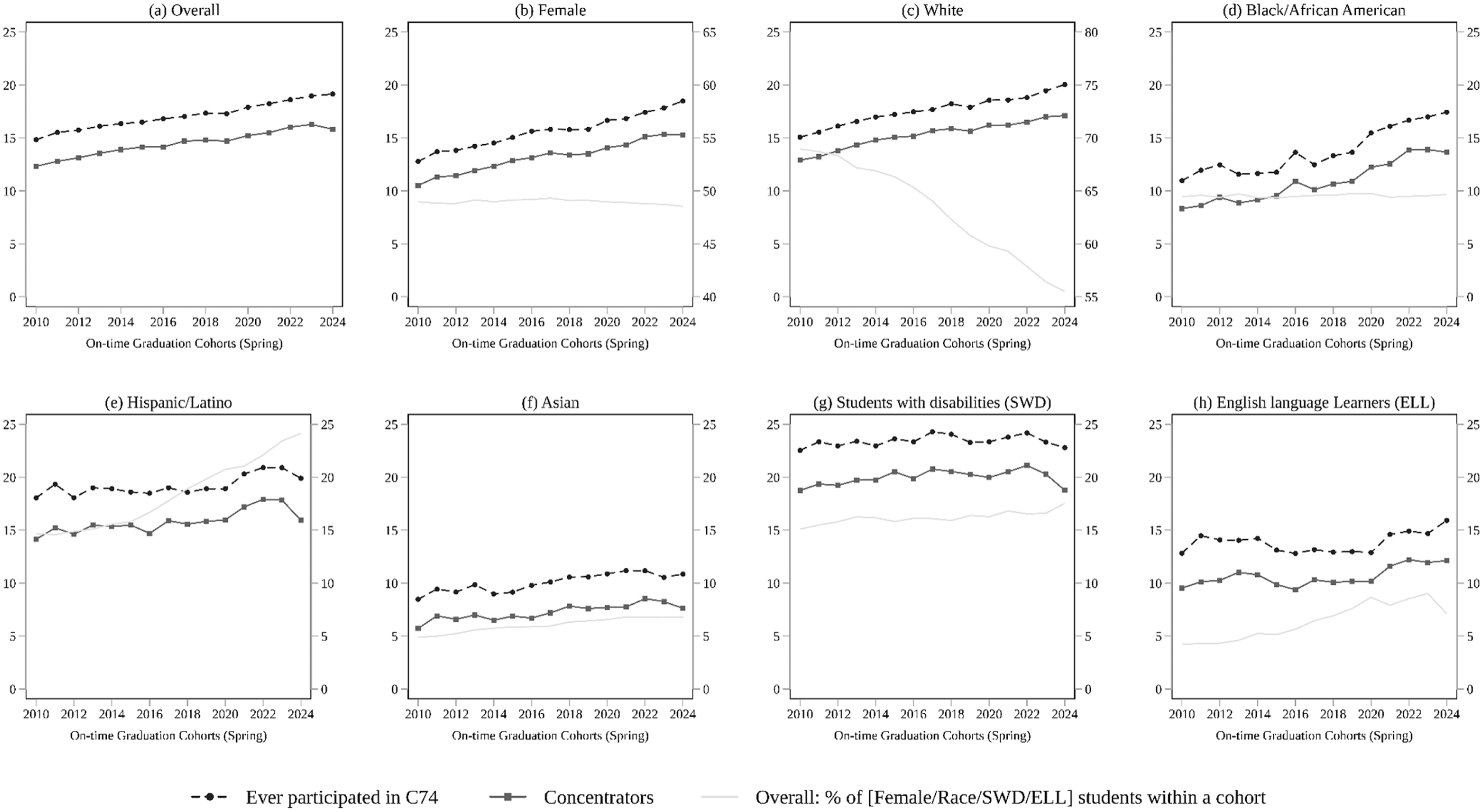
Cohort trends in the share of Chapter74 participants and concentrators: across students’ demographics.
In contrast, Hispanic/Latino students and English language learners (ELLs) exhibit relatively flat participation trends over time, suggesting a reduction in their relative representation in high-quality CTE. Given that these two groups experienced the most significant demographic growth over the past 15 cohorts (Figure A3), their stagnant participation trends raise questions about an equitable increase in participation. Figure A4 further supports this by illustrating that participation growth has failed to keep pace with overall demographic expansion. Notably, while Hispanic/Latino students exhibit higher representation among Chapter 74 participants relative to their population share, the narrowing of this gap over time indicates that their participation has not scaled in proportion to their demographic increase.
How Have Demographic Differences in Concentration Changed Within Schools and Towns?
The raw patterns raise an important question: Are these changing disparities primarily driven by differences in access to high-quality programs, or by unobservable factors operating within schools and towns, such as differences in preferences, information, or supports? To explore this, we generate estimates over time in concentration disparities after accounting for differences in program supply and access—where town of residence shapes which schools students can access, and school-cohort combinations capture which programs are available at a given time. This decomposition approach is informed by prior studies highlighting concerns about CTE access (e.g., Ansel et al., 2022; Dougherty & Macdonald, 2020) and distinct drivers of CTE participation gaps across demographic groups (Jacob & Ricks, 2023).
Figure 2 presents the adjusted association between each demographic characteristic and the likelihood of becoming a concentrator over cohorts, using models with high school and town-of-residence fixed effects, while accounting for baseline academic achievement, attendance, free or reduced-priced-lunch eligibility, and other demographics. This approach allows us to isolate the net association for each demographic group. If raw disparities were driven largely by program supply and access, these estimates would remain small across cohorts.
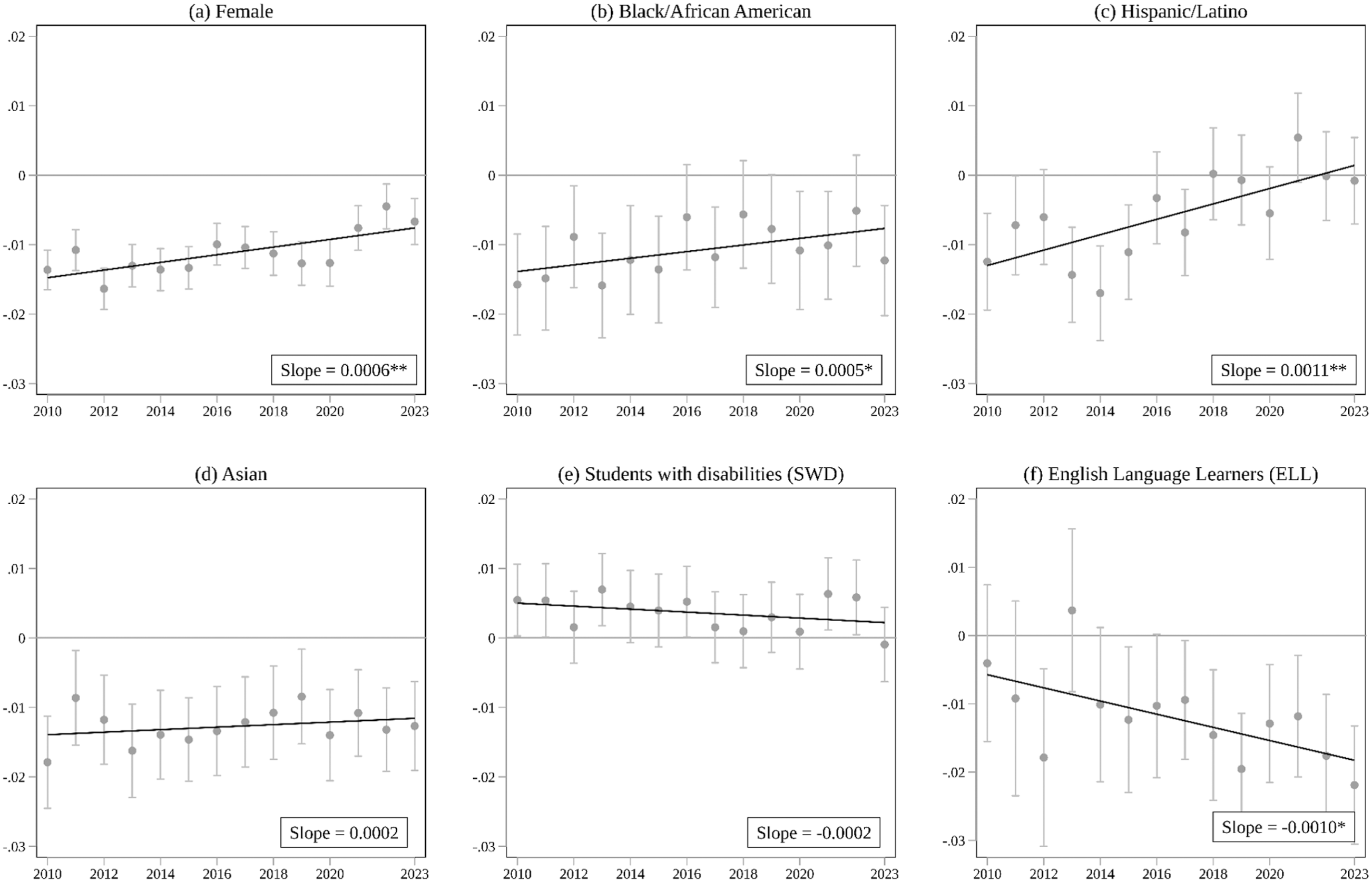
Cohort trends in adjusted coefficients of becoming a Chapter 74 concentrator: across students’ demographics.
The results reveal diverging cohort trends: For female and Hispanic/Latino students, the negative association with Chapter 74 concentration within schools and towns has steadily converged toward zero. In contrast, the disparities for ELLs have widened, meaning that they have become progressively less likely to concentrate than their within-school peers, even after controlling for baseline demographics and academic achievement. These remain robust when using participation as the alternative outcome (Figure A5).
Discussion
This brief uncovers three key patterns with important implications for future research and the design of equitable high-quality CTE systems.
First, female students have become better represented in high-quality programs over time. Their more muted adjusted coefficients suggest that factors within schools and towns (such as student preferences or supports) might have become less predictive of who concentrates on this pathway. Their improving representation may therefore reflect both rising supply and access and the diminishing influence of earlier barriers.
Second, Hispanic/Latino students’ overall concentration rate remains flat relative to the statewide increase, even as their within-school and within-town disparities diminish across cohorts. This suggests that sorting patterns within these contexts may have become more equitable over time. This pattern points to unobserved factors related to residential sorting and school enrollment, rather than within-school dynamics, as the potential driver of their concentration not scaling with demographic growth. This finding holds even when replacing high school with Grade 8 school fixed effects (Figure A6), reinforcing that these patterns reflect residential and access factors not captured by high school–level controls alone. For Hispanic/Latino students, access to the programs remains the critical lever, underscoring the need for targeted policy attention as states expand high-quality CTE offerings.
Third, ELLs may face intensifying barriers to concentrating in these pathways even within the same schools and towns. Unlike other groups, ELLs exhibit increasingly negative adjusted coefficients across cohorts. To illustrate this point, Figure A7 shows that these widening gaps hold even within the Hispanic student population (which accounts for about two-thirds of all ELLs in the state), suggesting that linguistic access (rather than ethnicity alone) may be a more pronounced barrier to high-quality CTE concentration. ELLs may encounter challenges related to program fit or limited language-responsive supports in technical coursework. This is particularly relevant given that the recent expansion of Chapter 74 programs is more pronounced in programs (Figure A8), such as education and health services, that often place higher demands on English proficiency compared to traditional sectors like construction or transportation. Our findings underscore the need for continued efforts to ensure that high-quality CTE pathways are accessible and supportive for multilingual learners, even within schools that already offer these programs.
Taken together, these patterns speak to a broader challenge facing high-quality CTE systems: As states invest in upgrading program quality and expand their access, the benefits of that investment may not reach all students equally. The contrast with Perkins-only concentrators (Figure A9), where demographic associations are substantially more muted and show no meaningful cohort trend, suggests that inequities in representation are a more distinctive feature of high-quality pathways that may be allowed to use selective criteria to participate—one that warrants focused attention as demand for these programs continues to grow.
Supplemental Material
sj-docx-1-edr-10.3102_0013189X261467378 – Supplemental material for Fifteen Years of Change in High-Quality CTE Participation
Supplemental material, sj-docx-1-edr-10.3102_0013189X261467378 for Fifteen Years of Change in High-Quality CTE Participation by Yerin Yoon and Shaun M. Dougherty in Educational Researcher
Footnotes
Acknowledgements
We also gratefully acknowledge the generous support and partnership of the Massachusetts Department of Elementary and Secondary Education and the Rappaport Institute for Greater Boston. Any errors, opinions, findings, or conclusions presented in this paper are solely those of the authors.

Funding
The authors disclosed receipt of the following financial support for the research, authorship, and/or publication of this article: This project was supported by a grant from the Rappaport Institute for Greater Boston at the Harvard Kennedy School of Government (Grant No. 5115451).
Declaration of Conflicting Interests
The authors declared no potential conflicts of interest with respect to the research, authorship, and/or publication of this article.
Supplemental Material
Supplemental material for this article is available online.
Author Biographies
References
Supplementary Material
Please find the following supplemental material available below.
For Open Access articles published under a Creative Commons License, all supplemental material carries the same license as the article it is associated with.
For non-Open Access articles published, all supplemental material carries a non-exclusive license, and permission requests for re-use of supplemental material or any part of supplemental material shall be sent directly to the copyright owner as specified in the copyright notice associated with the article.
