






Abstract
Educational policies that impact second language (L2) learners—a rapidly-growing group—are often enacted without consulting relevant research. This review synthesized research regarding optimal conditions for L2 acquisition, facilitative L2 learner and teacher characteristics, and speed of L2 acquisition, from four bodies of work—foreign language education, child language research, sociocultural studies, and psycholinguistics—often overlooked by educators. Seventy-one peer-reviewed journal articles studying PK-12 L2 learners met inclusion criteria. Findings included: 1) Optimal conditions for L2 learners immersed in a majority-L2 society include strong home literacy practices, opportunities to use the L2 informally, well-implemented specially-designed L2 educational programs, and sufficient time devoted to L2 literacy instruction, whereas L2 learners with little L2 exposure require explicit instruction to master grammar; 2) L2 learners with strong L2 aptitude, motivation, and first language (L1) skills are more successful; 3) Effective L2 teachers demonstrate sufficient L2 proficiency, strong instructional skills, and proficiency in their students’ L1; 4) L2 learners require 3-7 years to reach L2 proficiency, with younger learners typically taking longer but more likely to achieve close-to-native results. These findings, even those most relevant to education, are not reflected in current US policy. Additional research is needed on the characteristics of successful or unsuccessful L2 learners and L2 teachers. Such research should attend systematically to the differences between L2 learning in maximal versus minimal input settings; whereas the psycholinguistic challenges of L2 learning might be common across settings, the sociocultural and interactional challenges and opportunities differ in ways that can massively impact outcomes.
Keywords
Second and foreign language education are topics attracting increasing interest across the globe. In the United States, the number of children entering school who speak a language other than English at home is increasing much more rapidly than the overall school-aged population (Office of English Language Acquisition, Language Enhancement and Academic Achievement for Limited English Proficient Students, 2010). Educators are challenged to help these children reach the level of proficiency required for learning sophisticated academic content through English. Around the globe, the popularity of learning English as a foreign language has exploded, making second language (L2) education a mainstream endeavor (Hu, 2007).
Nonetheless, immigrant students continue to lag behind native speakers in academic achievement in the United States (National Assessment of Educational Progress, 2009), and foreign language education in the United States and elsewhere in the world is far from universally successful (Byun et al., 2011; Chen & Goh, 2011; Robinson, Rivers, & Brecht, 2006). We argue in this review that progress in meeting the educational challenges of L2 learning and teaching has been hampered by the failure to integrate information from across the several fields of research that are relevant to the topic. We identify four of those fields, briefly summarize their contributions to thinking about L2 learning, and then show how they complement one another in responding to some important questions of research and practice, while still leaving others unresolved.
We approach this review by highlighting the contributions from the four groups who have contributed to research on issues of L2 learning and teaching: foreign language educators, child language researchers, sociocultural researchers, and psycholinguists. Research from the foreign language educator perspective took off in the decades after World War II, with the founding of the journal Language Learning in 1948, of the Center for Applied Linguistics in 1959, and of the International Applied Linguistics Association in 1964. Starting in about 1970, researchers in the new field of child language acquisition started applying their methods and thinking to L2 learners. Subsequently sociocultural and psycholinguistic considerations were brought to bear both on first language (L1) and L2 issues. These four groups remain the primary sources of research related directly to issues of L2 learning.
These four groups have brought distinct perspectives, with different motivating questions, to the field of L2 acquisition (see Table 1). They have worked with different default populations acquiring L2s in different contexts. They have also brought different methods to their questions and have published in different journals, with the result that they have not communicated effectively across their disciplinary and professional boundaries. Foreign language educators, for example, traditionally focus on L2 acquisition among adolescents or adults in classroom settings and use correlational or small-scale quasi-experimental methods to identify good students or good teaching techniques. Foreign language educators bring the most practice-oriented perspective to L2 acquisition but may limit themselves by thinking of L2 acquisition as an outcome of L2 teaching in a classroom setting, disregarding informal or naturalistic acquisition. Child language researchers, on the other hand, use descriptive, longitudinal techniques with young L2 learners in naturalistic settings, often focusing on caregiver–child interactions. Child language researchers have focused most on what factors influence children’s L1 or L2 acquisition. Sociocultural researchers study L2 learners of any age, but they tend to use qualitative methods to understand the social and cultural forces at work in any L2 learning environment. Research from a sociocultural perspective also may examine the L2 learner’s or teacher’s own point of view and how issues of identity affect L2 acquisition. Psycholinguists, by contrast, examine the mental processes involved in L2 acquisition at any age and typically use quantitative methods to study language elicited in laboratory settings, often through controlled experiments. They have been very interested in the component skills that build L2 competence and which cognitive skills may be able to transfer from L1 to L2.
Differences among the perspectives
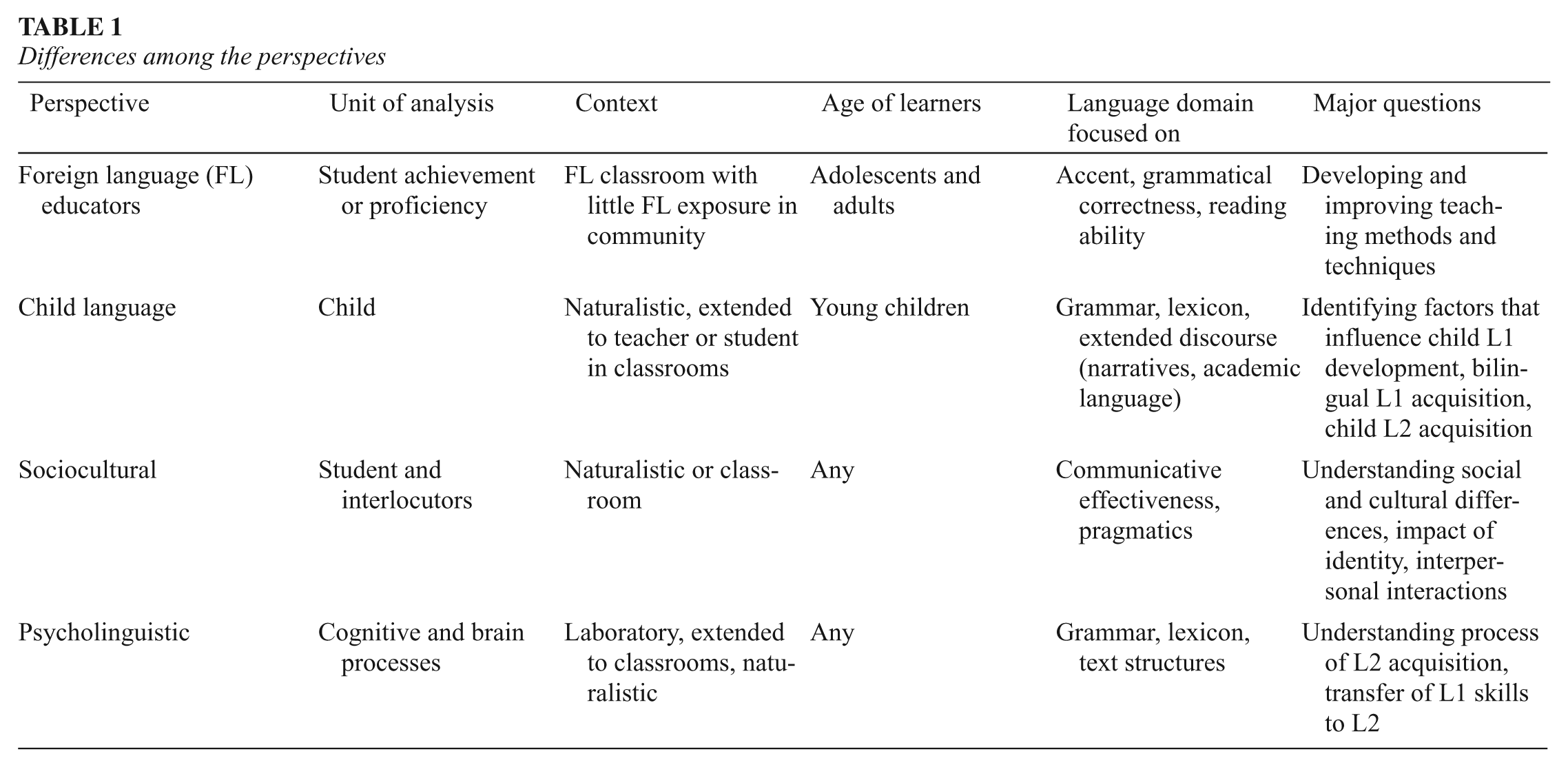
Researchers from these four perspectives have generally worked at the periphery of the issues that are most urgent in U.S. education—supporting the achievement of L2 learners, bilinguals, and students from language-minority homes in mainstream classrooms. Even the work of foreign language educators, though of course centrally focused on educational issues, has not been exploited for optimal relevance to L2 learners or to students with academic challenges associated with their language-minority status. The other three groups have often asked questions with implications for education, but not those that address teachers’ immediate instructional concerns. Even when they examined L2 acquisition in classroom contexts, these researchers often did not focus on the curriculum and instruction issues that specifically inform educational practice. Nonetheless, these perspectives have contributed much to understanding L2 acquisition; we include them precisely because they may be less well known to educators than are the findings of researchers directly evaluating educational programs.
Of course, other bodies of work have contributed to our understanding of L2 acquisition as well, notably theoretical linguistics. Linguists are primarily interested in the properties of languages themselves, how languages are similar and different, and how the complexity of linguistic systems should best be represented. Much work in child language was originally motivated by a search for evidence to support or refute hypotheses on the nature of language, but sociolinguists and psycholinguists focus more on communicative effectiveness and real-time performance than on the nature of language itself. The recurrent observation that L2 acquisition is, generally, more effortful and less successful than L1 acquisition does not interest linguists but remains a puzzle for the four groups of researchers whose work we highlight in this review.
What exactly do we mean when we use the term L2 acquisition? L2 acquisition includes second (or foreign) language learning in both naturalistic (unschooled) settings as well as classroom-based learning, including both oral and written forms. For the purposes of this article, we define the term broadly to describe the learning of a second (or subsequent) language by anyone who has basic command of one (or more) language(s) already. We use the term L2 education to refer specifically to classroom-based instruction or educational programs designed to aid students in mastering an L2, in either oral or written form (or both). Within L2 education, there are two main contexts that need to be distinguished: a “foreign language” context and an “L2-majority” context (referred to by many as a “second language” context). Children learning an L2 in a foreign language context have little exposure to the L2 outside of the classroom. By contrast, children learning an L2 in an L2-majority context are typically surrounded by the L2 within the broader society in which they live. This article does not discuss the situation of children exposed to two languages from birth, which has been termed “bilingual first language acquisition” (De Houwer, 2009), although some of the research perspectives have examined bilingual L1 acquisition to better understand how learning an L2 after an L1 is established (sequential bilingualism) differs from simultaneous bilingualism.
We reviewed the research to address five questions of particular relevance to educators (see Snow, 1993, 1998, for earlier responses to the first two of these):
What are optimal conditions for L2 acquisition?
What are the characteristics of excellent or unsuccessful L2 learners?
What are the characteristics of excellent or unsuccessful L2 teachers?
What are reasonable expectations for speed and accomplishment for L2 learners of different ages?
Has information generated by the four research perspectives influenced the formulation of educational policies for L2 learners?
These five questions have been chosen because of their centrality to the four perspectives and their relevance to L2 education. Question 1 (Q1) illuminates the home, community, school, and classroom factors that educators need to consider to adjust their schools, programs, and classrooms to better serve their L2 learners. Although studies addressing Q1 come from all four perspectives, sociocultural researchers may be said to be most concerned with this question. Sociocultural researchers argue that context is an extremely important and understudied aspect of L2 acquisition. Even though educators may not always be able to set up completely optimal conditions, knowing what to work toward, and improving those conditions over which they have control, can help educators improve their L2 students’ achievement.
Question 2 (Q2) and Question 3 (Q3) have been central to foreign language educators. Regarding Q2, foreign language educators have typically identified students who are likely to succeed in L2 classrooms and have in some cases limited access to L2 (or L3) education to those with demonstrated ability. Current educators with L2 students in either foreign language or L2-majority contexts may want to use information on student characteristics to identify students who need extra support or instruction in learning an L2. Regarding teachers, Q3 helps school administrators and district officials distinguish teachers who may be better suited to work with L2 learners as well as discover what traits or attributes to work toward fostering in teachers. When these attributes are identified, preservice and in-service training for teachers can include activities that build these traits. Identifying these characteristics could lead to the development of a screening tool that could exclude teacher education candidates who did not possess important traits that are not trainable; in this way, new teachers could be chosen who will have the best chance of success of working with L2 learners.
Of most interest to child language researchers and psycholinguists, Question 4 (Q4) is perhaps the most urgent: What can educators reasonably expect from L2 learners in different contexts? Answering this question is critical to aiding the formulation of research-based L2 education policies, such as deciding how long L2 education services should be provided for children learning L2 in L2-majority contexts. Q4 is also relevant to foreign language educators, in identifying how many hours of L2 instruction is necessary for students to reach desired benchmarks. In addition, Q4 results can help teachers to set rigorous but attainable academic goals for L2 learners. Question 5 (Q5) ties the other questions together by asking whether current U.S. policy reflects these research findings. If relevant research findings have not previously influenced policy, then we need mechanisms to move the policy conversation beyond a single-minded search for the best L2 program to an understanding of why certain approaches might work better with some students or in some contexts than others.
This article is not meant to be a comprehensive review of all studies related to L2 acquisition; rather, our goal is to demonstrate the value of integrating information from diverse perspectives in thinking about educational questions. Our review thus differs from books such as Ortega (2009) and Mitchell and Myles (2004) by incorporating insights from four distinct bodies of work that are not typically brought into relation with one another, and by bringing these bodies of work specifically to an audience of educators and educational researchers. In addition, we review studies from all four perspectives published up through 2011.
We first describe the methods used for this review, followed by brief overviews of each of the four perspectives to familiarize the reader with each perspective’s general approach to studying L2 acquisition. In the subsequent findings section, evidence from all four perspectives is synthesized to provide answers to our five research questions.
Method
Searches for peer-reviewed articles were conducted in Academic Search Complete, Education Full Text (Wilson), ERIC (EBSCO or CSA), Linguistics and Language Behavior Abstracts (CSA), PsycINFO (CSA), Social Sciences Full Text (Wilson), and Sociological Abstracts (CSA). Because a previous review from these perspectives was published in 1998, we limited our search to 1997 to 2011. We used terms relating to L2 acquisition, such as second language acquisition, ESL, L2, foreign language, foreign language education, and ELL education, combined with terms specific to our five questions, such as optimal conditions, classroom factors, learner characteristics, teacher traits, time, age, educational outcomes, educational policy, and instructional programs. To capture references that described each approach, we also searched the above L2 terms in combination with general terms relating to our four perspectives, such as child language, sociocultural, and psycholinguistic. We also used the following literature reviews on related topics to locate empirical studies that met our inclusion criteria: August and Shanahan (2006), Bialystok (1997), Birdsong (2006), Genesee, Lindholm-Leary, Saunders, and Christian (2006), Goldenberg and Coleman (2010), Hammer, Jia, and Uchikoshi (2011), Hyltenstam and Abrahamsson (2000), Liddicoat (2006), Lightbown (2000), Long (2005), Marinova-Todd, Marshall, and Snow (2000), Masgoret and Gardner (2003), Menken (2009), Muñoz (2008a, 2008b), Muñoz and Singleton (2011), Nikolov and Mihaljević Djigunović (2006), Rothman (2008), Saunders and Goldenberg (2010), Scovel (2000), Singleton (2005), Slabakova (2006), Snow and Kang (2006), Stevens (2006), and Ushioda (2010). Because the listed reviews frequently included studies from a general educational psychology perspective, we refer the reader to them for an additional perspective regarding our questions. In addition, we consulted recent texts by leaders in the fields and handbooks related to the perspectives and L2 acquisition as additional sources for defining the perspectives, identifying contributions of each perspective to L2 acquisition, and formulating current issues within each perspective; we have cited these sources when used, with full references in the reference list.
These initial searches provided tens of thousands of references, so we reduced the reference lists by general relevance (according to title). Our inclusion criteria required that the empirical studies (a) were empirical, (b) were published in peer-reviewed journals, (c) were published between 1997 and 2011, (d) included participants in grades prekindergarten to 12 (ages 4–18), (e) addressed at least one of our five questions, (f) included some measure of L2 proficiency or academic achievement as an outcome, and (g) were conducted from one of the four perspectives. As an exception to the first criterion, we retained theoretical or conceptual pieces from our search that described one of our four perspectives as well as articles that described U.S. federal, state, and local educational policy. To determine the perspective or research tradition from which an empirical study was conducted, we examined methods, participants, setting, theoretical framework, and the orientation of the prior research cited in the study. At this first phase of screening, we excluded studies that obviously did not address our research questions, such as studies of assessment, world Englishes, and dialect features. We then combined the articles from all the searches and removed duplicate references.
After obtaining a pool of 4,457 potentially relevant studies, we examined abstracts to exclude articles that failed to meet our inclusion criteria. This resulted in a reduced pool of 1,541. Many excluded studies described specific linguistic features in relation to universal grammar, examined code switching, involved university students as participants, measured only socioemotional outcomes, or focused on teaching L2 learners in the content areas (e.g., math, social science), in which the specific academic content, rather than L2 proficiency, was the goal of instruction. At this point, we obtained the articles and looked more closely at design, sampling, and methods to screen for quality and confirmed that they met our inclusion criteria. We eliminated studies that were identified at this stage as using a convenience sample or arbitrary sampling (e.g., first 20 to respond) or that did not state how the sample was obtained. Among studies using quantitative data analysis methods exclusively, we eliminated those with sample sizes of fewer than 30, because these smaller studies do not have the statistical power to detect effects except for large correlations, which will also be evident in larger studies (Light, Singer, & Willett, 1990). As we read through the studies, we applied the principles outlined in Scientific Research in Education (National Research Council, 2002) to further assess their quality. We thus obtained a final pool of 71 empirical studies addressing one of our five questions (see Table 2) and 8 articles describing U.S. policy for Q5. We also identified 63 theoretical, conceptual, or empirical articles for background or current trends relating to one of the four perspectives, 18 of which we ultimately used. We noted a few studies that were repeatedly cited in articles obtained through our search and that seemed relevant to our questions. We obtained copies of those articles and included the 3 that met our other criteria.
Summary of empirical studies included in the review

Note. C = child language researchers; CP = critical period; CPH = critical period hypothesis; EFL = English as a foreign language; EL1 = English as the first language; ESL = English as a second language; F = foreign language educators; FFL = French as a foreign language; FL = foreign language; GFL = German as a foreign language; L1 = first language; L2 = second language; LOTE = language other than English; P = psycholinguists; PI = Pacific Islander; PSP = perspectives; SFL = Spanish as a foreign language; TBE = transitional bilingual education; TWBE = two-way bilingual education; pre-K = prekindergarten; SC = sociocultural researchers; SIOP = sheltered instruction observation protocol; S = student; T = teacher; US = United States.
Studies that met our criteria were apportioned to an author according to which question they addressed. Studies that addressed more than one of our questions were considered separately for each question. Studies were coded for perspective, methods, and setting by at least two authors. Key findings and relevance to our question were also noted. The studies pertinent to each question were considered as a group, and key findings were organized around themes that emerged from the studies. The original articles were consulted as necessary to further contextualize findings and look for possible causes of discrepant findings.
Foreign Language Educators’ Perspective
For centuries, the interest of foreign language educators has basically remained the same: to enhance effectiveness in L2 education by selecting and testing optimal pedagogical methods and techniques. Theoretically allied with applied linguistics, foreign language educators tend to study L2 learning of mostly adolescent and adult learners in classroom settings.
Among the many models foreign language educators have proposed to understand student differences in L2 attainment (Lightbown & Spada, 2006), two models, widely tested in studies that derive from the foreign language educators’ perspective, have particular relevance to our questions: the input–interaction–output (IIO) model and the socioeducational model. In the IIO model, input—through speech or print—provides the data from which L2 learners must discern the rules (Alcon, 1998). L2 learners then try out their understanding of the rules through speech or writing—output. Interaction then offers learners essential feedback on whether the learners’ output was understandable (Gass & Mackey, 2007). The socioeducational model proposed by Gardner (1985, 2000), by contrast, focuses on learners’ “integrativeness, attitudes towards the learning situation, and motivation” (Masgoret & Gardner, 2003, p. 126). Integrativeness is defined as L2 learners’ psychological adaptability to another cultural and linguistic community. The excitement or anxiety L2 learners may feel in an L2 context compose their attitudes, and motivation is the observable behavior driven by goals and desires (Masgoret & Gardner, 2003). Though Gardner’s model has been challenged and modified by other researchers (Dörnyei, 1994, 2000, 2003; Noels, 2001; Woodrow, 2006), its recognition of the importance of motivation and its identification of related variables have made it noteworthy.
Child Language Researchers’ Perspective
Child language researchers have studied the natural sequence of language acquisition, the role of language input, children’s developmental errors and their verbal interaction with adults and other children (Bavin, 2009). Research on how a child acquires the L1 has influenced theories in L2 acquisition and practices in L2 education. Coming from a variety of theoretical orientations, child language researchers started studying child language with descriptive methods such as parents’ diaries and audio or video transcription of children’s utterances. With the development of cognitive science and advanced technology, child language researchers have been able to study child language development from the perspective of mental representations of the lexical and syntactical information contained in children’s linguistic systems (Gleason & Thompson, 2002). Child language researchers have also studied language interactions between caretaker and child or teacher and child, examining what types of interactions promote children’s language development (Cote, 2001; Pan, Rowe, Singer, & Snow, 2005; Quiroz, Snow, & Zhao, 2010). Child language researchers emphasize the developmental aspects of L1 and L2 acquisition, for example, that errors are systematic and rule governed (Paradis, 2005; Paradis, Rice, Crago, & Marquis, 2008).
Sociocultural Approaches to L2 Learning
Social and cultural researchers argue that L2 acquisition cannot be fully understood without examining the specific social interactions learners engage in within their cultural contexts. Originally, sociocultural approaches to L2 learning emerged from new perspectives in anthropology, sociology, cultural psychology, and cultural studies (Swain & Deters, 2007; Tarone, 2007; Zuengler & Miller, 2006). Sociocultural researchers’ emphasis on the importance of a learning environment’s social features in optimizing L2 acquisition is based largely on sociocultural theory, which in turn was informed by Vygotsky’s (1978) developmental theory. Vygotsky argued that all human cognitive processes originate from social interaction; what begins as social problem solving or communication is internalized to become individual cognitive processes (Eun, 2011). Vygotsky argued that learners reach new levels of development by obtaining mediation from others who have already mastered the task (Lantolf & Thorne, 2007; Takahashi, 1998).
Another major current in what can be broadly considered the sociocultural perspective derives from Halliday’s systemic functional linguistics (Eggins, 2004). Halliday (1991/2007b) theorized that people use language to create meanings within their social and cultural context. Halliday’s work emphasized the immediate social context more than the overarching culture, but he acknowledged these as interrelated. Halliday (1978/2007a) related this to L2 learning by pointing out that the L2 learners must learn the new contexts they are likely to encounter in using the L2 as well as the new types of content that are expected in these new contexts.
The interaction between L2 learners and their environment emphasized by sociocultural theory converts the traditional L2 teacher’s obsession with linguistic correctness into a concern with appropriateness. Bachman (1990) divided L2 proficiency into organizational competence and pragmatic competence, asserting that both types of competence were important for successful L2 learning. Bachman defined organizational competence as the capability to acquire general linguistic knowledge prescribed by traditions and norms and pragmatic competence as the ability to apply linguistic knowledge appropriately in different cultural and contextual situations. After Bachman, researchers have incorporated direct and contrastive pragmatic teaching into L2 classroom activities (Barron, 2008; Fredsted, 2008; A. L. García, 2006).
In sum, the sociocultural approach has brought attention to the social and cultural dimensions of languages, thus changing the role of the teacher and the goal of and strategies for L2 learning. The purpose of L2 learning is seen as acquisition of more than linguistic forms; L2 teaching is redirected to assist individual learners in finding their own effective ways of communicating in different contexts. This emphasis on the communicative component of languages has given rise to renewed communicative teaching in many contexts, refocused on how communication can be accomplished within specific social and cultural contexts.
The Psycholinguistic Approach to L2 Processing
Psycholinguistic research is interdisciplinary, incorporating theories and research methods from linguistics, developmental psychology, neuropsychology, and cognitive science. At its most basic, psycholinguistics seeks to explain the internal processes that lead to successful (or unsuccessful) L2 learning by observing external, naturally occurring linguistic behaviors or experimental task performance. Current research in L2 acquisition from a psycholinguistic perspective answers questions such as the following: Is information involving two or more languages processed in separate systems or in a shared system? Do bilinguals or multilinguals have a cognitive advantage over monolinguals? Are the processes in L1 and L2 language general or language specific? How do L1 and L2 acquisition interact with each other?
Many psycholinguists use connectionist models in their research. Connectionist computational models are derived from close analyses of language learning behaviors, neuroimaging evidence, and observation of individuals with learning impairment. These models propose that input provides the examples learners need to create connections between basic processing units; more input reinforcing a certain rule leads to a stronger connection, which in turn leads to more predictable performance (Ellis, 2002, 2003; Seidenberg, 2007).
MacWhinney (2005, 2008) recently proposed a unified model of both L1 and L2 acquisition. Under the unified model, L2 acquisition processes are not very different from L1 acquisition, except that L2 acquisition starts with more information (from the L1); L2 learners acquire new mappings of sound to meaning based on the existing L1 system. As learners’ L2 proficiency increases, the dependence on L1 decreases.
Although a connectionist framework is widely used by psycholinguists in L2 acquisition research, it has been challenged because of the lack of empirical evidence supporting it (VanPatten & Benati, 2010) and its insensitivity to meaning and associated context (Seidenberg, 2007). Pinker (1999) challenged connectionism on the grounds that it was essentially associative and could not explain the application of rules to new verbs, although he suggested irregular verbs and other exceptions to grammatical rules might be learned in this way. Also from a psycholinguistic perspective, Cummins (1981) originated the “interdependence hypothesis,” which proposes that certain shared cognitive skills underlie academic proficiency in a bilingual’s two languages; this hypothesis has been the focus of much research in L2 acquisition.
The focus of psycholinguistic research on L2 remains strategies rather than rules, processes rather than outcomes. Psycholinguists, who historically focused on adult L2 acquisition, have now started to study L2 acquisition in childhood (Paradis, 2007). The uniqueness of psycholinguistics lies in providing theoretical models that offer a fundamental architecture for understanding how L2 acquisition works in the mind. In addition, psycholinguists have joined with neuropsychologists in the use of online processing techniques such as event-related brain potentials and functional magnetic resonance imaging to investigate not only word-level language production and comprehension but also sentence-level processing mechanisms (Brown & Hagoort, 2000). To date, much more work using neurocognitive technologies has been done on monolinguals, especially English-speaking monolinguals, than on speakers of other languages or bilinguals.
Findings
In this section, we provide evidence-based answers to our five questions, using studies found through the process detailed in the method section. Although we set out to review studies about L2 acquisition in all kinds of different settings, two settings dominated the studies found: L2 acquisition of English among children of immigrants to the United States and foreign language classroom settings. We integrate the research from the four bodies of work to answer each of our five questions in turn.
Q1: What Are Optimal Conditions for L2 Acquisition?
The definition of optimal conditions is relative; there is no “one best way” to educate L2 learners. Optimal conditions for acquiring an L2 for different populations vary according to learning contexts, pedagogical goals, program setup, learner characteristics, and the interactions among these contextual variables.
L2 Learners in L2-Majority Contexts
Contextual variables
Reese, Garnier, Gallimore, and Goldenberg (2000) found that young children from higher socioeconomic status (SES) homes and those whose parents and grandparents attained higher education levels predicted L1 literacy skills, which then promoted L2 reading proficiency in middle school. Carhill, Suárez-Orozco, and Páez (2008) found that maternal education and parental L2 English skills were significant predictors of oral academic L2 proficiency in adolescent immigrants—but the strength of the association decreased when exposure to L2 at school and in informal settings were also considered. They also found that the opportunity to use L2 in informal settings had the largest effect on L2 oral proficiency, controlling for age, time in the United States, parental L2 skills, and L2 use in school. Interestingly, Jia and Aaronson (2003) found that older children in their sample made more friends who mostly used L1 than younger children, who were limited in their friend pool to those in their class or in their neighborhood. Combined with Carhill et al.’s (2008) findings, these results suggest that some of the advantage that young L2 learners may have in learning the L2 may be related to opportunities to use the L2 with peers. (Age and L2 acquisition are dealt with in more detail regarding Q4.)
Home environment
Many studies have found a correlation between parents’ use of L2 at home and their children’s L2 vocabulary and literacy skills, in some cases several years later (Duursma et al., 2007; Hammer, Lawrence, & Miccio, 2008; Quiroz et al., 2010). However, Hammer, Davison, Lawrence, and Miccio (2009) examined L1 Spanish-speaking families’ change in home language use over 3 years, as their children attended 2 years of preschool and 1 year of kindergarten. Hammer et al. found that increased use of L2 English at home did not help the children’s L2 vocabulary or literacy development, but it did depress the children’s L1 vocabulary. Hammer et al.’s (2009) findings suggest that educators should not ask parents to change the language they use at home, recognizing that parents with low L2 proficiency may not provide the quality of L2 input that their children need for home L2 use to aid L2 development.
Home literacy practices in L1 or L2, such as frequency of book reading with children and taking children to the library, also contribute to later L2 oral language and literacy achievement (Gonzalez & Uhing, 2008; Hammer, Miccio, & Wagstaff, 2003; Reese et al., 2000; Roberts, 2008). Examining home book reading practices more closely, Quiroz et al. (2010) found that the more mothers asked labeling questions in L1, the higher their children’s vocabulary was in both L1 and L2, though the effect was stronger for L1.
Bilingual education programs
Bilingual education, particularly two-way programs, is supported by several studies. Winsler, Díaz, Espinosa, and Rodríguez (1999) found that young, low-income, Mexican-origin L2 learners of English in the United States who attended bilingual preschool programs for 1 or 2 years gained L2 proficiency, with no harm to their L1 proficiency, compared to a matched control group. In one secondary school, a bilingual education model that combined L1 content instruction with intensive L2 instruction for a whole school of L1 Spanish speakers, mostly newly arrived immigrants from the same home country, was shown to be highly successful as measured by graduation rates and passing rates on the state’s challenging graduation exams (O. García & Bartlett, 2007).
Two-way bilingual programs combine L2 learners of English who all speak the same L1 (usually Spanish) with L1 English speakers; the goal is for all students to become fully proficient in both languages (de Jong, 2002). Two separate case studies of elementary-level two-way bilingual programs indicate this type of program can be successful at promoting an L2 among L1 speakers of a minority language and L1 speakers of the majority language in the United States (de Jong, 2002; López & Tashakkori, 2004). In a third case study of a preK–8 two-way bilingual program in the United States with students selected by lottery, Kirk Senesac (2002) found L2 learners of English who had been in the program for at least 5 years consistently performed above grade-level monolingual norms on standardized tests of L2 reading. At the preschool level, children who were randomly assigned to two-way bilingual made equal progress in English oral vocabulary and literacy skills, with better progress in Spanish vocabulary, compared to those who had been randomly assigned to English immersion (Barnett, Yarosz, Thomas, Jung, & Blanco, 2007). In a comparison of English L2 learners in two-way bilingual compared to transitional bilingual programs, López and Tashakkori (2006) found no difference between the students’ English reading proficiency after 4 or 5 years in their respective programs; however, two-way students met oral English proficiency criteria for exiting English L2 services more quickly than did transitional bilingual students.
Characteristics of instruction
The quality of instruction can also influence L2 outcomes. Optimal conditions for L2 acquisition may include well-implemented specialized instruction for L2 learners, such as the sheltered instruction observation protocol (SIOP) model (Echevarria, Short, & Powers, 2006; McIntyre, Kyle, Chen, Muñoz, & Beldon, 2010). The SIOP model, based on sociocultural principles, includes the following components for lesson planning, implementation, and evaluation: preparation, building background, comprehensible input, strategies, practice or application, lesson delivery, and review or assessment (McIntyre et al., 2010). The SIOP model has been found to improve L2 learners’ middle school writing (Echevarria et al., 2006) and elementary school reading (McIntyre et al., 2010) skills, compared to students from matched classrooms and schools and controlling for previous achievement.
Time
Branum-Martin, Foorman, Francis, and Mehta (2010) reported that time in L2 reading instruction was positively related to L2, and negatively related to L1, reading comprehension among first-grade English L2 learners in bilingual programs in Texas and California. This finding suggests that cross-linguistic transfer does not happen immediately or automatically and that sufficient time needs to be allocated to literacy development in L2.
L2 Learners in Foreign Language Settings
Explicit instruction
In foreign language classrooms with limited L2 exposure, teachers’ explicit instruction about grammatical features of L2 seems to be beneficial in L2 learning. White, Muñoz, and Collins (2007) found that using explicit instruction involving “contrastive information and repeated contextualized practice” (p. 283) to teach English possessive determiners helped students gain more accuracy in the posttest on the target structure. Three types of instruction—structured-input instruction that focused on form, output-based instruction that focused on meaning, and regular communicative-based L2 instruction—were tested in a randomized experiment by Erlam (2003). Erlam found that both the structured-input and output-based groups performed better than controls on orally producing French pronouns, but only the output-based class performed significantly better than the control group on written production.
Intensity
Students who received 400 hours of L2 instruction in 5 months as opposed to the same number of instructional hours over 10 months did not significantly differ in their L2 listening comprehension, vocabulary, and spelling (Collins & White, 2011).
Content-based instruction
Wode (1999) found that students studying one subject through L2 English in Germany produced a greater number of lexical items—and more that had not come from grade-level L2 textbooks—than the controls who had the same amount of L2 language arts instruction.
Summary
Overall, optimal conditions for L2 learners in L2-majority contexts include higher family SES and parent and grandparent education, strong home literacy practices, opportunities for informal L2 use, well-designed and well-implemented educational programs specifically for L2 learners, and sufficient time for L2 literacy instruction. Of these, educators can influence several: They can encourage home literacy practices by sending home books and other literacy materials and prompting parents to read with their children in either L1 or L2 and to take their children to the library; they can promote informal L2 use by mixing L2 learners with L1 speakers and encouraging integrated extracurricular activities; they can ensure the educational programs and lesson plans implemented in their schools follow research-tested designs and are well implemented; and they can ensure sufficient time is apportioned to literacy development in the L2. Research in optimal conditions for L2 learners in a foreign language setting is more sparse. However, it appears that explicit instruction helps students, particularly in learning grammar, that intensity of L2 instruction makes no difference, and that using academic content to teach the L2 may be beneficial to building vocabulary in the L2.
Each of the four perspectives contributed to these findings. Foreign language educators tended to study the effect of different instructional techniques, program features, or program configurations on L2 outcomes. Child language researchers examined how young L2 learning children fare in different contexts and studied the role of L1 proficiency on L2 outcomes. Sociocultural studies focused on programs that take an explicit interest in social or cultural context, such as SIOP and two-way bilingual. Two-way bilingual programs also build on the work of child language researchers who note children’s strength in implicit language learning. Psycholinguistic studies on optimal conditions in L2 learning quantified the effects of different contextual variables on L2 outcomes. Results must be viewed cautiously; most of the studies reviewed for this question lacked randomization and adequate controls and were investigated only with a small sample, weaknesses that are common in educational research.
Q2. What Are the Characteristics of Excellent or Unsuccessful L2 Learners?
Language learning is a multifaceted process that entails active involvement and collaboration of L2 educators with L2 learners. However, an age-old question from L2 teachers is the following: Why are some L2 students noticeably more successful than others?
Aptitude
Sparks, Patton, Ganschow, and Humbach (2009) found L2 learning aptitude was the strongest predictor of L2 spelling, reading comprehension, writing, and speaking and listening for students with 2 years of foreign language instruction in a classroom setting only, controlling for other factors including motivation. Aptitude, however, appears to play a different role for younger compared to older L2 learners (DeKeyser, 2000; DeKeyser, Alfi-Shabtay, & Ravid, 2010; Harley & Hart, 1997). Studying 11th graders in a foreign language setting, Harley and Hart (1997) found that memory for text was the strongest predictor of L2 vocabulary knowledge and listening comprehension for early (Grade 1) immersion students, with analytic ability explaining only a small portion of the variance for listening comprehension. By contrast, memory for text was not a significant predictor of any of the L2 outcomes for late (Grade 7) immersion students; analytic ability was the only statistically significant predictor for this group for vocabulary knowledge and writing skills.
In an L2-majority setting, aptitude, or verbal analytical ability, was found to be significantly correlated with grammatical knowledge for L2 learners who started before 16 or 18, but not significantly correlated for the younger starters (DeKeyser, 2000; DeKeyser et al., 2010).
Motivation
Motivation is a factor that has been established in the research literature as important for L2 learners in foreign language classroom settings (Csizér & Dörnyei, 2005; Dörnyei & Csizér, 2005). Sparks et al. (2009) found that L2 motivation explained 9% of the variation in L2 reading comprehension and 4% of the variation in L2 listening and speaking skills, after L2 aptitude was controlled. In one of the most comprehensive studies done to understand what constitutes motivation in L2 learning, Csizér and Dörnyei (2005) measured five aspects of motivation: integrativeness, instrumentality, perceived vitality of the L2 community, attitudes toward L2 speakers, and interest in the L2 culture. Those students who scored high on integrative motivation also indicated they intended to expend more effort learning the L2; thus, motivation was strongly correlated with intended effort. In a separate study, Dörnyei and Csizér (2005) found that contact with L2 speakers contributed generally to positive attitudes toward the L2 and the L2 culture as well as contributed to higher learner self-confidence in using the L2.
L1 skills
Sparks et al. (2009) found that L1 decoding (word-level reading), a composite of scores from Grades 1–5, was the strongest predictor of L2 decoding in Grade 10 after 2 years of foreign language study, with L2 aptitude explaining only a small amount of the variance. Sparks et al. suggested that tests of L2 aptitude may tap into many of the same underlying cognitive abilities that also contribute to L1 academic skills. In an L2-majority setting, Reese et al. (2000) also found that L1 literacy skills, in combination with L2 oral proficiency, at school entry resulted in higher L2 literacy skills 6–8 years later.
Other factors
In a foreign language setting, Sparks et al. (2009) found L2 anxiety explained a small but unique amount of variation in L2 learners’ L2 word decoding (11%), spelling (3%), and reading comprehension (3%), controlling for aptitude and motivation. Another factor may be gender; Csizér and Dörnyei (2005) found girls, overall, to be more highly motivated than boys in learning any L2.
In sum, L2 aptitude and motivation are learner characteristics that appear to make the largest difference in L2 outcomes, but other variables, such as L1 skills, L2 anxiety, and gender, also may play a role. The generalizability and educational import of these findings are limited by the fact that they have emerged from studies undertaken within the foreign language educator or psycholinguistic traditions of research. Intriguingly, similar results regarding the greater importance of verbal ability (or language aptitude) for older L2 learners compared to younger L2 learners were found in both foreign language and L2-majority contexts. In addition, L1 literacy skills were found to predict L2 literacy skills later. Whether motivation, anxiety, and gender play a role in L2 learning in L2-majority contexts remains to be tested; sociocultural approaches to L2 learning might predict that the variance in outcomes for foreign language students is explained by quite different factors than for learners in L2-majority settings. Clearly, much more research needs to be done to understand the effects of different L2 learner characteristics on L2 outcomes for PK–12 students, particularly L2 learners in L2-majority contexts.
Q3. What Are the Characteristics of Excellent or Unsuccessful L2 Teachers?
Successful L2 learning may in part depend on effective L2 teachers. Identifying characteristics of L2 teachers that affect student outcomes can be a first step toward improving teacher professional development in this area.
L2 proficiency
First, a competent L2 teacher must possess adequate proficiency in the target L2 (Andrews, 1999; Sešek, 2007). Through observations, teacher interviews, teacher reports, and school reports, Sešek (2007) found that many L2 teachers in a foreign language setting did not have adequate control over the L2, particularly over the higher-level vocabulary needed to teach students who were in advanced L2 classes. Sešek also documented many instances in which the teaching goal was not reached because of a deficit of teacher proficiency. Teachers themselves reported needing L2 competence specifically focused on pedagogy: how to simplify grammatical and lexical items, how to teach learners the use of context in inferring meaning, and how to recognize and properly correct errors in student output (Sešek, 2007). Teachers also reported requiring sociolinguistic competence, particularly in teaching advanced L2 classes at the preuniversity levels. In a multiple-case study, Andrews (1999) illuminated how L2 competence in metalinguistic awareness can affect teacher quality. Andrews found that the teacher with greater metalinguistic knowledge was better able to use student output as a basis for teaching target L2 forms, whereas teachers with less metalinguistic knowledge provided more formulaic and/or confusing input to L2 learners.
Desire to teach well
Akbari and Allvar (2010) conducted the only study we identified that found links between the characteristics of L2 teachers and student academic achievement. Using multiple regression analysis with data from 30 public school L2 teachers in one province in Iran, they found that “teaching style, teacher reflectivity, and teacher sense of efficacy can significantly predict student achievement outcomes” (p. 10). Akbari and Allvar found the correlations among self-efficacy, intellectual excitement, and teacher reflectivity could be attributed to one underlying factor, the desire to teach well.
Classroom organization
Another theme that emerged from the literature described the instructional characteristics of effective L2 teachers. Akbari and Allvar (2010) found that good teachers had classrooms where instruction was clearly organized and students knew exactly what was expected of them. A case study of a prekindergarten teacher identified as being effective with L2 English learners in her majority-L1 English classroom also supported this finding (Gillanders, 2007).
L1 proficiency
Having at least some proficiency in the L1 of the students and knowing when and how to use it was also identified as an important skill for L2 teachers to develop (Gillanders, 2007; Sešek, 2007). Teachers in Sešek’s (2007) study, who were native speakers of their students’ L1, reported needing to develop better translation skills and a more detailed understanding of how and when to code switch between L2 and L1 to support student learning. Observations indicated that many novice teachers in particular overused the L2, thus confusing especially the beginning-level students (Sešek, 2007). In an L2-majority context, Gillanders’s (2007) case-study teacher, an effective L1 English-speaking teacher who had just begun to see L1 Spanish-speaking children in her class, incorporated the use of Spanish-language materials in the classroom, including print materials, videos, and songs, and enrolled in a Spanish class, viewing L1 use as helping to build a trusting relationship between herself and her students.
Summary
Overall, more high-quality research needs to be done to illuminate what makes excellent or unsuccessful L2 teachers, particularly teachers in mainstream classrooms with many L2 learners. Work on this question derives primarily from the foreign language educators’ perspective and identifies proficiency in the learner’s L2 as a key predictor of success; it seems likely that this conclusion could be extrapolated to U.S. bilingual classrooms, where some teachers may have limited proficiency in English. More research on this question from a sociocultural point of view could provide an understanding of the trade-offs among teacher proficiency in L1 and L2, metalinguistic skill, motivation, and establishment of a strong teacher–student relationship in which the L2 learner’s culture is valued and identity affirmed.
Q4. What Are Reasonable Expectations for Speed and Accomplishment for L2 Learners of Different Ages?
Educators need to be able to set ambitious yet realistic expectations for their L2 learners. How long should it take for an L2 learner to be able to succeed academically in grade-level work in the L2? How should expectations differ for L2 learners in L2-majority contexts compared to L2 learners in foreign language classrooms?
L2 Learners in L2-Majority Contexts
Time
Hakuta (2011) examined data from one school district in California that was considered effective with English L2 learners. He found that it took 7 years for approximately 80% of the learners to gain proficiency in listening, speaking, reading, and writing English as measured by the California English Language Development Test (CELDT), with about 80% reaching intermediate status within 2 years. Similarly, Carhill et al. (2008) found that more time in the United States was a strong predictor of oral academic L2 proficiency among adolescent immigrants. Studying children who began a well-implemented bilingual program in Grades K–3 in Arizona, MacSwan and Pray (2005) found that 21% of children reached L2 proficiency by the end of 2 years, 69% by the end of 4 years, and 92% by the end of 5 years, as measured by the Bilingual Syntax Measure (BSM), which examines students’ oral mastery of various syntactic features. Why the difference between Hakuta’s results and MacSwan and Pray’s? Although the CELDT, used by Hakuta, is not meant to measure grade-level academic achievement, it measures reading and writing as well as speaking and listening. By contrast, the BSM, used by MacSwan and Pray, is a completely oral test, which was designed to measure language proficiency separately from academic achievement. Putting the two findings together, it can be inferred that it takes less time for L2 learners to become orally proficient in the L2 syntax than it does for them to master reading and writing in the L2. In addition, Hakuta examined data from a whole school district, whereas MacSwan and Pray studied six schools that had been identified as strong implementers of the district’s bilingual education program. Although the district chosen by Hakuta was considered effective with L2 learners, it is likely that not every school in the district implemented their programs perfectly. Thus, MacSwan and Pray’s results may suggest an ideal to which schools can aspire, whereas Hakuta’s results may reflect a more realistic time frame, given real-life constraints.
Age of arrival
Age has long been a factor examined in studies of L2 acquisition, reflecting the child language researchers’ assumption about a critical period and psycholinguists’ interests in cognitive changes across the life span. Arriving at a younger age in an L2-majority context leads to stronger L2 oral skills and grammatical knowledge (Abrahamsson & Hyltenstam, 2009; Carhill et al., 2008; DeKeyser et al., 2010; Flege, Yeni-Komshian, & Liu, 1999; Kovelman, Baker, & Petitto, 2008; Reichle, 2010). However, close examination of the research indicates a more nuanced picture: younger learners usually have an ultimate attainment advantage (DeKeyser et al., 2010; Flege et al., 1999), but older learners tend to demonstrate efficiency and rate advantages (Harley & Hart, 1997; MacSwan & Pray, 2005).
Younger learners seem to show strengths in certain areas of L2 acquisition. For pronunciation, for example, younger learners seem to have a great advantage (Abrahamsson & Hyltenstam, 2009; Flege et al., 1999). Despite their advantage, however, only a very few younger learners achieved actual native-like proficiency on all measures of pronunciation and speech perception (Abrahamsson & Hyltenstam, 2009; Flege et al., 2006; Flege & MacKay, 2004; Yeni-Komshian, Flege, & Liu, 2000). Flege and MacKay (2004) found that early L2 learners who continued to use their L1 frequently showed differences in vowel perception from native speakers, whereas early L2 learners who did not use their L1 frequently did not. In addition, Flege and MacKay found that some L2 learners of English who immigrated to Canada after age 12 achieved native-like perception of vowel sounds, indicating perception of L2 sounds is possible for later learners.
Grammar is another area in which younger learners seem to have a long-term advantage (Abrahamsson & Hyltenstam, 2009; DeKeyser, 2000; DeKeyser et al., 2010). Studying L2 learners in two different L2-majority contexts, DeKeyser et al. (2010) showed the decline in grammatical knowledge was most dramatic for age of arrival younger than 18, then tended to flatten out. Even in grammar, however, some L2 learners have been found to demonstrate native-like knowledge despite starting after age 12 (van Boxtel, Bongaerts, & Coppen, 2003). McDonald (2000) demonstrated that L2 learners have more difficulty mastering grammatical structures that native speakers take longer to judge as grammatical or not.
Age of arrival also influences language preference. Jia and Aaronson (2003) found that younger learners switched to L2 more quickly than older learners; their switch of language preference seemed to be influenced by cognitive factors such as L1 proficiency and social factors such as peer preferences, social abilities, and cultural preferences.
Because of their relatively slow rate of acquisition at the beginning stage, young L2 learners do not typically catch up with their monolingual peers in areas such as reading comprehension and vocabulary knowledge even after several years of formal instruction (de Ramírez & Shapiro, 2006; Hemsley, Holm, & Dodd, 2006; Jean & Geva, 2009; Páez, Tabors, & López, 2007). With systematic instruction, however, L2 learners can make rapid progress and even acquire peer-equivalent English proficiency in reading, despite lower oral L2 skills (Geva & Yaghoub Zadeh, 2006; Lipka & Siegel, 2007; Tagoilelagi-Leota, McNaughton, MacDonald, & Farry, 2005). In a longitudinal study, Lipka and Siegel (2007) found that young English L2 learners in Canada improved their phonological processing, memory, spelling, word reading, and lexical access skills from kindergarten to the end of Grade 3 to equal their L1 English-speaking peers; however, the L2 learners’ syntactic awareness remained lower than that of their L1 peers.
For general L2 proficiency, Hakuta, Bialystok, and Wiley (2003) found L2 learners with a later age of arrival self-reported lower rates of English success, with a gradual decline according to age. Hakuta et al.’s results seem to contradict those of DeKeyser et al. (2010), who found a dramatic decline in grammaticality judgment from about age 12 to 18, followed by rather flat performance thereafter. Perhaps some aspects of L2 acquisition (such as grammaticality judgment) are subject to a critical period, whereas others are not. Reichle (2010) also found that L2 learners of French, regardless of age, showed native-like performance on information structure judgment tasks.
Education
In fact, age is not the only factor affecting L2 outcomes. Hakuta et al. (2003) found that immigrants with more education (either in the United States or in their home country) rated their own proficiency in L2 English more highly after at least 10 years living in the United States, regardless of their age of immigration. In addition, children’s starting points at school entry also make a difference (Hammer et al., 2008; Reese et al., 2000). Children from homes where only Spanish was spoken learned L2 English vocabulary faster than children from Spanish–English homes, but these Spanish-only children still scored significantly lower than their Spanish–English peers, and both groups were below the monolingual norms, by the end of 2 years of preschool (Hammer et al., 2008). Reese et al. (2000) found that children who started school with higher L1 literacy and oral L2 skills transitioned to L2 English instruction more rapidly and showed stronger English reading skills in middle school.
Other factors
In addition, researchers have found that typological distance between the L1 and L2 (Bialystok & Miller, 1999; Birdsong & Molis, 2001; McDonald, 2000) and continued L1 use (Piske, MacKay, & Flege, 2001; Yeni-Komshian et al., 2000) are negative predictors of L2 performance, whereas the quantity of input (Flege et al., 2006), as well as other characteristics of the learning environment, are positive predictors.
L2 Learners in Foreign Language Contexts
In foreign language settings, younger learners’ attainment advantage does not automatically manifest itself. On the contrary, late L2 learners who display more cognitive maturity may overtake early learners (Cenoz, 2002; Miralpeix, 2007).
Age of initial instruction
Early L2 learners demonstrated better results on tests of listening comprehension, reading comprehension, and writing (Doiz & Lasagabaster, 2004; Mihaljević Djigunović, 2010), without controlling for the extra hours of instruction early starters had accumulated. However, the additional hours for the early starters in Doiz and Lasagabaster’s (2004) study was exclusively focused on oral communication; thus, Doiz and Lasagabaster argued that the finding that early starters performed better on writing fluency suggested some advantage to starting young rather than more instruction.
Among studies that did control for hours of instruction, however, older learners appear to have the advantage. Late learners (age 11) outperformed early starters (age 8) in writing proficiency (Celaya, Torras, & Pérez-Vidal, 2001; Cenoz, 2002; Navés, Torras, & Celaya, 2003). Celaya et al. (2001) and Navés et al. (2003) found that students who started later performed better in most of the four writing areas—fluency, accuracy, lexical and syntactic complexity—after 200, 416, and 726 hours of instruction, although a few specific skills were the same among early and late starters or better among the early starters. Among young L2 learners with about a 6-month age difference who all had the same amount of L2 instruction, the older learners scored better on L2 receptive vocabulary, reading accuracy, reading comprehension, and listening (Sollars & Pumfrey, 1999).
In a psycholinguistic study, Ojima, Matsuba-Kurita, Nakamura, Hoshino, and Hagiwara (2011) found that Japanese children who started learning L2 later displayed higher comprehension of oral L2, controlling for hours of L2 instruction. Cenoz (2002) found higher scores for later L2 learners in many areas of oral proficiency, reading, and writing, but lower scores in pronunciation (Cenoz, 2002). Bongaerts, van Summeren, Planken, and Schils (1997), however, found some L1 Dutch learners who first received L2 instruction at or after 12 who were later identified as native speakers in oral tasks. These L2 learners were highly motivated, studied in an L2-majority context after age 18, and received specific training in L2 speech perception and pronunciation.
Hours of instruction
Barón and Celaya (2010) found that children’s pragmatic skills (ability to use gambits and routines, to change topics, and to respond in time) improved as their number of hours of L2 instruction increased, even in the absence of direct instruction.
Other factors
The quality and quantity of input (Larson-Hall, 2008; Marsden & David, 2008; Ojima et al., 2011) and the quality of teaching (Mihaljević Djigunović, Nikolov, & Ottó, 2008) also play important roles in determining L2 outcomes in foreign language settings. In addition, motivation, focus of L2 instruction, and desire to sound like a native speaker must be taken into account in interaction with age to explain L2 outcomes in foreign language settings (Bongaerts et al., 1997). These findings lead to the speculation that the effect of age in naturalistic learning settings might be mediated by its association with quality of input and access to interaction, just as in instructional settings.
Summary
What does all this mean for the L2 educator? In an L2-majority context, young L2 learners are likely ultimately to be successful at L2 learning, but only after several years. However, L2 learners (of any age) are more likely to reach native-like proficiency in oral fluency, vocabulary, and literacy tasks than on grammatical intuition tasks or pronunciation, especially if they start after age 12. However, these differences in grammatical knowledge or pronunciation are unlikely to impede overall academic achievement. Educators should be encouraged that even the L2 learners who arrive as teenagers will be able to succeed academically in the L2, given appropriate instruction, input, and motivation. In addition, educators should be aware that L2 learners’ L1 skills can affect their rate of L2 acquisition and that, generally, children whose L1 is more distant from the L2 (e.g., Korean and English) will take longer to acquire the L2 than children whose L1 and L2 are closer (e.g., Dutch and English).
For educators in a foreign language context, the canard that “younger is better” should be rejected; in fact, the research is quite robust that, holding hours of instruction constant, older learners perform better on measures of L2 proficiency. However, additional input is important in this setting, so an early start could be beneficial for providing more hours of input. Although native-like proficiency is rarely achieved in this setting, high proficiency is attainable, especially with some study in an L2-majority context.
How did the four perspectives contribute to answering this question? Foreign language educators have tried to disentangle the effects of the age of initial instruction from total hours of instruction. Child language researchers focused on the influence of input and interaction on children’s L2 development. Viewing language learning as continuous throughout the life span, sociocultural researchers are more interested in describing learners’ success in communicative interactions than in measuring their technical proficiency. Thus, few studies regarding rate of acquisition have been conducted from the sociocultural perspective. Psycholinguists examined differences in L2 learning at different ages and are starting to contribute insights from brain imaging to the discussion. It is striking that results from foreign language educators and from child language researchers, studying learners of different ages and in different settings, converge so powerfully on the importance of amount of input and interaction with native speakers in explaining both speed of acquisition and level of proficiency attained; combining perspectives from those two approaches might help generate a more unified explanation for the observation that older learners are more efficient but less likely to achieve native-like proficiency.
Q5. Has Information Generated by the Four Research Perspectives Influenced the Formulation of Educational Policies for L2 Learners in the United States?
To answer this question, we must review what the current educational policies regarding L2 learners are in the United States. First, we consider policies regarding English L2 learners in the United States, then policies regarding foreign language learning in the United States.
No Child Left Behind Act (NCLB)
Although meant as a general education reform, NCLB, passed by the U.S. Congress in 2001, set policies that had unforeseen consequences for L2 learners and L2 education. In its original form (currently modified through Department of Education regulatory changes), NCLB mandated that states assess all students in English literacy, mathematics, and science every year and report the scores for disaggregated groups, including English L2 learners, separately (Menken, 2009; Rosenbusch, 2005). L2 learners must participate in these assessments and at the secondary level must pass tests required by the state for high school graduation. NCLB also specified that all educational decisions should be made based on “scientifically based research” (Rosenbusch, 2005). However, changes in personnel at the district or state levels could mean dramatic shifts in policy when individuals in charge interpreted L2 acquisition research differently (Johnson, 2009; Wright, 2005).
State policies for L2 education
States, then, determine the details of policies toward L2 learners of English. Prior to the passage of an English-only law in Massachusetts in 2002, E. E. García (2002) reported that 17 states permitted or mandated instruction in the L2 learner’s L1, whereas 2 states required L2 learners to be instructed in English only, in special programs for a period of 1 year; current totals are thus 16 states in which L1 instruction is permitted, 3 with L2 instruction mandated. E. E. García (2002) also reported that 15 states required a cultural component to their programs for L2 learners of English. Research from the four perspectives is supportive, but not conclusive, regarding the benefits of L1 instruction for L2 learners, and the sociocultural perspective in particular would champion the inclusion of culture in L2 programs.
In Arizona, bilingual education for L2 learners of English was replaced with a 1-year sheltered English immersion program (Wright, 2005). Similar to those in California and Massachusetts, the Arizona law allows bilingual education only with parent waivers but restricts waivers to children fluent in English, older than 10, or who have special educational needs not related to L2 status. Because of unclear language, this policy was interpreted differently by two different superintendents of public instruction after its passage (Wright, 2005). Is this policy based on the research from the four bodies of work reviewed here? No research from any of the perspectives indicates that the majority of L2 learners can gain sufficient English proficiency to succeed in a mainstream classroom after only 1 year. Research indicates 3 to 7 years is a more realistic time frame for L2 learners to master the L2 (Hakuta, 2011; MacSwan & Pray, 2005). Even in states without the 1-year rule, a 3-year time frame for L2 proficiency is very common, which matches the lower end of the range found in the research but does not reflect the findings that many L2 learners will need substantially more time to gain the L2 proficiency needed to be successful in mainstream classrooms.
Alternative programs for L2 learners
Two-way bilingual programs are built on theories from psycholinguistics, such as Cummins’s interdependence hypothesis, and sociocultural research, which emphasizes the importance of learner interaction and equalization of power relations. In addition, these programs combine foreign language education with approaches designed to capitalize on children’s implicit learning mechanisms; thus, all four perspectives would support such programs in principle. Although these types of programs are gaining in popularity, only 398 two-way bilingual programs currently exist in the United States (Center for Applied Linguistics, 2011), and they are insufficiently evaluated. One study reviewed was a randomized trial, of a preschool two-way program; the rest of the studies reviewed (e.g., de Jong, 2002; Kirk Senesac, 2002; López & Tashakkori, 2004) were case studies, and the students in the programs were self-selected. Thus, the evidence supports that two-way bilingual education is effective at the preschool level, but from the case studies we can simply say that some two-way programs, with voluntary enrollment, have been found to be effective at the preK–8 levels.
Foreign language policy
There is no national policy on foreign language learning or teaching (Blake & Kramsch, 2007). NCLB does not mention foreign language teaching and has been reported to have the effect of deemphasizing L2 learning for English speakers by not including it in the tested subjects required for school accountability (Jensen, 2007; Pufahl & Rhodes, 2011). Federal foreign language initiatives tend to come from the Departments of Defense or State and promote study of “critical languages” that are deemed important to “national security” (Sehlaoui, 2008). Research indicates that foreign language teaching in the United States is not, by and large, highly effective. In a representative subsample of the General Social Survey, only 10% of respondents who studied a foreign language reported they spoke the L2 “very well” (Robinson et al., 2006). Conversely, 67% of respondents who said they learned a language other than English at home reported they spoke the language very well. U.S. policy on L2 learning does not reflect this reality by encouraging children and adolescents who speak a language other than English at home to maintain and develop that language to high levels; on the contrary, a quick transition to English is emphasized. L1 English speakers, on the other hand, are then encouraged to study a foreign language, at least if they are planning to attend university, despite their low chances of actually learning the L2 well. In addition, U.S. policy does not address issues regarding identification of L2 students who may need more support or may excel in L2 learning nor development of effective L2 teachers. In summary, U.S. policy toward L2 learners of English or other languages does not incorporate the research findings of any of the four bodies of work reviewed here.
Conclusion
We have argued that four different perspectives or research traditions have contributed to the current state of knowledge regarding L2 acquisition, though not all four perspectives have offered responses to all of the key questions identified. Although distinct in origin, the perspectives have also influenced one another. Foreign language educators originated the practice of using linguistic categories in contrastive analysis of the L1 and the L2 for pedagogical purposes, and psycholinguists continue to use the concept to analyze where positive (or negative) transfer could occur for L2 learners in different contexts. Child language researchers, likewise, have been inspired by sociocultural theorists to examine the context of child L2 learning closely, whether naturalistic or classroom based, although many child language researchers have taken a psycholinguistic perspective in their studies. Sociocultural thought has influenced many foreign language educators to emphasize social interaction in their classrooms and examine the cultural aspects of L2 learning more deeply. Psycholinguists have also recognized the importance of sociocultural variables and have tried to incorporate some of them into their models.
Although some perspectives have influenced others, each perspective could benefit by considering the other perspectives more deeply. Foreign language educators have focused on specific teaching techniques as well as teacher needs, the importance of age of initial instruction as opposed to total hours of instruction, and factors that influence individual learners’ L2 achievement; in the process they have generated information about the role of the native speaker expert, about the advantages older learners bring, and about learner motivation that is equally relevant to researchers from the other perspectives. Child language researchers have spotlighted the language interactions that occur between teachers and children and among peers that can facilitate L2 education, as well as investigating variability in developmental trajectories among young L2 learners and differences between young children and adolescents in learning. The other perspectives could gain from focusing more specifically on the influences on the child that affect L2 acquisition and on using longitudinal techniques to follow children’s development over time. Sociocultural theories and principles have given rise to innovative forms of education for L2 learners and have highlighted the importance of working to build strong relationships between teachers and students. Making sure the social and cultural context is taken into account is essential for all the perspectives. Psycholinguists offer an analysis of the component cognitive skills that underlie the acquisition of oral language, particularly vocabulary, and reading, and which skills may transfer between L1 and L2; knowing these components can help all those interested in L2 education better understand the specific skills L2 learners need and create more targeted curricula to teach these skills and enable transfer of relevant skills. In addition, psycholinguists have investigated the differences in cognitive processes that may underlie age differences in L2 learning. Synthesizing the four perspectives allows us to develop a fuller, richer, and more nuanced understanding of L2 acquisition. For example, understanding why foreign language learners of English in Cuernavaca might end up with higher English proficiency levels than Mexican immigrants in Des Moines requires an understanding of how interactional opportunities, identity, motivation, and L1 skills influence the process; the psycholinguistic challenge is identical for both groups, but the sociocultural, instructional, and developmental situations are quite different. Information from all four perspectives is needed to understand the full array of factors related to L2 outcomes and to the likely success of various educational policies and practices.
We considered all four of these perspectives together in the hope of finding more comprehensive answers to our questions, and indeed in some cases two or more perspectives have provided complementary information. However, much room for further research remains, particularly in examining learner characteristics and teacher characteristics that contribute to successful L2 acquisition. Understanding propitious teacher characteristics seems a particularly urgent task. What personality traits, attitudes, or competencies should educators look for in recruiting future L2 teachers? Which of these characteristics are potentially malleable, and how could preservice teacher education programs promote them? Further examination of L2 learner characteristics may help us to identify students at risk of difficulties in acquiring an L2 and therefore to intervene at an early stage with programs that can be tailored to different learner profiles. By continuing to study the ways in which L2 learners in different contexts master or fail to master L2s, researchers from the four different perspectives will glean new insights to help L2 educators better serve their students.