






Abstract
In light of recent technological, scientific, and medical innovations our societies have seen as an outcome of interdisciplinary teamwork, the study of reasoning within these teams has received heightened attention in the literature. Prior syntheses have been published on interdisciplinary teamwork. However, no reviews have systematically investigated reasoning and thinking as they occur in disciplinarily diverse teams. Thus, this systematic review was conducted to examine the literature addressing reasoning and thinking processes within these teams and how thinking and reasoning processes interact with problem characteristics. Forty documents were identified and synthesized, involving over 1,400 individuals engaged in interdisciplinary teamwork. The findings indicate that task characteristics, domain expertise, and the reasoning and thinking that underlie decision-making may shape how interdisciplinary teams approach and resolve problems. These insights highlight the cognitive complexity of interdisciplinary collaboration and suggest directions for future research on how reasoning processes support effective teamwork.
Keywords
Progress and innovation often occur at the intersection of multiple disciplines as individuals work together to tackle complex problems (Alexander et al., 1991; Nissani, 1995). The significance and success of these teams have garnered increased attention across multiple fields, including science, technology, engineering, and education. What we currently know about teamwork spanning multiple disciplines comes from research in various domains, including education, industrial and organizational psychology, social psychology, sociology, engineering, and medicine. Notable achievements, including advancements in human spaceflight (Leonard, 2020), smart technologies (Tang, 2019), and renewable energy (Sioshansi et al., 2021) showcase how interdisciplinary collaboration can address intricate societal problems. The global response to the COVID-19 pandemic further highlights the effectiveness of such teams (Fleuren et al., 2021). Gaining insights into the dynamics of these disciplinarily diverse teams could enhance future team efficiency and effectiveness in problem-solving.
However, the value of collaborations involving disciplinarily diverse teams is not restricted to large-scale, global, and transformative problems such as those described. Their value can be witnessed at a more local level, as with the collaborations among architects, contractors, and skilled laborers building a new home (Poirier et al., 2016); a team of medical professionals diagnosing and treating patients (Jacobsohn et al., 2022); or college students taking part in a capstone design project (Meah et al., 2020). To complement these current workplace environments, many universities have developed programs for a variety of majors that are intentionally interdisciplinary in form (Jacob, 2015; Jones et al., 2013; Oprisan, 2022). Synthesizing evidence regarding the context, characteristics, and processes involved across student and professional disciplinarily diverse teams is the focus of this systematic review.
What We Know About Disciplinarily Diverse Teams
When describing teams that span multiple disciplines, the literature has identified several typologies: multidisciplinary, transdisciplinary, and interdisciplinary (Aboelela et al., 2007; Phoenix et al., 2013; Wagner et al., 2011). We note, however, that in current research and practice, these terms are often used interchangeably. This may be due to overlapping similarities in the definitions that muddy their conceptual boundaries (Collin, 2009). Some scholars argue for clearer definitions and careful usage of these terms to help identify any unique effects they may have on team processes and outcomes (Gooding et al., 2024; Wagner et al., 2011). The current review makes no claim regarding the explicit value of one typology over another. Instead, we treat each as a valid way to describe disciplinarily diverse teams. Thus, rather than limiting this review conceptually, we intentionally include all typologies that characterize teams involving more than one discipline in order to look broadly at this body of work. Further, for the purpose of this review, we have selected “interdisciplinary” as our umbrella term.
Research on cognitive processes, particularly reasoning and thinking, has been a focal point in education research since the 1960s (Kilpatrick, 1969; Klauer & Phye, 2008; Stafford, 1972). Notably, the 1980s witnessed the emergence of a distinct branch dedicated to collaborative reasoning and thinking (Frederiksen, 1984). However, inquiries into the cognitive processes that transpire within teams representing diverse disciplines remained relatively underexplored. A growing body of literature across social and organizational psychology is now beginning to model these complex dynamics of teamwork among individuals with varied expertise (Kozlowski, 2025; O’Bryan et al., 2024). Nonetheless, while educational psychology boasts a substantial corpus of research addressing related constructs of reasoning, problem characteristics, and expertise, these insights have yet to converge with the literature on teamwork. Thus, we aim to initiate a review of the reasoning and thinking processes within teams informed by theory and research from educational psychology (Alexander, 2003; Frederiksen, 1984). The purpose is to explore how the reasoning and thinking processes group members engage in may shed light on the nature and effectiveness of interdisciplinary teamwork.
Reasoning and Thinking
Reasoning has an extensive history as a specific field of inquiry in human cognition and problem-solving that often overlaps with subfields of inquiry in thinking (Johnson-Laird & Wason, 1977). Yet, in other fields, reasoning and thinking processes have been conceptually disentangled from one another and used to describe distinct processes (Alexander, 2016; Johnson-Laird & Wason, 1977). For the purpose of this review, the following definitions of reasoning and thinking guide our analysis and interpretation of the literature. Specifically, we understand reasoning to be the process of “drawing conclusions from known or assumed premises . . . or making inferences from known or assumed facts” (Darley et al., 1984, p. 622). Thinking, by comparison, refers to the systematic transformation of mental representations of knowledge to characterize actual or possible states of the world, often in service of goals (Holyoak & Morrison, 2005).
A key point of contrast between these related concepts is the level of consciousness or awareness they entail. Thinking can happen both unconsciously and consciously, meaning individuals may not always recognize how their thoughts connect (Humphrey, 1951). This idea contrasts with the empiricist perspective, which defines reasoning as a conscious process that requires intentional effort to understand how thoughts relate according to established logical rules (Nisbett, 1993). However, recent research challenges this strict distinction between reasoning and thinking. Scholars are now focusing on more complex cognitive processes, suggesting that reasoning is just one part of a larger thinking system rather than a standalone process (Razzouk & Schute, 2012). This broader view implies that reasoning can be seen as a component that contributes to thinking processes (Choi & Kim, 2017).
Research into reasoning and thinking processes has provided valuable insights into the development of expertise (Alexander, 2023), individual differences (Poluektova et al., 2023), and learning theories (Dinsmore et al., 2023). Yet, there is a significant gap in the understanding of how reasoning and thinking operate within teams composed of individuals from different disciplinary backgrounds. Conducting a systematic review on this topic could inform how reasoning and thinking processes are integrated and applied in collaborative teamwork settings that require diverse knowledge and experience. By synthesizing the relevant theories and frameworks from the selected documents, we can contribute to theory development and identify opportunities for future research. This undertaking could also shed light on how to improve collaboration and innovation in interdisciplinary teams.
Problem Characteristics
Across journals on education research, there is an abundance of investigations on the relation between reasoning and thinking and problem characteristics (Bransford & Stein, 1993; Lipman, 2003). As noted, reasoning describes a class of cognitive engagement, which does not always focus on finding a solution to a given problem. In contrast, problem-solving is a term that captures the intention of cognitive engagement where the purpose is to find a solution or reach a goal (Holyoak & Morrison, 2005; Phoenix et al., 2013).
To situate how reasoning unfolds in collaborative problem-solving, we draw from classical and contemporary models of problem-solving. Polya’s (1945) framework highlights how individuals move from understanding a problem to planning, executing, and evaluating a solution. However, when reasoning occurs in interdisciplinary teams, additional sociocognitive processes are required. The macrocognition in teams model (Fiore et al., 2010) posits that collaborative problem-solving involves developing shared mental models of the problem space, integrating diverse disciplinary knowledge, and coordinating roles and reasoning strategies across members (Graesser et al., 2018). This perspective offers a lens for organizing how problem characteristics, task directives, and team composition shape the reasoning observed across studies. We highlight several problem characteristics that influence how teams approach the problem space and potential changes in reasoning that emerge in pursuing a viable solution.
Structuredness
One of the ways that problems have been described is in relation to the structure of the problem space, and whether that space can be described as well-structured or ill-structured (Alexander & Judy, 1988; Davidsen et al., 2020). Well-structured problems tend to have clear, algorithmic solution paths that result in a widely accepted answer. In contrast, ill-structured problems are approached more heuristically and can have multiple acceptable solutions (Alexander, 2007; Frederiksen, 1986; Simon, 1973). Research on solving ill-structured problems has become increasingly important, especially in teamwork studies within engineering and design fields (Dringenberg & Purzer, 2018; Singh & Chakrabarti, 2024). In contrast, how teams solve well-structured problems has received less attention. This systematic review aims to enhance understanding of how teams solve problems across the spectrum of structuredness given that these types of problems arise in all domains. Additionally, we will explore how these problem structures relate to team reasoning and thinking processes.
Knowledge Demands
The ability to reason and think invariably requires knowledge related to the problem at hand. When it comes to interdisciplinary teamwork, individuals have specialized knowledge of their specific discipline as well as understanding pertinent to related fields. They should be able to integrate and transfer their knowledge across disciplinary domains in order to effectively collaborate with team members representing other areas of expertise (Klein, 2011; Spiro & Jehng, 1990). In empirical studies examining problem characteristics, researchers have often examined two types of problems: those that require minimal knowledge (knowledge-lean; Holyoak, 1991) and those that demand extensive expertise (knowledge-rich; Anderson, 1987). Findings in educational psychology indicate that reasoning processes vary significantly based on the knowledge requirements of the problem at hand (Kulikowich & DeFranco, 2003). One goal of this review is to explore how these knowledge demands affect the reasoning and thinking processes of teams with diverse disciplinary backgrounds.
Task Directives
Assessing task directives is essential for understanding team decision-making processes and their navigation through problem spaces. Several researchers have conceptualized problem spaces as consisting of several stages (Gick, 1986; Goldman, 1983; Polya, 1945) that we generalize here as: first, understanding the problem; second, devising a plan to test the initial understanding; third, carrying out the test; and fourth, identifying or producing a solution or decision. Researchers in educational psychology have explored how specific directives, such as prompting information-gathering for initial sensemaking or creative directives for solution-building, can affect individuals’ reasoning and thinking processes involved within specific stages of problem-solving (Xun & Land, 2004; Puntambekar, 2022). Notably, Lajoie (2003) has found that analyzing tasks can reveal important differences in reasoning and strategic planning among individuals with varying levels of knowledge and experiences throughout the problem-solving process. This review explores the influence of task directives (information-gathering, procedural, creative, prioritization, and decision) on interdisciplinary teams, focusing on how those directives vary based on the knowledge and experience of team members.
Team Composition
Diversity in age (Luksyte et al., 2022), race (Hattery et al., 2022), and gender (Borgonovi et al., 2023) has been shown to significantly impact collaborative team problem-solving. For instance, Borgonovi et al. (2023) conducted a cross-country study on gender performance in problem-solving. They found that in countries where social and political conditions support women, women often outperform their male counterparts. In contrast, in countries where societal factors limit educational opportunities for women, the performance gap is wider. Moreover, both the area of expertise (Raine et al., 2014) and individual’s level of expertise (Alexander et al., 2009) should be key considerations when assessing team dynamics. Traditionally, research on expertise has compared novices directly against experts within a dichotomous framework (Chi et al., 1981; Newell & Simon, 1972). However, in this review, we adopt a broader perspective on expertise development that accounts for various competency levels over time (Alexander, 2003). We explore how team characteristics differ across disciplines and analyze whether these differences have a bearing on team reasoning and thinking.
Methodological Approaches
What we will be able to glean about the reasoning and thinking processes of disciplinarily diverse teams will be related to the methods and measures researchers use to uncover and analyze those occurrences.
Direct Observation
Laboratory-like, or in vitro, methods have been the leading method of choice in much of the research related to reasoning, decision-making, and problem-solving (Dumas, 2017). The popularity of these methods lies in the controlled environment that researchers can create, allowing for the study of outcomes that could arguably go unnoticed in more naturalistic settings (Johnson-Laird & Wason, 1977). However, limitations of studying interdisciplinary teams in these settings include reliance on pre- or post-data rather than real-time interactions (Schunn, 2017).
In contrast, there are researchers who employ in vivo or naturalistic methods (Dunbar, 1998; Dunbar, 2001; Frey, 1994; Salas et al., 2008) that allow for direct observation of reasoning and thinking within an ecologically valid environment. While these types of studies are rarer in an educational context (Dumas, 2017), they are more common in professional studies and applications of cognitive science and psychology (Chan et al., 2012; Kuo et al., 2019; Paletz et al., 2011; Price et al., 2022; Yong et al., 2014). Although there are noteworthy movements in this area, such as naturalistic decision-making (Brown et al., 2023; Klein, 2011) and team mental models (DeChurch & Mesmer-Magnus, 2010), many publications lack an explanation of how discrete forms of reasoning were involved (W. Zhang & Pastel, 2015; D. Zhang & Shen, 2015). Therefore, for this review, we intentionally searched for studies that examined explicit forms of reasoning and thinking occurring in teams to understand the underlying processes that influence real-time collaborative problem-solving efforts.
Setting
To understand the nature of interdisciplinary reasoning and thinking, it is imperative to examine the context in which teams are situated. Evidence suggests that the context of a study significantly influences the reasoning and cognitive processes exhibited by individuals during problem-solving (Jurdak, 2006; Rhodes et al., 2024). Moreover, individuals operating in professional workplaces are more likely to grapple with ill-structured problems, whereas students collaborating in educational environments typically encounter more well-structured problems (Danaher & Schoepp, 2020). More recently, considering current societal demands presented in our introduction, an increasing number of researchers are investigating how students navigate ill-structured problems within educational contexts (D. Jonassen et al., 2006; McNeill et al., 2016). Consequently, this review seeks to delineate the distinctions in reasoning and problem-solving approaches across these varied settings.
Data Sources
Given that the setting and research designs described are broad in scope, researchers’ choices as to the sources of data to be investigated become highly critical in the interpretation of findings (Payne & Westerman, 2003). For instance, within the naturalistic studies of teamwork, there are clearly two camps. One camp views these naturalistic designs as an opportunity to collect rich qualitative data, often emphasizing ethnographic and phenomenological approaches to understanding team processes (Steffensen et al., 2016). The other camp views these as an opportunity to quantify team processes using systematic coding schemes that are later incorporated in quantitative models for predictive or correlational analyses (Chiu & Khoo, 2005). Within this systematic review, we want to examine sources of data used in both qualitative and quantitative methods to understand how these data contribute to our understanding of thinking and reasoning in disciplinarily diverse teamwork.
The Current Study
To our knowledge, no review currently exists that simultaneously considers reasoning and thinking in conjunction with characteristics of collaborative, interdisciplinary problem-solving to assess how these processes may correlate with various team outcomes. Although there is a general understanding that reasoning processes play a crucial role in the operation of disciplinarily diverse teams, it remains unclear how the interactions among team members facilitate the problem-solving process. Further, what needs to be understood is how the composition of teams, the problems they tackle, the task directives they are given, and the setting in which they interact influence the reasoning that emerges and the outcomes that arise. To explore these factors, we conducted a systematic review of the literature to answer the following questions:
What characteristics of teams, features of the problems, and methodological approaches for studying disciplinarily diverse teamwork have been documented in the literature?
What forms of reasoning and thinking were investigated in disciplinarily diverse teams analyzed in this review?
What meaningful patterns emerged in the interactions among the forms of reasoning and thinking examined in conjunction with descriptives of the disciplinarily diverse teams, characteristics of the problem, and the methodological approaches used to study these teams?
Such a literature review should be informative in setting an agenda for future inquiry into collaboration spanning multiple domains, as well as offer guidance in preparing individuals to function effectively as members of these teams.
Method
To ensure that this review was appropriately conducted, we followed the guidance set forth by the Preferred Reporting Items for Systematic Reviews and Meta-Analysis (PRISMA) (Page et al., 2021) with additional suggestions from Alexander (2020) for establishing search parameters and interpreting outcomes.
Search Parameters
Two databases were selected for this systematic review, EBSCO and Web of Science. These databases were chosen because they encompass a variety of sources that were likely to contain team research. Within EBSCO, three smaller databases were identified and selected for the search. These included APA PsychInfo, Psychology and Behavioral Sciences Collection, and Open Dissertations. We selected Open Dissertations to expand our search to include nontraditional research such as theses, dissertations, and conference proceedings. Our rationale was based on evidence of an increase in interdisciplinary teamwork and research occurring at the doctoral level (Millar & Dillman, 2013). For Web of Science, we did not limit the search of the database.
To locate relevant documents, the following search string was used: (“interdisciplinary team” OR “multidisciplinary team”) AND AB (interdisciplinary OR “inter-disciplinary” OR multidisciplinary OR “multi-disciplinary” OR “cross-disciplinary”) AND AB (thinking OR “thinking process*” OR reasoning OR “reasoning process*” OR “complex reasoning” OR “relational reasoning” OR “problem-solving” OR “decision making”) NOT “systematic review.”
Limiters in each database were used in conjunction with this search string. The first limit concerns the timeframe. The decision was made only to include documents published since 2012. The justification for this timeframe was to focus on recent research to examine contemporary influences on reasoning and thinking within interdisciplinary teams. Further, while interdisciplinary teamwork has been in practice for quite some time, it is only recently that we have seen a surge in the empirical study of interdisciplinary reasoning and thinking. This time frame provides us with answers to how present-day problems in our community and schools are being solved through interdisciplinary teamwork. Our search was further narrowed by specifying that only documents written in English would be considered because neither author could read or analyze research published in other languages. Also, we limited the age to late adolescence and adults to ensure that the content and depth of verbal interactions among interdisciplinary team members would be sufficiently rich for analysis. This search process yielded 1,233 documents, 116 of which were duplicates, resulting in an initial pool of 1,117 documents.
Eligibility Criteria
Inclusion Criteria
In addition to the delimitators set in the search parameters, documents included in this systematic review needed to meet the following criteria: First, the participants in these studies:
a) must include adults,
b) represent multiple domains of study, and
c) have been observed or studied working together within a real-time context.
Although we recognize the importance of understanding interdisciplinary teamwork in adolescents, we only focused on late adolescents and adults to potentially draw insight from the outcomes of more mature working groups. Second, to be included in this review, the documents had to:
d) be empirical studies,
e) be published between 2012 and 2025 in peer-reviewed journals,
f) be published in dissertation abstracts or conference proceedings or as research reports,
g) include specific data on reasoning or thinking.
Exclusion Criteria
The following criteria excluded documents from the final analysis: (a) the participants were adolescents in K–12 school settings; (b) problem characteristics or reasoning data pertained to individuals working alone; (c) participant data came only from individual interviews conducted; (d) reasoning or thinking was not analyzed in the study; (e) there were no dedicated data on the characteristics of the problem the groups were tasked with; and (f) documents that were systematic reviews, meta-analyses, proposals in curriculum instruction and design, or program evaluations. For example, in Andrews et al. (2020), the researchers followed a team of professional engineers and medical professionals developing a device for patient benefit in pain management. However, no data on the reasoning or thinking processes underlying this collaboration were reported. Therefore, this work was excluded.
Culling Procedure
We proceeded with the culling procedure to ensure that only those published works meeting the set criteria would be analyzed fully. These steps included the abstract and title review, a full-text analysis, and a final bias assessment in which interrater reliability was calculated. The PRISMA chart (Figure 1) shows the number of documents included and excluded from the initial search through the culling procedure. The codebook used in this process can be found in Table S1 of the online supplemental material.
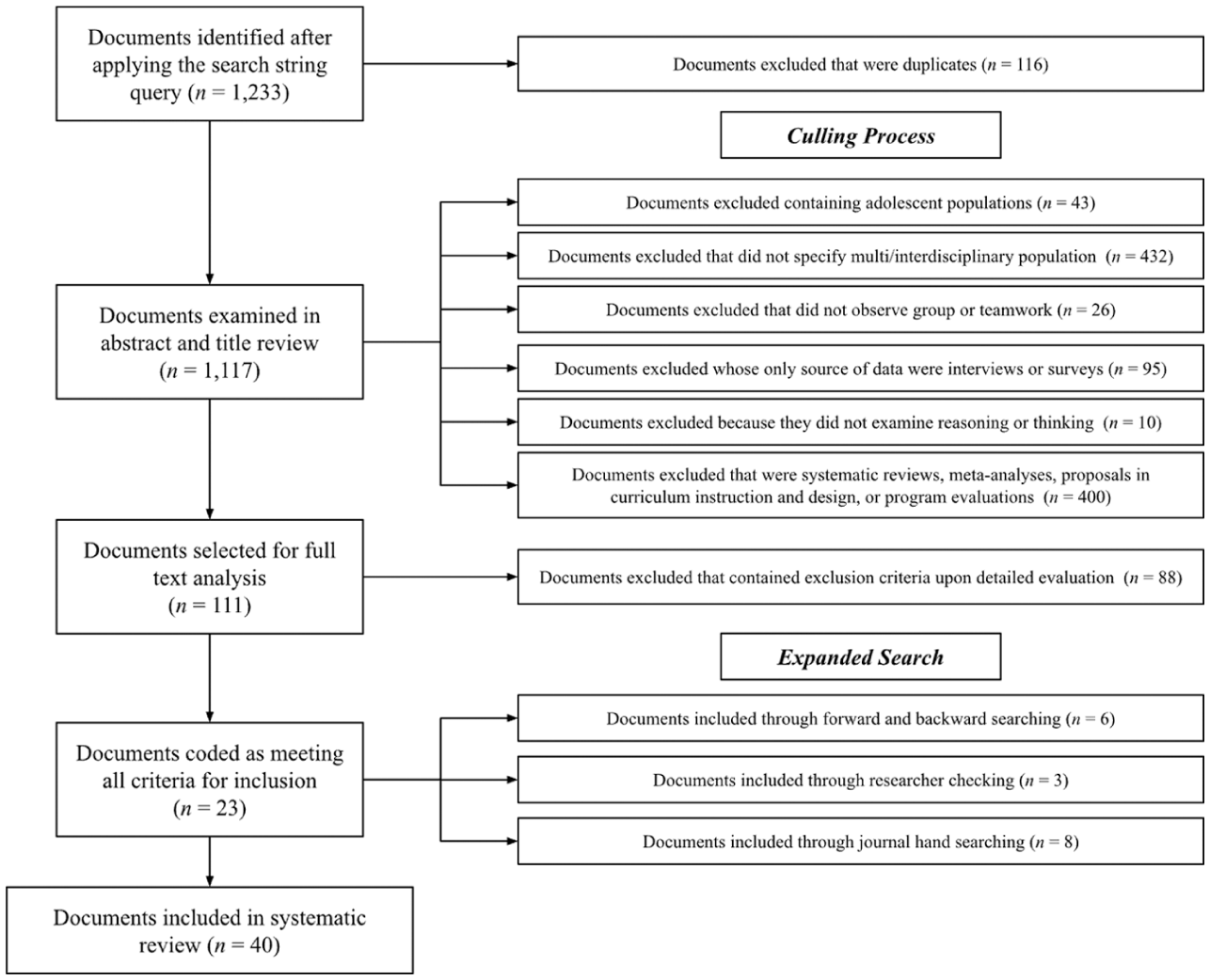
Process for systematic literature review.
Abstract and Title Review
Each of the 1,117 documents identified in the initial search was exported from each database and imported into an online software program called Rayyan (rayyan.ai). The information imported into Rayyan included the title, year of publication, author(s), keywords, and abstract. The first author proceeded with an abstract and title review to ascertain whether they addressed each of the inclusion criteria. If not, or if the abstract mentioned one of the exclusion criteria, it was excluded from further analysis. One of the most frequent reasons for exclusion (38.67%; n = 432) was that the participants in these studies were not interdisciplinary. Rather, while documents referenced the terms “interdisciplinary,” “multidisciplinary,” or “cross-disciplinary,” these terms were only descriptors of researchers’ orientation or approach to their study and not characteristics of the teams involved. Further, despite having excluded adolescent populations within our search parameter, we still identified 43 (3.84%) such documents during title and abstract review. Other reasons for excluding documents during the abstract and title review included publications did not observe group or teamwork (2.33%; n = 26) and publications whose only source of data were interviews or surveys (8.50%; n = 95) or that did not examine a reasoning or thinking process (.90%; n = 10) or were characterized as literature reviews, program evaluations, or proposals in curriculum instruction and design (35.81%; n = 400). In total, we excluded 1,006 documents at this step in the culling process.
Full Text Analysis
The remaining 111 documents were analyzed in their entirety to ensure that the inclusion criteria were met and that there were no exclusionary conditions present. For instance, an article by Kodkanon et al. (2018) examined decision-making within a team of interdisciplinary educators with a focus on teachers’ experiences and how they communicated and supported one another. However, because there was no explicit data on the reasoning processes involved in participants’ decision-making, it was excluded.
In a few cases, we found it necessary to detangle the authors’ writing pertaining to how the sampled participants engaged in interdisciplinary reasoning and thinking. For instance, Ertl et al.’s (2021) title, “Encouraging communication and cooperation in e-learning: solving and creating new interdisciplinary case histories,” and purpose in exploring clinical students’ engagement in case-based learning activities online to help them develop the skills of synthesizing information from multiple disciplines initially led us to consider this paper. What the full-text analysis revealed, however, was that these students’ interactions with the scenario-based cases were performed entirely independently. The entire procedure for the full-text analysis resulted in the exclusion of 88 documents, with 40 documents retained in the final document pool.
Expanded Search
To expand the search beyond the documents captured by the selected search engines, we conducted forward and backward searching through the citations of the initial pool of documents, researched authors to examine their curriculum vitae for relevant research, and hand-searched selected additional journals for potentially relevant research.
Forward and Backward Searching
In forward searching, we searched to find what other documents cited the publications identified in our initial search as a potential source of other relevant studies. Through this process, we found that the databases we selected did not produce a comprehensive record of where the documents identified in the initial search had been cited. For that reason, we decided to incorporate Google Scholar to aid in locating the source of document citations. In backward searching, we read the references of identified documents to determine if other publications might be considered. This forward and backward searching procedure resulted in an additional six documents being added to the initial pool.
Researcher Checking
In the next step in the search process, we looked up the published works of the first authors of documents identified through the selected databases. First, we reviewed any promising titles against the specified inclusion criteria. Second, for those authors whose publications included several relevant documents, we expanded our search by locating their curriculum vitae and checking whether any additional works warranted examination. This multistep procedure added three documents to the initial pool.
Journal Hand-Searching
For journal hand-searching, we used Excel to identify all duplicates within the Journal Name column to determine whether any journal names appeared multiple times. International Journal of Technology and Design Education and Education Sciences were two journals that appeared on multiple occasions in our pool. Therefore, we hand-searched the volumes and issues of these two journals for the period 2012 through 2024 to locate any potential publications missed by the other search procedures. This journal hand-searching process resulted in an additional eight articles being added to the document pool.
Document Coding
The coding of each of the 40 documents was guided by our critical questions and charted in our coding process, which can be found in our online supplemental material (Table S2). No specific code in the table was used more than once to keep the information across the columns clear and comprehensible. Whenever no information for a particular element could be extracted from the article or inferred, the code NA was used.
Further, we employed both inductive and deductive reasoning during the coding process. When coding for problem characteristics related to knowledge and structuredness, we took a deductive approach, applying codes based on previous literature. For all remaining codes, we used an inductive approach, whereby codes were generated from each document as they arose. We wanted to ensure that we captured the author(s) characterizations to the best of our ability.
Codes for Team Characteristics
The following designations for participants’ level of expertise were used: undergraduates (UG), graduate students (GS), undergraduate and graduate students (U|GS), graduate students and professionals (GS|P), and professionals (P). Gender was coded as male (M), female (F), or nonbinary (NB). Participants’ race and ethnicity were based on self-identified categories of White or Caucasian (C), Black or African American (B), Hispanic or Latino (H), and Asian or Asian American (A). Some researchers chose to report nationalities instead of race. In that case, we coded them as citizens from the United States (US) or as representing multiple nationalities (MN). Many documents had several unique disciplines working together in teams, and so we coded the number and type of disciplines authors described. Given the vast array of disciplines compiled, we chose to collapse those into broader characterizations (formal, natural, social, and applied sciences, and humanities). Citations for included works related to these codes can be found in Table S3 of our supplemental material (online).
Codes for Reasoning and Thinking Processes
Reasoning (R) and thinking (T) were the cognitive processes that researchers designated in their studies. We did not impose those categories on the processes mentioned in the studies we analyzed but relied on the researchers’ determinations. Further, in parentheses, we denote the specific form of reasoning and thinking that the researchers chose to examine. For example, Hanum et al. (2023) were interested in the clinical reasoning abilities of an interdisciplinary team of students, and so we denoted this as R (clinical) to represent this focus on clinical reasoning. Only a few researchers did not provide a specific form of reasoning or thinking in their papers. Noroozi et al. (2013) discussed the reasoning underlying transactivity in collaborative learning and problem-solving but did not identify any particular form of reasoning per se, so we denoted this paper with an R with no parentheses.
Codes for Problem Characteristics
We organized codes related to the characteristics of problems into four sections centered on structuredness, knowledge demands, task directives, and team composition. The citations for these can be found in Table S4 (online only).
Structuredness
Structuredness in relation to the problem within each document was coded as either well-structured (WS) or ill-structured (IS). Our process for coding structuredness relied on descriptions of the problems given by authors. For example, Avery et al. (2024, p. 3) describe their participants as following a specific design process that was outlined for them and working on a “well-defined and targeted research question.” Given this description, we denoted this problem as well-structured. In contrast, Baaki et al. (2017, p. 670) described their team working on a “non-routine and non-procedural design project.” We judged this description to be indicative of an ill-structured problem, given the high frequency with which nonroutine is used as a descriptor of ill-structured problem-solving (Basadur et al., 1994).
Knowledge Demands
The knowledge demands of each problem were coded as either knowledge-lean (KL) or knowledge-rich (KR). Our process for coding these characterizations relied on descriptions of the problems given by authors. For example, Seidel and Fixson (2013, p. 23) noted that their participants were novices and had “minimal experience in design thinking methods.” This description prompted us to code their problem as knowledge-lean, given its alignment with the definition, whereby the participants were not required to come into the problem with extensive prior knowledge in order to complete the task given to them. A case for knowledge-rich was found in Chen and Qian (2014), who described the teams tasked with a challenge that pushed them to “advance visual analytics tools” with the expectation that they would act as “innovative designers.” We deduced from these characterizations that the problem was knowledge-rich in nature, whereby team members needed a deep and extensive knowledge base in order to produce an innovative solution.
Task Directives
As indicated within the document coding manual, this review incorporated codes for four types of task directives (information-gathering, decision-making, creative, procedural). An example of an information-gathering directive (IG) is found in McMahon and Bhamra (2017, p. 603), who discuss how participants were on a “journey of exploration to acquire . . . new knowledge” to provide a solution to the problem. Shen et al. (2015) described their team as being responsible for deciding which “assessment items to be used in introductory science courses” (p. 2815), and so we characterized this as a decision-making task (DM). Chan and Schunn (2015, p. 129) described their team as being “tasked with developing a new product concept for a hand-held application of thermal printing technology for children” requiring “creative concept generation,” and so we coded this as a creative task (CR). Lastly, the team in Miller et al. (2019, p. 755) followed a “step-by-step guide in the development of the app” that they were constructing. Given this characterization of the problem, we coded this as a procedural type of task (PR).
Codes for Methodological Approaches
Setting
For the setting of interdisciplinary teamwork, we tracked whether the study occurred in a workplace context (W) or an educational context (E).
Data Sources
We identified several approaches to data collection and data analysis. We coded these as researcher-developed measures (RM); standardized measures where validity and reliability were reported (SM); quantitative analyses of transcripts (DA); qualitative, thematic analyses of transcripts (TA); ethnographic analysis of conversations (CA); content analysis (CON); analysis of field notes or artifacts (FN); and expert evaluations (EE). We further organized these sources of data into three broad categories to represent quantitative (QT) methods, qualitative methods (QL), and the use of mixed or multimethod approaches (MX). The citations for each of the papers coded with these codes can be found in Table S5 in supplemental material (online).
Bias Assessment
To mitigate bias in the document coding and analysis process, a research assistant, uninformed about the purpose of the study, was trained using the document coding manual. Once the research assistant demonstrated competency with training materials using 5% of the included documents, they coded 45% of the remaining documents independently. A high degree of agreement (85.7–100%) was achieved (see Table S6 in supplemental materials, online.)
Results and Discussion
After the search process was completed, a total of 40 documents were submitted to systematic analysis. This final pool consisted of 32 peer-reviewed journal articles, five dissertations, and three published conference proceedings. These documents were systematically analyzed to address the research questions guiding this review, and the results were organized according to those core questions.
Research Question 1: Characteristics of Interdisciplinary Teamwork
To address our first research question, we present trends in the descriptive data for each problem characteristic.
Team Characteristics
Descriptive findings for team composition are organized into three sections: team demographics, levels of expertise, and disciplines. Figure 2 provides visual representations of the frequencies found for team and problem characteristics.
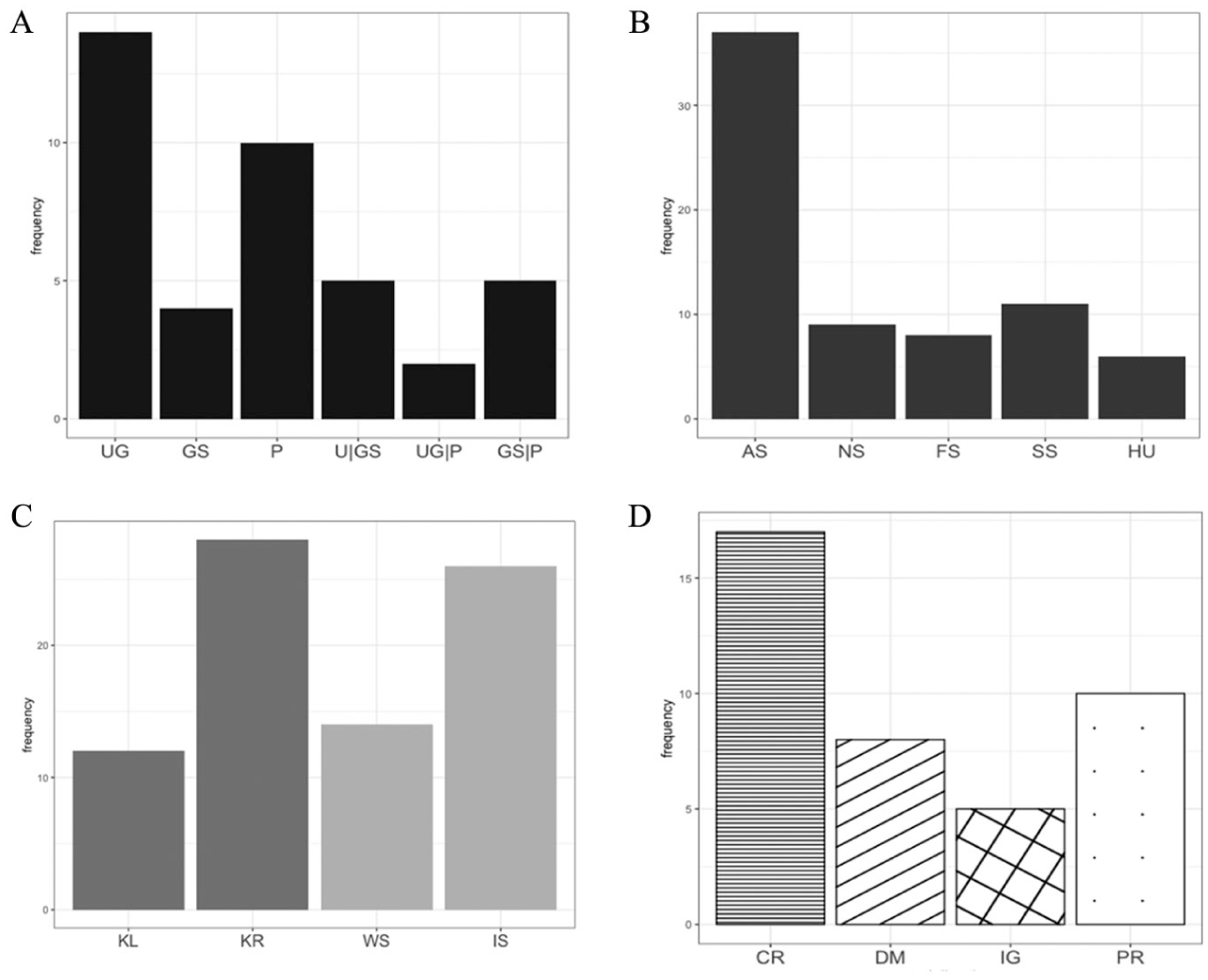
Descriptive findings for team member and problem characteristics.
Team Demographics
This review represents data collected from roughly 1,472 participants across the 40 documents. Information regarding the gender of participants was only provided in a handful of documents (n = 13; 32.5%). The trend of limited reporting on demographics continued with information regarding the racial and ethnic identities of team members (n = 2; 5%), with a few only reporting nationalities (n = 4; 10%). Among studies that included team demographics, only a few (n = 2; Sorici et al., 2023; Ward et al., 2016) analyzed these data directly during teamwork. Sorici et al. (2023) found notable qualitative differences between male and female team members. Females engaged in relaxed dialogue, asking questions to stimulate discussion, while males focused more on gathering components for their robot. However, we could not discern if these findings were also related to design thinking or problem characteristics in significant ways within their study (Sorici et al., 2023). We did have one study that recognized their lack of including gender in their analysis as a potential limitation for their study and suggested this be a focus in future research (Tan et al., 2021).
The limited reporting on gender, race and ethnicity, and nationality was justified in one study as a way to protect the anonymity of participants. Abueg (2020) reported that while demographics for her participants, who were employees at a suburban school district, were available, she decided not to report that data to protect their confidentiality. Regardless, this lack of reporting is low compared to other areas of education research (Fassett et al., 2022; Oleson et al., 2022). It raises a notable gap in the current research regarding the role of identity and its potential influence on the thinking and reasoning processes of disciplinarily diverse teams engaged in problem-solving.
Levels of Expertise
All 40 documents within this review provided information on the level of expertise of their participants (see Figure 2A). We found that most documents sampled undergraduate students (n = 14; 35%), followed by professionals or experts (n = 10; 25%), and lastly, graduate students (n = 4; 10%). A subset of studies within this review observed teams with a mixture of expertise levels (n = 12; 30%). We found studies that discussed teamwork involving undergraduate and graduate studies (n = 5; 12.5%) and teams composed of graduate students and professionals (n = 5; 12.5%). Teams composed of undergraduates and professionals were the rarest (n = 2; 5%).
The reasons given for investigating interdisciplinary problem-solving among undergraduate and graduate students were twofold. First, researchers were interested in understanding how more novice teams engaged with more experienced students when reasoning through problems (Miller et al., 2019). Second, researchers focused on these different levels of experience to garner pedagogical insights that could inform teaching practices (n = 10; Allinson & Mahon, 2022; Biello et al., 2022; Collins, 2021; McMahon & Bhamra, 2017; Packard et al., 2012; Seif et al., 2014; Sorici et al., 2023; Spelt et al., 2017; Ward et al., 2016; Zhou et al., 2022). This was the case for Seidel and Fixson (2013), who followed an undergraduate team over the life of a semester-long project. Their results highlighted ways in which design thinking could be implemented or taught successfully in collegiate classrooms. For instance, their novice teams struggled with reflexivity, which often slowed their performance as a consequence of excessive questioning and rediscussion of ideas. These researchers discussed ways in which future instruction might mitigate such effects.
For studies that focused on professionals, their frameworks varied, including some that proposed frameworks for professional practice (Collins, 2021) or models for group problem-solving (Soukup Ascencao, 2017) to traditional novice–expert frameworks (Kiernan et al., 2020b). Many of the studies on professional samples were focused on exploring cognitive theories such as dissonance and conflict theory (Paletz et al., 2013), dual-process theory (C.-Y. Lee et al., 2025), theories of creativity (Chan & Schunn, 2015), experiential learning theory (Brown et al., 2023), and adult learning theory (Abueg, 2020).
Disciplines
This review brought together a compilation of studies representing a variety of disciplines. The applied sciences were the most represented in this review (n = 37; 92.5%), followed by the social sciences (n = 11; 27.5%), natural sciences (n = 9; 22.5%), formal sciences (n = 8; 20%), and the humanities (n = 6; 15%) (see Figure 2B).
The applied sciences are a clear focus in the studies on thinking and reasoning processes of disciplinarily diverse teams, particularly in health and medical contexts where decision-making carries immediate practical consequences. For instance, both C.-Y. Lee et al. (2025) and Soukup Ascencao (2017) examined how reasoning unfolds within high-stakes healthcare teams. C.-Y. Lee et al. (2025) set out to examine clinical reasoning in neurosurgery teams and reported that clinical reasoning relies on distributed cognition, information sharing, and iterative discussion. Comparatively, Soukup Ascencao (2017) found that decision quality in cancer care teams depends on how cognitive and socio-emotional factors interact during complex deliberations.
Problem Characteristics
Structuredness
The following descriptions are displayed visually in Figure 2C. Descriptive results show that the majority of papers within this review focused on ill-structured problems (n = 26; 65%) rather than on well-structured problems (n = 14; 35%). This focus supports a similar emphasis in the teamwork and organizational literatures that aim to understand aspects of cognition in ill-structured contexts (Dringenberg & Purzer, 2018; Singh & Chakrabarti, 2024). When examining ill-structured problems, many studies discussed various frameworks or models that characterize the nature of team collaboration and how reasoning and thinking processes may influence teams (n = 6; Chen & Qian, 2014; Christensen & Ball, 2016; Collins, 2021; Flannery & Malita, 2014; Kiernan et al., 2020a, 2020b; Shen et al., 2015). However, the understudying of well-structured problems in this review merits attention, given that, in the context of human development, students are often asked to solve more well-structured problems before transitioning into ill-structured problem spaces within the context of traditional classroom problems (Reed, 2016).
Knowledge Demands
In terms of problem characteristics related to the knowledge demands placed on teams, the descriptive findings show a dominant focus on the study of knowledge-rich problems (n = 28; 70%) in contrast to knowledge-lean problems (n = 12; 30%). This trend parallels other fields also investigating knowledge-rich problem-solving that could have potential implications for understanding how specialized teams engage with knowledge-intensive and rich problems (Carmeli et al., 2021; Yang et al., 2022). Further, the focus on knowledge-rich problems is warranted when much of the research on disciplinarily diverse teams is focused on the effective communication and synthesis of knowledge from various fields, often in domain-specific problems (Christensen & Ball, 2016; Flannery & Malita, 2014; Kiernan et al., 2020a; Shen et al., 2015; Ward et al., 2016).
Task Directives
As detailed in the coding manual, we further characterized problems based on the types of directives given to teams for the problem-solving task. We found that the majority of studies chose tasks that were creative (n = 17; 42.5%), where students or professionals were instructed to design or create something novel (see Figure 2D). Other types of task directives included procedural tasks (n = 10; 25%), decision-making tasks (n = 8; 20%), and information-gathering tasks (n = 5; 12.5%). These findings highlight the centering of creativity and novel solutions that many teamwork (Ciriello et al., 2024) and interdisciplinary curricula (Chang et al., 2022) literature discuss. Therefore, it is logical to see this focus on creativity carry over into the literature on teamwork and collaborative problem-solving for disciplinarily diverse teams.
These findings also point to how task directives shape the reasoning processes teams engage in during different stages of problem-solving. For instance, Brown et al. (2023) examined an interdisciplinary group of professors and researchers synthesizing information about the role of enzymes in second-generation biofuels. As members exchanged disciplinary perspectives, their understanding of the problem evolved, revealing how interdisciplinary dialogue can reshape how problems are framed and how evidence is interpreted.
In contrast, Barré et al. (2017) evaluated a method for guiding novice multidisciplinary teams through requirement analysis and need identification during design thinking tasks. Their findings showed that structured instructional practices can support more effective collaboration and guide how teams will interact in future problem-solving stages. Task directives appear to influence not only the products teams create but also how members conceptualize the problem space and coordinate their reasoning during early stages of problem-solving.
Methodological Approaches
Setting
The most common setting for studying disciplinarily diverse teams was the educational context (n = 27; 67.5%), followed by studies that observed teams in workplaces (n = 13; 32.5%). This finding supports trends in academic institutions looking for opportunities to both embed and analyze students working through problems in collaborative spaces to mirror the type of on-the-job exchanges they may encounter (Bates et al., 2022; Price et al., 2022). While studies with students were often designed to be educational to support their development in skills related to interdisciplinary teamwork (Barré et al., 2017; Biello et al., 2022; Hanum et al., 2023; H. Lee, 2019; McMahon & Bhamra, 2017), studies that observed experts or professionals wanted to capture their teamwork as it unfolded naturally often with no involvement by the researcher (Baaki et al., 2017; Chan & Schunn, 2015; Hjörne & Saljo, 2014; C.-Y. Lee et al., 2025; Paletz et al., 2013; Soukup Ascencao, 2017). Only a few studies addressed ways to continually support the professional development of these experts as they continue operating in teams (Abueg, 2020; Allinson & Mahon, 2022; Brown et al., 2023; Collins, 2021).
Data Sources
As outlined in the coding manual, we charted several different types of data sources utilized by researchers in their studies. The most common source of data relied on transcripts of the verbal exchanges among team members (n = 19; 47.5%), followed by researcher-developed measures (n = 16; 40%). Types of researcher-developed measures included questionnaires (Schöfer et al., 2018), surveys (Biello et al., 2022), and researcher-developed observation measures (Noroozi et al., 2013). Data generated through qualitative coding schemes to be later analyzed in thematic analyses were also used frequently (n = 14; 35%; Baaki et al., 2017), as well as notes gathered from interviews (n = 12; 30%; Avery et al., 2024). Data generated through quantitative coding schemes were the source for several analyses (n = 10; 25%; Paletz et al., 2013). These contrast to coding schemes developed for qualitative research, because they are often numerically defined (i.e., five instances of “analogies”; Chan & Schunn, 2015) versus linguistically defined (i.e., themes that highlight design thinking processes; Baaki et al., 2017). The codes generated from these more quantitative coding schemes are then analyzed differently, often incorporated into statistical models (Christensen & Ball, 2016).
Other data sources collected included artifacts and fieldnotes (both n = 9; 22.5%) and expert ratings and evaluations of team performance (n = 7; 17.5%). Some studies did employ standardized measures (n = 7; 17.5%) such as the Team Skills Scale (Packard et al., 2012) or the Torrance tests of creative thinking (Wu & Huang, 2017) that had already been previously established in terms of their validity and reliability, but these sources of data were the least common. Further, we found it most common for studies of interdisciplinary problem-solving to rely on multiple data sources to address research questions (n = 38; 95%) instead of a single data source (n = 2; 5%). In studies that had a mixed-method orientation, the inclusion of multiple data sources was always the case, whereby these studies had, on average, 3.6 data sources that were incorporated into their analyses.
Method
Three methodological frameworks were charted across documents. Within this review, the most frequent methodological approach used by researchers was qualitative (n = 19; 47.5%), although quantitative approaches were well represented (n = 16; 40%). Mixed-methods designs, which combined these two approaches, were identified, but their instances were relatively fewer in number (n = 5; 12.5%).
Research Question 2: Reasoning and Thinking Processes in Disciplinarily Diverse Teams
Research question two addresses the specific reasoning and thinking processes we uncovered in this systematic review, and the data sources and methodologies used to empirically examine these cognitive processes.
Reasoning and Thinking Processes
Findings regarding the frequency of reasoning and thinking processes studied in disciplinarily diverse teams show that thinking processes were considered more often (n = 26; 65%) than reasoning processes (n = 14; 35%). The most common thinking process that appeared was critical thinking (n = 9; 22.5%). Design thinking was often under investigation in studies that were focused on understanding how concepts like insight, creativity, and novel solution production manifest within design-based problem-solving (n = 7; 17.5%).
The greater part of the studies incorporated in this review focused on different thinking processes (n = 26). The most common thinking processes examined were critical thinking (n = 9), followed by design thinking (n = 7), creative thinking (n = 6), and convergent and divergent thinking (n = 2). Critical thinking was defined by several authors as a process that involves both convergent and divergent thinking, questioning and analyzing information, and making informed decisions regarding the information (Kiernan et al., 2020b; McMahon & Bhamra, 2017). Throughout our review of these papers, we also noted that while strategic thinking was only explicitly mentioned by a few papers, the underlying concept of strategic thinking was evident in many studies. For instance, the goal of several studies was to identify how interdisciplinary teams think through problems that necessitated certain strategies and steps that these experts were previously trained for (n = 3; Hjörne & Saljo, 2014; C.-Y. Lee et al., 2025; Soukup Ascencao, 2017). A case of this is found in Hjörne and Saljo’s (2014) study, which examined the reasoning processes of a multiprofessional team tasked with evaluating and addressing student cases within a school system. Given prior training and competencies of these professionals, one aspect of Hjörne and Saljo’s (2014) study was to first evaluate their process for handling such cases. Thus, when their observations deviated from an expected or anticipated action, the researchers then delved into the nature of the teams’ reasoning within those particular instances of deviation.
The most common forms of reasoning studied in this body of literature were analogical reasoning (n = 4) and clinical reasoning (n = 4), followed by team reasoning (n = 1) and then general reasoning (n = 3). The researchers who utilized analogical reasoning each defined it as the process where a source and a target are linked to one another by a systematic mapping of attributes and relations, allowing for the transfer of knowledge to the target (Chan & Schunn, 2015; Christensen & Ball, 2016; Goel et al., 2014; Paletz et al., 2013). Clinical reasoning in these studies focused on cognitive processes that involve particular teams composed of nurses, doctors, and physicians, among others who are engaged in collecting, processing, and disseminating patient case information aiding in decision-making (Hanum et al., 2023; C.-Y. Lee et al., 2025; Seif et al., 2014; Ward et al., 2016).
Our findings regarding each of the thinking and reasoning processes identified are summarized in Table 1. This table lists each key thinking and reasoning process identified in the review and summarizes the most commonly coded team, problem, and method characteristics used when investigating that particular process. Table 1 sets the stage for the third research question on the ways in which these thinking and reasoning processes interact or coincide with these characteristics.
Problem Characteristics by Forms of Thinking and Reasoning
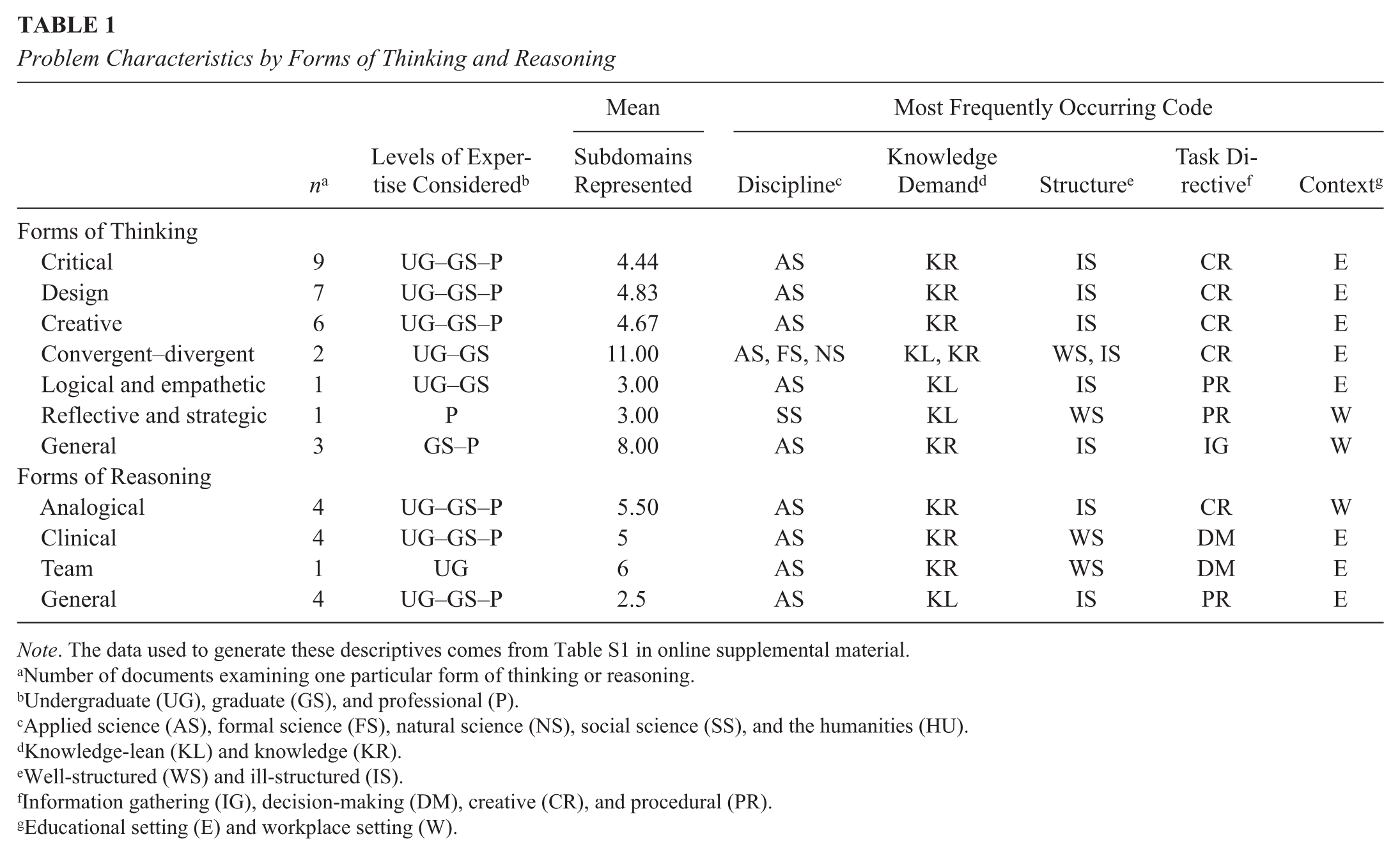
Note. The data used to generate these descriptives comes from Table S1 in online supplemental material.
Number of documents examining one particular form of thinking or reasoning.
Undergraduate (UG), graduate (GS), and professional (P).
Applied science (AS), formal science (FS), natural science (NS), social science (SS), and the humanities (HU).
Knowledge-lean (KL) and knowledge (KR).
Well-structured (WS) and ill-structured (IS).
Information gathering (IG), decision-making (DM), creative (CR), and procedural (PR).
Educational setting (E) and workplace setting (W).
Research Question 3: Interactions Between Characteristics of Disciplinarily Diverse Teams and Reasoning and Thinking Processes
The third research question guiding this review focused on meaningful interactions that emerged among the forms of reasoning and thinking for disciplinarily diverse teams, characteristics of the problem, the setting of the activity, and the methods used to study teams. As evident in various models of problem-solving that can be found in the literature (Fiore et al., 2010; Graesser et al., 2018), these different elements do not operate in isolation but in conjunction with one another. When looking at the outcomes in the results presented here, we see that an interplay occurs.
Disciplines by Setting by Reasoning Processes
We first discuss the disciplines, the contexts in which they were studied, and the insights we gained about the reasoning processes that occurred in these situations. Specifically, we found that most studies with a focus on reasoning processes examined teams from the applied sciences observed in educational settings (n = 9; Table S2, online). Moreover, the educational setting was a clear indicator of the focus and purpose of the research. For instance, studies examining clinical reasoning in educational settings with individuals in the applied sciences (n = 3) were focused on interprofessional teamwork (Hanum et al., 2023; Seif et al., 2014; Ward et al., 2016) and how students’ exposure to those experiences and complex problems improved their ability to engage in clinical reasoning. While the settings in these studies were educational, the researchers’ intent was to simulate real-world situations. These studies illustrate how educational contexts functioned as structured environments for rehearsing discipline-specific reasoning, where students were encouraged to articulate assumptions, justify interpretations, and coordinate perspectives as they worked through the case. In this way, the setting and discipline jointly shape the form and enactment of reasoning, emphasizing explanation, evidence evaluation, and collaborative sensemaking.
In the workplace setting, we observed a narrower focus on specific forms of reasoning and changes in the number of disciplines involved. For instance, this was evident in studies examining analogical reasoning as key to solving interdisciplinary problems (n = 3; Chan & Schunn, 2015; Christensen & Ball, 2016; Paletz et al., 2013). In these workplace contexts, analogical reasoning functioned as a way for team members to map concepts across disciplinary boundaries, making their interpretations visible and mutually interpretable. Interdisciplinary teams require members to synthesize knowledge from different fields and apply it to specific problems. Therefore, having the ability to recognize patterns of similarity across these various disciplines becomes increasingly critical.
Problem Structuredness by Task Directives by Thinking Processes
Further, we identified interactions among problem structuredness, task directives, and the thinking processes utilized in these problems. The most common combination of problem structure and task directives was ill-structured problems with directives that prompted the team to solve the problem in creative ways or to devise novel solutions (n = 12). This combination was found in studies interested in design thinking (n = 5). Given the flexibility and the degree of autonomy that teams had in these spaces, design thinking was presented to these teams as a method they could use to navigate ill-structured spaces requiring creative solutions (Allinson & Mahon, 2022; Avery et al., 2024; Baaki et al., 2017; Brockman et al., 2015; H. Lee, 2019). Design thinking was described as though, if an individual were engaging in it, they would follow through with an investigation phase, find design opportunities when interpreting data, generate ideas, experiment with prototypes, and engage in iterative cycles through these processes (H. Lee, 2019). Thus, the structuredness of the thinking process was not synonymous with the structuredness of the task.
Several teams operating in an ill-structured problem space were tasked with gathering information that could potentially provide insight into a problem (n = 4). The purpose of bringing together disciplinarily diverse teams for these design tasks was not, per se, to solve problems. Rather, it was more to discuss ways in which a problem could be solved (Brown et al., 2023; Collins, 2021). Similarly, other researchers were interested in how teams engaged in the first stage of problem-solving, understanding the problem. In this early stage of problem-solving, team members worked to develop a shared framing of the problem, where the reasoning centered on jointly interpreting incomplete information, questioning disciplinary assumptions, and negotiating how the problem itself should be defined (Biello et al., 2022; McMahon & Bhamra, 2017).
In contrast to ill-structured problem spaces, well-structured problems did not appear within this review as frequently when researchers were interested in the thinking processes of teams (n = 7). We found that teams working on well-structured problems were presented with tasks that were very procedural in nature (n = 3). These more structured problems were the focus for researchers interested in creating experiences for teams where they learn how to work together and develop critical thinking skills in the process (Avery et al., 2024; Spelt et al., 2017; Wu & Huang, 2017). The findings of this research were often meant to inform pedagogical frameworks that promote interdisciplinary learning and professional development (Abueg, 2020; Spelt et al., 2017).
Expertise and Subdomains by Knowledge Demands by Thinking and Reasoning Processes
We further found that various combinations of team members and problem characteristics occurred for studies addressing thinking and reasoning processes. We noticed that the pool of studies addressing thinking and reasoning processes involved participants with a range of expertise. For instance, as seen in online Table S5, we have empirical investigations on the nature of critical, design, and creative thinking, as well as analogical and clinical reasoning, that assessed undergraduates, graduates, and professionals (citations for these can be found in Table S3 online).
When assessing the knowledge demands of these problems, we observed that knowledge-rich problems (n = 28) were more frequent than knowledge-lean problems (n = 12). When tasks demanded a base of prior knowledge and were specifically situated within a particular subject, roughly a third of these studies targeted professionals (n = 9). Other researchers considered teams with a mixture of professionals and graduate students (n = 5). Further, teams with higher levels of expertise also represented multiple specializations with a range of 2 to 10 subdomains (M = 5.14). For example, Soukup Ascencao (2017) followed a group of medical professionals from five different domain specializations who were analyzing patient cases to deduce patterns or observations of their critical thinking processes within these contexts.
Knowledge-lean problems often focused on undergraduates (n = 7) and graduate students (n = 2) or a mixture of these groups (n = 2). The focus was often on the way in which disciplinarily diverse teams engaged in solving problems that were more general in nature and did not require highly specialized knowledge (Noroozi, 2013). The use of these knowledge-lean problems may have allowed researchers to focus on the manipulation of certain team characteristics, such as personality (Barré et al., 2017; Wu & Huang, 2017), and the influence of instructional approaches (Noroozi et al., 2013; Tan et al., 2021), or to test particular theories (Spelt et al., 2017; Zhou et al., 2022) or frameworks (Avery et al., 2024; Zyfers, 2019). For example, Tan et al. (2021) revealed how providing preparation time can shape how teams enter into the collaborative space, influencing how they articulated prior knowledge, proposed initial interpretations, and coordinated their reasoning once the task began.
Methods by Data Sources by Findings
The prior findings regarding team members and problem characteristics highlight the importance of understanding the design and methodological approaches undertaken by researchers. As discussed, qualitative methods were most commonly employed, with the focus primarily on observations of team processes unfolding in natural contexts (Brockman et al., 2015; Chen & Qian, 2014).
The data collection for these qualitative studies centered around evidence from interviews, transcripts, field notes, and artifacts, with codes generated from thematic analyses (n = 8). Triangulation of evidence is known to be an essential component of qualitative research that bolsters the integrity and reliability of findings (Denzin, 2009; Merriam & Tisdell, 2016). Half of the qualitative studies in this review incorporated more than three data sources (n = 6), while the others examined only one or two pieces of evidence (n = 7). Further, while some researchers used specific qualitative methods such as ethnography (Chen & Qian, 2014), case study (Brockman et al., 2015; Kiernan et al., 2020b; Kiernan et al., 2022; H. Lee, 2019; McMahon & Bhamra, 2017; Miller et al., 2019), or phenomenology (Hanum et al., 2023), few identified no specific approach (Allinson & Mahon, 2022; Goel et al., 2014; Spelt et al., 2017; Zyfers, 2019).
For quantitative studies, the analysis of codes generated from coding schemes was common (n = 5), as was the deployment of both researcher-developed (n = 8) and standardized measures (n = 3). Studies that employed coding schemes were often focused on capturing naturalistic team processes similar to the aims of qualitative researchers. However, the analysis focused primarily on numerically identifying connections and associations between reasoning processes and problem characteristics (Abueg, 2020; Shen et al., 2015) guided by a priori hypotheses to guide analysis (Christensen & Ball, 2016; Paletz et al., 2013). Researcher-developed measures often included questionnaires (Schöfer et al., 2018; Sorici et al., 2023) or surveys (Yong et al., 2014) that were systematically administered during the collaborative teamwork to capture details of members’ perceptions of the ongoing project and the collaborative experience. In contrast, standard measures were typically used to capture specific data on teams’ reasoning processes (Seif et al., 2014; Ward et al., 2016) or creative thinking (Wu & Huang, 2017).
Whether the primary methodology was qualitative or quantitative in nature, there was evidence that interdisciplinary teams were generally capable of engaging in problem-solving in both educational and workplace contexts. In fact, every study in this review described the usefulness of such teams, especially when problems were knowledge-rich, ill-structured, and creative.
Conclusions and Implications
Prior to discussing the contributions of this systematic review for education research and practice, we provide an overview of the limitations that emerged during the conduct of this investigation.
Limitations
As with any systematic review, this one has limitations. First, although we categorized different types of measures used to examine reasoning within interdisciplinary team problem-solving (Table S4, online), we did not critically analyze those assessments. Thus, the ensuing discussion relied on what was reported by authors as outcomes of those measures without consideration of the quality of those assessments. This limited the extent to which we are able to determine precisely how reasoning and thinking were measured psychometrically and what implications the specific data sources have for the interpretation of findings. Second, the current review focused on adult populations with a range of expertise levels but did not include younger populations. Whether or how the reported outcomes would relate to children and adolescents remains undetermined. Further, we relied on the search results of two primary databases, EBSCO and Web of Science, which may have narrowed the pool of eligible studies.
While beyond our control, researchers’ lack of reporting on team demographics or the specifics of measures and problems they used constrained our abilities to delve even more deeply into the nature of interdisciplinary teams’ reasoning and thinking. Consequently, this may have influenced the conclusions and implications we could draw from this literature. While it can be challenging to ensure the anonymity of team members’ identities in small and specialized settings, this does not negate the importance of understanding how individual and team characteristics play a role in the reasoning and thinking that unfold in dynamic collaborative problem-solving spaces.
Key Insights
Several insights into the reasoning and thinking occurring within disciplinarily diverse teams emerged from our analysis of the 40 documents examined in this review.
The Meaning of Interdisciplinarity Remains Vaguely and Variably Defined
Even though our primary aim in this review was to delve into the nature of reasoning and interdisciplinary team problem-solving, we first had to deal with the very notion of interdisciplinary represented in this body of work. We did not expect there to be a singular or consistent definition of this or related constructs. However, we had anticipated some common characteristics as to what constitutes interdisciplinarity. Yet, beyond the fact that more than one area of study, profession, or domain was presumably involved, there was little else that established that groups or teams in many studies were actually interdisciplinary in nature. This was made evident in the abstract and title review, where we removed over 400 documents that merely mentioned “interdisciplinary” or “multidisciplinary” without further conceptual explication, identification of the domains or disciplines involved, or other delineating characteristics. Given the high level of diversification we encountered, there was a clear need for more detailed descriptions of the members constituting these interdisciplinary teams. In effect, there needed to be researcher-provided explanations for why the collections of individuals they studied could justifiably be labeled interdisciplinary.
Certain Problem Characteristics May Necessitate Disciplinarily Diverse Teamwork
Researchers most often studied disciplinarily diverse teamwork in relation to ill-structured, knowledge-rich, and creative problems, suggesting that such contexts are viewed as especially relevant for interdisciplinary collaboration. Even in samples that observed more novice teams, researchers were often concerned with how these teams were functioning so that they could better inform educational practices to ensure the next generation of students entering the workforce can solve such problems. Additionally, it was very clear from the descriptive findings that professions within the applied sciences dominated the focus of participants sampled within this pool of studies. This makes sense, given that fields within the applied sciences are highly interdisciplinary by nature, drawing on knowledge and skills in formal, natural, and social sciences to achieve workable and relevant solutions to existing problems.
Scope of Understanding Thinking and Reasoning Processes Varied
It was further evident from this review that the scope of investigation into thinking and reasoning processes varied. Some studies focused on thinking and reasoning processes that subsumed an entire system or sequence of sub-processes, whereas other studies investigated more granular forms of thinking and reasoning (Table S6, online). For instance, the studies into design thinking often evaluated multicomponent thinking and reasoning processes within the entire scope or cycle of design thinking (Baaki et al., 2017; H. Lee, 2019; Sorici et al., 2023). In contrast, we had several studies that investigated specific forms of thinking and reasoning, such as the studies into analogical reasoning (Chan & Schunn, 2015; Christensen & Ball, 2016; Goel et al., 2014; Paletz et al., 2013). We found the definitions of these processes to be clear and targeted within the studies in which they were operationalized, which allowed the outcomes to be interpreted more precisely, highlighting potential relationships between reasoning processes and collaborative outcomes reported by the sampled authors.
Implications for Education Research and Instructional Practice
The studies reviewed here provide insight into the conditions and contexts that shape how interdisciplinary teams engage in reasoning and problem-solving. The following sections outline implications for future research on reasoning and thinking processes in disciplinarily diverse teams, as well as how to design educational experiences that may foster effective interdisciplinary teamwork.
Education Research
Manipulation of specific person, task, and context factors
What was characteristic of studies in this review was an interesting balance of qualitative, quantitative, and mixed-methods studies. Often in these studies, researchers centered on some particular dimensions of thinking and reasoning processes in relation to features of the problem (Abueg, 2020; Avery et al., 2024; Biello et al., 2022; Kiernan et al., 2022) or the levels of experience and skills of team members (Kiernan et al., 2020a; Miller et al., 2019; Shen et al., 2015). To deepen understanding of interdisciplinary reasoning and thinking, future investigations should systematically manipulate task or setting characteristics within samples that represent a diverse range of competencies to clarify how these factors influence reasoning processes and collaborative dynamics.
For example, future investigations could test hypotheses that vary key features of the individual, the task, or the setting. At the person level, teams that include members with different levels of expertise, such as graduate students and professionals, may engage in more frequent analogical reasoning than teams composed entirely of novices, particularly when the problem is knowledge-rich. At the task level, teams working on ill-structured problems that are intended to be creative may display more iterative reasoning cycles and divergent thinking than those students assigned to well-structured or more procedural tasks. At the setting level, teams operating in authentic workplace contexts may integrate disciplinary perspectives more effectively and demonstrate more distributed reasoning than those performing comparable tasks in simulated educational environments.
Each of these hypotheses follows from patterns observed in the current synthesis, underscoring that reasoning in disciplinarily diverse teams is shaped by the interactions among individual competencies, task demands, and contextual factors. In addition to differences in disciplinary expertise, future research could also consider developmental factors as well. Variation in developmental factors such as age or maturity may affect how effective an interdisciplinary team is at navigating disagreement, negotiating perspectives, or reaching a consensus. These factors may become more relevant as nontraditional students with diverse life and professional experiences are becoming increasingly more represented in undergraduate populations. Future researchers should therefore consider how developmental factors intersect with disciplinary expertise to shape reasoning processes in interdisciplinary teams.
Intervention designs
Further, multifactorial studies could examine the effects of training or interventions on these person, task, and context components. For instance, the effects of interventions that focus on specific forms of reasoning, such as relational reasoning, could be empirically analyzed by means of both variable-centered and person-centered analyses to better gauge the dynamics of interdisciplinary problem-solving (citation omitted; Klauer & Phye, 2008). These interventions would address the concern for additional support needed by students overall or in special clusters when reasoning through interdisciplinary problems. This type of design could also provide researchers with the opportunity to compare and contrast interventions and outcomes related to reasoning and thinking processes.
Instructional Practice
What seemed evident from the studies we analyzed is that carrying out interdisciplinary problem-solving studies effectively is challenging even for researchers with a background in this area. The question arises, therefore, what would educational practitioners need to know or be able to do to incorporate interdisciplinary teams in their classrooms in a manner to facilitate reasoning and thinking within interdisciplinary team problem-solving?
One suggestion would be to draw on existing instructional programs that have interdisciplinary reasoning and thinking as core components, such as problem-based or project-based learning (Bates et al., 2022; Razak et al., 2022). By relying on these established curricular programs, educators would have access to guidelines and resources that could support their efforts. Even then, however, teachers need to be sensitive to the backgrounds and experiences of their students. As the work of those carrying out training in clinical reasoning with health professionals illustrates, it is critical to try to match the complexity of the problem characteristics within the task to the knowledge and skills of students (Avery et al., 2024; Spelt et al., 2017; Wu & Huang, 2017). Therefore, in order to provide appropriate challenges for students in the initial stages of learning to collaborate in these contexts, educators should be mindful of the types of tasks they ask teams to perform, particularly if their goal is to develop the reasoning and thinking abilities of these individuals.
For example, starting with less complex and more structured problems and modeling ways of thinking and sharing ideas would be helpful when working with younger or less-experienced individuals (D. H. Jonassen, 1997; Reed, 2016). With younger and less-experienced learners, it might also be advisable to discuss the value of interdisciplinarity and provide procedural guidelines on how teams should function (Murphy et al., 2018). What are the expectations for each team member, for instance, and how does the team ensure that all members are positively engaged? Further, educators could introduce specific reasoning and thinking strategies that students can use when tackling different types of problems (Biello et al., 2022; Chen & Qian, 2014; Goel et al., 2014; Noroozi et al., 2013). Learning to synthesize information from differing sources does not come naturally for many students, as the literature on multiple document use has repeatedly demonstrated (List & Sun, 2023). Consequently, it would seem helpful for educators to take time to explain how they synthesize ideas that are expressed in writing or orally (Nelson & King, 2023). In that way, students may benefit more from exploring problems from different disciplinary angles and be better equipped to propose alternative solutions to the problem at hand.
Finally, when incorporating interdisciplinary problem-solving into instructional contexts, educators need to consider the composition of the teams. That consideration should not only weigh the background knowledge and skills members would bring to the task, but also social, cultural, gender, and ethnic factors (Borgonovi et al., 2023; Hardt et al., 2025). Care should be taken so that certain students do not dominate the process and that other students do not feel isolated and even dismissed by team members. These observations parallel foundational principles identified in the cooperative learning literature, particularly positive interdependence and individual accountability (Johnson & Johnson, 1989; Slavin, 1995). Instructors designing interdisciplinary team experiences may draw from these models to structure tasks that emphasize mutual reliance and clear expectations for participation.
Concluding Thoughts
The empirical research synthesized in this systematic review spans multiple domains, including engineering, medicine, social work, and psychology, and collectively underscores the value of interdisciplinarity for understanding complex problem-solving (Abueg, 2020; Chan & Schunn, 2015; Ward et al., 2016). This review brought together evidence regarding the ways in which contexts, team and task characteristics, and cognitive processes shape how disciplinarily diverse teams engage in reasoning and thinking during collaborative work. Across 40 documents, researchers examined how teams approach problems that vary in structure, knowledge demands, and task directives, and how these factors interact with team characteristics. Through the breadth of methodological approaches, we were able to deduce rich findings that elucidated the ways in which reasoning and thinking manifest in disciplinarily diverse teams. Yet, these findings also revealed a need to continue refining how various constructs within reasoning and thinking are both defined and measured.
Taken together, this synthesis represents one step toward bringing clarity to the reasoning and thinking processes of current interest within the literature of interdisciplinary teamwork and how these processes relate to the conditions under which collaboration occurs. Educators and researchers are encouraged to describe interdisciplinary teamwork carefully, specify the problems and contexts that necessitate interdisciplinary teamwork, and design interventions that strengthen the reasoning and thinking needed for effective collaboration and true synthesis of knowledge.
Supplemental Material
sj-docx-1-rer-10.3102_00346543261448567 – Supplemental material for Reasoning and Problem-Solving in Disciplinarily Diverse Teams: Implications for Research and Practice
Supplemental material, sj-docx-1-rer-10.3102_00346543261448567 for Reasoning and Problem-Solving in Disciplinarily Diverse Teams: Implications for Research and Practice by Margaret W. Logan and Patricia A. Alexander in Review of Educational Research
Footnotes
Author Note
Preliminary results from this review were previously presented at the American Educational Research Association 2023 in Chicago during Poster Session of Division C. There were no conflicts of interest in the production of this manuscript.

Notes
Authors
MARGARET W. LOGAN is a doctoral student at the University of Maryland, College Park, within the Human Development and Quantitative Methodology department, College Park, MD, USA;
PATRICIA A. ALEXANDER is a distinguished university professor and the Jean Mullan Professor of Literacy in the Department of Human Development and Quantitative Methodology at the University of Maryland, College Park, MD, USA; e-mail:
References
Supplementary Material
Please find the following supplemental material available below.
For Open Access articles published under a Creative Commons License, all supplemental material carries the same license as the article it is associated with.
For non-Open Access articles published, all supplemental material carries a non-exclusive license, and permission requests for re-use of supplemental material or any part of supplemental material shall be sent directly to the copyright owner as specified in the copyright notice associated with the article.
