






Abstract
The field of education has renewed its focus on whiteness and white supremacy as constitutive forces in local educational politics. Using integrative literature review methods, this article examines what scholarship on local educational politics reveals about how whiteness operates in specific contexts and how the field theorizes whiteness. Five themes emerged: the mechanisms of whiteness, the power and disempowerment of parents and communities, segregation and isolation, the hegemonic power of non-racism, and the reconstruction of white racial identity. Findings reveal that whiteness is actively maintained through subtle and overt policies, practices, and governance systems that uphold racial hierarchies, yet this scholarship often highlights individual actors over structural, historical, and class-based forces. Using local educational contexts as sites for transformative, liberatory inquiry, future research should center anti-Blackness; situate whiteness within broader political, economic, and spatial systems; and prioritize dismantling rather than merely documenting racial domination.
Keywords
An immense chasm exists between the ardent belief in America’s educational system as a powerful force for societal betterment and the persistent reality of structural inequality embedded within it (Tyack & Cuban, 1995). As Labaree (2010) observes, “The American system of education is highly accessible, radically unequal, organizationally fragmented, and instructionally mediocre” (p. 11). This fragmentation is not incidental but constitutive as educational inequality is actively organized, legitimized, and contested through the everyday decisions of school boards, district administrators, and community stakeholders at the local level. Understanding this enduring contradiction between the democratic ideals of schooling and the unequal structures that sustain it requires examining how local educational systems reflect and shape broader political forces through their governance, decision-making, and resource allocation.
Although federal and state accountability regimes have constrained local control to varying degrees, districts remain critical intermediaries in shaping policy implementation and educational opportunity (B. C. Fusarelli & Cooper, 2009; Spillane, 1996). They not only respond to macro-level directives but reinterpret and recontextualize them within local governance processes, making local contexts essential sites for examining how racial ideologies materialize. As Nasir et al. (2016) argue, local institutions are not merely technical implementers but “institutional actors” that actively sustain or contest the ideological formations of broader sociopolitical movements, shaping educational policy in distinctive ways (p. 357).
From a critical policy perspective, examining these local dynamics reveals how educational institutions both reflect and reproduce social hierarchies of power (M. W. Apple, 2019). Since education is inherently political, struggles over authority, legitimacy, and the purposes of schooling unfold locally in ways that reflect and rework national tensions (Malen et al., 2014). Building on these insights, this review focuses on whiteness as a structuring force in local educational politics, showing how racial ideologies take root in everyday governance and policy enactment. By synthesizing two decades of scholarship, I examine how whiteness is theorized, enacted, and contested within the local governance of K–12 education, bridging systemic logics of racial domination with the daily realities of educational politics.
Review of Literature
Whiteness Studies as a Field of Inquiry
Whiteness studies emerged as a distinct scholarly intervention that fundamentally reoriented the study of race. Rather than analyzing how racism affects people of color, scholars increasingly examined whiteness itself—theorizing it not as an unmarked norm or fixed biological reality related to skin color but as an active, constructed system conferring material and ideological benefits (Omi & Winant, 1994). This epistemological shift required treating whiteness as a racial project demanding explicit examination (Nakayama & Krizek, 1995; Leonardo, 2002). By centering whiteness as an object of study, this emerging field developed analytical frameworks for understanding how racial domination is maintained and reproduced through racialized experiences and ideologies.
Three Waves of Whiteness Studies
Scholars frequently conceptualize whiteness studies as evolving through distinct waves, a heuristic notably articulated by Twine and Gallagher (2008), though the field’s diversity resists rigid periodization. Nonetheless, the three-wave framework provides a useful organizing schema for understanding how whiteness scholarship has shifted its emphases over time.
The first wave, as credited by Giroux (1997) and Doane (2003), draws foundational insight from W.E.B. Du Bois’s work, notably in Black Reconstruction in America (1935) and The Philadelphia Negro (1899). Du Bois theorized whiteness as a social and psychological “wage” with material privileges (e.g., access to jobs, contracts, state resources) and psychological benefits (e.g., status, deference) that white laborers gained by embracing the white racial identity rather than pursuing class solidarity with freed Black people. Equally important, Du Bois showed how white supremacy operates through invisibility in that most people of the white racial identity remained unconscious of their role in racial discrimination, viewing prejudice as natural. His analyses also introduced concepts such as double consciousness and the veil, exploring how Black identity was constructed through the gaze and the structures of whiteness. Other early works exploring this relational dynamic, such as Baldwin’s (1963) The Fire Next Time, form part of the first wave’s intellectual groundwork. This wave established a foundational insight into how whiteness is a constructed system maintained through both material advantages and ideological invisibility, requiring analysis of the beneficiaries of racial domination, not just those harmed by it.
Emerging most prominently in the late 1980s and early 1990s, the second wave of whiteness studies progressed the first wave’s focus on the social construction of racial categories and the privileges associated with whiteness by analyzing the institutional mechanisms and practices through which whiteness sustains its dominance. This wave is marked by key publications from cultural sociologists and historians like Frankenberg’s White Women, Race Matters (1993) and Roediger’s The Wages of Whiteness (1994), which contributed seminal analyses of whiteness as a cultural, identity, and labor construct. This era was also decisively shaped by critical race theory (CRT) and critical legal studies, which foreground whiteness as a systemic and structural phenomenon embedded in law and institutions (Crenshaw, 1989; Delgado & Stefancic, 1997). Cheryl Harris’s formative 1993 essay, “Whiteness as Property,” advanced an analytic framework describing whiteness in law and policy as “(1) rights of disposition; (2) rights to use and enjoyment; (3) reputation and status property; and (4) the absolute right to exclude” (Ladson-Billings & Tate, 1995, p. 59). Building on Du Bois’s concept of whiteness as a “wage,” Harris theorized whiteness as a form of property that granted rights to groups racialized as white, enabling them to claim exclusive access to legal and social benefits as well as resources like land, jobs, contracts, and schools (Harris, 1993). The shift in second-wave whiteness scholarship facilitated analyses of the specific mechanisms through which whiteness allocates material advantages. While whiteness scholarship in this time period is not reducible to the epistemic positionings of these few figures, their work remains vital to understanding how whiteness is institutionalized, systematized, and normalized across law, labor, and culture.
The third wave of whiteness studies, beginning in the late 1990s and continuing into the present, broadens both theoretical and empirical approaches. Unlike earlier waves that emphasized whiteness as a relatively stable structural or ideological formation, third-wave scholarship attends to the situational, relational, and historic contingencies that reshape and reposition whiteness in particular contexts. As Twine and Gallagher (2008) characterize it, this wave focuses on “the nuanced and locally specific ways in which whiteness as a form of power is defined, deployed, performed, policed and reinvented” (p. 5).
Third-wave scholars examine the specific mechanisms through which whiteness maintains dominance in particular contexts. This includes analysis of the whiteness mechanisms, such as the use of color-evasive discourse that masks racial domination (Bonilla-Silva, 2003), the normalization of white experience as universal, the strategic deployment of privilege to exclude others, and the duplicitous claim to neutrality while sustaining inequalities (Annamma et al., 2017; Mayorga-Gallo, 2019). Scholars in this period also explore how whiteness is performed, contested, and reconstituted in everyday practices, institutions, and cultural contexts, attending to intersections with gender (Twine, 1996), class (Byrne, 2006), and historically shifting racialized identities (Gallagher, 2006). A key insight of third-wave scholarship is that whiteness, while maintaining systemic dominance, is not monolithic. It is defended, destabilized, and negotiated differently across class, geographic, and temporal contexts, yet always ultimately serving to maintain racial hierarchies even as its specific expressions shift (Twine & Gallagher, 2008).
Whiteness in Educational Scholarship: Positioning This Review
Within the field of education, recent reviews of scholarship have advanced critical understandings of whiteness across educational policy and higher education contexts. Piontaka and Zajiceka’s (2024) review of literature on whiteness in state and federal policymaking demonstrated how it is reproduced through manipulated discourse, colorblind ideologies, and safeguarding against the perceived danger to white supremacy—mechanisms that sustain racial hierarchy even within seemingly neutral policy language. Southern (2025) extends this analysis to higher education institutions, demonstrating how whiteness remains entrenched through institutionalized values, diversity initiatives, and standards of “excellence” that uphold racial dominance. While these studies offer vital insight into education’s systemic entanglement with whiteness, there is an absence of systematic reviews on how these dynamics operate within the localized governance of K–12 schooling.
This review differs from prior work by centering K–12 local educational politics (board, district, school leadership, school, and parent/community levels) where policy is actively negotiated and implemented. Examining local educational politics through the lens of whiteness is essential because it is precisely at this level of politics that racial ideologies become material reality for students and communities. While acknowledging that classroom- and state-level processes also shape, and are shaped by, these local dynamics, by narrowing the scope to these levels, the review can more clearly trace the context of policymaking and institutional governance where decisions about resource allocation, school access, and structural inequities are most directly enacted in local contexts. By examining whiteness within these contexts, the reviewed literature holds the potential to illustrate the mechanisms through which racial hierarchies are reproduced and potentially contested, offering pathways essential for scaling policy changes toward genuine educational transformation and racial justice. This systematic review also expands on previous scholarship by connecting systemic theories of whiteness to the localized, context-specific enactments of whiteness that sustain its broader structural power.
Present Study
In examining the varying ways scholars have adopted whiteness over time, this paper aligns first and foremost with Roediger’s (1994) contention that “whiteness is not just false and oppressive, it is nothing but false and oppressive” (p. 13). As Leonardo and Zembylas (2013) urge, this assertion brings critical aspects of whiteness into the center. The falsity lies in the popular idea that whiteness is reflective of a unified consciousness attached to the white racial identity. The white racial identity has always remained conditional on the sociohistorical requirements of white supremacy to maintain power over lives deemed “other” (HoSang & Molina, 2019). It stands that whiteness has expressed itself in varying ways throughout history, with classifications of the white racial identity reflecting this range (Omi & Winant, 1994). Thus, the construction of this identity has always depended on defining the “other” as negative (Guess, 2006).
Although the falsity of whiteness rests, in part, on its mutability, the objective of whiteness was and continues to be a matter of racial domination (Leonardo & Zembylas, 2013). The oppressiveness of whiteness endures both in ideology (Mayorga-Gallo, 2019) and the material inequalities organized along lines of race and class (Roediger, 1994). Hence, to effectively characterize whiteness, one must attend to the ways whiteness defines the hierarchies of power within a “racialized social system” and is also a “historically contingent social identity” defined as a means to legitimate systemic inequality (Doane, 2003, p. 9).
I take the view that whiteness is not predicated on phenotype. Looking only at skin color risks overlooking the system that has given meaning and value to white identity to uphold racial stratification. This conceptualization aligns with critical whiteness scholars who theorize whiteness as a structure of dominance rather than a set of physical traits (Frankenberg, 1993; Leonardo, 2004). In a related vein, the inclusion of racialized ascriptions (i.e., white, Black, Latinx, etc.) in this paper reflects the language used in the reviewed literature. Thus, their inclusion in this paper should be understood not as a reification of the biological and cultural essentialism of race but rather with the stipulation that racialized identifications are reflective of broader structures of white supremacy.
For the purposes of this review, this stance directed my interpretation of the literature. Specifically, I focused on the mechanisms through which educational processes reproduce or challenge racial domination, highlighting the relational dynamics of power, legitimacy, and stratification embedded in local governance and decision-making. Moreover, studies were interpreted not in terms of who was phenotypically “white,” but in how whiteness functioned as an organizing logic within educational institutions and practices.
Methods
This review focused on empirical and conceptual studies that explicitly examined whiteness or white supremacy in the context of local educational politics in U.S. K–12 schools. Articles were included if their abstracts or stated research focus centered on whiteness or white supremacy as a core analytic concept. Given the focus of this inquiry on the structural and ideological functions of whiteness, studies addressing related constructs such as systemic racism, hegemonic ideologies, or racial domination were included only if whiteness was treated as an explicit organizing logic. In other words, studies were included if they analyzed how these related constructs reproduced or contested whiteness.
Search Strategy
To locate relevant literature, I searched Educational Resources Information Centers (i.e., ERIC, ProQuest, and Summons) in February 2024 using the Boolean terms: “whiteness” OR “white supremacy” AND “school board policy” OR “school board” OR “school district policy” OR “school district” OR “district leadership” OR “school leadership” OR “central office” OR “superintendent” OR “parent engagement” OR “community engagement” OR “parent organizations” OR “teachers’ unions”
Given the salience of these concepts to the nature of this inquiry, I exclusively searched article abstracts to identify studies that positioned whiteness or white supremacy as central to their analyses. These terms were selected to capture the organizational, political, and governance dimensions of local educational contexts. While Boolean terms such as “school board” and “school district” are not exclusively school policy–oriented, they were retained to ensure inclusion of literature addressing the political and organizational dimensions of local schooling, rather than macro-level or state policy contexts. The results of this search were subsequently filtered to peer-reviewed articles published in the previous two decades (i.e., 2004–2024) to capture scholarship reflecting contemporary policies and social contexts in local educational politics while aligning with what Twine and Gallagher (2008) describe as the third wave of whiteness research.
Article Screening and Selection
Across the three different platforms, the searches yielded 169 nonduplicative peer-reviewed scholarly articles. The article screening proceeded in two stages. First, abstracts were reviewed to identify potential relevance based on inclusion criteria. Second, full-text articles were read when the abstract alone did not provide sufficient information to determine whether whiteness or white supremacy was substantively analyzed. During this stage, articles were excluded if they met any of the following conditions:
Articles that assessed policies and practices in countries outside the United States. Given the co-construction of whiteness and colonial domination, it is unsurprising that educational scholars have examined this topic in countries such as the United Kingdom, Australia, and Canada (Green et al., 2007). The contextual factors that impact the institutionalization of whiteness, as well as the divergent systems of schooling in varying countries, fell outside of the scope of this inquiry. Thus, the search focused solely on articles in the United States.
Articles that focused on whiteness in higher education, as this study centered on K–12 schooling.
Articles that exclusively assessed whiteness in historical periods. Although historicizing whiteness is essential to comprehending its formation and sociopolitical evolution, this study focused on school district policies and practices that occurred in the past 20 years.
Articles that evaluated whiteness in classroom-level processes or state policies. This exclusion criterion does not negate the influence these aspects of schooling hold to reify white supremacy. However, this decision reflects the focused lens on local educational politics, such as board, district, school leadership, school policies/practices, and parent/community decision-making. While acknowledging that fully capturing mutual reinforcement across levels remains a crucial agenda for future research, it is likely best accomplished by initially clarifying local policy enactments as a foundation for related inquiries.
Articles that did not center their analysis on whiteness or white supremacy beyond a small number of transient mentions in introductory sections of the paper.
Data Analysis
Following this process, 26 articles met all criteria and were included in the final review (see Table 1). These articles were coded and tracked in Microsoft Excel using a systematic coding framework organized across 12 columns: (1) full citation, (2) abstract/stated goals, (3) theoretical/conceptual framework explicitly named by authors, (4) research questions, (5) methods and data sources, (6) study population and setting, (7) key findings summary, (8) implications proposed by authors, (9) which local political level was examined (board/district, school leadership, school policies/practices, parent/community), (10) how authors defined or theorized whiteness, (11) key aspects or mechanisms of whiteness the study surfaced, and (12) gaps or analytical limitations I identified. This comprehensive documentation created an audit trail that enabled systematic comparison across studies and supported theme development.
Overview of Reviewed Articles
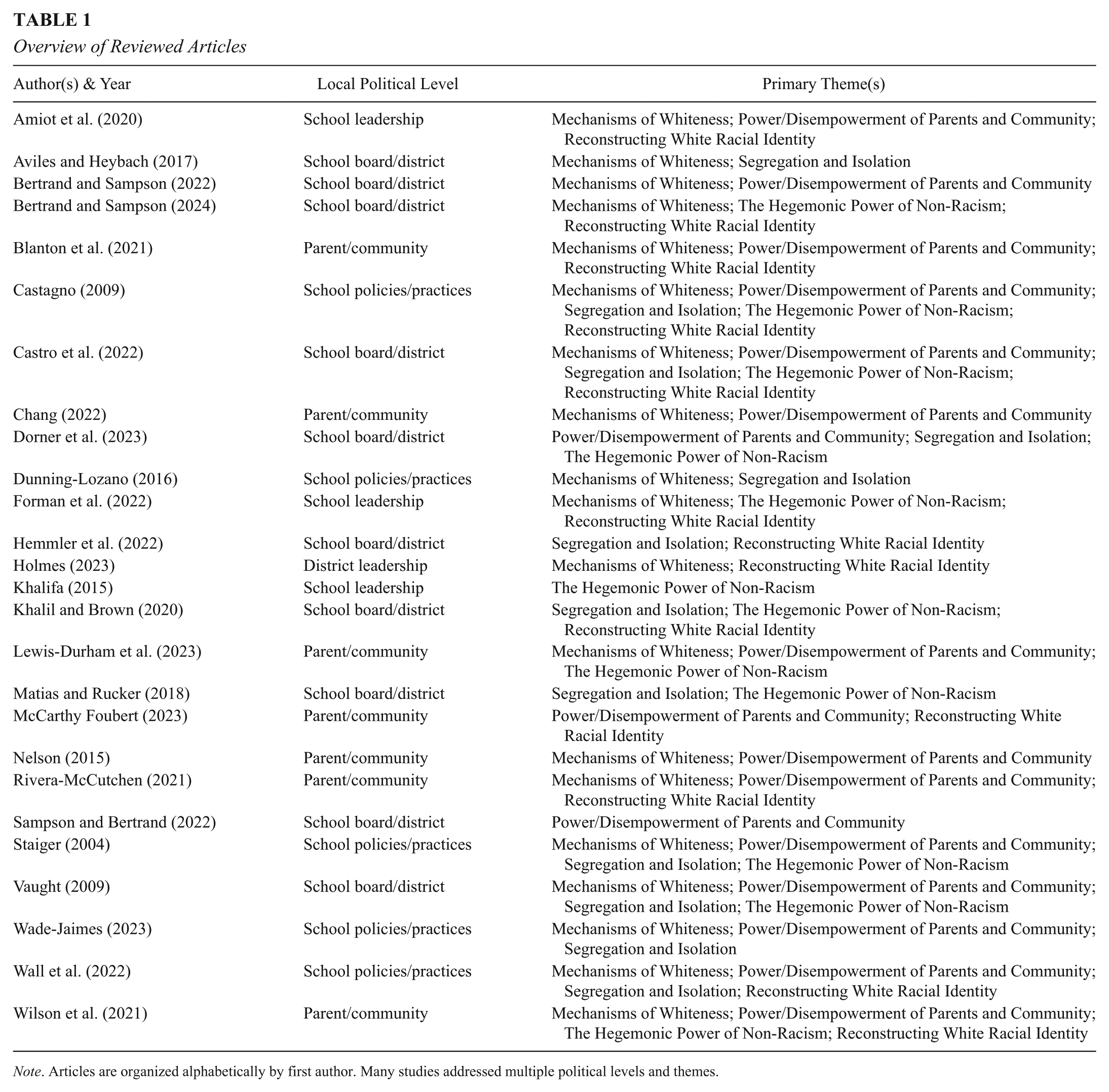
Note. Articles are organized alphabetically by first author. Many studies addressed multiple political levels and themes.
Building on the approach of Viesca et al. (2019), I analyzed these studies for their theoretical, conceptual, and methodological orientations. The coding process proceeded through three iterative cycles. In the first cycle, I conducted open coding after several readings of the article, generating initial codes that captured both theoretical orientations and empirical patterns (Miles et al., 2018). These initial codes included both inductive and deductive codes. Deductive codes were derived from the aforementioned theorizations of whiteness proposed by various scholars and adopted in this paper, with specific attention paid to third-wave conceptualizations of whiteness (e.g., color-evasiveness, class intersections). Inductive codes emerged from the data (e.g., white parent authority, identification processes as exclusion). Based on this process, initial codes included, but were not limited to: white privilege, segregation, equity rhetoric without material change, white parental power, individual-focused implications, and anti-Blackness.
In the second cycle, I conducted pattern coding to identify relationships among initial codes and consolidate them into broader analytic categories. Pattern coding not only illuminated deeper meanings behind initial codes (Saldaña, 2013) but also revealed recurring material and ideological dimensions of whiteness (Miles et al., 2018). The third cycle involved comparing patterns across all 26 articles to develop the five overarching themes, attending to both what appeared frequently and what was notably absent in the literature.
To ensure analytical rigor and reflexivity, I maintained analytic memos throughout the coding process, documenting decisions about code application, noting emergent patterns, and interrogating my own interpretations (Saldaña, 2013). I also engaged in constant comparison, revisiting previously coded articles as my understanding of patterns developed, which led to the refinement of several initial codes. For instance, early in the process, I coded multiple articles under “class intersections,” but later recognized a need to distinguish between studies that acknowledged the socioeconomic status of individuals (e.g., middle-class white parents) and those that linked it to structural processes of domination. This refinement led to the development of a subcode that differentiates these orientations, thereby informing my critique of the relative absence of literature that deeply interrogated the intersection of whiteness and dimensions of class hierarchy.
Throughout the analysis, I coded for how studies theorized whiteness or white supremacy, and when no explicit framework was named, I examined how authors invoked race, racialization, and racism. For example, Dorner et al. (2023) used theories of policy enactment to guide their analyses of dual language bilingual education (DBLE) programs. I coded for how the authors employed whiteness and related constructs of race to guide their findings and what it demonstrated about their theorization of the concept. In this particular example, whiteness was closely tied to white parental choice and the power it wielded over the DBLE program, at the expense of multilingual or immigrant families’ input.
Positionality Statement
My positionality shapes both what questions I ask and how I interpret the scholarship examined in this review. As the daughter of immigrants and granddaughter of Holocaust survivors, I have been attuned to how historical trauma and structural exclusion persist across generations and contexts. This background, along with my scholarly pursuits, has cultivated a critical consciousness regarding power, belonging, and the material conditions that determine who is granted access and opportunity.
My queer identity and my navigation of multiple cultural positions have also called me to question how visibility and invisibility operate within systems of access and privilege. Relatedly, my relative privilege, particularly my capacity to remain mutable with respect to race, faith, and sexuality, demands reflexivity. Following Táíwò’s (2020) concept of deference epistemology, I recognize that my experiences of marginalization do not automatically grant me insight into structural oppression or authorize my perspective on those struggles. Rather, this positionality calls me toward constant interrogation. It requires that I resist assumptions of shared experience, remain skeptical of claims to special understanding, and stay accountable to the communities whose struggles I am examining.
These commitments have shaped my analytical approach, as I have sought to foreground the material conditions and systemic processes that structure educational inequality, rather than attributing inequity to individual choices or characterizations. I have attempted to center the perspectives and struggles of those most harmed by racial domination, while remaining aware of my own limits and responsibilities in this work. This positionality does not grant me inherent insight. Rather, it compels me to approach research as an act of illumination, revealing how equity is claimed, contested, and constrained in practice while remaining grounded in the concrete action and collective work necessary for genuine transformation.
Findings
Five themes emerged from this review: (1) the mechanisms of whiteness, (2) the power and disempowerment of parents and the community, (3) segregation and isolation, (4) the hegemonic power of non-racism, and (5) reconstructing the white racial identity. Please refer to the online supplementary Table 2 for the full distribution of articles across themes. Although presented separately, these themes often reinforce one another, with concepts from one theme frequently fortifying aspects of another to uphold whiteness’s supremacy in local educational politics. The mechanisms of whiteness (i.e., color-evasion, privileging, normalization, and duplicity) establish the foundational logics through which the remaining themes operate. These mechanisms animate the dynamics through which white families exercise power over schools and communities, constructing and defending advantage against perceived threats. Segregation and isolation, in turn, translate those dynamics into durable spatial and structural arrangements that embed racial hierarchy into the physical organization of schooling. The hegemonic power of non-racism then provides the ideological cover for these arrangements, maintaining inequitable structures while professing commitment to equity. Finally, reconstructing the white racial identity signals that dismantling these interlocking systems requires not only structural transformation but also an interior reckoning, compelling those who benefit from whiteness to actively refuse its logics rather than merely acknowledge them. Together, these five themes illuminate whiteness not as a fixed set of attitudes or identities but as a dynamic system that operates simultaneously through discourse, family and community relations, spatial organization, institutional ideology, and individual subjectivity. However, as I will argue in the discussion that follows, the literature rarely names these connections explicitly, treating each dynamic as a discrete phenomenon rather than as part of a coherent, self-reinforcing system of racial domination. This limitation constitutes one of the various analytical gaps in the field’s engagement with whiteness scholarship in local educational politics.
The Mechanisms of Whiteness
One primary theme of this review centered on the literature’s engagement with frequently cited mechanisms of whiteness: color-evasion, privileging, normalization, and duplicity. While all four mechanisms ultimately serve to legitimize white dominance and often co-occur, each operates through distinct processes: color-evasion obscures racialized dynamics, privileging legitimates benefits to those racialized as white, normalization renders whiteness invisible as the default, and duplicity actively disguises and denies racial advantage. The 19 articles (n = 19) categorized under this finding engaged with these mechanisms to varying degrees, in that not every article conceptualized whiteness through each outlined tenet. Evaluated together, however, they largely align with third-wave scholarship on whiteness, which asserts that whiteness can be recognized through these common mechanisms. These mechanisms were observable across the literature through both discursive patterns (e.g., how race and equity are discussed or avoided) and material practices (e.g., how resources, opportunities, and access are distributed).
Half of the articles discussed the concept of colorblindness or color-evasiveness, a term used in the literature to describe the ideology that minimizes, ignores, or obscures the significance of race (Annamma et al., 2017). Studies were identified as engaging with this concept if they explicitly discussed either colorblindness or color-evasiveness in relation to their topics of study, or if they referenced how whiteness was maintained by evading the subject of race or racism. Collectively, these studies make evident how colorblind or color-evasive discourse serves to maintain hegemonic schooling conditions (Amiot et al., 2020; Bertrand & Sampson, 2022, 2024; Castagno, 2009; Castro et al., 2022; Dunning-Lozano, 2016; Forman et al., 2022; Holmes, 2023; Rivera-McCutchen, 2021; Staiger, 2004; Vaught, 2009; Wade-Jaimes, 2023; Wall et al., 2022; Wilson et al., 2021). For instance, Bertrand and Sampson (2022) utilized discourse analysis and the strategy of intertextual co-optation to evaluate community members’ responses to their school board’s failure to effectively take action against incidents of racism. Their strategies reflect the oppressive, color-evasive ideologies and discourse of board members in the protection of whiteness. The presentation of whiteness through color-evasiveness often demonstrated its duplicitous nature in that whiteness frequently exploits invisible and furtive means in maintaining the racial state. Interestingly, in Staiger’s (2004) evaluation of a gifted magnet program in California, the authors observed how whiteness becomes tantamount to giftedness. Regardless of the magnet school’s initial construction to facilitate desegregation, the program avoided overt discussions of race and instead protected the segregated white students in the gifted program through the rationale of giftedness (Staiger, 2004). The literature on this theme largely confirms the central premises of foundational whiteness theories, which contend that whiteness preserves privileges associated with the white racial identity by strategically avoiding explicit discussions of race and recasting inequality through seemingly neutral frameworks (Annamma et al., 2017; Mayorga-Gallo, 2019). The reviewed studies echo the enduring adaptability of whiteness and its capacity to reproduce racial hierarchies through familiar educational discourses like “giftedness” that obscure structural inequality.
Whiteness is noted here even when the outward appearance of local educational politics seemingly facilitates laudable projects of racial equality (e.g., school desegregation). As such, I offer that there is an adaptable, surreptitious nature to whiteness that is expressed in the literature as well. This understanding of whiteness is, to some extent, sustained through the normalizing function of whiteness. The formalized and tacit rules of school board meetings exemplify this, where stakeholders generally accept systematized guidelines of local school board governance as the standard, despite these guidelines being racialized and silencing oppositional voices (Sampson & Bertrand, 2022). As such, the normativity of whiteness produces the uncontested center, remaining undetected precisely because it is the accepted standard from which to judge (Doane, 2003).
Yet the normalizing function of whiteness extends beyond institutional procedures. Holmes (2023) reveals how whiteness operates through the cultural encoding of regional identity in rural Wyoming. By examining how administrators’ resistance to diversity operates through “Cowboy Epistemology,” a framework combining demographic conservatism, cultural homophily, and whiteness as an invisible standard, the author shows that whiteness does not rely on explicit racist rhetoric. Instead, it functions through the normalization of a particular way of life (i.e., ranching, extraction economy, and isolationism) as the default against which diversity is measured as aberrant. In this context, adherence to traditional values becomes indistinguishable from whiteness, revealing how whiteness produces the uncontested center not only through governance procedures but through the cultural sedimentation of regional belonging itself. Where Sampson and Bertrand (2022) identify how school board meeting rules silence oppositional voices, Holmes (2023) shows how regional identities are racialized in ways that render diversity as foreign or threatening, making resistance to inclusion appear as cultural preservation rather than racial domination.
Finally, in the reviewed local educational policy literature, whiteness is positioned as legitimating privileges and benefits to people racialized as white. Dunning-Lozano (2016) specifically addresses this in their study of the enrollment and referral processes that systematically segregated students of color in an under-resourced continuation school. Dunning-Lozano (2016) renders these practices as part and parcel of “how racism continues to determine the livelihood and quality of life experienced by some privileged groups and not others” (p. 455). Privilege granted to those of the white racialized identity is a consequence of whiteness, granting entitlements across racialized and class-based domains. Therefore, privilege is understood as primarily held by white people and specifically by white stakeholders in the local political process. Wall et al. (2022) make this concept evident through their exploration of institutional processes that impeded working-class Latinx and Black families’ access to two-way dual language (TWDL) programs. Drawing from tenets of critical race theory (Delgado & Stefancic, 2000), Wall et al. (2022) assert that white privilege, or the unmerited benefits accrued from being racialized as white, is understood through the dichotomy of ownership in that a person either owns the property of whiteness or does not. The favoring of white, affluent families in district and school-level processes allowed this group of stakeholders to capitalize on this asset and secure access to TWDL schooling while excluding other racialized families. As follows, the possession of privileges by students and families of the white racialized identity permits them to assert power in local educational politics, which in turn allows them to confer additional educational advantages.
Identifying these mechanisms (i.e., color-evasive, privileging, normalization, duplicitous) provides recognizable markers for naming and challenging whiteness, even when actors within systems appear to operate with benign intent. The finding, however, holds larger implications for the field in that relying on these mechanisms may serve to essentialize whiteness. Whiteness is expressed through historical and locally situated relations of power, which were often secondary or completely omitted in this literature in favor of these accepted features of whiteness. Although nearly 75% of the reviewed articles were categorized under this theme, only four studies (n = 4) contextualized these mechanisms in specific local settings by tracing how elements of whiteness originated in or were influenced by local histories. Without examining how historical decisions, funding structures, or political pressures produced particular policies and practices in specific districts, the literature risks reifying whiteness as an abstract ideology disconnected from the concrete institutional arrangements and relations that give it power in local contexts. This gap is particularly consequential because it limits our understanding not only of how whiteness becomes embedded differently across unique local contexts, but also what material hierarchies and racialized distributions of resources particular expressions of whiteness sustain and defend over time. Thus, this theme should be regarded as a cautionary signal to the field of the imminent reductionism in research on whiteness in local educational policy, if researchers continue to overemphasize these essences.
The Power and Disempowerment of Parents and Community
More than half of the studies (n = 17) reviewed examined the power dynamics affecting parents and communities, highlighting how local institutions sustain the social and material advantages of white families at the expense of marginalized racialized groups. Central to this finding was the consistent focus on white parents and their influence in shaping local educational politics. In particular, this literature analyzed how whiteness is reproduced through the prioritization of white parents’ interests and desires, enabling the hoarding of resources and opportunities to the detriment of other racialized groups. White parents’ ability to secure access to STEM programming (Wade-Jaimes, 2023), dual language schools (Blanton et al., 2021; Dorner et al., 2023; Wall et al., 2022), augmented school funding (Vaught, 2009), and gifted programs (Matias & Rucker, 2018; Staiger, 2004) become demonstrative of this.
In a similar vein, the literature presents white parent advocacy as a formidable force in local politics, evident in their countermovements against culturally responsive curricula, such as ethnic studies (Chang, 2022), and their influence in school rezoning processes that perpetuate school segregation (Castro et al., 2022). As aptly summarized by Wade-Jaimes (2023), “In the cases presented here, it is clear that it is not the students, teachers, or families in the ‘failing school,’ but rather White parents and families, and industry leaders that are in control of ‘reforms’” (p. 1209). The literature in this study thus validates how local institutions, through their investments in whiteness, maintain the social and material benefits associated with the white racial identity. As such, this literature affirms how white parents are actors who not only leverage these benefits but also reinforce similar structures that further disadvantage specific racialized groups.
Critically, this pattern of white parental power and the marginalization of racialized communities extends beyond formal school governance structures to ostensibly progressive movements. Rivera-McCutchen (2021) demonstrates this through their analysis of the New York State opt-out movement against high-stakes testing. Despite the movement’s equity rhetoric and legitimate critique of testing policies, the movement was dominated by white middle-class parents whose concerns centered on preserving advantage for their own children. The movement’s framing emphasized individual parental choice and raising awareness about testing harms, but largely unexamined were the underlying structural issues of how testing policies differentially impact communities with fewer resources to absorb educational disruptions (Rivera-McCutchen, 2021). This exemplifies how white parental power operates not only within institutional decision-making but within activist spaces, where the prioritization of white middle-class concerns, which are framed as universal equity concerns, effectively marginalizes the distinct interests and structural analyses of communities of color.
A notable underexplored area in this body of research is how socioeconomic status intersects with whiteness to shape parental authority in school politics. While many studies note the middle-class status of white parents, the majority of this literature did not interrogate the intersection of whiteness and class. Wilson et al. (2021) provide a rare exception, examining a rural parent engagement program aimed at including lower-income white parents in school decision-making. Their findings suggest that middle-class white norms continued to structure participation, both limiting access for lower-income parents and shaping the evaluative lens through which these parents judged others. This example validates how whiteness operates through class stratification even among those racialized as white, thereby determining access to the local political process. Even in this case, however, parental authority is primarily framed in terms of individual behavior rather than the structural conditions (e.g., broader economic restructuring, housing policies, or labor market changes) that enable or constrain participation. Although the literature of this review did not thoroughly interrogate the intersection of whiteness and dimensions of class hierarchy, its nascent inclusion exposes an undertheorized dimension of whiteness that merits deeper scrutiny—how class becomes implicated in racial domination.
Critical Inclusion/Consideration of Parents of Color
While the research discussed in this theme has demonstrated the power granted to white middle-class parents, an interdependent consideration in the literature was how whiteness silences and marginalizes parents and communities of color. This is evident in board meetings where the formalized rules in place and the discursive strategies employed by board members serve as operative, furtive means to restrict parents of color from educational decision-making (Bertrand & Sampson, 2022, 2024; Sampson & Bertrand, 2022). The marginalization of community and parent input along racialized lines was also noted in other district-level processes, such as school rezoning boards (Castro et al., 2022) or local dual language policy enactment (Dorner et al., 2023; Wall et al., 2022). By excluding input from parents and communities of color, these spaces structured whiteness into the hierarchical dimensions of local school governance. This finding points to a key facet of whiteness, which is that the strategic omission of various racialized communities from the local political process can serve to uphold a stratified educational system.
Studies that used whiteness as a frame to examine parent involvement reveal that school-level policies and practices similarly suppressed the input and agency of select racialized stakeholders. Chief among these was literature on systems of parent involvement, such as Parent-Teacher Associations/Organizations (PTAs/PTOs) and other select programs that attempt to engage parents in school-level decision-making (Blanton et al., 2021; Lewis-Durham et al., 2023; McCarthy Foubert, 2023). For instance, McCarthy Foubert’s (2023) multicase study of Black parents’ school engagement in PTOs revealed that, although parents from racialized communities were present in these spaces, other school stakeholders disregarded their contributions unless they aligned, at least partially, with narrow, often anti-Black and classist visions. Thus, merely including parents is wholly insufficient when whiteness, as regarded through the power given to white middle-class parents and school leaders, ensures the persistent marginalization of parents and communities of color.
Based on the influence given to white middle-class parents, often to the detriment of racialized groups, the assessed literature referred to several considerations for centering systematically minoritized communities in local educational politics. For example, Nelson’s (2015) interrogation of whiteness through essays on the closure of the Mexican American studies program in the Tucson Unified School District offers that converging on Chicana/o sensibilities through counterstories “creates the necessary conditions to engage the dialogic relationships between whiteness and co-cultural experiences with the intent of taking action against oppressive structures and representations” (p. 77). This emphasis on counterstorying returns us to the mechanisms of whiteness previously discussed, particularly how whiteness operates discursively to control which narratives are legitimized in local educational decision-making. The literature on this theme demonstrates that challenging whiteness requires not only identifying its discursive mechanisms (i.e., color-evasion, privileging, normalization, duplicity) but also actively contesting them through counternarratives that center the experiences and knowledge of racialized communities. Scholars often invite readers to question not only who gets to decide and who is overlooked in district and school policymaking but also, in some instances, what aspects of power and ideology detract from fundamentally shifting local politics toward more expansive and equitable views of shared governance. By highlighting narrative control as both a mechanism of whiteness and a site of resistance, this body of work illuminates how discourse functions simultaneously as a tool of domination and a space for transformative action.
Segregation and Isolation
The evaluated literature further explores the consequences of whiteness, with nearly half of the articles (n = 12) highlighting the segregation of students of color as a chief byproduct of endemic whiteness. Close to half of the studies on this theme employed “whiteness as property” as a theoretical framework (Harris, 1993). This literature demonstrates how whiteness contributes to the physical isolation of various student groups. For example, Vaught’s (2009) ethnographic analysis of a West Coast school district found that the district’s policies on school choice and weighted student funding, as well as their decentralized governance structure, resulted in increased segregation and unequal resource allocation across racialized domains. Particularly in the culture of student tracking, whiteness legitimates disenfranchisement through the guise of legitimacy and policy neutrality while obstructing a more equitable alignment toward distributive justice (Vaught, 2009).
Through the synthesis of this literature, I advance that this shared tenet surfaces how whiteness produces both the conditions and the rationale for inequitable education. Separation is positioned as the consequence of school district and school-level policies and practices that, despite attempts to amend segregated schooling opportunities on the surface, functioned as instruments to exclude (e.g., Castagno, 2009; Castro et al., 2022; Dorner et al., 2023; Khalil & Brown, 2020). Notably, the isolation of various racialized ethnic groups was undergirded by whiteness latent in identification processes (Dunning-Lozano, 2016; Hemmler et al., 2022; Matias & Rucker, 2018; Staiger, 2004; Vaught, 2009; Wade-Jaimes, 2023; Wall et al., 2022; Wilson et al., 2021). Identification processes, as regarded in the research of this review, would determine eligibility for specialized school programs and spaces. Hemmler et al.’s (2022) research provides a glimpse into the exclusionary processes of prevailing mechanisms for identification. In their study of 11 school districts’ rural gifted education programs, Hemmler et al. (2022) observed that Black students were “over three times more likely to be excluded from gifted identification than their White peers with the districts’ methods of identification” (p. 15). The authors interrogate how the preponderance of whiteness in gifted spaces ensures spatial injustice, where access to “valued” opportunities is undercut despite eligibility and similar educational experiences (Hemmler et al., 2022). Extending Hemmler et al.’s (2022) findings, the studies in this review deepened comprehension of whiteness not only as a driver of unequal outcomes but as a constitutive logic shaping how educational policies, identification systems, and opportunity structures are designed and justified. In local educational contexts, whiteness sustains itself through institutional practices that segregate racialized groups and deprive them of material and educational resources, thereby reproducing perceptions of racialized inferiority (e.g., non-gifted) that are later cited to rationalize continued exclusion.
Implicated in the literature on segregated schooling is also the changing geographical landscape of municipalities, prominently seen through gentrification (Aviles & Heybach, 2017; Blanton et al., 2021; Khalil & Brown, 2020; Wade-Jaimes, 2023; Wall et al., 2022). For example, in Khalil and Brown’s (2020) examination of school leaders’ attempts to reintegrate their charter schools through relocation, the authors found that diversity-oriented school-level policies alone were insufficient to combat the displacement of lower-income students of color resulting from city policies and gentrification. This example illustrates the connection between school-level initiatives and broader municipal and policy contexts in that local efforts to promote equity are deeply constrained by structural and spatial processes beyond the school’s control.
Throughout the literature on this theme, only a limited number of studies addressed these contextual dynamics, which were identified based on whether authors explicitly connected school-level outcomes to neighborhood, city, or policy-level processes. While most examined institutional actors or school policies in isolation, only four articles traced the contextual importance of neighborhood change in the persistent segregation of lower-income students of color. Within this subset, Aviles and Heybach (2017) provide the most expansive contextual analysis. In studying Chicago’s closure of 49 predominantly Black schools and its impact on students experiencing homelessness, they connect school closings to housing instability, gentrification, neoliberal urban policy, and the racialized displacement of Black families. Their analysis demonstrates the nature of systemic contextual work, showing how education policy is inherently intertwined with housing policy, municipal development decisions, and the economic logics that render certain communities disposable.
The limited attention to broader structural and spatial contexts demonstrates an ongoing gap in the field. Without connecting local educational patterns to the political-economic forces that shape disinvestment, displacement, and racialized resource allocation over time, scholarship risks presenting segregation as primarily the product of individual decision-making (e.g., which families choose which schools, which students are identified as “gifted”). Expanding analytical attention to these intersecting dynamics would strengthen understanding of how local educational, housing, and urban policies together sustain the racial project of whiteness and reproduce enduring hierarchies of opportunity.
The Hegemonic Power of Non-Racism
Twelve studies investigated policies and practices that maintain whiteness despite the adoption of diversity- and equity-oriented rhetoric (Bertrand & Sampson, 2024; Castagno, 2009; Castro et al., 2022; Dorner et al., 2023; Forman et al., 2022; Khalifa, 2015; Khalil & Brown, 2020; Lewis-Durham et al., 2023; Matias & Rucker, 2018; Staiger, 2004; Vaught, 2009; Wilson et al., 2021). This hegemonic embrace of “non-racism” demonstrates mechanisms of whiteness in action. For instance, duplicity operates through the gap between professed values (e.g., equity, inclusion, diversity) and the practices that maintain them (e.g., tracked classes, neighborhood-based assignments, competitive gifted programs). By adopting the language of equity without restructuring opportunity, districts deploy what Bonilla-Silva (2003) terms “racism without racists,” where systemic inequity is maintained through ostensibly non-racial policies.
For instance, research by Bertrand and Sampson (2024) on school district leaders’ responses to racism classified hollow and evasive equity initiatives as part of the “white innocence playbook,” where school boards avoid responsibility by naming racism through strategies of positive image management (see also Bridgeforth, 2021). Lewis-Durham et al. (2023) further clarify this theme through their analysis of a social justice–centered school where, despite the school’s explicit use of equity language, the leadership’s stated commitments to disrupting whiteness were contradicted by their inaction when confronted with white dominance in parent spaces. Even when presented with opportunities to disrupt practices that advantaged some families over others, such as an open-door policy that gave unfettered access to those with time and resources to visit during the day, the leaders took no direct action to remedy these problems of inequitable access (Lewis-Durham et al., 2023). This case emphasizes a critical difference between anti-racism and non-racism: leaders’ professed anti-racist values become non-racist in nature when they perpetuate whiteness through silence and procedural legitimacy, allowing ostensibly neutral processes to function as mechanisms of exclusion.
Matias and Rucker (2018) similarly assessed the disconnection between purportedly “equity-oriented” policies and reality through their evaluation of Denver Public Schools’ Denver 2020 plan, which was principally intended to close the achievement gap in their district. The findings from the study, however, indicate that the tools and policies instituted to support this chief aim only proliferated historical racialized inequities (Matias & Rucker, 2018). Despite pretenses of equity in their positionings, the research of this review converges in highlighting the constant embedding of white supremacy in the policies and practices of local education agencies.
Relatedly, Castro et al. (2022) evaluated school leaders’ and community stakeholders’ narratives on school redistricting rezoning. Their research shows how persistent segregated schooling can be upheld through rhetoric that largely accentuates resource equality before integration and obscures the racialized history that shaped the present political moment (Castro et al., 2022). Castagno (2009) further explores this disjuncture between the unsubstantiated equity claims of policies and the reality of persistent injustice in their assessment of an urban district in Utah. In it, the author contends that this disjuncture is the difference between formal equality and substantive equality, where the former foments small changes in local political contexts and the latter would bring forth expansive visions of educational equity that largely upend the present conditions of oppression in education (Castagno, 2009). Consistent with the literature on this theme, historical and present-day decisions to emphasize educational equality can obscure the preservation of hegemonic power dynamics. They illuminate that diversity- and equity-oriented policies should be equally interrogated for their maintenance of whiteness, as they can often serve as rhetorically palatable ways to sustain racialized material inequalities.
While studies in this theme identify the gap between equity rhetoric and material outcomes, few trace how this gap is produced through connections between educational policy and broader political-economic forces. For instance, studies documenting hollow equity initiatives often don’t examine how funding structures, city policies, or state accountability regimes constrain local leaders’ capacity to enact substantive change, even when they possess a genuine commitment to equity. By focusing primarily on discourse and stated intentions, much of this scholarship foregrounds the moral and rhetorical dimensions of equity work but gives less attention to the structural conditions that limit its realization. As a result, policy shortcomings may appear as failures of leadership or will rather than as products of systemic constraints that persist regardless of individual actors’ values or awareness.
Notably, a small subset of the literature (n = 5) cited whiteness as being maintained by non-white individuals (Bertrand & Sampson, 2022, 2024; Castro et al., 2022; Forman et al., 2022; Khalifa, 2015). For example, Khalifa (2015) examined abusive and exclusionary practices instituted by Black school principals, challenging the common notion that whiteness is displayed only by those of white racial identity. As argued by the author, This study has deep implications for our understanding of White supremacy, for it reinforces our understanding that it is systemic and can be reproduced by anyone. In fact, it might be argued here that systems of White supremacy would intentionally pursue non-threatening Black principals who will ostensibly not resist a very palpable racially oppressive context. (pp. 277–278)
These sobering implications point to the importance of taking a systemic lens in such research.
The literature within this subgroup problematized the diversity of political actors in educational contexts, deeming it inadequate to effectively address whiteness. Indeed, Khalifa’s (2015) study shows that we must move away from analyses of equity that use diversity narratives alone and instead take on systemic lenses to fully uncover white supremacy’s structuration of local educational politics. This strand in the literature was not as established, although it was classified under the overarching ideas of this theme. It, nevertheless, resurfaces key takeaways from this subset of literature and one that merits further evaluation in studies of whiteness.
Reconstructing the White Racial Identity
Thirteen articles in this review suggested that whiteness could be addressed at the individual level by fostering awareness of and engagement with racial justice. I found that studies in this group often emphasized individual remediation strategies, including building awareness (Wall et al., 2022), taking responsibility (Bertrand & Sampson, 2024; Castagno, 2009), thoughtfully listening and engaging (Blanton et al., 2021; Wall et al., 2022), and shifting beliefs (Hemmler et al., 2022; Wilson et al., 2021), among others. It is necessary to acknowledge that not every article under this theme proposed actions solely focused on individual remedies. Nevertheless, roughly half of the evaluated studies contended that working to reconstruct the white racial identity by modifying stakeholders’ consciousness, responsiveness, and perspectives was a viable means of addressing whiteness ingrained in their specific contexts.
For example, Forman et al. (2022) explored school leaders’ attempts to connect social-emotional learning (SEL) with anti-racist objectives. The authors found that leaders often applied strategies that frame SEL as a way for teachers to manage their emotions of fear, defensiveness, and shame when becoming knowledgeable about racism and to provide teachers with tools to better understand racialized students’ experiences (Forman et al., 2022). With these findings in mind, Forman et al. (2022) emphasize that although SEL cannot solve systemic racism, it is a constructive way to contest racism and harm done to students of color by addressing “White teachers’ emotional resistance to implementing anti-racist instructional practices” (p. 377). Unsettling the mindsets of white teachers is thereby situated as a method that educational leaders can use to assist in teachers’ comprehension of and investment in racial justice.
Research implications on the improvement of white stakeholders’ mindsets and actions further promoted improved dialogue and awareness strategies. For instance, Blanton et al.’s (2021) research on a Black mother’s counterstorytelling on their engagement in school and PTA processes demonstrated the marginalization of Black families in dual language (DL) programs. Alongside policy recommendations, Blanton et al. (2021) “encourage[d] White parents and administrators to listen and thoughtfully engage when confronted with the ‘sneaky’ ways in which Whiteness is perpetuated in DL and other educational settings” alongside having these groups “acknowledge that they may be celebrated while parents of color are often vilified for speaking against racism” (p. 481). In this respect, attending to the harmful racial dynamics in DL programs was, to some degree, contingent on white stakeholders recognizing their differential privileges and assuming a more attentive and receptive position when approached about racialized inequities.
The research in this theme asserts that subverting whiteness requires those of the white racial identity to reflect on and recognize their privilege, their harm to racialized communities, and their racist beliefs at multiple levels of school governance and decision-making. In this view, changing the tide of white supremacy in local educational politics calls on individuals to commit themselves to possessing greater knowledge of racial injustice and advance policies and practices that reflect a commitment to racialized equity. Correspondingly, educational equity is predicated on individuals reconstructing their white racial identity, which is not only myopic but also relegates anti-racism to an individual pursuit rather than a systemic one.
This finding also reflects a tension between identifying systemic issues and relying on personal transformation as the main response. Many studies document how whiteness operates through institutional mechanisms, such as identification processes that sort students into unequal tracks or policies that concentrate resources in predominantly white schools, while emphasizing changes in individual consciousness as a means of redress. For example, Amiot et al. (2020) examined a leadership team’s use of critical race theory to guide equity audits that revealed systemic bias in tracking, identification, and discipline practices. Their interventions centered on building teacher awareness through professional learning communities and family dialogues. These efforts contributed to greater reflection and modest improvements in school outcomes, yet the underlying systems that produced inequities remained largely intact.
While shifting mindsets holds value, its predominance allows scholarship to appear structurally critical while proposing interventions that often leave the racial project of whiteness intact. Without diminishing the role of individual complicity in sustaining racial inequity, the recurring emphasis on reconstructing the white racial identity through awareness, listening, and responsibility-taking risks positions personal transformation as sufficient when the issues identified (e.g., resource hoarding and inequitable policy design) demand structural change and material redistribution.
Discussion
In this literature review, I sought to assess what the prevailing scholarship on local educational politics reveals about the function of whiteness in certain contexts and the field’s interpretations of whiteness as a theory. These studies provide insight into whiteness by examining its underlying mechanisms, consequences, rhetorical positions, and future directions, as illustrated in the outlined themes. Based on the findings, the ongoing segregation within local educational contexts affirms that mechanisms of whiteness establish conditions of domination, thereby politically restructuring racialized subordination through the allocation of educational resources along racial and class dimensions. Other facets of educational politics reflect this racialized hierarchy, such as parent/community authority. Examinations of whiteness thus attune education research to question who is given power and who is permitted in the inner sanctum of local political decision-making. Another principal conclusion from this review is a recognition of processes of whiteness that appropriate the rhetoric of educational equity.
Importantly, this review draws attention to the distinctive aspects of local education contexts as a site for understanding racial domination. The examined literature illuminates how whiteness institutionalizes itself through narratives of fairness and equal opportunity while producing racialized inequalities. Literature on local educational politics helps define how whiteness accomplishes this paradox through mechanisms like identification systems that determine access to “gifted” programs and diversity initiatives that appropriate equity language to safeguard material advantages. This uniquely exposes the rhetorical and ideological labor required to legitimize exclusion through dynamics particular to local educational contexts, where selection and differentiation are institutionalized in unique ways.
Moreover, local educational politics reveal how whiteness is actively performed, defended, and reconstituted through everyday practices, such as parent engagement structures. Focusing on this cross-section of educational politics exposes whiteness not as a passive advantage but as an actively maintained system sustained through the institutional participation of educators, parents, administrators, and school board members.
Mutually Reinforcing Dynamics
It is important to recognize that the five themes identified in this review do not operate in isolation. Rather, they often reinforce one another, creating cumulative effects that sustain white supremacy in local educational politics. For instance, in Blanton et al. (2021), the authors demonstrate how mechanisms of whiteness, which legitimize privileges to people racialized as white, shaped which parental voices are heard and which forms of engagement were deemed legitimate. This, in turn, reinforces patterns of exclusion and disempowerment, particularly among racially minoritized families, perpetuating structural inequities in access to decision-making and student educational access. The authors suggest that the implications of this research call on people of white racial identity to listen and engage when their whiteness is confronted, as well as further understand their privilege.
These interconnected dynamics underscore how rhetoric, policy, and practice work together to sustain existing hierarchies. By foregrounding these mutually reinforcing relationships, this review emphasizes the ways in which whiteness operates as both an ideological and structural force, shaping local educational politics not only through overt exclusion but also through subtler mechanisms of normalization. Understanding these interactions provides a framework for interpreting the findings and situating them within broader discussions in whiteness studies.
Overall, the 26 articles analyzed in this review are a part of third-wave whiteness scholarship in that they attend to locally specific, performative expressions of whiteness in educational contexts. However, my analysis reveals significant gaps in how third-wave frameworks have been operationalized in education research. In the next section, I discuss the complexities of these findings and their alignment or lack thereof with fundamental developments in third-wave whiteness studies.
Ontology of Whiteness
Understanding the mechanisms of whiteness (e.g., color-evasive, privileging, normative, and duplicitous) is aligned with the scholarly premises of the third-wave whiteness studies of the past few decades. There is utility alone in naming these elements, as it makes visible the hidden ontology of hegemonic power relations. Identifying these mechanisms also circumvents the notion of intentionality. Since white supremacy pervades society, the institutionalization of whiteness through rhetorical, ideological, and material devices can skirt claims of intentional harm (Matias & Newlove, 2017).
Nevertheless, the significance of naming the ancillary elements of whiteness (e.g., color-evasive, privileging, normative, and duplicitous) should be coupled with epistemological caution against essentialization. As stressed by Nakayama and Krizek (1995), “The risk for critical researchers who choose to interrogate whiteness . . . is the risk of essentialism” (p. 293). “There is no ‘true essence’ to ‘whiteness,’” Nakayama and Krizek (1995) continue, “there are only historically contingent constructions of that social location.” (p. 293). As seen in this review, scholarly sensitivity to these mechanisms may impede discernment of the ways the “performativity of whiteness” shifts in local political contexts over time (Matias & Newlove, 2017, p. 319). The absence of acknowledgments of local histories in a significant portion of the literature may be illustrative of this. Ahistoricism, notably as it pertains to whiteness, devalues the complexity and mutability of racial projects, masking the fact that the process of racial supremacy is, by nature, deeply historical (Doane, 2003). Thus, the ahistorical nature of the reviewed studies could be the byproduct of essentialism, where scholars opt to account for dimensions of whiteness that have been readily acknowledged rather than attuning to the situational and historical relations of power that have restructured whiteness in service of the present moment (Twine & Gallagher, 2008).
Moreover, whiteness can be sustained by those racialized as non-white. Focusing analysis on individual privileges (i.e., who has them, who doesn’t, who acknowledges them) obscures how “whiteness is not synonymous to white people,” but operates as a structural force that can be upheld regardless of the racialized identity of specific actors (Matias & Newlove, 2017, p. 317). Additionally, privilege is the everyday counterpart of structural domination. Privilege cannot be gained in the first place without the persistent stronghold of structural domination (Leonardo, 2004). As such, the rhetoric of white privilege in the assessment of whiteness has the potential to inaptly focus on the byproduct of white supremacy (i.e., “being dominant”) rather than the “institutional processes that secure domination” (Leonardo, 2004, p. 137). Although not all articles in this review adopted this lens, this distinction should remain at the forefront of research on local educational politics that seek to use whiteness as a lens in their inquiry.
Actors vs Systems
In critical respects, the literature reviewed illustrates the disproportionate attention paid to certain actors, such as white middle-class parents, while giving less consideration to the broader systems that shape local educational politics. Notwithstanding the importance of judging how these figures comprise a vital force shaping the course of school policies and practices, the immense significance given to this group begs the question of whether education scholars have “mystif[ied] the process of racial accumulation through occlusion of history and forsaking structural analysis for a focus on the individual” (Leonardo, 2004, p.141). Simply put, if not connected to broader systems of racism, these studies may further obscure the racial project of whiteness by overemphasizing individual political actors.
Gillborn (2008) points to an analogy that exposes the limitations of concentrating whiteness studies exclusively on individuals. In it, they assert that “individual people (teachers, policy-makers, commentators) and separate agencies (education; the media; the criminal justice system) can be viewed as spokes connected through a central hub of whiteness, i.e. the shared supposedly ‘commonsense’ beliefs that privilege White experiences, assumptions and interests” (Gillborn, 2008, p. 244). Gillborn (2008) continues by saying, Every individual actor is important and implicated but each individual can hide in the mass of other spokes and deny their significance. One of the strengths of institutional racism is that no single person or agency can be held up as wholly responsible, but to some extent the system draws authority from them all. (p. 244)
Gillborn’s (2008) hub-and-spoke model clarifies why an actor-focused lens can obscure systemic processes: Individuals derive their authority from the structural networks in which they operate. Without attending to these networks, analyses risk underestimating the logics of whiteness that extract power from the number of other spokes in the system and reify its supremacy (Gillborn, 2008). Thus, the prominence of literature that solely focuses on figures operating in the institution of whiteness may obfuscate other “spokes” at work in their contexts and the structural aspects that give meaning and legitimacy to the actions of these figures.
Non-Racism vs Anti-Racism
Through the scholarship in this study, the field of education has also come to apprehend the third-wave focus on “how power and oppression are articulated, redefined, and reasserted through various political discourses and cultural practices that privilege whiteness even when the prerogatives of the dominant group are contested” (Twine & Gallagher, 2008, p.7). The recasting of seemingly “good” motivations in local political processes remain circumspect insofar as they appropriate the discourse of diversity and equity-oriented politics to safeguard whiteness in local educational contexts. Put simply, the assessed policies and practices in this review allude to “the commodification of ‘diversity’ that holds white supremacy in place,” advancing evidence of whiteness as being articulated through rhetoric and optics to evade opposition (Gerrard et al., 2022).
Accordingly, scholars in this review have begun to develop a theorization of whiteness that intellectualizes the distinction between “non-racism, a form of image management” and “anti-racism, a political project.” (Leonardo & Zembylas, 2013, p. 151). In the present conditions, local political developments reflect non-racism, allowing school districts and political actors to feign substantive changes toward educational equity while fashioning local educational contexts to further sustain marginalization. Thus, participation in the discourse of diversity, equity, and inclusion divorced from the political project of anti-racism becomes exploitative at best and oppressive at worst.
Reconstruction vs Abolition
Finally, the thematic emphasis that implied a reworking of the awareness and actions of those who are racialized as white engages in the oppositional conclusions made by whiteness theorists for many decades: Does dismantling racial domination require the abolition or reconstruction of whiteness? Hallmark literature produced by Frankenberg (1993) and Roediger (1994) offers a glimpse into this dialectic. Bonnet (1996) rightly situates these texts as offering divergent conclusions on how to challenge whiteness. Frankenberg (1993) aligns with the prospect that white people must name, challenge, and reconstitute whiteness toward anti-racism. Roediger (1994), on the other hand, stresses that whiteness must be abolished altogether, calling for anti-racism to align itself instead with class struggles. In later texts, Roediger (1999) questions whether a healthy white identity is possible, arguing that “fostering awareness of how Whiteness operates as a category is different from encouraging an identification with Whiteness” (p. 243). Although they have different means of diminishing the oppressive consequences of this racial project, both authors propose valuable considerations, only one of which seems to be reflected in the literature evaluated in this review.
Commitment to reconstructionism offers an opening for stakeholders who are racialized as white to engage in racial dialogue and recognize their privilege vis-à-vis awareness of whiteness. Buy-in, in this regard, is predicated on acknowledgment and understanding but critically fails to call for the relinquishing of material resources that justice necessitates (Leonardo, 2004). In other words, reconstruction does not, by nature, lead to the disinvestment from the racial project of domination. With this in mind, Hartman (2020) offers: The possessive investment in whiteness can’t be rectified by learning “how to be more antiracist.” It requires a radical divestment in the project of whiteness and a redistribution of wealth and resources. It requires abolition, the abolition of the carceral world, the abolition of capitalism. What is required is a remaking of the social order, and nothing short of that is going to make a difference. (para. 7)
While it remains difficult to envision the “remaking of the social order,” Hartman’s assertion bears further study. Can shifting knowledge and beliefs toward anti-racism alone dismantle whiteness structured into local educational institutions and systems? The favored position of reconstruction in the literature, although valuable, may constrain the vision of what is possible in these contexts and anti-racism work in general (Gillborn, 2006). This is not to dismiss consciousness work entirely. Awareness of whiteness remains necessary—one cannot divest from what remains unnamed and unrecognized. However, I contend that research on local educational contexts must reposition awareness as only a preliminary step rather than the endpoint—necessary but insufficient for achieving structural transformation. Reconstructing white racial identity to be “less harmful” leaves intact the structures that make whiteness valuable in the first place. Although whiteness scholars have historically debated the limitations and possibilities of the abolishment or reconstruction, the field of education is obliged to examine the possibilities of both paths for racial transformation in educational policies and practices.
Implications and Future Directions
Of the articles assessed, over 85 percent were produced in the past decade, and two-thirds were published in the past four years alone. This pattern reflects a renewed and prolific reuptake within education research to whiteness specifically, and white supremacy more broadly, as central dimensions of local educational politics. The field is therefore positioned at a critical juncture in whiteness studies and a decisive moment to reorient education research toward emancipatory visions.
Based on the findings of this review, education scholars have not fully realized the analytic potential of the third wave of whiteness studies, as defined by Twine and Gallagher (2008). The third-wave’s strength lies in its attention to context-specific and often covert performances of whiteness, illuminating the social and cultural enactments of racialized power. However, this focus tends to privilege individual actors and interactions, framing whiteness primarily as a socially constituted phenomenon, rather than as a process embedded in systemic structures. As Leonardo (2004) aptly argued, “Domination can be distinguished from dominance where the former connotes a process and the latter a state of being, the first a material precondition that makes possible the second as a social condition” (p. 140). Put differently, the structural processes that sustain racialized inequality receive less attention than the socially visible performances of whiteness.
For instance, limited research examines how systematically minoritized racialized groups maintain white supremacy, which is an aspect of whiteness theorized in third-wave studies but was largely overlooked by scholars examining dynamics of local educational politics. Similarly, the interplay between whiteness and class dynamics remains underdeveloped, with much of the literature overlooking Roediger’s (as cited in Cleaver, 2007) insight that “whiteness conferred compensation for exploitative and alienating class relationships” (p. xx). These gaps suggest that the problem is not inherent to previous waves of whiteness theorizations but rather reflects how the scholars have selectively applied it, highlighting the need for research on local educational contexts to engage with whiteness studies more deeply and move beyond the recurring emphasis on its hidden, socially manifested aspects.
A Proposed Reframing
Rather than proposing a distinct “fourth wave,” I offer that education scholarship deepen and extend third-wave whiteness analysis through more rigorous theoretical engagement. To operationalize this reframing in practice, I propose the following analytical framework for future research on whiteness in local educational politics: Research aligned with this reframing must simultaneously ask: (1) How is whiteness performed and legitimized in this specific context? (2) What material hierarchies and resource distributions does this performance sustain? (3) How did the historical development of this particular locality produce these specific expressions of whiteness? (4) How do the mechanisms of whiteness in local educational contexts intersect with the other structures in the local political economy, such as housing, municipal, and economic policies? (5) How are racialized communities organizing against these structures, and what do their demands reveal about what transformation requires? (6) What structural changes in policy, funding, and governance would their liberation necessitate?
This approach demands methodological expansion beyond discourse analysis and interviews with institutional actors. Researchers must trace policy genealogies through archival work, connecting present practices to historical local policy decisions. They must analyze city and state policy and data alongside local educational policies. Critically, they must also center the organizing work of Black and racialized communities, not as “participant voices” but as theorists of their own conditions whose insights drive the research questions themselves.
For instance, rather than documenting that identification processes exclude Black students in local educational contexts and recommending “awareness training,” whiteness research under this reframing would trace how these identification criteria emerged from specific local resistance to desegregation court orders in the 1970s and ’80s (Naff et al., 2020) or document how Black parent organizations have demanded universal enrichment programming. Similarly, as opposed to documenting white parent hoarding of DL programs, whiteness scholarship could trace how the district’s DL program expansion coincided with gentrification policies that displaced Latinx families while attracting white professionals; analyze enrollment policies, transportation access, and school placement in relation to housing costs and displacement patterns; or center Latinx community organizations’ demands for community-controlled schools and Spanish language preservation.
While these methodological shifts exemplify the practical dimension of this reframing, they are anchored in a deeper theoretical imperative: to move beyond documenting the operations of whiteness and critically interrogate the conditions that necessitate its continual reproduction. Where third-wave scholarship illuminates how locally specific expressions of whiteness are performed, scholarship insists we ask why it must be performed. Local educational contexts are particularly revelatory in this regard, as understanding how whiteness is employed through mechanisms such as district policies and parent engagement structures is insufficient without understanding what material hierarchies and racialized distributions of resources they sustain and defend. As has been surfaced in this review, local educational contexts provide a crucial site where this insight becomes urgent, as it directly affects the material realities of students and communities. This proposed reframing demands both third-wave analytical sophistication and clarity about what must fundamentally change.
Presently, the field of education has made immense contributions in recognizing the functions of whiteness in local political contexts, yet it is not postured toward alternative liberatory possibilities. Research rooted in emancipatory potentials of local educational policy and practice would necessitate a rhetorical and philosophical reconstitution of whiteness that reframes racial domination not as a byproduct of whiteness but rather as its intended outcome. The field must begin to grapple with the politics of whiteness as a deeply implanted fear of the “other” to acutely comprehend the conditions of emancipation.
Scholars may be called to question whether focusing on the white racial identity should be the primary mode of inquiry in whiteness literature. By assessing those that possess power to shape the trajectory of their particular contexts, “whiteness, and white people, are turned into the key agents of historical change, the shapers of contemporary America” and local educational policies (Bonnett, 1996, p. 153). In this regard, the field of education may reestablish the center of whiteness through the vantage point of the advantaged rather than the material realities of those who remain oppressed through the dynamics of the racial state (M. Apple, 1998). An alignment with liberation would compel us to question whether liberation can be conceived through a constrained lens of who and what has comprised the “center” of whiteness studies.
Correspondingly, reorienting whiteness studies in education calls for a stringent conceptualization of local educational policy and practices as fundamentally rooted in anti-Blackness, a concept that, while related to whiteness, demands distinct analytical attention. As Dumas (2016) theorizes, anti-Blackness positions Black bodies as an ontological threat to the social order, making Blackness “a/the key ‘other’ against which civil society is built” (p. 12). This is not merely another expression of whiteness but rather reveals whiteness’s constitutive dependence on Black subjugation.
Although the methodology of this review focuses specifically on whiteness as a distinct theoretical formation, the literature reviewed surfaces a limitation of that framing, suggesting that whiteness scholarship alone cannot fully theorize the anti-Black logics that structure local educational contexts (Dumas & Ross, 2016). The reviewed literature demonstrates this dynamic through the exclusion of Black families from dual language programs (Blanton et al., 2021; McCarthy Foubert, 2023), the systematic under-identification of Black students for gifted programs (Hemmler et al., 2022), and even the maintenance of whiteness by Black principals (Khalifa, 2015), all of which suggest that anti-Blackness operates as a structuring logic in local educational contexts. While whiteness studies establish how dominance is maintained and performed, centering anti-Blackness reveals how education reform itself often functions to manage and contain Blackness rather than pursue genuine equity. As Dumas (2016) argues, anti-Blackness operates as the foundational logic against which other forms of racialized exclusion are organized. The literature reviewed here demonstrates this not only through the exclusion and marginalization of Black families and students, but also through the systematic displacement of Latinx communities and other racialized ethnic groups via similar mechanisms of containment and control.
Understanding whiteness thus requires analytical frameworks that refuse to recenter whiteness and instead commit to the liberation of all communities systematically oppressed by white supremacy, recognizing how anti-Blackness functions as the constitutive foundation that enables these broader patterns of domination. If whiteness is deemed, first and foremost, a political project to maintain racial order, then “fomenting a new politics, a new practice of education, committed to Black—and therefore human—emancipation” is one of the few paths forward to fundamentally shift the entrenchment of whiteness in local education politics (Dumas, 2016, p. 17). While research is merely one of many intertwined mechanisms in this broader liberatory project, the repositioning of educational policy research toward liberation is an avenue the field cannot ignore.
Conclusion
The proposed reframing of future third-wave whiteness analysis demands more than theoretical acknowledgment. It requires fundamental shifts in research practice. Future research on whiteness in local educational politics should go beyond individual-level explanations and essentialist assumptions, attending to how local governance is situated within and influenced by broader political, economic, and spatial structures. It must historicize whiteness in specific local contexts rather than treating it as a set of transhistorical principles. Most critically, scholars should recognize that analyses of whiteness hold the potential for liberatory aims when they both center anti-Blackness as a foundational logic and account for how whiteness structures the oppression of Latinx, Indigenous, and other racialized communities through interconnected systems of domination. Thus, future scholarship should be called to interrogate how to study whiteness in ways that actively dismantle rather than inadvertently reinscribe its centrality, centering instead the liberation of all communities harmed by white supremacy.
Local educational politics, precisely because of their proximity to the material consequences experienced by students and communities, offer a generative ground for such reimagining. The findings of this review demonstrate that whiteness operates through locally specific mechanisms that both reflect and reproduce broader racial hierarchies. Understanding these mechanisms is essential, but insufficient. What remains urgent is research that not only documents how whiteness functions but actively participates in its dismantling through rigorous structural analysis, genuine material redistribution, and resolute commitment to the liberation of systematically oppressed communities. The question facing education researchers is whether we will seize this moment to reorient the field toward transformative possibilities.
Supplemental Material
sj-docx-1-rer-10.3102_00346543261451890 – Supplemental material for The Supremacy of Whiteness in Local Educational Politics: A Review of Literature
Supplemental material, sj-docx-1-rer-10.3102_00346543261451890 for The Supremacy of Whiteness in Local Educational Politics: A Review of Literature by Cassandra F. Rubinstein in Review of Educational Research
Footnotes

Author
CASSANDRA F. RUBINSTEIN is a doctoral candidate in teacher education and learning sciences at North Carolina State University, 1010 Main Campus Drive, Raleigh, North Carolina 27606; email:
References
Supplementary Material
Please find the following supplemental material available below.
For Open Access articles published under a Creative Commons License, all supplemental material carries the same license as the article it is associated with.
For non-Open Access articles published, all supplemental material carries a non-exclusive license, and permission requests for re-use of supplemental material or any part of supplemental material shall be sent directly to the copyright owner as specified in the copyright notice associated with the article.
