







Abstract
Critical qualitative research has evolved over time and is an invaluable tool in advancing education research and practice. Researchers who have conducted critical literature reviews—through either a systematic/scientific or a synthesis approach—have enriched the breadth and depth of our understanding of said population or topic. More important, their/our work strives to raise critical consciousness, pushes for social transformation, and disrupts structural oppressions. The purpose of our collective work is to name, offer examples, and discuss how researchers have taken up critical qualitative inquiry to contribute to and expand knowledge through a literature synthesis approach. We share our positionalities, discuss the usage of critical theory, identify literature review examples, and offer considerations for conducting syntheses.
Keywords
Introduction
There is a typical orientation to critical qualitative inquiry that will have students and early-career scholars learning about Marxism, the Frankfurt School, Deleuze, Giroux, and Habermas. We acknowledge that Whiteness is perpetuated with White men scholars being the “foundation” for critical theory. Scholars have applied the concepts from critical theory to qualitative research methods in education (Briscoe & Oates, 2025; Duran & Jourian, 2023; Marine & Nicolazzo, 2014). The origins of the need for critical qualitative research stem from postpositivist orientations to qualitative research that were often unable to adequately address issues of oppression. 1 For example, Ladson-Billings and Tate (1995) introduced critical race theory into the field of education in 1995 as a lens to better articulate how education perpetuates oppression. Education researchers turn to critical theories to attend to the social construction of oppressive systems.
We present how the expansiveness of critical theory beyond theories centered in Whiteness or Eurocentrism can guide literature reviews. We are cognizant that not everyone has had the opportunity to engage in critical qualitative inquiry. Scholars are often trained in qualitative research without bridging the connection between critical theories and qualitative research, resulting in limited training in critical qualitative inquiry. Standard textbooks cover the logistics and application of qualitative research, with a few dedicated to critical qualitative inquiry explicitly (Bhattacharya, 2017; Cannella et al., 2016; Esposito & Evans-Winters, 2021; McMillian & Pasque, 2024; Toliver, 2021). In addition to textbooks, scholars have been pushing critical qualitative research across education, providing examples for education researchers on how to engage with critical qualitative inquiry (Kovach, 2019; Stewart, 2022; Takeuchi et al., 2020).
In this article, we employ the terms critique, criticality, and critical qualitative inquiry. We provide a working definition of each term to frame our understanding because there are many ways critique and criticality appear in scholarship. Our foundation of critique and criticism is rooted in the work of Black women scholars such as hooks, Collins, and Crenshaw. We build on the idea of social transformation and note that being critical and offering critique are not merely evaluation tools. Engaging criticality should lead to structural change. Critical theories often provide the language to name what has occurred or is occurring; researchers can illuminate the manifestations of the oppression(s) at the individual, group, and systemic levels (Kolluri & Tichavakunda, 2023; Tachine & Nicolazzo, 2023). When given the language to name something, you open space for change and transformation (Crenshaw, 2016).
Critical qualitative research is a comprehensive umbrella for research that aims for liberation. 2 A more recent perspective on critical qualitative research draws from critical theories, including feminist theories, Indigenous knowledge, decolonization, disability theories, queer theories, critical race theory and its subsequent branches, and other critical areas focused on improving the conditions of marginalized and oppressed communities. We acknowledge the expansive nature of critical qualitative inquiry, which extends beyond the traditional scope that scholars may encounter in their graduate curriculum. Often, early-career scholars must research these critical approaches outside their formal curriculum or program of study (Roberts et al., 2021; Squire & McCann, 2018). There is a need for those conducting critical qualitative literature reviews to be cognizant of and engage with the possibilities. Literature reviews are included in the expansion of possibilities afforded by critical qualitative inquiry. We present examples of scholars applying critical scholarship to literature reviews and provide considerations for scholars wanting to do the same.
Throughout this article, we highlight several critical theories used by education researchers in literature reviews. The theories named are not an exhaustive list of the critical theories. We challenge you to find a theory that aligns with your research aims and interests. You can use the characteristics we discuss about conducting critical literature reviews to help you determine which theory is appropriate. We believe it is imperative for scholars to engage with critical theories and research to offer additional possibilities for addressing oppression in education. No single approach can address all structural issues in education, but the possibility for transformation increases as scholars engage more deeply with critical theories in their research and practice.
Critical qualitative inquiry is integral to the advancement of education research. The multitude of education research is highlighted in how researchers engage with critical qualitative inquiry in interdisciplinary, multidisciplinary, and transdisciplinary ways. Education scholars, for example, should name how systemic oppression created and perpetuated the current education landscape (Ladson-Billings & Tate, 1995; Squire et al., 2018). Starting with the foundation that education is rooted in systemic oppression, critical education scholars are tasked with researching to resist and combat oppression and consequently advance social transformation. Social transformation “refers to changes in the dominant structural and cultural institutions of a society seeking more equitable and sustainable social arrangements that satisfy the basic needs of all people” (Montero, 2009, p. 73). Through critique, we get closer to social transformation and elevate critical consciousness.
Critical consciousness is a tool for liberating oppressed communities (Freire, 1970, 1990). In critical qualitative research, researchers, participants, and readers all can contribute to contextualizing critical consciousness. Critical consciousness, however, is not a single concept; Watts et al. (2011) identified three core elements of critical consciousness essential for youth action research: critical reflection, political efficacy, and critical action. Raising critical consciousness is cathartic, positively impacts one’s development and relationship with the world, and provides space to cultivate resistance to oppression (Collins, 2000; hooks, 1989, 2000). To strive for social transformation in education, scholars must employ methodologies that advance critical consciousness and challenge oppressive structures.
Critical qualitative research asserts research is inherently subjective as opposed to objective and that it is often political (hooks, 2000). We all bring our subjectivities to the research process, including within literature reviews. However, being critical can come with risks. For example, engaging in criticality or being critical has been characterized as “wokeness” or a challenge to “traditional” American values inherent within the academic structure. Who gets to produce knowledge, how the knowledge is created, and whose experiences are deemed worthy frame the creation and dissemination of academic scholarship and undergird the academic infrastructure. This institutionalized infrastructure perpetuates whose knowledge is centered (i.e., academic canon) and devalued (i.e., relegated to the margins).
Collins (2000) argued “suppressing the knowledge produced by any oppressed group makes it easier for dominant groups to rule because the seeming absence of dissent suggests that subordinate groups willingly collaborate in their own victimization” (p. 3). Knowledge claims by critical scholars or the communities with whom they research are often in direct opposition to standards or values upheld by those within the academy. The purpose of our collective work is to identify, provide examples of, and discuss how researchers have adopted critical qualitative inquiry, thereby contributing to and expanding knowledge through a literature synthesis approach. We share our positionalities, discuss the application of critical theory, identify examples of literature reviews, and offer considerations for conducting syntheses.
Our Reflexivities and Positionalities as Researchers
Reflexivity is not only a prerequisite to constructing a positionality statement; it is also foundational to a critical scholar’s disposition in all facets of their life (Ríos & Patel, 2023). Naming one’s positionality helps readers make sense of one’s interpretation of and relationship to the topic and data. As critical qualitative researchers, we must appreciate that theory operates beyond being a mere tool for our engagement with research: it is an embodied praxis that permeates our sociopolitical roles in society. Our centering of critical social theory was born out of our experiences existing and thriving at the intersections of our identities and oppressions—often in community with other Black women (Evans-Winters, 2019).
Author Dajanae Palmer’s journey to critical consciousness began in her early years of socialization as a Black girl navigating the educational system. Through her ongoing engagement with higher education, she discovered theories that helped her articulate the systemic oppression she witnessed and experienced. During her first year of doctoral studies, she enrolled in two transformational courses, Black Feminism and Critical Race Theory. In these courses, she began an intentional interrogation of the issues she witnessed and experienced. She found space that validated the knowledge and experiences she brought to the academy. Her self-confidence was solidified in her continual coursework, taking a course on feminist methodologies. Her doctoral studies cultivated her comfort with being critical and critiquing the systems of oppression that work(ed) against Black women in higher education.
The confidence in her thoughts shaped her dissertation experience and influenced her understanding of the usefulness of critical qualitative inquiry. Using Sista Circle Methodology in her dissertation research presented initial challenges in articulating the need to align her methodology with the community she centered, Black women doctoral students (Johnson, 2015; Palmer, 2021). She strengthened her confidence in methodologic understanding and now teaches courses in this area. Due to her care and attention to the upliftment of Black people, she focuses on the experiences and knowledge of Black women as well as their intersectional identities. She adopts the mindset of other Black women scholars, whereas the only ones who genuinely care about Black women are Black women themselves (Combahee River Collective, 2014). Knowing yourself and the communities you represent instills confidence and self-assurance that challenges traditional norms that silence marginalized people.
In her 1942 autobiography, Zora Neale Hurston shared, “Research is formalized curiosity” (p. 143). Author Janice Byrd-Badjie’s identity as a critical researcher began when she was theorizing and making meaning of her lived realities as a child. Born to two factory workers who did not finish high school in the rural South, her positionality is rooted in the foundation of the teachings/values of her parents but influenced by many personal and professional experiences and still evolving and growing. While she would like to think she knows herself extensively, the reality is the hidden self is still being unveiled. With regard to critical qualitative research, her desire to explore herself and the world critically is heavily influenced by her experiences navigating the “crooked room” (Harris-Perry, 2011, p. 29) of life as a Black girl/woman who grew up in poverty, surrounded by beautiful Black southern folks.
As someone who actively seeks to challenge the Whiteness socialization inherent in our society and educational settings, Janice would be remiss not to acknowledge she has been educated in both predominantly White and Black spaces but they all to varying degrees centralize Whiteness as the norm, equate it to success, and inform what she was taught to be rigorous research. Values espoused by family and community members centered on elders as orators and, in their regard, as theorists who conveyed the importance of maintaining relationships with God and the Earth and familial relationships (i.e., blood or chosen), as well as upholding cultural history and expectations. Juxtaposing the teachings ascertained in familial and educational spaces reminds her of the ever presence of “multiple consciousness” (Evans-Winters, 2019, p. 15); she had to balance what she thought of herself (i.e., intergenerational teachings and tales of struggle/triumph) with stereotypical views others had of her as a Black woman. This awareness helps her make meaning of the experiences of others through research and how she sees the world and encourages ongoing reflective practices as a pivotal part of the research process.
Author Christa Porter’s engagement with qualitative inquiry began with Black women before she knew it by name. At an early age, she witnessed and was influenced by the oral narratives of Black women in her family as well as their historical accounts of who they were/are as people and what was necessary to create change (Evans-Winters, 2019). Those experiences framed her lens as a Black girl in high school, college, and ultimately graduate school. Alongside Black undergraduate women at a predominantly White institution, she formally engaged in qualitative inquiry via grounded theory to co-construct an identity-development model. Much of the work she read as part of her graduate studies on student development and identity was rooted in the experiences of White students and examined identities as singular as opposed to intersectional and multiplicative; researchers failed to nuance the institutional context with gendered-racist oppression.
While her dissertation experience catalyzed her research trajectory, it was other teachable moments and learning along the way that helped to position her as a critical qualitative researcher. Her research questions shifted from “what” to “how”—it was less about what experiences she was trying to understand; she concerned herself with the sociocultural contexts within which said experiences were occurring. The more she engaged with Black feminist onto-epistemologies and explored methodologies as a researcher, faculty member, and dissertation chair, the more she began to understand the challenges and opportunities that came with engaging critical qualitative research. In other words, she had to make sense of what it meant to “push back” on and guide journal editorial boards/reviewers as an author and editor (Breeden & Porter, 2024), how to advise graduate students to “let go” of traditional ways of doing research (Porter, 2023), and unapologetically “play with” theories and methods that are culturally relevant to those with whom one is researching (Evans-Winters, 2019).
Examples of Literature Reviews as Methodology
Concerning educational literature reviews, we specifically reflect on researchers’ approaches to conducting a literature synthesis. While similar in name to a systematic literature review (Petticrew & Roberts, 2006), there are structural differences in the ways researchers have engaged the “how” when approaching an educational literature review. For example, a systematic literature review seeks to present a “scientific summary of the evidence in any area” in a more positivistic, strict, and formulaic nature while attempting to minimize bias (Petticrew & Roberts, 2006, p. 10). In contrast, a synthesis melodically reveals a holistic understanding of scholarship (and the associations among the works in relation to a phenomenon) within a threshold of inclusionary and exclusionary parameters (Saldaña, 2016). A synthesis considers theoretical and/or conceptual lens(es) through which the analysis is framed as well as researchers’ interpretations of said analysis via the selected works. We note, however, that across the literature, scholars have used names interchangeably, such as systematic, analysis, review, or synthesis. Thus, we denote it as such based on the authors’ use of terminology.
Critical scholars (Garcia et al., 2019; Goings & Ford, 2017) have approached conducting a systematic literature review or synthesis in varied ways that honor both the spirit of criticality and the methodologic structure that underpins this tradition. Notably, conducting a critical systematic literature review or synthesis is an intricate, multifaceted endeavor that necessitates a mindset (i.e., a way of being and knowing) and a foundational awareness of critical theories to guide every phase of the methodologic process. In this section we provide practical guidance on how scholars can conduct a critical systematic literature review or synthesis, informed by scholarship that serves as models or examples to guide the process. Guided by a critical conceptual or theoretical framework, these authors identified critical theory(ies) guiding the inquiry and uniquely represented their process and findings.
Identification of Critical Theory(ies) Guiding the Inquiry
Choosing a critical theory to guide your systematic literature review/synthesis involves evaluating your research objectives and considering the sociopolitical context of your study (Tomaselli et al., 2008). Critical theories examine how power operates in society and critique oppressive systems, highlighting issues related to capitalism, racism, classism, ableism, sexism, and other forms of social inequality. Notably, it honors historical context, illuminates the impact of intersecting forms of oppression on individuals, and investigates the unequal power between dominant and marginalized groups. However, critical scholars have suggested that inquiries should move beyond describing the impact of structures of power on those who are marginalized to provide guidance on how to transform educational policies and practices (Warren et al., 2024). For example, Evans-Winters (2019) noted, when discussing critical Black feminism, that “qualitative researchers have the opportunity to politically collaborate and disseminate our observations and interpretations with more culturally and linguistically diverse audiences” (p. 25). Some recent applications of critical theory in educational scholarship include, but are not limited to, critical race theory, disability critical race theory (DisCrit), Black critical race theory (BlackCrit), tribal critical race theory (TribalCrit), and critical Whiteness studies.
Authors of the selected examples intentionally chose critical theories that aligned with the aims of their study and provided the language to describe the nuanced experiences of oppression faced by their population of interest (Alvarez, 2020; Haynes et al., 2020; Johnson, 2021; Porter & Byrd, 2021; Warren et al., 2024). For example, Porter and Byrd (2021) employed intersectionality (Crenshaw, 1989, 1991) in their synthesis of the literature to examine how and to what extent the development and success of undergraduate Black women were affected by college environments in the United States. Porter and Byrd (2021) thoroughly described how the manifestation of Crenshaw’s three dimensions of intersectionality is evident in the day-to-day experiences of Black undergraduate women and provided strategies that administrators and policymakers can employ to support them.
Similarly, Haynes et al. (2020) conducted a literature synthesis on scholarship about Black women in higher education, focusing on how scholars in those research studies used intersectionality as an analytic tool (Collins & Bilge, 2016; Crenshaw, 1989, 1991). As a result of their literature synthesis, they developed the intersectionality methodology and provided a list of critical lenses commonly used in conjunction with intersectionality to deepen the researcher’s understanding of the oppression faced by Black women. Warren et al. (2024) used BlackCrit to examine educational scholarship from a period of political turmoil and social change in the United States to explore how discussions about Black life influence their educational realities. Johnson (2021) used the Interactive Model of Student Success for Underserved Students (Rendón, 2006), an ecological model that centers the lived realities of underserved students, to examine scholarship on undergraduate youth formerly in foster care. Finally, Alvarez’s (2020) exploration of youth trauma in educational environments from a race-conscious perspective used a racialization framework to explore how trauma is discussed in scholarship on youth in K–12 settings.
The theoretical frameworks described in these examples (Alvarez, 2020; Haynes et al., 2020; Porter & Byrd, 2021; Warren et al., 2024) are also central to their positionality and reflexive framing. Haynes et al. (2020) and Porter and Byrd (2021) outlined a positionality statement, highlighted the shared realities with their population of interest, and described their personal intersectional experiences. Incorporating positionality aligns with critical qualitative inquiry, expressing how authors’ subjectivity influences the literature review process. Warren et al. (2024) delineated a “subjectivity statement” as a distinct section, but, as in other examples, they documented their reflexivity throughout the body of their articles, specifically highlighting their personal/professional connections to the theory or topic. For example, Alvarez (2020) shared: As a Latinx parent and former teacher of 6 years at an elementary school in a residential psychiatric facility, I approach the intersection of race, trauma, and education with familiarity, criticality, and hopes of contributing to a deeper collective understanding of trauma within the racialized context of U.S. pre-K–12 schools. (p. 584)
Meanwhile, Warren et al. (2024) shared, “One’s personal relationship to their research goes beyond the perfunctory positionality statement” (p. 31). Their sentiments introduced readers to the growing criticism of positionality statements among critical scholars (Boveda & Annamma, 2023; Ríos & Patel, 2023) and highlighted the evolution of critical theories and the desire to redefine their application.
Representation of Process and Findings
To effectively represent the findings from a systematic literature review or synthesis, scholars often employ a multifaceted approach that encompasses both narrative and visual elements. Narrative elements not only summarize the findings but also use the guiding theoretical framework to provide contextual depth, illuminate the nuances of the manifestations of oppression, and note parallels and contradictions that further illustrate the complexities of realities faced. Complex issues (such as oppression) need complex solutions, and articulating nuance through narratives is necessary for critical qualitative research. Literature reviews can shift from a positivist orientation, with objective and flat investigations of educational research, to a critical orientation, with subjectivity and more complex investigations of education research.
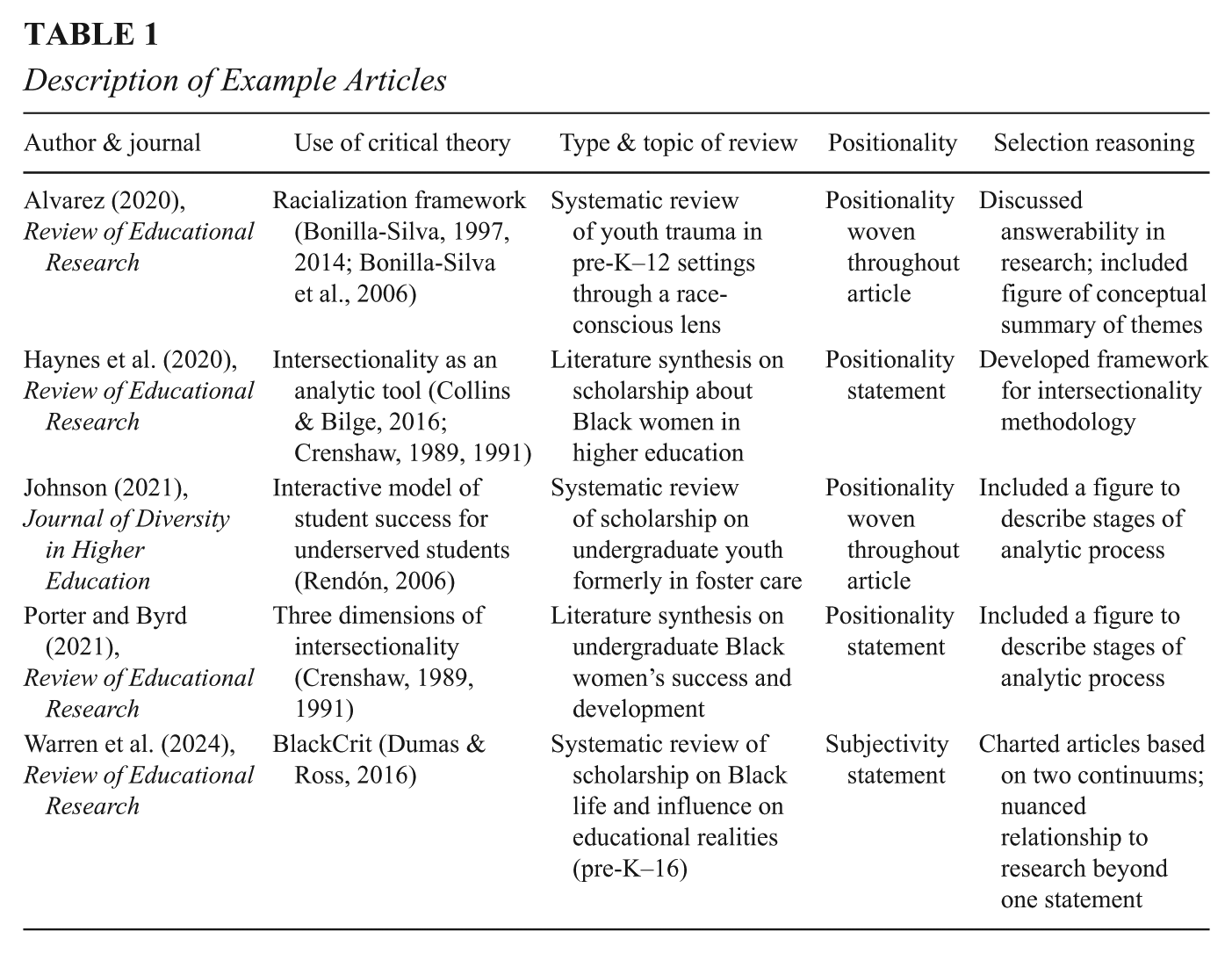
Visual elements often include a chart highlighting the source, a brief description, and details of the inclusion criteria for the data examined (i.e., articles and written sources). Additionally, scholars often include a diagram illustrating the stages/phases of the systematic literature review or synthesis. For example, Porter and Byrd (2021) and Johnson (2021) provided figures describing the tasks completed at each stage of the research process, including the number and types of articles read, the number of articles included/excluded, and efforts to ensure trustworthiness (i.e., cross-checking).
Most examples provided diagrams to illustrate how critical theory provides a vehicle through which researchers can frame or make meaning of the data. Across the visual representation of findings, most examples shared characteristics, including, but not limited to, representation of themes and publication outlet and whether the literature reviewed was empirical or conceptual. Additional characteristics (e.g., institution type, as in Porter & Byrd, 2021, and description of trauma, as in Alvarez, 2020) are all specific to their respective inquiries. For example, Warren et al. (2024) provided a chart of the standout articles and placed them on two continuums: “BlackCentric Perspectives,” “SettlerCentric Perspectives,” “Refusal of the Conditions of Black Suffering,” and “Illustration of the Conditions of Black Suffering” (p. 19). Warren et al. (2024) offered a visual depiction of their application of critical theory.
We identified five examples and discussed practical guidance for identifying critical theories and representing one’s process and findings. We provide an example of a visual element to summarize the example articles used in this article in Table 1. These articles were highlighted because they are examples of systematic literature reviews/syntheses represented in our respective disciplines that use critical theoretical frameworks across all aspects of the research process. An emphasis was placed on representations located in the Review of Educational Research. We acknowledge there are more and different approaches to conducting a critical literature review, and we encourage readers to use these (and others cited within the section) as a starting point. In the next section we offer considerations to guide one’s thought process before conducting a critical literature review as methodology.
Description of Example Articles
Considerations for Doing Critical Literature Reviews
Throughout the process of writing this article, we identified how we came to understand critical qualitative inquiry and corresponding methodologies. We offered our positionalities, examples, and reflexivity in practice not only to center and illuminate differing perspectives but also to acknowledge the messiness, or the push and pull, that often accompanies research processes. Although speaking specifically to critical literature synthesis as a method, we acknowledge that the transferability of strategies to other methods also may be relevant. In this next section we offer guidance (and pose questions) to think about and employ before and during the process of conducting a critical literature synthesis.
Ask Yourself, Do the Research Question(s) Necessitate a Critical Literature Synthesis?
What would you like to know, and how would you like to learn about it? Determine whether your goal is to identify what researchers have discussed about the topic or to interrogate how the topic has been discussed and through what lenses. The nuance between these two goals matters and will dictate your methodologic decisions. Additionally, your understanding of goals will determine whether you should engage or potentially depart from a prescribed way of doing research and being a researcher (Porter & Byrd, 2023). For example, depending on the lens through which you frame your question and data-collection techniques, you will need to determine whether you are (still) centering Whiteness via Westernized or Eurocentric onto-epistemologies and framing or uplifting critical frameworks relevant to the respective population or phenomenon. We ask this question, knowing one’s socialization to criticality may not be linear nor celebrated and that there are potential risks associated with being a graduate student and early-career scholar compared with a post-tenure researcher.
To research topics and engage methods that push against Westernized and White ways of doing research can be transformative—but also dangerous (Stewart, 2024). Stewart (2024) posed the question, “What would it mean for scholars to move research and inquiry well beyond the bounds of the intellectual exercise to a praxis of radical, disruptive, and potentially liberatory work” (p. 6). More pointedly, Evans-Winters (2019) asserted, “Although Black women have always conducted research using qualitative methodologies, rarely are Black women given space to play with or theorize methodological moves in qualitative inquiry” (p. 1). Researchers and scholars have identified both consequences and opportunities that help push the canons of literature and make significant contributions through critical syntheses of literature specifically and the disruption and expansion of qualitative inquiry more broadly (see Breeden & Porter, 2024; Duran & Foste, 2024; Patel, 2015).
Align Your Positionality, Research Questions, and Theoretical/Conceptual Framework with the Methods
Once you have situated yourself and made sense of the research goals, strive for congruence or alignment. Congruence and alignment demonstrate how a researcher’s “chosen theoretical perspectives align with their methodological traditions, data collection, analysis, and dissemination strategies” (Duran & Lange, 2023, p. 171). For example, if you are exploring a topic concerning the experiences of racially and/or ethnically minoritized people, ask yourself whether the framework was developed with a centering of or sensitivity to those who are racially and/or ethnically minoritized (i.e., employing an ecological model that fails to name systems of power; see Cabrera et al., 2016; Renn & Smith, 2024). If the answer is no, then conduct your due diligence to locate a culturally appropriate framework or a merger of frameworks that aligns with your question and population/topic in mind (see Alvarez, 2020, or Warren et al., 2024). When theorizing, or engaging a theoretical framework, your efforts should not be formulaic but rather intentional and critical and “based on cultural, personal, and social contexts” (Howard-Hamilton, 2003, p. 20). You may need to move beyond your discipline. Or perhaps, given the research questions, you may intentionally take this as an opportunity to co-construct a framework grounded within the experiences of your population of interest.
The process of engaging a critical literature synthesis is not meant to be unbiased or objective—your positionality matters. Every decision or attempt at congruence is dictated by you, the researcher, so acknowledge that. Name your relationship to the topic. Ask yourself why you, why this, why here, and why now (Patel, 2015). In addition to selecting the framework(s), think about ways you will employ reflexivity versus reflection and understand the difference between the two (see Gildersleeve, 2010; Espino & Croom, 2021). Avoid perpetuating a deficit perspective, epistemic violence, or erasure of persons or communities (Brunch, 2015; Dotson, 2011). In other words, we must proactively refuse to marginalize or silence the voices of those with whom we are exploring. We must foster, as Dillard (2006) stated, “research as a responsibility, answerable and obligated to the very persons and communities being engaged in the inquiry” (p. 5), thus seeking alignment or congruence throughout the qualitative inquiry process.
Ask Yourself, In What Ways Am I Enacting My Responsibility as a Researcher?
Responsibility requires us to remain conscious of and reflexive to “the order, power, and unity that flows through all of life and that encompasses an energy and responsibility greater than ourselves” (Dillard, 2000, p. 700). Thus, throughout the qualitative life cycle—from selecting which data to review, how to analyze and interpret those data, and within which frameworks to ground said interpretations—our decisions must situate an ethic of care and answerability to the topic or population (Patel, 2015). You must enact responsibility when conducting a literature synthesis; otherwise, the work is not critical, and the work may fall short in elevating critical consciousness. For instance, authors of the five examples employed criticality or critical theories to expand, extend, or nuance not only the discourse of a phenomenon but also strategies and action steps for transformative and structural change because of how they engaged. Criticality is not just about asking the “right” questions; it encompasses the very methodologic choices or actions we take; values we hold, disrupt, and/or perpetuate; folks and systems we center or uplift; and implications we identify. To conclude our considerations, we offer the following summarizing question: When thinking about conducting a critical literature review, what does enacting responsibility look like for me and my research?
Conclusion
Critical qualitative research has evolved over time and is a valuable tool in advancing education research and practice. Researchers who have conducted critical literature reviews—either through a systematic/scientific approach or through a synthesis approach—have enriched the breadth and depth of our understanding of said population or topic. More important, their/our work strives to raise critical consciousness, pushes for social transformation, and disrupts structural oppressions. In this article we offer guidance on thinking through your positionality and process, discuss five examples as a launching point, and identify key considerations. We intentionally uplift more questions than answers to situate and align your qualitative inquiry, reflexivity, and responsibility when conducting a critical literature synthesis.
Footnotes

Funding
The authors received no financial support for the research, authorship, and/or publication of this article.
Declaration of Conflicting Interests
The authors declared no potential conflicts of interest with respect to the research, authorship, and/or publication of this article.
Notes
Authors
DAJANAE L. PALMER is an assistant professor of qualitative inquiry in educational leadership and policy analysis at the University of Missouri. Her research interests include examining and uplifting graduate students’ experiences, exploring feminist methodologies, and using critical theories to analyze the systems of domination in higher education.
JANICE A. BYRD-BADJIE is an associate professor of education (school counseling emphasis) in counselor education at Pennsylvania State University. Her scholarship uses critical qualitative approaches to center the lived experiences of Black students across the educational pipeline to interrogate how policies, relationships, and ecological conditions shape their academic, career, and social/emotional development.
CHRISTA J. PORTER is vice provost for graduate education and dean of the Graduate School at the University of Maryland, Baltimore County. Her scholarship examines trajectories of development, socialization, and praxis in higher education and student affairs, with particular interest and expertise in Black women’s experiences in and through higher education.