






Abstract

Sooner or later, as schools move to implement the new Common Core and other forthcoming standards, almost every teacher in the United States will face the challenge of how to support students from homes where English is not the dominant language in meeting subject-matter academic expectations that require increasingly demanding uses of language and literacy in English. In this chapter, I review research that provides potential insights on how “mainstream” teachers might be prepared for responding to this challenge, both in preservice teacher preparation programs and throughout their careers. I argue that efforts to prepare teachers for working with English learners (ELs) 1 to engage with increasing language and literacy expectations across the curriculum requires development of pedagogical language knowledge (Galguera, 2011)—not to “teach English” in the way that most mainstream teachers may initially conceive of (and resist) the notion, but rather to purposefully enact opportunities for the development of language and literacy in and through teaching the core curricular content, understandings, and activities that teachers are responsible for (and, hopefully, excited about) teaching in the first place. I review recent literature that presents various approaches to what this knowledge might entail and how teacher preparation and development initiatives might go about fostering it. I conclude by proposing that, in an age of increasing linguistic demands associated with new academic expectations, building teachers’ understanding of language as action (van Lier & Walqui, 2012) could serve as the foundation for preparing them to engage—and support—ELs in both challenging and meaningful academic tasks.
As educators begin to navigate a new era of policy reform with new common standards at its heart, there are many uncertainties. As I write, teachers, school administrators, district personnel, state policymakers, and others are scrambling to prepare to implement the new standards, at a time when the science standards have not yet been finalized, high-stakes assessments that will measure students’ achievement on the Common Core standards in English language arts and mathematics are still under development, and states are only beginning to revise English language proficiency standards and assessments to correspond to the new standards.
At the same time, as I discuss in the first part of this chapter, there are a number of things that we do know: that the new standards will involve language and literacy demands that are challenging for all students, but especially challenging for ELs; that these challenges call for shifts in the way that instruction for ELs has typically been conceived; that preparing teachers to implement these shifts must become a “mainstream” concern; that ELs represent a heterogeneous population; and that one of the implications of all of the above is that teachers need to know something about language. It is less clear, however, what knowledge about language mainstream teachers need in order to engage and support ELs in meeting the kinds of language and literacy demands associated with the new standards, and how teachers might best be prepared to develop this knowledge. After discussing several possible approaches, I argue that what mainstream teachers need is not pedagogical content knowledge about language as might be expected of second language teachers, but rather pedagogical language knowledge that is integrally tied to the teaching of the core subject area(s) for which they are responsible. The bulk of the remainder of the chapter is then devoted to exploring how different teacher education and professional development initiatives have envisioned this pedagogical language knowledge and enacted it in their programs.
What We Know
Meeting the New Academic Expectations Will Involve Language and Literacy Demands That Will Be Challenging for All Students, but Especially for English Learners
Language has long been understood to play a central role—perhaps the central role—in teaching and learning (see Cazden, 2001; Halliday, 1993; Halliday & Martin, 1993; Mehan, 1979; Schleppegrell, 2004; Vygotsky, 1987b; Wells, 1999). The kinds of learning activities and outcomes privileged by the new standards have emphasized this role by calling for levels of engagement in, and production of, language and literacy that go well beyond the focus on “basic skills” and often scripted curriculum that was at the heart of much of the accountability and testing regime during the No Child Left Behind era (Cummins, 2009; see also Carbone & Orellana, 2010; Dyson, 2008; Enright & Gilliland, 2011; Hillocks, 2002; Pease-Alvarez, Samway, & Cifka-Herrera, 2010). The language and literacy demands that undergird the new standards clearly present challenges for all students, but particularly for students who are still in the process of learning the language of instruction.
The precise nature of the language demands and challenges facing ELs presented by the new standards are only beginning to be unpacked (see Bunch, Kibler, & Pimentel, 2012; Council of Chief State School Officers [CCSSO], 2012; Fillmore & Fillmore, 2012; Hull & Moje, 2012; Moschkovich, 2012; Quinn, Lee, & Valdés, 2012; van Lier & Walqui, 2012; Walqui & Heritage, 2012). But even a cursory look at the standards and frameworks reveal the centrality of language and literacy inherent in the new content-area expectations. For example, the Common Core State Standards for Mathematics (National Governors Association Center for Best Practices and Council of Chief State School Officers, 2010b) emphasize the development of mathematical practices as well as content, calling on students to “explain correspondences between equations, verbal descriptions, tables, and graphs”; “justify their conclusions, communicate them to others, and respond to the arguments of others”; “listen or read the arguments of others, decide whether they make sense, and ask useful questions to clarify or improve the arguments” (pp. 6–7, italics added). Similarly, a central component of the Framework for K–12 Science Education (Committee on Conceptual Framework for the New K–12 Science Education Standards [Committee], 2012) is a set of “Scientific and Engineering Practices” that individually and collectively emphasize the role of language in scientific “sense-making” (see also Quinn et al., 2012):
Asking questions (for science) and defining problems (for engineering)
Developing and using models
Planning and carrying out investigations
Analyzing and interpreting data
Using mathematics and computational thinking
Constructing explanations (for science) and designing solutions (for engineering)
Engaging in argument from evidence
Obtaining, evaluating, and communicating information (Committee, 2012)
Meanwhile, and perhaps least surprisingly, the Common Core State Standards for English Language Arts (which include disciplinary literacy standards as well) call for expanding and raising expectations for students’ language and literacy practices. These standards call on students to engage with a variety of sources, including complex informational texts; to use evidence in both writing and oral discourse to inform, argue, and analyze; to demonstrate an awareness of different text types for different audiences and purposes; and to use speaking and listening skills to collaborate, understand multiple perspectives, and present ideas. To do all of the above, the ELA standards require students to concurrently “gain a firm control over the conventions of standard English” and “come to appreciate that language is at least as much a matter of craft as of rules” (National Governors Association Center for Best Practices and Council of Chief State School Officers, 2010a, p. 51).
Supporting ELs’ Engagement and Success With the Standards Calls for Shifts in the Kind of Instruction Available for ELs
The language and literacy demands prefaced above clearly call for a shift in the kind of instruction that has typically been available for ELs. For example, writing instruction in secondary English as a Second Language (ESL) classes has often been dominated by grammar and mechanics, “controlled composition,” and “copying individual sentences” (Leki, Cumming, & Silva, 2008, p. 23; see also Gebhard & Harman, 2011; Ortmeier-Hooper & Enright, 2011; Valdés, 1998, 2001). Students who have exited ESL classes, whether they are still classified as EL or not, usually transition into low-track, non-college-preparatory regular English classrooms, where the conditions may be equally problematic (Leki et al., 2008). Such courses
make fewer cognitive demands, require little extended prose, expose students to only a few genres, focusing on ones that are supposedly the most practical but are least academic, and so make it even more difficult for the students to develop the kinds of fluency with academic genres and registers that might be required in college. (Leki et al., 2008, p. 24)
Overall, the teaching of writing in the United States has often focused on “skills” such as the teaching and learning of “rules” concerning spelling, punctuation, the structure of sentences or paragraphs, and features of writing such as transition words, often in isolation from the social and meaning-making functions associated with these features (Ivanič, 2004). As Gebhard and Harman (2011) point out, K–12 classroom practices for ELs are still often influenced by behaviorist perspectives on second language acquisition, centering on “drill and practice in language forms with a curricular progression that typically focuses on mastering sound, word, sentence, paragraph, and textual patterns, in that order” (p. 47). It is doubtful that such instructional approaches will prepare ELs for the language and literacy demands associated with the deep engagement in and interaction around the kinds of disciplinary practices called for at the heart of the new standards.
Preparing Teachers to Support ELs in Meeting the New Demands Must Become a “Mainstream” Concern
Just as the Common Core standards envision the development of literacy to be a shared responsibility between language arts teachers and teachers in other disciplines (Bunch et al., 2012), the preparation of ELs for the kinds of language, literature, and learning demands called for by the new standards can no longer be seen as the sole responsibility of a small cadre of language specialists teaching ESL courses (see Bunch, 2010; Fillmore & Snow, 2002; Lucas & Grinberg, 2008; Lucas & Villegas, 2011; Santos, Darling-Hammond, & Cheuk, 2012; Valdés, Bunch, Snow, & Lee, 2005). Students currently classified as ELs represent more than 10% of the total student population in the United States, significantly larger proportions in the country’s most populous states (e.g., California, New York, Florida, Texas), and dramatically growing numbers in other states, particularly in the South and Midwest (see Valdés & Castellón, 2011). As mentioned earlier, in addition to those students currently designated as ELs, large numbers of former ELs reclassified as “fluent English proficient” are still in the process of acquiring the English language and literacy necessary to succeed in increasingly challenging academic settings (Olsen, 2010). These reclassified students, along with many ELs who are placed into regular content-area instruction, now form a significant part of what Enright (2011) has called the “new mainstream,” which also includes fully functional speakers of English who speak languages other than English at home and students who are monolingual, native speakers of stigmatized varieties of English, such as African American Vernacular English or Chicano English (Godley, Sweetland, Wheeler, Minnici, & Carpenter, 2006). This is not to say that ESL teachers and curriculum specialists will no longer be needed, but rather that the education of ELs must be seen as a shared responsibility by all teachers and that the knowledge and skill base for all teachers must be reconceptualized accordingly.
Centralizing—and normalizing—a focus on ELs clearly presents challenges in the United States, where the teaching force is predominantly White, 2 presumably monolingual, and undoubtedly influenced by long-dominant societal ideologies privileging monolingualism and linguistic homogeneity (Crawford, 1992, 1999; O. Garcia, 2009). The challenges are compounded by the fact that most mainstream teachers have received little or no preparation for working with ELs (Lucas, 2011). For this reason, over the past decade or so, an increasing number of publications have addressed the preparation of mainstream teachers for working with ELs, either focusing exclusively on this population (for reviews, see August & Calderón, 2006; August & Shanahan, 2008; Bunch, 2010; E. García, Arias, Harris Murri, & Serna, 2010; Goldenberg & Coleman, 2010; Lucas & Grinberg, 2008) or addressing ELs as part of efforts to prepare teachers for students from a range of linguistically diverse backgrounds (e.g., Fillmore & Snow, 2002; Trumbull & Farr, 2005; Valdés et al., 2005).
Such literature has addressed several different aspects of teacher preparation for ELs. Conceptual overviews have drawn on the literature to analyze and often advocate for particular approaches to the preparation of teachers for linguistic diversity (e.g., Bunch, 2010; Commins & Miramontes, 2006; Fillmore & Snow, 2002; E. García et al., 2010; Harper & de Jong, 2004; Lucas & Grinberg, 2008; Lucas & Villegas, 2011; Lucas, Villegas, & Freedson-Gonzalez, 2008; Trumbull & Farr, 2005; Valdés et al., 2005). Studies, and reviews of studies, have also addressed teachers’ knowledge, beliefs, and attitudes related to teaching current and former ELs (e.g., de Jong & Harper, 2011; Faltis, Arias, & Ramírez-Marín, 2010; Gándara, Maxwell-Jolly, & Driscoll, 2005; Pawan & Craig, 2011; Pettit, 2011; Stoddart, Pinal, Latzke, & Canaday, 2002). Existing programs, initiatives, or practices designed to foster the preparation of preservice and in-service teachers for linguistic diversity have been profiled and studied, often by those involved in the intervention (e.g., Athanases & de Oliveira, 2011; Brisk, 2008; Brisk & Zisselsberger, 2011; Echevarria, Short, & Powers, 2006; Galguera, 2011; Gebhard, Demers, & Castillo-Rosenthal, 2008; Hutchinson & Hadjioannou, 2011; Levine & Howard, 2010; Meskill, 2005; Sakash & Rodriguez-Brown, 2011; Short, Fidelman, & Louguit, 2012; Walker, Ranney, & Fortune, 2005; Walker & Stone, 2011). Other literature has addressed efforts to prepare preservice teacher educators and those responsible for the professional development of in-service teachers with the knowledge and skills necessary to prepare teachers for working with ELs (e.g., Brisk, 2008; Costa, McPhail, Smith, & Brisk, 2005; Gort, Glenn, & Settlage, 2011; Nevárez-La Torre, Sanford-DeShields, Soundy, Leonard, & Woyshner, 2008; Walqui, 2011). Finally, literature has addressed policy issues relevant to the preparation of teachers for ELs, including teacher assessment, and how teachers respond to different policy and assessment contexts (e.g., Bunch, Aguirre, & Téllez, 2009; Gándara & Maxwell-Jolly, 2006; Pease-Alvarez & Samway, 2012; Pease-Alvarez et al., 2010; Téllez & Waxman, 2006; Varghese & Stritikus, 2005; Villegas & Lucas, 2011).
The predominant message of the literature in all of these areas is that mainstream teachers need “special knowledge and skills” (Lucas, 2011, p. 6) to work with ELs. As I will explore later in this chapter, however, there are a variety of approaches to conceptualizing the nature of that knowledge and those skills, the role of language that undergirds the preparation of teachers for ELs, and how teacher development programs and interventions might best help teachers develop the relevant understandings and expertise.
ELs Represent a Diverse Population
Students designated by their schools and districts as EL include students who are diverse in terms of language and literacy backgrounds, socioeconomic status (both in the United States and, for those born abroad, in their countries of origin), and levels and quality and prior formal schooling (Walqui, 2005). For example, ELs include those who have arrived very recently in the United States and who may speak and understand little or no English, students who have developed enough oral proficiency and literacy in English to engage in some kinds of academic and social tasks but who have difficulty with other kinds, and students who are quite fluent in English but whose non-native-like features of oral or written English, along with underdeveloped academic literacy skills, may have prevented them from exiting the EL designation. Valdés et al. (2005) have used the terms incipient bilinguals, ascendant bilinguals, and fully functional bilinguals to highlight the differences among students often considered ELs. At the same time, ELs at every level of English language proficiency have a range of experiences with literacy in their home languages, from students who have had limited opportunities to develop home-language reading and writing due to substandard or interrupted formal education to students who arrive in the United States with strong academic literacy skills in their first languages. 3 Once students are redesignated as fluent English proficient, they may struggle to succeed in mainstream classes but continue to use and develop each of their languages as circumstances allow and require, exhibiting normal and healthy features of bilingualism that will, by definition, contrast with the language practices of monolingual speakers of English (Grosjean, 1982; Gutiérrez & Orellana, 2006; Orellana & Gutiérrez, 2006; Valdés, 2003, Valdés, Capitelli, & Alvarez, 2011).
ELs also vary in terms of the varieties of English that they will acquire and use. All native speakers of English speak one or more dialect(s), defined by linguists as variations of a language developed by speakers as they grow up and interact with communities based on geography, race, class, ethnicity, or other markers of identity (Finegan & Rickford, 2004; Hudley & Mallinson, 2011; Valdés et al., 2005). In U.S. schools, as in schools worldwide, not all varieties of English carry the same levels of prestige and power, and therefore children from some linguistic communities begin school as native speakers of nondominant, stigmatized dialects of English, such as African American English (AAE), Chicano English, Hawaiian Creole, and dialects used by working-class Anglo-American families (Baugh, 1999; Fought, 2003; Godley et al., 2006; Lippi-Green, 1997; Nero, 2006; Perry & Delpit, 1998; Zentella, 1997). Many ELs live and attend schools in communities where such “nondominant” dialects are widely used, and therefore even the fully developed English of former ELs is likely to be marked with features of often-stigmatized varieties of English such as Chicano English and AAE. In fact, it may be impossible for educators to know whether a particular “non-native-like” feature of students’ oral or written language is due to still-developing second language proficiency, fossilized acquisition by more proficient users of the language, or stable features of “contact-varieties” of the target language itself (Valdés, 1992). The point is not that teachers necessarily need to be able to make these particular judgments, but rather that they understand that there are a range of reasons that their students’ language might deviate from “native-like” or “standard” English and that this “flawed” language can be used to engage productively in the practices called for by the new standards.
Teachers Need to Know Something About Language
Given the central role of language and literacy in the new common standards, the linguistic needs represented by ELs of different backgrounds, and the lack of current preparation most teachers have received for this population, there is clearly a need to bolster mainstream teachers’ knowledge about language. The questions revolve around what teachers need to know about this most complex psychological, sociological, and ideological phenomena in order to support ELs, what to prioritize given all the other demands facing teachers as they prepare for and develop their practice throughout their careers, and how teacher preparation programs and professional development initiatives can best support the development of this knowledge. In many cases, it has been unclear what conceptions of language, language development, and language use in academic settings underlie current efforts to prepare teachers for ELs. Perhaps as a result of this lack of clarity, a wide—almost overwhelming—array of language-related knowledge and skills have been proposed as essential for mainstream teachers of ELs. In the next section, I discuss several options for conceiving of the language-related knowledge base necessary for mainstream teachers to create the instructional conditions necessary for ELs to succeed in engaging in the language and literacy expectations associated with the new standards, ultimately arguing that what teachers need is pedagogical language knowledge that must be conceived of differently from either the pedagogical content knowledge about language needed by teachers specializing in second language teaching or the pedagogical content knowledge mainstream teachers need in the core subject matters.
Considering the Language-Related Knowledge Base for Mainstream Teachers of ELs
Perhaps not surprisingly, foundational knowledge in linguistics and second language acquisition (SLA) is often at the center of proposals for what all teachers need to know in order to work effectively with ELs. Fillmore and Snow (2002) have argued that all teachers need a foundation in “educational linguistics.” Specifically, they highlight the need for teachers to have knowledge about the basic units of language, regular and irregular forms and how they relate to each other, sociolinguistic variation in language use, historical linguistics to understand why English spelling is so complicated; the “linguistic proficiencies” needed for subject-matter learning (p. 27); and the importance of both interaction with native speakers of English as well as “explicit teaching” of English in academic settings (p. 36). More recently, Lucas and Villegas (2011) have argued that building the expertise of what they call “linguistically responsive teachers” requires, among other areas, a focus on SLA principles, including the distinction between conversational and academic language proficiency; comprehensible input; social interaction for authentic communicative purpose; transfer from L1 to L2; and how anxiety about L2 can interfere with learning (see also Lucas et al., 2008). Valdés et al. (2005) focus on the sociolinguistic knowledge that teachers need to understand that all speakers of English use the dialects, registers, and styles with which they are familiar and come to school as “competent speakers” of their home languages and varieties of language, and the knowledge of disciplinary literacy necessary to support their students in expanding their “linguistic repertoires” to “discuss ideas, to understand texts, and to demonstrate . . . learning” across the curriculum (p. 160).
It is, of course, logical to conceive of fields such as linguistics and SLA as foundational for what teachers need to know in order to support the content and language development of ELs. However, questions have been raised about the breadth and scope of topics that can reasonably be “covered” in teacher preparation and professional development endeavors, which areas should be prioritized, and how language-related knowledge can most effectively be developed by teachers.
First, there is the practical question of the time it takes to provide an adequate introduction to these topics and where in the course of teachers’ professional development such instruction should occur. For example, responding to the number of preservice educational linguistics courses proposed by Fillmore and Snow (2002), teacher educators have raised questions about the space and place for such courses in already-intensive teacher education programs (Baca & Escamilla, 2002; Gollnick, 2002; Richardson, 2002). Alternatives have been suggested for including a focus on language and literacy throughout the preservice teacher education curriculum and through professional development opportunities throughout teachers’ careers (Baca & Escamilla, 2002; Gollnick, 2002; Valdés et al., 2005).
Second, as Richardson (2002) points out, it is important to consider the relationship between teachers’ “formal” or “foundational” knowledge, such as in linguistics and SLA, and the “practical” knowledge necessary to teach effectively. These questions, of course, are among those that have been addressed in the literature on the education of teachers in general (Feiman-Nemser, 2008; Hammerness, Darling-Hammond, & Bransford, 2005; Korthagen & Kessels, 1999) as well as for culturally and linguistically diverse students in particular (A. F. Ball, 2009; Faltis et al., 2010; Walqui, 2008). Interestingly, the field of second language teaching itself has begun to raise similar questions about the appropriate knowledge base for language teaching. As Johnson (2009) argues, second language teacher educators have historically “positioned disciplinary knowledge about the formal properties of language and theories of SLA as foundational knowledge for the professional preparation of L2 teachers” (p. 11), and they have envisioned language teaching “as a matter of translating theories of SLA into effective instructional practices” (p. 11). Thus, most second language teacher preparation programs “operate under the assumption that it is necessary to provide teachers with discrete amounts of disciplinary knowledge, usually in the form of general theories and methods that are assumed to be applicable to any teaching context” (p. 12). Drawing on Shulman (e.g., 1987) and others (D. L. Ball, 2000), Johnson (2009) has raised questions about the pedagogical content knowledge necessary in that field. Lively discussions have considered what kinds of awareness of language should be at the core of the knowledge base of language teachers (see Andrews, 1999, 2003; Freeman & Johnson, 1998, 2005; Johnson, 2009; Tarone & Allwright, 2005; Trappes-Lomax & Ferguson, 2002).
A third concern relates to which aspects of linguistics, SLA, and related fields are most appropriate for mainstream teacher preparation programs to focus on. Historically, a few concepts from these areas, some of them under significant challenge by scholars in the fields, are privileged and sometimes reified in teacher education programs and professional development endeavors, often without teachers having any idea that they are controversial. For example, multiple theories of second language development have been advanced in the field of SLA (see Atkinson, 2011; Block, 2003; Lightbown & Spada, 2006; van Lier, 2004; van Patten & Williams, 2007; Valdés et al., 2011). Yet a single theory, Krashen’s monitor theory (e.g., Krashen, 2003), has long dominated discussions of SLA in teacher preparation texts and curricula, sometimes without any mention of alternative perspectives or the considerable critiques that the theory has generated (see Lightbown & Spada, 2006; van Patten & Williams, 2007). Likewise, Cummins’s threshold hypothesis and the distinction between “basic interpersonal communication skills” (BICS) and “conversational academic language proficiency” (CALP) language (e.g., Cummins, 1981, 2000) have dominated teacher preparation programs’ approach to academic language, despite critiques of the constructs since their inception (see Bunch, 2006, 2010; Cummins, 2000; Hawkins, 2004; MacSwan, 2000; MacSwan & Rolstad, 2003; Rivera, 1984).
Finally, the question must be raised as to whether SLA is the most appropriate foundational knowledge base for mainstream teachers in the first place (Hawkins, 2004). Teachers, and some teacher educators, might be surprised to learn, as Valdés et al. (2011) point out, that the field of SLA itself has been dominated by a focus not on pedagogical practice but on development of theories of language acquisition, that very little SLA research has focused on children and adolescents, that few longitudinal studies have been conducted, and that there is little evidence that the explicit teaching of language forms leads to productive use of those forms beyond discrete assessments that test for learners’ knowledge of them.
Perhaps even more important is the fact that language is not considered by most mainstream teachers to be the principle core content of their professional practice. It is here that it is helpful to distinguish between the notion of pedagogical content knowledge, either for second language teachers or for mainstream teachers in their principle subject area(s), and pedagogical language knowledge for mainstream teachers in preparing to work with ELs. As Shulman (1987) originally described it, pedagogical content knowledge is “the blending of content and pedagogy into an understanding of how particular topics, problems, or issues are organized, represented, and adapted to the diverse interests and abilities of learners, and presented for instruction” (p. 8). The sources of such knowledge, according to Shulman, include scholarship in the content area itself, educational materials such as curricula and textbooks, findings from formal educational scholarship, and the “wisdom of practice” (p. 11). As mentioned earlier, the notion of pedagogical content knowledge for language teachers has, with some adaptation, been applied to language teaching. In that case, one source of pedagogical content knowledge is knowledge about the target language, linguistics, second language acquisition, bilingualism, and so on. In contrast, the pedagogical content knowledge for mainstream teachers naturally centers on the particular content area or areas they teach (most often, a single content for secondary teachers and multiple content areas for elementary school teachers). 4 Therefore, the knowledge about language necessary for mainstream teachers to teach ELs across the curriculum seems to require a different conceptional foundation than that of pedagogical content knowledge.
Inspired by Galguera (2011), I argue that the pedagogical language knowledge of mainstream teachers can be construed as knowledge of language directly related to disciplinary teaching and learning and situated in the particular (and multiple) contexts in which teaching and learning take place. To be sure, such an approach draws on insights from linguistics, SLA, and other related fields. Indeed, as Galguera points out, “critical language awareness” (Alim, 2005; Fairclough, 1999, van Lier, 1995) should be at the heart of pedagogical language knowledge, and there is clearly the need for attention to linguistics, SLA, bilingualism, and other language-related knowledge bases as part of teacher education endeavors (Valdés et al., 2005). But the notion of pedagogical language knowledge positions both the knowledge itself and how it might be addressed with teachers in direct relation to teaching and learning at the heart of the curriculum. As Galguera (2011) proposes, it may be through providing teachers with
opportunities to examine specific functions of language in academic contexts and experience ways in which language is used to represent knowledge in classrooms as well as the power and status differences encoded in language [that teachers] begin to construct deep understandings of language. (p. 90)
Therefore, providing teachers with new experiences, along with analysis, reflection, and discussion about those experiences, is crucial for the development of pedagogical language knowledge (Galguera, 2011). In the remainder of this chapter, I review literature on teacher preparation practices for ELs that approach the development of what I am conceiving of as pedagogical language knowledge in a variety of ways.
Developing Pedagogical Language Knowledge: Varying Approaches in Practice
In the sections that follow, I draw from recent literature to review examples of current or recent initiatives that can be viewed as addressing the pedagogical language knowledge of mainstream teachers. Selection of these examples, which come from both the research literature and descriptions of recent initiatives in publications geared toward teacher education practitioners, were chosen based on a number of criteria. First, given the focus on language in this review, only initiatives that revealed the conception of language, language development, or the role of language in academic instruction grounding the approach were included. Second, to be included, the particular conception of language had to be linked in some direct way to the texts, activities, or practices at the center of mainstream academic instruction, either in specific subject areas or with regard to practices that could cross disciplinary boundaries. Third, the initiative had to explicitly address the preparation of teachers for working with ELs, either as the primary focus or at least with the EL population explicitly mentioned among the students whose needs the program was designed to address. Fourth, the initiative described had to be one that had been implemented in practice, at least in a pilot stage, as opposed to simply recommended or proposed. Finally, some sort of teacher or student outcomes had to be discussed. In order to expand the range of examples I was able to profile and for other reasons I will address below, I admittedly took a lenient approach to the comprehensiveness and rigor with which such outcomes had to be reported to be included in this review. In the final section, I abandon the criteria completely to briefly introduce other potentially promising approaches to pedagogical language knowledge represented in the literature that would have otherwise been excluded.
Before proceeding, it is necessary to emphasize that research on teacher preparation initiatives for linguistic diversity is in its infancy, with few studies systematically measuring outcomes on teachers and even fewer measuring student outcomes (Lucas & Grinberg, 2008). Most reports, including many of the ones that I discuss here, are descriptive in nature. Although most at least briefly mention outcomes on teachers or their students, only a few present data on those outcomes and describe how those data were analyzed. As has been typical of research in this area (see Lucas & Grinberg, 2008), most pieces were authored by those who created and administered the initiatives, providing helpful depth of context but also presenting obvious limitations. Clearly, potential claims regarding the efficacy of each initiative are limited by the available data. Nonetheless, it is important to keep in mind that my rationale in highlighting these particular programs is not to make such claims. Rather, it is to illustrate a variety of approaches to conceiving of and working to develop the pedagogical language knowledge for mainstream teachers to support ELs in the kinds of language and literacy demands associated with the new standards. Further exploration and investigation will clearly be needed for all of the approaches highlighted, as well as for other existing practices endeavoring to support teachers’ development of pedagogical language knowledge that have not yet been published.
As a further point of clarification, my intention is not to provide an exhaustive review of the literature on the preparation of teachers for ELs. To allow space to discuss both the approach to language used in each case as well as the initiative itself, I have chosen a relatively small number of approaches to highlight in some depth, privileging those that articulate a coherent conception of language, or at least of the role of language in instruction and learning for ELs. The initiatives profiled represent a range of approaches and contexts, from large-scale, multiyear studies funded by the federal government to one study by a single teacher educator conducting inquiry on his own practice. The practices cut across grade levels and content areas. Included are reports on efforts to prepare teachers, teacher educators, and professional development providers. Target grades include those at the elementary, middle school, and high school levels, although I did not attempt to review literature on the preparation of teachers for teaching initial reading and writing in the early grades, obviously an important area but one beyond the scope of this chapter. Each approach is either targeted toward teachers of a particular content area or, especially in the elementary examples, highlights approaches to help mainstream classroom teachers focus on language-related aspects of instruction in more than one subject area.
Focusing on Linguistic Features of Texts and Tasks Using Systemic Functional Linguistics
One approach to envisioning the pedagogical language knowledge necessary for mainstream teachers has focused on knowledge of the grammatical features of content-area texts and tasks and how teachers can support ELs by introducing them to this knowledge in the context of their disciplinary instruction. Initiatives using systemic functional linguistics (SFL; Halliday, 1994) have provided teachers with tools to analyze the language features central to academic work in different content areas, especially with regard to written texts (e.g., Schleppegrell, 2004; Schleppegrell & Achugar, 2003; Schleppegrell, Achugar, & Oteíza, 2004; Schleppegrell & de Oliveira, 2006). Unlike traditional approaches to grammar instruction, SFL considers the relationship between linguistic form and social context in school settings, focusing on specific linguistic choices that influence and are influenced by different purposes and audiences (see Johns, 2002; Halliday & Martin, 1993; Schleppegrell, 2004; Schleppegrell & Colombi, 2002; Unsworth, 2000; Veel, 1997). Used widely in Australia, SFL has begun to be used in the United States as a means to enable teachers, and students, to understand how the linguistic features of spoken and written texts simultaneously realize and are realized by the social contexts of the production of those texts, including the disciplinary content traditions in which they are embedded (Gebhard, 2010; Schleppegrell, 2004). In the United States, SFL has been described as a response to the concern that the focus on “sheltered instruction” and “comprehensible input” that has traditionally been provided to mainstream teachers when they do have some preparation for working with ELs often does not include enough focus on the “linguistic structures that characterize academic language” (Aguirre-Muñoz, Park, Amabisca, & Boscardin, 2008, p. 298).
Analyzing Linguistic Features of Secondary History Texts
Achugar, Schleppegrell, and Oteíza (2007, p. 11) describe two teacher preparation initiatives designed to help mainstream history teachers develop a “metalanguage for talking about how knowledge is constructed in language” in their subject area and how to incorporate that knowledge into their teaching. As part of the California History Project, a teacher development initiative designed to foster content-area knowledge among secondary history teachers, the authors developed “Literacy in History” workshops to support mainstream teachers in working with their increasing numbers of ELs. The workshops were guided by the notions
that students need to develop literacy in important and authentic curriculum contexts, that genre is a way of highlighting patterns in the way language is used to write history, and that focusing on grammar is a means of discussing and critiquing texts. (p. 14)
According to Achugar et al. (2007), a focus on genre helped teachers understand the mismatch between the kinds of texts students are expected to write in history classrooms and those they are assigned to read. Subsequently, in-depth training to deconstruct texts at the sentence level allowed teachers to analyze textbook passages and primary source documents and to incorporate this kind of language analysis with ELs. An external evaluation, according to the authors, showed that ELs and other students of teachers participating in the summer institute had greater gains on a standardized social studies test than did students of nonparticipating teachers. At the same time, teachers reported that learning how to use the language-focused strategies represented a major commitment on their part but that the time and effort necessary diminished as the teachers gained experience. According to the authors, teachers reported that the effort they did expend represented time well-spent because it fostered enhanced critical thinking in their students, more in-depth discussions, and deeper historical understanding.
In a second project, SFL specialists worked with the Institute for Learning initiative at the University of Pittsburgh, as part of its “disciplinary literacy” courses targeted for teachers and administrators with the goal of developing schools’ capacity to foster “thoughtful, cognitively demanding engagement with complex written texts, difficult problems, and challenging inquiries,” especially for struggling students (Achugar et al., 2007, p. 16). The linguists worked collaboratively with historians to develop guiding questions to help educators connect content and language through the analysis of texts. Teachers and administrators from schools around the United States participated in 3-week-long professional development sessions that included activities that allowed them to experience, as learners, the opportunity to examine historical texts from a linguistics perspective. The SFL approach is exemplified by the guiding questions used by the initiative to focus teachers on the linguistic and rhetorical features used to construct historical meaning in particular texts (Achugar et al., 2007, p. 17):
What is the social purpose of the text?
What is going on? (What are the events, who are the participants, and what are the circumstances?)
What is the orientation of the writer to the information?
What is the relationship between reader and writer?
How is the information organized?
To address each of these questions, teachers were directed to identify how the structure and linguistic features of a text provide information. For example, teachers learned that the particular positions taken by an author in relation to an addressed topic can be understood both by identifying modals (such as will, must, have to, usually) and through evaluative vocabulary expressing attitudes, emotions, judgments, and appreciation. Likewise, they were taught that how an author constructs a relationship with her intended audience can be revealed both by the use of particular types of clauses (declarative, interrogative, imperative) and by pronouns and “terms of address” (Achugar et al., 2007, p. 17). According to the authors, participants in the institute reported that the linguistic tools and text-exploration strategies featured in the institute increased their confidence in working with ELs, helped their students produce better writing, and fostered more in-depth historical thinking.
Promoting “Functional” Feedback in Secondary English Language Arts
In an example of the use of SFL in secondary English language arts, Aguirre-Muñoz et al. (2008) developed four training modules to familiarize in-service middle school English/language arts teachers with SFL and a genre-based approach to writing instruction. Middle school teachers were encouraged to help their students respond to literature by focusing on the linguistic features authors use to signify protagonists and antagonists, key events, how “qualities and characters are ascribed and evaluated,” and how overall cohesion is manifested in the text (p. 300). In addition to reading overviews of SFL theory, teachers were presented with guidance in analyzing examples of texts generated by ELs, the opportunity to role-play “minilessons” designed to teach writing, and joint lesson planning activities. Throughout the sessions, teachers were presented with a set of strategies to incorporate into their discussions of literature and writing instruction and feedback. Aguirre et al. report high satisfaction with the course expressed by teachers and a statistically significant shift in how participants provided feedback, planned for instruction, and incorporated the training into their instruction. Teachers decreased the amount of “traditional” feedback related to writing style and errors and increased their “functional” feedback related to the audiences and purposes students were aiming to address. Furthermore, the authors report, the majority of teachers incorporated the content of the training into their writing instruction.
Using SFL to Enhance Elementary Writing Instruction
At the elementary level, Brisk and Zisselsberger (2011) describe a professional development project that introduced in-service elementary teachers to an SFL approach to the teaching of writing. The authors position the power of SFL in terms of its ability to help teachers focus on how particular syntactic forms are important not because they represent the “correct rules” but rather because they “are essential for certain contexts” (p. 112). Brisk and Zisselsberger argue that SFL-based pedagogy “makes the linguistic, lexical, grammatical, and schematic structure of texts within genres explicit,” providing greater access for all learners to be able to understand and produce them (p. 114). The authors designed, implemented, and researched a university-based professional development initiative participated in by participants (eight mainstream K–5 teachers, one K–2 science teacher, one ESL teacher, and a literacy coach) from three elementary schools. The participants attended professional development sessions before and during the school year. In these sessions, the facilitator (Brisk) presented a foundation of SFL and its application to teaching writing and shared materials that included selected target genres found in elementary school texts, explanations of each genre’s structural organization and language demands, and strategies for teaching each genre.
According to Brisk and Zisselsberger (2011), interviews and other discussions with teachers revealed that teachers found the materials useful for planning classes and the professional development helpful for complementing their current curricula. All participants tried new ways of teaching writing as a result of the professional development, such as focusing their students’ journal writing on a variety of audiences and purposes instead of simply writing for themselves. About two thirds of the teachers “carried out well-planned writing units integrated with their literacy and content area lessons” (p. 117). The majority of participants felt that the most direct impact on their teaching, and by extension on their students’ learning, stemmed from the one-to-one coaching provided by the researchers. Teachers found this coaching helpful for incorporating a focus on textual and linguistic features into their existing writing lessons; for planning, enacting, and writing new lessons with these features in mind; and for analyzing student work. Some teachers reported that their change in instructional practices as a result of the initiative had affected their students. These teachers reported that their students’ writing had improved because students had been “let in on the secret” of how texts are created in the context of U.S. schooling. Teachers also pointed out that students moved beyond recounts and narratives to experiment with genres such as procedures, reports, and expositions. According to the authors, teachers also associated their own ability to provide better coaching, direction, and feedback with students’ ability to write longer, more coherent pieces about a wider variety of topics, and with students’ greater enthusiasm toward writing.
Brisk and Zisselsberger (2011) are also forthright about the challenges they faced in introducing teachers to SFL. In response to participants’ dissatisfaction with not being able to make connections during the workshops between the professional development’s focus on what to teach and their desire to learn how to teach it, the facilitators devoted the last two sessions to instructional practices, along with guiding steps for teachers to follow. Believing that teachers were struggling with the amount of new information they were encountering, the facilitators themselves analyzed the linguistic features both of commercial texts and sample student texts. The authors point out that the new time and focus devoted to practical guidelines for organizing lessons and units was helpful to teachers but took away time needed to help them gain a better understanding of the functional linguistics approach to use in their future instruction.
Reflecting on potential applications to the preparation of teachers to support ELs for the language and literacy demands presented by new standards, the pedagogical language knowledge offered by the SFL initiatives profiled above centers on awareness of the linguistic features of school texts, the particular ways that language is used to realize meaning in those texts (in particular disciplines), and how teachers can focus students’ attention on those features in support of students’ engagement with and production of such texts. As mentioned in each of the profiles discussed above, considerable time and effort are needed to prepare teachers with the technical linguistic knowledge necessary to incorporate an SFL approach in their classrooms, which of course implies that teacher educators themselves must have this knowledge as well. The technical demands of SFL have been the source of criticism of the approach (for a discussion of and response to these and other critiques, see Gebhard, 2010; Gebhard & Harman, 2011). Another critique has been the potential for SFL pedagogy to lead to the “static representation of text types rather than a critical analysis of disciplinary discourse” (Gebhard, 2010, p. 801, citing Luke, 1996). Addressing this last critique, at least one teacher preparation initiative for ELs, discussed next, has integrated SFL with critical language awareness in an effort to focus teachers’ and students’ attention on the roles of power and identity in using language to engage with different audiences for different purposes.
Integrating Genre-Based Pedagogies With Critical Language Awareness
Gebhard and Willett (2008) and their colleagues (Gebhard et al., 2008; Gebhard, Willett, Jiménez Caicedo, & Piedra, 2011) have augmented SFL with insights and commitments from critical language scholars (e.g., Cope & Kalantzis, 1993, 2000; Fairclough, 1989, 1992; Luke, 1996; New London Group, 1996) in teacher preparation initiatives based on “critical instantiation of genre theory and genre-based pedagogies.” Such an approach positions SFL as one set of tools in larger efforts to apprentice teachers into becoming “critical text analysts and action-researchers who are able to analyze the linguistic features of their students’ emergent academic literacy practices and to implement responsive pedagogical practices” (Gebhard et al., 2008, p. 275). The focus of pedagogical language knowledge in this approach integrates a focus on the linguistic features of disciplinary texts with attention paid to the role of language in the interests, commitments, and power dynamics inherent in texts inside and outside of the classroom.
Gebhard and Willett (2008) describe their initiative as combining insights from SFL (Schleppegrell et al., 2004; Schleppegrell & Go, 2007) and multiliteracies (Cope & Kalantzis, 1993) as part of a master’s degree and ESL certificate for preservice and in-service teachers at the University of Massachusetts, Amherst. The ACCELA Alliance (Access to Critical Content and English Language Acquisition), a federally funded partnership between the university and two urban school districts, was designed to prepare mainstream teachers to support ELs academic language development. The project was guided by four principles:
Language is a dynamic system of linguistic choices
Academic language differs from everyday language in significant ways
Teaching academic language means more than teaching vocabulary
The goal of academic language instruction is not to replace home and peer ways of using language. (Gebhard & Willett, 2008, p. 43)
Courses in the ACCELA program were organized around local issues, teachers’ interests, and national standards in Teaching English to Speakers of Other Languages (Teachers of English to Speakers of Other Languages, 2006). The program introduced teachers to a model for planning curriculum that called for them to identify a project that integrated students’ interests, their and their schools’ curricular goals, and state standards. Teachers then identified authentic audiences and purposes they wanted their students to address, targeting an academic genre “well-suited to students achieving their purposes in reading and writing about this topic for this audience” (Gebhard & Willett, 2008, p. 43). Examples included letters to policymakers about a salient current issue and “action-oriented” research papers (Gebhard & Willett, 2008, p. 43). After selecting a target genre, teachers were asked to analyze the specialized vocabulary, sentence structures, and organizational conventions relevant to that genre and to provide students with models and instruction to help students understand the associated linguistic features. Teachers then designed supportive material (e.g., graphic organizers and assessment rubrics) and provided students with opportunities to collaborate with other students and the teacher to complete the writing process, including planning, drafting, revising, and editing. Finally, teachers tracked changes in their students’ use of academic language and reflected with students on their use of academic language to work toward particular goals in their school and community.
Although Gebhard and Willett (2008) did not discuss outcomes of the program in detail, they reported that the success of the teachers’ projects varied. They argue that “most ACCELA teachers developed a deeper understanding of subject matter and the specific language practices used to construct subject-matter knowledge” (p. 45). In an ethnographic case study, Gebhard et al. (2011) investigated the literacy practices of one fourth-grade teacher participating in the ACCELA program and one of that teacher’s students over the course of an academic year. According to Gebhard et al. (2011), at the beginning of the year the teacher (a coauthor of the study) was not optimistic about her ability to integrate “ACCELA ideas” in the context of mandated textbooks and standardized expectations that she felt did not represent her students or their interests. Nor did the mandated unit’s approach to narrative align with insights on the genre from SFL presented in the ACCELA course. As a result, as she taught the first unit, the teacher ignored both her ACCELA coursework’s approach to the features of narrative and her students’ inclinations to highlight those same features. Instead, “driven by the teacher’s manual,” she attempted to shoehorn students’ perceptions of narrative into the textbook-prescribed list of features, leading to interactions that “discounted or did not take up other responses that were both valid and provocative” (p. 98). Given her dissatisfaction with her and her students’ experiences during the first unit, for the next two units the teacher drew on research on the use of multicultural children’s literature as well as SFL-based pedagogies. According to the authors, the focal student’s work and comments demonstrated that, over the course of the school year, the student developed an understanding of the features of narrative as a genre, the differences between oral and written registers, and the role of punctuation in instantiating those differences.
Gebhard et al. (2011) are careful to point out that not all ACCELA teachers were as successful as the one profiled in this study in integrating SFL into their classrooms and that several “resisted it entirely.” Nonetheless, they argue that the case study demonstrates that, although time-consuming and challenging, engaging in a “three-pronged” approach to professional development, one that addresses standards-based instruction, SFL approaches toward developing academic literacy, and a focus on multicultural literacy, can ultimately be productive. For the purposes of this review, the ACCELA initiative in general, and the teachers’ experiences discussed by Gebhard et al. (2011) in particular, represents the potential to augment a focus on pedagogical language knowledge derived from the grammatical focus of SFL with other insights, such as those from critical literacy and critical language studies. Such a combination would clearly represent one approach to preparing teachers for the language and literacy demands that ELs will face in the new standards.
Sociocultural Approaches: Apprenticing ELs Into Academic Practices
Other approaches that can be considered in the service of the development of pedagogical language knowledge for mainstream teachers have focused less on the discrete linguistic features of individual texts and more on the role of language in participation in academic practices. That is, the “structures” focused on in these approaches often begin not with linguistic structures but rather with structures of participation. The focus is on language as a resource for participation in the structures and activity at the heart of academic work, not primarily through focusing on the ways that participation is embodied in the grammar of language, but rather by looking at multiple layers of language as activity. As such, although the three approaches outlined in this section vary from each other in their approach to language in preparing mainstream teachers for ELs, the pedagogical language knowledge at the heart of each of them can be situated broadly in sociolinguistic and sociocultural approaches to language, learning, and the development of language and literacy (see Block, 2003; Hull & Moje, 2012; Johnson, 2009; van Lier, 2004). Johnson (2009, p. 1) describes the core of a sociocultural perspective as one that “defines human learning as a dynamic, social activity that is situated in physical and social contexts, and is distributed across persons, tools, and activities” (see Rogoff, 2003; Vygotsky, 1978; Wertsch, 1991). In this view, as Johnson (2009) puts it, language “gains its meaning from concrete communicative activity in specific sociocultural contexts” (p. 3), or put differently, “meaning resides not in the grammar of the language, or in its vocabulary, or in the head of an individual, but in the everyday activities that individuals engage in” (p. 44). As Hawkins (2004) has pointed out, such approaches focus on classrooms as “complex social systems” (p. 15), and ELs’ language and literacy development, as well as their learning in other areas, as products of social interaction within and outside of those classrooms. Hawkins enumerates a number of concepts relevant to such a view, which for the purposes of this review would also be relevant to the pedagogical language knowledge of mainstream teachers for working with ELs in light of the new standards. Among these are the notions that understanding involves mediation through the use of a variety of linguistic and nonlinguistic tools (Wertsch, 1991) and that learning happens through apprenticeship (B. Rogoff, 1990; Vygotsky, 1987a) in communities of practice (Lave, 1996; Lave & Wenger, 1991). Each of the following initiatives also focuses teachers’ attention on the related notion of scaffolding for ELs (Walqui, 2006; Walqui & van Lier, 2010).
Participant Structures as Professional Learning Tasks
Galguera (2011), studying the results of his own practice as a teacher educator, focuses on the development of pedagogical language knowledge through preservice teachers’ engagement in varying participant structures designed to apprentice teachers’ future students into academic discourse communities. The specific participant structures modeled, such as pair-shares, round-robins, and jigsaws, were chosen to highlight for teachers ways to promote the connection between oral language proficiency and reading comprehension, as part of efforts to prepare all students for “language use for academic purposes” (p. 85). The participant structures served as Professional Learning Tasks (PLTs) designed to ground teacher preparation pedagogy “in the tasks, questions, and problems of practice” (D. L. Ball & Cohen, 1999, p. 27, as quoted in Galguera, 2011, p. 91). In this case, the purpose of the PLTs was to provide teachers with examples of language development scaffolds (Walqui, 2006) and opportunities to discuss larger issues of pedagogy and curriculum to promote language development.
The participant structures were also designed to present teachers with a “functional view of academic language,” one that focuses on students’ ability to use language to do things such as describe complexity and abstractions, use figurative expressions, be appropriately explicit for different audiences, and use evidence for arguments that are “nuanced, qualified, and objective (Zwiers, 2008)” (Galguera, 2011, p. 90, citation in original). Galguera contrasts this approach with those that envision broad distinctions between “academic language” and “social” or “conversational” language (e.g., Cummins, 2008). Drawing on Barnes (1992) and Bunch (2006), Galguera argues that such distinctions are misleading because it is “expected and actually desirable” for students to use vernacular varieties or even their home languages in group work or while preparing for presentational tasks that will require more formal language use in English (Galguera, 2011, p. 89; see also Bunch, 2010).
Galguera (2011) reports on written reflections by and interviews with elementary and secondary teacher candidates in two of his courses regarding the use of two of the targeted participant structures. These included an Extended Anticipation Guide that supported candidates in activities requiring them to read in Spanish, a language that few of the them spoke fluently, and an Oral Language Development Jigsaw requiring students to engage in a series of group configurations to describe “somewhat ambiguous” illustrations to classmates and create a narrative using the illustrations (p. 94; see also Walqui, 2006). Written responses indicated that students were “generally appreciative” of both participant structures, and most students indicated that they would use them in their future placements (p. 95). In interviews, students said that engagement in the participant structures helped them understand and contextualize class readings and discussions more than traditional lectures or class discussions had done. Students particularly highlighted their experiences engaging in the reading task in Spanish, both in terms of the challenges involved in working in a language they had limited proficiency in as well as their feelings of accomplishment regarding what they were able to do with support during the activity. In follow-up interviews reflecting on what lessons about “teaching for language development” remained most salient more than a month after the course, students focused on the role of the target participant structures in scaffolding students’ reading development. According to Galguera, both written reflections and interviews also demonstrated evidence of preservice teachers’ use of the participant structures to make connections to theories and constructs discussed elsewhere in his course or in other courses in the program.
Preparing Elementary Teachers to Integrate Language and Science Instruction
Stoddart and her colleagues (Stoddart, Bravo, Solis, Mosqueda, & Rodriguez, 2011; Stoddart, Solis, Tolbert, & Bravo, 2010; see also Bravo, Solís, & Mosqueda, 2011; Bravo, Solís, Mosqueda, Collett, & Mckinney De Royston, 2011; Solís, Bravo, Mosqueda, Collett, & Mckinney De Royston, 2011) drew on sociocultural theory to develop a preservice teacher education intervention designed to integrate a focus on inquiry-based science instruction with language and literacy for ELs for preservice elementary teachers of science. The NSF-funded Effective Science Teaching for English Learners (ESTELL) is designed to prepare novice elementary school teachers to engage with their students in five central practices that manifest the “reciprocal and synergistic” relationship between science learning and language and literacy development (Stoddart et al., 2010, p. 157): integrating science, language, and literacy development; engaging students in scientific discourse; developing scientific understanding; collaborative inquiry in science learning; and contextualized science instruction. 5 The practices are based on sociocultural theory (e.g., A. S. Rogoff & Wertsch, 1984; Tharp & Gallimore, 1988) positing that students learn through social activity in contexts that are “culturally, linguistically, and cognitively meaningful and relevant” (Stoddart et al., 2010, p. 153), as well as empirical research on effective instruction for ELs emanating from this perspective (see, e.g., Stoddart et al., 2002; Stoddart et al., 2011).
The five practices were incorporated into four science methods courses developed collaboratively between the researchers and teacher educators in three state universities preparing elementary teachers in California (Stoddart et al., 2011). Three courses were designed for candidates preparing to deliver instruction in English and one for candidates pursuing a credential authorizing them to deliver instruction in Spanish. Each course revolved around preparation to teach state-standards-based instructional units designed to illustrate the practices, with methods instructors focusing particularly on one or two of the practices during each unit. In addition, cooperating teachers in student teaching practicum sites participated in 2-day professional development workshops that included an introduction to ESTELL pedagogy, review of lesson plans that exemplify ESTELL practices, observation guides and other mentoring resources, and readings on effective mentoring and science instruction for ELs.
Preliminary results of the first year of the intervention showed statistically significant differences between teacher candidates participating in the intervention compared with a control group for several categories on a classroom observation protocol designed to measure teachers’ implementation of the ESTELL principles in their student teaching sites (Stoddart et al., 2011). This positive impact was most pronounced for candidates in the bilingual program, who, compared with the “business as usual” control group (also in a bilingual program), used instructional formats that promoted greater interaction among students and between teacher and students, were more likely to model “science discourse patterns” such as “providing evidence, making scientific explanations, or even proposing methods for conducting inquiry activities,” and were more likely to use “the kind of investigatory and epistemic types of questions and commentary that are highly restricted for ELs in classrooms where yes and no, closed type of questions dominate classroom talk” (p. 14). Two additional studies have investigated different aspects of the same intervention. Solís et al. (2011) found that, according to classroom observations conducted during student teaching and again 1 year after earning the credential, treatment group participants outperformed teachers in the control group on two domains (language and literacy and contextualization). Bravo, Solís, Mosqueda, Collett, et al. (2011) found that the achievement of students on a science writing prompt after a month-long unit taught by ESTELL-trained teachers outperformed students in a control condition.
Preparing Teachers to Scaffold English Learners’ Language Development and Academic Success
Walqui (2011), through WestEd’s Quality Teaching for English Learners (QTEL) initiative, has enacted a vision of pedagogical language knowledge for mainstream teachers—and for those who work to prepare them—that integrates sociolinguistic approaches to language and sociocultural approaches to learning (see also Walqui & van Lier, 2010). Drawing on Vygotsky (1978, 1987a) and others, the initiative was based on a view of learning as “joint activity that focuses on academic concepts and skills, and provides opportunities for learning through interaction” (Walqui, 2011, p. 162). As described by Walqui, because “all learning is mediated through language,” and because, from a sociocultural perspective, development occurs when learners encounter tasks beyond their present ability to carry out independently, the teacher’s role is to offer “deliberate, well-constructed” instruction to foster such development. Joint activity ultimately fosters students’ ability to progress “from apprenticeship to appropriation, from the social to the individual plane” (p. 163). Concurrently, QTEL is based on sociolinguistic principles that privilege students’ ability to use language to communicate “purposely and appropriately within specific contexts” over their accuracy, correctness, or lexical or grammatical complexity (p. 164). In secondary disciplinary contexts, successful communication is inherently linked to the joint activity required for learning, requiring that “participants in an interaction understand each other’s ideas and intentions, respond to them by accepting them, building on what has been stated, or countering arguments in order to accomplish their social purposes” (p. 164).
Sociocultural theory is also the basis for QTEL’s conception of how teachers learn. QTEL participants are invited to work in their own zones of proximal development, to participate in joint activity that requires them to use relevant concepts and appropriate language (e.g., by participating in and analyzing lessons developed for ELs), and to progress from apprenticeship to appropriation over time (by eventually developing their own lessons based on the models and possibly coming up with their own innovations as their own theory and practice develops).
Walqui (2011) describes this process in a collaboration between WestEd and the New York City Department of Education (NYCDOE) designed to prepare both instructional support specialists (those responsible for the professional development of teachers) and in-service teachers for educating adolescent ELs with “high levels of academic engagement, rigor, and depth.” The initiative was designed to help educators learn how to “scaffold the students’ development of conceptual, academic, and linguistic subject matter skills” in the middle and high school grades (see also Walqui, 2006). Using an apprenticeship model grounded in the principles discussed above, QTEL’s work with NYCDOE involved several phases of professional development designed to allow instructional support specialists to appropriate the “tools, resources, language, and understandings” to support teachers in developing their expertise to teach ELs. Phase 1 included three intensive, week-long institutes for the instructional specialists. These sessions were designed to build a “firm base” in theoretical understandings and instructional practices and included opportunities for the specialists to read and critique professional articles, design lessons, and reflect on the relationship between their prior notions of appropriate instruction for ELs and their emerging understandings based on the institute. In Phase 2, the specialists did participant observation as WestEd staff engaged in professional development with teachers from around the city. In this phase, specialists had the opportunity to observe, participate in, reflect on, and discuss the kind of professional development with teachers that they would ultimately facilitate themselves. In Phase 3, focused on enactment, the instructional specialists, after meeting several prerequisites to demonstrate their ability to do so, led QTEL professional development for New York teachers for five consecutive days, assisted by WestEd “coaches” who provided support throughout the process. During Phase 4, designed to foster appropriation, the specialists designed and conducted a minimum of 3 hours of professional development of their own, with WestEd staff serving as consultants but not active coaches. The specialists videotaped their own sessions and had opportunities to reflect upon sections of the videos afterwards.
Walqui (2011) argues that the kind of learning around which QTEL is centered is only visible when measured, both quantitatively and qualitatively, as changes in engagement in participation over time. Although outcomes of the NYC initiative are not reported in detail, Walqui (2011) relates that evaluations of the initial building the base institutes (Phase 1) were “unanimously superlative” (p. 169). In Phase 3, Walqui argues that the number of specialists who passed the prerequisites and successfully conducted their own sessions is indicative of the power of the apprenticeship model to induce both “handover” of responsibility from project leaders to participating educators and the concurrent “take over” of roles by these same educators.
Two randomized experimental studies (Bos et al., 2012; Rockman et al., n.d.) of other QTEL initiatives found no evidence of improvement of school-level standardized test scores for students in schools where some teachers had participated in QTEL, yet neither study was able to isolate student outcomes for students taught by participating teachers, so the meaning of those findings is unclear. Furthermore, fidelity of QTEL implementation was significantly compromised in both studies, and important limitations were associated with available instruments. These factors may account for other disappointing results, including lack of evidence of change in teacher attitudes, beliefs, and practices. Nevertheless, there were some positive outcomes reported in both studies. Using a measure of classroom quality developed specifically to capture practices aligned with QTEL, Bos et al. (2012) found a statistically significant impact of student-to-student interaction on overall scores on this measure in QTEL classrooms compared with the control. Rockman et al. (n.d.) found beneficial impacts for teachers in the treatment group on assessments measuring teachers’ pedagogical content knowledge and on surveys indicating a reduction in teachers’ reliance on teacher-directed instruction (i.e., short, known-answer questions) and a decrease in teachers’ simplification of communication (consistent with QTEL’s promotion of opportunities for the elaborated use of English by both teachers and students). Meanwhile, qualitative data analyzed by Rockman et al. indicate that teachers who participated in QTEL professional development were positive about the program, that qualitative classroom observations revealed increased instances of engagement of students in higher order thinking and reciprocal talk, that teachers reported changes in their own classroom practice, and that teachers and administrators indicated that they observed positive changes in students’ learning behaviors and attitudes when they implemented QTEL tasks.
In all three of the initiatives described in this section (focusing on pedagogical language knowledge through professional learning tasks; preparing teachers with sociocultural tools to integrate a focus on language, science education, and ELs; and preparing teachers to scaffold ELs’ language development and content learning by means of the QTEL initiative), further qualitative and quantitative research would be helpful to understand the precise nature of the pedagogical language knowledge that the teachers were engaged in developing, the role of the various aspects of the intervention in the development of that knowledge, and the relationship between different aspects of that knowledge and change in classroom practice. All three, however, point to how such knowledge can be treated as related to, and developed in, the kinds of practices that will be central to teaching and learning in the era of new standards.
Other Potential Directions
The initiatives profiled above represent only some of the potential approaches for conceiving of and promoting pedagogical language knowledge for mainstream teachers of ELs in an era of common standards. In this section, I veer from the criteria listed earlier to briefly consider literature that did not meet one or more of the criteria but that suggest other approaches worth further study.
Promoting Students’ Home and Community Language, Literacy, and Cultural Practices as Resources for Learning in Mainstream Classrooms
The importance of conceiving of students’ home language, literacy, and cultural practices as a resource for both learning and language development in English has long been highlighted as an essential aspect of teacher preparation for ELs. In light of increasing globalization, transnational migration, and linguistic heterogeneity in the 21st century, Garcia and colleagues (O. Garcia, 2009; O. Garcia, Flores, & Haiwen, 2011; Garcia & Kleifgen, 2010) have discussed the need for a “dynamic theoretical framework of bilingualism” that “allows the simultaneous coexistence of different languages in communication . . . and supports the development of multiple linguistic identities” (O. Garcia, 2009, p. 119). Even in the midst of increasing racial and socioeconomic segregation, O. Garcia et al. (2011) assert that linguistic heterogeneity within classrooms is on the rise, as Latinos, Black, and Asian speakers of languages other than English often study in the same, non-White classrooms. O. Garcia (2009) and O. Garcia et al. (2011) describe two schools that promote the home language use of students from a wide variety of linguistic backgrounds within classes where the main medium of instruction is English. In a similar vein, Moschkovich (2007, 2012) has highlighted the necessity of teachers understanding the importance of both students’ home languages and their developing English in mathematics classrooms as they demonstrate what they are learning and develop the various “mathematical discourses” relevant to the discipline. Such instructional arrangements are promising for supporting access for ELs to instruction that will prepare them for meeting the new standards, but only if the pedagogical language knowledge of their teachers includes an understanding of the nature of bilingualism, even if those teachers are monolingual speakers of English.
The literature on grounding instruction in the linguistic and cultural practices of nondominant student populations more generally is also relevant for conceptualizing the pedagogical language knowledge for mainstream teachers of ELs. Focusing explicitly on preparing teachers for speakers of stigmatized varieties of English, Godley et al. (2006) focus on sociolinguistic issues, especially those emanating from “negative beliefs about the grammaticality, logic, and even morality of stigmatized dialects” that are “widespread in U.S. society and difficult to change” (p. 30). According to Godley et al., teachers need to learn that “standard” varieties of a language—those valued in schools, businesses, government, and the media—are no better than any other variety by any objective linguistic measures and are preferred only because they represent the varieties used by those in power. The authors point out that substantial research evidence demonstrates “strong connections between teachers’ negative attitudes about stigmatized dialects, lower teacher expectations for students who speak them, and thus lower academic achievement on the part of students” (p. 31). They, therefore, conclude that any efforts to diminish the achievement gap between dominant and nondominant students must include a focus on preparing teachers for working with speakers of stigmatized varieties of English (Alim, 2005; Baugh, 1999). The authors, focusing on efforts that research has shown to have positive results (e.g., A. F. Ball & Muhammad, 2003; Okawa, 2003), propose three themes for foundational teacher education courses and programs to address dialect diversity for future and practicing teachers. First, they advocate for anticipating and overcoming resistance based on negative attitudes toward stigmatized dialects (p. 31). Second, they focus on the need to address issues of language, power, and identity, including the need for teachers to become willing to “teach for social change” because “the very act of affirming vernacular language runs counter to mainstream language ideologies” (p. 33). This includes viewing the teaching of standard English as a move designed to increase students’ linguistic repertoires as opposed to a more correct substitute for the language varieties students already use. The third focus advocated by Godley et al. involves highlighting pedagogical applications of research on language variation for improving students’ academic success and development of literacy by emphasizing dialect diversity as a resource, using contrastive analysis to distinguish dialect patters from errors, and building on rather than replacing students’ “robust language competence” (p. 35).
Focusing specifically on secondary content-area instruction for students from linguistically and culturally nondominant groups, Lee (2007) highlights the “crucial importance of understanding cultural displays of knowledge constructed in the everyday routine practices of children and adolescents and the relationship of such displays to targets of academic knowledge” (p. 25). Highlighting work done to understand and focus on the relationship between the home and school practices of linguistically and culturally diverse students in mathematics (e.g., Nasir & Saxe, 2003) and science (e.g., Rosebery, Warren, & Conant, 1992), and her own work on African American students in English literature classrooms, Lee describes “Cultural Modeling” as “a framework for the design of learning environments that examines what youth know from everyday settings to support specific subject matter learning” (p. 15). Lee presents classroom examples of one teacher’s use of what she calls “culturally responsive instructional discourse”—designed to maximize the ways in which students’ use of “African American Vernacular English and its rhetorical features can serve as a resource for communicating complex discipline specific reasoning, in this case in the study of literature” (p. 107). Lee argues that a wide range of considerations need to be made in order to negotiate differences between community-based and school-based norms (p. 25), several of which are directly related to language and literacy: “linguistic differences, such as differences in norms for verbal interactions, in basic syntactic structures and lexicon, and in assumptions about appropriate gestural language; or other arenas such as in epistemological orientations” (p. 25). To manage such negotiation, Lee (2007) emphasizes the need for teachers to have a deep and broad knowledge of the nature of the target discipline and the role of culture not only in issues such as motivation, topic relevance, and classroom management but also in what she calls the “innards of subject matter learning” (p. 111). Lee argues that while foundational classes during preservice teacher education programs can help, the “pedagogical toolkit” necessary for Cultural Modeling consists of “knowledge-in-practice” that can only be developed in teachers’ own classrooms.
Focusing on Informational Density in Content-Area Texts
Recently, Fillmore and Fillmore (2012) have pointed out that to become proficient in reading the kind of complex texts called for by the ELA standards, ELs must have opportunities to engage with such texts. This is because no one, including native speakers of English, is likely to find conversational partners, even teachers, to interact with them in the kind of language used in complex written texts. Furthermore, the authors argue, academic language cannot be “taught” in separate classes in the way that language teaching has usually been conceived. For ELs, the problem is that they have often only encountered simplified texts. As Fillmore and Fillmore put it, such texts, “given prophylactically as a safeguard against failure—actually prevent [ELs] from discovering how language works in academic discourse” (p. 2). According to the authors, much of the challenge in reading complex texts stems from their informational density, because the linguistic means used to embed such density are often unfamiliar to ELs and inexperienced readers. Therefore, according to Fillmore and Fillmore, ELs need instructional support from teachers to “discover how to gain access to the ideas, concepts, and information that are encoded in the text” (p. 6). The authors are clear to point out that they are not arguing that students need to learn the grammatical terms that linguists might use to describe the complexity of a text but rather need support in accessing meaning in such texts. The authors describe efforts developed by Lily Wong Fillmore in several cities to support students in accessing complex texts in science, social studies, and English literature at various grade levels, K–12. A key component of the strategy is having teachers spend a part of each instructional day focusing on a single sentence chosen from the disciplinary text that students were working on. The goal is to help students unpack language that exhibited informational density in order to “gradually internalize an awareness of the relation between specific linguistic patterns and the functions they serve in texts” (p. 6). Fillmore and Fillmore do not address the preparation of teachers for what they would need to know to help students unpack these “juicy sentences” (p. 8), but it is clear that such preparation would require a particular type of pedagogical language knowledge to help students analyze informational density to unpack meaning in the ways advocated for by the authors.
Talk as a Tool for Learning
Although they do not discuss implications for ELs, Michaels and O’Connor (2011) outline an approach they have found successful in getting teachers to foster productive classroom talk conducive to learning. I discuss the approach here because of its potential implications for ELs and the kind of pedagogical language knowledge that would underlie such an approach. Drawing on sociocultural and sociohistorical theory and research on talk as “mediational means,” Michaels and O’Connor advocate for working with teachers to understand language as a tool, and more specifically, what they call talk moves as a tool teachers can employ to foster learning in “any content area, at any grade level, and often at any point in a discussion” (p. 12). The authors describe working with teachers to understand four “necessary and foundational steps” to create the conditions necessary for discussions that enhance students’ reasoning and understanding: (a) help students share, expand, and clarify their own thoughts; (b) help students listen carefully to each other; (c) help students “deepen” their reasoning; and (d) help students engage with the reasoning of others. Teachers are then provided with 10 explicit “productive talk tools” (see also Chapin, Anderson, & O’Connor, 2003; Michaels, O’Connor, Hall, & Resnick, 2002). For example, to help students share, expand, and clarify their thinking, teachers provide students with time to think through partnering, writing, or wait time; encourage students to say more; and verify or clarify students’ thinking by revoicing what they have said. To help students listen carefully to one another, teachers ask Who can rephrase or repeat? and What did your partner say? Tools designed to meet the goals of helping students deepen their own and others’ reasoning include Asking for Evidence or Reasoning, eliciting a Challenge or Counterexample, and asking students to Add On to their classmates’ arguments. Important questions, not addressed by Michaels and O’Connor (2011), must be considered in thinking about the pedagogical language knowledge that would be required for teachers to create the conditions under which students at various stages of learning English could participate in and benefit from the kinds of talk-centered classrooms advocated. At the same time, a focus on “talk as tools” is clearly one way to get teachers to think about language in a way that can get them to move beyond a focus on “native-like” or “standard” English and instead focus on the role of language as a resource for learning. Simultaneously, with proper support, it is possible that classrooms featuring the kinds of talk moves advocated for by Michaels and O’Connor could serve as productive sites for promoting the kind of interaction productive for the development of English by ELs.
Supporting the Development of Language Functions Corresponding to the New Standards
Finally, another way to think about the pedagogical language knowledge necessary for mainstream teachers to work with ELs can be extrapolated from a new comprehensive framework developed by the Council of Chief State School Officers for the development of English Language Proficiency standards corresponding to the Common Core State Standards and the Next Generation Science Standards (CCSSO, 2012). The framework itself, along with sample English language proficiency standards meeting the framework’s guidelines, suggests that the language demands associated with the standards can only be understood by first looking at the “key practices” associated with each set of standards. For example, key practices in the Common Core standards for mathematics include, among others, making sense of problems and persevering in solving them, reasoning abstractly and qualitatively, constructing viable arguments and critiquing the reasoning of others, and modeling with mathematics. In turn, for each of those practices, the CCSSO framework identifies relevant analytical tasks and productive and receptive language functions.
For example, the analytical tasks behind the practice of constructing viable arguments and critiquing the reasoning of others in mathematics include the following: understanding and using the stated assumptions, definitions, and previously established results; making conjectures and building a logical progression of statements to explore the truth of those conjectures; justifying conclusions, communicating them to others, and responding to counterarguments; and so on (CCSSO, 2012). For that same key practice, the framework identifies relevant receptive language functions, in this case related to comprehending oral and written concepts, procedures, or strategies used in arguments and reasoning: questions and critiques using words or other representations, explanations offered using words or other representations by others (peers or teachers), and explanations offered by written texts using words or other representations. Productive language functions for that same practice include those used to communicate using words (orally and in writing) about concepts, procedures, strategies, claims, arguments, and other information related to constructing arguments and critiquing reasoning: provide written or verbal explanation of argument, justify conclusions and respond to counterarguments, recognize and use counterexamples, and so on.
As reproduced in Table 1, the framework then provides a matrix conceptualizing the different types of communicative activities that would characterize students’ and teachers’ language use in classrooms engaged in learning the key disciplinary practices at the heart of each set of common standards. The matrix includes teachers’ and students’ receptive and productive language tasks, modality (referring to whether communication is “one-to-many,” “many-to-many,” “one-to-group,” or “one-to-one”), and examples of the types of colloquial, classroom, and disciplinary registers that would be relevant for learning in that particular discipline. Although the document was intended to be used by state agencies in their development of English language proficiency standards, it can also be read as an articulation of what would need to be addressed by any attempt to define the pedagogical language knowledge that would serve teachers well in designing classrooms in which ELs could both simultaneously engage with the practices at the heart of the new standards and continue to develop the linguistic resources relevant for doing so.
Discipline-Specific Language in the K–12 Mathematics Classroom
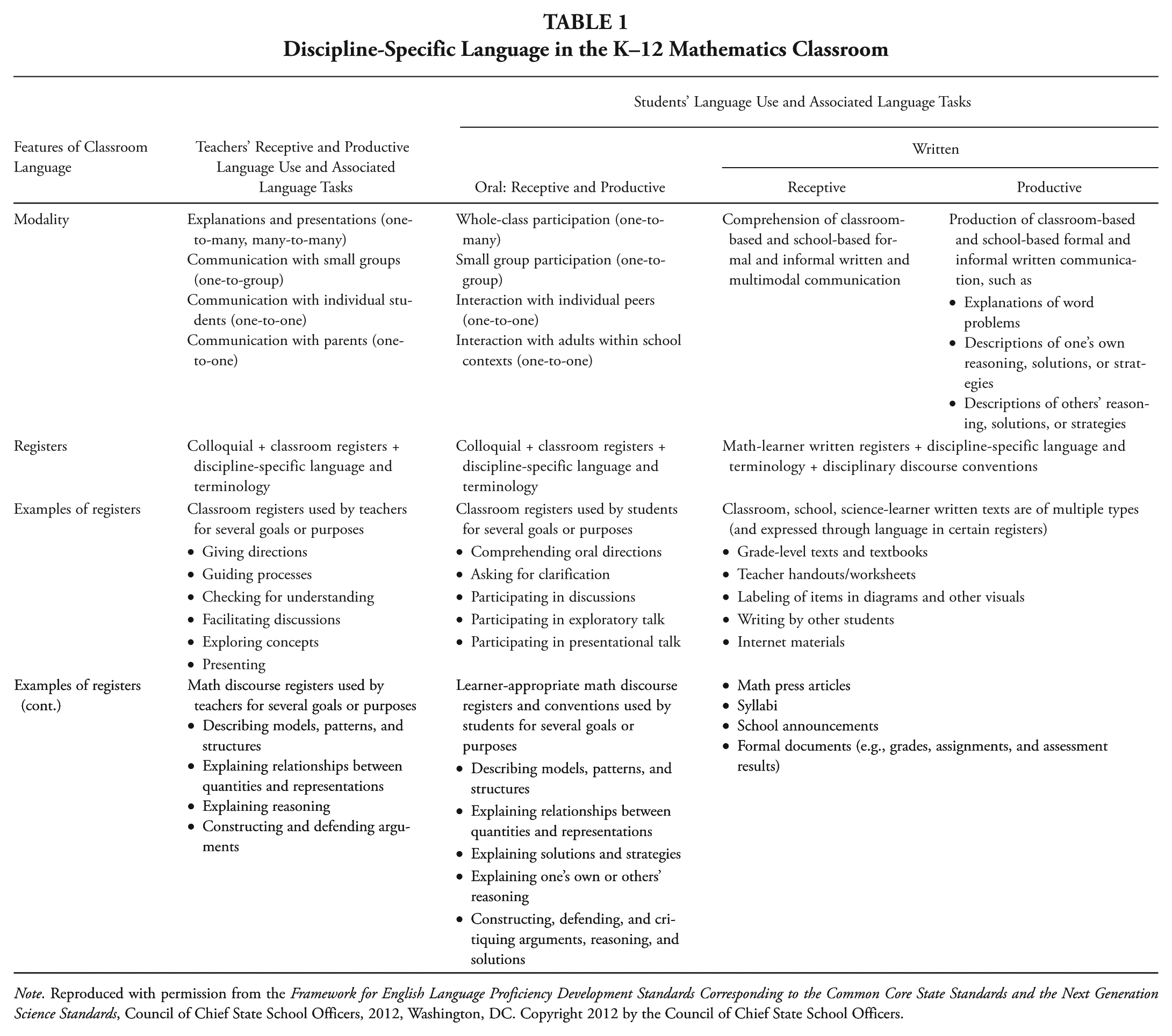
Note. Reproduced with permission from the Framework for English Language Proficiency Development Standards Corresponding to the Common Core State Standards and the Next Generation Science Standards, Council of Chief State School Officers, 2012, Washington, DC. Copyright 2012 by the Council of Chief State School Officers.
Conclusion
In introducing the framework discussed in the previous section, the authors describe the “double challenge” faced by ELs in light of the new common standards: “They must simultaneously learn how to acquire enough of a second language to participate and learn in academic settings while gaining an understanding of the knowledge and skills in multiple disciplines through that second language” (CCSSO, 2012). In this chapter, I have explored various ways to conceive of, and help teachers develop, the pedagogical language knowledge necessary to support ELs in meeting this double challenge. I have argued that the knowledge needed is fundamentally of a different sort than the pedagogical content knowledge used either by second language teachers or by mainstream teachers in their target disciplines.
The approaches toward the development of pedagogical language knowledge in the initiatives profiled in this chapter range from using SFL to develop teachers’ understandings about the linguistic features of disciplinary texts in order to make these features more transparent to ELs, to sociocultural approaches that engage teachers in participant structures to model the scaffolding necessary to apprentice ELs into the language and literacy practices of different disciplines. In addition to different approaches toward pedagogical language knowledge and its development, the initiatives profiled above also vary in terms of the educators for whom they are targeted (in-service or preservice teachers, elementary or secondary, target subject areas), the size and scope of the intervention, and the depth and type of research that has been conducted on them.
As I have attempted to make clear throughout this chapter, the research claims that can be made regarding student or even teacher outcomes as a result of the initiatives discussed here vary but are mostly quite limited. As pointed out by Lucas and Grinberg (2008) in an earlier review, empirical research on the preparation of teachers for ELs is strikingly thin (see also August & Calderón, 2006; August & Shanahan, 2008; Goldenberg & Coleman, 2010). Certainly, research measuring teacher and student outcomes stemming from various approaches to preparing teachers for ELs will be necessary as common standards are implemented in the coming years. The shifts will be large in terms of how teachers will need to approach the instruction of ELs in order to support students’ engagement in and development of the kind of language and literacy practices called for by the standards. In many cases, there will be strong purchase by teachers on what are likely to be long-held personal and societal beliefs about language and language learning. Therefore, any research agenda must take a long-term view. Areas important to study will be mainstream teachers’ current conceptions of language, literacy, and ELs; how those conceptions change over the course of time; what affects this development; how teachers’ practices change as a result of interventions based on various notions of pedagogical language knowledge; and, of course, the relationship of all of the above to teachers’ classroom practice and student outcomes of various sorts. As these topics are explored, it is important to keep in mind that, as August & Calderón (2006) point out, the relationship between teachers’ change in beliefs and change in practice is a complex one (see Ruiz, Rueda, Figueroa, & Boothroyd, 1995). The path of change may not always be “unidirectional” (August & Calderón, 2006, p. 563), and the opportunity to engage in new practices leading to better student outcomes can itself be a catalyst for change in beliefs (see Calderón & Marsh, 1988).
Those responsible for teacher preparation and development, of course, cannot wait until such research is conducted to make decisions regarding what directions to move in to prepare mainstream teachers for ELs, especially given the speed with which implementation of the new common standards is moving. This chapter has pointed to the importance of considering questions about the pedagogical language knowledge that underlies any potential approach to preparing teachers for working with ELs, the degree of correspondence between that knowledge and the language demands ELs will encounter in engaging in the kind of instruction called for by the common standards, and the expertise needed to be developed among teacher educators in order to implement the approach. Ultimately, the question facing decision makers will undoubtedly be what is absolutely essential for mainstream teachers to know and be able to do in order to create the instructional conditions in which ELs can productively engage in the key practices called for by the common standards?
That question would most likely be answered differently by proponents of the different approaches discussed here, and one of my arguments in this chapter has been that it is important to understand the differences. At the same time, the initiatives share some important commonalities, and these too are important to consider. Perhaps most important, each envisions language as an essential mediator of teaching and learning rather than as either a discrete curricular target (as has often been the case in ESL instruction) or solely a means to communicate the content one has already learned (often the view held by mainstream teachers, especially at the secondary level). 6 The assumption underlying each of the approaches focused on in this chapter is that ELs develop language and literacy in and through engagement with the kinds of texts and practices called for by the common standards, rather than as a prerequisite to such engagement. The initiatives all also prepare teachers to provide various sorts of support for that engagement, depending on the background of the learner and the demands of the tasks at hand. Although there is room for explicit instruction in each of the approaches, none of them call for the “curricularizing” of language into individual components that must be taught before ELs begin to engage in the types of texts and practices central to the new standards (Valdés et al., 2011).
Another important similarity in all the approaches to pedagogical language knowledge discussed in this chapter is that the focus is not on the extent to which ELs’ English can be made to be more “native-like” or “standard” for its own sake but rather on fostering ELs’ use and development of linguistic resources for learning and demonstrating learning across the curriculum. Each approach, in one way or another, helps teachers focus on how language is used differently for different audiences and purposes, both within and across different academic and nonacademic settings. Such a focus on audience and purpose helps complicate the overly simplistic contrasts between “everyday” and “academic” language that teachers are often presented when learning about instruction for ELs (Valdes, 2004). Instead, these approaches highlight the wide variety of home and community language and literacy practices that can effectively be employed to do high level academic work, along with the perhaps-unfamiliar (to students, but maybe also to teachers) linguistic and discursive expectations of communicating with various academic audiences for various purposes.
I close by suggesting that as efforts move forward to envision, develop, and study the pedagogical language knowledge necessary for mainstream teachers of ELs, the notion of language as action (van Lier & Walqui, 2012) might serve as an overarching principle. As van Lier and Walqui (2012) have pointed out, language is “an inseparable part of all human action,” connected to other forms of action, and “an expression of agency, embodied and embedded in the environment” (p. 4). Such an approach, which recognizes that language form and function are “subservient” to action, challenges traditional conceptions of language and language instruction and “requires a different way of thinking about what language is and what it does” (p. 5). In terms of instruction for ELs, an action-based perspective might look like the following:
ELs engage in meaningful activities (projects, presentations, investigations) that engage their interest and that encourage language growth through perception, interaction, planning, research, discussion, and co-construction of academic products of various kinds. During such action-based work, language development occurs when it is carefully scaffolded by the teacher, as well as by the students working together. The goals and outcomes specify academic and linguistic criteria for success, and the road to success requires a range of focused cognitive and linguistic work, while at the same time allowing for individual and group choices and creativity. (van Lier & Walqui, 2012, p. 4)
The question at the heart of this review is one that I argue must be central to efforts to prepare teachers for ELs in an era of new common standards: What would teachers need to know about language to enact instruction such as that envisioned in the excerpt above, and how can they best be supported in developing that knowledge, both as they prepare to enter the profession and throughout their careers?
Footnotes
Acknowledgements
I wish to thank Guadalupe Valdés, Chris Faltis, and two anonymous reviewers for helpful feedback on earlier drafts and Harriet Dang and Nancy Yue for invaluable reference assistance.