






Abstract
The “defund the police” movement has recently called for the removal of police—or school resource officers (SROs)—from schools. This call is driven by concerns that SROs may heighten student contact with criminal justice or lead to disproportionately harsh disciplinary consequences. This study uses linked disciplinary, academic, juvenile justice, and adult conviction data from North Carolina to estimate the effects of middle school SROs on a variety of student outcomes. Our findings indicate that SROs not only decrease the incidence of serious violence but also increase the use of out-of-school suspensions, transfers, expulsions, and police referrals. This study provides new insights into the effects of police in schools and implies new directions for policies, training, and accountability.
Calls to defund the police in response to the George Floyd killing on May 25, 2020, have led directly to a nationwide effort to remove police officers—commonly known as school resource officers (SROs)—from public schools. School districts in Minneapolis, Seattle, Portland, Denver, and Oakland decided to remove SROs less than a month after the killing of Floyd (Goldstein, 2020), and media reports indicate that many other districts across the country are also actively considering either eliminating or reducing the SRO program in their schools (Chavez, 2020). This movement, embedded within the larger Black Lives Matter movement, is driven by concerns that SROs have “criminalized” relatively minor misconduct by all students, but particularly for Black students (Nolan, 2011; Theriot, 2009; Wolf, 2014). These concerns have often crystallized around specific incidents of police violence against Black students in the classroom (Lee, 2015).
Racial disparities in exclusionary discipline (i.e., suspensions and expulsions) and in school-related arrests are a major focus of national policy discussions about school discipline (Executive Office of the President, 2016; Fisher & Hennessy, 2016; Na & Gottfredson, 2011; Weisburst, 2019). The concerns about school discipline and arrests are linked by the belief that disciplinary responses that start with suspensions eventually escalate to arrests and involvement in the juvenile justice system, and ultimately, the adult criminal justice system (Heitzeg, 2009; Kupchik, 2010; Skiba et al., 2014). The term “school-to-prison pipeline” has been widely used by advocates, researchers, and policymakers to imply a causal path linking school disciplinary practices, particularly those that physically exclude students from school, with student involvement in the juvenile justice and criminal justice systems (Skiba et al., 2014).
The presence of police in schools is seen as one possible component of the “school-to-prison pipeline,” motivated by the belief that police in schools lead directly to more exclusionary school-based discipline like suspensions/expulsions, more referral to law enforcement, and more school-related arrests (The Best Schools, 2020; Nance, 2016).
It is certainly true that the increased use of police in schools has coincided with an increase in suspensions. From 1972 to 2011, the K–12 suspension rate in the United States for White students nearly doubled from 3% to 5%, and the rate for Black children, which was already twice that of White children in 1972, nearly tripled from 6% to 16% (Losen et al., 2015). In 1972, less than 1% of U.S. schools were actively patrolled by police officers assigned to the schools. Starting in the 1990s, the use of SROs began to increase, and their use accelerated after the Columbine shooting and later mass school shootings (James & McCallion, 2013; Na & Gottfredson, 2011; Nance, 2016; National Association of School Resource Officers [NASRO], 2012). By 2015, almost half of all public schools were regularly patrolled by a school-based police officer (National Center for Education Statistics [NCES], 2018; New York Times Editorial Board, 2013). Many public schools have also introduced other policies intended to increase school safety, including zero-tolerance policies, surveillance technologies, and security guards (Kupchik, 2010). Hirschfield (2008) claims that this pattern reflects an overall movement to “criminalize” school disciplinary problems, a reflection of dynamic social processes including the student rights movement and efforts by teacher and principal unions/associations to limit their constituent’s liability for disciplinary actions.
Given this narrative of “criminalization,” we might then also expect that juvenile arrests have also increased during this period. However, much of the growth in SROs and the overall trend to “criminalize” school misbehavior has occurred during a period of dramatic decline in juvenile arrest rates. The overall juvenile arrest rate increased 30% from 1980 to 1996, before declining, first slowly (40% by 2010) and then precipitously (another 50% from 2010 to 2018, for an overall 75% drop since 1996); (Office of Juvenile Justice and Delinquency Prevention, 2019). These declines in arrest rates are mirrored in an equally dramatic 65% decline in student victimization rates at school from 2000 to 2018 (NCES, 2020).
Some observers have made the claim that the decline in arrests and victimization is partially the result of SROs (NASRO, 2012). This claim is grounded in prominent theory of policing known as community-based policing. The community policing movement was part of a larger movement toward new, proactive policing strategies that can both prevent crime and reduce conflicts between police and communities of color (National Academies of Sciences, Engineering, and Medicine, 2018, p. 63). Community policing is designed to rely on “more community-based crime control that draws not only on the resources of the police but also on the resources of the public” (National Research Council [NRC], 2004, p. 233). Community policing achieves these goals by assigning officers to permanent beats, involving citizens in decision-making, and problem solving using noncriminal justice techniques like mentoring and new tools like third-party policing (National Academies of Sciences, Engineering, and Medicine, 2018; Skogan, 2006). Third-party policing techniques involve police efforts to persuade third parties to take more responsibility for preventing crime or reducing crime problems using noncriminal justice strategies.
SROs are a specialized kind of community-based police officer (Barnes, 2008; NASRO, 2012), where police officers are assigned permanently to schools where they regularly interact with students as informal counselors and educators and work closely with school administrators, sometimes encouraging them to take more responsibility for preventing crime using noncriminal justice strategies. The most popular model for SROs is the NASRO triad, in which officers are given three distinct roles/tasks: create a safe campus, educate students on law-related topics, and mentor students informally as role models (NASRO, 2012).
It is possible that in the context of schools, these community policing mechanisms could contribute to both a decrease in the number of arrests and referrals to the juvenile justice system, and an increase in the use of school disciplinary techniques, like suspensions. Interviews with SROs found that the more their relationships with students developed, the more they were inclined to seek alternatives to arrest in response to student misconduct; in contrast, SROs believed that traditional officers coming into the school to deal reactively with a disciplinary problem were more likely to use the juvenile justice system (Thurau & Wald, 2009). From the perspective of community policing, the use of school disciplinary techniques may be an improvement, if delinquency decreases and more formal juvenile justice involvement is avoided. In this context, suspensions, while still exclusionary, are less exclusionary than the juvenile justice system. The question then becomes whether the same goals can be achieved with other, even less exclusionary techniques.
Alternatively, SROs can contribute to the rise in suspensions as a result of accidental or even intentional conflation of school safety and school discipline. Much of the movement toward the use of SROs has come from concerns about school shootings. The clear hope is that having an armed, trained police officer on site full time will both deter potential shooters and provide quick response if an incident does occur. However, serious school safety issues like school shootings are very rare. Qualitative research has found that SROs with free time naturally tend to get involved in school discipline events like suspected thefts, fights among students, or drug or alcohol possession (Kupchik, 2010). When SROs view student misconduct through the “criminal justice” lens rather than the “normative youth development” lens, their involvement in school discipline can escalate the school’s disciplinary responses to an incident, especially if students became upset at the rule enforcement (Kupchik, 2010; Thurau & Wald, 2009).
While clearly distinct issues, the way a school deals with disciplinary issues can affect overall school safety. Using police to deal with minor problems as a way to prevent more serious crime, including violence, is consistent with a popular trend in policing toward a type of proactive policing known as “Broken Windows” policing (Kelling & Coles, 1996; Wilson & Kelling, 1982). The name comes from an experiment showing that physical disorder (i.e., broken windows) tends to encourage further crime. The foundational belief of Broken Windows theory is that aggressive policing toward minor crime (disorder) can prevent serious crime. However, the now clear consensus is that this practice, particularly when implemented as aggressive policing against people of color, young Black men in particular, does not reduce crime (Fagan & Davies, 2000; Harcourt & Ludwig, 2006; National Academies of Sciences, Engineering, and Medicine, 2018). Yet it may be effective when used within the context of community policing where the focus is on creating social and physical order, and not arresting/citing individuals (Childress, 2016; National Academies of Sciences, Engineering, and Medicine, 2018).
Research on attitudes of SROs and attitudes toward SROs provides some support for SROs as an effective community policing tool. Most administrators feel the presence of SRO officers increases school safety and helps establishing an orderly environment, although conflicts can arise regarding lines of authority because SROs work for a local police agency, not the school district (Barnes, 2008; Cooper & Beatty, 2006; May et al., 2004). Most students also appear to support the presence of officers in the schools (Kupchik, 2010), feel safer when they are aware of the presence of an SRO (Brown & Benedict, 2005; Pentek & Eisenberg, 2018; Raymond, 2010; but see Theriot & Orme, 2016), and report improved attitudes toward the police as a response to interactions with the SROs (Theriot, 2016). SROs perceive an important function of their role to act as “ambassadors” for law enforcement with students, particularly students of color, although they fall short of engaging students in honest conversation about the need for policing reform in the United States (Kupchik et al., 2020).
It is also true that high-profile media incidents where SROs are filmed behaving in alarming or even abusive ways have created a perception that SROs are not engaging in the best practices of community policing (Lee, 2015). These individual cases have provided much of the momentum for the “defund the SROs” movement. The resulting conflict has created a real policy dilemma for school administrators and city administrators. This conflict is highlighted in the Final Report of the President’s Task Force on 21st Century Policing (2015), a report from an elite national panel that is often seen as a guide to best practice in policing. The section on schools emphasizes the need for law enforcement to work with school administrators to move away from policies that exclude students from schools or push students into the juvenile justice system and move toward more inclusive, restorative processes. However, at the same time, the report also focuses on the importance of community policing as a guiding policy for all stakeholders. Removing police officers from schools is antithetical to this foundational element, at least if police officers are adhering to the ideals of the SRO model.
In this study, we try to better understand the causal role that SROs play in the creation of school safety and the day-to-day practice of school discipline by using incident-level administrative data from North Carolina public schools to examine the impact of SROs in middle school on both reported disciplinary events and assigned disciplinary consequences. Although we know that SROs can shape perceptions of school climate at the organizational level (Barnes, 2008; May et al., 2004; Theriot, 2016), our analysis sheds light more directly on one of the central concerns of the “defund the SROs” movement: whether SROs increase punitive disciplinary responses to student misbehavior and/or student contact with the criminal justice system. Our research design makes use of within-school variation over time in student exposure to SROs, facilitated by the fact that the state of North Carolina invested heavily in SROs in middle schools through a graduated rollout during the observed time period of interest. We proceed in the next subsection by providing a review of the existing literature on SROs.
The Effects of Police on Student and Staff Behavior in Schools
Although there is substantial research documenting the impact of SROs on school climate from the perspective of students, teachers, and administrators, there is little rigorous research on the causal impact of SROs on either the behavior of students or school disciplinary practices by school staff (Fisher & Hennessy, 2016; James & McCallion, 2013; Steinberg & Lacoe, 2017; but see Na & Gottfredson, 2011). In response to the general lack of research on school safety, the Obama administration created the Comprehensive School Safety Initiative in 2014 to fund research that could identify effective strategies, including SROs, to resolve safety issues faced by schools and students. The Initiative explicitly encouraged research that recognized the tension between reducing crime and maintaining fair policing that do not increase racial disparities in discipline. Partially as a result of this initiative, new empirical studies have begun to try to pin down the causal impact of SROs on both safety and school discipline (Anderson, 2018; Gottfredson et al., 2020; Owens, 2017; Weisburst, 2019; Zhang, 2019).
Owens (2017) explored the causal impact of SROs on arrest and delinquency by exploiting variation in the use of SROs created by the federal Cops in Schools (CIS) grants program. Using data from 2003, 2005, and 2007 National Center for Education’s Statistics School Survey on Crime and Safety (SSCS), Owens showed that CIS grants were associated with reductions in recorded student misbehavior and small increases in the likelihood that school administrators report contacting police about the incidents that are recorded. Earlier work by Na and Gottfredson (2011) with the same data found that school administrators in schools that added armed security officers since the last survey recorded 29% more weapons and drug violations in the year they added the officer than schools that do not add armed security staff. This finding is associated with an increase in detection, rather than an increase in the underlying behavior.
Owens (2017) also used data from the National Incident Based Reporting System (NIBRS) between 1997 and 2007 to identify delinquency in schools that are officially reported to the police. She found that police jurisdictions that received CIS grants learned about more violent delinquency taking place in schools, along with more weapons and drug violations. In addition to an increasing knowledge of school violations, Owens (2017) found that the law enforcement agencies awarded CIS grants made more arrests of juveniles less than 15 years of age for delinquent acts committed in school. The former result, which is consistent with Na and Gottfredson (2011), is also partially echoed in the work of Zhang (2019), who used between-school variation in the presence of police in West Virginia middle and high schools from 2014 to 2016 to study the impact of SROs on disciplinary events, and in the work of Gottfredson et al. (2020), who examined monthly disciplinary data over 2 years from 33 middle and high schools in California that increased SRO staffing. Zhang found that schools with a police officer for at least 1 year recorded roughly 35% more drug violations than schools without an officer. Gottfredson et al. found that increased SRO presence in schools increased the number of drug- and weapon-related offense reports relative to matched schools without increased staffing, and increased the number of exclusionary disciplinary actions by school administrators. Overall, these results highlight the tensions between increased school safety—through increased knowledge of delinquent or problematic behavior by both school administrators and law enforcement—and more frequent imposition of punitive disciplinary sanctions.
Na and Gottfredson (2011) and Owens (2017) report that their results are largely the same for schools regardless of racial makeup—if anything, they find that the positive link between school police officers and delinquency reporting is weaker in schools/counties with more Black and Hispanic students, suggesting, in contrast to the current narrative, that the School-to-Prison pipeline is weaker in these communities. However, neither study is overly confident in this conclusion in part because they are not able to focus narrowly on schools and communities that are largely Black. It is possible that the School-to-Prison pipeline mechanism is found largely in schools and districts that are disproportionately Black (Ramey, 2015). More detailed analysis of individual level data rather than school or district level is clearly needed to unpack the racial impact of SRO programs more definitively (Na & Gottfredson, 2011).
Emily Weisburst’s paper in 2019 responds directly to these concerns. Like Owens, she studied the impact of the CIS program, but unlike Owens, she was able to study the impact of SROs on individual students. Using rich student-level data from Texas public middle schools, she found that, for middle school students, the presence of an SRO in the school district increased the risk of receiving school discipline, particularly disciplinary actions associated with low-level offenses. She found that the impact of SROs on suspensions and other disciplinary actions were more than 50% greater for Black students than White students—a result that is consistent with the defund movement’s claim that police officers in schools are partially responsible for the disparate impact of school discipline on Black students. Weisburst (2019) also found that students in middle schools that had a CIS grant had a 2.5% reduction in high school graduation rates and a 4% decrease in college enrollment—she did not find a significant difference in these effects by race.
In this study, we build on Weisburst (2019) by using incident-level administrative data to examine the impact of SROs on both reported disciplinary events and assigned disciplinary consequences. Specifically, we examine the impact of SROs in North Carolina middle schools on short-term student outcomes in school and in the juvenile justice system during the years 2005–2009 as well as long-term student outcomes in educational attainment and the adult criminal justice system. During this period, North Carolina invested heavily in SROs in middle schools through a graduated rollout, expanding a program that had reached near-complete coverage in public high schools. Between the 2005 and 2009 school years, the number of districts with full SRO coverage in public middle schools increased 45% from 58 in 2005 to 84 in 2009. Apart from this practical reason to focus the study on the middle school level, middle school grades represent the first time that many students interact with either formal school disciplinary processes or with school police. Middle school is also viewed as a critical time for determining student trajectories toward either school engagement or school dropout (Balfanz et al., 2007).
This study makes four primary contributions to the existing research on the topic. First, the fact that we have data on each disciplinary event allows us to distinguish between effects of SROs on reported student disciplinary behavior and effects on student disciplinary consequences. Na and Gottfredson (2011) found that the SROs did not increase the likelihood of suspension for events reported to school administrators. Weisburst (2019) was not able to consider administrator responses directly, because she only had data on the suspension. If SROs increase reporting (Na & Gottfredson, 2011; Owens, 2017; Zhang, 2019), they will also increase suspensions, even if they do not change the rate at which suspensions are assigned. Therefore, it is important, if possible, to distinguish between the behavior that enters the school’s formal disciplinary system, and the formal responses to that behavior, to understand the mechanisms by which SROs affect disciplinary outcomes.
Second, our study provides the first direct assessment of whether the presence of an SRO increases referrals to police and juvenile justice complaints against students from a school. Not all referrals to police result in a juvenile justice complaint (NRC, 2013). In addition, both school personnel and law enforcement can file juvenile justice complaints. Nationwide, only about 80% of juvenile justice complaints originate with police (NRC, 2013). Using juvenile justice complaints rather than arrest as an outcome allows us to include the potential impact of SROs on more formal juvenile justice involvement through either police or school administrators (May et al., 2018). Third, the study examines long-term effects on criminal conviction in young adulthood, an outcome which has yet to be studied in relation to SROs. And finally, our analysis moves away from the district-level intent-to-treat approach of Owens (2017) and Weisburst (2019) to explore direct impacts of SRO placement at the school level.
SROs in North Carolina Schools
The first SRO program in North Carolina began during the 1974–1975 school year in Forsyth County Schools, and they grew slowly until the mid 1990s when their growth began to accelerate. Between the 1995–1996 and 2008–2009 school years, the number of SROs in North Carolina schools increased by nearly 250% (from 243 to 849—Department of Juvenile Justice and Delinquency Prevention—Center for the Prevention of School Violence, 2010). As of 2009, 88% of high schools, 70% of middle schools, and 1% of elementary schools had exclusive SROs. Another 19% of North Carolina high schools, 22% of middle schools, and 20% of elementary schools shared an SRO with another school.
Two state initiatives and two federal initiatives have driven a large portion of this growth. In 1993, the Governor’s Task Force on School Safety gave a set of recommendations for strengthening schools’ responses to violence, including preliminary funding for SROs. Beginning in the 1995–1996 school year every local education agency received the dollar equivalent of one SRO position per high school. Shortly thereafter, two federal grant programs also sponsored SROs: the CIS program, which was funded until 2005, and State Formula Grants under the Safe and Drug Free Schools and Communities Act (SDFSCA), which was funded until 2009. Local educational agencies could use funds they received under the SDFSCA State Formula Grant program for, among other things, hiring and training school security personnel. 1
Table 1 documents from the 2004–2005 to 2008–2009 school years (our primary time period of interest) the number of North Carolina SRO positions by source of funding and by type of affiliated law enforcement agency. Locally funded SROs receive funding from the county through either a law enforcement agency and/or school system funding. State-funded SROs receive funding primarily through a categorical funding allotment called “at-risk student services.” This line item of the state budget provides the dollar equivalent of one SRO position for each high school in the district (plus additional funds based on the number of students and poor students in the district if any funds remain). Finally, the federal grant programs described previously support SROs separately and as part of combined funding programs with local and state agencies. As one can observe in the rightmost columns, the majority of SROs affiliate with local sheriff departments or city or town police departments.
SRO Positions by Funding Source and Law Enforcement Agency Affiliation

Note. “Combined” implies that the SRO position is funded by some combination of local, state, and federal revenues. Summing horizontally the four columns under funding source or three columns under agency affiliation gives the total number of SRO positions each year in the state of North Carolina. SRO = school resource officer.
Data
To conduct an analysis of how SROs affect students across a variety of school contexts, we use administrative public school records from the North Carolina Education Research Data Center (NCERDC), supplemented with information on SRO placement and matched to individual juvenile justice records and adult conviction records from the North Carolina Department of Public Safety (NCDPS).
SRO data comes from the Annual School Resource Officer Census conducted by the Center for the Prevention of School Violence under the Department of Juvenile Justice and Delinquency Prevention. These annual reports are available with county-level information on SRO assignment in North Carolina middle schools from the 2004–2005 through 2008–2009 school years. In particular, each census contains a map of the state with each county labeled as one of the following in terms of its SRO coverage: (a) all middle schools covered, (b) some middle schools covered, (c) no middle schools covered, or (d) no middle schools in local education agency. 2 North Carolina has 100 counties and 115 school districts. There is one county school district corresponding to each county. In addition, there are 15 city school districts scattered around 11 counties. The SRO coverage of those 11 counties includes middle schools in both county school districts and city school districts.
We define exposure to an SRO as zero if the student attends a middle school in a county with no SRO coverage and as one if the student attends a middle school in a county with full SRO coverage. For students attending middle schools in partial SRO coverage counties, we assign a probabilistic likelihood of exposure to SROs in that school and year
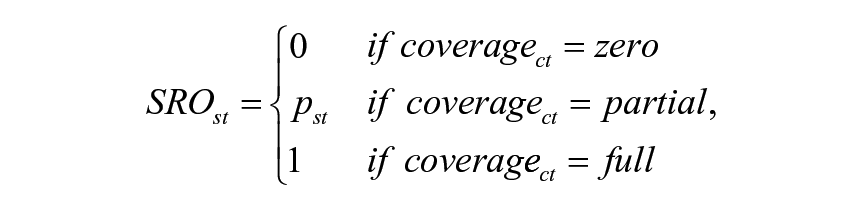
where
The absence of an exact measure of the presence of an SRO at the school level introduces measurement error into our independent variable, which should create attenuation bias toward zero. However, despite this limitation, we believe our SRO measure at the school level builds on the two most comparable studies by Owens (2017) and Weisburst (2019), which both use district-wide measures of SRO funding.
Our variation in SRO coverage of middle schools spans across 450 middle schools over a period of five academic years. Our study period aligns well with the roll out of additional police officers in middle schools across the state. A major report to the governor from then Attorney General Roy Cooper in 2006 called “Keeping North Carolina Schools Safe and Secure” put forth a specific recommendation to expand the SRO program, primarily to middle and elementary schools (Cooper & Beatty, 2006). The number of public middle schools with an SRO grew from 353 in 2005–2006 to 416 in 2008–2009, an increase of 18%. As can be seen in Figure 1, the number of counties with full SRO coverage in public middle schools increased 45% from 58 in 2005 to 84 in 2009. As of 2009, the most recent year of our data, 70% of middle schools had exclusive SROs, and 22% of middle schools shared an SRO with another school.
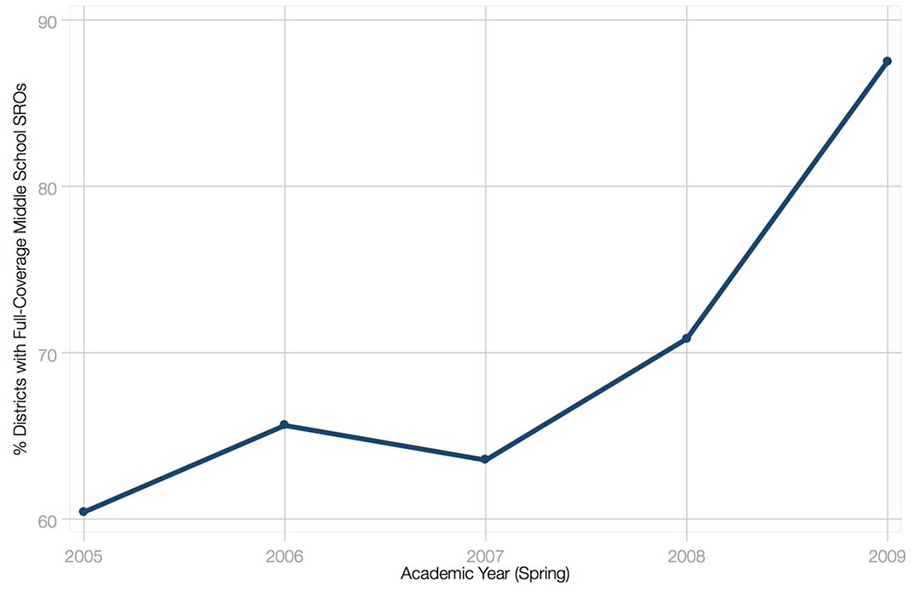
SRO coverage in North Carolina middle schools by year: 2005–2009.
Although the overall rise in middle school SRO placement during this time period was modest, this trend cloaks year-to-year losses and gains of SROs. Of the 100 counties in our sample, 50 have some fluctuations in SRO coverage during the observed 5 years. Twenty-four counties have lost middle school SRO coverage at least once, and 45 counties have gained middle school SRO coverage at least once (see Figure 2). The counties gaining SROs between 2005 and 2009 reflect a diverse group, from the less populous Pamlico county in eastern North Carolina and Polk county in western North Carolina, to the more populous Wake and Forsyth counties, which contain the cities of Raleigh and Winston Salem, respectively. Schools with SROs are descriptively similar to schools without SROs across many dimensions, including student racial composition, student test scores, per-pupil funding, teacher–student ratio, and county demographics (Supplementary Appendix Table A2 in the online version of the journal). SROs do, however, tend to be assigned to larger schools with a higher concentration of both minor and serious disciplinary offenses.

Changes in middle school SRO coverage in North Carolina between 2005 and 2009.
We matched this collected data by county and year to a comprehensive data set from the NCERDC on student, school, and district administrative records from 2005 through 2009 and to administrative records of juvenile justice complaints from 2005 to 2009 from the NCDPS. To examine the short-term influence of SROs on student outcomes, we focused in particular on patterns in reported disciplinary offenses and consequences, but also on changes in juvenile justice complaints against students and end-of-year test score achievement.
The disciplinary database from NCERDC includes a record for each referral of a student disciplinary offense, regardless of whether that referral results in an eventual suspension. We can therefore analyze effects of SROs both on the incidence of student misbehavior that result in referrals and on the severity of resultant consequences assigned by administrators. We distinguished referrals between those that are not mandatory to report—“minor offenses”—and those that are mandated by statute to be reported to the district and state—“reportable offenses.” Minor offenses include a variety of forms of misconduct, including disruptive behavior, insubordination, fighting, inappropriate language or disrespect, aggressive behavior, and bus misbehavior. We measure the counts of minor offenses at the school-year level as one dependent variable. Due to changes in school reporting behavior, this measure is only reliable in 2008 and 2009. For the reportable offenses, representing 2% of total disciplinary referrals, we categorize all disciplinary incidents into three categories to construct three school-year level dependent variables: counts of alcohol or drug possession, counts of weapon possession, and counts of violent incidents. Supplementary Appendix Tables A3 and A4 in the online version of the journal present the frequency of different types of minor and reportable offense in middle schools across the 2005–2009 school years and the likelihood of short-term suspension or long-term removal from school associated with each offense type.
In this study, we are using the reported offenses primarily as measures of student behavior. However, prior research has documented that school staff have considerable discretion on what behavior generates a report, particularly for minor offenses (Anyon et al., 2016); Black students get disproportionately more discipline referrals than White students for subjectively defined misbehavior (Girvan et al., 2017). Using the reported offenses as measures of student behavior can be problematic when the presence of SRO results in changes in the reporting behavior of school personnel. SROs might also more likely to detect and report certain kinds of student misbehavior, and as a result, we might see an increase in reports of weapons violations and drug possession after a trained police officer reports for duty (Na & Gottfredson, 2011). Given these concerns, this study will focus primarily on serious offenses, for which reporting is mandatory, and therefore less subject to teacher or police discretion.
In addition, this study will also focus on how the presence of an SRO affects the outcomes of a school’s disciplinary process. We consider two additional dependent variables reflecting potential spillovers onto rates of suspension and other serious disciplinary consequences. The first measure is a count of the number of short-term out-of-school suspensions (OSS) at the school, defined as lasting 10 or fewer days. The second is a count of the number of long-term removal of students, including long-term OSS, expulsions, and transfers to an alternative learning program/school (ALP). Typically, these long-term suspensions and other forms of removal are considered more serious and are more likely to have detrimental impacts to the student. We examine these separately for the minor and reportable offenses mentioned above, unlike Weisburst (2019), who studied all suspensions. We will therefore capture changes in suspensions, conditional on being “caught” for one of these mandatory report offenses or minor offenses. We also consider effects on reports to law enforcement conditional on reportable offenses or minor offenses, although this variable is only reliable for two of the five years of data.
Another major concern with police in schools is that schools with an SRO may increase student contact with the juvenile justice system (Theriot, 2009; Wolf, 2014). To evaluate such concern, we merge SRO data with juvenile justice data from the NCDPS. This data contains each complaint filed against a juvenile in the juvenile court. A juvenile justice complaint can be filed by citizens or by law enforcement officers and represent the start of the juvenile justice process (Langberg & Robinson, 2015). We create three measures of juvenile justice complaints to answer the question of whether SRO presence increases juvenile justice complaints against students at that school. The first measure is the total number of juvenile justice complaints against all students at the school-year level (excluding status complaints and complaints from the month of July). The second measure is the number of juvenile felony complaints within this total; the third measure is the number of juvenile misdemeanor complaints. These measures allow us to examine not only changes in the overall number of juvenile justice complaints but also changes to the composition of complaints. Because the juvenile justice data lack a reliable measure of the source of complaints prior to 2007, we cannot distinguish between school-related complaints and complaints from other sources. According to official reports in 2007 and 2009, school-related juvenile justice complaints cover approximately 40% of total juvenile justice complaints (North Carolina Department of Juvenile Justice and Delinquency Prevention, 2007, 2009). Interviews with police chiefs found that SROs obtain valuable information about criminal activities taking place outside of school from students (Thurau & Wald, 2009). By looking at juvenile justice complaints from all sources, we include the spillover effects of SROs on juvenile justice complaints filed by law enforcement outside of school.
The other short-term student outcomes examined are student test-score achievement in reading and math. We use end-of-grade test scores in reading and math and standardize those scores to have mean zero and standard deviation of one for each grade and year. Then, we measure these two outcomes as the average standardized scores at the school-year level.
In addition to the 15 short-term outcome variables described above and our independent variable of student exposure to SROs in their middle school, we also construct an expansive set of control variables. These include time-varying measures at the school level such as teacher–student ratio, percent of students by race/ethnicity, proportion of reportable offenses that are violent incidents, proportion of reportable offenses that are weapon possession, and proportion of reportable offenses that require instant report to the police; and time-varying measures at the district or county level such as per-pupil total expenditures, child poverty rate, and unemployment rate. 4 Descriptive statistics of all school-year level variables in the short-term analysis are presented in Table 2.
Descriptive Statistics for Short-Term Analysis in North Carolina Middle Schools
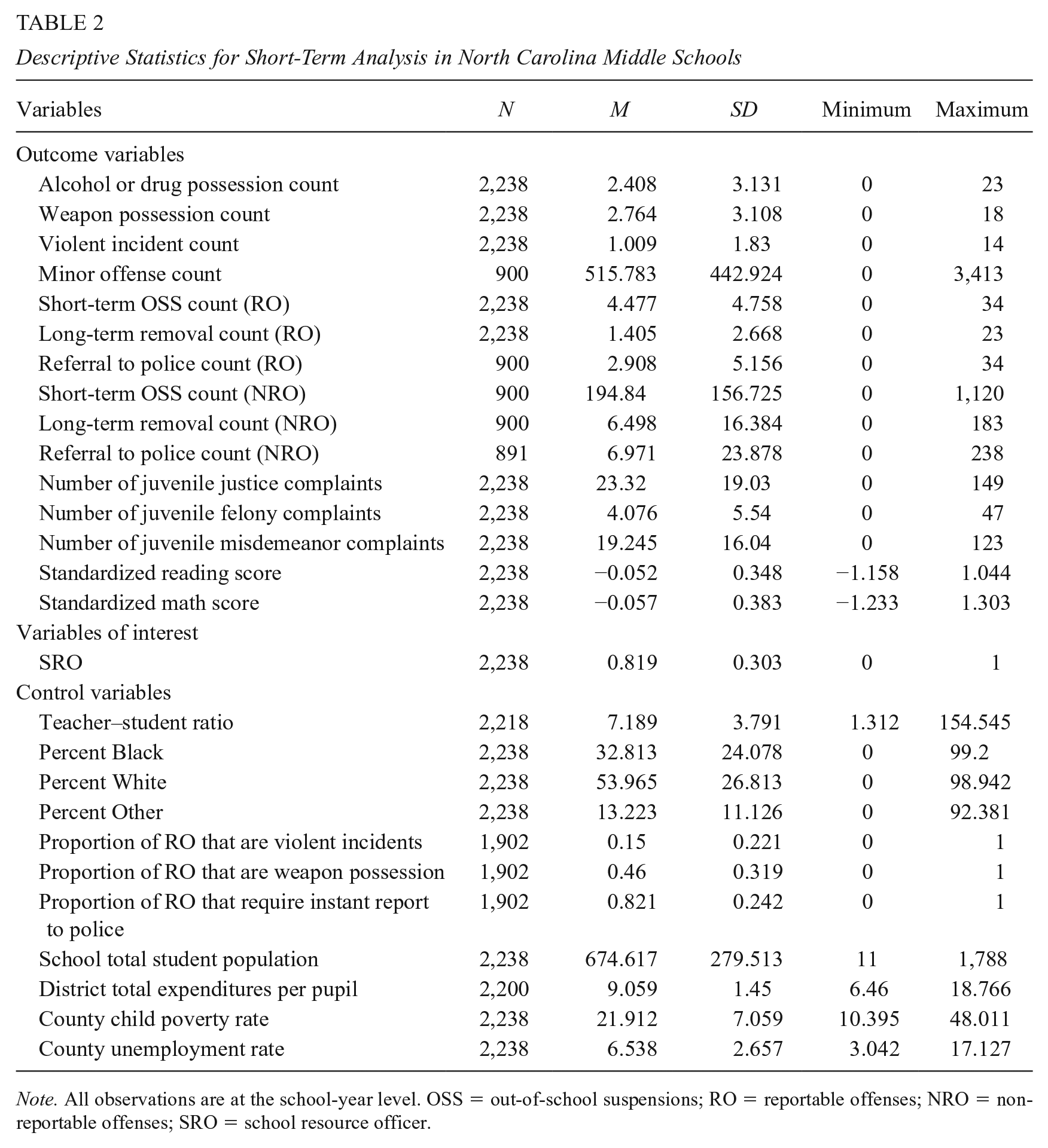
Note. All observations are at the school-year level. OSS = out-of-school suspensions; RO = reportable offenses; NRO = non-reportable offenses; SRO = school resource officer.
Finally, this study extends prior literature on the short-term impacts of SROs by asking whether the number of years exposed to SROs in middle school have lasting impacts on students into young adulthood. Specifically, we tracked students who started middle school between 2005 and 2007 longitudinally to examine the long-term impact of SRO exposure during middle school on their eventual high school graduation status and interaction with the adult criminal justice system. We first create a measure of intended exposure time to SRO from Grade 6 to Grade 8 for cohorts of students starting middle schools from 2005 to 2007. Then, we matched the SRO exposure data and education data to the full set of adult criminal conviction records from NCDPS from 2005 to 2016, attained through a Web scraper of the publicly available offender search function. In this way, we can determine whether each middle school student ever ends up appearing in the adult criminal justice system. Because the courts consider all individuals as adults at the early age of 16 in North Carolina, our longitudinal data provide sufficient time for three cohorts of individuals in the original sample to age into eligibility for adult criminal conviction. In fact, 214,811 students in our sample were successfully matched to the DPS offender database. For simplicity, we use as the dependent measure an aggregated school-cohort count of students that receive any criminal conviction in North Carolina by age 20. We also supplement this long-term outcome with another long-term outcome from the education data, the school-cohort count of students that graduated high school on time in North Carolina. Control variables in the long-term analysis include the intended Grade 6 to Grade 8 average of school-level teacher–student ratio, percent of students by race/ethnicity, county-level per-pupil education expenditures, child poverty rate, and unemployment rate.
Method
Our research design makes use of within-district variation over time in student exposure to SROs, facilitated by the fact that North Carolina invested heavily in SROs in middle schools through a graduated rollout during the observed time period of interest (see Figure 1). This section will describe our empirical approach first for estimating immediate impacts of student exposure to an SRO, and second for estimating long-term impacts of cumulative exposure to an SRO.
The short-term analysis estimates the impacts of enhanced SRO presence on a series of student disciplinary, juvenile justice, and academic outcomes aggregated to the school-year level. These regressions are specified as follows for each outcome Yst in school s and year t:

The variable of interest
Difference-in-difference models with two-way fixed effects rely on a number of assumptions (Goodman-Bacon, 2018). First, even in instances with homogeneous treatment timing, a two-way fixed effects model supposes that treatment units would have continued on the same trend as the control units in the postperiod absent treatment. Although we cannot test this directly, we can compare the baseline characteristics of schools by their form of SRO variation between 2005 and 2009 (no change, lose only, gain only, gain and lose) in Supplementary Appendix Table A5 in the online version of the journal. Although there are some baseline differences among these treatment change groups, there are no meaningful differences at baseline in disciplinary behaviors or consequences. Second, our Equation 1 model assumes constant treatment effects during the postperiod. To relax this assumption and visually assess trends in outcomes prior to and following introduction of an SRO, we also conduct a nonparametric event study analysis:

In this approach, the outcome, control variables, and fixed effects remain the same as before.
The long-term analysis proceeds with a similar method but examines the impacts of cohort exposure over the entire middle school career to SROs on the count of students graduating high school on time and the count of students receiving criminal conviction by age 20. These two outcomes, aggregated to the school-cohort level, are modeled as follows:

Because not all outcome variables in this study are continuous and normally distributed, we estimate both ordinary least squares (OLS) regressions and compare to appropriate nonlinear estimation methods. Apart from reading and math scores standardized by grade and year and then averaged by school-year, which possess fairly normal distributions (Supplementary Appendix Figure A1a and A1b in the online version of the journal), the remainder of our short-term outcomes represent counts by school-year and do not possess normal distributions. As illustrated in Supplementary Appendix Figures A1c to A1q in the online version of the journal, these disciplinary behavior counts, disciplinary consequence counts, juvenile justice complaint counts, and high school graduation and criminal conviction counts all appear to be generated by a Poisson-like process. We formally test whether there is overdispersion in all count outcomes. When there is overdispersion, we perform negative binomial regressions instead of Poisson regressions. 5 For disciplinary offense counts, counts of juvenile justice complaints, counts of students graduating on time, and counts of criminal conviction by age 20, we control for exposure in terms of the total number of student population. For disciplinary consequence outcomes, we control for exposure in terms of the total number of offenses.
Results
Impacts of SROs on Student Outcomes
The results from this analysis are presented in three steps. First, we show the impacts of SRO presence on middle school minor disciplinary offenses and serious offenses. Second, we show the impacts of SROs on the rate of disciplinary consequences for minor or serious offenses, to determine the extent to which SROs influence a school’s disciplinary responses to student misconduct. And third, we show the impact of SROs on the number of juvenile justice complaints against students, school academic performance, and student long-term outcomes including high school graduation and criminal conviction. Each model is estimated with school fixed effects and a variety of time-varying controls such that the coefficient estimate represents within-school changes in response to SRO placement.
Table 3 presents findings from regressions of a series of school-year-level disciplinary count outcomes on an indicator of SRO coverage in that middle school. Each column represents a different outcome type, and each row represents the specific population of students over which the regressions are estimated. Specifically, the school-year outcome measure is aggregated for all students in the first row and then aggregated separately for White, Black, and Hispanic students in the subsequent rows. We present only the estimated coefficient on SRO presence for each cell and omit coefficient estimates for control variables which are presented separately in Supplementary Appendix Table A6 in the online version of the journal.
Effects of SRO Presence on School Disciplinary Outcomes in North Carolina, by Student Race/Ethnicity
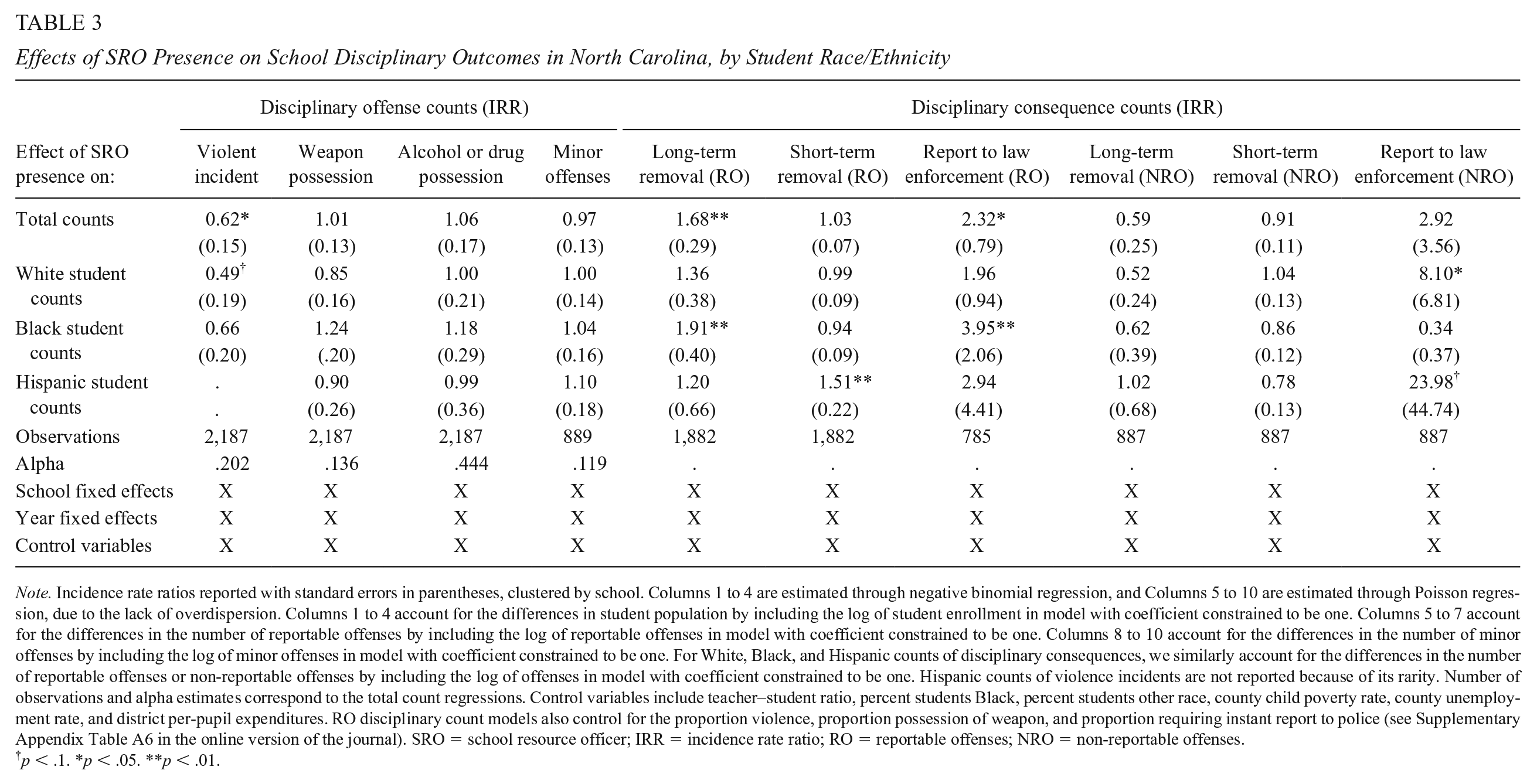
Note. Incidence rate ratios reported with standard errors in parentheses, clustered by school. Columns 1 to 4 are estimated through negative binomial regression, and Columns 5 to 10 are estimated through Poisson regression, due to the lack of overdispersion. Columns 1 to 4 account for the differences in student population by including the log of student enrollment in model with coefficient constrained to be one. Columns 5 to 7 account for the differences in the number of reportable offenses by including the log of reportable offenses in model with coefficient constrained to be one. Columns 8 to 10 account for the differences in the number of minor offenses by including the log of minor offenses in model with coefficient constrained to be one. For White, Black, and Hispanic counts of disciplinary consequences, we similarly account for the differences in the number of reportable offenses or non-reportable offenses by including the log of offenses in model with coefficient constrained to be one. Hispanic counts of violence incidents are not reported because of its rarity. Number of observations and alpha estimates correspond to the total count regressions. Control variables include teacher–student ratio, percent students Black, percent students other race, county child poverty rate, county unemployment rate, and district per-pupil expenditures. RO disciplinary count models also control for the proportion violence, proportion possession of weapon, and proportion requiring instant report to police (see Supplementary Appendix Table A6 in the online version of the journal). SRO = school resource officer; IRR = incidence rate ratio; RO = reportable offenses; NRO = non-reportable offenses.
p < .1. *p < .05. **p < .01.
The first four columns of Table 3 depict effects on four types of disciplinary offense counts recorded: violent incidents, weapon possession, alcohol or drug possession, and minor offenses, overall and by student race. The negative binomial estimates in the first row indicate no significant effect of SRO presence on the total counts of weapon possession, alcohol or drug possession, or minor offenses recorded, but a statistically significant reduction in counts of violence recorded. Specifically, according to the incidence rate ratio (IRR) of 0.62, the introduction of an SRO reduces the incidence of reportable violent offenses by 38% (p < .05) from a baseline average of one offense count per school-year. This reduction in violence is driven primarily by fewer violent incidents committed by White students. SRO presence reduces the incidence of serious violent offenses by White students by 51% (IRR = 0.49, p < .1).
Columns 5 through 7 present effects of SROs on the number of student disciplinary consequences per reportable offense. Here, we find strong evidence of heightened disciplinary responses to student misconduct corresponding to SRO presence in the middle school. The presence of an SRO appears to increase the number of long-term OSS, ALP, or expulsions per reportable offense by 68% (p < .01) and the number of referrals to law enforcement per reportable offense by 132% (p < .05). 6 This means that even though schools with SROs record fewer student violent offenses, recorded offenses are more likely to incur exclusionary disciplinary consequences and referral to law enforcement. The latter finding is in essence a validity check, because any incident in which an SRO is present will count as a referral to law enforcement. On the contrary, the link to school suspensions is not obvious, because the SROs do not, and indeed should not, play a direct role in the assignment of suspensions, which are the sole responsibility of the school administration. Yet, our finding that the SRO presence increases the use of suspensions indicates at least indirect involvement in the school disciplinary responses toward an incident. Prior qualitative observations of SROs have documented that school administrators can feel that they need to suspend a student when the SRO thinks suspension is necessary. When both the school and the officer define a misbehavior as criminal, SROs can lend legitimacy to the imposition of harsh disciplinary responses (Kupchik, 2010). Alternatively, textbook community-policing efforts might emphasize the use of school-based strategies instead of criminal justice strategies for crime control. Whatever the cause, our analysis of the differential effects of SROs by student race makes it clear that the escalated disciplinary response disproportionately affects Black students, who see increases in long-term removals of 91% (p < .01) and increases in reports to law enforcement of 295% (p < .01), respectively. Hispanic students experience the largest increase in short-term school suspensions at an increase of 51% (p < .01). This result suggests that SROs lead to more suspensions for the same offenses, particularly for Black and Hispanic students.
Columns 8 through 10 of Table 3 display the estimated effects of SRO presence on disciplinary consequences for minor (non-reportable) offenses. Unfortunately, we only have data on minor offenses for two of the five years, and so these models are slightly underpowered. It does appear again, however, that reports to law enforcement for minor offenses increase significantly with assignment of an SRO to the school, particularly for White and Hispanic students this time.
Given this evidence that SRO influence on school disciplinary responses to student misconduct points to harsher treatment for Black and Hispanic students, it is important to examine the full range of punishments, including referrals to juvenile court. Column 1 of Table 4 shows that SRO presence does not substantively increase the overall number of juvenile justice complaints against students at the school. However, Columns 2 and 3 suggest that SRO presence changes the composition of those juvenile justice complaints. Specifically, SRO presence increases the number of juvenile misdemeanor complaints by 14% (p < .1) but reduces the number of juvenile felony complaints filed against students by 25% (p < .1). Race-specific analyses show that the increase in the number of juvenile misdemeanor complaints is primarily driven by White students, while students of all racial/ethnic groups have fewer juvenile felony complaints. The decrease in juvenile felony complaints is consistent with our finding that SROs deter serious violent incidents at school. The fact that SRO presence in schools does not increase juvenile justice complaints against Black and Hispanic students despite increasing number of referrals to law enforcement per offense is consistent with prior qualitative findings that SROs make efforts to seek alternatives to arrest or referral to the juvenile justice system in addressing student problems (Thurau & Wald, 2009). Despite clear evidence that there is more police involvement in school discipline after the arrival of SROs, and more punitive disciplinary actions taken toward Black and Hispanic students, this pattern does not translate into similar growth in the prevalence of, or disparities in, formal referrals to the juvenile court system.
Effects of SRO Presence on Other Outcomes in North Carolina, by Student Race/Ethnicity
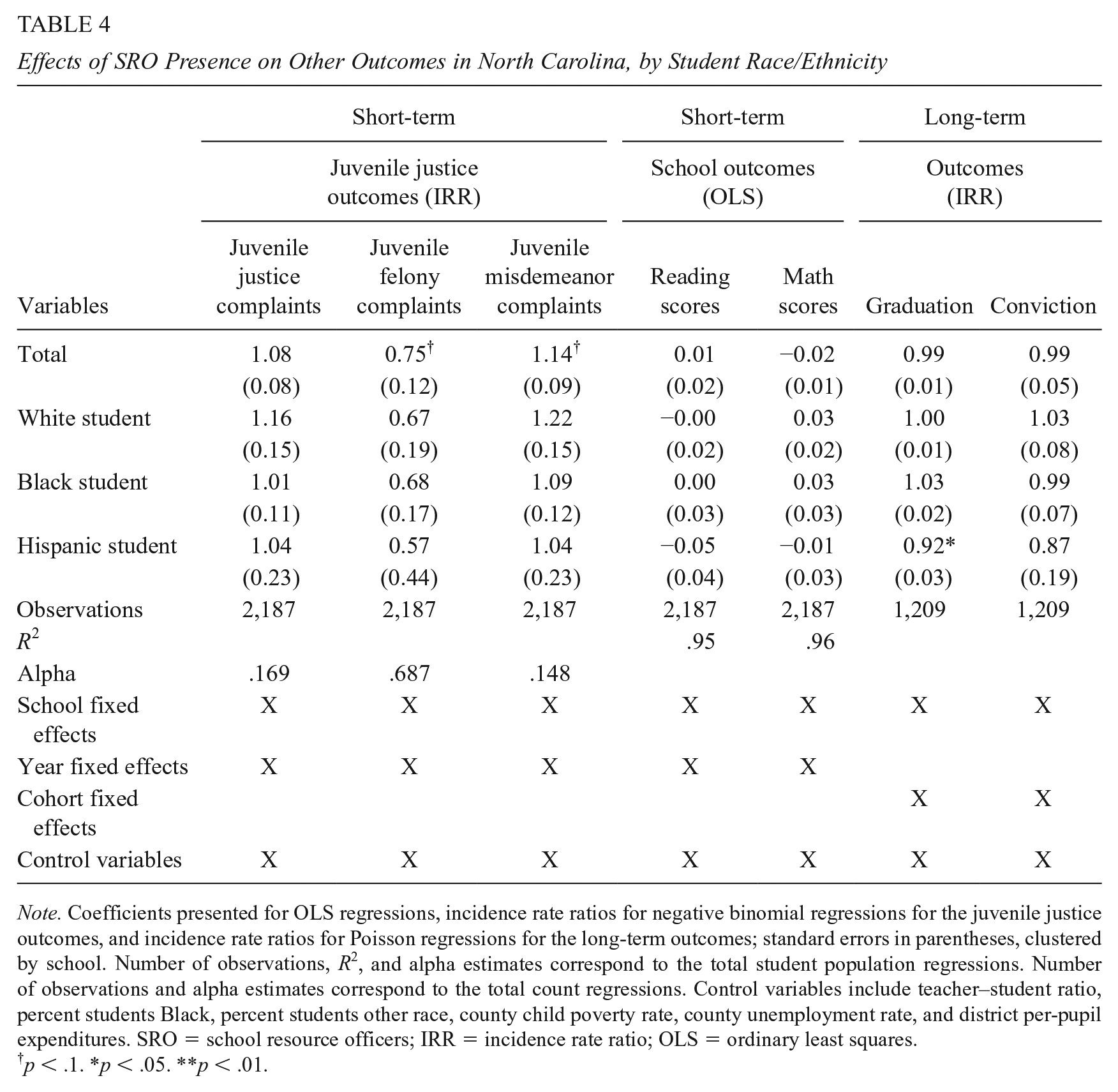
Note. Coefficients presented for OLS regressions, incidence rate ratios for negative binomial regressions for the juvenile justice outcomes, and incidence rate ratios for Poisson regressions for the long-term outcomes; standard errors in parentheses, clustered by school. Number of observations, R2, and alpha estimates correspond to the total student population regressions. Number of observations and alpha estimates correspond to the total count regressions. Control variables include teacher–student ratio, percent students Black, percent students other race, county child poverty rate, county unemployment rate, and district per-pupil expenditures. SRO = school resource officers; IRR = incidence rate ratio; OLS = ordinary least squares.
p < .1. *p < .05. **p < .01.
Finally, we consider the spillover effects of SRO presence in middle schools on student academic performance and long-term outcomes. Estimates from Columns 4 and 5 of Table 4 show that SROs have no significant effects on either reading or math test scores among all students and among students of specific race/ethnicity populations. Columns 6 and 7 provide results from models estimating the effects of SRO exposure in middle school on long-term outcomes. As described in greater detail in the “Method” section, these models use a school-cohort data set with SRO impacts identified through variation in cumulative SRO exposure during middle school, accounting for middle school fixed effects and cohort fixed effects. We uncover null or minimal effects of exposure to SROs in middle school on both high school graduation and adult criminal conviction rates among all students and among students of each racial/ethnic group. This could reflect a “fade-out” phenomenon, in that any benefits or negative consequences from SRO presence do not have enduring effects on individual long-term trajectories. Or, it could reflect the fact that the negative and positive effects of exposure to SRO in middle schools cancel each other out. For example, the detrimental effects of increased use of suspensions per offense could be offset by the benefits of having a safer school environment and the decreased use of arrest. Either way, unlike the analyses in Weisburst (2019), our analyses indicate negligible long-term consequences of SROs for student outcomes.
Robustness Tests
We interrogate the sensitivity of our main findings to alternative specifications of the independent variable (SRO) and to alternative specifications of the model. First, as described in the “Data” section, the SRO variable equals one for full coverage counties, zero for no coverage counties, and “likelihood of SRO assignment” for partial coverage counties. For these partial coverage counties, our preferred, conservative method assigns a constant SRO probability across all middle schools based on the number of SROs not in full coverage counties in that year.
As an alternative, we could assign a school-specific SRO probability to a school based on that school’s characteristics. We used the Office of Civil Rights Data Collection (CRDC) 2016 data on middle schools across the country to build a predictive algorithm for the likelihood of having an SRO based on school observable characteristics, including student enrollment, student racial composition, pupil-to-teacher ratio, number of violent events, number of weapon possessions, and number of OSS, expulsions, and transfer. 7 We then apply this predictive algorithm to North Carolina middle schools from 2005 to 2009 to create an alternative “likelihood of SRO assignment” for partial coverage counties. Results from this alternate SRO measure, presented in Column 2 in Table 5, look very similar to those from our main measure (see Column 1).
Alternative Model Specifications for Effects of SROs on Student Outcomes in North Carolina
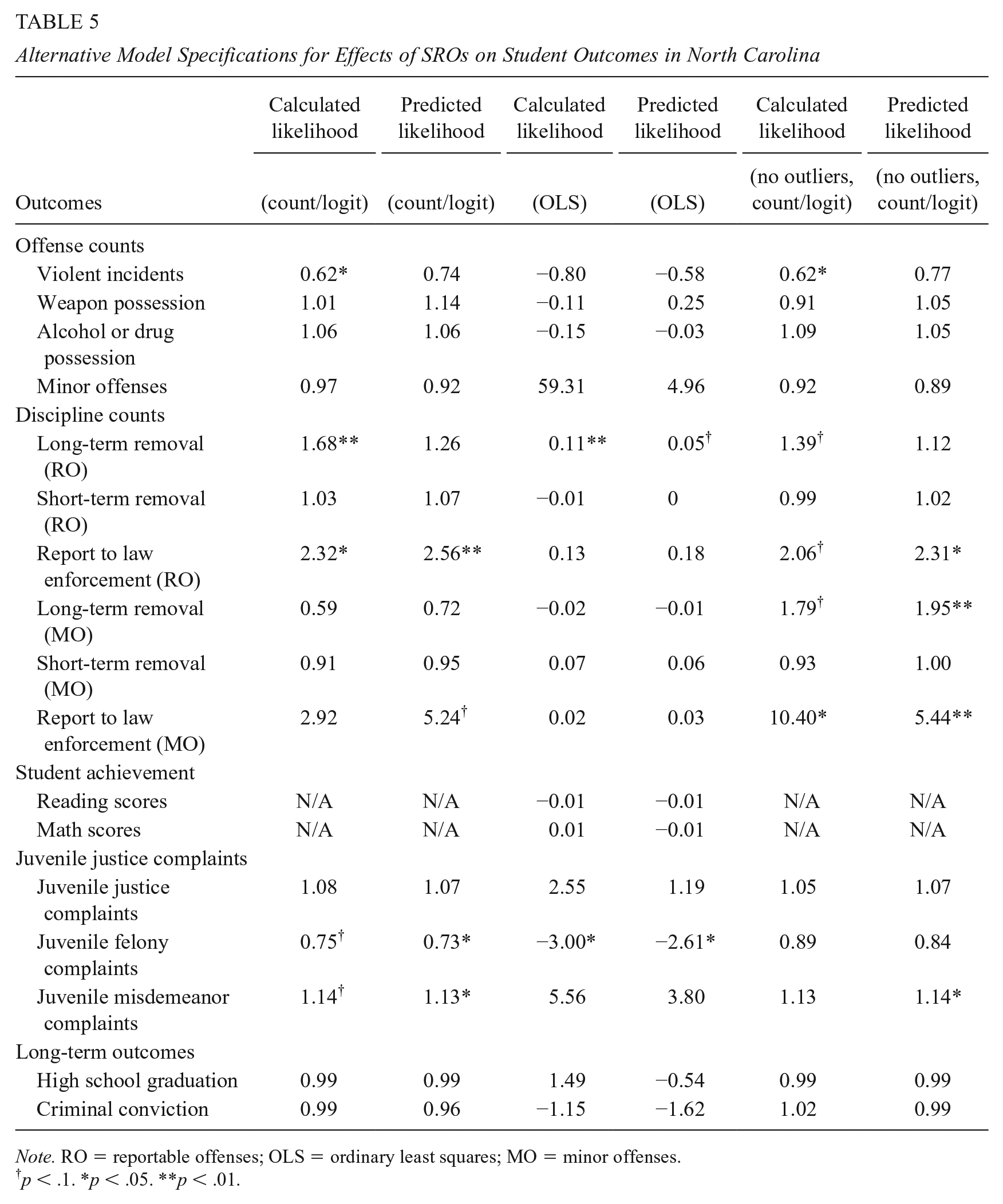
Note. RO = reportable offenses; OLS = ordinary least squares; MO = minor offenses.
p < .1. *p < .05. **p < .01.
The second series of robustness tests looks at different model specifications. First, we perform all negative binomial, Poisson, and logistic regressions from above as OLS regressions. We start by transforming the count variables into rates. For disciplinary offenses, the rate equals the number of offenses per 1,000 students. For disciplinary consequences, the rate equals the number of that type of consequence per offense. For juvenile justice complaints, the rate equals the number of juvenile justice complaints per 1,000 students. For long-term outcomes, the rate equals the number of high school graduations or criminal convictions per 1,000 students. OLS findings are also provided in Table 5, Columns 3 and 4. Generally, the direction of SRO effects found in the OLS results mirrors those from nonlinear models, although there are some changes in statistical significance. Second, we replicate the count regression models excluding outliers at the top of the distribution (observations above the 95th percentile), with results presented in Columns 5 and 6. Under this restriction, coefficients on SRO still consistently indicate reductions in violence and increases in long-term removals for reportable offenses, but also now indicate large increases in long-term removals and referrals to law enforcement for minor offenses. These additional findings—though neither contradictory nor particularly surprising—do show that the results for minor offenses are more sensitive to specification changes given their short span of data coverage. The effects of SROs on juvenile felony complaints are more sensitive to outliers, but the results for total juvenile justice complaints and misdemeanor complaints are robust across specifications.
To examine directly the trends of outcome variables prior to and following SRO appointment, we also conduct event study analyses shown in Supplementary Appendix Figures A2a to A2f in the online version of the journal. We restrict outcomes to short-run outcomes for which we have all 5 years of data. We exclude any schools which lose an SRO during the time period of study and define the treatment event as moving from an SRO value of less than 1 to an SRO value of 1. The control group is therefore the set of all schools which have no change in SRO assignment during 2005–2009. Unfortunately, this event study analysis is underpowered due to the short time period of study, the fact that many SROs are introduced in 2009, and the loss of sample from removing schools that lose SROs during the study period. We can therefore make very limited inference from these graphs, other than a descriptive observation that pretreatment trends do not differ significantly between schools receiving an SRO and those not receiving one.
Concluding Discussion
In keeping with the community policing model, SROs occupy a unique role in the typical middle school. They have no authority to execute school discipline or other school policy, a power that functions directly through school administrators. On the contrary, they have the power to implement law enforcement solutions (i.e., arrest) without direct constraint by administrators such as principals, who have no direct authority over SROs. Although previous research has examined student and staff perceptions of school safety and school climate under this unique institutional arrangement, less research has estimated the impact of SROs on actual student and staff behavior. Our article uses rigorous methods to focus on the impact of SROs on referrals of student misbehavior, and disciplinary responses to those referrals, within schools.
First, we find that SROs reduce serious violent behavior on school grounds, but have no effect—positive, or negative—on weapon, drug, or alcohol offenses. The introduction of SROs typically subjects students to tighter scrutiny (Kupchik, 2010), which could hypothetically increase the number of recorded disciplinary offenses given the same level of student misconduct. In fact, prior studies consistently found that SRO presence increases the number of recorded drug and weapon-related offenses (Gottfredson et al., 2020; Zhang, 2019). Yet, we find that increasing SRO presence in North Carolina middle schools substantially decreases the number of recorded serious violent offenses and has a null effect on the number of recorded drug or weapon possession. Either, SROs do not significantly improve detection of crimes in the case of North Carolina middle schools, or these findings support the value of SROs in effectively preventing student involvement in criminal activities on campus.
Second, SROs integrate into the school disciplinary process of both serious and minor incidents. When a school increases its SRO presence, referral to law enforcement per serious offense and per minor offense both rise substantially, particularly for Black and Hispanic students. Similarly, we show that SROs substantively increase the use of short-term OSS per serious offense among Hispanic students and the use of long-term OSS, transfers to alternative schools, or expulsions per serious offense among Black students. Because SROs are often the last stage of the triage hierarchy (first teachers, then school administrators) in response to student misconduct (Thurau & Wald, 2009), these results indicate that teachers and school administrators are asking SROs to intervene in both serious incidents and minor student misconduct that are clearly school discipline matters. Despite increasing referral to law enforcement per offense, an increase in SRO presence does not result in a substantially greater number of juvenile justice complaints against students. Overall, our findings imply that although SROs in North Carolina primarily seek noncriminal justice strategies to deal with student problems when asked to intervene, these strategies still disproportionately intensify the punitive environment faced by Black and Hispanic students within schools.
This result that SROs are associated with increased exclusionary disciplinary consequences per offense for students of color is usually interpreted as a danger of SROs (Weisburst, 2019) because school disciplinary removals are linked to reductions in adult educational attainment and increased adult conviction rates (Bacher-Hicks et al., 2019). However, in this study, we do not find evidence that increased SROs in middle schools translate into long-term consequences for educational attainment or conviction within the adult criminal justice system. This stands in contrast to Weisburst (2019), who concluded that longer periods of SRO exposure led to decreased student likelihood of high school graduation. We hypothesize that this divergence in results arises due to our exclusive focus on middle school SROs, rather than both middle and high school SROs. More generally, given the shift toward a crime control paradigm in the definition and management of student deviance in schools over the past several decades (Hirschfield, 2008), the benefits of utilizing school disciplinary strategies in place of criminal justice strategies for crime control may have diminished. School administrators and SROs may need other less exclusionary options to help foster and maintain safe schools (Cook et al., 2010).
One limitation of our study is that it does not have an independent measure of student misbehavior—instead, we must rely on reported disciplinary events in the school. We cannot rule out the possibility that SROs themselves affect the reporting of these events. We also have imperfect measures of minor disciplinary misconduct and referrals to law enforcement, which are only available for 2 years within our data set. The large observed increases in referrals to law enforcement should be interpreted with caution. At the same time, our measure of the likelihood of SRO exposure for partial coverage counties introduces measurement error into the key independent variable, which should bias our estimates toward zero.
The lack of detailed data on SRO officers in schools is at least a partial function of the fact that these SROs do not work for the school, but rather the local police agencies. As a result, we have detailed data on teachers and principals, but not SROs. Because we do not directly observe either the characteristics of the SRO or their direct interactions with students or disciplinary processes within the school, we cannot assess whether SRO demographic characteristics, experience, or training matter. We are also unable to determine whether overt police powers such as arrest were necessary to achieve the safer school environment, although suspensions and expulsions certainly appear to be at least one part of the strategy.
It is also important to remember that this article studies the introduction of SROs through state funding during a relatively short time span relatively late in the development of SROs in North Carolina. SROs were a regular feature in many North Carolina schools well before the start of our study. As a result, the results apply to relatively later adopting schools, and the general pattern may differ earlier in the process, particularly if the initial or the most intense efforts are targeted at schools with a disproportionate number of Black students (Nolan, 2011; Zhang, 2019). It is also important not to make inferences about what would happen if North Carolina removed SROs based on this study. We are studying mostly a period of increase—and the process of removal may be quite different, particularly given that other school personnel may have changed their practices and policies in response to having an SRO in the school full time.
As school districts across the United States assess the future role of police in schools, it is important to compare the current model to proposed alternatives. Consider for example the proposal that SROs be limited to interactions with students that deal only with serious violence like those associated with the mass shootings where referral to police is required by law (Pittsburgh Board of Directors, 2020). Proponents of SROs might note that this kind of proposal directly contradicts the ideals of the community policing model, which emphasize daily interactions and regular and repeated cooperation between police and community members, usually on small, less serious matters. The kind of policy statement considered by the Pittsburgh public schools also displays a basic assumption that the discretion of police and school administrators is what leads to the racial disparity in formal punishment. The solution then is to prescribe responses into policies and indeed even law. Future research should assess whether this is truly the case, and whether school environments with more discretion in discipline and policing, as compared to those with less discretion, fare better for equity in student outcomes. Previous policy attempts to reduce discretion in school discipline—namely, zero tolerance policies—were associated with more racial disparity, rather than less (Hirschfield, 2008).
It is possible that the fact that these new attempts to remove discretion will lead to different outcomes because they are occurring in an environment which seeks to reduce, rather than increase, the overall use of disciplinary tools. It is also possible that the extraordinary low rates of juvenile arrest and delinquency currently enjoyed in the United States will help create different outcomes. This may be especially true in an environment where we are seeing large decreases in the rate of racial disparities in the adult criminal justice system (Sabol et al., 2019). Will racial disparities in the juvenile system and the school disciplinary system also follow suit?
The current evidence shows that schools have made some progress in the effort to reduce the use of suspensions and racial and ethnic disparities in the use of suspensions. In response to the detailed guidance from the U.S. Department of Education on reducing exclusionary and discriminatory discipline, more than 50 of the largest U.S. school districts instituted discipline reform and many states revised their laws to try to reduce exclusionary and discriminatory discipline (Kaymenetz, 2018). The most recent evidence from the U.S. Department of Education found that the suspension rate has dropped from 5.6% to 4.7% from 2012 to 2016, with the reduction concentrated among members of Black and Hispanic students and students with disabilities. Indeed, the Black–White racial disparity for both K–12 students and high school students has been reduced by 33% and there appears no longer to be any meaningful difference in the suspension rates of White and Hispanic students (Harper et al., 2019; see also evidence from North Carolina—Public Schools of North Carolina, 2020). These changes may not be universal across all schools—future research should investigate whether the observed changes depend in meaningful ways on the racial environment within the school (e.g., predominantly Black or Hispanic vs. integrated), which has been shown to be correlated with the disciplinary environment (Ramey, 2015).
In part because of the wide variations across schools in disciplinary environments (Sorensen et al., 2021), the removal and restriction of SROs could have significant implications for this largely positive trend in fewer suspensions, particularly for Black and Hispanic students. If the introduction of SROs is working counter to the recent decline in suspensions and racial disparity in suspensions, which is what our results suggest, then their removal or restriction should accelerate this encouraging trend. However it is at least plausible that the removal of the police could in the short term destabilize schools, particularly in secondary schools where police are now the norm, rather than the exception. Removing police without designating and supporting alternative groups to ensure school safety risks a rise in violence and subsequent growth in support for punitive school discipline (Sharkey, 2020).
President’s Task Force on 21st Century Policing (2015) recognized the need for policing reform across the United States, including reforms to school-based policing, and introduced several policy recommendations. These recommendations ask law enforcement agencies to collaborate with schools to: (a) remove procedures that push children into the juvenile justice system; (bi) encourage alternative strategies such as restorative justice, youth courts, and peer interventions; (c) adopt instructional approaches to discipline that help students develop new behavior skills and positive strategies to avoid conflict, redirect energy, and refocus on learning; (d) create a continuum of developmentally appropriate and proportional consequences for addressing ongoing and escalating student misbehavior; and (e) establish memoranda of agreements for the placement of SROs that limit police involvement in school discipline.
Our study calls attention to tensions created by these lofty goals—particularly when they call for an explicit delinking of the school safety function and school disciplinary process. Our findings show that, if anything, SROs strengthen the link between school safety and school discipline. As schools increasingly transition from the punitive disciplinary model to more preventive and restorative approaches to discipline (Osher et al., 2010; Valdebenito et al., 2019), future research should explore whether the current training and day-to-day practices of SROs still fit these approaches. Such research could track in finer detail the daily interactions between SROs and their students and administrators (such as Curran et al., 2021) to identify specific helpful and/or harmful practices, with special attention to the connection between school safety and school discipline. Of course, this form of rigorous review and evaluation requires data not currently in existence. For education agencies to make timely, informed decisions about SROs, they must first prioritize collecting and publishing widespread data on the placement and activities of police in schools.
Supplemental Material
sj-docx-1-epa-10.3102_01623737211006409 – Supplemental material for Making Schools Safer and/or Escalating Disciplinary Response: A Study of Police Officers in North Carolina Schools
Supplemental material, sj-docx-1-epa-10.3102_01623737211006409 for Making Schools Safer and/or Escalating Disciplinary Response: A Study of Police Officers in North Carolina Schools by Lucy C. Sorensen, Yinzhi Shen and Shawn D. Bushway in Educational Evaluation and Policy Analysis
Footnotes
Acknowledgements
The authors are grateful for feedback from Frank Edwards, Emily Owens, Mo Canady, David Weisburd, anonymous reviewers, participants of the PAA session on Child and Youth Exposures to Criminal Justice, the Northeast Economics of Education Workshop, the NIJ Virtual Conference on School Safety, and the APPAM session on Schools, Crime, and Policing. They would like to thank Alexander Morse and Hui-Shien Tsao for data assistance. They are also appreciative of conversations with Elizabeth Gifford and many public officials and practitioners within North Carolina schools and law enforcement, which have informed this work.
Declaration of Conflicting Interests
The author(s) declared the following potential conflicts of interest with respect to the research, authorship, and/or publication of this article: S.D.B. prepared the work as employee of RAND Corporation. Any opinions expressed in this publication are those of the authors and not necessarily of RAND Corporation.
Funding
The author(s) disclosed receipt of the following financial support for the research, authorship, and/or publication of this article: This research is supported by Award 2017-CK-BX-0006 from the National Institute of Justice, Office of Justice Programs, U.S. Department of Justice. The opinions, findings and conclusions expressed in this publication are those of the authors and do not necessarily reflect the views of the Department of Justice.

Notes
Authors
LUCY C. SORENSEN is an assistant professor of public administration and policy in the Rockefeller College of Public Affairs and Policy at University at Albany, SUNY. Her research uses econometric methods to explore issues related to K–12 education policy, human development, and social inequality.
YINZHI SHEN is a postdoctoral research associate at the Office of Population Research of Princeton University. Her research uses quantitative methods (including demographic techniques and causal inference) to understand crime and social control in neighborhood and school context, macro trends in punishment, and cumulative disadvantage in punishment over the individual life course.
SHAWN D. BUSHWAY is a senior policy researcher at RAND Corporation. He is an economist/criminologist who studies various aspects of criminal justice policy. He is particularly interested in policies, like school resource officers and background checks, where the criminal justice system interacts with other government systems (i.e., schools) or life domains (i.e., employment).
References
Supplementary Material
Please find the following supplemental material available below.
For Open Access articles published under a Creative Commons License, all supplemental material carries the same license as the article it is associated with.
For non-Open Access articles published, all supplemental material carries a non-exclusive license, and permission requests for re-use of supplemental material or any part of supplemental material shall be sent directly to the copyright owner as specified in the copyright notice associated with the article.
