






Abstract
Research concerning family preferences for schooling indicates that they value proximity to home as much as academic quality when choosing schools. However, preferences for proximity likely represent inability to access schools farther away from home, especially for disadvantaged students. I test whether distance and district boundaries constrain access to high-performing and effective schools for Detroit students where families choose between intradistrict, interdistrict, and charter schools, as well as an assigned school. I employ a unique data set that includes enrollment records, addresses, and commute times for Detroit residents regardless of where they attend school. Results show that disadvantaged students have little access to the highest quality schools available, specifically those outside Detroit. However, students attend higher performing schools within Detroit.
Keywords
Some proponents of school choice argue that it can increase the supply of effective schools in addition to access to these schools. In theory, allowing students to attend schools outside of their neighborhood or even their local district breaks the monopoly that individual schools and districts have on students and thus creates competition for students. This encourages the establishment of many schools with a variety of curriculum, offerings, and management strategies to meet the needs and preferences of students and their families. Under such a system, schools may change their offerings to meet families’ preferences to attract students. If they fail to attract students, they will shut down. Therefore, competition for students would result in the creation of a more effective supply of schools as long as parents prefer academic performance or school’s effectiveness in increasing achievement, have accurate and transparent information concerning school quality, and the ability to overcome barriers associated with attending school outside of their neighborhood (Chubb & Moe, 1990; Friedman, 1962).
Critics of this theory have argued that competition, by itself, cannot regulate the quality of the supply of schools. Since schooling is compulsory, schools will draw students regardless of the school’s quality if there are no other options or at least no more effective options. Furthermore, there is little incentive for effective or high-performing schools to expand their capacity (Harris, 2017). Therefore, more recent school choice scholars have proposed systems of managed competition or portfolio models where schools are held accountable for their academic performance by districts or authorizers in addition to families (Harris, 2017; Hill, 2006). These proposals also call for cooperation and coordination across schools within an education market to regulate not only the quality but also the quantity of schools.
Regardless of whether school choice policies increase the supply of effective schools, these policies will only increase access to more effective options if there is demand for effective schools. To accomplish this, families must prefer academic quality over other school characteristics, effective schools must be accessible, and there must exist accurate and transparent information concerning school quality (Harris, 2017; Levin, 2015). Prior work on parent preferences in choice-rich environments finds that families do value academic achievement. However, there are other school characteristics they value similarly. The most prevalent is proximity to home—even in a market where many schools are in principle available (Denice & Gross, 2016; Glazerman, 1998; Glazerman & Dotter, 2017; Harris & Larsen, 2019; Hastings et al., 2005; Lincove et al., 2018; Singer, 2020). Although much of this literature frames proximity as a preference, distance is likely a constraint on the quantity of schools families have the ability to attend, particularly for the most disadvantaged students. Families living in high-poverty neighborhoods are less likely to have access to a car (Urban Institute Student Transportation Working Group, 2018). Furthermore, most parents in choice-rich cities report that they drive their students to school with about one third reporting transportation as a barrier to their preferred schools (Jochim et al., 2014).
In this article, I test whether distance and district boundaries are constraints to accessing high-quality and effective schools, as measured by academic performance, for students living in Detroit, Michigan. Detroit provides an ideal context to test whether the supply of effective schools is constrained by geographic barriers for a few reasons. First, Detroit students have many schooling options that are geographically dispersed. They can choose from schools within their own district (intradistrict choice), schools in surrounding districts (interdistrict choice), and charter schools. In addition, there is little accountability, coordination, transparency, or accessibility in the Detroit education market. Michigan’s charter school law receives high marks from pro-school choice organizations for its lack of regulation on and use of nondistrict authorizers (Candal, 2018; Ziebarth, 2019). As universities and colleges can authorize charter schools throughout the state with little oversight from the state or districts and there are no caps on brick and mortar open enrollment charter schools (Michigan Department of Education [MDE], 2017), little coordinated oversight of the quantity or quality of schools exists in and around Detroit. Also, there exists no centralized enrollment system or universal transportation policies for Detroit schools unlike other cities with similar levels of choice, including New Orleans. As Detroit has an unrestrained supply of schools with little regulation on their accessibility, it is an ideal case to test whether geography constrains families’ ability to attend preferred schools in absence of universal enrollment or transportation policies. Furthermore, this permits the test of the role of the residentially assigned school in school choice decisions as well. In sum, I test whether the mere existence of school choice policies are enough to provide meaningful choice between schools.
To do so, I first describe the role of geography, in terms of district boundaries and distance, in the use of formal school choice policies. I focus on whether students who are disadvantaged in terms of poverty or access to transportation are more or less likely to use school choice. Furthermore, recognizing that in a high-choice environment the decision to enroll in one’s default neighborhood school is itself a “school choice,” I provide some of the first evidence for the ways in which a student’s residentially assigned school may factor into family decision making. I accomplish this using a set of multinomial logistic regressions that predict sector and location of school attended as a function of student and assigned school characteristics. Then, I test whether Detroit students attend more effective schools, as measured by their contribution to student’s test scores, or schools with higher levels of achievement within their choice sets using discrete choice models. More specifically, I ask the following questions:
I provide evidence that families’ choice sets are likely constrained to within city boundaries or within their traditional public school (TPS) district. Specifically, disadvantaged students, particularly those living in neighborhoods where families have lower incomes and do not have access to a car are less likely to participate in public school choice, especially the options located outside of city limits. Furthermore, I show that families’ preferences for academic quality and school effectiveness are stronger when choice sets are restricted to schools within Detroit or DPSCD and in earlier grades. I conclude by recommending that increasing the accessibility of choice options through transportation and enrollment policies may increase access to effective schools in a choice-rich system.
This study adds to the literature concerning preferences for schools in choice-rich cities in multiple ways. First, it is one of the few studies to frame distance and district boundaries as barriers to attending effective schools instead of a preference, especially for disadvantaged families. Furthermore, I test whether these constraints limit access to academic quality. Also, I describe choice in a deregulated environment that lacks a centralized enrollment system, retains little local control of the supply of schools, and allows students to attend schools outside of district boundaries. In particular, this article is one of the first to expand students’ choice sets to include choices available through interdistrict choice—a prevalent but understudied form of choice—where other major forms of choice within multiple public school systems is possible.
Motivation: Supply of, Demand for, and Access to Effective Schools in Choice-Rich Areas
Supply
Although school choice advocates argue that school choice can increase the effectiveness of the supply of schools, little empirical evidence exists that competition, by itself, increases school quality, even when there are preferences for school effectiveness. First, studies of school leaders’ perceptions of and responses to competition for students in Milwaukee and New Orleans, two choice-rich cities, find that schools are more likely to increase the marketing of their schools than improve achievement or instruction in response to competitive pressures (Jabbar, 2015; Loeb et al., 2011). Furthermore, studies that measure the extent to which competitive pressures from charter and private schools increase achievement of students remaining in traditional public schools find some small positive effects (Booker et al., 2008; Cordes, 2017; Figlio & Hart, 2014; Sass, 2006; Winters, 2012) with some studies finding no effect (Zimmer & Buddin, 2009; Zimmer et al., 2009), and one finding some negative effects (Imberman, 2011).
A set of studies of school choice in New Orleans also illustrate that even when there is demand for academic quality, competition, by itself, may not increase the supply of effective schools. In New Orleans, research shows that families have preferences for schools with high levels of academic achievement as measured by school performance ratings (Harris & Larsen, 2019; Lincove et al., 2018). Although families listed high-performing schools as their preferred option on the common application, less than 40% of students attend their first choice schools. Most attend lower quality schools than their first choice due to the limited supply of high-performing schools in New Orleans (Lincove et al., 2018). Furthermore, a recent study finds that most of the improvements in the effectiveness, as measured by value-added measures, of the supply of schools in New Orleans over time can be attributed to the takeover of low-performing schools and the opening of higher quality schools rather than the development of existing schools (Harris et al., 2019). Most of these takeovers and openings were a result of the performance-based charter authorizing process instead of competition by itself (Bross et al., 2016).
Demand
Taken together, there is inconsistent evidence that shows that school choice policies create a more effective supply of schools without external performance accountability. However, these policies can still increase access to effective schools if three conditions are met: Families must have strong preferences for academic performance, the ability to overcome barriers associated with attending a school other than the assigned school, and accurate information concerning school quality (Chubb & Moe, 1990; Harris, 2017; Levin, 2015). I discuss the empirical evidence concerning each of these assumptions in turn.
Parental Preferences
When surveyed, parents state that the most important single factor when choosing a school is academic quality. This stated preference is especially strong for low-income families (Bell, 2009; Jochim et al., 2014; Schneider & Buckley, 2002; Schneider et al., 1998). Nonetheless, self-reported preferences are subject to social desirability bias. For example, when surveyed, Washington, D.C., parents reported that they prioritize academic quality over other factors in their school search. However, an analysis of their internet searches shows that parents search schools’ student demographics and location more often than their test scores (Schneider & Buckley, 2002).
Studies that use parents’ rank-ordered (i.e., revealed) preferences on enrollment applications show that parents value higher levels of academic achievement, as measured by the schools’ average test scores, accountability ratings, and peer quality (Abdulkadiroğlu et al., 2020; Beuermann et al., 2019; Denice & Gross, 2016; Glazerman, 1998; Glazerman & Dotter, 2017; Harris & Larsen, 2019; Hastings et al., 2005; Lincove et al., 2018). Results concerning preferences for effective schools, as measured by their contribution to student achievement as growth percentiles or value-added measures, are mixed. In New York City and Washington, D.C., there is little evidence that families prefer schools with larger contributions to student achievement (Abdulkadiroğlu et al., 2020; Glazerman & Dotter, 2017). In contrast, studies of New Orleans and Trinidad and Tobago find that parents value schools with higher value-added measures on high stakes tests in addition to overall achievement (Beuermann et al., 2019; Harris & Larsen, 2019). In this study, I use state-calculated accountability ratings and author-constructed school-level value-added measures to test whether parents prefer academic quality when choosing schools.
Although parents have strong preferences for academic achievement, they value other qualities as well as achievement. Studies of Washington, D.C., and Minneapolis show that families prefer schools where their child is not a racial minority (Glazerman, 1998; Glazerman & Dotter, 2017). Specifically, Denice and Gross (2016) find that White families in Denver have preferences for schools with few racial minority students. In New Orleans, families have a strong preference for extracurricular activities and child care (Harris & Larsen, 2019). In addition, some evidence exists that families prefer district-run schools as well as private schools over charter schools in Denver and New Orleans (Denice & Gross, 2016; Lincove et al., 2018).
One of the most valued school characteristics is proximity from home (Abdulkadiroğlu et al., 2020; Beuermann et al., 2019; Denice & Gross, 2016; Glazerman, 1998; Glazerman & Dotter, 2017; Harris & Larsen, 2019; Hastings et al., 2005; Lincove et al., 2018; Singer, 2020). Families prefer schools that are closer to home, have shorter commutes, and are accessible by public transportation. To my knowledge, only one other study examines student choice sets constrained by geography. Denice and Gross (2016) find that when choice sets are restricted to a 2-mile radius around a student’s home, all families, regardless of race, have strong preferences for high-performing schools, implying that distance is a possible constraint to access to effective schools. I add to this literature by providing some of the first empirical evidence that families’ choices—especially those of income-disadvantaged families—are meaningfully constrained by distance and geography even with multiple options legally available. In addition, I examine the role of the student’s assigned school in their use of school choice. Then, I use this information to restrict students’ choice sets to estimate their underlying preferences for academic quality.
Preferences for school characteristics also vary across race, income, and academic ability. Racial minority, lower income, and lower achieving students have an especially strong preference for proximity that outweighs their preference for academic achievement (Denice & Gross, 2016; Harris & Larsen, 2019; Hastings et al., 2005). For example, Hastings et al. (2005) find that as their child’s test score and their income increase, families are more willing to travel farther to access higher quality schools. Differential preferences between advantaged and disadvantaged students could create a two-tiered system where high-income and high-achieving students attend high-performing schools and whereas low-income and low-achieving students are stuck in their neighborhood schools (Hastings et al., 2005).
Barriers to Access
The difference in stated and revealed preferences, particularly for disadvantaged students, may be driven by constraints on their ability to overcome barriers associated with attending school outside of their neighborhoods. First, the revealed preference for schools closer to home could in fact be due to a lack of access to transportation. Families may be unable, but not unwilling, to attend higher quality schools farther from home. Few states require schools to provide transportation to students using choice policies to attend them (McShane & Shaw, 2020). Thus, it tends to be the sole responsibility of the parent to get their child to and from school every day. This may be particularly difficult for low-income families who are less likely to have access to a car or other forms of direct transportation (Urban Institute Student Transportation Working Group, 2018). In choice-rich cities, over 20% of parents report that transportation is a barrier in sending their child to the school of their choice (Jochim et al., 2014). Furthermore, differences in preferences for academic achievement by race disappear when choice sets are restricted to schools close to home (Denice & Gross, 2016). Therefore, it is likely that students attend schools near their residence out of necessity rather than solely preference.
Another likely set of barriers to access to effective schools is enrollment systems, practices, and policies. Parents, especially disadvantaged parents, cite application deadlines, the number of applications, difficulty with paperwork, and confusion with eligibility requirements as problems when choosing schools (Jochim et al., 2014). Furthermore, unregulated enrollment systems could create unequal access by providing opportunities for schools to select the best students or push out lower achieving students. One solution that can ease the burden on parents and create more equitable opportunities is unified enrollment systems where parents only fill out one application and a third party determines enrollment through a random lottery. At least eight cities have instituted a unified enrollment system over the last decade (Ekmekci & Yenmez, 2019). Parents in Denver report that the common application made the enrollment process more manageable (Gross et al., 2015). Furthermore, causal evidence exists showing that the adoption of the unified enrollment system increased the percent of minority students and English Learners participating in charter school choice in Denver (Winters, 2015).
Accurate and Transparent Information
Families also need accurate information on school quality to choose effective schools. Few families have accurate information on the school’s contribution to learning or achievement and instead rely on the social connections and the demographics of the student body to determine school quality (Schneider & Buckley, 2002; Schneider et al., 1998). About a quarter of families reported that they were unable to find an adequate amount of information to make the best school choice decision for their child (Jochim et al., 2014). However, information interventions that send school-level achievement information to families have increased the number of students attending effective schools (Hastings & Weinstein, 2008; Valant, 2014). Although many unified enrollment systems also increase the amount of publicly available information concerning school quality and offerings, parents in cities with these systems report wanting more tailored and rich information about schools (Gross et al., 2015).
Background on School Choice in Michigan and Detroit
The amount of choice, and, in particular, the lack of centralized planning concerning the quantity and quality of schools serving Detroit students has been indicated as a contributor to the well-documented financial decline and eventual bankruptcy of Detroit Public Schools (Strauss, 2016). Detroit has an option demand choice system where students are assigned to a school within the newly formed Detroit Public Schools Community District (DPSCD) based on their residence but can option to attend other schools if the receiving school has space available similar to Denver and Washington, D.C. (Bell, 2009). For over 20 years, Detroit students have been able to attend charter schools located inside and outside of Detroit, schools in other districts, and other traditional public schools in Detroit instead of their assigned school. The Michigan legislature passed Act 105 of the Revised School Code in 1996 enacting the Schools of Choice Program, which oversees interdistrict choice in Michigan (MDE, 2013). Under Acts 105 and 105c, Michigan school districts have the option to accept students from other districts in their intermediate school district and surrounding intermediate school districts (ISDs). Districts that choose to receive students through Schools of Choice decide the number of students they enroll; the grades, programs, and buildings nonresident students can enroll in; and the timeframe they accept applications. Thus, sending districts, including Detroit, are not guaranteed to enroll a majority of their resident population. If a district chooses to not participate in Schools of Choice, they still are able to make agreements with specific districts to accept their students or they can accept nonresident students on a case-by-case basis. Districts are not required to provide transportation to nonresident students, but they can if they choose to do so (MDE, 2013). For example, less than 20% of Metro Detroit TPS districts offer any transportation to nonresident students, with only two of almost 70 districts reporting that they will cross district boundaries to provide transportation. During the 2017–2018 school year, Detroit students attended 60 different traditional public school districts within the three surrounding intermediate school districts.
In addition, Michigan districts can choose to allow students to attend schools other than the one they are assigned to within the district through intradistrict choice. Within DPSCD, students are able to choose from their assigned school, other neighborhood schools, and magnet schools. There were 24 magnet schools in DPSCD, with 14 having competitive application or examination requirements during the 2018–2019 school year. DPSCD only guarantees transportation to K–8 students who attend their assigned school and live at least three quarters of a mile away from their school. All DPSCD high school students receive bus passes (Urban Institute Student Transportation Working Group, 2018).
Furthermore, Detroit has one of the highest rates of charter school attendance of cities in the United States at almost 50%. Only New Orleans and Washington, D.C., have a higher percent of students attending charter schools (Hesla et al., 2019). In 1993, Michigan adopted Part 6A of the Revised School Code, which allowed districts, intermediate school districts, community colleges, and universities to authorize charter schools (MDE, 2017). In contrast with the majority of charter school laws in the United States, authorizers in Michigan may approve applications for charter schools located anywhere in the state without oversight from state or local governments (Wixom, 2018). Thus, there is no one body overseeing where schools open, how many schools open, when schools open or close, and what types of schools exist in Detroit. In contrast, New Orleans only allows the Orleans Parish School Board and the state to authorize charter schools (Wixom, 2018). While charter schools in Michigan cannot practice selective admissions policies, enrollment may be a barrier since each charter school oversees its own application process leaving families to apply to each school individually with no guarantees of enrollment in contrast to Denver, Washington, D.C., and New Orleans which have centralized enrollment systems. Furthermore, charter schools are not required to provide transportation to its students, unlike New Orleans and Washington, D.C. (Urban Institute Student Transportation Working Group, 2018). During the 2018–2019 school year, there were 380 charter schools operating in Michigan, with almost one hundred located within the boundaries of DPSCD.
Compared with other choice-rich cities, including New Orleans, Denver, and Washington, D.C., Detroit’s system of school choice remains one of the least regulated due to its lack of planning concerning school openings and closings, centralized enrollment systems, and universal transportation policies. When the Michigan legislature was crafting the bailout of Detroit Public Schools in 2016, the creation of a nonpartisan entity, the Detroit Education Commission, was proposed to oversee the opening and closing of schools, serve as an accountability mechanism, manage a centralized enrollment system, and coordinate transportation needs across all traditional public schools and charter schools in Detroit (Coalition for the Future of Detroit Schoolchildren, 2015). Although the state approved the return of an elected school board and the creation of a new debt-free school district, the Detroit Public Schools Community District, no citywide oversight, enrollment system, or transportation policy was put in place (Gray, 2016).
During his 2018 State of the City address, Mayor Duggan announced the Get On and Learn bus loop (GOAL Line) as one of the first efforts of citywide coordination between DPSCD and charter schools. His objective was to decrease the number of Detroit residents attending schools outside of the city since over 20% were leaving the city every day to attend school (Levin March 21 2019). Currently, 14 schools in northwest Detroit, half of which are charter schools, participate in the bus loop where students can get on at any of the schools to travel to any other school on the loop (Community Education Commission, 2019). In addition to transportation to and from school, GOAL Line provides transportation to an after-school program. An analysis of ridership and parent surveys finds that GOAL Line is mostly used for its after-school program rather than transportation (Edwards et al., 2019).
Data
The main sources of data for this article are student-level records from 2012–2013 to 2017–2018 provided by the MDE (MDE) and the Center for Educational Performance and Information (CEPI). These records include student addresses geocoded at the census block level, student demographic information (e.g., race and ethnicity, gender, disability status, English Learner status, and economic disadvantaged status 1 ), and student test scores on the Michigan Student Test for Educational Progress (M-STEP) for all Michigan public school students. I generate the school-level variables used in my analysis from the student-level data and a variety of publicly available data sets made available by MDE and CEPI. These school-level data sets contain information about all schools in Michigan including the school’s sector, address, their accountability rating on Michigan’s Overall School Index System, and graduation rates. In addition, I create a set of variables describing the programs schools offer using the 2018–2019 Detroit Parents’ Guide to Schools, which includes application requirements, uniform requirements, transportation, before/after school care, and top activities for all public schools located within the boundaries of DPSCD. Finally, I use 2017–2018 catchment zone boundaries provided by DPSCD to determine students’ residentially assigned schools. 2
Measures of Sector and Location
To answer my research questions, I estimate the relationships between student and school characteristics and the use of choice for students living in Detroit during the 2017 to 2018 school year. As discussed above, Detroit students can attend their assigned school, other DPSCD schools, TPS in other districts, and charter schools located inside and outside of city limits. Therefore, I define use of choice as a categorical variable with five mutually exclusive outcomes determined by the sector and location of the school attended: the student’s assigned school, another DPSCD school, a charter school located inside of Detroit, a TPS in another district, and a charter school located outside of Detroit. First, I determine the students’ assigned schools using the coordinates of the population weighted centroids of their residences and the 2017–2018 DPSCD catchment zones. I consider all other DPSCD schools, regardless if they are neighborhood or magnet schools, as Other DPSCD schools for that particular student. I determine whether or not a charter school and is located inside or outside of Detroit using the school’s coordinates and the 2016–2017 Michigan school district boundaries from the Michigan Department of Technology, Management, and Budget, the most recent year available at the time of analysis.
I calculate driving times (in minutes) for each student from his or her census block or tract to his or her assigned school for all students in the sample. For distances within a 2-mile radius (as the “crow flies”), drive times are calculated from the center of each students’ home census block to the center of each school’s census block. For distances more than 2 miles, drive times are calculated from the center from each students’ home census tract to the center of the school’s census tract. I estimate driving times using the Google Distance Matrix application programming interface (API). Because Google API does not calculate drive times from the past, drive times are calculated using predicted travel conditions for weekdays between September 2017 and April 2020 assuming usual traffic at 8:00 a.m. Drive times are calculated for weekdays during the months of the school year where little to no snow would be expected (September through November and March through May).
Measures of Poverty and Access to Transportation
My first research question examines choice use for students who are likely to face difficulty attending schools farther away from home. Two groups of students that are likely to have difficulty overcoming barriers associated with using school choice are impoverished students and students without access to transportation. In addition to the measure of student economic disadvantage provided by MDE and CEPI, I use the median income of the student’s resident census tract from the 2017 American Community Survey (ACS) as a measure of poverty. My first measure of transportation access, which is also from the ACS, is the percent of residents that do not own a car in the student’s resident census tract. As Detroit has an inefficient public transportation system compared with other choice-rich cities and the majority of Detroit parents report driving their children to school, car ownership is likely necessary to transport students to schools outside of their neighborhoods (Jochim et al., 2014; Urban Institute Student Transportation Working Group, 2018).
Another factor in choice use may be whether the school itself provides transportation. The only school a Detroit student may be guaranteed transportation to is their assigned school. Students attending their assigned school and living more than 0.75 miles walking distance from that school may ride the school bus in elementary and middle school. To account for the role of school-provided transportation in decisions to participate in school choice, I create an indicator of transportation eligibility. To determine whether a student is eligible for transportation to their assigned school, I calculate the walking distance from the centroid of the student’s resident census block to the school using Here Technologies API assuming average traffic. I consider students who are in kindergarten through eighth grade who live more than 0.75 miles from their assigned school as eligible for transportation to their assigned school.
In Table 1, I provide summary statistics for my full sample as well as differences by sector of school attended. The vast majority of the students in my sample are Black and economically disadvantaged. Students who attend their assigned school have shorter drive times to their assigned school on average than the students attending schools in other sectors. In addition, students attending schools outside of Detroit live in census tracts with slightly higher rates of car ownership and higher median incomes.
Student and Neighborhood Characteristics by Sector of School Attended
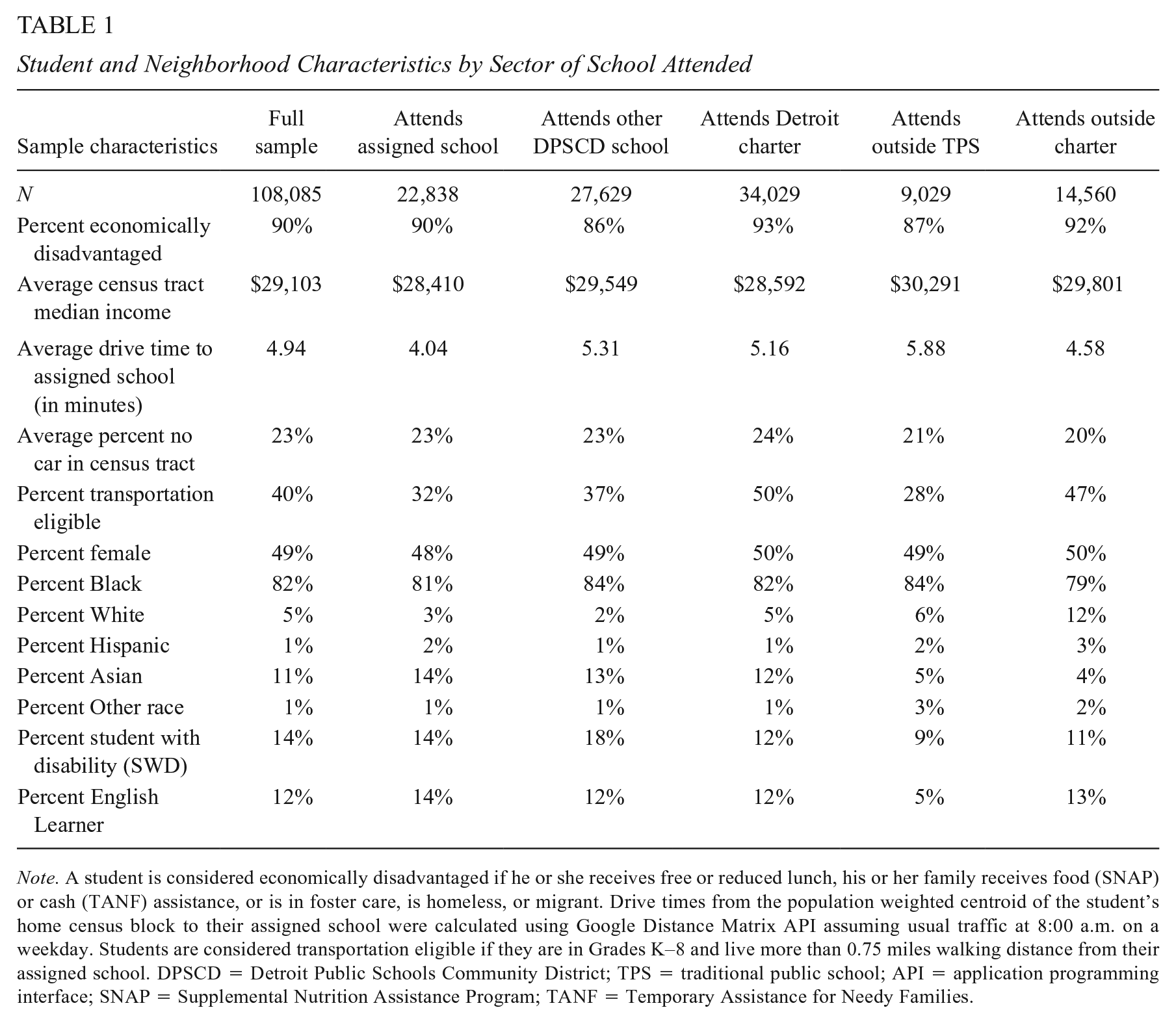
Note. A student is considered economically disadvantaged if he or she receives free or reduced lunch, his or her family receives food (SNAP) or cash (TANF) assistance, or is in foster care, is homeless, or migrant. Drive times from the population weighted centroid of the student’s home census block to their assigned school were calculated using Google Distance Matrix API assuming usual traffic at 8:00 a.m. on a weekday. Students are considered transportation eligible if they are in Grades K–8 and live more than 0.75 miles walking distance from their assigned school. DPSCD = Detroit Public Schools Community District; TPS = traditional public school; API = application programming interface; SNAP = Supplemental Nutrition Assistance Program; TANF = Temporary Assistance for Needy Families.
Academic Quality Measures
The notion of “school quality” is itself a fairly subjective construct, and whether and to what extent schools are held accountable by federal, state, or local jurisdictions for some metric of performance is an enduring debate among education policymakers. This is a particularly important consideration in a study of school choice, which itself is a policy alternative predicated—as I describe above—at least in part on the notion that different families value different aspects of a school’s contribution to their children’s success. On the other hand, school ratings on different dimensions are a relevant part of the current policy environment, and school characteristics—regardless of whether schools are in control of them—can and do constitute an important part of parental decision making, especially in high-choice environments (Lincove et al., 2018).
For these reasons, rather than choosing a single metric of academic quality, I focus on three different metrics that capture different aspects of a school’s academic performance. The measures are the school’s state-generated academic accountability rating, the school’s contribution to student test scores as measures by the school’s value-added measure, and the school’s graduation rate during the 2016–2017 school year. I choose to use the year prior to the sample because this is the information parents would have had to use to make their school choice decisions. In particular, I calculate academic quality as follows:
School’s rating on the Michigan School Index System. Index values range from 0 to 100. This is a composite measure made up of six components: student growth on state assessments, student proficiency on state assessments, school quality or student success, graduation rate, English Learner progress, and assessment participation. This measure is highly correlated with the school’s average performance on state assessments. I use the school’s rating from MDE as a school quality measure because it is made publicly available on a “Parent Dashboard” maintained by the state. I refer to this as a school’s accountability rating or ranking because the index is the accountability system for Michigan schools under the Every Student Succeeds Act (ESSA).
School value-added measure. To measure school’s contribution to student learning, I calculate the school’s value-added measures, the school’s contribution to students’ math and English Language Arts (ELA) test scores, for the 2016–2017 school year for students in Grades K–8. Although value-added measures may be better measures of school quality, they may not be related to family’s preferences for high-quality schools since Detroit families do not directly observe them. To construct school-level value-added measures, I follow the procedure described by Koedel et al. (2015). 3 I choose this procedure because it shrinks the estimated error variance which is preferred when using value-added estimates in secondary analysis as the errors could attenuate the results (Koedel et al., 2015). I report the results of the models using the school’s value-added to math test scores. Results using the ELA measures are similar and available by request.
Graduation rate. Value-added measures are unavailable for most high schools as students are only administered a state standardized exam once between Grades 9 and 12 in Michigan. Therefore, I use 4-year graduation rates as my secondary academic quality measure for students in Grades 9 to 12. In addition, graduate rates have become a typical alternative to test scores as outcome measures in school choice evaluations (Angrist et al., 2016; Wolf et al., 2013).
School Characteristics
To examine other preferences for school characteristics specifically in the Detroit area where this study is focused, I use information on school offerings found in the 2018–2019 Detroit Parents’ Guide to Schools (DPGS), one of the first sources of centralized information on schools in Detroit that includes facts on charter schools in addition to DPSCD schools. I use a data set created from the DPGS that contains information on application requirements, school hours, transportation, before and after school care, uniforms, security, and top activities for all public schools located within Detroit. In addition, prior research has shown that families have preferences for student demographics. To measure the concentration of students by demographic characteristics, I construct the percent of students who are female, Black, White, Asian, Hispanic, Other Race, and economically disadvantaged as well as the percent of students with disabilities and who are English Learners at each school using student-level demographic data.
Table 2 displays the average school characteristics for the student’s assigned school by sector of school attended. Students choosing to leave the city have default options with a higher percentage of Black students on average. Students choosing to attend other DPSCD schools and schools outside of Detroit have assigned schools with lower than average accountability ratings.
Student Weighted Assigned School Characteristics by Sector of School the Student Attends
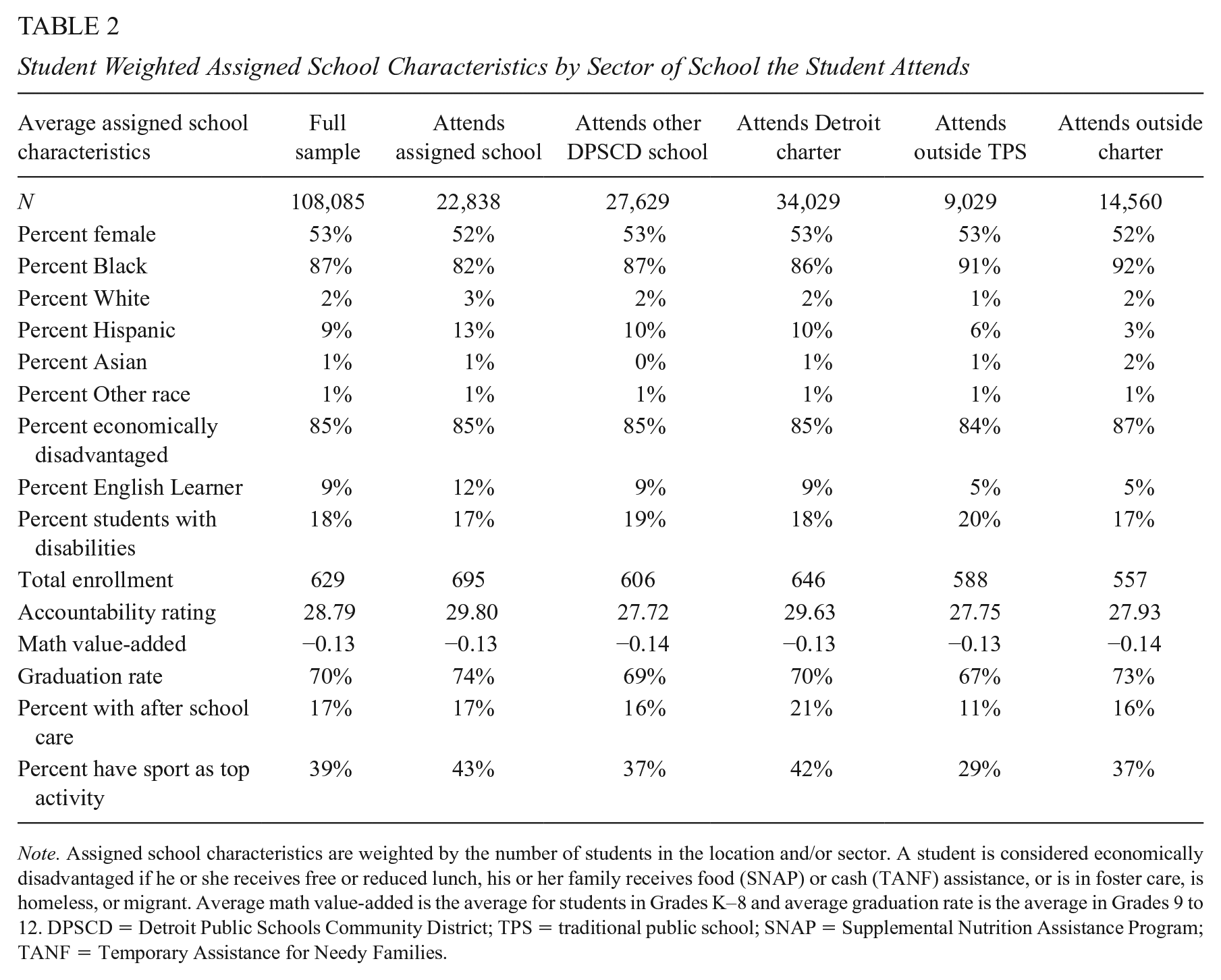
Note. Assigned school characteristics are weighted by the number of students in the location and/or sector. A student is considered economically disadvantaged if he or she receives free or reduced lunch, his or her family receives food (SNAP) or cash (TANF) assistance, or is in foster care, is homeless, or migrant. Average math value-added is the average for students in Grades K–8 and average graduation rate is the average in Grades 9 to 12. DPSCD = Detroit Public Schools Community District; TPS = traditional public school; SNAP = Supplemental Nutrition Assistance Program; TANF = Temporary Assistance for Needy Families.
Method
RQ1: What Are the Roles of Poverty, Access to Transportation, and Student’s Assigned School in Use of School Choice?
To examine the differences in school choice take-up among disadvantaged students, I estimate a multinomial logistic regression as my dependent variable is a categorical variable. This model is described in Equation 1:
where
where
RQ2: Do Detroit Students Attend the More Effective Schools and/or the Schools With the Highest Levels of Achievement Within Their Choice Sets?
To examine preferences for school sector, proximity from home, academic quality, and student demographics, I estimate the relationship between the school characteristics outlined above and the probability that a student attends each school available to them. I accomplish this using a conditional logit model under the framework for alternative specific discrete choice models created by McFadden (1974), which stresses individuals making decisions between a competing set of discrete choices and is also a common approach in the school and college choice literature (e.g., Carlson et al., 2013; Harris & Larsen, 2019; Long, 2004). Thus, I must construct a choice set for each student in the sample. I begin with the sample of students created for my first research question and restrict it to students in kindergarten, sixth grade, and ninth grade, the grades that students typically choose new schools. This sample includes 8,970 kindergarteners, 8,628 sixth graders, and 8,719 ninth graders. Table 3 displays the percent of Detroit students attending each sector by grade. Regardless of the grade, less than a quarter of students attend their assigned school, approximately 40% attend a charter school, and about one in five students leave the city to attend school. In kindergarten, a higher percentage of students attends their assigned school compared with the other grades while more ninth graders attend outside TPS and other DPSCD schools.
Sector of Attendance by Grade
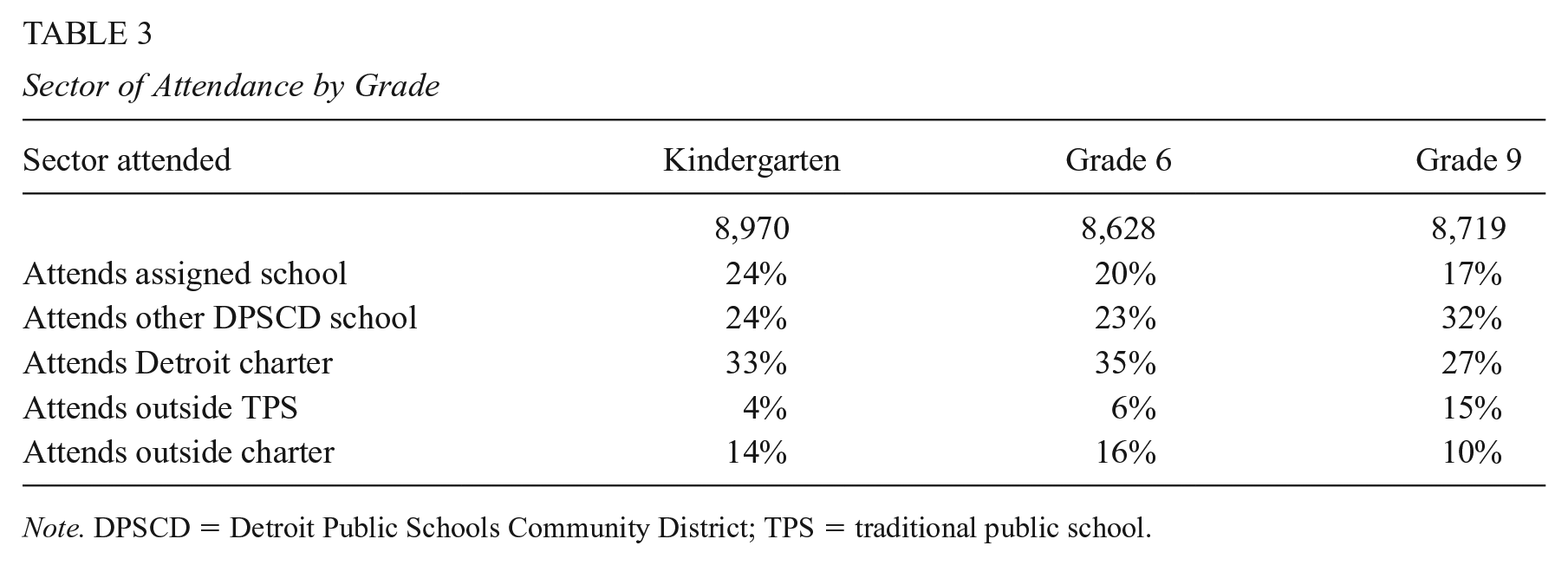
Note. DPSCD = Detroit Public Schools Community District; TPS = traditional public school.
In Table 4, I report the characteristics of the schools in Detroit students’ choice sets by sector separately for each analysis grade. A student’s choice set is constructed by creating all pairwise combinations of students and the sample of schools offering his or her grade. For each student, the sample of schools in his or her choice set includes all traditional public schools and charter schools in the three intermediate school districts surrounding Detroit, Wayne Regional Education Service Authority, Oakland Public Schools, and Macomb Intermediate School District that offer general education, and serve at least one Detroit student, making it plausibly accessible to Detroit students. Detroit students attend over 600 different schools located within the boundaries of 69 different traditional public school districts in the tri-county area. There are 361, 278, and 169 schools within the choice sets of kindergarten, sixth-grade, and ninth-grade students, respectively. The average demographic characteristics for schools located within Detroit reflect the population of students living in Detroit. Across all grades, schools located outside of the city, particularly outside TPS, have higher accountability ratings. However, fewer Detroit students attend these schools. Interestingly, Detroit charter schools have higher accountability ratings and value-added measures than DPSCD schools on average in kindergarten and sixth grade, but in ninth grade, DPSCD schools have higher average accountability ratings and similar graduation rates than Detroit charter schools. This change in academic quality may explain the differences in attendance by sector within Detroit between ninth grade and the earlier grades seen in Table 3 if families have preferences for academic achievement.
School Characteristics by Sector and Grade
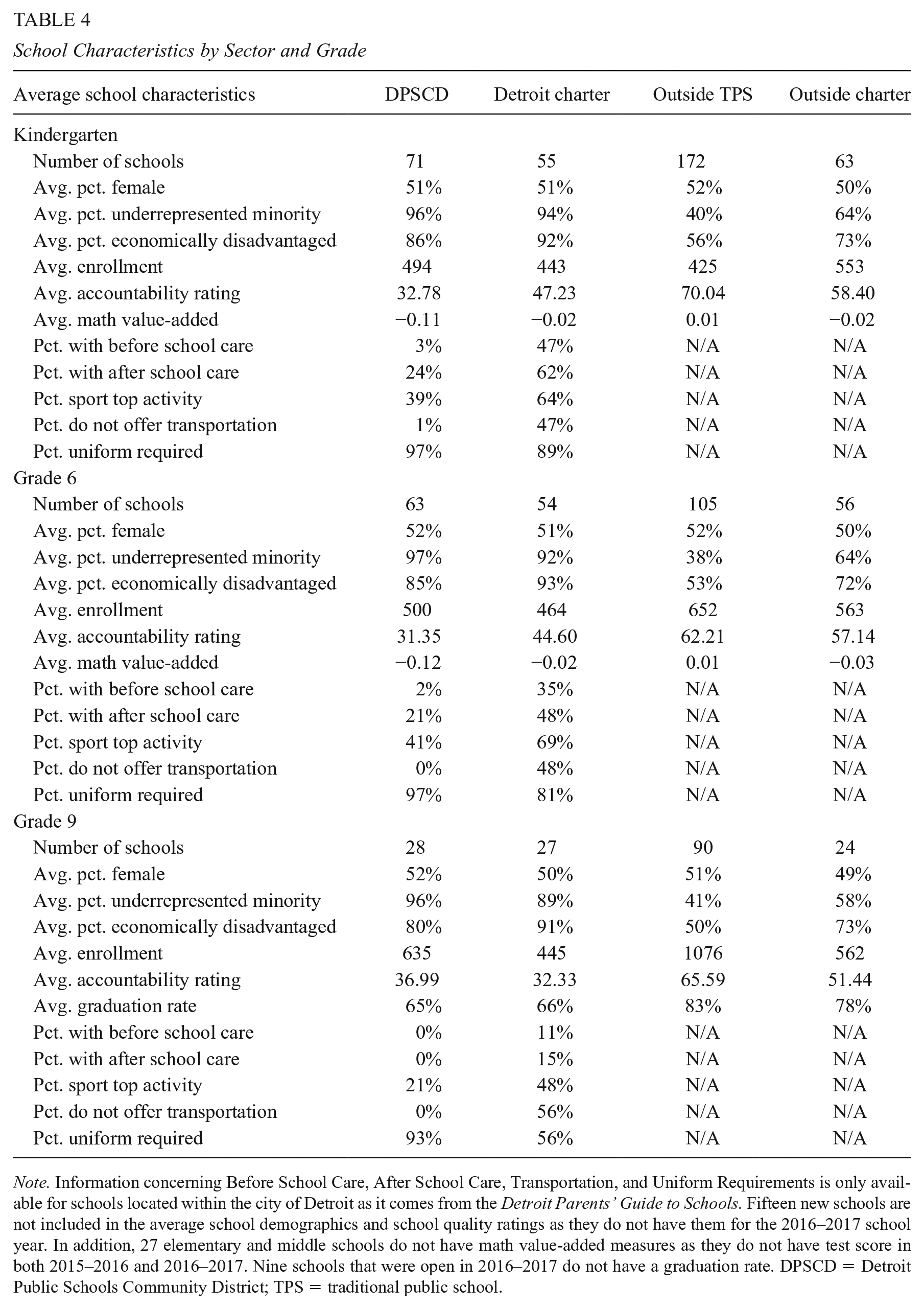
Note. Information concerning Before School Care, After School Care, Transportation, and Uniform Requirements is only available for schools located within the city of Detroit as it comes from the Detroit Parents’ Guide to Schools. Fifteen new schools are not included in the average school demographics and school quality ratings as they do not have them for the 2016–2017 school year. In addition, 27 elementary and middle schools do not have math value-added measures as they do not have test score in both 2015–2016 and 2016–2017. Nine schools that were open in 2016–2017 do not have a graduation rate. DPSCD = Detroit Public Schools Community District; TPS = traditional public school.
To examine the attributes of the schools students attend, I estimate a discrete choice model represented by Equations 3 and 4 separately for students in kindergarten, sixth, and ninth grades:
where
in which
Results
RQ1: What Are the Roles of Poverty, Access to Transportation, and Student’s Assigned School in Use of School Choice?
Table 5 contains the estimated marginal effects of the models represented by Equations 1 and 2. Columns 1 through 5 present the results of the models represented by Equation 1. The results in Column 1 show that students living in census tracts with high rates of residents without a car and lower median incomes are more likely to attend their assigned school holding all else constant. In addition, students who live farther from their assigned school and those who are eligible to ride the school bus to it have a lower probability of attending their assigned school. As bus eligibility is a function of walking distance to the assigned school, this finding may be driven by distance rather than the opportunity to use school provided transportation. As for other sectors, students who have low rates of car ownership in their resident census tract are less likely to attend schools located outside of Detroit city limits. Furthermore, economically disadvantaged students are more likely to attend charter schools but less likely to attend other DPSCD schools. Overall, these results show that exposure to poverty, access to private transportation, and distance to assigned school play a role in whether or not a student uses school choice, especially to attend schools located outside of the city.
Estimated Marginal Effects of Student and Assigned School Characteristics on School Type Attended
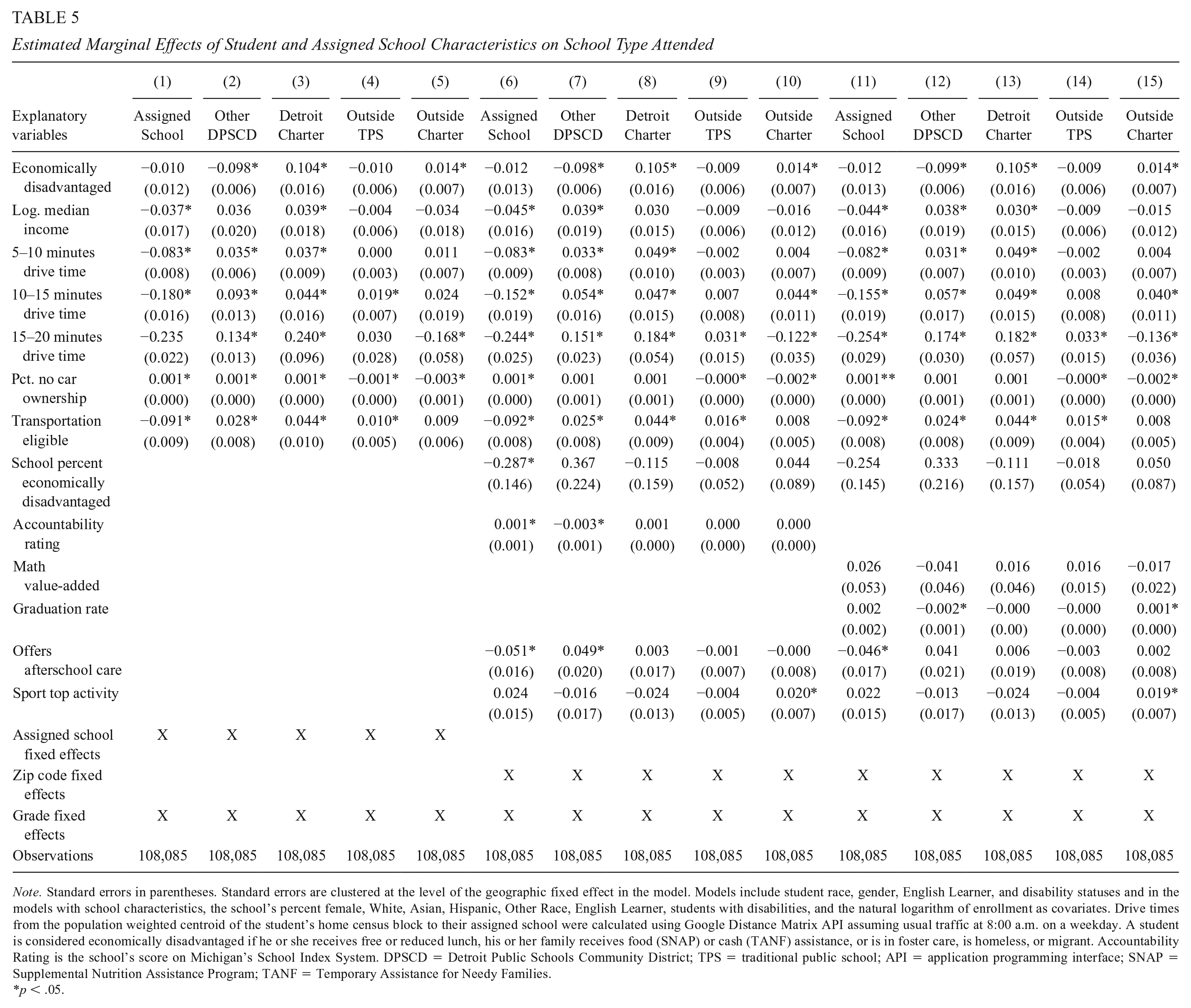
Note. Standard errors in parentheses. Standard errors are clustered at the level of the geographic fixed effect in the model. Models include student race, gender, English Learner, and disability statuses and in the models with school characteristics, the school’s percent female, White, Asian, Hispanic, Other Race, English Learner, students with disabilities, and the natural logarithm of enrollment as covariates. Drive times from the population weighted centroid of the student’s home census block to their assigned school were calculated using Google Distance Matrix API assuming usual traffic at 8:00 a.m. on a weekday. A student is considered economically disadvantaged if he or she receives free or reduced lunch, his or her family receives food (SNAP) or cash (TANF) assistance, or is in foster care, is homeless, or migrant. Accountability Rating is the school’s score on Michigan’s School Index System. DPSCD = Detroit Public Schools Community District; TPS = traditional public school; API = application programming interface; SNAP = Supplemental Nutrition Assistance Program; TANF = Temporary Assistance for Needy Families.
p < .05.
Columns 6 through 15 of Table 5 contain the estimated marginal effects of the model represented by Equation 2 which includes assigned school characteristics as explanatory variables. The probability that a student attends his or her assigned school increases if it has a smaller concentration of economically disadvantaged students, a higher accountability rating, and does not offer after school care. However, there is no significant relationship between the assigned school’s value-added and choice use. Thus, families may value student demographics and school performance levels, a finding consistent with prior literature. Although this may suggest that Detroit families have preferences for these school attributes, it is possible that they are correlated with other unobserved features that families use to determine which school to send their child to.
In contrast, the estimated marginal effects for many of the assigned school characteristics for attending another DPSCD school have the opposite signs than the predicted effects for attending the assigned school. These findings may imply that families substitute other DPSCD schools for their assigned school when the assigned school has fewer desirable characteristics. Furthermore, the estimated marginal effects of assigned school characteristics for attending schools outside of Detroit are small and statistically insignificant in most cases. This suggests that families that choose schools outside of Detroit may not even consider their assigned school as an option. Taken together, these results provide some suggestive evidence that different Detroit families have different and restricted choice sets. Some families may only consider DPSCD schools or schools within Detroit, whereas others only look outside of city limits for a school for their child.
RQ2: Do Detroit Students Attend the More Effective Schools and/or the Schools With the Highest Levels of Achievement Within Their Choice Sets?
Table 6 presents the results of the discrete choice model described in Equations 3 and 4 for all students in the sample. As previously described, the models were restricted by grade to ensure than all students in the model had the same choice set. Estimated coefficients are reported as log odds coefficients. All the estimated coefficients for the sector indicators are negative and significant in the main models. This indicates that on average, students are more likely to attend their assigned schools than charter schools, schools outside of Detroit, and other DPSCD schools, even when distance is held constant. The coefficient estimates for all commute time indicators are negative and significant across all specifications indicating a negative relationship between increased distance and attendance. Thus, families are less likely to choose schools farther from home. Also, I find that students have a higher probability of attending schools with higher rates of economically disadvantaged students in the majority of the models. As for academic quality, kindergarten and sixth-grade students have a higher probability of attending schools with higher accountability ratings and higher contributions to student achievement as measured by math value-added. As for ninth grade, there is no significant relationship between accountability rating or graduation rate.
Conditional Logit Predictions of School Attendance for School Characteristics by Grade
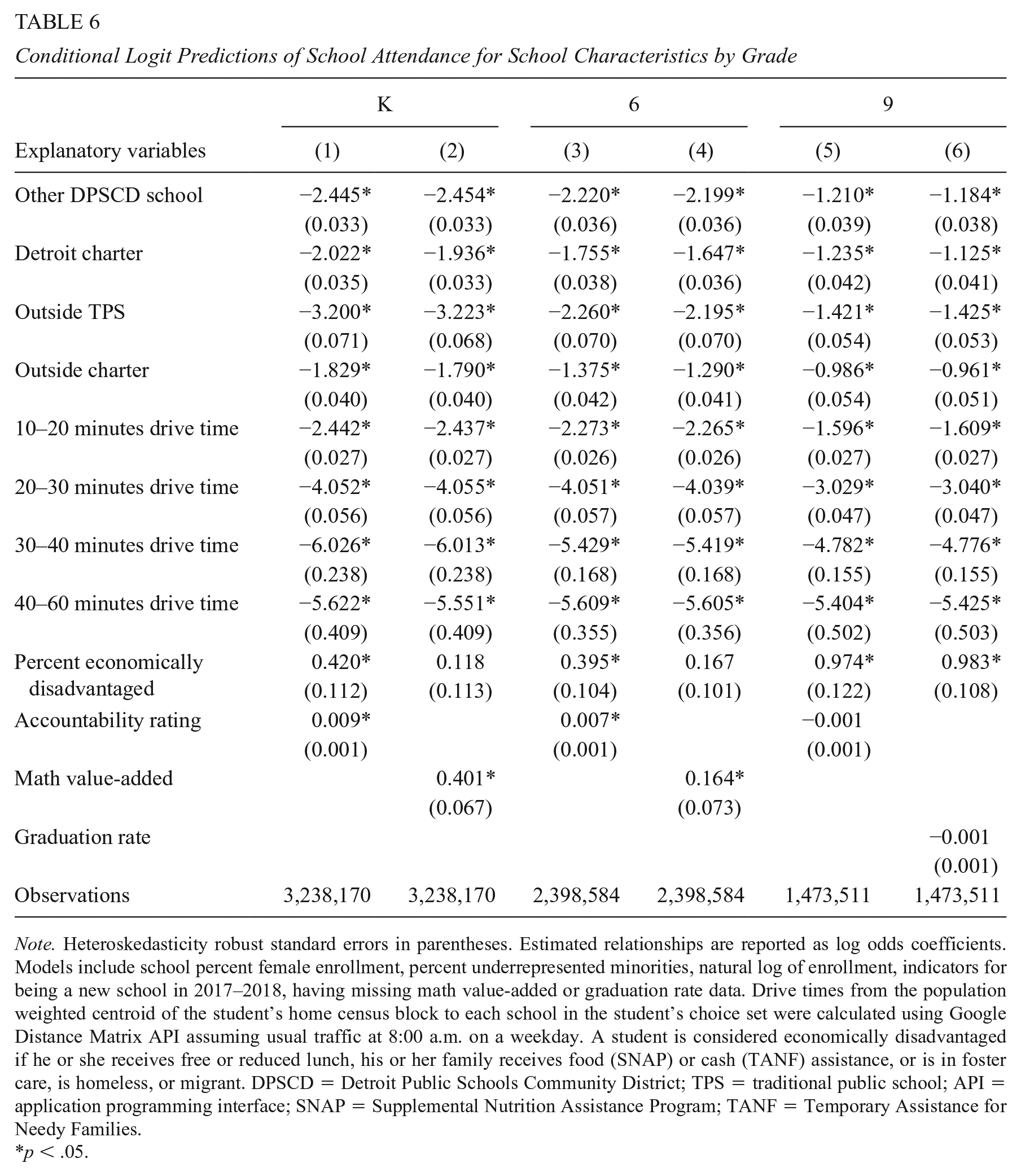
Note. Heteroskedasticity robust standard errors in parentheses. Estimated relationships are reported as log odds coefficients. Models include school percent female enrollment, percent underrepresented minorities, natural log of enrollment, indicators for being a new school in 2017–2018, having missing math value-added or graduation rate data. Drive times from the population weighted centroid of the student’s home census block to each school in the student’s choice set were calculated using Google Distance Matrix API assuming usual traffic at 8:00 a.m. on a weekday. A student is considered economically disadvantaged if he or she receives free or reduced lunch, his or her family receives food (SNAP) or cash (TANF) assistance, or is in foster care, is homeless, or migrant. DPSCD = Detroit Public Schools Community District; TPS = traditional public school; API = application programming interface; SNAP = Supplemental Nutrition Assistance Program; TANF = Temporary Assistance for Needy Families.
p < .05.
Heterogeneous Choice Sets
Although there exist positive relationships between my measures of academic quality for Michigan schools and the probability of attending a school for kindergarten and sixth-grade students, these relationships may differ if the student’s choice set is geographically restricted. Indeed, my findings from the first research question suggest that families’ choice sets may be restricted by location and/or sector before considering individual school qualities especially for students with little access to transportation or impoverished students. Specifically, the results indicate that some families are choosing between DPSCD schools, within city limits, or solely outside of the city. To investigate this further, I examine mobility between sectors over time for Detroit students.
Table 7 presents the percent of students who have ever attended another sector between 2012–2013 and 2017–2018 by sector attended during the year of analysis. Only 9% of students attending a school inside of Detroit during the 2017–2018 school year have ever attended a public school located outside of city limits while living in Detroit. More specifically, about 2% of students who did not attend an outside TPS school in the year of analysis ever attended one. In contrast, about four out of 10 students attending an outside Detroit school have attended a Detroit school in the past. In addition, about a quarter of DPSCD students have attended a non-DPSCD school, and a similar amount of non-DPSCD students have attended a DPSCD school.
Percent of Students Who Have Ever Attended Another Sector by Sector and Location Between 2012–2013 and 2017–2018
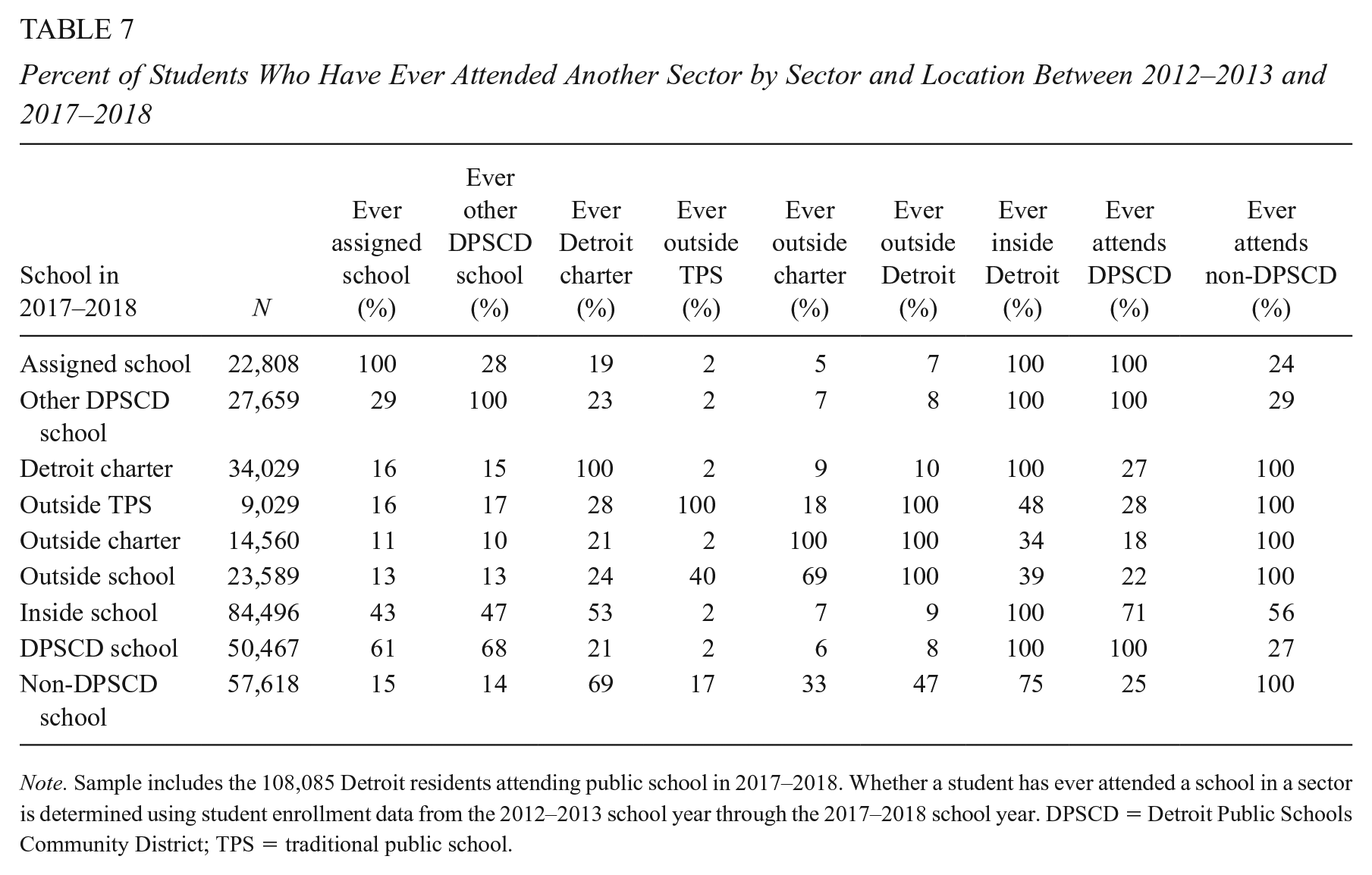
Note. Sample includes the 108,085 Detroit residents attending public school in 2017–2018. Whether a student has ever attended a school in a sector is determined using student enrollment data from the 2012–2013 school year through the 2017–2018 school year. DPSCD = Detroit Public Schools Community District; TPS = traditional public school.
Although examining the mobility of all students over time may be informative, this analysis may understate the amount of mobility that happens between sectors as it includes students who did not make active choices in some years. To more accurately explore the movement between sectors of students, I examine the mobility between sectors of students who changed schools between the 2016–2017 and 2017–2018 school years in Table 8. I consider the mobility patterns of structural movers, students who were in the last or terminal grade of the school they attended in 2016–2017, and nonstructural movers separately. Almost 90% of structural and nonstructural movers who attended a Detroit school in 2017–2018 also attended one the previous year. However, only a third of nonstructural movers attending a school outside of the city during the year of analysis attended one the year before while three quarters of structural movers remained in an outside school between years. About two thirds of structural and nonstructural movers attending a DPSCD school in 2017–2018 were in a DPSCD school in 2016–2017. Interestingly, 88% of structural movers attending a non-DPSCD school attended a non-DPSCD school in both years.
Percent of Students Attending a Different Sector Last Year by Sector and Mobility Type
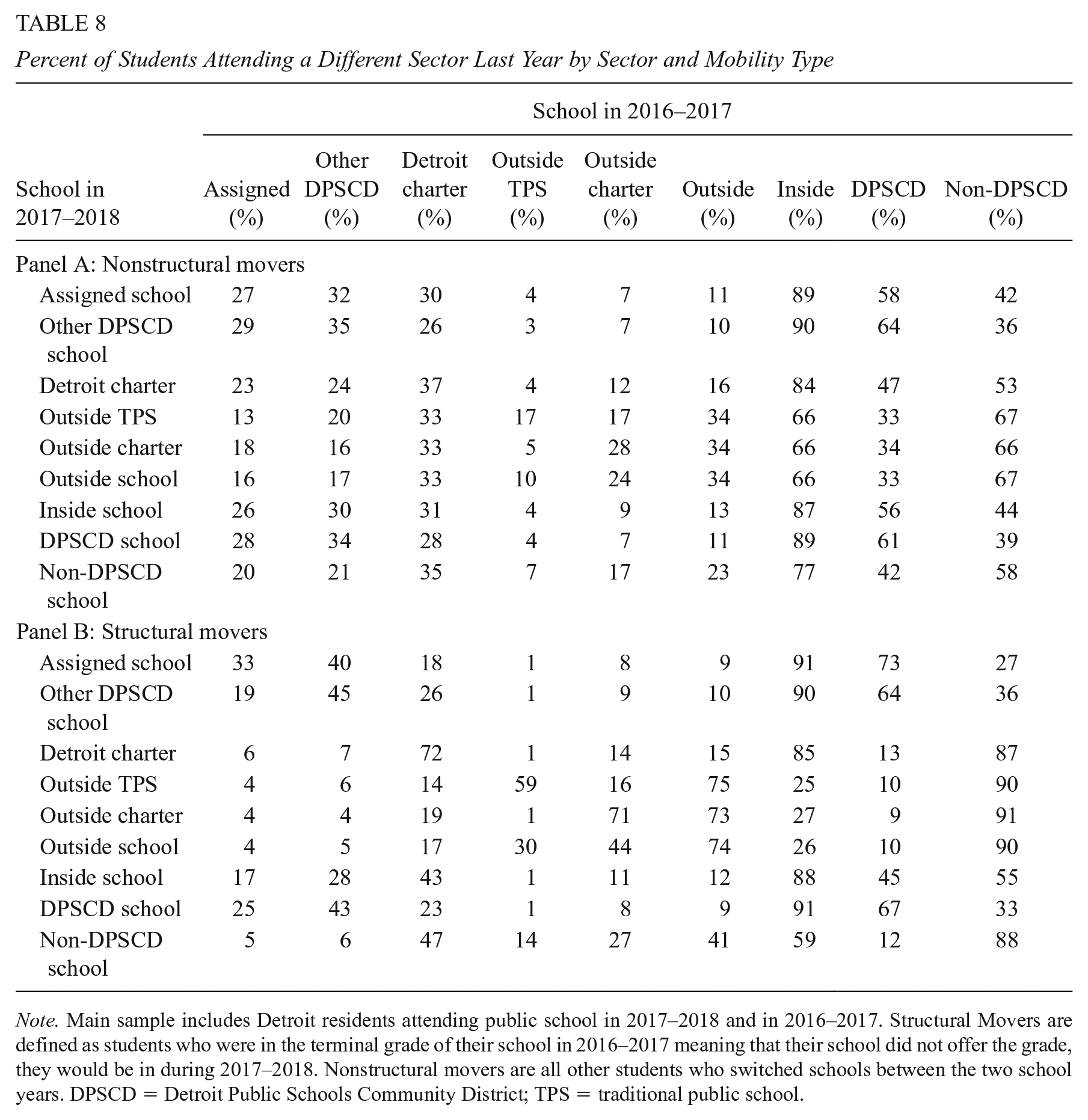
Note. Main sample includes Detroit residents attending public school in 2017–2018 and in 2016–2017. Structural Movers are defined as students who were in the terminal grade of their school in 2016–2017 meaning that their school did not offer the grade, they would be in during 2017–2018. Nonstructural movers are all other students who switched schools between the two school years. DPSCD = Detroit Public Schools Community District; TPS = traditional public school.
Restricted Choice Set Results
When the evidence from Tables 5, 7, and 8 is combined, it seems likely that some families have choice sets restricted to schools within city limits or within DPSCD. Furthermore, the differences in who attends outside schools and the lack of relationship between attending outside schools and assigned school characteristics suggest that those attending outside schools may choose to attend schools outside of the city before considering specific schools. In accordance with these findings, I estimate the model represented in Equations 3 and 4 separately by grade and for students attending: inside Detroit, outside Detroit, a DPSCD school, or a non-DPSCD school. Thus, the schools in the students’ choice set are restricted to schools in that location/sector for each analysis. The results of these analyses are presented in Table 9. Panel A displays estimates for the Inside and DPSCD samples and Panel B shows the results for the outside and non-DPSCD samples. Estimates should be interpreted in comparison to other schools within that location or sector.
Conditional Logit Predictions of School Attendance for School Characteristics by Grade and Location
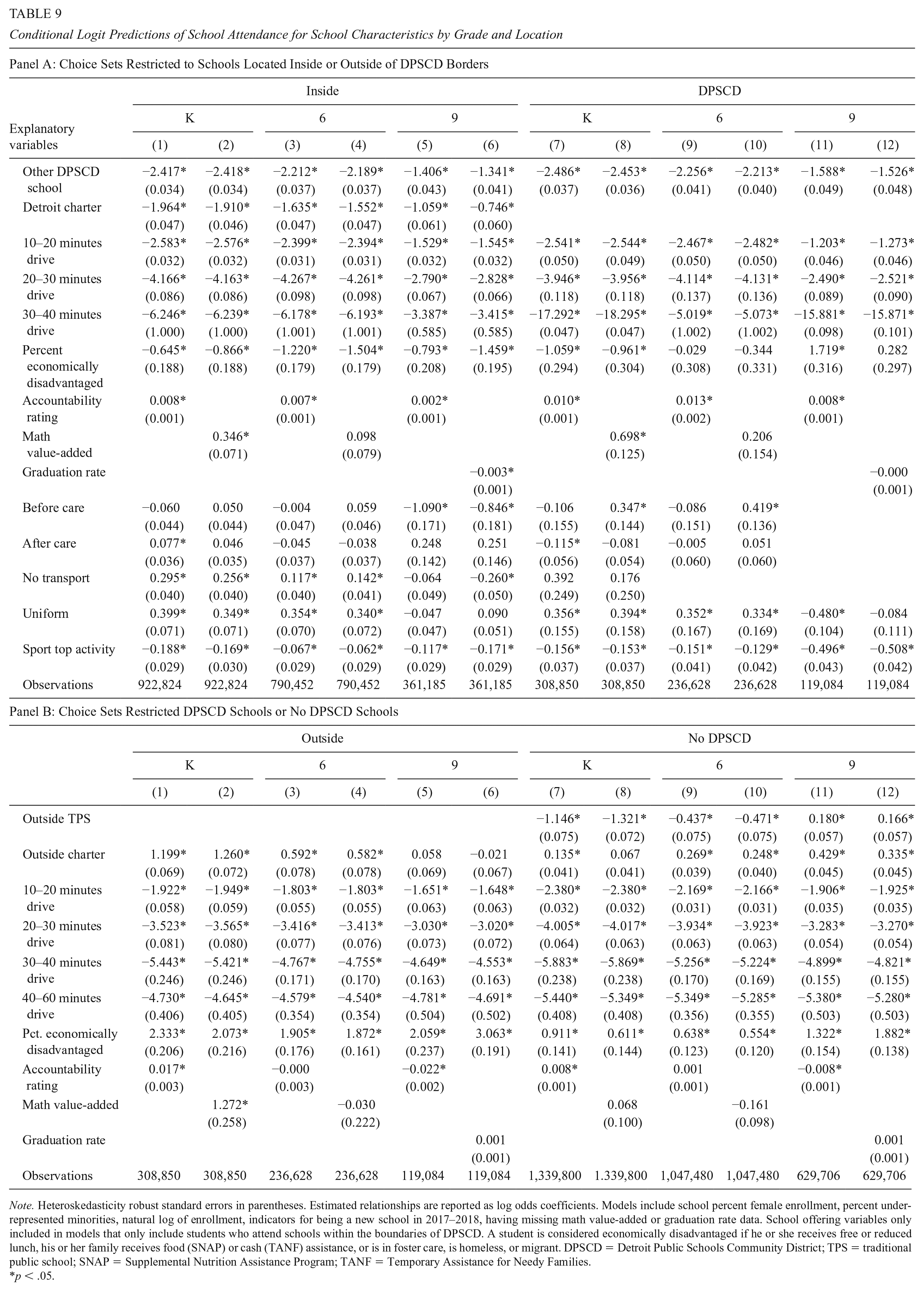
Note. Heteroskedasticity robust standard errors in parentheses. Estimated relationships are reported as log odds coefficients. Models include school percent female enrollment, percent underrepresented minorities, natural log of enrollment, indicators for being a new school in 2017–2018, having missing math value-added or graduation rate data. School offering variables only included in models that only include students who attend schools within the boundaries of DPSCD. A student is considered economically disadvantaged if he or she receives free or reduced lunch, his or her family receives food (SNAP) or cash (TANF) assistance, or is in foster care, is homeless, or migrant. DPSCD = Detroit Public Schools Community District; TPS = traditional public school; SNAP = Supplemental Nutrition Assistance Program; TANF = Temporary Assistance for Needy Families.
p < .05.
After restricting the choice sets to schools located inside of Detroit and DPSCD, students still have a lower probability of attending schools farther from home. In addition, students are less likely to attend Other DPSCD and Detroit charter schools compared with their assigned schools. In contrast with the full sample results, students attend schools with a lower percent of economically disadvantaged students when the sample is restricted to all schools inside Detroit. These contrasting results are explained by the strong positive relationship between the percent of economically disadvantaged students and attendance when the choice set is restricted to schools outside of Detroit as seen in Table 9 Panel B. Taken together, these results imply that students inside Detroit choose schools with fewer economically disadvantaged students but those who attend schools outside are more likely to attend the more impoverished schools within their choice set.
By restricting the choice set to schools inside Detroit or just to DPSCD schools, I can also include school characteristics from the Detroit Parents’ Guide to Schools as seen in Table 9 Panel A. Across grades, student have a lower probability of attending schools that list a sport as a top activity. In the earlier grades, students have a higher probability of attending schools that require uniforms, and when all Detroit schools are included in the choice set, they are more likely to attend schools that do not offer transportation. Since these characteristics are likely correlated to other unobserved characteristics of schools that families used to determine where they send their child, I do not interpret these as preferences.
As for measures of academic quality, students seem to have a higher probability of attending a school as its accountability rating increases when the choice set is restricted to schools inside of Detroit or DPSCD across all grades. The relationships are larger when the choice set is restricted to DPSCD schools, suggesting that there may be a larger preference for high accountability ratings after accounting for geographic and administrative barriers. In addition, there is a positive relationship between school value-added and attendance for kindergarteners. The results for the choice sets for students who attend outside or non-DPSCD schools vary by grade. In kindergarten, there is a positive relationship between accountability rating, value-added, and attendance for outside Detroit and non-DPSCD choice sets. However, there is no significant relationship between either of the academic quality measures and attendance for sixth grade students in either of these choice sets. A negative relationship exists between accountability rating and attendance for ninth grade students in both outside and non-DPSCD choice sets. In kindergarten, there is a positive relationship with school value-added and attendance. Therefore, these findings suggest that the possible preferences for academic quality and student demographics may be constrained for students looking to attend school outside of Detroit or DPSCD especially in the later grades.
Discussion
In this article, I show that students’ choice sets are likely geographically constrained, especially for impoverished students and students with little access to private transportation in Detroit, a choice-rich city and region without regulations that promote accessibility or transparency. Although I am unable to directly test whether families do not prefer high-quality schools as I do not have any record of parent’s set of preferred schools, I provide some strong suggestive evidence that families have some preference for higher performing schools when families are choosing between schools located within Detroit and especially within DPSCD. In addition, I offer some indication that families have limited access to the relatively higher quality schools located outside of the city, constraining their ability to attend schools with their desired characteristics. This contributes to the parental preference literature by framing distance and administrative barriers as constraints to families’ preferences instead of as a preference itself and expanding choice sets to include interdistrict choice options.
The findings of this study provide a compelling empirical example of the idea that strong preferences for effective schools can exist throughout an education market and, yet students may also have differential access to high-quality schools due to where they live and what their historical demographic and current economic circumstances are especially when there is little regulation on where schools locate and what enrollment rules they govern by exists. Thus, it is unlikely that parents and families can regulate the school supply through market transactions even when they have strong preferences for academic quality. This implies that choice-rich cities, regardless of whether they offer intradistrict, charter school, or interdistrict choice, may need to provide oversight of the schooling market to ensure an adequate supply of effective schools. This oversight likely includes centralized planning of the quantity and location of schools and performance accountability as suggested by Harris (2017).
Furthermore, choice-rich cities may need to ensure that effective schools are accessible to all students. Two policies that could promote or restrict access to effective schools are transportation policies and enrollment policies. Increasing school transportation has the potential to remove the burden from parents of transporting their children to school, making it easier to attend schools located farther from home. However, few states require to provide transportation to students attending charter schools or participating in interdistrict choice (McShane & Shaw, 2020). Furthermore, enrollment policies have the potential to promote or restrict access to effective schools. Multiple applications with varying deadlines likely restrict access to effective schools for the most vulnerable populations, possibly explaining why Detroit students have difficulty accessing the highest quality schools, especially in the later grades. A centralized enrollment application could increase access to effective schools through choice as causal evidence exists showing that they are effective in increasing enrollment in charter schools for disadvantaged students (Winters, 2015). To date, however, only a handful of cities have implemented these policies. Extensions of this work and others in this literature should consider in particular the role that enrollment rules play in promoting or restricting access to schools even in a system where choice is widely available.
Footnotes
Author’s Note
This research result used data structured and maintained by the MERI-Michigan Education Data Center (MEDC). MEDC data are modified for analysis purposes using rules governed by MEDC and are not identical to those data collected and maintained by the Michigan Department of Education (MDE) and/or Michigan’s Center for Educational Performance and Information (CEPI). Results, information, and opinions solely represent the analysis, information, and opinions of the author and are not endorsed by, or reflect the views or positions of, grantors, MDE, and CEPI or any employee thereof. All errors are my own.
Declaration of Conflicting Interests
The author(s) declared no potential conflicts of interest with respect to the research, authorship, and/or publication of this article.
Funding
The author(s) received no financial support for the research, authorship, and/or publication of this article.
Notes
Author
DANIELLE SANDERSON EDWARDS is a doctoral candidate in education policy at Michigan State University, College of Education. She primarily uses quantitative and quasi-experimental methods to understand how where students live can determine what educational opportunities they have, and the potential for policy to alleviate these geographic inequities in access to effective schools and teachers.