







Abstract
Much recent policy debate focuses on whether states should reduce teacher licensure requirements to ease the burdens of recruiting high-quality teachers. We examine the effectiveness of individuals who entered the teacher workforce in Massachusetts during the pandemic by obtaining an emergency license, which requires only a bachelor’s degree. In 2021–22, newly hired emergency licensed teachers had similar measures of student test score growth as their traditionally licensed peers. However, emergency licensed teachers with the least prior investment in teaching had lower on-the-job performance in English Language Arts and were more likely to leave teaching following the 2021–22 school year. These results encourage the creation of additional flexibility in licensure requirements for those who have demonstrated prior efforts to join the educator pipeline.
Keywords
E
When the COVID-19 pandemic began in 2020, many states—including Massachusetts, the context we study—temporarily altered licensure requirements to prevent a pandemic-induced teacher shortage (DeArmond et al., 2023; Slay et al., 2020). In this study, we examine whether and how the first wave of teachers who entered the workforce with COVID-era reduced licensure requirements differ with respect to measures of effectiveness and turnover; the findings offer valuable insights for shaping current and future teacher licensure policy.
The Massachusetts Context
Prior to the pandemic, individuals seeking teaching positions in Massachusetts public schools typically needed to obtain a provisional or initial license. Provisional licenses require a bachelor’s degree and passing all required Massachusetts Tests for Educator Licensure (MTELs). Initial licenses require the completion of an educator preparation program and obtaining required endorsements, in addition to a bachelor’s degree and passing required MTELs.
When the onset of the COVID-19 pandemic disrupted these traditional licensure pathways into teaching, Massachusetts authorized an emergency teaching license in June 2020 as a short-term stopgap measure. The emergency license required only a bachelor’s degree in any field from an accredited college or university to become eligible for teaching positions in public schools (An Act Relative to Municipal Governance During the COVID-19 Emergency, 2020), thereby substantially reducing the requirements for entering the teacher workforce.
In our prior work, we found that the creation of the emergency license in Massachusetts not only offered a pathway to teaching for individuals who were otherwise on track to enter via traditional licensure but also attracted new individuals to the supply of available teachers. These newcomers include individuals who were previously unable to pass required licensure exams, out-of-state educators, and individuals who wanted to try the profession (Bacher-Hicks et al., 2023). We also found that newly hired teachers with emergency licenses were more racially and ethnically diverse than their traditionally licensed peers, and they overwhelmingly intend to obtain permanent licensure to remain in the profession.
Current Study
The creation of the emergency license achieved the immediate intended goal of maintaining a steady supply of teachers during the pandemic and had the additional benefit of increasing the racial and ethnic diversity of the teacher workforce. However, open questions remain regarding the effectiveness and retention of emergency licensed teachers (ELTs) who entered the workforce with reduced licensure requirements. Backes and Goldhaber (2023) examine COVID-era licenses issued in New Jersey (see Supplemental Appendix A [available in the online version of this article] for additional information), but the Massachusetts context is unique in requiring only a bachelor’s degree for licensure eligibility.
To further our understanding of the relationship between reduced teacher licensure requirements, teacher effectiveness, and teacher turnover in the first 2 years of the pandemic, we use data from the Massachusetts Department of Elementary and Secondary Education (DESE) to examine:
What is the distribution of performance evaluation ratings among newly hired ELTs, and how do their ratings compare to those of their more traditionally licensed peers?
How do the mean student growth percentiles (SGPs) of newly hired ELTs compare to those of new hires with provisional and initial licenses?
How does teacher turnover among newly hired ELTs compare to that among new hires with provisional and initial licenses?
ELTs may differ in effectiveness and turnover as compared to teachers with provisional and/or initial licenses, as our prior work indicates that emergency license holders not only include those who were waylaid from obtaining either provisional or initial licenses during the pandemic but also those who would not—or could not—have obtained either license type, even in the absence of the pandemic (e.g., those who could not pass the licensure exams, those who wanted to try teaching before taking on licensure requirements; Bacher-Hicks et al., 2023).
One potential benchmark for considering the effectiveness of ELTs is whether they perform at least as well as those who qualify for entry to the workforce by meeting the typical licensure requirements for new teachers, whether that be the provisional or initial licensure route. Therefore, we examine how the outcomes of ELTs compare to those of provisional and initial license holders, focusing on whether they perform at least as well as one of these two groups.
Data and Methods
We draw upon administrative data from Massachusetts DESE, which includes all teachers employed in Massachusetts public schools between 2019–20 through the fall of 2022–23. These records include teacher characteristics (e.g., race/ethnicity and gender), school assignments, and licensure information. For school year 2021–22, the records also contain teacher performance evaluation ratings and teacher-student links, as well as student-level administrative data, including demographic characteristics, school and class assignments, and SGPs in math and English Language Arts (ELA) in grades 4 through 8. We leverage (a) performance evaluation ratings and (b) mean SGPs (mSGPs) to examine measures of teacher quality among newly hired teachers. We also leverage (c) employment data from 2021–22 and the fall of the 2022–23 school year to examine turnover among newly hired teachers.
Newly hired teachers consist of individuals who are employed as teachers in Massachusetts public schools in the current, but not the prior, school year. Due to small sample sizes, we exclude newly hired teachers (a) with temporary licenses, which are for teachers who are licensed in another state and have at least 3 years of teaching experience in that state, and (b) who are unlicensed but employed under a licensure hardship waiver, for which a district submits an application to DESE in the event that the employer has not been able to recruit a licensed teacher for a particular position despite making a good faith effort to do so.
Performance Evaluation Ratings
Newly hired teachers are required to be evaluated annually using the Massachusetts Educator Evaluation Framework. Teachers receive a summary rating of Exemplary, Proficient, Needs Improvement, or Unsatisfactory, which is an overall assessment summarizing performance across four domains (see Supplemental Appendix B [available in the online version of this article] for additional information). Due to the pandemic, we only have valid ratings from the 2021–22 school year. Our analysis includes the comparison of ratings of 4,680 newly hired teachers, of whom 1,766 hold emergency licenses, 732 hold provisional licenses, and 2,182 hold initial licenses. Supplemental Appendix Table A1 Columns 1 to 3 (available in the online version of this article) provide summary statistics for the analytic sample by license type. ELTs are more likely to (a) be Black and Hispanic/Latinx (p < .001) and (b) teach in schools with higher shares of low-income students and students of color (p < .001), than their traditionally licensed peers. Supplemental Appendix Table A2 (available in the online version of this article) provides information on the teacher assignment and subject areas among ELTs in our analytic sample. The majority of ELTs are assigned to teach core subjects as a classroom teacher, both at the K–8 level (n = 750) or the secondary level (n = 294). Many also teach core subjects to students with mild or moderate disabilities as a consultative content (i.e., support) teacher (n = 173) or a sole content teacher (n = 140).
To examine the relative likelihood that newly hired ELTs are rated below proficient in 2021–22, we use ordinary least squares (OLS) to estimate the coefficients in the regression model:

where
Mean SGPs
To measure teachers’ contributions to student test scores, we calculate teachers’ mSGPs by linking individual teachers to their students in grades 4 through 8 in core math and ELA classes and then taking the simple average of their students’ subject-specific SGPs (see Supplemental Appendix C [available in the online version of this article] for additional information). Our analysis of mSGPs is restricted to include only data from 2021–22, as valid SGPs were unavailable for the prior year due to the pandemic’s interference with test administration in 2020. As mSGPs are only available for math and ELA teachers in grades 4 through 8, our samples of newly hired teachers with mSGPs are naturally smaller than our sample with performance ratings described above. We observe math mSGPs for 636 newly hired teachers, of whom 205 hold emergency licenses, 95 hold provisional licenses, and 336 hold initial licenses. In ELA, we observe mSGPs for 639 new hires, of whom 188 hold emergency licenses, 99 hold provisional licenses, and 352 hold initial licenses. Supplemental Appendix Table A1 (available in the online version of this article) Columns 4 to 6 and 7 to 9 provide summary statistics for the math and ELA analytic samples, respectively, by license type. Among our sample of newly hired teachers in 2021–22, the correlation between evaluation scores and mSGPs is 0.197 in math (p < .001) and 0.123 in ELA (p < .001).
To compare the effectiveness of newly hired ELTs to the effectiveness of their more traditionally licensed peers, we use OLS to estimate:

where
Turnover
To measure turnover, we examine teachers who are employed in the 2021–22 school year and then examine their employment status in the fall semester of the subsequent school year, 2022–23. Our analysis sample includes the same individuals included in the evaluation ratings sample described above. We derive two measures of turnover:
Transfer schools within Massachusetts: A teacher in 2021–22 transfers to a different Massachusetts public school in the fall of the 2022–23 school year but remains in a teaching assignment.
Leave teaching in Massachusetts public schools: A teacher in 2021–22 is no longer in a teaching assignment in a Massachusetts public school in the fall of the 2022–23 school year.
To examine the relative likelihood that newly hired ELTs transfer or leave teaching following the 2021–22 school year, we use OLS to estimate:

where
Results
We find that, in 2021–22, the vast majority (82%) of newly hired ELTs were rated Proficient or above, and their ratings were similar to those of their provisionally licensed peers. Newly hired ELTs in tested grades and subjects had similar mSGPs in math and ELA as their peers with provisional and initial licenses. Turnover among newly hired ELTs was also similar to that among newly hired provisional license holders. However, we find evidence that the subgroup of ELTs with no prior employment in Massachusetts public schools and no prior engagement with the teacher pipeline (i.e., enrollment in teacher preparation, attempting licensure exams) had lower mSGPs in ELA and were more likely to leave teaching in Massachusetts public schools the following year. We now discuss each set of results in turn.
Performance Evaluation Ratings
As shown in the third row of Figure 1, the vast majority (81.3%) of newly hired ELTs receive a Proficient rating on their evaluations by their administrators, while 17.4% receive a rating of Needs Improvement. Very few ELTs received either the lowest or highest ratings, with 0.5% obtaining an Unsatisfactory rating and 0.7% obtaining an Exemplary rating. This distribution is largely similar to that among provisional license holders (second row of Figure 1), of whom 82.4% are rated Proficient, and 15.8% are rated Needs Improvement.
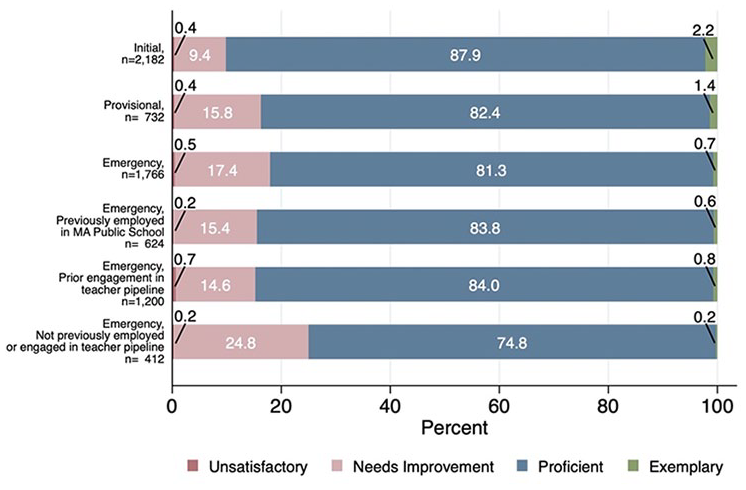
Evaluation ratings of newly hired teachers by license type.
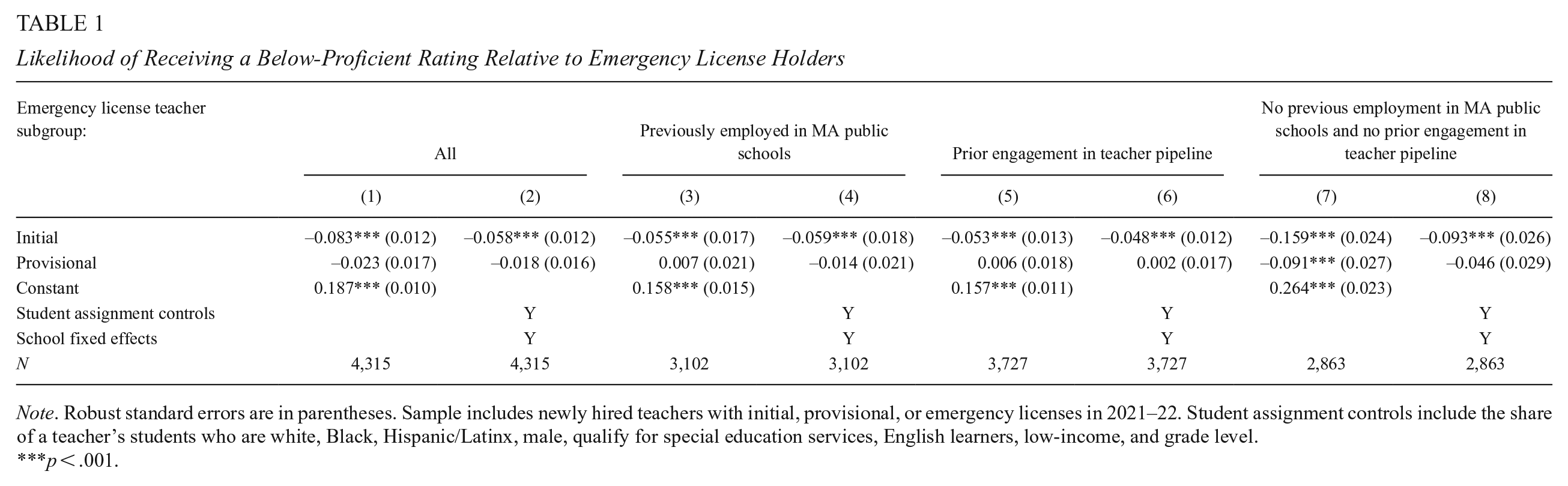
When compared to initial license holders (first row of Figure 1), emergency license holders are more likely to receive a below-proficient rating. Table 1 presents the estimated coefficients of interest from Equation 1; as shown in Column 1, new hires with emergency licenses are 8.3 percentage points more likely to receive a rating below proficient (p < .001). After the inclusion of student assignment controls and school-fixed effects (Column 2), the estimate attenuates by almost one-third to 5.8 percentage points (p < .001). This suggests that some of the difference in the likelihood of being rated below proficient among emergency license holders, relative to initial license holders, may be driven by differences in the characteristics of schools that tend to hire them and characteristics of students that they are assigned. However, there is no statistically significant difference between the likelihood that provisional licensed teachers and ELTs receive a below-proficient rating (p = .28).
Likelihood of Receiving a Below-Proficient Rating Relative to Emergency License Holders
Note. Robust standard errors are in parentheses. Sample includes newly hired teachers with initial, provisional, or emergency licenses in 2021–22. Student assignment controls include the share of a teacher’s students who are white, Black, Hispanic/Latinx, male, qualify for special education services, English learners, low-income, and grade level.
p < .001.
We also examine whether the subgroups of ELTs with (a) prior employment in the state’s public schools (e.g., as a paraprofessional), (b) prior engagement in the teacher pipeline (i.e., enrollment in a teacher preparation program or taking a licensure exam) or (c) no prior employment in the state’s public schools and no prior engagement in the teacher pipeline, are rated differently (see Supplemental Appendix D [available in the online version of this article] for definitions). The performance rating distributions of these groups are shown in rows 4 through 6 of Figure 1. The ratings of those (a) with prior employment and (b) with prior engagement (rows 4 and 5, respectively) are similar to those of the whole group.
Those with (c) no prior employment in the state’s public schools and no prior engagement in the teacher pipeline (row 6) appear more likely to be rated below proficient, with almost 25% receiving a Needs Improvement rating. Table 1 Column 7 indicates that this subgroup of emergency license holders is 15.9 (p < .001) and 9.1 (p = .001) percentage points more likely to be rated below proficient than initial and provisional license holders, respectively. However, these point estimates attenuate after the inclusion of student assignment controls and school-fixed effects in our preferred model (Table 1 Column 8). We find that this subgroup of emergency license holders is 9.3 percentage points more likely to be rated below proficient than initial license holders (p < .001) who teach in the same schools with similar student assignments. They are also 4.6 percentage points more likely to be rated below proficient compared to their provisionally licensed peers, but this difference is no longer statistically significant (p = .12). Taken together, our results suggest that overall, newly hired ELTs were largely rated proficient in 2021–22, and their ratings were similar to those of their provisionally licensed same-school peers with similar student assignments.
Mean SGPs
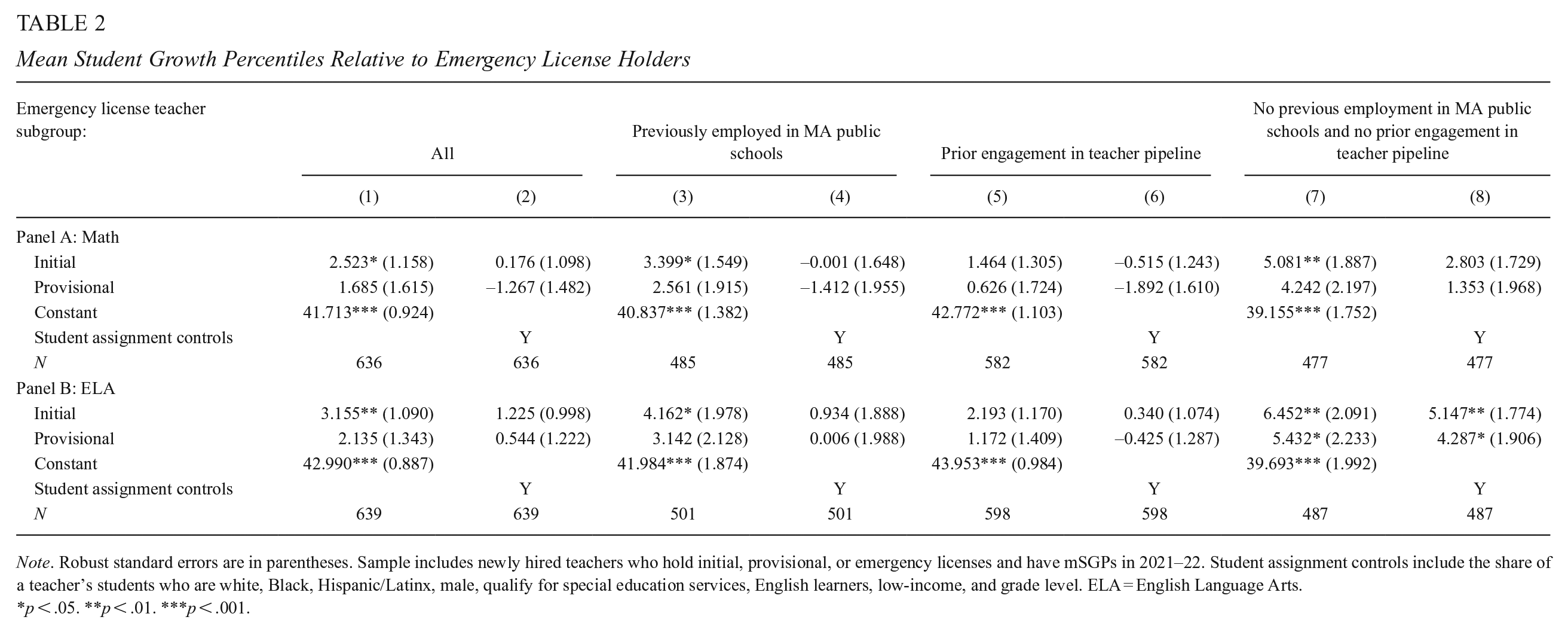
In Table 2, we present the estimated coefficients of interest from Equation 2. In math (Panel A), newly hired emergency license holders have mSGPs that are lower than those of initial license holders in models that do not control for the characteristics of students assigned to each teacher (Column 1). However, this difference shrinks in magnitude and is no longer statistically significant in our preferred model that controls for student characteristics (Column 2). In ELA (Panel B), the results are similar. Moreover, there are no statistically significant differences between the mSGPs of newly hired ELTs and provisionally licensed teachers.
Mean Student Growth Percentiles Relative to Emergency License Holders
Note. Robust standard errors are in parentheses. Sample includes newly hired teachers who hold initial, provisional, or emergency licenses and have mSGPs in 2021–22. Student assignment controls include the share of a teacher’s students who are white, Black, Hispanic/Latinx, male, qualify for special education services, English learners, low-income, and grade level. ELA = English Language Arts.
p < .05. **p < .01. ***p < .001.
In Columns 4 and 6, we examine the relative mSGPs of newly hired ELTs with (a) prior employment in the state’s public schools, and (b) prior engagement in the teacher pipeline, respectively, conditional on student assignment characteristics. Again, we find no statistically significant differences between the mSGPs of these newly hired ELT subgroups and their traditionally licensed peers.
Finally, we compare the mSGPs of newly hired ELTs with (c) no prior employment in the state’s public schools and no prior engagement in the teacher pipeline to those among newly hired initial and provisional license holders. As shown in Column 8 of Panel A, conditional on student assignment characteristics, we find no statistically significant differences in mSGPs between this subgroup of ELTs and either initial or provisional license holders in math. However, in ELA (Column 8 of Panel B), we find that the mSGPs of this ELT subgroup are, on average, lower than those of initial license holders by 5.15 (p < .01) and lower than those of provisional license holders by 4.29 (p = .03). That is, if the average student taught by the average ELT in the subgroup (c) performed better than 40% of academically similar students in ELA (see Table 2, Panel B, Column 7, Constant), these results suggest that the average student taught by the average initially (or provisionally) licensed peer performed better than 45% (or 44%) of academically similar students in ELA. While these differences in mSGPs in ELA are statistically significant, it is worth noting that the sample size of ELTs in this subgroup is very small (n = 36), and therefore, this result should be taken with caution. Further analysis using additional years of data will be important to confirm these patterns.
Taken together, our results suggest that, with respect to improving student test scores, newly hired ELTs in tested grades and subjects perform similarly to their peers with provisional and initial licenses after adjusting for differences in the students they are assigned. However, at least in ELA, there may be some performance concerns with the subgroup of ELTs with no prior employment in the state’s public schools and with no prior engagement in the teacher pipeline.
Turnover
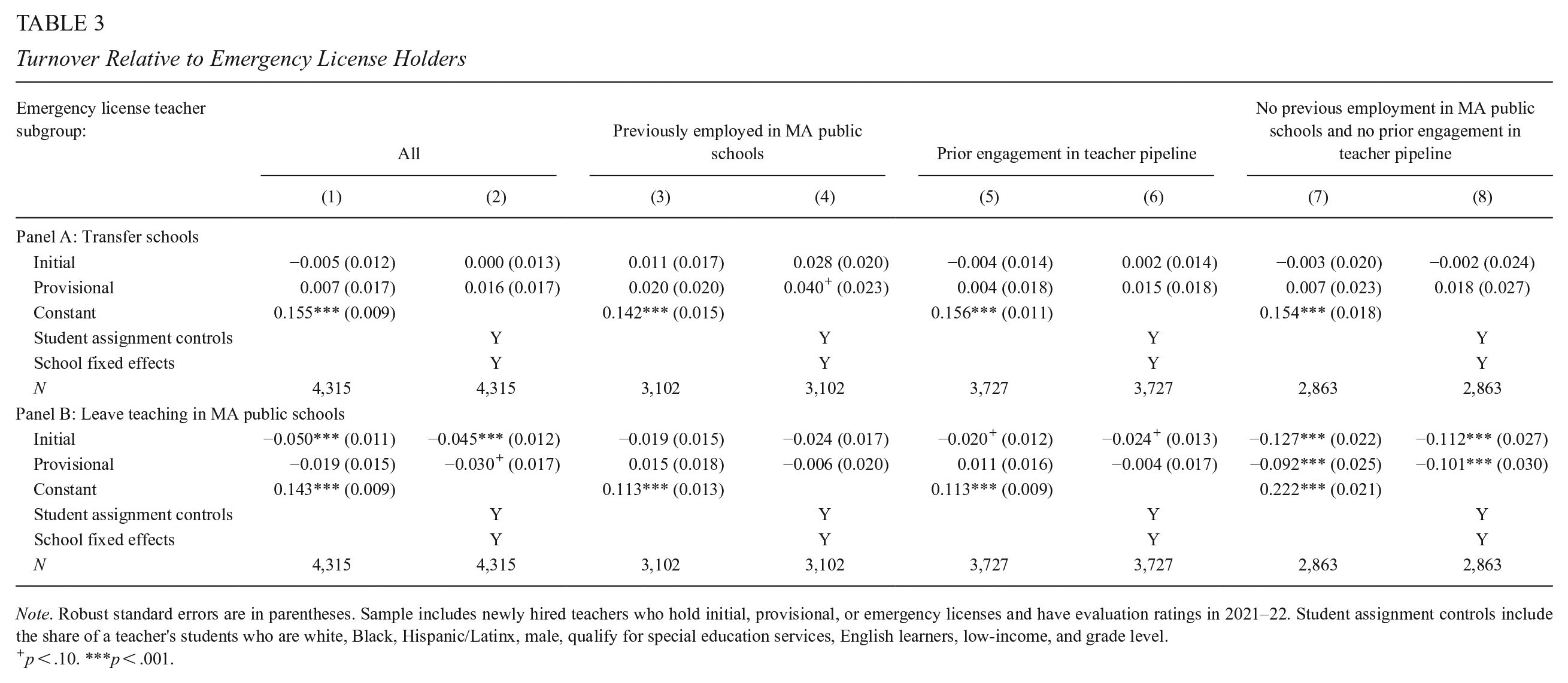
In Table 3 Panel A, we present the estimated coefficients of interest from Equation 3, focusing on the outcome of transferring schools following the 2021–22 school year. We do not find any statistically significant differences in the likelihood of transferring schools between ELTs and their initial or provisionally licensed peers. The same holds true when we compare each of the subgroups of ELTs to initial and provisional license holders.
Turnover Relative to Emergency License Holders
Note. Robust standard errors are in parentheses. Sample includes newly hired teachers who hold initial, provisional, or emergency licenses and have evaluation ratings in 2021–22. Student assignment controls include the share of a teacher's students who are white, Black, Hispanic/Latinx, male, qualify for special education services, English learners, low-income, and grade level.
p < .10. ***p < .001.
In Table 3 Panel B, we examine whether ELTs differ in their likelihood of leaving teaching in Massachusetts public schools following the 2021–22 school year. In our preferred model (Column 2), we estimate that newly hired ELTs are 4.5 percentage points more likely to leave teaching than are newly hired initial license holders (p < .001), and 3.0 percentage points more likely to leave teaching than are their provisionally licensed peers, though the latter result is not statistically significant at traditional levels (p = .07).
We do not observe any statistically significant relative differences in the likelihood of leaving teaching between newly hired ELTs with (a) prior employment in the state’s public schools (Column 4), and (b) prior engagement in the teacher pipeline (Column 6), conditional on student assignment characteristics and school-fixed effects. However, as shown in Column 8, we find that newly hired ELTs with (c) no prior employment in the state’s public schools and no prior engagement in the teacher pipeline are 11.2 percentage points more likely to leave teaching than initial license holders (p < .001) and 10.1 percentage points more likely to leave teaching than provisional license holders (p = .001).
Together, our results suggest that newly hired ELTs are overall no more likely to transfer schools than their initial and provisional licensed peers, and they leave teaching at rates that are not significantly different from their provisionally licensed peers. However, the subgroup of ELTs with no prior employment in the state’s public schools and with no prior engagement in the teacher pipeline is more likely to leave teaching than both initially and provisionally licensed new hires with similar student and school assignments.
Conclusion
Our study provides an important examination of the effectiveness and turnover among the first wave of teachers who were enabled to enter the workforce by the creation of the emergency license as a pandemic-induced stopgap measure. Our results indicate that newly hired ELTs, as a whole, (a) performed similarly to their provisionally licensed peers with respect to performance ratings, but were 6 percentage points more likely to be rated below proficient than their initially licensed peers; (b) had similar mSGPs in math and ELA to those of provisional and initial license holders; and (c) had similar rates of transferring schools and leaving teaching as their provisionally licensed peers, but were 5 percentage points more likely to leave teaching than their initially licensed peers. It is worth noting that the majority of ELTs in our sample had previously engaged with the Massachusetts teacher pipeline (i.e., enrolled in a preparation program and/or took a licensure exam) and/or were previously employed in Massachusetts public schools. The subset of ELTs with no prior employment in Massachusetts public schools and no prior engagement with the teacher pipeline had lower mSGPs in ELA and were more likely to leave teaching following the 2021–22 school year. These insights from the first wave of ELTs support policies that increase flexibility in fulfilling traditional licensure requirements, particularly for those who have demonstrated interest and efforts in the educator pipeline by working in public schools or attempting traditional licensure requirements.
Two important limitations of our analysis are that it examines measures of teacher effectiveness and turnover from only one academic year that also overlapped with the second year of the pandemic, and we are only able to examine ELTs who received emergency licenses within the first 2 years of the policy. While it may be tempting to infer that a more permanent reduction of licensure requirements would yield entrants that are similar in effectiveness to their traditionally licensed peers, doing so may be misguided. Our prior work (Bacher-Hicks et al., 2023) and current analysis indicate that many first-wave emergency license holders were engaged in the broader educator workforce (e.g., as paraprofessionals and long-term substitutes) or attempted some licensure requirements. In other words, many of those who entered the teacher workforce under the emergency license provision in the first 2 years of the policy may have been “waiting in the wings.”
In concurrent work that extends this study, Backes et al. (2024) examine how a more recent wave of ELTs (e.g., those who became employed in 2022–23) differ in background characteristics and effectiveness from those who obtained emergency licenses and employment earlier in the pandemic. If a similar policy to reduce licensure requirements were to be enacted again, it may yield incoming teachers with substantially different profiles, and possibly, differing levels of effectiveness. Moreover, our results raise some concerns about reducing requirements to afford entry to those without previously demonstrated interest and efforts to join the educator pipeline.
Additional research on the longer-run impacts of reducing teacher licensure requirements is needed to guide efforts aimed at optimizing licensure policy for building an effective and inclusive workforce. Nonetheless, our work does suggest that the substantial number of teachers who were hired from the first wave of emergency license holders performed largely on par with many of their traditionally licensed peers. As the expiration dates for pandemic-issued licenses approach, Massachusetts and other states that made similar changes should prioritize policies that offer flexible long-term licensure pathways to retain those teachers who have demonstrated effective on-the-job performance.
Supplemental Material
sj-pdf-1-epa-10.3102_01623737251329345 – Supplemental material for Teacher Licensure and Workforce Quality: Insights From the First Wave of COVID Era Emergency Licenses in Massachusetts
Supplemental material, sj-pdf-1-epa-10.3102_01623737251329345 for Teacher Licensure and Workforce Quality: Insights From the First Wave of COVID Era Emergency Licenses in Massachusetts by Olivia L. Chi, Andrew Bacher-Hicks, Ariel Tichnor-Wagner and Sidrah Baloch in Educational Evaluation and Policy Analysis
Footnotes
Acknowledgements
The authors are grateful to the Massachusetts Department of Elementary and Secondary Education (DESE) for providing data access, feedback, and comments throughout the research process, with particular thanks to Claire Abbott, Matt Deninger, Liz Losee, Elana McDermott, and Aubree Webb. The findings and conclusions in this paper are those of the authors and do not represent the positions or policies of the Massachusetts DESE.
Declaration of Conflicting Interests
The author(s) declared no potential conflicts of interest with respect to the research, authorship, and/or publication of this article.
Funding
The author(s) disclosed receipt of the following financial support for the research, authorship, and/or publication of this article: This work was supported by DESE contract 22EEPAW1.

Authors
OLIVIA L. CHI, PhD, is an assistant professor at Boston University’s Wheelock College of Education and Human Development. Her research focuses on the economics of education, teacher labor markets, and measures of teacher quality.
ANDREW BACHER-HICKS, PhD, is the vice president of evidence and evaluation at Arnold Ventures. His research focuses on education policy and the economics of education.
ARIEL TICHNOR-WAGNER, PhD, is a lecturer at Boston University’s Wheelock College of Education and Human Development. Her research focuses on K–12 education policy implementation, teacher policy, and school improvement.
SIDRAH BALOCH, MA, is the assistant director of policy at Boston University’s Wheelock Educational Policy Center. Her work focuses on conducting and disseminating policy-relevant research in partnership with state and local education agencies.
References
Supplementary Material
Please find the following supplemental material available below.
For Open Access articles published under a Creative Commons License, all supplemental material carries the same license as the article it is associated with.
For non-Open Access articles published, all supplemental material carries a non-exclusive license, and permission requests for re-use of supplemental material or any part of supplemental material shall be sent directly to the copyright owner as specified in the copyright notice associated with the article.
