







Abstract
The four-day school week (4DSW) is an alternative schedule gaining popularity among K–12 schools in the United States, with a resultant growing body of empirical research. This scoping review examined the extent and types of published empirical research evidence on the 4DSW. As of November 2024, we located 123 empirical research studies on the 4DSW in U.S. K–12 schools. The majority of studies provided evidence on the effects of 4DSWs (n = 78; 63%), examined 4DSWs in rural communities (n = 91; 74%), and are published in gray literature (n = 92; 75%). We created an online interactive database for interest holders to explore the diverse types of available evidence for studies most relevant to their specific contexts and informational needs.
Keywords
Introduction
The four-day school week (4DSW) is an alternative school schedule in which students only attend school 4 days per week, with schools attempting to compensate for lost instructional time by increasing the school day or school calendar year. Historically, school districts have switched to the 4DSW primarily for anticipated cost-savings and attendance issues commonly faced by schools located in rural communities (Thompson et al., 2021). Since the onset of the COVID-19 pandemic, districts are increasingly considering the 4DSW as a non-pecuniary benefit for teachers and staff (Camp et al., 2024). For districts that cannot afford to increase financial compensation for teachers and staff, the 4DSW aims to improve working conditions (i.e., reduced stress and burnout) as a recruitment and retention tool (Ainsworth et al., 2024). That said, recent research calls into question whether the 4DSW effectively and sustainably addresses turnover (Ainsworth, et al., 2024; Camp et al., 2024; Morton & Dewil, 2024)—especially as the presence of nearby 4DSW districts strongly predicts policy adoption (Anglum & Park, 2021; Thompson et al., 2021), thereby reducing its ability to serve as a distinct competitive advantage relative to other schools and districts in a local labor market.
The 4DSW is gaining popularity among K–12 schools in the United States, as more than 2,100 schools in nearly 900 districts across 26 states have adopted a 4DSW (Morton et al., 2024). This growth in popularity has largely been facilitated by policy changes in western states that allow waivers of minimum yearly instructional day mandates of traditional school calendars (Kilburn et al., 2021; Thompson et al., 2021). In states without these policy changes for public K–12 schools, charter schools may have the flexibility to adopt the 4DSW in conjunction with efforts to extend the length of the school day and year (Kraft & Novicoff, 2024).
As a result of interest in the 4DSW across the United States, a growing body of empirical research aims to provide interest holders with information on its effects and implementability. For example, numerous studies have examined whether the 4DSW achieves its stated aims on cost-savings (Morton, 2021; Thompson, 2021), student attendance (Morton, 2023; Thompson et al., 2022), and teacher recruitment and retention (Camp et al., 2024; Maiden et al., 2020). In addition, educational interest holders are concerned about potential unintended negative and inequitable impacts on student achievement (Morton et al., 2024; Thompson et al., 2023; Thompson & Ward, 2022), health (Israel et al., 2020; Tomayko et al., 2020, 2021), and societal well-being (Fischer & Argyle, 2018). Interest holders also want to learn about the experience of implementing the 4DSW, such as satisfaction with the schedule change and district services available on the fifth “off day” (Kilburn et al., 2021). Given mixed and heterogeneous findings across 4DSW studies, interest holders particularly want to use research evidence from studies most relevant to their specific educational contexts and informational needs. However, to date, no evidence synthesis has systematically identified and characterized empirical research studies on the 4DSW.
The objective of this scoping review was, therefore, to examine the extent and types of published empirical research evidence available on the 4DSW at U.S. K–12 schools. Scoping reviews aim to explore and characterize the breadth of the published literature on a research topic (Peters et al., 2020; Tricco et al., 2018). Scoping reviews are particularly useful as a preliminary exercise in an emerging research area when it is still unclear whether more specific questions can be valuably addressed in future systematic reviews (Anderson et al., 2008). Consequently, this scoping review summarizes the types of empirical research evidence available for education interest holders, assesses whether sufficient evidence exists for subsequent systematic reviews, and identifies existing gaps in the literature to inform future primary research.
Methods
We designed this study using the JBI Manual for Evidence Synthesis (Peters et al., 2020), which includes a chapter dedicated to best practices in conducting scoping reviews. We prospectively registered the review on the Open Science Framework (https://osf.io/kqyc6/). We drafted this manuscript using the Preferred Reporting Items for Systematic reviews and Meta-Analyses (PRISMA) extension for literature searches (Rethlefsen et al., 2021) and the PRISMA extension for scoping reviews (Tricco et al., 2018) to transparently report why our scoping review was done, what methods we used, and what we found.
Eligibility Criteria
We included empirical studies examining 4DSWs at K–12 schools. We excluded studies focused on other alternative school schedules (e.g., extending the school year) that did not involve reducing traditional five-day school weeks to 4DSWs. Based on the interests of our research institute advisory board and other interest holders, we excluded studies in pre-school, postsecondary school, and countries other than the United States. The population of interest was any interest holder considering the shift to a 4DSW. We included all research designs that involved the analysis of empirical data or simulated empirical data. We excluded conceptual papers, opinion articles, narrative literature reviews, and non-research sources (e.g., news). We included gray literature unless we could not obtain the full text. Due to limitations in resources and language proficiency, we excluded studies published in languages other than English.
Information Sources
We searched for eligible studies using the following electronic databases (search platforms) from inception to November 2024: APA PsycINFO (APA PsycNet), PubMed (National Library of Medicine), ProQuest Dissertations & Theses A&I (ProQuest), and Social Science Premium Collection (ProQuest). The Social Science Premium Collection contains the Criminology Collection, Education Collection (including Education Resources Information Center, or “ERIC”), International Bibliography of the Social Sciences, Library & Information Science Collection, Linguistics Collection, Politics Collection, Social Science Database, and Sociology Collection. To identify any further potentially eligible citations, we searched reference lists of included studies and citing references using citationchaser (Haddaway et al., 2022). We additionally hand-searched several key journals: Economics of Education Review, Education Finance and Policy, Journal of Education and Training Studies, Journal of School Health, and Rural Educator. We chose these journals because they produced the largest number of relevant studies during our initial search of bibliographic databases. We also looked for gray literature using Google Scholar. Although we did not contact authors nor search specific websites, we did add citations identified serendipitously (e.g., through social media).
Search Strategy
We developed the search strategy using the Peer Review of Electronic Search Strategies (PRESS) Guideline (McGowan et al., 2016), which guides the translation of review research questions into search terms and the implementation in electronic databases via appropriate Boolean and proximity operators, subject headings, text word searching, spelling, syntax, line numbers, limits, and filters. We used terms common in studies from a preliminary scan of the literature on Google Scholar. The search strategy involved the following terms: 4-day school week, 4-day schedule, 4-day model, 4-day modified school, 4-day students, four-day school week, five-day school week, school schedules, short* schedule, short* school week combined with school, students, teachers, child, youth, adolescents, teens or parents (see Online Supplement 1 for full search strategy). It did not involve any published search filters. We uploaded citations into a web-based systematic review data management software (DistillerSR) and used its “Duplicate Detection” function to search for duplicates prior to screening.
Selection Process of Sources of Evidence
Two review authors independently screened titles and abstracts of each citation for potentially eligible studies. We retrieved full texts for each citation deemed potentially eligible by at least one reviewer. Two review authors independently assessed each full text for eligibility, recording reasons for excluding citations. Reviewers discussed initial disagreements of full-text eligibility decisions, meeting with a third reviewer as needed for unresolved disagreements. We used standardized forms in DistillerSR and did not blind review authors to journal titles, study authors, and authors’ institutions.
Data Charting Process and Items
One PhD-level reviewer (SG) and either another graduate-level reviewer (KSF) or two undergraduate reviewers (a combination of BC, SH, and SM) independently collected data from each eligible article using DistillerSR. Reviewers resolved any disagreements through discussion, meeting with a third reviewer as needed for unresolved disagreements. We developed our data collection form through an iterative process—continually updating the items as data collection progressed and revisiting studies when new items were added to the form (Peters et al., 2020; Tricco et al., 2018). The form began with bibliographic items for author name, publication year, publication type (journal article, preprint, report, or student dissertation/thesis), and publisher (journal, preprint server, organization, or university). For student manuscripts, we collected information on degree level (doctoral, master’s, or undergraduate) and discipline (economics, education, music, psychology, or sociology). The form then included items characterizing the source of evidence: that is, years from which study data were collected, community types (rural, suburban, urban) and states in which the study took place, grade and school levels, student race/ethnicity, and any activities on the fifth “off day” officially offered by schools or districts. Because scoping reviews aim to characterize the extent and nature of existing evidence regardless of methodological quality or risk of bias, we did not critically appraise the included sources of evidence (Tricco et al., 2018).
The data collection form concluded with items about the types of empirical evidence provided by the included studies. Based on the GRADE Evidence-to-Decision framework for structuring policy and practice decision-making (Alonso-Coello et al., 2016), we assessed six types of empirical evidence: acceptability (extent to which the 4DSW is acceptable to specific interest-holder groups), effectiveness (impact of the 4DSW on student, school, and community outcomes), equity (degree to which the 4DSW has differential impacts by population and setting), feasibility (how the 4DSW was implemented), priority (focused on examining growth of schools, districts, or states adopting the 4DSW), and resource use (costs and resource implications of 4DSW adoption).
Synthesis of Results
We narratively and visually summarized the study search and selection process via the number of records screened, assessed for eligibility, and included in our scoping review (Page et al., 2021; Tricco et al., 2018). We analyzed and summarized characteristics of the empirical research evidence through descriptive statistics. We present results through narrative and tabular summaries.
Results
Of 4,211 unique citations, we excluded 3,679 citations during title and abstract screening. Reasons for exclusions include citations being about the 4-day work week (rather than school week), block scheduling and year-round school (rather than four-day week schedule), or news reports and opinion articles (rather than empirical research) about the 4DSW. Of the 513 remaining citations we could locate for full-text eligibility assessment, we excluded 367 citations. We included the remaining 123 studies (reported in 146 manuscripts) in our scoping review (see Figure 1).
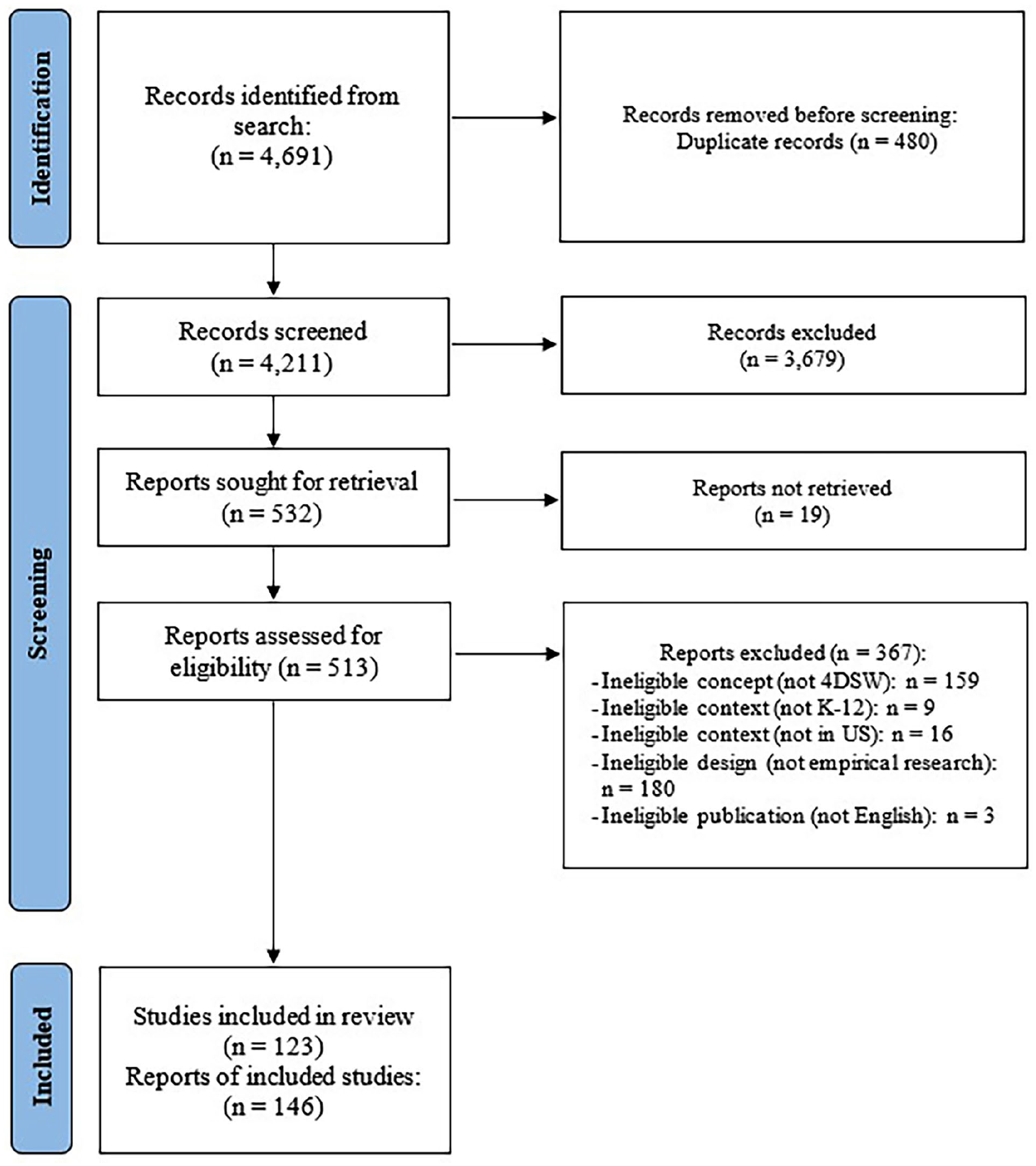
Flow diagram for selection of sources of evidence.
Characteristics of Sources of Evidence
We provide a summary of characteristics of sources of evidence in Table 1 (full details in Online Supplement 2). Included studies were published from 1980 to 2024 (median of 2018). Of the 123 studies, most (n = 92; 75%) are published in gray literature: 72 (59%) as student dissertations or theses, 16 (13%) as self-published reports, and 4 (3%) as working papers pre-printed before journal peer review. Only 31 studies (25%) had a peer-reviewed journal article as the final version of record. Of the 72 student dissertations and theses, 59 (82% of student manuscripts) were at the doctoral level, 11 (15%) at the master’s level, and 2 (3%) at the undergraduate level. Most students completed dissertations and theses in partial fulfillment of degrees in education (n = 64; 89%), followed by economics (n = 4; 6%), psychology (n = 2; 3%), sociology (n = 1; 1%), and music (n = 1; 1%).
Characteristics of Included Sources of Evidence
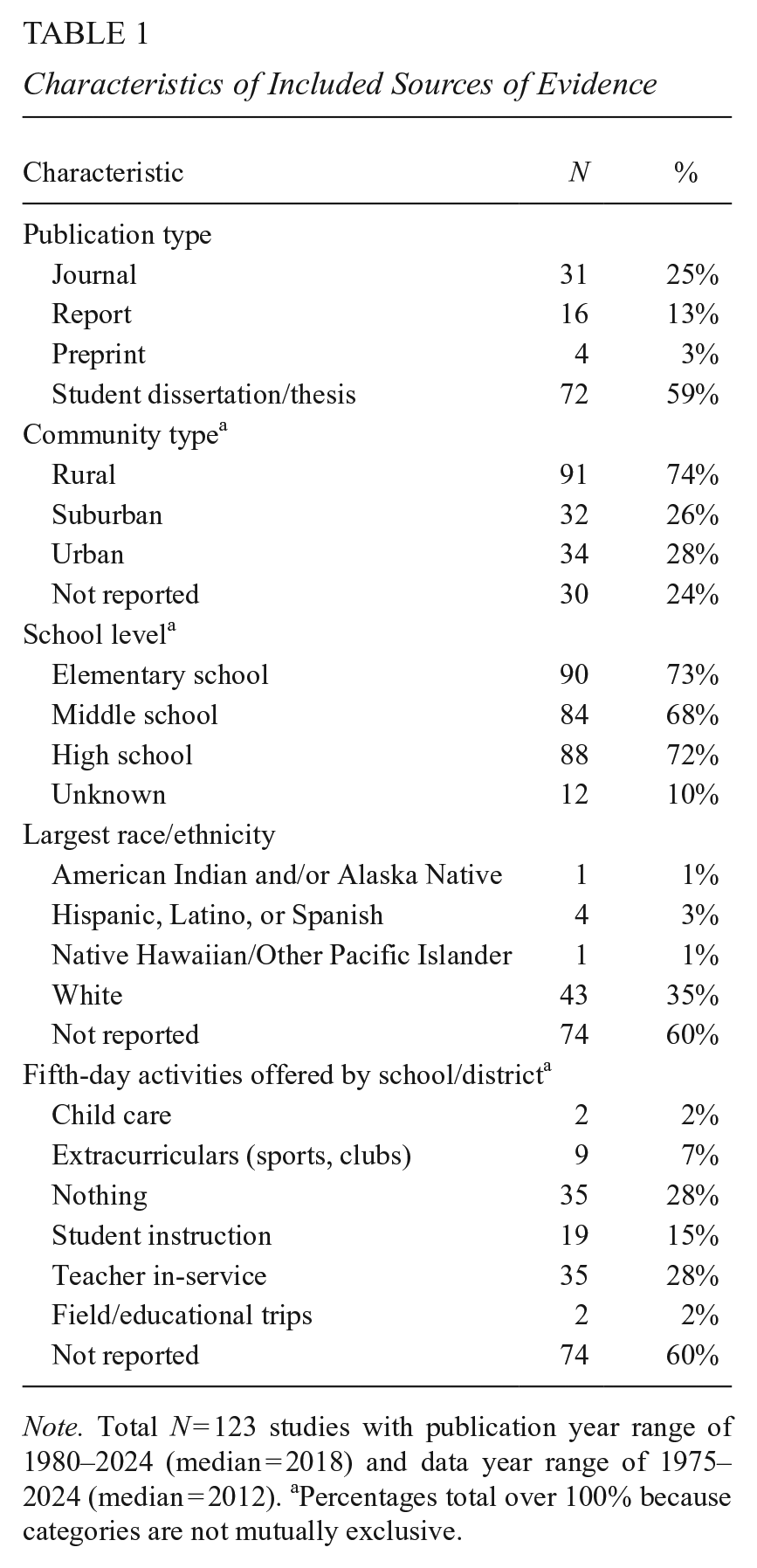
Note. Total N = 123 studies with publication year range of 1980–2024 (median = 2018) and data year range of 1975–2024 (median = 2012). aPercentages total over 100% because categories are not mutually exclusive.
Studies collected and analyzed data from 1975 to 2024 (median of 2012). Studies predominantly included data from rural communities in their sample (n = 91; 74%), though numerous studies also included data from urban (n = 34; 28%) and suburban communities in their samples (n = 32; 26%); 30 studies (24%) did not report information on community type. Studies included data from 34 states—most predominantly from Missouri (n = 36; 29%), Colorado (n = 28; 23%), Oklahoma (n = 18; 15%), Oregon (n = 18; 15%), New Mexico (n = 13; 11%), and South Dakota (n = 12; 10%). The number of studies providing data from elementary (n = 90; 73%), middle (n = 84; 68%), and high (n = 88; 72%) schools was fairly evenly distributed across levels, with data representing all grades (except kindergarten) included in at least half the studies. Most studies did not provide information on student race/ethnicity (n = 74; 60%) nor activities on the fifth “off day” officially offered by schools or districts (n = 74; 60%).
Types of Empirical Research Evidence
We provide a summary of types of empirical research evidence in Table 2 (full details in Online Supplement 3). Of the 123 included studies, most reported evidence on 4DSW effectiveness (n = 78; 63%). Among these 78 studies, seven different methodological and statistical approaches were used: 19 studies used difference-in-differences (24% of effectiveness studies), 15 studies (19%) used descriptive statistics only, 14 studies (18%) used a before-after design, 14 studies (18%) used a between-group design without controls, 7 studies (9%) used a between-group design with controls, 6 studies (8%) used matched-pair designs, and 3 studies (4%) used computational models. These 78 studies provided outcome data across nine domains: 52 studies (67% of effectiveness studies) reported on student achievement, 24 (31%) on student attendance, 13 (17%) on teacher and staff recruitment and retention, 9 (12%) on student health status or health-related behaviors, 8 (10%) on student attainment, 7 (9%) on school climate, 5 (6%) on disciplinary incidents during school, 4 (5%) on household impacts, and 2 (3%) on juvenile crime. Most effectiveness studies (n = 42; 54% of effectiveness studies) also reported evidence on equity of 4DSW effects according to nine domains: 28 (67% of equitability studies) on student age, 10 (24%) on community type or rurality, 9 (21%) on student socioeconomic status, 7 (17%) on student race or ethnicity, 5 (12%) on student gender identity or sex, 5 (12%) on student special education status, 3 (7%) on student English language learner status, 3 (7%) on gifted student status, and 1 (2%) on student immigration status.
Available Empirical Research Evidence on Four-Day School Weeks
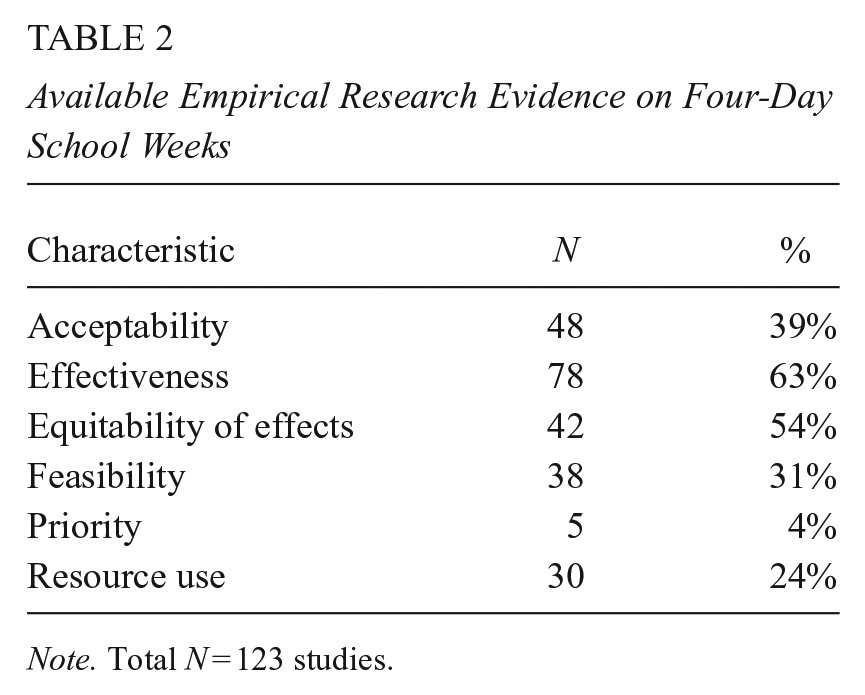
Note. Total N = 123 studies.
Of the 75 studies (61%) that reported one type of evidence on the implementability of the 4DSW, most (n = 48; 64% of studies with implementability data) reported evidence on acceptability. These 48 studies examined satisfaction with the 4DSW among teachers (n = 33; 69%), parents (n = 20; 42%), administrators (n = 18; 38%), students (n = 15; 31%), community members (n = 11; 23%), principals (n = 8; 17%), school staff (n = 8; 17%), superintendents (n = 7; 15%), and the athletics department, business owners, school board members, and counselors (n = 2 each; 4% each). In addition, 38 studies (51% of studies with implementability data) reported evidence on the feasibility of implementing the 4DSW, and 30 (40%) reported evidence on resource use associated with switching to a 4DSW. Lastly, only five studies (4% of all studies) reported evidence on 4DSW as a policy priority through an explicit empirical focus on the growth of schools, districts, or states adopting the 4DSW.
Discussion
Our scoping review identified 123 studies published from 1980 to 2024. Our findings indicate that empirical research evidence exists on the acceptability, effectiveness, equity, feasibility, priority, and resource use associated with 4DSW adoption across a range of states. Most studies reported evidence on 4DSW effects, though outcomes measured and the rigor of the method used to assess effectiveness (and thus potential credibility of the evidence) vary considerably across these studies. In addition, more than half the studies examined at least one aspect of 4DSW implementability (i.e., acceptability, feasibility, or resource use). Strikingly, the vast majority of existing empirical research evidence is available only in the gray literature. While gray literature by definition involves work not published in peer-reviewed journals, the vast majority of gray literature manuscripts (96%) are student theses and formal reports that likely went through an evaluation or quality assurance process. In addition, including gray literature is a best practice in evidence syntheses to address reporting biases by identifying manuscripts that are inherently more difficult to find (McKenzie et al., 2024).
Particularly in light of the amount of difficult-to-find gray literature, we created an online interactive bibliographic database to make this body of evidence more readily available to interest holders. This interactive dashboard provides links to and information about each included study, providing empirical research evidence on 4DSWs in the United States (https://hedcoinstitute.uoregon.edu/dashboards/four-day-school-week-research-database). Interest holders can use this open-access database to explore the diverse types of evidence available and find the studies most relevant to their specific contexts and sufficiently reliable for their evidence-informed decision-making needs.
Given continued interest-holder attention to the 4DSW as an alternative school schedule, and the growing body of research on the 4DSW documented in this scoping review, there is clearly a need for future systematic reviews synthesizing the findings of empirical studies on the 4DSW. These reviews might assess the quality and rigor of available studies; estimate average and differential impacts on student, school, and community outcomes; and examine the implementability of the 4DSW. That said, this current scoping review has already identified several key gaps in the existing evidence base that should be addressed in future primary research. For instance, although evidence that is from non-rural communities, on marginalized populations, and collected after the onset of the COVID-19 pandemic does exist, the literature predominantly represents rural communities, is based on data collected prior to the pandemic, and does not examine equitability implications. In addition, future primary research should investigate and report information on student demographics, differential findings by various gradients of societal advantage, and activities offered on the fifth day. These additional primary studies and future systematic reviews could provide a range of education interest holders with valuable evidence that can inform their decision-making around the tradeoffs associated with a shift to a 4DSW.
Supplemental Material
sj-pdf-1-epa-10.3102_01623737251362865 – Supplemental material for The Four-Day School Week at K–12 Schools in the United States: A Scoping Review of Empirical Research Evidence
Supplemental material, sj-pdf-1-epa-10.3102_01623737251362865 for The Four-Day School Week at K–12 Schools in the United States: A Scoping Review of Empirical Research Evidence by Sean Grant, Shaina D. Trevino, Katarzyna Steinka-Fry, Elizabeth Day, Beatriz Cabrera, Samantha Hamilton, Samantha Martinez, Lisa K. Chinn and Emily E. Tanner-Smith in Educational Evaluation and Policy Analysis
Footnotes
Acknowledgements
The authors thank Jen Davis for her invaluable administrative leadership and contributions to this project, Superintendent George Mendoza of the La Grande School District for drawing our attention to the importance of this topic, and the HEDCO Institute Advisory Board for their insights and feedback throughout the project.
Author Contributions
Conceptualization (SG), Data Curation (SDT, SG), Formal Analysis (SG, SDT), Funding Acquisition (EETS), Investigation (SG, BC, SH, SM, KSF, ED), Methodology (SG, SDT, KSF, EETS), Project Administration (SDT, SG), Resources (EETS), Software (SDT, SG), Supervision (SG, EETS), Validation (SDT), Visualization (SDT), Writing – Original Draft (SG, LKC), Writing – Review & Editing (SG, SDT, KSF, ED, BC, SH, SM, LKC, EETS).
Data Availability Statement

Declaration of Conflicting Interests
The authors declared no potential conflicts of interest with respect to the research, authorship, and/or publication of this article.
Funding
The authors disclosed receipt of the following financial support for the research, authorship, and/or publication of this article: Core funding for the HEDCO Institute for Evidence-Based Educational Practice is provided by donor funds to the University of Oregon. The funders had no role in study design, data collection and analysis, preparation of this manuscript, or decisions about publication and other dissemination.
Authors
SEAN GRANT, DPhil, is a Research Associate Professor at the HEDCO Institute for Evidence-Based Educational Practice in the College of Education, University of Oregon. His scholarship focuses on the generation, synthesis, and use of evidence from intervention research across the social, behavioral, and health sciences.
SHAINA D. TREVINO, PhD, is a Research Associate at the HEDCO Institute for Evidence-Based Educational Practice in the College of Education, University of Oregon. Her scholarship is focused on intergenerational transmission of self- and emotion regulation, youth well-being, and violence prevention.
KATARZYNA STEINKA-FRY, MA, MPA, is a Senior Research Assistant at the HEDCO Institute for Evidence-Based Educational Practice in the College of Education, University of Oregon. She has experience in evaluation research in the social and health sciences, with expertise in the areas of data management, systematic reviews, and meta-analysis.
ELIZABETH DAY, PhD, is a Research Assistant Professor at the HEDCO Institute for Evidence-Based Educational Practice in the College of Education, University of Oregon. Her research focuses on understanding how to best bridge research, practice, and policy, with a particular focus on child and adolescent well-being and social policy at the state level.
BEATRIZ CABRERA is an Undergraduate Scholar at the HEDCO Institute for Evidence-Based Educational Practice in the College of Education, University of Oregon. She is studying for a Bachelor’s degree in Education Foundations, with a minor in Spanish.
SAMANTHA HAMILTON is an Undergraduate Scholar at the HEDCO Institute for Evidence-Based Educational Practice in the College of Education, University of Oregon. She is studying for a Bachelor’s degree in Family and Human Services, with minors in Disability Studies and Special Education.
SAMANTHA MARTINEZ is an Undergraduate Scholar at the HEDCO Institute for Evidence-Based Educational Practice in the College of Education, University of Oregon. She is studying for a Bachelor’s degree in Educational Foundations, with a minor in Business Administration.
LISA K. CHINN, PhD, is a Postdoctoral Scholar at the HEDCO Institute for Evidence-Based Educational Practice in the College of Education, University of Oregon. She has expertise in typical cognitive development, developmental effects of adversity, executive functioning, and neuroimaging.
EMILY E. TANNER-SMITH, PhD, is the Executive Director of the HEDCO Institute for Evidence-Based Educational Practice and Thomson Professor in the College of Education, University of Oregon. Her scholarship focuses on the prevention and treatment of substance use, delinquency, mental health, and academic problems among youth.
References
Supplementary Material
Please find the following supplemental material available below.
For Open Access articles published under a Creative Commons License, all supplemental material carries the same license as the article it is associated with.
For non-Open Access articles published, all supplemental material carries a non-exclusive license, and permission requests for re-use of supplemental material or any part of supplemental material shall be sent directly to the copyright owner as specified in the copyright notice associated with the article.
