






Abstract
English learner (EL) classification can provide multilingual students (MLs) with key supports while limiting access to important educational opportunities. To determine when students are ready to exit EL status, some states require students to meet academic criteria in addition to demonstrated English proficiency. However, few studies empirically examine these criteria, which may become increasingly restrictive in upper grades. We use administrative data from Texas and a regression discontinuity (RD) design to estimate the effect of using academic criteria to reclassify students at the end of eighth grade. Reclassified students earn more advanced credits, but graduate high school at lower rates, indicating a need for greater course access for EL-classified students and increased support for former ML-ELs.
Introduction
Multilingual students classified as “English learners” (EL)—hereafter “ML-ELs” 1 —are one of the fastest-growing groups in the United States, comprising over 10% of all public school enrollment (Hussar et al., 2020). To ensure equitable educational experiences and outcomes, federal mandate requires states to develop policies for formally identifying students as ELs, supporting them toward attaining English proficiency, and ultimately reclassifying them as “English proficient” (Every Student Succeeds Act [ESSA], 2015). EL classification can provide students with critical supports, including English language development (ELD) instruction (Baker et al., 2014), home-language content instruction (Porter et al., 2023; Steele et al., 2017), and specialized teacher expertise (Master et al., 2016). However, retaining students in EL programming after support services are no longer needed may become actively detrimental, given that EL status is also linked to linguistic isolation (Gifford & Valdés, 2006), assignment to less experienced or effective teachers (Gándara, 2021; Torre Gibney & Henry, 2020), and tracking into lower-level classes (Dabach, 2014; Estrada, 2014; Kanno & Kangas, 2014). Accurately determining the right time for reclassification is therefore a critical challenge for policymakers.
Each state sets its own reclassification criteria, typically combining English language proficiency (ELP) assessments with additional indicators such as teacher evaluations (Rafa et al., 2020). While a growing body of research uses test-based criteria to measure the causal impact of reclassification on subsequent outcomes, far less is known about how the inclusion of particular criteria in the reclassification process shapes those outcomes (Morales & Lepper, 2024). As of 2023, 18 states include non-ELP assessments in the reclassification process. Among them, California, Texas, Florida, and New York—four of the states serving the largest numbers of ML-ELs—require students to meet minimum scores on English language arts (ELA) content exams to reclassify (California Education Code, 1999; Commissioner’s Regulations Part 154-2, 2015; Florida Administrative Code, 2006). Other states like Nevada and South Dakota include ELA assessments as alternative criteria for reclassification for students who have lower ELP scores (Nevada Department of Education, 2022; South Dakota Exit Criteria, 2025). The use of ELA content exams in reclassification decisions remains contentious: some scholars contend that requiring students to demonstrate academic content mastery may unnecessarily delay reclassification for otherwise proficient students (Abedi, 2008; Umansky & Porter, 2020). However, empirical evidence on the impacts of including academic content exams in the reclassification process is sparse.
In this study, we provide some of the first state-level evidence on the effects of using academic reclassification criteria. Drawing on administrative data from Texas, we use a frontier regression discontinuity (RD) design in which we first condition our sample to include only those who meet all ELP exam thresholds, and then estimate the effect of just barely passing the reclassification threshold on the state’s eighth-grade ELA content assessment. Our study is also one of the first to examine reclassification in Texas—the state that serves the second largest population of EL-classified students in the United States—bringing rigorous evidence to bear on current debates about the appropriateness of using academic reclassification criteria and the role of the state in setting policy that ensures educational thriving for all students (Umansky & Porter, 2020). Finally, as students progress through school, the likelihood of reclassification decreases while course differentiation and tracking increase (Gamoran, 2009; Johnson, 2020; Long & Iatarola, 2012). EL status in high school may thus meaningfully affect students’ instructional environment and subsequent outcomes. We extend the relatively sparse literature on reclassification in later grades by focusing specifically on reclassification in eighth grade, during the critical transition into high school (Johnson, 2019).
For eighth-grade students with advanced English proficiency (those who met all three English language requirements for reclassification), we find that reclassifying based on ELA criteria has a significantly positive impact on the likelihood of earning advanced course credit in high school. However, we also observe large negative impacts on the likelihood of graduating from high school, with suggestive evidence that reclassified students were more likely to fail core academic courses in high school and less likely to pass the Algebra I end-of-course (EOC) exam, a requirement for high school graduation. We note that in the Texas context, students who just miss the ELA cutoff receive accelerated instruction the following year. As such, the counterfactual to reclassification in our study is remaining EL and accessing additional academic support. Our results are robust to different model specifications and bandwidths. Taken together, our findings indicate that using ELA content exams to reclassify ML-EL students may have both positive and negative impacts on the marginal student’s high school outcomes. Our mixed results do not offer conclusive evidence on how states should incorporate academic criteria into the reclassification process. However, our findings do suggest that ML-EL students who demonstrate potential should be supported in accessing advanced courses, regardless of language status. Simultaneously, policymakers and practitioners should carefully monitor reclassified students and increase support for those who struggle in the period following program exit.
Conceptual Framework
The Potential Effects of EL (Re)Classification
Under federal policy, public schools are required to identify students whose English proficiency level would preclude full participation in English-only instructional settings as “English learners” and provide them with services to support both English language and content learning (ESSA, 2015). Classification as an EL can alter various aspects of students’ instructional environments, including curriculum, course placement, teachers, and peer composition (Umansky & Porter, 2020). Prior literature suggests that staying EL-classified can both benefit and harm students, depending on their readiness to succeed in mainstream classes and how classification changes students’ instructional settings (e.g., school services, resources) in each specific context.
EL classification can benefit students by providing access to additional services and supports, including direct instruction in English language skills (Hopkins et al., 2022), bilingual instruction (Porter et al., 2023), and English-as-a-second-language (ESL)- or bilingual-certified teachers (Loeb et al., 2014; Master et al., 2016). When implemented well, these resources can bolster both academic and ELP (Master et al., 2016; Porter et al., 2023). Students typically lose access to these services when they exit EL classification, so reclassifying too early can negatively affect outcomes by removing necessary supports. For example, in their study of the Los Angeles Unified School District (LAUSD), Robinson-Cimpian and Thompson (2016) found that EL-classified students who just barely met criteria to reclassify in Grades 9 or 10 had lower ELA performance and were less likely to graduate from high school than similarly achieving peers who remained EL-classified. These effects disappeared in subsequent years after policymakers adopted more stringent reclassification criteria, suggesting that the prior negative effects were driven by students losing access to beneficial supports before they were ready.
Conversely, EL classification may negatively impact other aspects of students’ educational experiences. A growing body of literature finds that EL status is associated with decreased access to educational resources such as highly experienced teachers, rigorous courses, and exposure to core academic content (Callahan et al., 2010; Dabach, 2014; Gándara et al., 2003; Torre Gibney & Henry, 2020; Umansky, 2016a). Policies that prioritize English acquisition at the expense of exposure to academic content knowledge may contribute to these disparities (Umansky & Avelar, 2023). For example, many schools meet federal requirements to support English acquisition by enrolling students in one or multiple ELD courses during the school day. In some contexts, ELD can crowd out space in students’ schedules for other classes, including core academic courses (Lillie et al., 2012; Umansky, 2016a). Another common strategy for supporting both academic and language proficiency development is to place ML-ELs in EL-specific content courses that often offer less rigorous instruction and lower academic content coverage (Dabach, 2014). Furthermore, research suggests that formally labeling students as English deficient can be academically and socially stigmatizing (Umansky, 2016b). Research shows that teachers tend to view EL-classified students as less academically capable than non-EL peers with comparable test scores (Umansky & Dumont, 2021) and that students who remain classified as EL report lower academic self-confidence than those who narrowly reclassify (Lee & Soland, 2022). Positive effects of reclassification on outcomes like achievement may, therefore, signal that EL status imposes harmful constraints on learning that are removed when students exit, or that students are being retained in EL classification for too long.
Finally, exiting EL status may simultaneously harm and benefit students. For example, reclassified students may lose supports such as testing accommodations and instructional scaffolding; at the same time, they may gain access to more college-preparatory content. The observed impacts of reclassification thus represent the combined effect of losing supports and removing constraints, with the direction of results depending on the magnitude of harm versus benefit. Given that the particular circumstances surrounding ML-ELs mediate reclassification effects on subsequent student outcomes, it is important to provide evidence about the impacts of reclassification from multiple contexts.
The Use of Academic Content Criteria
All states use some measure of ELP to determine reclassification, but some apply additional criteria; for instance, several include performance on ELA content exams in reclassification decisions (Morales & Lepper, 2024; Rafa et al., 2020). Although the specific assessments used in each state vary, ELA content assessments are designed to measure different constructs than ELP reading and writing assessments; this difference is particularly pronounced in later grades. While ELP assessments often focus on decoding, vocabulary, understanding grammatical structures, and comprehending short texts, ELA assessments typically assess higher-order thinking skills like understanding abstract language, analyzing authorial intent, and evaluating literary or scientific texts (Forte et al., 2012; Krathwohl, 2002). Proponents argue that including ELA achievement measures ensures that ML-EL students are academically prepared to succeed in a mainstream classroom environment, acting as a bulwark against early exit (Linquanti, 2001; Ragan & Lesaux, 2006). Critics counter that state content exams are not designed to assess language learners and thus produce biased test scores that fail to represent ML-ELs’ true content knowledge (Umansky & Porter, 2020; Wolf & Leon, 2009). Furthermore, English-only students are typically not required to meet state thresholds on ELA content exams to be placed in mainstream classrooms, creating policy incoherence (Abedi, 2006; Bailey & Carroll, 2015; Gándara & Baca, 2008; Solano-Flores, 2008; Umansky & Avelar, 2023).
Concern over the growing population of long-term ML-ELs is one factor fueling criticism of the use of academic criteria for reclassification. Research suggests that it typically takes up to 7 years to develop proficiency in a new language (Thompson, 2017), yet many students remain EL-classified for much longer, with one meta-analysis finding that nearly a quarter of students who started kindergarten as ELs never reclassified (Garibay & Abdelkader, 2024; Olsen, 2010; Thompson, 2017). Because reading and writing proficiency criteria are usually the hardest for students to meet, particularly at the secondary level, critics suggest that including ELA content exams in the reclassification process increases the likelihood that students will be retained in EL status for multiple years based on a single criterion (Abedi, 2006; Robinson, 2011; Thompson, 2017). Remaining in EL services that cater to lower English proficiency students can initiate a vicious cycle wherein students feel stigmatized and lose confidence, disengage from school, and consequently demonstrate decreased academic performance—that is then used to hold them in EL status (Flores et al., 2015; Menken et al., 2012; Umansky & Avelar, 2023). However, empirical evidence on the utility of using content exams for reclassification is limited. Reclassification effects are often assessed through RD studies that apply a binding-score design and thus reduce multiple reclassification criteria to a single composite score (Johnson, 2019; Reyes & Hwang, 2021; Robinson, 2011). Very few studies systematically evaluate which tests contribute to reclassification and whether there are heterogeneous effects by threshold.
Reclassification Timing and the Middle-to-High-School Transition
The relative benefits and harms of reclassification may also depend in part on its timing. Researchers frequently find that reclassification effects vary across grade levels or bands (Betts et al., 2020; Pope, 2016; Robinson, 2011) and may be strongest during the transition between school levels (Johnson, 2019). The evidence base on reclassification at the secondary level is generally more limited than its elementary equivalent. However, a growing body of research examines reclassification effects in middle or high school. Each of the three potential directions of reclassification effects discussed above bears out in these studies, which find a range of positive, negative, and null impacts on measures of math and ELA achievement in several different contexts (Betts et al., 2020; Carlson & Knowles, 2016; Cimpian et al., 2017; Johnson, 2020; Pope, 2016; Reyes & Hwang, 2021; Robinson, 2011; Robinson-Cimpian & Thompson, 2016).
Research on the impacts of later-grade reclassification on high school graduation is similarly mixed. In Wisconsin, Carlson and Knowles (2016) find suggestive evidence that reclassifying in 10th grade increased high school graduation rates and stronger evidence that it increased students’ likelihoods of postsecondary enrollment. In another state, however, reclassification in middle and high school had no effect on graduation (Cimpian et al., 2017). Two studies found that high school reclassification in the LAUSD had a negative effect on graduation that disappeared when the criteria became more stringent (Betts et al., 2020; Robinson-Cimpian & Thompson, 2016), while Johnson (2019) found null effects of eighth-grade reclassification on graduation rates in another California district. Altogether, the extant literature on secondary reclassification might best be described as conclusively varied.
It is not surprising that effects of reclassification differ across studies, given that both reclassification criteria and EL services vary widely across state and even district lines. For example, in their study of eighth-grade reclassification in a California district, Reyes and Hwang (2021) attribute null findings to the lack of variation in instructional settings for ML-ELs and mainstream students in their study context. By contrast, Carlson and Knowles (2016) suggest that 10th-grade reclassification may be particularly influential because it influences ELA curriculum exposure in 11th grade, the year that all students in Wisconsin take the American College Testing college entrance exam (ACT). In the absence of automatic reclassification processes (Bartlett et al., 2024), school districts may also vary in how strictly or loosely they follow state guidelines. Cimpian et al. (2017) directly examined variation in the degree of reclassification policy adherence among districts in two different states and found significant heterogeneity in both the likelihood of reclassification and its subsequent effects on student achievement and graduation. These studies emphasize the importance of context and highlight the need for more research on the effects of reclassification in different settings.
As described above, reclassification may have heterogeneous effects across not only contexts but also outcomes, varying in both direction and magnitude. However, existing evidence on some key outcomes is sparse. For example, disparities in access to academic content are one of the most frequently cited potential negative effects of EL classification. While a large body of descriptive research suggests that ML-ELs are less likely than peers to take advanced or upper-level courses in middle and high school (Callahan et al., 2010; Cashiola et al., 2022; Johnson, 2019; Zuniga et al., 2005), only three RD studies address this topic, all suggesting that EL classification has no impact on advanced course engagement (Reyes & Hwang, 2021; Robinson, 2011; Umansky, 2016b). There remains a need for more research on course access as well as other outcomes that shape students’ in-school experiences.
Taken together, the existing base of literature on reclassification suggests that exiting EL status can be consequential for students’ future success in certain contexts, but research on the specific impacts of eighth-grade reclassification and on the efficacy of using academic content criteria in the process remains limited. In addition, the majority of past studies are single-district cases situated in California. Our study extends the small body of work that examines the impacts of reclassification at the critical juncture between middle and high school by studying academic-based reclassification in Texas, providing new causal evidence on how EL classification impacts course taking, achievement, and attainment.
State Policy Context
We situate our study in Texas, the state that currently has the highest percentage of EL-classified students, at nearly a fifth of all public-school enrollment (English Learners in Public Schools. Condition of Education, 2024). Ninety-nine percent of school districts in Texas serve EL-identified students; the concentration of ML-ELs is highest in districts along the Texas-Mexico border in the Rio Grande Valley and El Paso regions (31%–40%) and in the regions surrounding the major urban centers of Houston, Austin, and Dallas (21%–30%). The most common language spoken by ML-EL students in the state is Spanish, by a large margin—over 85%, followed by Vietnamese and Arabic at less than 2% each (Emergent Bilingual Students in Texas, 2025).
Texas Reclassification Requirements
School- or district-level Language Proficiency Assessment Committees (LPACs) in Texas make reclassification determinations each spring based on exit criteria provided by the Texas Education Agency. During our study period from 2013 to 2017, TEA stipulated that reclassification decisions for eighth-grade ML-ELs should be based on the following criteria: (a) English oral (i.e., speaking and listening) and writing proficiency, as measured by scoring “advanced high” on corresponding domains on the Texas English Language Proficiency Assessment System (TELPAS) or fluent on a different assessment from a state-approved list 2 ; (b) English reading proficiency, as measured by meeting the passing standard on the State of Texas Assessments of Academic Readiness (STAAR), the state ELA content assessment; and (c) a subjective teacher evaluation. Notably, although federal guidance recommends using a “valid and reliable ELP assessment” for all four domains, Texas did not use an ELP reading test for reclassification during our study period and used only the state ELA content exam to assess reading proficiency (Ensuring English Learner Students Can Participate Meaningfully and Equally in Educational Programs, p. 3).
Replacing ELP reading with the state content exam could be consequential for students along two dimensions: (a) differences in content assessed and (b) differences in the relative difficulty of obtaining the passing threshold. We use a revised version of Bloom’s Taxonomy, a common framework for classifying the rigor of educational tasks, to demonstrate differences in the content assessed by each exam (Krathwohl, 2002). Items on the TELPAS (ELP) typically focus more on assessing students’ comprehension of text, level two of Bloom’s Taxonomy. The STAAR (ELA) exam includes more items that assess higher-order thinking skills like analyzing text and evaluating authorial intent. TELPAS (ELP) asks students to complete a sentence with the correct vocabulary word; STAAR (ELA) asks students to identify evidence in a three-paragraph article. It bears noting, however, that the passing standard for STAAR was also relatively lower than the standard for TELPAS. During our study period, 44% of eighth-grade ML-ELs passed STAAR Reading on the first try, while only 24% met the required standard of “advanced high” on TELPAS reading. Therefore, Texas’ choice to replace ELP reading with the ELA exam both emphasized critical reading skills and held students to a relatively lower standard for demonstrating reading proficiency to reclassify.
EL Services in Texas
At the secondary level, most ML-ELs in Texas are enrolled in ESL courses, in which educators teach in English while providing instructional supports to foster both English language acquisition and academic proficiency (see Supplemental Appendix Table A1 in the online version of the journal). Schools in Texas can choose to offer ESL services either in all core content courses or only in ELA (Texas Education Agency, 2025). 3 ESL services can be offered in either separate classes or integrated classes with both ELs and non-ELs (Dabach, 2014; Gifford & Valdés, 2006).
Unique Characteristics of the Texas Context
A few characteristics of the Texas context distinguish it from other settings of prior reclassification studies. First, Texas state law requires all elementary schools that enroll 20 or more ML-ELs to offer bilingual instruction, in stark contrast to states like California, where bilingual education was legally restricted until 2016. This early access to bilingual programs may have implications for students’ readiness to succeed in mainstream courses when reclassifying in eighth grade. Second, the central role of the LPAC in Texas reclassification is fairly unique. Other states, such as California and Wisconsin, do not require the establishment of local committees; in fact, reclassification in Wisconsin is automated at the state level (Carlson & Knowles, 2016). Situating this analysis in the relatively decentralized Texas context may also provide some transferable insights to states like Florida, which also serves large numbers of ML-ELs and involves committee-based decision-making (Florida Administrative Code, 2006).
Lastly, Texas requires all students, including ML-ELs, to pass five EOC exams in ELA, math, science, and social studies to graduate (Assessment Requirements for Graduation, 2024), creating a set of high stakes consequences that may come to define large swathes of the high school educational experience. Compared with states that lack such extensive testing requirements (e.g., California and Wisconsin), graduate test requirements may widen the gap between EL and mainstream instructional settings. Under these circumstances, holding students past the point at which they stop benefiting from EL programming or exiting them prematurely could be particularly detrimental to their learning and ultimate K–12 attainment outcomes.
Research Design and Methods
Sample
This study draws upon administrative data from Texas public schools. We focus on five cohorts of students from the 2012–2013 to 2016–2017 academic years who were classified as ELs in eighth grade and expected to graduate high school between 2017 and 2021. We restrict our sample to students who (a) were EL-classified in eighth grade; (b) had valid test scores on both TELPAS and STAAR Reading; (c) scored “advanced high” in three TELPAS language domains: speaking, listening, and writing (32% of all eighth-grade ML-ELs); (d) took the second administration of STAAR; and (e) re-enrolled in a public school in the state of Texas in ninth grade. The second and third restrictions are necessary for the frontier RD design at the core of our analysis; the fifth allows us to identify students’ EL-status in the following year.
The fourth restriction creates a cleaner comparison between reclassifiers and those who remain EL-classified (Hwang & Koedel, 2023). All students in Texas take STAAR at least once in the spring of eighth grade (in March or April). Almost all students who fail on their first attempt retake the exam in May or June, and ML-ELs who pass on the second try become eligible to reclassify. 4 A large number of ML-ELs who score below the passing threshold on the first attempt exceed it on the second and go on to reclassify (see Supplemental Appendix Figure B1 in the online version of the journal). Using the second STAAR administration allows us to compare students who ultimately qualify for reclassification to similar peers who never met STAAR criteria, creating a clear contrast to better isolate the treatment effect. Table A2 in the Supplemental Appendix (available in the online version of this article) shows that relative to peers who take STAAR on the first attempt, students who take the second attempt are lower performing on metrics like seventh-grade achievement (see Columns 3 and 4). Our findings thus measure the impacts of exiting EL-status for a subgroup of students with relatively high ELP and more marginal academic proficiency. This profile is particularly common among long-term ML-ELs who have been in EL classification for at least 5 years previously and make up a significant proportion of all secondary ELs. Our final analytic sample includes 21,044 observations (Supplemental Appendix Table A2, Column 6 in the online version of the journal).
Table 1 presents descriptive characteristics of our sample (Column 2) vis-à-vis all eighth-grade ML-ELs (Column 1). Our analytic sample is similar to the entire population of eighth-grade ML-ELs across observable characteristics, with three key differences. First, 95% of students in the analytic sample have been in U.S. schools for at least 5 years, compared to 72% of all eighth-grade ML-ELs. Second, the representation of students receiving special education is slightly smaller in our sample (12% of ML-ELs vs 7% of students in our sample). Third, as we discussed above, we chose to use students who take the second administration of STAAR, typically because they failed the first administration, as our analytic sample. Thus, our sample has notably lower seventh-grade achievement than the full eighth-grade ML-EL population. It is mostly composed of long-term ML-ELs who have relatively high ELP and lower ELA proficiency, a group that may be particularly negatively affected by the inclusion of ELA content exams in the reclassification process (Morales & Lepper, 2024; Olsen, 2010).
Descriptive Characteristics of the Sample, 2013 to 2017
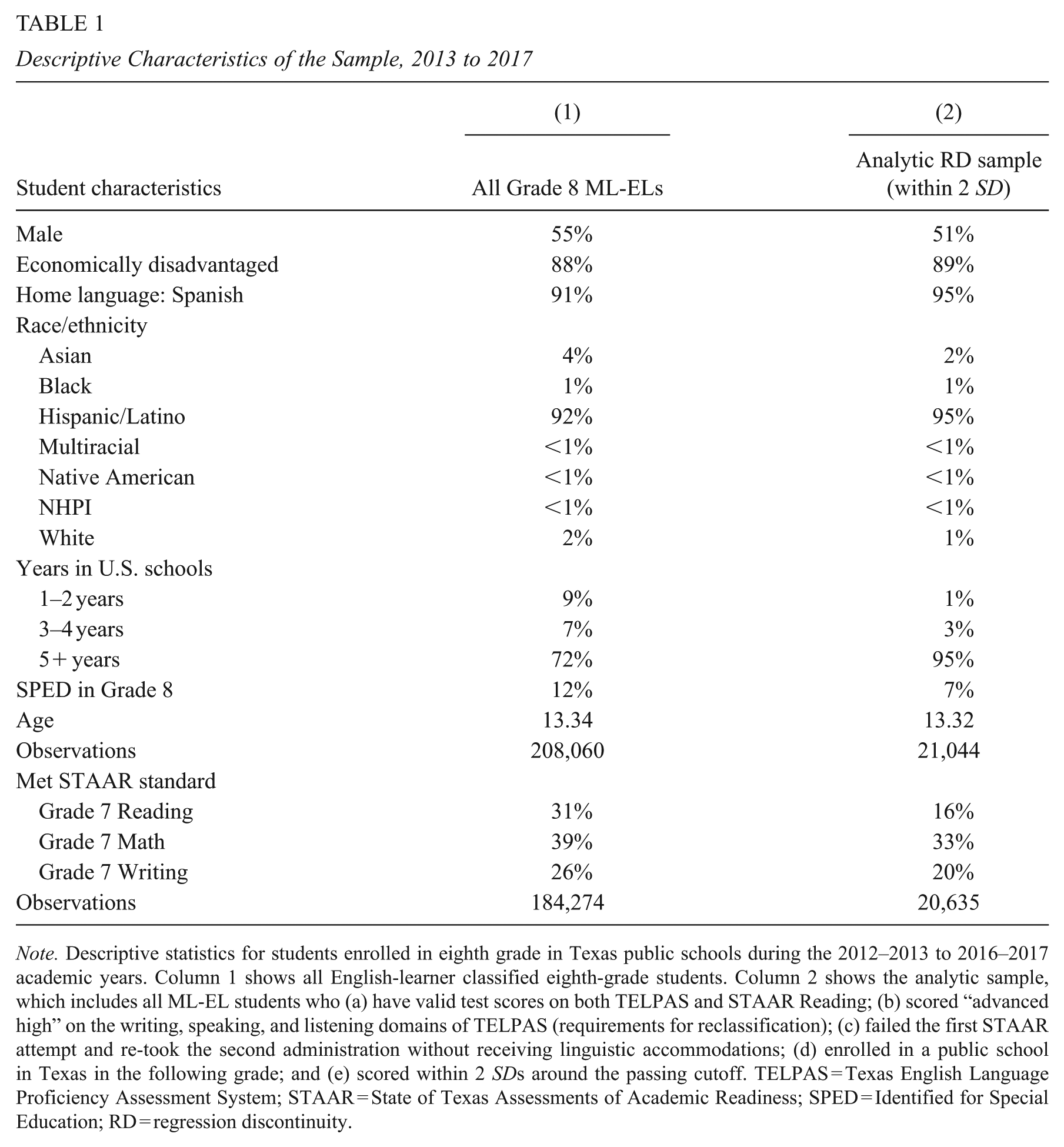
Note. Descriptive statistics for students enrolled in eighth grade in Texas public schools during the 2012–2013 to 2016–2017 academic years. Column 1 shows all English-learner classified eighth-grade students. Column 2 shows the analytic sample, which includes all ML-EL students who (a) have valid test scores on both TELPAS and STAAR Reading; (b) scored “advanced high” on the writing, speaking, and listening domains of TELPAS (requirements for reclassification); (c) failed the first STAAR attempt and re-took the second administration without receiving linguistic accommodations; (d) enrolled in a public school in Texas in the following grade; and (e) scored within 2 SDs around the passing cutoff. TELPAS = Texas English Language Proficiency Assessment System; STAAR = State of Texas Assessments of Academic Readiness; SPED = Identified for Special Education; RD = regression discontinuity.
Measures
We consider the relationship between ELA content-based reclassification in eighth grade and three sets of high school outcomes: course taking, academic achievement, and graduation. For the remainder of the article, we use “reclassification” for brevity; however, we are always referring to reclassification under the timing and criteria conditions specified above.
Treatment Variable
Eighth-grade students in Texas were assigned a raw score on the STAAR Reading test ranging from 0 to 52 (scores ranged from 0 to 44 in academic year 2016–2017 only) and a corresponding scale score ranging roughly from 900 to 2,200. To achieve passing standard, students’ scaled scores must fall above the threshold for “Satisfactory” performance (“Approaches standard” in 2016–2017). Because the scale scores increase discontinuously and vary in their discrete values across years, we utilize the raw scores for the running variable, using score conversion tables provided by TEA to identify the passing cutoff in each year. 5 The treatment variable for our reduced-form, intent-to-treat (ITT) model is a binary indicator equal to 1 if a student scored at or above the passing threshold and achieved eligibility for reclassification, and 0 if they scored below the threshold. However, because final reclassification decisions in Texas are determined by the human judgment of the LPAC, not all students who score above this cutoff are necessarily reclassified, or “treated.” We discuss our empirical strategy for addressing this fuzziness in the reclassification process in greater detail below.
It is also important to note that EL classification is a dynamic status. Our analyses compare students who barely meet the criteria to reclassify in eighth grade to those who just miss the threshold and thus remain EL-classified. However, Table A3 in the Supplemental Appendix (available in the online version of this article) demonstrates that a portion of students in the comparison group eventually reclassify in subsequent years. Our research should thus be thought of as measuring the impact of entering high school classified as English proficient rather than as an EL on subsequent outcomes in high school.
Outcome Variables
High School Course Taking
We consider the impact of reclassification on the likelihood of earning credit in two types of high school courses. First, we measure the likelihood of earning credit by earning a passing grade in an “advanced” core content course, which we operationalize as either advanced placement (AP), international baccalaureate (IB), or dual enrollment (DE). We focus on these three course types, specifically, to measure access to upper-level courses that are designed to prepare students for college and to provide opportunities to earn college credit, whether through exams or partnerships with postsecondary institutions. We consider whether students earn any AP, IB, or DE credit broadly, and in each core content area, and whether they earn multiple credits, which can indicate increased college readiness and a financial advantage if they pursue postsecondary education.
Second, we consider the likelihood of enrolling in and completing (i.e., earning credit in) remedial or non-college preparatory STEM classes. These include remedial math (defined as either a “Math Models” or “Strategies for High School Math” course) and an integrated physics and chemistry course, which replaces the more rigorous separate courses that are recommended for admission to the University of Texas at Austin—the state’s flagship university. If we observe an increased likelihood of taking advanced courses or a decreased likelihood of taking remedial/non-college prep courses, this might suggest that keeping students EL-classified based on their STAAR Reading achievement constrains course access. All course-taking outcomes are measured using binary indicator variables.
High School Achievement
We consider three measures of high school achievement. First, we consider performance on STAAR EOC exams, designed to assess students’ knowledge and skills in specific content areas. During our study period, Texas required students to pass five EOC exams to graduate high school: Algebra I (typically taken in Grade 9), English I (Grade 9), Biology (Grade 9), English II (Grade 10), and U.S. History (Grade 11). Students who fail on the first attempt can retake the tests or prove proficiency using an alternative test like the SAT. It is important to note that Texas allows students to retake an EOC exam without retaking the corresponding course if they achieved a passing grade on the first attempt. We first measure the impact of reclassification on students’ standardized scores on each exam, which provides some indication of their content proficiency, regardless of pass-fail status. Using a binary outcome variable, we also examine the likelihood of having to retake each EOC, which can shape subsequent course access and hinder graduation.
Given the limitations of standardized tests in measuring student academic performance, we consider an alternative measure: the likelihood of ever failing a course in one of the four core academic subjects during high school. This serves as a rough proxy for student grades, which we do not have access to. It may also be a function of other constructs our data preclude us from examining, such as students’ affective engagement with school. If we observe negative reclassification effects on achievement, this could suggest that students who are relatively proficient in English are nevertheless losing access to necessary supports too early—or that students who remain EL are being placed in less rigorous courses. Conversely, evidence that reclassification improves performance might suggest that exiting EL status increases access to rigorous instruction and improves exposure to academic content (Dabach, 2014).
High School Graduation
Finally, we consider four graduation outcomes: (a) the likelihood of ever graduating high school by Spring of 2022, our last year of data; (b) the likelihood of graduating high school on time, defined as in spring of the academic year that is 4 years after the student first enrolled in eighth grade; (c) the likelihood of graduating college ready, which we define as taking four English credits, three math credits (including Algebra I and II), three science credits (biology, chemistry, and physics), three social studies credits, and two world language credits, based on the recommended course sequence for admission to University of Texas at Austin; and (d) the likelihood of officially dropping out of high school. Although we do not formally test mediation in this study, one possible mechanism by which reclassification may impact graduation is through the achievement outcomes discussed above. Because students must both pass the five EOC exams and earn credits in core subjects to receive their diplomas, positive impacts of reclassification on achievement may also improve graduation outcomes; negative impacts could create additional barriers to graduating.
Empirical Strategy
To estimate the effect of eighth-grade reclassification on students’ subsequent high school outcomes, we use an RD design that exploits Texas’s use of test thresholds during the reclassification process. Because students who reclassify as fully English proficient are likely to differ systematically from their peers who continue as ML-EL, simple comparisons between their outcomes would not provide causal estimates of the treatment effect. However, students scoring within a narrow range around the test threshold are arguably similar on average across observable and unobservable characteristics (Imbens & Lemieux, 2008; Lee & Lemieux, 2010; Robinson, 2011).
Because Texas employs multiple reclassification criteria, we use a multiple-rating RD design (Reardon & Robinson, 2012; Wong et al., 2013). First, we limit our sample to students who demonstrated ELP in the domains of speaking, writing, and listening by scoring “Advanced High” on each corresponding section of TELPAS. We then use students’ raw scores from the second administration of the eighth-grade STAAR Reading exam as our running variable to predict reclassification. Put another way, if Texas did not include the state ELA content exam as part of the reclassification process, all students in our analytic sample would be eligible to reclassify based on TELPAS performance. Our frontier design allows us to explore the extent to which including an additional content exam criterion either creates an unnecessary barrier or adds a necessary check that ensures students do not lose access to EL services too early.
We first estimate the effect of attaining reclassification eligibility based on STAAR Reading. This ITT analysis uses the following general equation:
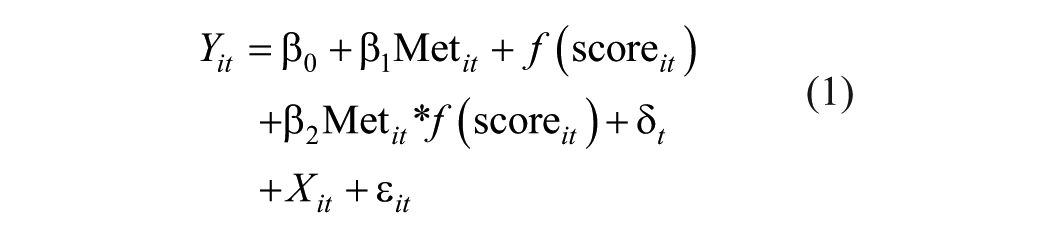
where Y is a generic outcome representing our outcomes of interest. Met is an indicator that equals one if student i, who was an ML-EL in eighth-grade cohort t, met the state policy threshold in STAAR Reading for reclassification. The running variable, score, is the students’ raw score on the second administration of STAAR Reading, recentered so that 0 is the passing score. f() is a flexible function linking test scores to outcomes. We include interactions to allow this relationship to vary on either side of the cutoff. Our coefficient of interest is
Because the decision to reclassify an ML-EL student in Texas is based on committee (LPAC) deliberation and incorporates teacher evaluations, students who attain the policy thresholds may remain EL-classified, while LPAC discretion may allow others to be reclassified despite missing the cutoff. In addition to the ITT estimates from Equation 1, we employ a fuzzy RD design to estimate a “complier average treatment effect” (CATE), defined as students whose reclassification outcome was induced by their performance on the STAAR Reading test. We use the following two-stage least squares equations:
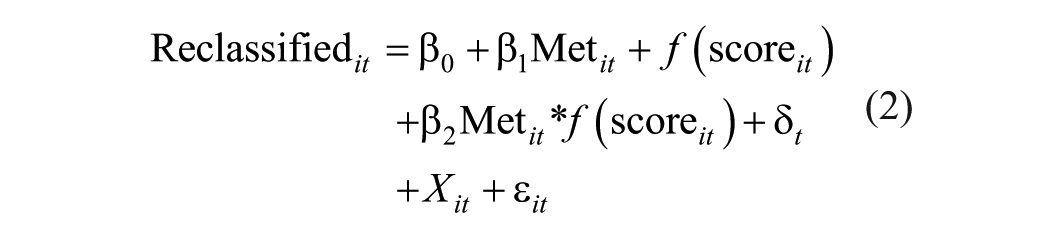
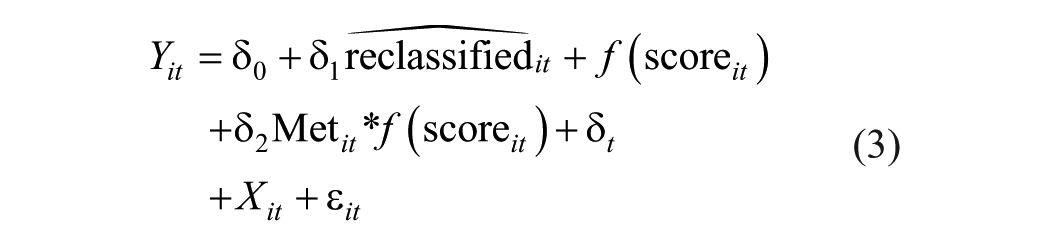
The first stage regression (Equation 2) predicts the probability of reclassification. The second stage (Equation 3) uses the predicted probability of reclassification to estimate the outcome of interest for compliers.
All models for both the ITT and CATE are estimated using local polynomial non-parametric regression and the rdrobust package in Stata (Calonico et al., 2017). We use the optimal bandwidth from the first stage estimation (Equation 2; Bandwidth (BW) = 5 points) for all of our main results selected using Calonico et al.’s (2014) bandwidth selection procedure. We demonstrate the robustness of our results to alternative bandwidths below. Given that we expect a smooth transition in characteristics around the cutoff, we use a triangular kernel (Chin, 2021). Standard errors are heteroskedasticity-robust and clustered at the eighth-grade school level (Kolesár & Rothe, 2018).
Identifying Assumption Checks
To yield valid estimates, our RD approach assumes that potential outcomes are continuous across the treatment threshold. We conduct three analyses that suggest we are very likely to meet this assumption. First, we fit a series of models of the form specified in Equation 1, replacing outcome Y with student-level observable characteristics. We find no evidence of meaningful differences between students who do and do not meet the threshold in the area around the cutoff (Supplemental Appendix Table A4 in the online version of the journal).
Second, we explore the possibility of test manipulation. One concern is that if students can easily manipulate their scores to be just above or below the cutoff for treatment, treated individuals may differ systematically from untreated individuals, particularly in unobserved characteristics, thereby invalidating our RD design. In our context, score manipulation is unlikely because STAAR is graded by unaffiliated scorers at a centralized state testing center, and students are very unlikely to predict the exact number of correct answers associated with scoring close to the cutoff. Nevertheless, we test for evidence of score manipulation in two ways. We first plot the density of raw STAAR Reading scores around the reclassification threshold to visually assess the possibility of manipulation (Supplemental Appendix Figure B2 in the online version of the journal). Table A5 in the Supplemental Appendix (available in the online version of this article) presents results for density tests for a smooth distribution of scores around the threshold and shows that we do not reject smoothness in any year (Cattaneo et al., 2018).
Our two-stage least squares instrumental-variables approach to estimate the CATE requires two additional identifying assumptions. First, we assume a strong first stage such that, conditional on meeting the TELPAS requirements for reclassification, passing the STAAR Reading threshold significantly increases the likelihood that students reclassify out of EL status.
Figure 1 plots the probability of reclassification as a function of students’ scores on the second administration of STAAR and shows that the estimated probability of eighth-grade reclassification increases by about 39 percentage points around the threshold.
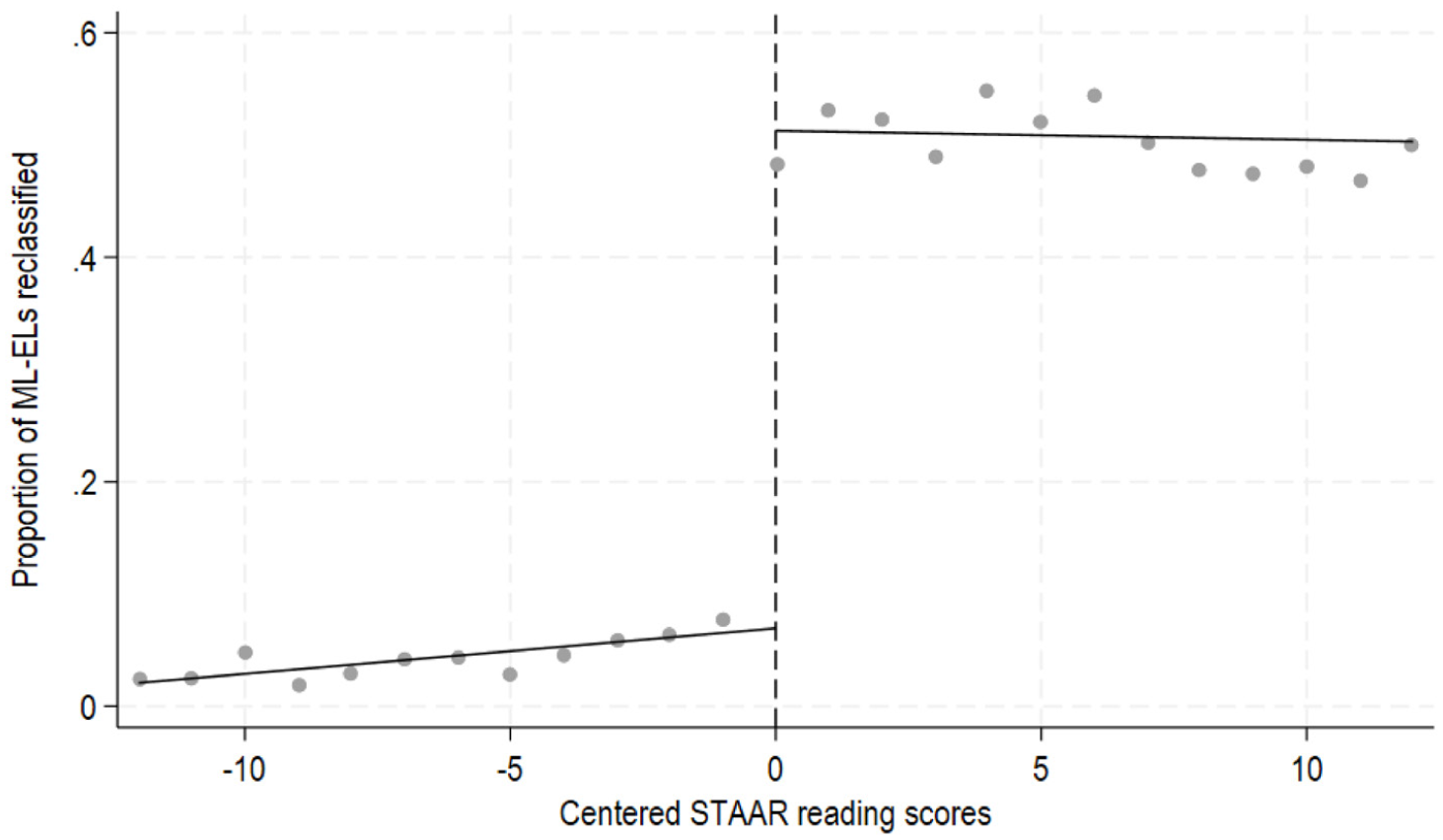
Probability of Reclassification as a Function of STAAR Reading Score.
Second, we assume that the exclusion restriction holds, meaning that the instrument—scoring above the running variable threshold—only affects our outcomes of interest through the reclassification process. One concern is that the STAAR Reading reclassification threshold is the cutoff for passing the exam itself. Failing STAAR Reading multiple times is one condition for receiving accelerated instruction and grade retention, so our control group might have received extra reading support. 6 We did not identify any other significant interventions that students receive based on meeting the passing threshold for STAAR Reading, although we acknowledge that passing STAAR may be related to ninth-grade course placement in some schools. We discuss this possibility and the potential effects of additional reading support in greater detail below.
Results
Impacts on High School Course Taking
For students near the eighth-grade STAAR Reading threshold who were relatively proficient in English, our results suggest that reclassifying at the end of eighth grade increased the likelihood of earning AP, IB, or DE course credit (hereafter “advanced”) in high school. Table 2 presents ITT (Columns 1 and 2) and CATE (Columns 3 and 4) estimates for course-taking outcomes from our main RD models, using the optimal bandwidth from the first stage. All models include year fixed effects. Columns 2 and 4—our preferred specifications—add pretreatment student, eighth-grade school, and district region covariates to increase precision. In this context, the ITT estimates capture the expected overall effect of including academic criteria in the state guidelines for reclassification, given imperfect reclassification rates for students who meet the academic thresholds, whereas the CATE estimates capture the expected impact on outcomes for students who actually reclassify based on meeting academic performance thresholds. We argue that both estimands are policy relevant at different organizational levels—namely, the state and individual levels.
Effects of Reclassification on Probability of Earning Advanced and Remedial Course Credit
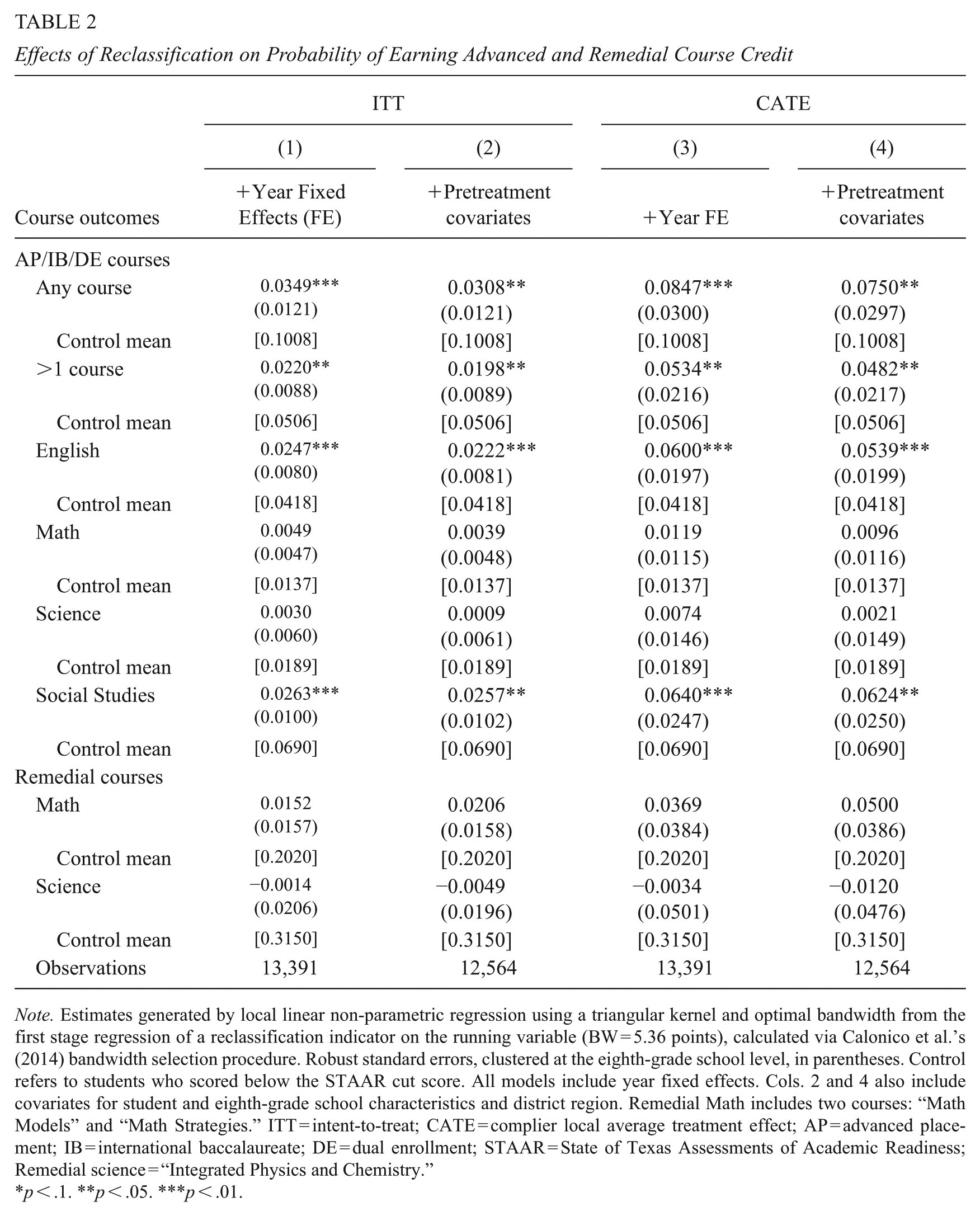
Note. Estimates generated by local linear non-parametric regression using a triangular kernel and optimal bandwidth from the first stage regression of a reclassification indicator on the running variable (BW = 5.36 points), calculated via Calonico et al.’s (2014) bandwidth selection procedure. Robust standard errors, clustered at the eighth-grade school level, in parentheses. Control refers to students who scored below the STAAR cut score. All models include year fixed effects. Cols. 2 and 4 also include covariates for student and eighth-grade school characteristics and district region. Remedial Math includes two courses: “Math Models” and “Math Strategies.” ITT = intent-to-treat; CATE = complier local average treatment effect; AP = advanced placement; IB = international baccalaureate; DE = dual enrollment; STAAR = State of Texas Assessments of Academic Readiness; Remedial science = “Integrated Physics and Chemistry.”
p < .1. **p < .05. ***p < .01.
We estimate that attaining reclassification eligibility by scoring just above the cutoff increased the likelihood of earning credit in any advanced course by roughly 3 percentage points (10% of students below the threshold in the “control” condition earn advanced credit at baseline) and the likelihood of earning multiple advanced credits by 2 percentage points (5% below the threshold). Actually exiting EL status increased the likelihood of any advanced credit attainment by 8 percentage points. These gains seem to be concentrated in the humanities. Our ITT models predict 2 percentage point increases in the likelihood of earning advanced English and 3 percentage point increases in the likelihood of earning advanced social studies credit (4% and 7% below the threshold). CATE estimates increase to 5 percentage points in English and 6 percentage points in social studies, nearly doubling the likelihood of earning credits in these advanced courses for ML-ELs who reclassify before high school matriculation, relative to their peers who enter under continued EL status.
Impacts on High School Achievement
Tables 3 and 4 present estimates for our achievement outcomes, including performance on the first attempt of the five EOC exams required for high school graduation in Texas and the likelihood of failing core courses in high school. Among students close to the threshold, just attaining reclassification eligibility resulted in a negative effect on initial Algebra I EOC scores, roughly 0.05 SD in magnitude (Table 3). Reclassifying out of EL status based on this eligibility—and subsequently, missing out on accelerated instruction—resulted in a negative effect of 0.13 SD in magnitude. Given the distribution of Algebra I EOC scores among ML-ELs, this decrease indicates that reclassified students scored at approximately the 40th percentile while their peers who remained in the EL-status scored at the 33rd percentile. In addition, we find suggestive evidence that reclassified students are more likely to retake the Algebra I EOC, which could indicate that score declines increase the likelihood of failing the exam. Our ITT estimates suggest that students just above the threshold are 3 percentage points more likely to retake the Algebra I exam at least once (relative to 29% below the threshold). Students who actually reclassify are 7 percentage points more likely to retake. These results are marginally significant under our preferred specifications in Columns 2 and 4. Estimates for other exam scores are generally negative, apart from biology, but are small in magnitude and insignificant.
Effects of Reclassification on High School Student Achievement
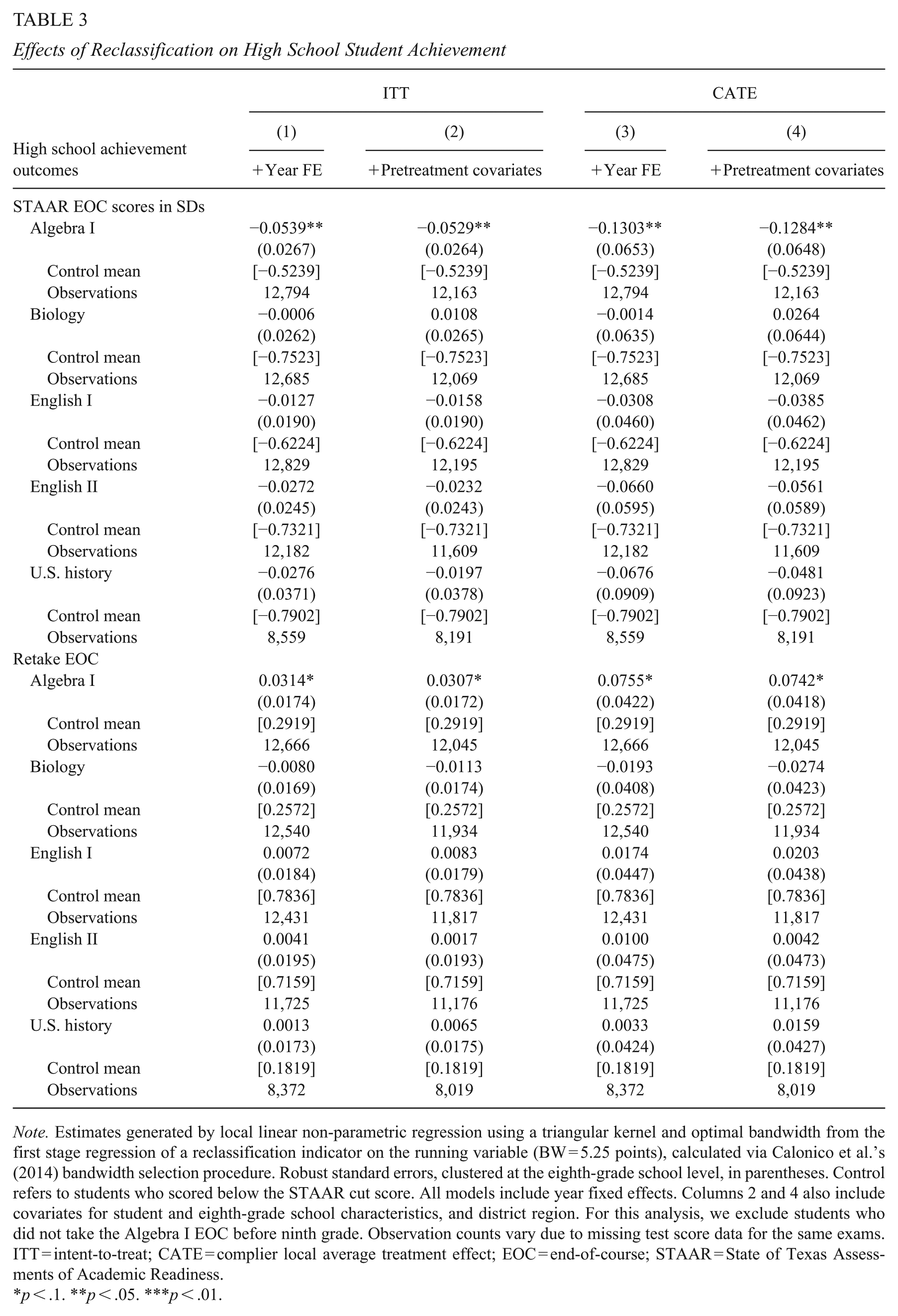
Note. Estimates generated by local linear non-parametric regression using a triangular kernel and optimal bandwidth from the first stage regression of a reclassification indicator on the running variable (BW = 5.25 points), calculated via Calonico et al.’s (2014) bandwidth selection procedure. Robust standard errors, clustered at the eighth-grade school level, in parentheses. Control refers to students who scored below the STAAR cut score. All models include year fixed effects. Columns 2 and 4 also include covariates for student and eighth-grade school characteristics, and district region. For this analysis, we exclude students who did not take the Algebra I EOC before ninth grade. Observation counts vary due to missing test score data for the same exams. ITT = intent-to-treat; CATE = complier local average treatment effect; EOC = end-of-course; STAAR = State of Texas Assessments of Academic Readiness.
p < .1. **p < .05. ***p < .01.
Effects of Reclassification on Probability of Failing at Least One Class, by Subject
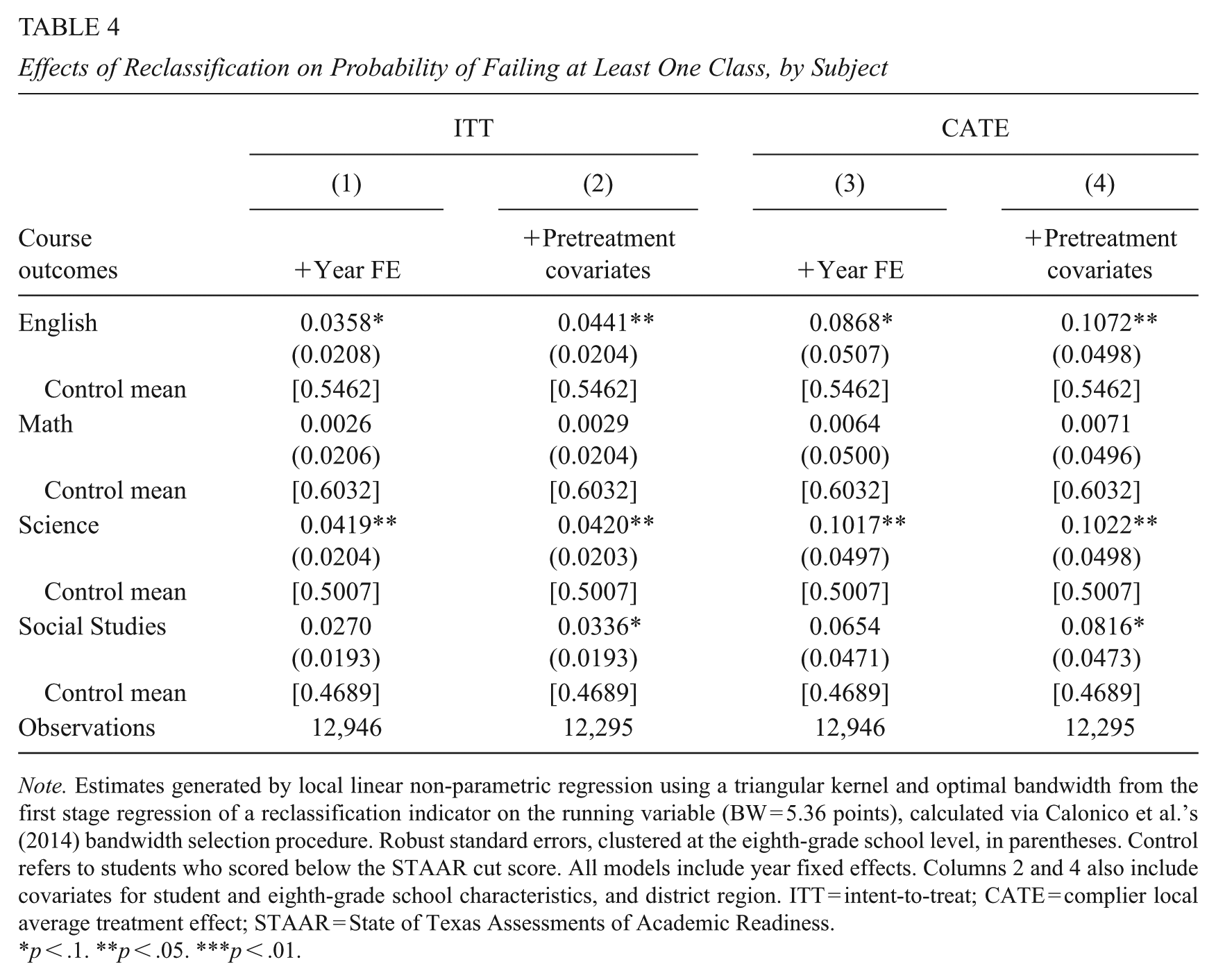
Note. Estimates generated by local linear non-parametric regression using a triangular kernel and optimal bandwidth from the first stage regression of a reclassification indicator on the running variable (BW = 5.36 points), calculated via Calonico et al.’s (2014) bandwidth selection procedure. Robust standard errors, clustered at the eighth-grade school level, in parentheses. Control refers to students who scored below the STAAR cut score. All models include year fixed effects. Columns 2 and 4 also include covariates for student and eighth-grade school characteristics, and district region. ITT = intent-to-treat; CATE = complier local average treatment effect; STAAR = State of Texas Assessments of Academic Readiness.
p < .1. **p < .05. ***p < .01.
We also find suggestive evidence of negative impacts on course performance (Table 4). Our ITT results indicate that students just above the threshold are approximately 3 to 4 percentage points more likely to fail at least one course in English (relative to 55% below the threshold), science (50% below the threshold), and social studies (47% below the threshold). CATE results in Column 4 suggest that reclassified students are 11 percentage points more likely to fail a class in English, 10 percentage points more likely to fail in science, and 8 percentage points more likely to fail in social studies. Although these results are only marginally significant at conventional levels, they suggest that among students with otherwise similar English proficiency and academic profiles, reclassification may lead to increased academic struggle, both on academic assessments and within their core courses.
Impacts on High School Graduation
Finally, we find evidence that reclassifying at the end of eighth grade negatively impacts a range of graduation outcomes (Table 5). Students who score just above the threshold are 4 percentage points less likely to graduate on time, defined as in the spring of the fourth year after entering high school (83% below the threshold); 3 percentage points less likely to graduate “college-ready,” that is, with the coursework required for a selective college (11% below the threshold); and 2 percentage points more likely to drop out of high school entirely (9% below the threshold; Column 2). Reclassified students are 5 percentage points less likely to ever graduate, 10 percentage points less likely to graduate on time, 7 percentage points less likely to graduate with college preparatory coursework, and 5 percentage points more likely to drop out (Column 4). All results are statistically significant at conventional levels and stable across models.
Effects of Reclassification on High School Graduation and Related Outcomes
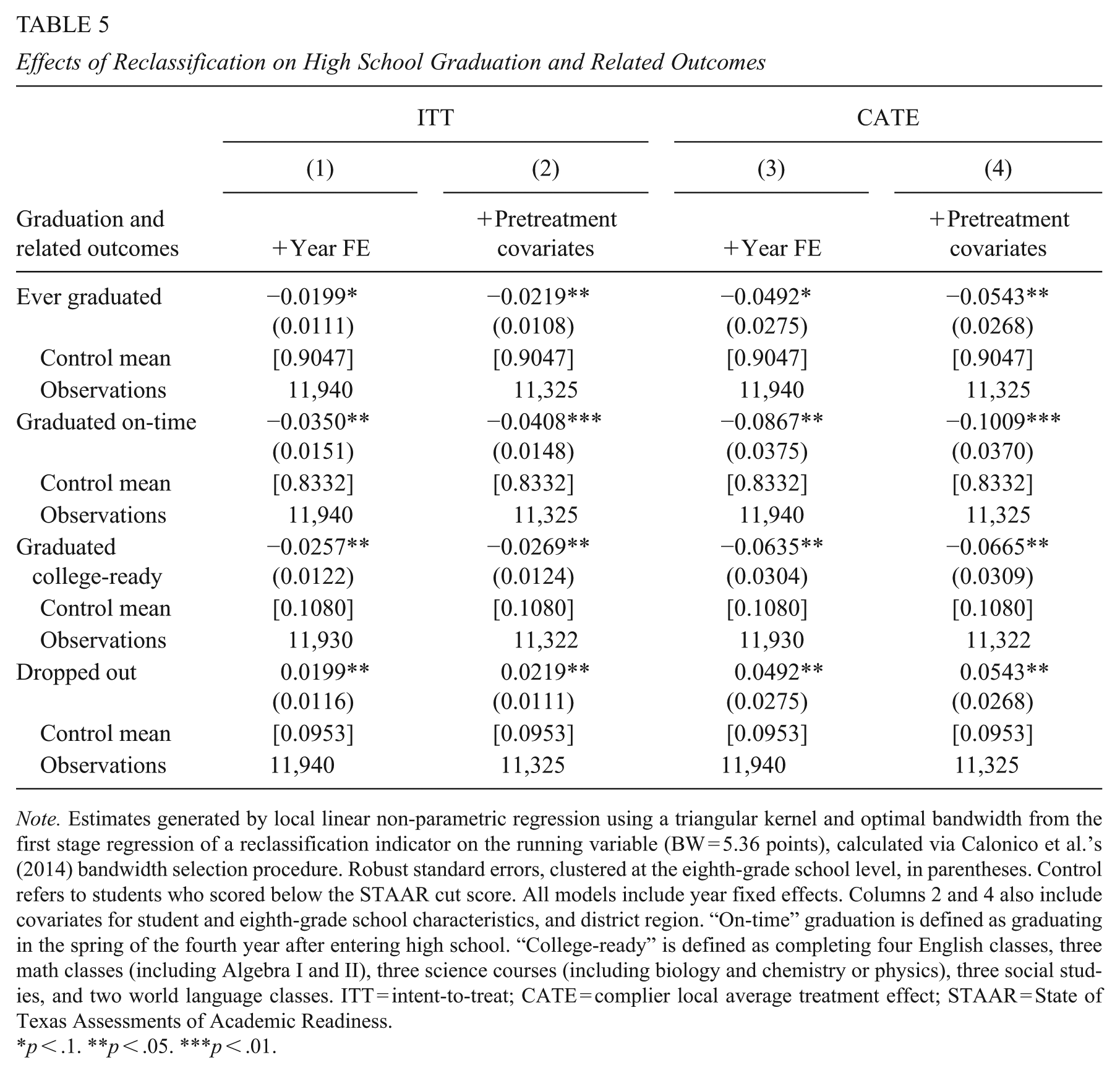
Note. Estimates generated by local linear non-parametric regression using a triangular kernel and optimal bandwidth from the first stage regression of a reclassification indicator on the running variable (BW = 5.36 points), calculated via Calonico et al.’s (2014) bandwidth selection procedure. Robust standard errors, clustered at the eighth-grade school level, in parentheses. Control refers to students who scored below the STAAR cut score. All models include year fixed effects. Columns 2 and 4 also include covariates for student and eighth-grade school characteristics, and district region. “On-time” graduation is defined as graduating in the spring of the fourth year after entering high school. “College-ready” is defined as completing four English classes, three math classes (including Algebra I and II), three science courses (including biology and chemistry or physics), three social studies, and two world language classes. ITT = intent-to-treat; CATE = complier local average treatment effect; STAAR = State of Texas Assessments of Academic Readiness.
p < .1. **p < .05. ***p < .01.
Robustness Checks
We verify the robustness of our results in several ways. First, in our main results in Tables 2 to 5, we show that results are robust to the inclusion of student, school, and district-region covariates. Although the magnitudes of some estimates differ by more than 10% with the inclusion of covariates, the direction and practical significance of all estimates remain the same across outcomes. In Tables A6 to A9 of the Supplemental Appendix (available in the online version of this article), we demonstrate that results are also robust to specifying multiple different bandwidths from 4 to 10 points around the threshold (Chin, 2021; Robinson-Cimpian & Thompson, 2016). Specifying bandwidths involves a trade-off between increasing precision as bandwidth expands and reducing bias as the bandwidth shrinks (Brunner et al., 2023). Our estimates generally increase in magnitude when we apply a smaller bandwidth. In Supplemental Appendix Tables A10 to A13 (available in the online version of this article), we run a series of falsification tests in which we shift the threshold for reclassification in both directions by 4 points. Point estimates are always statistically insignificant, and standard errors are large. We also show that our results are robust to excluding the 2016 and 2017 cohorts, who completed high school during the COVID-19 pandemic (Supplemental Appendix Tables A14–A17 in the online version of the journal).
Finally, to mitigate concerns about attrition, we conducted several tests. First, we test for differential attrition among students scoring near the cutoff. Specifically, we estimate Equation 1 where the dependent variable takes the value of 1 if the student has information on the outcome of interest and 0 otherwise. Tables A18 to A21 in the Supplemental Appendix (available in the online version of this article) show the results of this exercise for each outcome. We do not find evidence of differential attrition across outcomes. Our second check for attrition consisted of estimating all outcomes for the same analytic sample. When we condition the sample for students who have information on all outcomes, the effects of reclassification on course taking and graduation outcomes are very consistent with our main specification (see Supplemental Appendix Tables A22–A25 in the online version of the journal). The negative effect of reclassification on Algebra I standardized scores is no longer statistically significant. Finally, we checked if reclassification affected the probability of not enrolling in ninth grade and leaving our sample. Table A26 in the Supplemental Appendix (available in the online version of this article) shows that reclassification did not have an effect on attrition in ninth grade. Overall, our attrition analyses suggest that our main results are not driven by students leaving the sample.
Discussion
This study provides new causal evidence on two aspects of the EL reclassification process—timing and determining criteria—using statewide data from Texas, a highly salient policy context that serves the highest percentage of ML-ELs and the second largest population in absolute numbers (TEA, 2024). Overall, our results suggest that reclassifying at the end of eighth grade and entering high school without the EL label can be both a bulwark and a barrier to subsequent outcomes for students. We find that for the marginal student in our sample, entering high school as a non-EL positively impacts their course-taking outcomes, but negatively impacts achievement and graduation.
Our finding that reclassifying in eighth grade increases the likelihood of earning credit in advanced courses in high school provides some of the first causal evidence that EL classification limits students’ access to rigorous coursework (Callahan, 2005; Callahan & Shifrer, 2016; Callahan et al., 2010; Johnson, 2019). AP, IB, and DE courses can confer numerous benefits, including access to more rigorous instruction, the opportunity to earn college credits, and advantages in selective admissions processes (Warne, 2017). Our estimates suggest that removing the STAAR Reading reclassification criteria allows some students who would not have otherwise taken advanced courses to complete these credits. Removing the STAAR reading criteria would increase the likelihood of successfully completing an advanced course by about three percentage points for the marginal student, a modest but important change given that only 6% of eighth-grade ML-ELs ever earn credit in these courses. Because AP, IB, and DE classes are usually taken in later grades, our results also suggest that eighth-grade reclassification may have long-reaching implications for students’ high school trajectories.
Simultaneously, although reclassification allowed some students to access advanced courses, our results suggest that many of the students who reclassified before entering high school by meeting the STAAR Reading threshold struggled academically in their core classes. They were more likely to fail courses in multiple subjects and had lower standardized test scores in Algebra I. Although some students both pass advanced courses and fail core courses, the group of reclassifers who complete advanced credit and the group who fail core courses primarily represent distinct groups of students. Our combined course failure and testing results suggest that, on average, Texas students who reclassify by just barely meeting the eighth-grade STAAR Reading threshold may be struggling more across all four core content areas in high school, which is alarming. 7 A potential explanation for this finding is that reclassified students did not have access to the same additional reading support provided to students who did not pass STAAR in eighth grade. The benefits of these supports may have extended to other courses for students who just missed the STAAR cutoff and remained EL-classified upon entering high school. Prior research rarely examines achievement outcomes aside from test scores, making it difficult to contextualize our results within the existing literature. However, one study conducted by Pope (2016) in California’s LAUSD found that reclassification in middle and high school had no effect on subsequent math and ELA GPA; the apparent divergence of our findings from Pope’s emphasizes the highly contextual nature of reclassification effects.
Tables A27 to A30 in the Supplemental Appendix (available in the online version of this article) provide some suggestive evidence that access to EL services in academic classes may be a driving mechanism behind some of the observed negative impacts of reclassifying as “Fully English Proficient.” As discussed above, most secondary ELs in Texas are either placed in ESL for all content courses or ESL for ELA only (Supplemental Appendix Table A1 in the online version of the journal). We run two separate analyses: one using a subsample of schools where ESL All Content is the primary instructional program for ML-ELs and one using a subsample of schools where ESL ELA is the primary program. These results provide some suggestive evidence that the impacts of reclassification are more consistently negative in schools that offer ESL in all content courses. For example, we estimate that compared to peers who were likely placed in an ESL math class, reclassified students score about 0.2 SDs lower on their Algebra I EOC test (not significant at conventional levels). Our point estimate for schools with ESL in ELA Only is much smaller. Similarly, point estimates for the increased likelihood of core course failure and the decreased likelihood of graduating on time or college-ready are generally larger in ESL All Content schools. These patterns do not necessarily imply that ESL All Content is a more effective model; for example, in ESL All Content schools, classes are more likely to be segregated by ML-EL status. In ESL ELA-Only schools, core content classes are less segregated, meaning general education teachers have experience working with ML-ELs. Larger negative impacts of reclassification in ESL All Content schools could be explained by either more effective services in EL-specific classes or less support in general education classes once students exit. Nevertheless, negative impacts of reclassification in ESL All Content schools suggest the importance of supports for ML-ELs across academic content areas, even for relatively high English proficiency students like those in our sample. Prior research suggests that schools with larger ML-EL populations tend to offer more comprehensive and effective services for students who are learning English (Umansky & Reardon, 2014). Supplemental Appendix Tables A31 to A34 (available in the online version of this article) provide additional evidence that negative results of reclassification may be driven by losing access to effective EL support services. We run two separate analyses: one for the subgroup of students who attend schools in the bottom third in terms of ML-EL population (0%–8%) and one for students who attend schools in the top third (15%+). Estimates are imprecise due to a small sample size. Overall, however, our results suggest that the impacts of reclassification on test scores and long-term outcomes like graduation are more consistently large and negative in schools with larger ML-EL populations. If schools that serve more ML-ELs have more comprehensive supports, these findings may suggest that observed negative impacts of reclassification are driven by students losing access to effective services.
Finally, evidence that students who exit EL status prior to high school are four percentage points less likely to graduate on time than their peers who remained ML-EL is concerning, given the importance of a high school diploma for economic and social well-being in the United States (Campbell, 2015). Our achievement results offer one potential mechanism for this finding, as passing EOC exams and accruing core subject credits are graduation requirements in Texas. In Table A35 (see Supplemental Appendix in the online version of the journal), we present results from an exploratory analysis showing that reclassified students were less likely to accrue the total number of credits in English and science needed to graduate. These results, along with suggestive evidence from our course-taking results, also help explain why reclassified students were less likely to graduate “college-ready,” with the appropriate number and types of credits in each core content area to gain admission to many 4-year institutions in Texas. Reclassified students in our sample appeared somewhat more likely to take remedial math courses, which could divert them from the college-prep math track, although our coefficients did not reach statistical significance.
Taken together, our achievement and graduation findings suggest that high English proficiency, lower academic proficiency students in our sample who reclassify in eighth grade continue to struggle academically on average—and actually perform worse than similar peers who matriculate as EL-classified, with meaningful consequences for high school completion. The negative effects of reclassification seem to be most pronounced in schools with more comprehensive EL services and larger populations of ML-ELs.
Generalizability and Limitations
Our RD design offers strong internal validity. However, our sample restrictions influence the external validity of our results. Specifically, our results apply to a narrow but important subgroup: students with relatively high English proficiency who score near the reclassification threshold on their second STAAR Reading attempt. We argue that this group remains highly policy relevant for several reasons. First, the combination of strong oral proficiency and weaker academic literacy is common among secondary ELs and particularly among long-term ML-ELs (Fu, 2021). Second, while ELP exam retakes are less common, many states offer opportunities to retake the state ELA content exam. All three of the states that currently mandate ELA exams for reclassification allow students to retake the exam in some grades. Thus, our study sheds light on a scenario that parallels existing policies outside Texas.
As discussed above, two other factors distinguish Texas’ use of ELA exams during our study period. First, Texas used ELA as a substitute for ELP reading, not as an additional criterion. Our results do not speak directly to the impacts of requiring both ELA and ELP, which is now the criterion used in Texas, as well as California, New York, and Florida. However, other states like Nevada and South Dakota currently allow students who do not meet ELP requirements to reclassify based on ELA performance. Furthermore, given the frequent shifts in reclassification policies over time (Morales & Lepper, 2024), our study offers valuable evidence about the effects of using an ELA test as the determining reading criteria for reclassification. The passing threshold for STAAR ELA in Texas was also relatively low compared to the TELPAS ELP threshold. Indeed, more than half of all ML-ELs in our sample passed the ELA content exam each year. We can think of our results as providing insight into two policy choices: (a) emphasizing critical reading skills by using the ELA test instead of the ELP test and (b) holding students to a relatively low standard for demonstrating reading proficiency. In general, we find that using only an ELA test with a lower passing threshold allowed some students to lose access to support before they were ready while increasing access to advanced coursework for some other students.
Implications for Policy, Practice, and Research
Despite their locality, our findings have substantive implications for ML-EL secondary education. Below, we highlight three major areas for action from policymakers and practitioners at multiple organizational levels—state, district, and school—which can be facilitated by further scholarly advancements.
Increasing ML-ELs’ Access to Advanced Coursework
In spite of federal guidance stipulating that EL-classified students are entitled to equal access to AP, IB, and honors coursework (Ensuring English Learner Students Can Participate Meaningfully and Equally in Educational Programs, 2015), a large body of descriptive research suggests that ML-ELs have constrained access to advanced and college-preparatory classes, even after accounting for factors like prior achievement (Callahan, 2005; Callahan & Shifrer, 2016; Callahan et al., 2010; Kanno & Kangas, 2014). Our RD results provide causal evidence that EL status itself acts as a barrier to taking advanced courses, even for students with relatively high ELP. To help mitigate these effects, future research should explore the characteristics—for example, test performance, course grades, interest, access to school resources—that predict success in advanced classes for students who are ML-ELs in middle school. School leaders can then draw on those characteristics to proactively recruit MLs to enroll in advanced classes, regardless of EL status (Ricciardi & Winsler, 2021).
Schools should also reevaluate practices that create barriers to AP participation for students from marginalized backgrounds, such as requiring that students receive a teacher recommendation or that they take the AP exam if they enroll in the class without providing a fee voucher (Flores & Gomez, 2011). Ensuring that instruction in advanced courses is accessible for ML-ELs is a crucial part of meaningfully expanding access to advanced content (Kanno & Kangas, 2014). Finally, future research should explore the extent to which the supply of AP and other advanced courses is diminished at the schools that ML-ELs typically attend. If studies uncover significant disparities, district and state leaders can take steps to continually monitor school course offerings and potentially redistribute resources to guarantee more equitable access for all students.
Reassessing the Use of Academic Content Criteria in Reclassification Decisions
This study also provides new evidence on the appropriateness of requiring students to demonstrate ELA content proficiency to reclassify, a practice used by several states that serve the largest numbers of ML-ELs. Our results somewhat support arguments that using ELA to assess reading proficiency may decrease access to advanced courses among some students who are ready to succeed in these classes, particularly in English. We find that reclassified students are more likely to earn credit in AP, IB, or DE English classes. However, our results indicate that even among students who have met all three other test-based criteria—including the high bar of demonstrating “advanced high” proficiency on the TELPAS writing ELP exam—reclassification reduces overall achievement on average. Reclassifiers are more likely to fail courses, score lower on a key graduation exam, and are less likely to graduate high school on time. Contrary to the argument that including content criteria may be particularly harmful for long-term ML-ELs, our results suggest that for a specific subgroup of students who demonstrate strong English fluency but struggle with higher-order reading skills, simply requiring them to meet the minimum passing standard for ELA may be insufficient to ensure they are ready to succeed in “mainstream” instructional settings without additional services.
These results could indicate that the criteria for reclassification should be made more stringent, a step that Texas has already taken by adding the ELP reading exam as a reclassification criterion. However, given the policy context in Texas, it is difficult to disentangle whether the negative effects of reclassification based on ELA only are driven by the content assessed on the ELA exam or by the lower passing standard applied. Future research should explicitly test the effects of requiring students to pass both ELP and ELA tests to offer further insights into the implications of different ways that states choose to incorporate ELA into the reclassification process.
Supporting Multilingual Learners’ Academic Success and High School Completion
Our findings that reclassified students struggle academically and are subsequently less likely to graduate than peers who enter high school with similar English proficiency and academic skills are troubling and invite policy action. Although we explore a few potential explanations for this phenomenon, our evidence on the precise mechanisms linking EL classification to achievement for the marginal student remains suggestive, necessitating further research. We find some evidence that negative impacts on achievement may be driven by decreased access to beneficial EL services, particularly to EL-specific versions of content courses outside of ELA. If future research can identify particular services that benefit students who are nearing reclassification, continuing to provide these services during the transition out of EL status could be a good strategy to improve outcomes. For Texas, specifically, researchers should also extend prior work on how LPACs make decisions about testing accommodations for ML-ELs in the face of accountability pressures (Mavrogordato & White, 2020), and investigate how the sudden loss of such accommodations in non-ELA content areas might influence achievement for reclassified students. Policymakers might then consider whether accommodations in content areas like math should be allowable for students in the first few years of post-exit monitoring and adjust state guidelines accordingly.
Conclusion
Policy and programming for multilingual learners should enable their educational thriving; classification and reclassification are a few means to that end. Our study highlights the need for more holistic, nuanced approaches in research, policy, and practice that attend to the complexity of multidimensional reclassification effects. When ML-EL students reclassify, how they reclassify, who reclassifies based on the criteria instituted, and what changes when they reclassify are all important to understand in determining student placement and the subsequent support that they receive. Overall, our findings provide strong evidence that academic-based reclassification in eighth grade at the critical middle- to high-school school transition can be extremely consequential for ML-ELs’ high school experiences and outcomes. Attention to how the transition out of EL status affects different dimensions of the educational environment can guide more targeted policy and practice changes to support students during and after the process to improve their odds of long-term success.
Supplemental Material
sj-docx-1-epa-10.3102_01623737261445984 – Supplemental material for Bulwark or Barrier? The Effect of Academic Criteria-Based Reclassification on the High School Outcomes of Multilingual Learners in Texas
Supplemental material, sj-docx-1-epa-10.3102_01623737261445984 for Bulwark or Barrier? The Effect of Academic Criteria-Based Reclassification on the High School Outcomes of Multilingual Learners in Texas by Shirley H. Xu, Coral Flanagan and Diana Quintero in Educational Evaluation and Policy Analysis
Footnotes
Acknowledgements
The authors thank the Texas Education Agency (TEA) and the University of Houston Education Research Center (UH ERC) for access to the data used in this study. We also thank the UH ERC staff who provided crucial technical support for this project. We are grateful for the thoughtful feedback and comments from Brent Evans, Shaun Dougherty, and discussants and session participants at the Fall 2023 meeting of the Association for Public Policy Analysis and Management, the Spring 2024 meeting of the Association for Education Finance and Policy, and the Peabody Education Policy Seminar Series at Vanderbilt University. Finally, we thank the anonymous reviewers who provided invaluable feedback.
Author’s Note
Coral Flanagan is now affiliated to Far Harbor, LLC.
Declaration of Conflicting Interests
The authors declared no potential conflicts of interest with respect to the research, authorship, and/or publication of this article.
Funding
The authors received no financial support for the research, authorship, and/or publication of this article.

Notes
Authors
SHIRLEY H. XU, PhD, recently received her doctorate from Vanderbilt University’s Peabody College. Her research examines the causes and consequences of educational inequality within teacher labor markets, the education of multilingual learners, and K–12 politics and governance.
CORAL FLANAGAN, PhD, is a research scientist at Far Harbor. Her research focuses on college and career access and success, particularly for multilingual learners classified as English learners.
DIANA QUINTERO, PhD, is a postdoctoral research associate at the Annenberg Institute at Brown University. Her research examines educational inequities to inform policies aimed at supporting vulnerable student populations, with a particular focus on multilingual learners.
References
Supplementary Material
Please find the following supplemental material available below.
For Open Access articles published under a Creative Commons License, all supplemental material carries the same license as the article it is associated with.
For non-Open Access articles published, all supplemental material carries a non-exclusive license, and permission requests for re-use of supplemental material or any part of supplemental material shall be sent directly to the copyright owner as specified in the copyright notice associated with the article.
