







Abstract
“There would have been few survivors to tell the tale had it not been for the medical officers. With pitiful supplies of drugs, instruments and bandages, and in the most primitive conditions they toiled unwearingly to stem the ravages of cholera, dysentery, malaria and general debility, living themselves in the same squalor and privation as their patients and often being savagely beaten in trying to keep a sick man from work on the railway. Despite their efforts, thousands died. But more survived.” 1 Some 22 000 Australian military personnel were held prisoner by the Japanese military from 1942 to 1945 along with thousands of British, Dutch and American troops. 2 Thirty-four percent (or 7412) died in Japanese captivity, compared to a 3% mortality rate for those in European prisoner of war (POW) camps. About 12 000 of the Australians captured by the Japanese laboured on the notorious Burma-Thai Railway, of whom 2646 died. Those POW(J)s who returned home largely attributed their survival to the 106 captive medical officers (10 of whom died in captivity) and several hundred orderlies. 3 It is often stated that the heroes of the ‘Death Railway’ were the medical staff.
Among these 150 doctors on the Railway were 44 Australians including Dr Rowley Richards, a graduate of the University of Sydney (1939). Richards became a POW along with 85 000 Allied troops (including 17 000 men of the Eighth Division, AIF) on the capitulation of Singapore on 15 February 1941. He practiced medicine for 3½ years with rudimentary tools and few medicines, in the appalling heat and monsoon rains of the tropics, amid endemic malaria and cholera disease, like his patients severely malnutritioned, and being forced to endure brutal physical and psychological abuse by his captors. The doctors had to be surgeons, dentists, anaesthetists and psychiatrists, whether or not they had specialist knowledge. 3 Of the limited records of the ‘Railway doctors’, those of Dr Richards comment most on the psychological and psychiatric problems encountered. Richards survived and became a respected Sydney GP, with interests in occupational and sports medicine, and a fine appreciation of the relationship of the mind and the body. 4
THE RIVER KWAI
In order to transport oil and supplies from Burma, and to avoid the dangerous shipping lanes dominated by the Allies, the Japanese needed a secure route, a railway linking Rangoon and Bangkok. Most of the 415-kilometre route was to pass through thick, mountainous, malarial infested jungle. Large numbers of native labourers (romusha or ‘coolies’) were recruited or drafted from Burma, Malaya and Thailand to supplement the unexpected and embarrassing large numbers of Allied POWs in Japanese hands. In November 1942 they commenced the project with the transportation in cramped railway trucks of 50 000 prisoners from Singapore, then by foot to primitive camps along the proposed railway path. The food was inadequate and tropical diseases omnipresent. The workday could be as long as 14–17 hours, there were few rest days, the equipment used in construction was basic, and the violent abuse by the guards unpredictable, petulant and pervasive. The railway (Figure 1) was completed within a year, and was to survive just a few years (though remnants remain). In total, 190 000 romusha and 61 806 POWs worked on the railway. At least 80 000 Asian workers and 12 500 Allied POWs died.
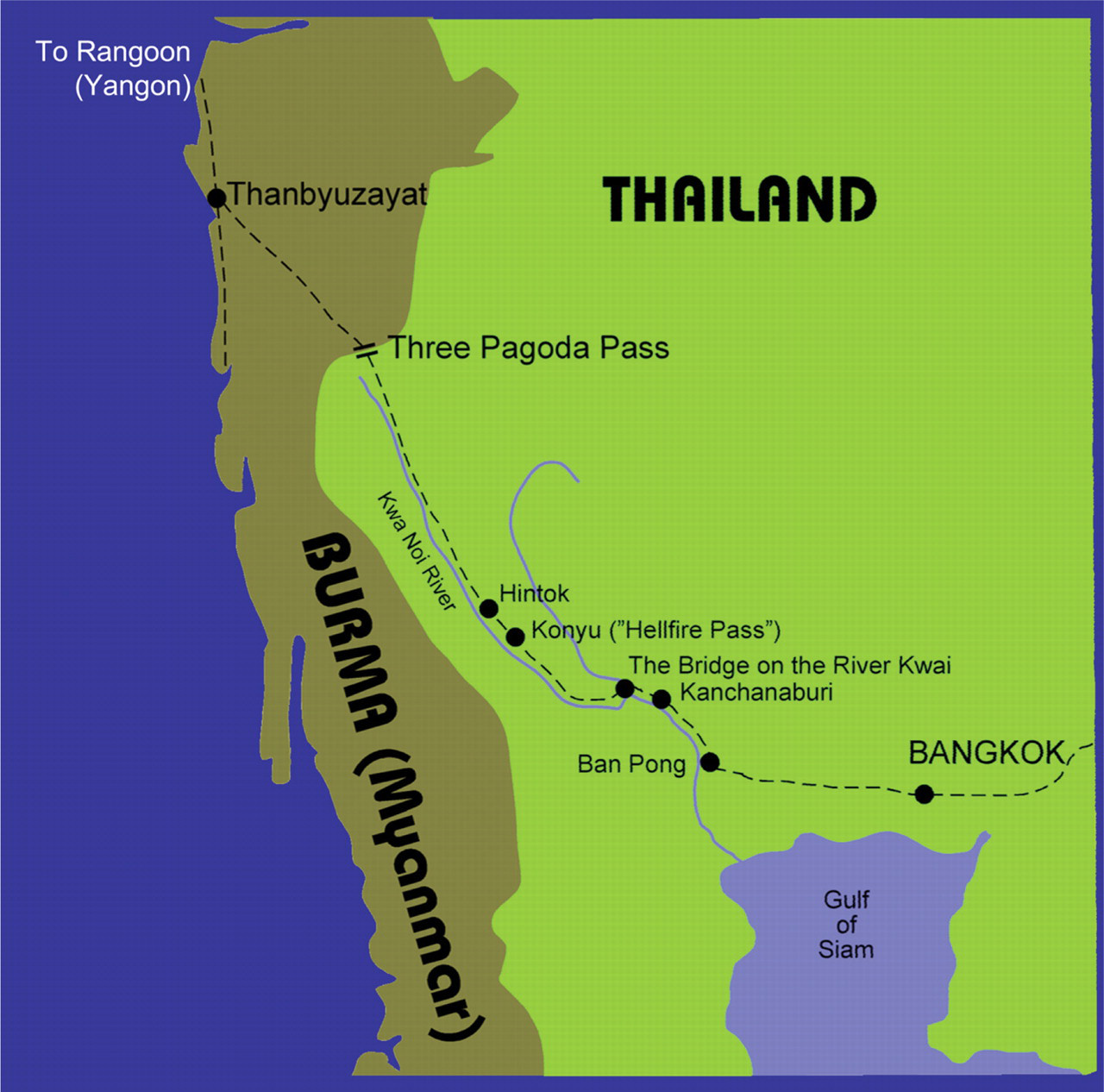
The Burma-Thai Railway.
Japanese culture emphasized the glory of military service and the utter dishonour of defeat or capture. To be a POW was shameful, and such individuals attracted little or no respect. The Japanese held no regard for the Geneva or Hague Conventions. Japan signed but did not ratify the 1929 Geneva Convention which stated “A prisoner of war shall be humanely treated and in no case shall any insult or maltreatment be inflicted upon him”. These conventions forbade anyone above the rank of warrant officer to work and accepted doctors as a special category because of their non-combatant status. Within the violent hierarchical structure of the Japanese military, which permitted officers to physically beat lower ranks and the lowest ranks to beat Korean recruits, POWs were close to the bottom of the ladder, with sick POWs at the very bottom. Sickness was regarded as a crime. 5 They reserved their harshest treatment for the sickest prisoners providing them only half the miserly rations in the belief that by starving them they would work harder. Weight loss of prisoners indicated that less food would need to be provided. 2 The Japanese military were indifferent to the health and welfare of these men as well as to their own wounded. 1
MEDICINE ON THE RAILWAY
There were many fine doctors on the Railway. A few left records, and a few have been written about by grateful others. The spectrum, extent and exotic nature of disease seen on the Railway had not been experienced before (or since) in British military history. 6 The medical officers were mostly young and inexperienced practitioners working solo without nursing support. The hovels allocated to the sick were euphemistically termed ‘hospitals’ but were usually little more than crowded pest-houses. 5 Medical duties included daily morning sick parades averaging 200 patients or perhaps 35% of the camp strength (and sometimes many more), attending emergencies during the working day, and caring for the sick at the end of the day (usually late into the evening). 4 On one occasion, Richards could only ‘produce’ for work 50 fit men (in reality 30) out of a force of 900. 4 Albert Coates, the Melbourne surgeon also in captivity, pointed out to Richards that the most valuable medical lesson he had learnt on the Railway was he had “learned to know when a man is sick”. 4 The doctor had to decide which of his frail men might survive another day of hard labour. Everybody was sick: it was more a matter of degree. 3 The doctors were blamed if ‘they’ could not provide sufficient labour. The guards usually overrode medical opinion anyway. The abuse of doctors was not only psychological. Verbal rage and physical assaults were everyday events. 7 The art of perfecting arguing, bargaining and persuading guards, ensuring they did not lose face in the process, was a key medical skill. 4 Some doctors such as ‘Weary’ Dunlop and Bruce Hunt, the Perth physician, were aggressive in their interactions Most learnt subtle negotiations were as effective and less damaging to personal health.
Heroic surgery was performed in unsavoury primitive dirty ‘theatres’. 1,5 Coates performed ileostomies for amoebic dysentery, appendicectomies with a razor blade, multiple amputations for tropical ulcers, tracheotomies for diphtheria, and even a debulking craniotomy. 7 Accidents, injuries (footwear was often not available) and trauma induced by the violent assaults of the guards were common. Amputations for tropical ulcers and gangrene were associated with a 10% immediate mortality and a 50% ultimate mortality. 5 Lack of anaesthesia was the greatest difficulty. 5
Diarrhoea was a constant for all men – it merely varied in severity. 4 Malaria was rife, the average was two attacks per month. Dengue fever, scrub typhus, diphtheria, pneumonia and deadly cholera epidemics wrecked havoc among the malnutritioned prisoners. Sanitation was inadequate, especially in the wet season, and water supplies were usually contaminated. There was limited access to cholera vaccine, 4 inadequate supplies of quinine, and the malicious denial of drugs and equipment by the Japanese made treatment difficult. Epidemics of cholera were deadly. Isolation, rehydration and rudimentary nursing cares were the only available treatments. The techniques of hydration were creative, using slithers of bamboo as ‘needles’, with jam jars and stethoscope tubing as the infusion apparatus. Blood transfusions were eventually able to be performed. 1,8 In the immune compromised, tropical ulcers were invariable, destructive and difficult to heal. Maggots, in plentiful supply, were used to clean the ulcers as was the immersing of limbs in the river so fish could clean the wounds, then banana leaves were used as dressings. Pus was welcomed as dying men reacted without inflammatory responses. 7 The respective mortality rates were malaria 2%, bacillary dysentery 17%, amoebic ulcer 20%, cholera 40%, vitamin deficiency 54% and pneumonia 83%. 6
The nutrition supplied by the Japanese to the workers was grossly inadequate, even if supplemented by occasionally locally acquired produce. Malnutrition and starvation accelerated with the passage of time. Polished rice and vegetable soup was inadequate. Diarrhoea, dermatitis, sore mouths, neuritic pains (‘happy feet’, burning neuropathic pains), peripheral oedema, failing eyesight, and confusion were symptoms heralding pellagra and beri-beri. Pellagra became a killer. 9 Yet astute medical observations continued to be made. Coates noted that the few men not suffering dysentery were able to withstand the lack of vitamins in the diet. 7 It was not known at that time that the bacterial flora of the bowel synthesized vitamins. The English doctor Hugh de Wardener, subsequently to become a pioneering renal physician, described 52 cases of Wernicke's encephalopathy (or cerebral beri-beri) in prisoners occurring after about 6 weeks of captivity, of whom nearly 50% responded rapidly to yeast tablets, thiamine injections or ‘marmite’ (whichever was available). These systematic observations, buried in a grave and recovered after the war, confirmed that B1 deficiency was alone responsible for Wernicke's encephalopathy. 10 Observational research projects continued despite the appalling predicament of both researchers and subjects. Autopsies were performed and medical records kept, though secretly.
PSYCHIATRY IN HELL
Occupied by the enormity of the physical state of their patients, most of the medical memoirs written make only brief references to the management of psychiatric problems. However, Richards made astute observations about the mental status of his men, comments which are certainly worthy of consideration for following and more fortuitous generations.
The most prevalent psychiatric disorder was that of acute (infective) delirium. The cramps and delirium of cholera meant there was “no silence, and the air is full of groans, cries for relief and curses in weak, husky voices”. 5 The ravings of delirium would echo through the jungle. Within 3–6 days of a malarial attack, delirium (cerebral malaria) could set in, the patient becoming combative and difficult to control. After a couple more days, exhaustion and semi-consciousness set in, then gradual recovery or, more commonly, death. 4 Coates recalled a couple of mental patients executed for wandering out of camp bounds. 7 Mostly, the frenzy of hyperactive deliria was partially limited by the fragile energies of the sufferer. Mental derangement was seldom marked though in the terminal phase extreme mental apathy (or hypoactive delirium) evolved. 5 ‘Cholera sleep’, a profound hypoactive delirium, was most feared and ominous. Open eyed, motionless and virtually unresponsive, actually determining death in these patients could prove challenging. 5 The delirium of typhus, often a fatal condition, could last for up to 2 weeks. 1 Management options were limited. Richards reports of the caring, reassurances and companionship of their mates, the only intervention for delirium possible. 4 Rapid cooling was difficult in the heat of the tropics and there were scarce supplies of antimalarial medicines. Sometimes, the ravings of cerebral malaria could be quietened with hyoscine if it was available. 11 Often, the only management strategy was to stand by and watch protectively as the natural history of the disease declared itself.
Severe affective states were recognized, but unusual. Dr Pavillard, an Anglo-Spanish doctor, records a soldier beaten over the head with a rifle butt, who in retaliation, unwisely, flung himself at the Japanese assailant. Although rescued by his colleagues he was threatened to be boiled in oil. The soldier kept repeating this threat despite the doctor's attempts to get the idea out of his head, the patient lost his will, contracted dysentery, and died. 1 When severely physically ill some men became morose and irritable. Men whom became negative and lost hope tended not to survive. Believing some men died due to a lack of a will to live, Richards also recognized that many men succumbed as a result of a positive will to die. 4 Emerging from a delirium and becoming aware of what was happening around them, they would make a definite decision not to live any longer. Interestingly “when men were closest to death”, Richards did not think they were strong enough to make a decision to let go, but as soon as they started to get better they gained the strength and will power to actively give up. 4 These negative psychological reactions were more likely demoralization (or perhaps nostalgia) than acute affective states. “Once a man lost the will to live, drugs and treatment were useless” – thus every possible subterfuge to keep the men cheerful was used, even sometimes inventing false news of the progress of the war, ordering a man to recover and even threatening court martial if he died. 1 Roy Mills, an innately palliative-inclined practitioner on the Railway (and subsequently in Newcastle) obviously had an intuitive appreciation of the suffering of others and he would on occasion lie down beside his ill patients “to console and make him feel he belonged” in a desperate attempt to cajole fluid intake and hope. 12 He was teased at the time that he would have to alter his bedside technique when he got home. Actual suicide attempts were infrequent. Dunlop personally knew of only six cases of suicide on the Railway. 5 He recalled a dysentery patient who had been bashed by the railway engineers for not moving fast enough, who subsequently committed suicide. 11 Physician-assisted euthanasia was occasionally and humanely practiced. 3
‘Neurotic conditions’ were surprisingly infrequent. 5 Dunlop suggested that the hostility of the captors to the sick made any secondary gain from psychological amplification unattractive, hence the rarity of hysterical (conversion) symptoms. Amid the numbers who presented for the morning sick parades, at times some professed dysentery and even provided factitious specimens ‘brought’ from the genuinely sick. 1 This was rare, though the Japanese were never convinced. 1 Of greater concern were those who went to work ill, presuming themselves fit enough (or fitter than their mates).
The universal coping strategies were those of denial and dissociation. Richards commented that strangely though we watched friends dying around us most of us believed “it can't happen to me”, and he recognized his own necessary disengagement, desensitization to death and blunting of emotions. 4 While fully aware of the grim risks faced, most became quite fatalistic. 4 There was no logic as to why one man lost his life and another did not. If it happened, it happened. Most men surrounded themselves in their own personal and protective armour. The doctors were fortunate in that they had not been deprived of their role. Indeed, the importance of their skills was actually enhanced by the predicament (despite being deprived of their instruments of trade). Richards and colleagues coped by an obsessive sense of duty. Long and challenging hours of work distracted them as it provided them esteem. “I had the advantage of retaining my role in captivity, this increased my chances of survival” stated Richards. 4 For others, it was humour or religious faith, and for all it was setting a deadline (“home by Christmas”). Although they knew it was artificial, it gave hope – by focusing on the future they could reject reality. 4 Their situation was dreadful, undoubtedly hopeless – rescue was unlikely and determining the conclusion of hostilities impossible. The occasional report gleaned from hidden radio receivers suggested changing fortunes of war but this hope was mitigated by the increasing expectations that POWs would be all massacred anyway. “We lived with the ugly anticipation that there were always likely to be worse days to come.” 4 Acknowledging this hopelessness encouraged individuals to make personal adaptations. Richards considered a critical issue was to recognize the difference between inevitability (which could not be altered) and the possibility of changing one's circumstances. 4 The fatalism concerned the situation, but “we still had control over our thoughts, we could still keep our minds active”. 4 This allowed a chance to find a way to adapt.
A component of the military medical officers’ tasks was to “keep morale up”, seemingly an impossible hope, though Dunlop suggested that good morale was the predominant attitude. 5 Doctors were expected to ‘manage’ morale in war, assisted of course by the padre. The basis of maintaining morale was diversional therapy and, particularly for the Australians, ‘mateship’ – the sense of comradeship and mutual dependence. Strict discipline, diverting games, recreation, entertainments, the fostering of intellectual imagination and recollections of civilian life were the key components dissociating the mind from the reality of existence. The favourite conversation was about food, the next baiting and hating the guards, and sex was a poor third (hunger cramps obliterating libido). 9 Chemists brewed forms of yeast and concocted herbal medicines, engineers improvised surgical instruments, tracts of Milton were memorized 12 and amateur actors strutted their stuff. Formal religion had little appeal, at least for the Australians. 5 The doctors were astutely aware of the need to turn anger into determination 4 for men who reacted to Japanese abuse risked death. While there was no such thing as counseling recognized in those days, Richards saw it as his duty to notice if a man was particularly down in the dumps. 4 He found often by just saying hello he would discover it was the man's wedding anniversary or some auspicious occasion, and that initiating a chat sometimes seemed to help him get things off his chest and pass the time. One can but speculate on the role of transference during these desperate days.
CONCLUSIONS
The Death Railway was not the most dangerous of Japanese prisons. Borneo and Ambon (where the death rate was 75%) represent the highest proportional loss of Australian lives of all Japanese camps. The ‘Hell Ships’ transporting prisoners to Japan to work in mines and shipyards were often sunk resulting in huge losses. Yet the Death Railway and ‘Weary’ Dunlop have come to symbolize in Australian memory this terrible epoch of Japanese history.
Determining the longer term health consequences of the survivors of Japanese imprisonment has proved difficult. As Burges Watson discovered, most were reluctant attendees, let alone research subjects. 8 Estimates of a rate of 29% suffering PTSD (even 40 years later) is likely to be an underestimate, 8 though Tennant was unable to make a diagnosis of PTSD in any of 126 Australian POW(J)s. 13 Denial, the primary coping mechanism of these men, and mateship were probably protective against evolving PTSD, 13 though the intensity of the abuse and its duration would certainly suggest the probability that most if not all the survivors harboured significant psychiatric wounds. The extraordinary intensity of the enduring comradeship of many of these men, relationships often closer than those with spouse and family, and their contained posttraumatic personality style made investigation by others very difficult. As a clinician of a subsequent generation, it has however been a rare privilege to attend some of these men.
Although only sparsely referred to in survivor stories, the doctors’ crucial role managing acute psychiatric crises, particularly delirium, demoralization, dysthymia, suicidal ideations, nostalgia, and interpersonal frictions, was outstanding. The positive and enduring regard for the doctors was a reflection of their usefulness, not only practically but also psychotherapeutically. Rowley Richards has bequeathed us this knowledge. It has been suggested that John Cade, a doctor prisoner in Changi for 3½ years, noting the strange and vacillating behaviours of fellow inmates, thought a toxin may be responsible. Perhaps lithium carbonate was also a heritage of these doctors forced to “practice medicine without medicine”. 4
Footnotes
Acknowledgements
I am indebted to Liz Rouse and the library staff at the RACP History of Medicine Library, Sydney for their wonderful assistance accessing the relevant literature.
Australian doctors on the Burma-Thailand Railway: BH Anderson, CD Anderson, HL Andrews, V Brand, FJ Cahill, RL Cahill, JS Chalmers, AE Coates, EL Corlette, TP Crankshaw, GD Cumming, GFS Davies, EB Drevermann, IL Duncan, EE Dunlop, NB Eadie, KJ Fagan, WE Fisher, JL Frew, T Godlee, T Hamilton, AR Hazelton, PIA Hendry, JP Higgin, D Hinder, AF Hobbs, TGH Hogg, BA Hunt, CP Juttner, SS Krantz, T Le Gay Brereton, EA Marsden, PT Millard, RM Mills, AA Moon, PF Murphy, RG Parker, CRB Richards, EA Rogers, SEL Stening, RH Stevens, JL Tayler, AJM White, RG Wright.
The author reports no conflicts of interest. The author alone is responsible for the content and writing of the paper.