







Abstract
Suicide is strongly influenced by culture. 1 We have previously detailed the suicides of historical figures (Lucretia, Judas, and Queens Cordelia and Boudica) and traced their representations to the present, so demonstrating that suicide has deep roots and a long-established function in Western culture. 2
Greek and Roman mythology contains many accounts of suicide. Notable examples (which we have not yet discussed), such as Hercules and Dido, have also contributed to Western culture.
Plato (c 424–348 BCE) taught that suicide was disgraceful and that perpetrators should be placed in unmarked graves. He did, however, recognize two exceptions: (i) when the self-killing is compelled by extreme misfortune, and (ii) when the self-killing results from shame (Laws IX 873c-d).
With the aim of confirming the deep roots of suicide in Western culture, we explored the attitude toward and motives for suicide recorded in Ovid's The Metamorphoses. This is a collection of more than 250 stories which the author claimed covered events “from the beginning of the world” to his own time. It was completed about 8 CE, and forms a centrepiece of the Western canon. The Metamorphoses are referred to by Ruben, Picasso, Chaucer, Milton, Proust, Kafka and Shakespeare (among many others). Accordingly, it has had an important influence on Western culture.
We were also interested to determine whether mental disorder was depicted as a cause of suicide.
METHOD
We examined various translations and selected that of Horace Gregory of 1958; 3 published in paperback by Signet Classics, it is the most available and least expensive.
All mentions of suicidal thoughts and actions, methods and censure of suicide, and accounts of mental disorder were examined.
RESULTS
There are 25 mentions of the wish to die due to a predicament, or the preparedness to die, if predicaments did not change, predominantly from humans, but also from a god (Phthonos/Envy, p. 56), a nymph (Daphne, p. 19) and a centaur (Hylonome, p.326).
Examples of the preparedness to die if predicaments did not change include:
Deucalion (p.13) to his wife, after the great flood, “For if wild sea/Had claimed you then I would have followed after”.
Orpheus (p. 259). His wife died by snake bite and he went to Hell to demand her release, “Yet if the Fates say No, here shall I stay/Two deaths in one – my death as well as hers”.
In addition, some entities asked the gods to convert them into non-human forms as a means of escaping a predicament. These may not be suicide in the true sense, but are allied. Examples include:
Daphne (p. 19) to Peneus, when she was being pursued by Apollo, “cover with green earth/This body I wear too well”. She was metamorphosed into a tree.
Cadmus (p. 105) to gods in general, in response to ill-fortunes, “Then let me be a snake”. Bingo.
Fifteen humans took action to end their own lives; details of relevant utterances and circumstances are listed in Table 1. The predicaments were six cases of loss of a loved person, four cases of escape from murder, and the consequences of defeat or plague, and one case each of rejection by loved person, avoidance of marriage, loss of status, physical pain, and defiance.
The individuals who completed suicide and the predicaments from which they were escaping
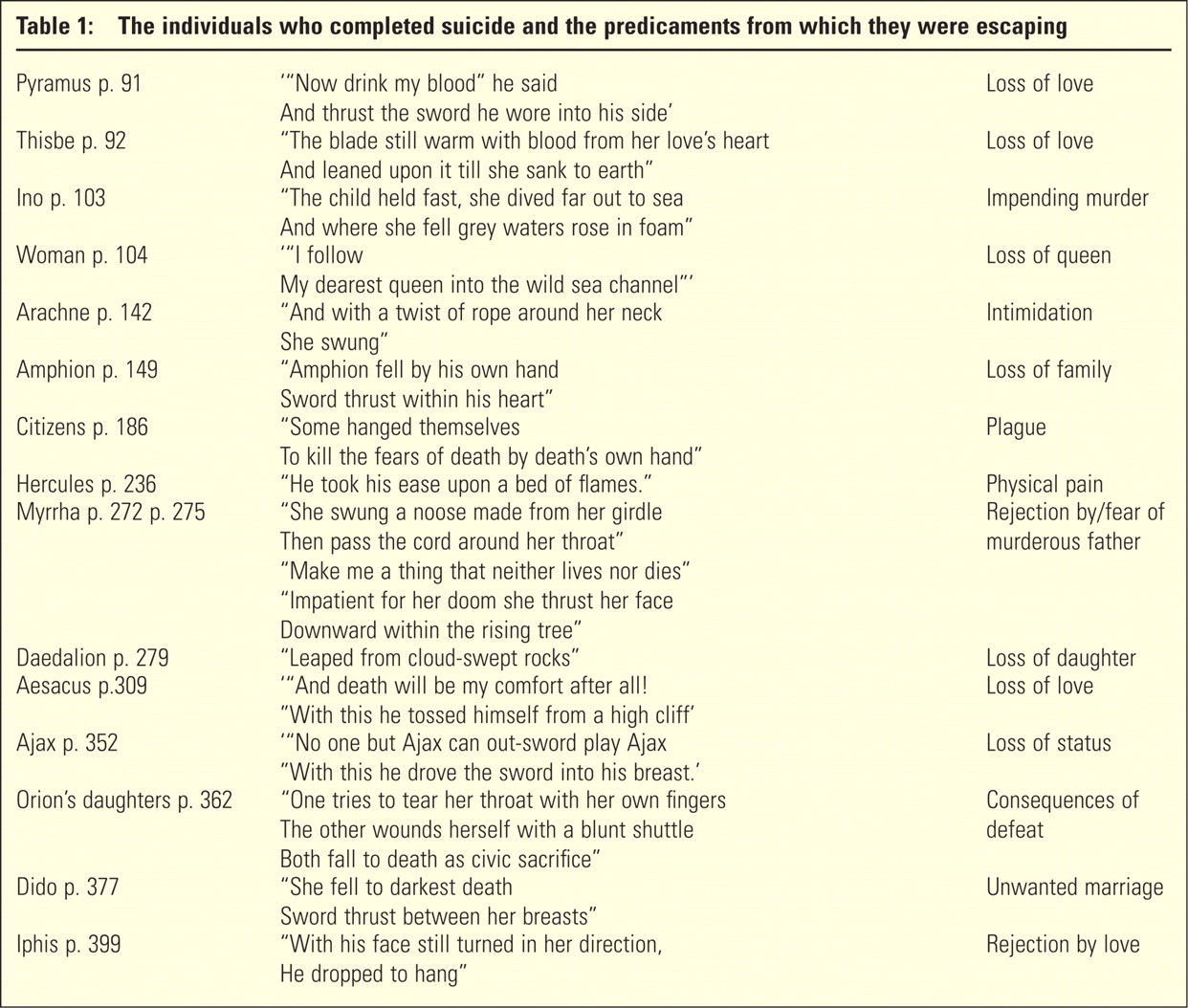
There is no mention of mental disorder leading to suicide. There are a number of mentions of madness, but none even associated with suicide. For example, when Orpheus lost his wife a second (and final) time he “went melancholy-mad” (p. 261), but did not complete suicide.
All means were violent; hanging, jumping and sword wound were equally common. There was one case of self immolation and one case of unclear means.
There was no censure of people who escaped predicaments by suicide.
DISCUSSION
This paper might be criticized because The Metamorphoses includes description of myths, and myths which have been treated with some poetic licence by Ovid, rather than the observations of a scientist. But that is to miss the point that, irrespective of the author's characteristics, this document is a foundation stone of Western culture and accordingly has influenced response behaviour.
As mentioned above, stories from The Metamorphoses are frequently represented in music, visual arts and literature. The suicide of Hercules is an example (Fig. 1).
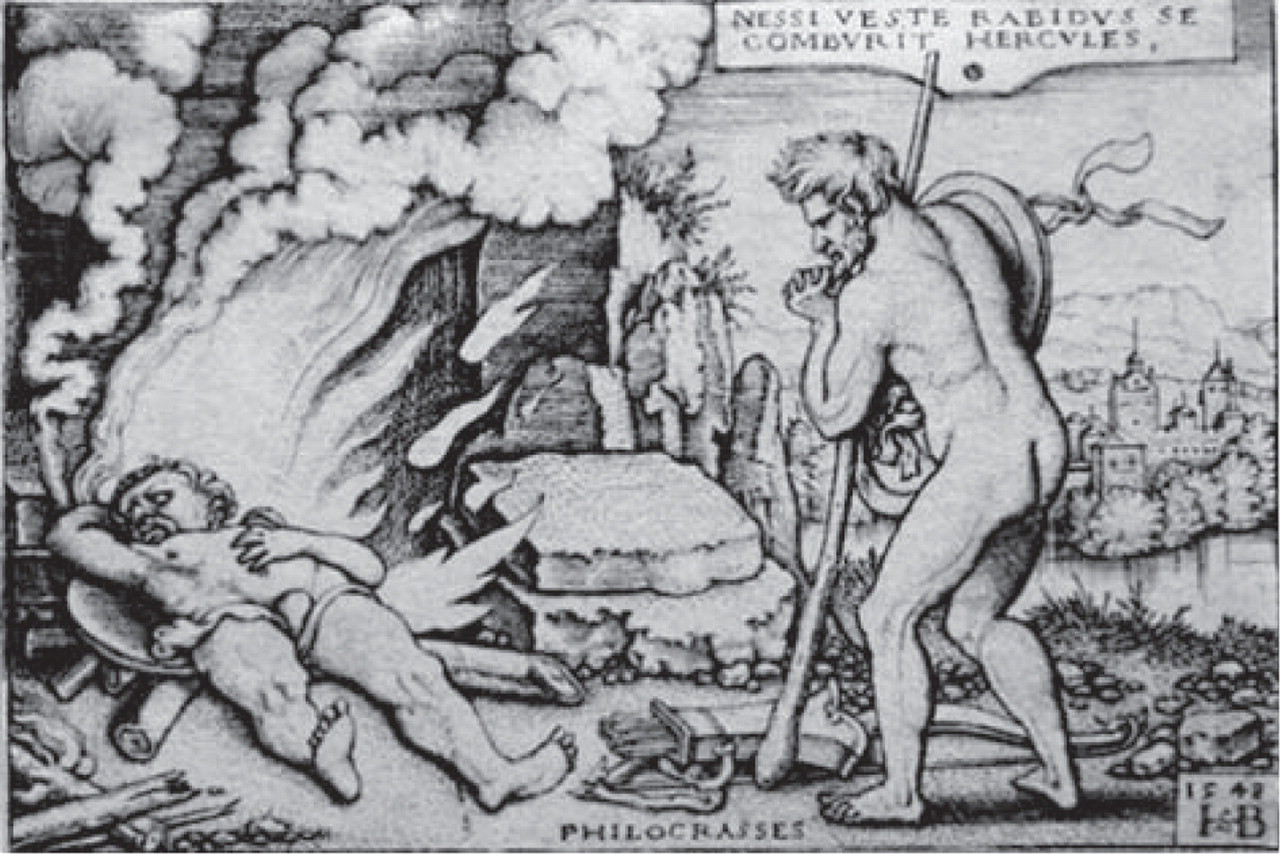
Hercules on his funeral pyre (engraving by Hans Sebald Benham, 1546).
An intention of the paper is to discover, in that document, attitudes towards and the motives for suicide. As mentioned, Plato taught that suicide was disgraceful, but made exception in the case of misfortune and shame. This was some 400 years before, and we were not able to find an opinion contemporary with the writing of The Metamorphoses. The predominant attitude toward suicide in this document is acceptance, and there is no censure of that response. This is consistent with the earlier view of Plato, as all the described individuals were facing misfortune or shame.
The motives have been tabulated and classified. Other readers may classify these slightly differently. For example, Myrrha (p. 273), under the cover of darkness, had pretended to be a concubine and tricked her father into copulating with her on numerous occasions. When he became aware of the facts, he came with a knife to kill her. We have classified her suicide as escape from murder. Others may have preferred to construe her suicide as a response to guilt.
The motives for suicide can be condensed into escape from the pain of loss of a loved person or status, rejection by a loved person, perilous circumstances (including unwanted marriage), physical pain, and defiance of intimidation. Such predicaments motivate some of the suicides of the current day, suggesting that the roots of this response run back to classical times.
Presently, hanging and jumping continue to be employed, but sword wound has been replaced by gunshot.
Ovid did not report mental disorder in those who completed suicide and all were in difficult circumstances. This is in accordance with the notion of ‘Type 3 suicide’ (i.e. where mental disorder is absent, but external factors driving the suicide can be clearly identified by the observer). 4
It is of interest that Hercules, one of the strong men of history, chose death over continuous physical pain. A god arranged for him to put on a poisoned shirt which caused him agony. He asked (p. 234) “take this burden from me which is life”, but got no relief. So, he had his friends build a pyre on which he threw himself.
Footnotes
Acknowledgements
The authors report no conflicts of interest. The authors alone are responsible for the content and writing of the paper.