Abstract
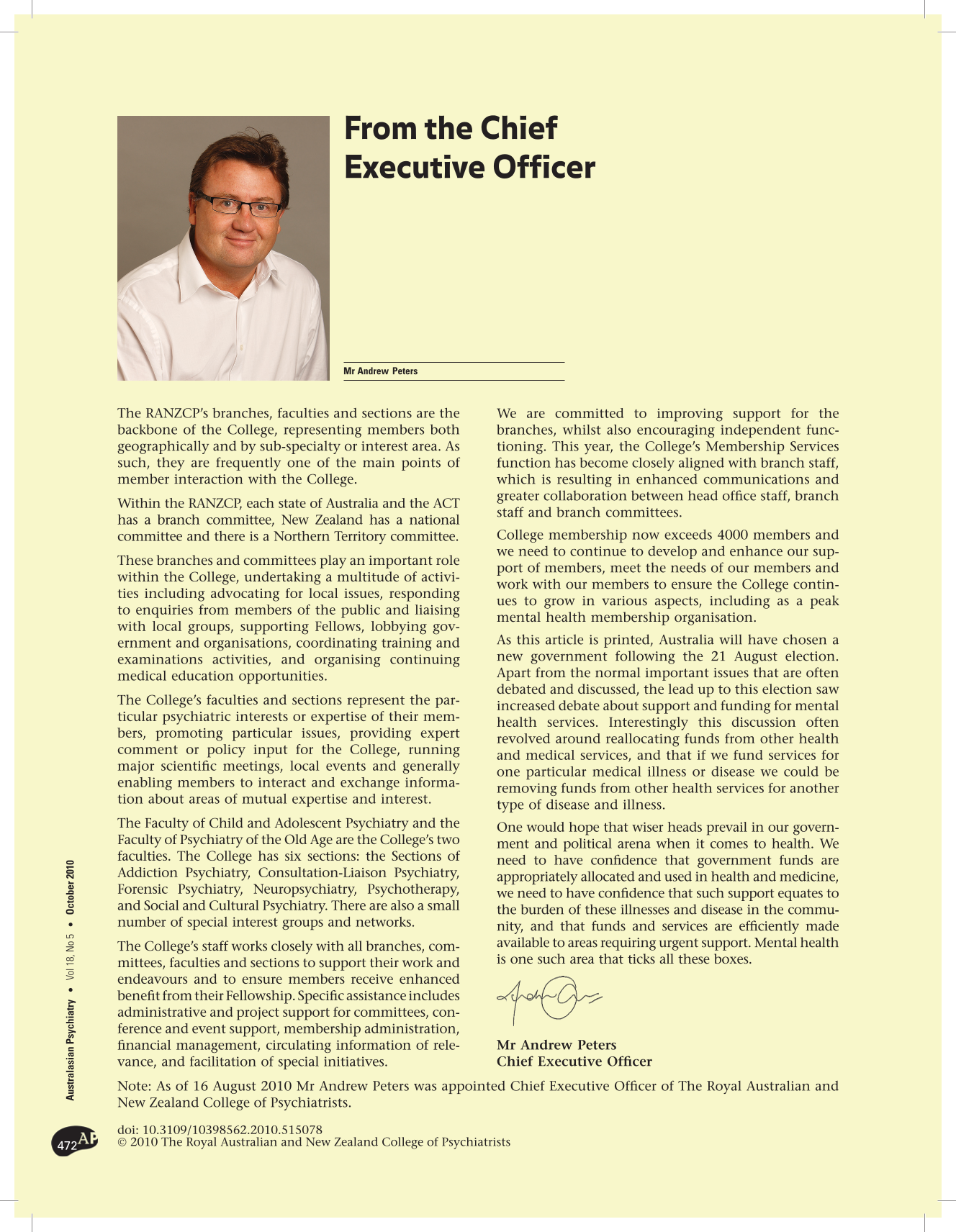
Mr Andrew Peters

The RANZCP's branches, faculties and sections are the backbone of the College, representing members both geographically and by sub-specialty or interest area. As such, they are frequently one of the main points of member interaction with the College.
Within the RANZCP, each state of Australia and the ACT has a branch committee, New Zealand has a national committee and there is a Northern Territory committee.
These branches and committees play an important role within the College, undertaking a multitude of activities including advocating for local issues, responding to enquiries from members of the public and liaising with local groups, supporting Fellows, lobbying government and organisations, coordinating training and examinations activities, and organising continuing medical education opportunities.
The College's faculties and sections represent the particular psychiatric interests or expertise of their members, promoting particular issues, providing expert comment or policy input for the College, running major scientific meetings, local events and generally enabling members to interact and exchange information about areas of mutual expertise and interest.
The Faculty of Child and Adolescent Psychiatry and the Faculty of Psychiatry of the Old Age are the College's two faculties. The College has six sections: the Sections of Addiction Psychiatry, Consultation-Liaison Psychiatry, Forensic Psychiatry, Neuropsychiatry, Psychotherapy, and Social and Cultural Psychiatry. There are also a small number of special interest groups and networks.
The College's staff works closely with all branches, committees, faculties and sections to support their work and endeavours and to ensure members receive enhanced benefit from their Fellowship. Specific assistance includes administrative and project support for committees, conference and event support, membership administration, financial management, circulating information of relevance, and facilitation of special initiatives.
We are committed to improving support for the branches, whilst also encouraging independent functioning. This year, the College's Membership Services function has become closely aligned with branch staff, which is resulting in enhanced communications and greater collaboration between head office staff, branch staff and branch committees.
College membership now exceeds 4000 members and we need to continue to develop and enhance our support of members, meet the needs of our members and work with our members to ensure the College continues to grow in various aspects, including as a peak mental health membership organisation.
As this article is printed, Australia will have chosen a new government following the 21 August election. Apart from the normal important issues that are often debated and discussed, the lead up to this election saw increased debate about support and funding for mental health services. Interestingly this discussion often revolved around reallocating funds from other health and medical services, and that if we fund services for one particular medical illness or disease we could be removing funds from other health services for another type of disease and illness.
One would hope that wiser heads prevail in our government and political arena when it comes to health. We need to have confidence that government funds are appropriately allocated and used in health and medicine, we need to have confidence that such support equates to the burden of these illnesses and disease in the community, and that funds and services are efficiently made available to areas requiring urgent support. Mental health is one such area that ticks all these boxes.