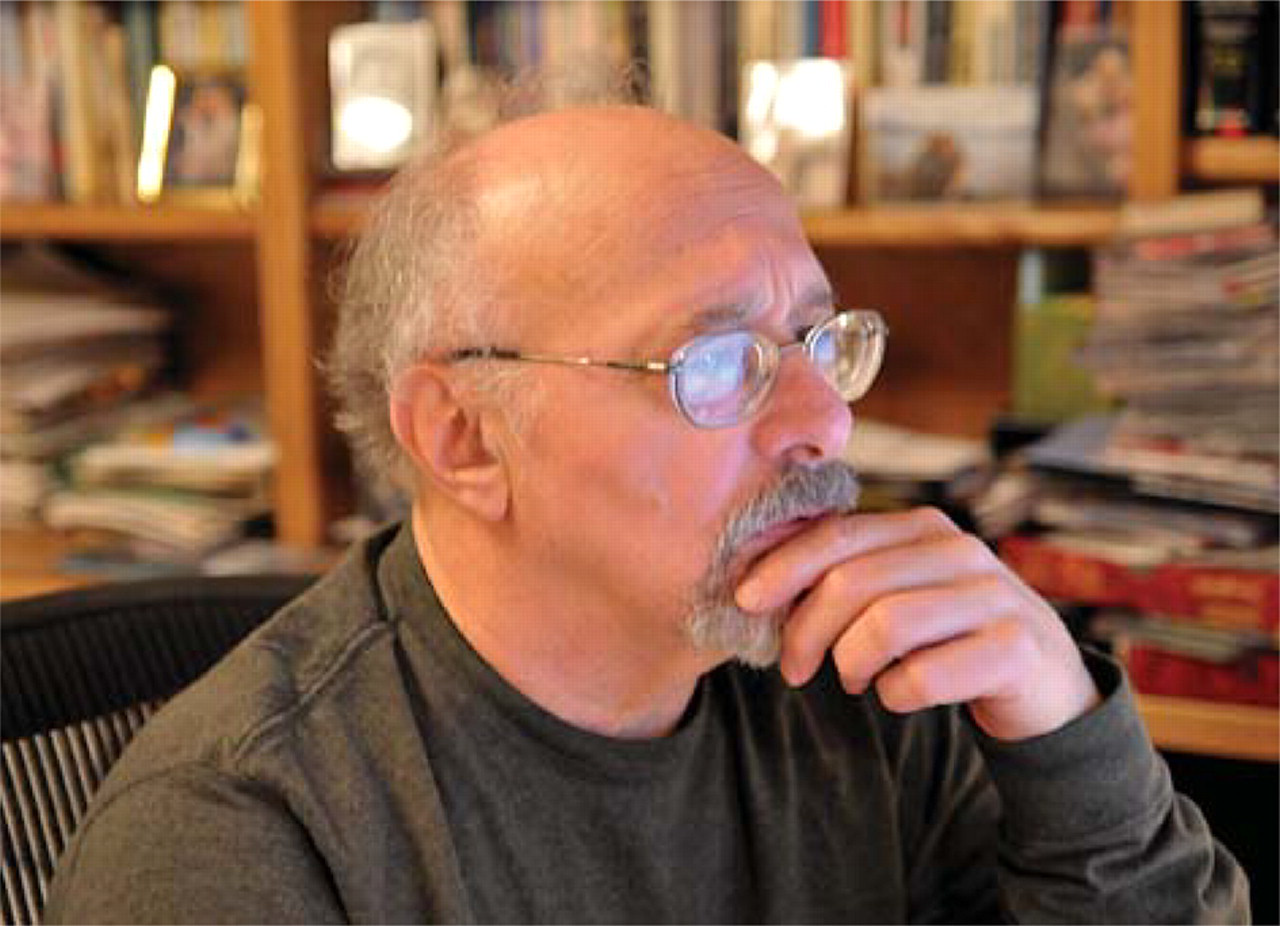
| Halasz |
We've just finished a very delightful lunch where we started to speak about some of the work that Judy, your wife, and you have been involved in for the best part of how many years? |
| Schore |
Since about 1990. The first article was written in 1990 and published in Psychoanalysis and Contemporary Thought in 1991. So it's been 20 years. |
| Halasz |
Could I start by asking you to reflect on the events that led up to your ‘91 article – how did you come to this area, which today is at the heart of the paradigm change in modern neurobiology of mind and development? |
| Schore |
For openers, let me point out that I'm a clinician-scientist rather than a scientist-clinician. Most of what I've done is theoretical research that directly ties to clinical models, although I'm now also doing experimental clinical research. But the scientist part has been carefully observing the inner worlds of the patients I've seen over the last 40 years. |
| |
This integration of the science and the clinical has been there from the start. I was trained in clinical psychology at the University of Pittsburgh, and although the mid-late 1960s was a seminal period of behavioral psychology I felt that psychodynamic approaches were more effective with a wider variety of patients. So from the very beginning of my professional life one trend, a psychoanalytic understanding of patients, has allowed me to understand work with more severely disturbed patients, narcissistic personality disorders and borderline personality disorders. The psychopathological roots of these disorders are early in life, and so the cases allowed me to see up close the later impacts of early relational disturbances. |
| |
But the second trend had its origins in my training in clinical neuropsychology that I received in an internship at Lafayette Clinic in Detroit. At the time the Halstead-Reitan and Luria neurodiagnostic batteries were used to anatomically localize neurological deficits. This training hospital had on staff a number of superb psychoanalytic clinicians, a contingent of prominent neurologists and neuropsychologists, a renowned psychophysiologist, and psychiatrists who were studying the biology of schizophrenia. Talk about interdisciplinary! I have strong memories of the exciting and heated staff meetings, when a number of disciplines converged in dialogue about common clinical matters. |
| |
This dual interest in science and clinical matters continued when I took a position in the Psychiatry Department at Kaiser Permanente here in southern California. In addition to seeing 30 patients a week, I did numerous neuropsychological evaluations and trained Kaiser's neuropsychologists, and lectured to the paediatric department. I also set up a private practice in order to work more deeply with long-term patients. In 1980, after working for 10 years, I decided to essentially cut back my clinical hours and start a period of intense study. Leaving Kaiser I thought I'd write something on the limitations of the DSM's concept of ‘organicity’. And so for the next decade along with my ongoing clinical practice I (re-) immersed myself in the world of academic scholarship, returning to not only clinical psychology, but to psychiatry, neurology and paediatrics (the areas which I was already involved) and ultimately into basic biology and biological chemistry. |
| |
For 10 years, every week I spent one day roaming the stacks of a California State University library near here. I'd copy large numbers of articles in various fields and then pore over them in my home office. I became extremely interested in the biological and neurological processes that lay at the core of the psychological and psychiatric problems of the patients I was treating. |
| Halasz |
What actually triggered your self-directed learning in this direction? This seems a departure from what was a traditional academic course or analytic training course? |
| Schore |
Exactly, and I was fully aware of the choice I was making. At that time I had finished my own psychoanalytic psychotherapeutic explorations, and I realized that I wanted to, first of all, follow a self-organizing path, as I'm by nature a self-organizing studier. And so I chose a solitary path of independent study, rather than moving towards a psychoanalytic institute or an academic position at UCLA. This fit my learning style, which continually seeks a great deal of novelty. It also fit my value system in which time devoted to scholarship is time well spent. As I continued my studies into a variety of disciplines, I became particularly interested in the points of contact between disciplines. I was most interested with the concepts that lie between fields, so I didn't want a context which would narrow down my wide ranging interests. The gains from my psychotherapy gave me enough confidence to pursue my own interests, wherever my curious mind led me, and that supplied the energy and motivation that sustained intense study during the entire decade of the 1980s. |
| Halasz |
That's quite a courageous move for a young clinician, researcher, academic to take on self-directed learning for around a decade. |
| Schore |
I used this early-forming self-directed learning mechanism rather successfully throughout my school years, up to and including getting my PhD in 3½ years. And I expanded it even more in my own therapy where I became more acquainted with the inner workings of my mind, and this allowed me to move into the ensuing period of independent study. In the same period the therapeutic explorations of emotional processes in my patients and in myself allowed me to become aware of how primary affect was in the subjectivities of both the patient and the therapist, and the power of a perspective that integrated the psychological and biological realms. |
| |
For the 10 years of independent study, unlike the decade of my formal education, there were no pressures of examinations, no need to explain or solve anything, and no need to publish. My mood was extremely positive, and imbued with the joy of learning new information from different fields, and my confidence and intense curiosity increased as I realized I could master a variety of different disciplines than those in which I was trained. And so I spent a number of years in reading journals in cell biology, neurochemistry, neurophysiology, neuroanatomy, etc., especially looking at changes over early developmental periods of an organism's life span. |
| |
I had to create a structure that self-organized my time, and an environment that could support my creativity. At the very outset of this independent study period I intuitively chose to return to the piano. When I was a child I dabbled with the piano for a year or two. So in my late 30s, I went back to the piano for a number of reasons. Not just to listen to but to create music, and thereby bring music into my home made ivory tower. I was aware that the music would allow me to understand something in my fingers and not just in my mind. Science, and emotions in particular were not apprehended just through logical understanding. I wanted to be able to visualize what I was beginning to know. Later I realized I needed to move more and more into my right brain, the source of creative processing. |
| |
The routine I came up with was to visit the local university library every week. I'd return with 30–40 xeroxed articles, and then take notes on each in 100 sheet 8½ by 11 legal pads. By the end of the decade the pads stacked well over 6 feet high, and they contained long sections of detailed notes on related research common to different fields. Every second or third notebook I noted repeating patterns across fields and began to integrate different research literatures. By this time I was sure that the integration of psychiatry, psychology and biology could produce powerful theoretical models. |
| |
At the end of the decade I intuitively made the decision to end the period of independent study. My plan was to now write a formulation of a psychoneurobiological perspective that related to the clinical phenomena I was observing in my practice. In fact some of the problems that I ended up studying, the role of mitochondria and energy production in development across the lifespan, the evolution of methanogenic bacteria and the earliest forms of life, the basic processes of recovery from disease, I hope to return to in the future. |
| |
All of this occurred in my late 30s and 40s, a time when I should have been building my practice. In fact I reduced my clinical work to 3 days, allowing the bulk of my time for study. In order to cover the economics my wife and I switched income responsibilities, and she built up her private practice. In a sense I was on a Judy Schore grant for 10 years. In other words the two of us had figured out economically how we could support my research, pay the mortgage, and also raise two children. |
| |
There were other advantages to setting up this arrangement. As soon as my daughter was born I cut my work days back to 4 days to allow more time for fatherhood. As my children got older and Judy and I re-organized our joint responsibilities, it turned out that I became the parent who was home when the kids came back from school. I point this out because all of the science that I've created has not occurred in a laboratory. In a very real sense all of my work has really come out of the home in which I lived and the relationships which I was a part of. And one of the profound changes in me was not only the relationship I shared with Judy, but my becoming a father. This fatherhood was a source of the emotional growth that occurred in me from my relationships with my children, especially when they were infants. From my college days I had always been extremely interested in developmental psychology, and my subjective curiosity also reflected upon my relationships with my children. And so the science and the data of development, which was occurring before my eyes, was filtered through my own subjectivity. It was myself in intimate relationships that became an important part of the focus of what I was academically researching, rather than the more detached perspective of science as usually practised. |
| |
Throughout this period I continued my clinical practice, especially focusing on treating narcissistic personality disorders, a clinical problem that at the time was being freshly addressed in the seminal works of Kohut, Kernberg, and Masterson. These authors were focusing on not oedipal but preoedipal stages of development, and more and more the older oedipally centered developmental theories were problematic. My own patients were also sources of developmental data, expressed in their disturbed early object relations and their ensuing personality deficits. In other words, the developmental models that emerged from my research could generate hypotheses about preoedipal experiences, the earliest periods of development, including the early development of the unconscious mind. This gave me a chance to test my ideas out on the patients I was seeing. The research-generated ideas had to also work clinically. |
| Halasz |
When you say older developmental theories, could you mention which ones and in what way they were problematic? |
| Schore |
In the 1980s the work of Mahler and Stern started to incorporate scientific observational techniques into developmental psychoanalytic research. These data complemented the ongoing work of clinicians on early developmental processes (e,g, Kohut on empathy, and Masterson on the role of not paternal but maternal factors in personality psychopathogenesis). The scientific and clinical domains both converged to show that psychoanalytic oedipal theories that focused solely on development of the personality at 3 and 4 years old, and that narrowed the source of all pychopathogenesis to aggression and sexuality, were not useful in understanding the structural deficits of the inner world of these more severely disturbed personality disorders. This was practical information, because at that time we were seeing more and more of these kinds of patients here in Los Angeles. |
| |
In addition, psychoanalysis at that time continued its banishment of real-life trauma in models in psychopathogenesis. Yet patients with developmental disorders clearly reported histories of early trauma. And so both theoretically and practically I realized that ongoing clinical models based on development of the verbal child at 3 years were much too late, and essentially ignored the critical events of infancy! I therefore started to move back earlier and earlier. That's not to say that certain major psychoanalytic developmentalists had not been working deep in the earliest stages of the unconscious. Certainly Bowlby and Winnicott were talking about the first year of life. And Klein's ideas about projective identification also focused on the very beginnings. |
| |
This move back from the verbal to the non-verbal also shifted the emphasis in my thinking from the development of the conscious to the unconscious, and the cognitive to the emotional realms. We are now clearly in a period in which the primacy of affect is well established. But at that time not only psychoanalysis but science downplayed the critical role of affective processes in the human experience. Recall, the 60s, the era of my early career, was the heyday of behavioural psychology. And then of course there was a paradigm shift in the seventies and the eighties into cognitive psychology, followed in the late eighties and the early nineties with the rumblings of a third force, the psychobiological psychology of emotions per se. |
| |
Now when it came to emotions I found that the kind of work that I was doing with my patients, especially these early disturbed patients, was all about emotion. Their interpersonal deficits were fundamentally deficits in coping with a wide array of emotions. In fact when it came to narcissistic personalities, the keystone affects were not sexuality and aggression or even anxiety, but rather early-forming fear-terror and shame. Incidentally, in the eighties, Judith's clinical research for her PhD was on shame. So I became very interested in early forming shame, which then lead me to the early development of emotions per se. |
| Halasz |
In that decade of the ‘Judy Schore fellowship’, you're saying that your theoretical work was informed by not only your patients but by Judy's academic and research studies of shame. |
| Schore |
Right. At that time, besides Sylvan Tomkins, there was very little work on the highly visual, non-verbal affect of shame. Much if not all of the focus was on verbally biased guilt, a later forming emotion. Essentially Judy and I were both moving into the earlier pre-verbal phases and the earlier pre-verbal emotions. |
| |
By the end of the 80s it became clear that shame is the hallmark of narcissistic personality disorders, and that working with this affect was essential in the treatment of developmental disorders. So more and more of my work went into the early interpersonal origins of this non-verbal affect. Nothing had been written on this. Clinically the matter of shame turned out to be relevant to not only development but the therapeutic process. In order to be able to work earlier and deeper, one has to be able to have some understanding of one's own shame dynamics. These are highly interpersonal dynamics, and although they begin in infancy they play out non-verbally, beneath the words, in all relationships and in all developmental stages. Interestingly, these insights occurred at the end of the decade, when I intuitively decided to finish my period of self study. It was now time to write, and I knew what this would be about – a model of early emotional development, with a specific focus on the emergence of shame. |
| Halasz |
Can you recall the very first paper or article that you wrote in this area? |
| Schore |
Yes. Judy and I wrote an article together and it was about shame and gender development. We submitted it to the Journal of the American Psychoanalytic Association and they would have none of it. |
| Halasz |
So it wasn't accepted for publication? |
| Schore |
No. We were not only talking about the primacy of emotion at a time when psychoanalysis had no theory of affect. But in addition we were questioning a cardinal tenet of psychoanalysis – the centrality of oedipal events in development and therapy. However, there was another psychoanalytic journal, one related to JAPA, Psychoanalysis and Contemporary Thought (which I think is no longer published). With a sense of relief I noticed that on its editorial board were people like Bob Emde, Fred Pine, and Erik Erikson, major developmentalists. When I saw their names I knew immediately that this journal would be a good fit. So I wrote my first paper, “Early superego development: the emergence of shame and narcissistic affect regulation in the practicing period” and submitted it to that journal. The paper ended with neurobiological speculations about the early development of the right hemisphere. It was accepted immediately. As I look back I view it as my first articulation of developmental neuropsychoanalysis. |
| Halasz |
Now this also sounds like it was the precondition for your first book, Affect Regulation and the Origin of the Self: the Neurobiology of Emotional Development. The ‘origin of self’ is a most profound subject to tackle, especially in your first book – how did you conceptualize it? |
| Schore |
As I mentioned, one outcome of the preceding period of independent study was the use of an interdisciplinary perspective that integrated biology and psychology. In thinking about development, this linkage allowed me to conceptualize specifically how nature and nurture interact. And by focusing on not early cognition but bodily based affect, it enabled me to think about how the developing mind and body interact. This theoretical lens looked at not only the development of psychological function but neurobiological structure that mediates these early-appearing essential psychobiological processes. Remember at this time the field was plagued with what appeared to be unresolvable dichotomies – biology versus psychology; nature versus nurture, brain versus mind; mind versus body. |
| |
Weaving together different disciplines I was convinced of the power of this model. Each time I applied it to another developmental phenomenon it provided a deeper understanding of the underlying developmental mechanism. And this same mechanism was operating in the unfolding developmental dynamics in the cases I was seeing. Essentially both the science and the clinical were coming together to provide a heuristic model of the evolution of psychic structure and how interpersonal experiences change psychic structure (for better or worse). So over the period of independent study my confidence in what would become regulation theory was also increased by my clinical experiences. For 10 years my expanding curiosity was the main driving force, and it resulted in a confidence in both the capacities of my mind and of the interdisciplinary perspective. Interestingly, we now know that it takes 10,000 hours (about 10 years) of intense study to acquire an intuitive expertise in any skill. |
| Halasz |
Your confidence came from within; it may have been centred on your model, but the actual sense of conviction is an interior state. Do you have any sense from where you actually derived both your curiosity and sense of conviction and confidence? |
| Schore |
I had explored the roots of this implicit conviction in my own therapy, where I became more acquainted with the inner workings of my mind. This in turn allowed me to move into the ensuing period of solitary, independent study. In the same period the therapeutic explorations of emotional processes in my patients and in myself allowed me to become aware of how primary affect was in the subjectivities of both the patient and the therapist, and the power of a perspective that incorporated a relational view of the human experience. |
| |
I continue to set aside large amounts of time in my daily life for reading and pondering new studies over a broad spectrum of disciplines. In this manner my conscious and unconscious minds are continuously stimulated, challenged and surprised by novel and intrinsically interesting information. My particular response to finding new scientific and clinical data is more than just intellectual. My period of independent study revealed that the process of both objective and subjective learning was a highly emotional one, and that studying subjective and intersubjective emotional processes can not be done without also introspecting into my own self. I became aware of this at moments of insight, at points which I could now more deeply understand something that couldn't be understood before. There's a significant emotional rush that occurs in that creative moment. |
| |
In order to come up with a fresh solution to the problems I was addressing I realized that my right brain implicit learning processes played an even larger role than my familiar left brain approaches. From the outset I decided never to explicitly memorize anything. And then I found that I had to expand my tolerance for the uncertainty of not knowing, to allow my mind to stay open long enough rather than prematurely closing down the exploratory process with what appeared to be a quick solution. In order to foster the creative process I never deliberately attempted to solve anything in particular. Rather, I would just take in large amounts of salient information, with an intuitive bodily based knack for knowing what is essential information. Ultimately my right brain unconscious mind would recognize patterns, which then my left brain conscious mind would describe verbally. Frequently these solutions took a visual form. I've been aware for some time that I'm studying right brain processes with right brain and not left brain learning mechanisms. |
| |
In the period of independent study and self exploration I found that my creativity expressed itself not in linear analytical intellectual ‘work’ but in non-linear positively emotionally charged ‘play-states’ which wander, and are sustained by extended spans of attention that last for long periods of time. Frequently, classical music, especially Mozart and Handel, are in the background. These creative play states that amplify positive arousal are long enduring moods marked by the positive affects of heightened interest and enjoyment, which at certain moments transform into excitement and joy. The play state also generates thought experiments that can trigger novel solutions. As you know studies show that play facilitates the processing of novel information and thereby improves learning capacity. |
| |
My confidence in my ability to wonder, recognize, understand and articulate increased with practice over the 10 years. This confidence was not even shaken by the concerns of my friends, who on the one hand admired me for taking this independent stance and yet on the other hand were worried that this enormous expenditure of time might lead nowhere. As long as I had the internal rewards of the exploratory process and the external support of my inner circle, my family, I was undaunted by their empathic concerns, “Why don't you get somebody to take a look? You may be wrong.” |
| |
This burgeoning trust in not the rational but the intuitive also allowed me to know when the period of self study was over, when it was time to write, and to test my ideas out in the scientific and clinical worlds. And so by the end of the 80s the internal journey now had to be converted into an external journey, one that would lead me to far away places (including Australia!). |