







Abstract
There is no currently known systematic and quantitative procedure developed to design smart workplace environments through guiding efficient and effective adoption and exploitation of the currently available wide variety of smart-environment-enabling technologies. This article presents a novel methodology to design a smart workplace environment objectively to improve, for example, productivity and safety. The proposed methodology starts by analysing the given subject workplace environment in terms of tasks and goals, and then structures and quantifies effect relations among workplace overall goals and the smart-environment-enabling technologies through linking them to the intermediate task objectives, potential improvement opportunities and smart characteristics affected by those smart technologies. Fuzzy relations are utilized to express vague effect relations among related goals, objectives, concepts and technology elements of the proposed design model. The Max–Min composition is used to compose relations to obtain the final overall goal-technology relationships. The methodology eventually yields a composed relation among workplace overall performance goals and the investigated smart-environment-enabling technologies. This overall composed relation reveals promising enabling technologies that are relevant to achievement of the specified goals. Identification of goals promising smart technologies can be used directly as a guide to realize a goal-based smart workplace environment design. Promising technology relations to task goals also help to deploy those promising technologies to the relevant tasks. A comprehensive example case is used to demonstrate the applicability of the methodology.
Keywords
Introduction
Ambient intelligence (AmI), smart enabling technologies and their applications are growing rapidly in numbers and extent. Consequently, reliable, practical and effective assessment tools are highly needed to ensure the justification of investment in implementing these smart technologies in new environment cases, settings and circumstances. The workplace is one of the still insufficiently exploited environments for the implementation of AmI technologies in the literature. In fact, the wide current availability of smart-environment-enabling technologies makes them appealing for exploitation in the workplace and opens a great opportunity to think about designing a smart workplace environment that would enhance worker quality of life, improve the productivity and performance measures of operations and gain competitive advantages.
Some important issues confront and hinder efficient and effective exploitation of smart technologies in various environments, including the workplace. These issues are a lack of technology knowledge and experience, unavailability of a systematic methodology and the ill-structuredness inherent in addressing and understanding the effect of smart technologies on the overall goals of the environment. Actually, there exists a vague effect relation between those available smart enabling technologies, on the one hand, and measures of performance, or goals of the workplace environment, on the other hand. Consequently, these effect relations must be studied, analysed, quantified and interpreted into assessment or adoption decisions. Another issue concerns the subjectivity and inexactness involved in quantifying technology-goal relationships. These relationships all complicate the decision to adopt ambient intelligence technologies for developing goal-based smart environment solutions for workplace. Consequently, these issues delay and prevent the possibility of clearly justifying the investment in such technologies. There is currently no systematic method to meet the above challenges and difficulties.
A review of the current literature on smart environments and AmI implementations has indicated attempts to address systematic approaches to formal design of the smart workplace environment. Halpern et al. [36] addressed the requirements to design innovative Intensive Care Units (ICU). They stated that the first charge of the design team is to develop a clear vision of the goals, characteristics and functionality of the new ICU. Halpern et al. continued to state all factors that must be addressed to design innovative smart ICUs. However, they did not describe an objective or structured procedure for designing the smart ICU. Instead, they explained the related factors, general guidelines, notions and advice to be considered. Wong et al. [43] presented an analysis of technical requirements for designing age-friendly smart homes for seniors, built on an intelligent control system. They focussed on providing a systematic approach to understanding the key intelligent attributes of the smart home devices that are needed to help design smart home technology. Rui et al. [68] introduced a general conceptual reference model that consisted of a physical structure model and a multi-agent system-based software architecture. Rui et al. did not give a rationale for the adoption of specific smart enabling technologies in the defined physical structure based on different environment settings, task types, and context. Moreover, the relationship of the physical structure and multi-agent system to environment goals was not addressed. Chambers [18] introduced a model-based approach to development of Ambient Intelligence domain-based software systems. It starts from modelling the content of the future AmI-dedicated software system and concludes by mapping the graphical concepts into final code. She noted that the developed approach presents a common means of communication amongst stakeholders participating in the creation of AmI-based environments. Chambers proposed a Domain Specific Language (DSL) for the Ambient Intelligence domain. However, her proposed approach did not consider an analysis of tasks, goals, and their relevance to AmI enabling technologies. Peruzzini et al. [58] introduced a methodology to design a smart home for seniors. They utilized Quality Function Deployment (QFD) to prioritize smart devices based on their pairwise correlations with senior needs, smart objects, and associated functionalities. The QFD data inputs were collected based on expert evaluations. Peruzzini focussed only on smart objects (i.e., technology-enhanced everyday objects or devices that are equipped with sensors, memory and communication capabilities [27]) dedicated in the market to seniors, and did not investigate common smart enabling technologies (e.g., indoor motion and positioning sensors and physiological wearables). Arditi et al. [9] structured the main characteristics of smart buildings into domains and subdomains based on the perspectives of construction professionals acquired through a questionnaire survey. They developed a smartness index for evaluation and benchmarking, through the Kruskal–Wallis test using collected questionnaire results. However, Arditi et al. neither addressed the smart enabling technologies nor related them to the proposed smart index. Instead, they merely considered the smart building characteristics. Wong and Leung [44] presented a study that aimed to identify the factors, and their inter-relationships, that influence adoption of elderly-friendly Smart Home Technologies (SHT) in Hong Kong. They used an interpretive structural modelling approach to analyse the factors to develop a better understanding of the relationships between factors influencing the SHT adoption decision. However, they neither considered the adoption of specific smart enabling technologies, such as sensors, actuators, networking technologies, and robots, nor told how these technologies could influence the goals of the subject home environment.
Several research projects have been conducted concerning the design of the smart workplace environment with different goals and with various exploitations of smart technologies. Among the prominent projects is the AIRE project [4]. AIRE designed intelligent workspaces, conference rooms, and kiosks that use smart technologies and characteristics such as gaze-aware interfaces and multi-modal sketching that enhance discussion between co-workers. The Interactive Room (iRoom) project at Stanford [46] allows for easy retrieval and display of useful information, such as the capability of a user to display URLs on a selected surface by simply dragging the URL onto the appropriate PDA icon. The Monica project [28] allows for recognition of gestures and activities to retrieve the needed information in a workplace environment. Concerning the manufacturing workplace, iShopFloor [71] provides an architecture for intelligent manufacturing planning, scheduling, sensing, and control. The system is based on three main agents: resource agents (manufacturing devices), product/part agents (parts), and service agents (coordination of resource and parts agents).
An analysis of the outcomes of the conducted research projects revealed that they are all unstructured approaches to designing the smart workplace. These approaches do not follow a specific formal structure for defining workplace goals; the smart characteristics and technologies are related to their achievement, but they merely address an unstructured, non-comprehensive and informal design of smart characteristics and technologies for improvement or enhancement of quality of life for some functions in the workplace. There is no rationale defined for why those specific technologies are adopted.
A related set of relevant research efforts that aimed to model the effect of AmI and smart-environment-enabling technologies on the performance of the workplace environment in general were conducted by the authors. Vrana and Aly [77] presented a pioneering conceptual model to map the effect of AmI technologies on the performance of the managerial decision support function. The proposed conceptual model for managerial AmI contained specification and definition of all model building blocks, including AmI enabling technologies, AmI characteristics, and performance measures of the managerial decision support function at the workplace. AmI characteristics encompassed proactivity, adaptiveness, context awareness, unobtrusiveness, uncertainty handling, ubiquitous computing/communications, and friendly interfaces. State-of-the-art smart enabling technologies were related conceptually to the AmI characteristics, which in turn were related to performance measures of the managerial decision support environment. Aly and Vrana stated that the developed models constitute a basis for further objective quantification of the effect of AmI and smart technologies on the performance of the managerial decision support function. Another, more objective step was their research conducted in [7] to develop a quantitative model through utilization of a Fuzzy Analytical Hierarchical Process (Fuzzy-AHP) to assess the vague influence of AmI on the managerial decision support system in the workplace. The top layer of the hierarchy included a set of criteria for decision support in smart offices, including creativity, economy, quality, productivity, timeliness, speed, accuracy and satisfaction. The middle layer included a set of decision support functions such as information/data collection, information retrieval, and data/information storage. The bottom layer included a set of common AmI characteristics such as adaptiveness, proactivity, unobtrusiveness, and ubiquity. However, specific AmI-enabling technologies were not included in the model.
Aly et al. [6] made a concrete move towards assessment and quantification of the effect of the ambient intelligence technologies on the performance of the workplace environment, particularly the manufacturing workplace. They implemented a Fuzzy-AHP model to link a relationship among the following relevant elements: AmI key enabling technologies, AmI characteristics, basic workplace functions, and performance measures for workplace activities. They implemented the model on the Ambient Intelligence Laboratory AMILAB case study [49]. Aly et al. structured these ill-defined significance relationships through a Fuzzy-AHP pairwise comparison model to assess hierarchically the significance of AmI key enabling technologies on the performance measures of the studied manufacturing workplace case. However, the models did not consider the task objectives or link them to the overall goals of the manufacturing workplace. Furthermore, the model was developed to study the effect of rather than to design a smart manufacturing workplace. Furthermore, the reliability of AHP utilization has been criticized in particular for increasing the number of assessed factors in each layer.
Based on the conducted survey of ambient intelligence and smart environment research literature, there clearly does not exist a current systematic and structured procedure or approach to the design of goal-based smart workplace environments. Despite that lack, smart environment technologies are increasing in types, applications and number. This increase could offer significant potential improvement in margins in different settings and for efficient, effective and safe management of tasks, functions and contexts in today’s environment. Consequently, their exploitation has become of high importance.
Actually, this work continues on the same line of the previously conducted research efforts in [7,77] and [6], but focusses more simply and objectively on analysing the workplace tasks and goals and on designing the smart workplace rather than only assessing the technology effect. In this paper, we employ a fuzzy relations-based model to structure the vague effect relationships among the overall goals of the workplace and relevant candidate and smart environment technologies. This task will be achieved by considering intermediate relationships between workplace and task goals, between task goals and smart characteristics, and between smart characteristics and smart enabling technologies. We utilize the Max–Min composition of fuzzy relations to propagate hierarchically the relationship values through various levels of the decision process. Eventually, through interpreting the outcomes of the composed relation, we could be guided to design a goal-based, smart workplace environment. We propose a methodology that structures conceptual relationships among workplace overall goals and task goals on the one hand, and together with the smart enabling technologies and their embodied smart characteristics on the other hand. The proposed methodology combines assessment and design in one paradigm that enables treating the ill-structuredness, subjectivity and inexactness of the smart environment design problem. Our focus is on design in the form of detailed adoption of smart enabling technologies to be implemented in every task of the workplace.
This article is organized as follows. Section 2 presents an extensive survey and categorization of the state-of-the-art smart enabling technologies and introduces citations of common smart environment characteristics. In Section 3, we present the methodology building blocks, utilized fuzzy relations operators and detailed procedural steps. Section 4 presents a detailed, step-by-step, illustrative, smart workplace design example. In Section 5, the conclusion is drawn.
In the next section, we present a result of the conducted survey for the common smart environment characteristics and smart enabling technologies that constitute the main building blocks of the proposed methodology.
Smart environment technologies and smart characteristics
Smart enabling technologies and the smart characteristics of the AmI, or smart environment, represent two fundamental building blocks of the proposed model. Consequently, it was significant to study these common smart technologies and characteristics, identifying and listing them for reference and investigation in the proposed model. In this section, we present the result of the conducted survey of state-of-the-art and common smart technologies and characteristics. However, it is important initially to define what is meant by the smart environment and what its basic constituents are. A typical smart environment would consist of the following basic building blocks or elements [12,45]:
Environment objects: comprise appliances, furniture, equipment, devices and any other resources that provide essential necessities or needs for the occupants or users. Smart environment objects are those equipped with sensors, actuators and communication capabilities.
Sensors: monitor activities and behaviour status of users or resources and send messages to a control system.
Actuators: receive control signals to perform real-time physical action.
Control systems: apply a set of programmed rules, using the information sent by sensors, and through instructions sent to actuators achieve the high-level goals of the environment.
Networks: allow communication between the control system, sensors, actuators and smart environment objects.
Interfaces: enable user communication with the system.
The above basic elements can be further divided into smart hardware and software enabling technologies. The common, typical state-of-the-art smart enabling hardware and software is presented in Tables 1 and 2, which represents (but is not limited to) the outcome of the conducted survey.
Classification of common smart enabling hardware technologies
Classification of common smart enabling hardware technologies
Also other technologies can play an important role, e.g. fault-tolerant computing, autonomic computing, parallel processing, speech synthesis, voice recognition, mobile devices (more general than wearables), eye-tracking, electron microscopy, laser cutting, manufacturing buses,…
Tables 1 and 2 list the state-of-the-art smart enabling technologies from which a decision maker can adopt an initial set of relevant technologies for more detailed investigation through our proposed methodology.
Another fundamental building block of our methodology is the set of common smart characteristics embodying the capabilities of the above technologies. Table 3 lists citations of statements and definitions from which we can identify the common set of smart characteristics.
Classification of common smart enabling software technologies
Commonly cited smart environment characteristics (keywords signifying characteristics are underlined)
The technologies in the tables are fairly general. Although the article relies on their general functionalities, the choice of specific technologies will depend on qualitative aspects (e.g. cost, reliability, industrial acceptance). As a result, the technologies may not be equivalent in practice. For example all wireless networks are able to send data, but with different qualitative characteristics that would determine the actual selection.
Based on a study of the citations of the smart environment characteristics in Table 3, it is possible to identify commonly agreed upon smart environment characteristics and to define them as follows:
Adaptive (A): environment automatically learns user preferences and accommodates their changes.
Autonomous (O): environment agents have the capability to perform independent actions on behalf of a user via programmed rules based on design goals.
Proactive (P): environment anticipates user needs or preferences and acts to realize them in advance.
Responsive (R): environment promptly interacts with user and responds to his/her needs.
Sensitive (S): environment identifies user and detects his/her activity and interactions with environment objects.
Ubiquitous/Pervasive (U): smart objects and computing devices are present and found everywhere in the environment.
Transparent/Non-intrusive (T): smart objects and computing devices disappear in the environment. They weave themselves into the fabric of everyday life until they are indistinguishable from it [82].
Naturally interactive (N): environment is equipped with multi-modal friendly interfaces supporting natural user interaction via for example gestures, speech, and gaze.
The eight smart environment characteristics identified above will constitute (but are not limited to) an essential intermediate building block to relate the smart enabling technologies to workplace goals and task objectives.
In the next section, we present the smart workplace design methodologies and then explain the complete building blocks of the proposed methodology.
In this section, we present the fundamental building blocks of the underpinning model of the proposed methodology and the conceptual relationships among them. Then, we present the procedural steps of the proposed methodology for designing a goal-based workplace.
Building blocks of the proposed methodology
The proposed methodology is created from a basic model that defines relations among the building blocks and the procedural steps that define the application of the methodology. In this subsection, we present the model building blocks and their conceptual relationships.
The model building blocks are as follows:
Workplace goals: the overall goals or collective aims of the workplace, defined by management or the workplace staff. Workplace goals include, for example, “Improving productivity”, “Enhancing safety”, and “Enhancing employee satisfaction”.
Let
the set of overall goals of the workplace
total number of overall workplace goals.
Task objectives: the objectives associated with the detailed steps, activities and utilization of resources (e.g., machines, devices, instruments, and tools) conducted within the task. Task objective examples include “Reducing defects”, “Increasing processing speed”, “Reducing workers’ injuries”, “Minimizing task delay”, and “Minimizing machine idle time”.
Let
total number of workplace tasks; the set of task objectives of the the number of task objectives for the
Task improvement opportunities: represent a necessary justification for adopting smart enabling technologies for designing a smart workplace. They are logical and potential chances that could be achieved in task performance, but not in terms of specific smart enabling technologies or implementations. They help to understand the effect of the smart environment characteristics of the task objectives because the introduction of justifiable smart characteristics and technologies should result in improving performance of tasks through positively influencing their objectives. Task improvement opportunities can be brainstormed or elicited by the team of participants in the smart workplace design project as mentioned earlier. Improvement might include for instance applying voice for controlling of switching the machines on/off, monitoring hazardous situations of worker-machine interaction to provide warning services, automatic scheduling of services and processing upon detection of processed parts. Task user-resource interactions are usually suitable places for potential improvement.
Let
the set of improvement opportunities for the the number of elicited improvement opportunities for the
Smart environment characteristics: smartness or ambient intelligence characteristics that are generally enabled or embodied within the environment through implementation of some or a combination of smart enabling technologies. They ensue as direct effects of implementing combinations of smart enabling technologies, depending upon the technology capabilities or characteristics. Based on the outcomes of the survey in Section 2, eight smart characteristics that characterize smart environments were identified.
Let
the set of smart environment characteristics
Smart enabling technologies: the main driver of improvement and the prime motive for designing the smart workplace. A comprehensive survey and classification of these technologies have been presented in this section. As long as the functionality or capability of the technology is the same, we will not consider a particular trademark, brand, or developing firm of smart environment technologies in our investigation, rather, we focus on the unique functionality and capability. We are interested in the effect relationship of each identified lowest level of such technologies on smart characteristics. Tables 1 and 2 present unique smart hardware and software enabling technology, each of which has a distinct functionality or capability. The smart environment experts or the decision analysts review and screen the state-of-the-art smart technologies with respect to the workflow of each task and select an initial list of relevant and promising enabling technologies according to the elicited improvement opportunities.
Let
the initial set of candidate smart enabling technologies of the
the number of candidate smart technologies for the
Note that in a set of candidate technologies, having technologies that are technological substitutes for each other is possible and normal. However, we are primarily interested in the positive effect of each of these technologies to differentiate among them.
Figure 1 depicts the conceptual hierarchical relationships among the main building blocks of the proposed model. The figure shows that the improvement opportunities constitute the justification for utilization and exploitation of smart technologies and smart characteristics on the one hand and the realization of the hierarchy of the workplace goals and task objectives on the other hand. Four effect relations exist among the defined five sets. Relation 1 is between the set of workplace overall goals and the set of task objectives. Relation 2 is between the set of task objectives and improvement opportunities. Relation 3 exists between the set of improvement opportunities and the set comprising 8 smart environment characteristics. Relation 4 exists between the set of smart environment characteristics and the set of candidate smart enabling technologies relevant for the task under consideration.
The above four relations clearly exhibit vagueness due to subjectivity and inexactness in judging the effect relationship among the elements of related sets. One efficient and widely used technique to handle such vagueness is the fuzzy relations method [30,86,87,90], which enables the expression of quantitative effect values of the relations through expert human judgment and linguistic values. Therefore, these 4 relations will be expressed employing fuzzy relations, and the Max–Min composition operator will be used to hierarchically compose the above relations.
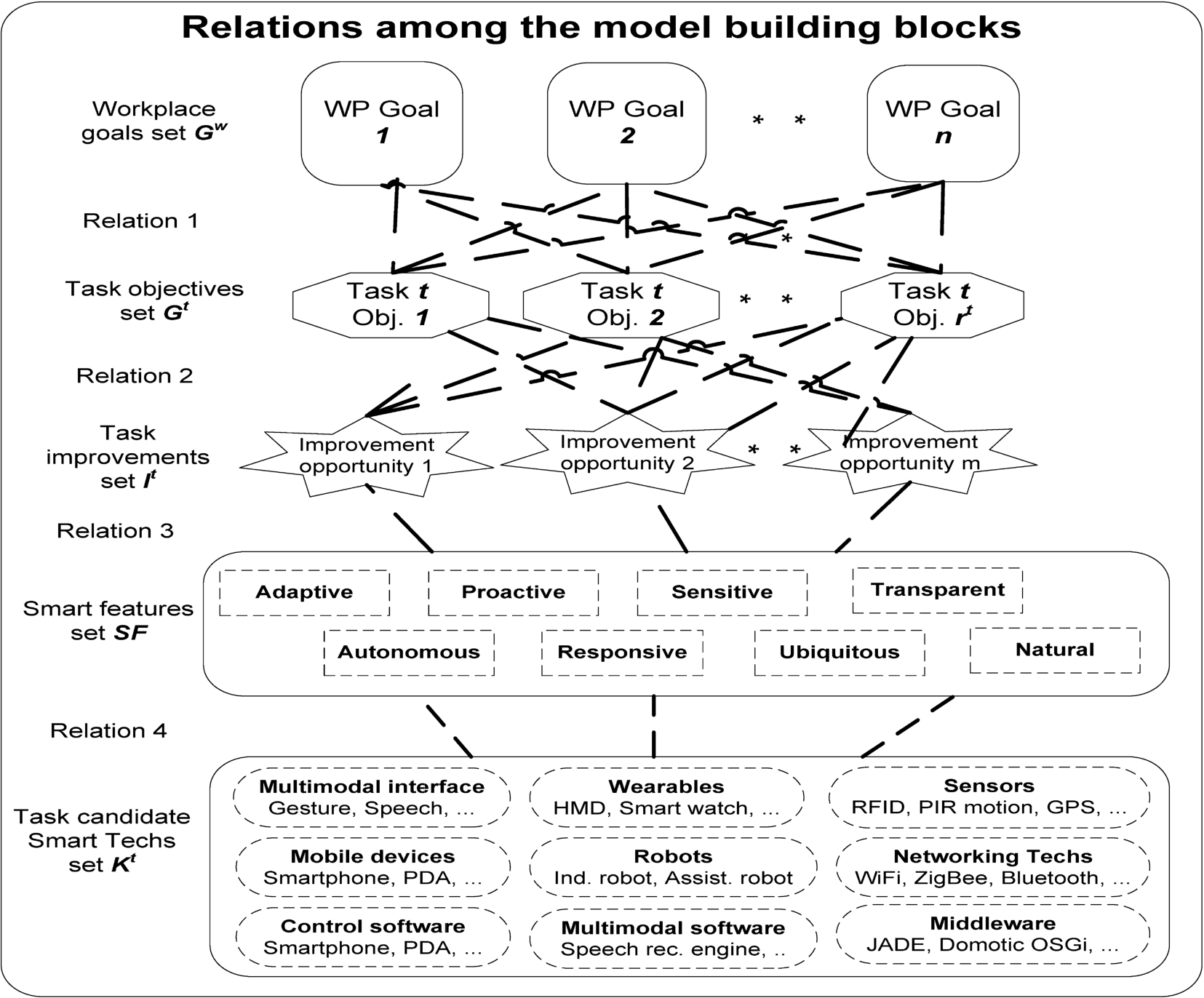
Conceptual relations in smart workplace design model building blocks.
The main notion of the proposed methodology involves quantifying the effect relationship that expresses the degree of positive influence of the smart enabling technologies on the defined overall goals of the workplace. This effect relationship will be expressed as a fuzzy relation matrix to accommodate vagueness due to subjectivity and inexactness. The overall effect relationship will be attained through composing the intermediate relations that link the other sets (sets of task objectives, improvement opportunities and smart characteristics) with the sets of smart enabling technologies and overall workplace goals.
In this section, we review fuzzy relations that will be utilized to express the relationships among the five defined sets (i.e., the building blocks) of the smart workplace design model. In addition, we explain the use of the Max–Min composition operator that will be utilized to compose the relations to attain expression of indirect relationship between two sets through their mutual relations to an intermediate set. Then, we will introduce and explain the linguistic scale to be used to assign fuzzy relation membership values to express the positive effect value among the elements of each relation between every two sets. Thereafter, we explain the hierarchical decomposition of the four relations to attain the target overall relationship between the smart enabling technologies and the overall workplace goals.
Fuzzy relations
In 1965, L.A. Zadeh [88] introduced the concept of fuzzy set theory. Fuzzy sets are a means of representing and manipulating data that are not precise but rather are fuzzy. Fuzzy set theory is an extension of classical set theory. A logic that is based on the fuzzy set theory is called a fuzzy logic.
In classical set theory, a subset A of a set X can be defined by its characteristic function
In fuzzy set theory, an element x can partially belong to a set A, expressed by a degree of membership
The value zero is used to represent complete non-membership, the value one is used to represent complete membership, and values in between are used to represent intermediate degrees of membership.
A relation mathematically describes a situation in which certain elements of sets are somehow linked (i.e., related) to one another. Fuzzy relations have been widely used in many fields such as fuzzy clustering, fuzzy control and uncertainty reasoning. They are very useful and playing important roles in diagnosis and modelling under ambiguous circumstances. Fuzzy relations generalize the concept of relations in the same manner as fuzzy sets generalize the fundamental idea of sets. It is important to distinguish between crisp and fuzzy relations:
– Crisp relation: Let
– Fuzzy relation: Let
The value 1 means complete membership of pair
A fuzzy relation R is conveniently presented in the form of a two-dimensional
A fuzzy relation between elements of two sets can have different meanings. For example, fuzzy relations include “x is very close to y”, “Approximately equal”, and “x is considerable smaller than y”. In this research methodology, the assessed fuzzy relation between the model sets’ elements is “Positively affects”. This type of fuzzy relation represents four relations among the five sets of the model, because we wish to quantify the positive influence (if it exists) among set elements to use this quantification as a guide in designing the smart workplace.
Quantifying fuzzy relations membership values
The construction of fuzzy relation matrices that quantify relations among the described five model sets requires a unified numerical scale to assign relation membership values among set elements. Such a scale will be more understandable and usable by the design team when numerical magnitudes of membership values have corresponding meaningful linguistic values. Therefore, to simplify the assignment of membership values for each pair relation, the experts or decision analysts in the design project team can utilize a corresponding linguistic value for a defined membership value scale (see Table 4).
Defined scale for relation membership values
Defined scale for relation membership values
Threshold of Significant Positive Effect (TSPI).
Here, the membership value of the relation “Positively affect” is graded from 0 up to one. Negative and neutral effects are considered equal to zero and are expressed linguistically as “Never”. We are only interested in knowing the positive effect relations for the smart enabling technologies on the overall workplace goals. Thus, the expert can quantify the relation membership value through assigning quantitative values to relations between each two elements of any two related sets, as defined in linguistic scale Table 4.
To make a final reliable decision concerning adoption of the most positively affecting smart technologies to be implemented on each task, one should also adopt a definite threshold for a positive effect relation to be considered significantly decisive and justifiable. Accordingly, we assign the threshold of Significant Positive Effect (PE) to “Highly” (H). Therefore, all relations’ membership values will be considered significantly positive effects if they are not less than 0.75.
The Max–Min composition operator [86–88] is used to combine two fuzzy relations between three sets of elements to obtain derived composed relations between the two indirectly related sets. The underpinning technique of this research is to utilize this Max–Min operator to successively compose intermediate relations between the overall workplace goals set and the smart enabling technologies set. The operator is formally defined as follows:
Let X, Y, and Z be universal sets, and let R and Q be relations that relate elements from X to Y and from Y to Z, respectively, i.e.,
Then, S will be a relation that relates elements in X that R contains to the elements in Z that Q contains, i.e.,
Max–Min composition is then defined as
In the proposed research methodology, we utilize the Max–Min composition of fuzzy relations between overall workplace goals and the smart enabling technologies.
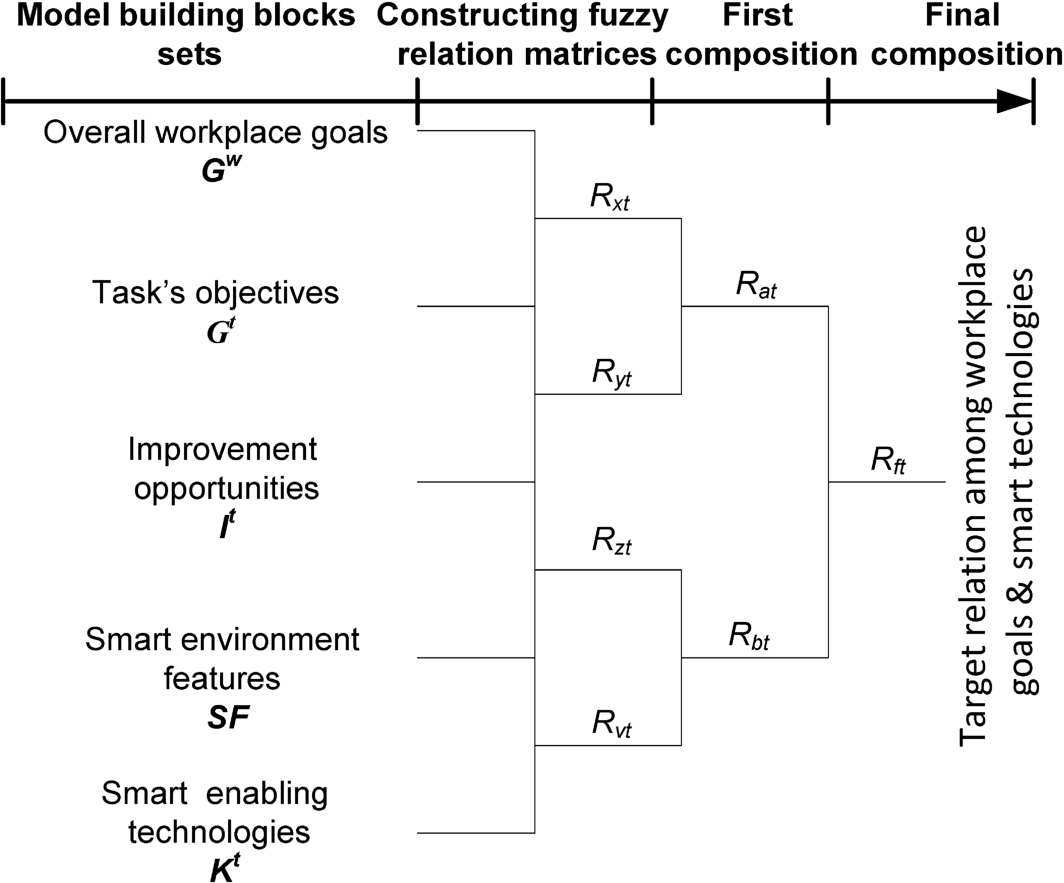
Hierarchical compositions of fuzzy relations to attain the target overall workplace goals – smart technology relation.
In the proposed model of the methodology, we have defined five sets that constitute the model building blocks. Consequently, we can investigate four successively positive effect relations among these five defined sets. They are as follows:
Relation 1: Overall workplace goals set (
Relation 2: Task objectives set (
Relation 3: Improvement opportunities set (
Relation 4: Smart environment feature set (
Every relation is expressed as a fuzzy relation matrix of the positive effect among the elements of the two sets. Because there is no direct relation between the overall workplace goal sets and the smart enabling technologies set, we employ the Max–Min composition operator to successively compose for each task the above four relations to attain the target final fuzzy relation matrix between the overall workplace goals set and the smart enabling set. The final target fuzzy relation enables identifying the promising, positively goal-affecting technologies to be used as a guide for designing the smart workplace (see Fig. 2).
Mathematically, the four fuzzy matrices among the five sets and the hierarchically composed matrices are defined as follows:
Let
The index for workplace tasks,
Fuzzy relation matrix between the set of overall workplace goals and
Fuzzy relation matrix between the
Fuzzy relation matrix between
Fuzzy relation matrix between the set of smart environment characteristics and the
Max–Min composition of
Max–Min composition of
Max–Min composition of
All Max–Min compositions are performed according to equations from 6 through 9. Figure 2 depicts the hierarchical compositions of the four fuzzy relation matrices, which are performed hierarchically for the four fuzzy relations to acquire knowledge of the positive effect relation between overall workplace goals and the given task smart enabling technologies.
The proposed methodology logically starts with analysing workplace tasks, defining the workplace overall goals and task objectives. Then, the candidate and relevant smart enabling technologies for each task are listed. Next, smart environment characteristics identified in Section 2 are listed, and their relationship to the smart enabling technologies and improvement opportunities will be investigated. Then, the set of logical improvement opportunities for each task is brainstormed and elicited for each workplace task. This process creates five sets among which four relations exist. This creation is followed by construction of the fuzzy relations matrices expressing the positive effect magnitudes among these model building-block sets. The next step is to apply the Max–Min composition operator to compose the constructed fuzzy relations to attain overall or combined resulting relations among the model building blocks set. The threshold of positive effect relations is used to judge the significance of each relation and would be interpreted to adopt the most effective, enabling smart technology.
A multi-disciplinary team consisting of workplace engineers or workers, together with smart environment experts and decision analysts, should conduct the procedure of the methodology.
The methodology is depicted in Fig. 3, and its steps are explained in detail as follows:
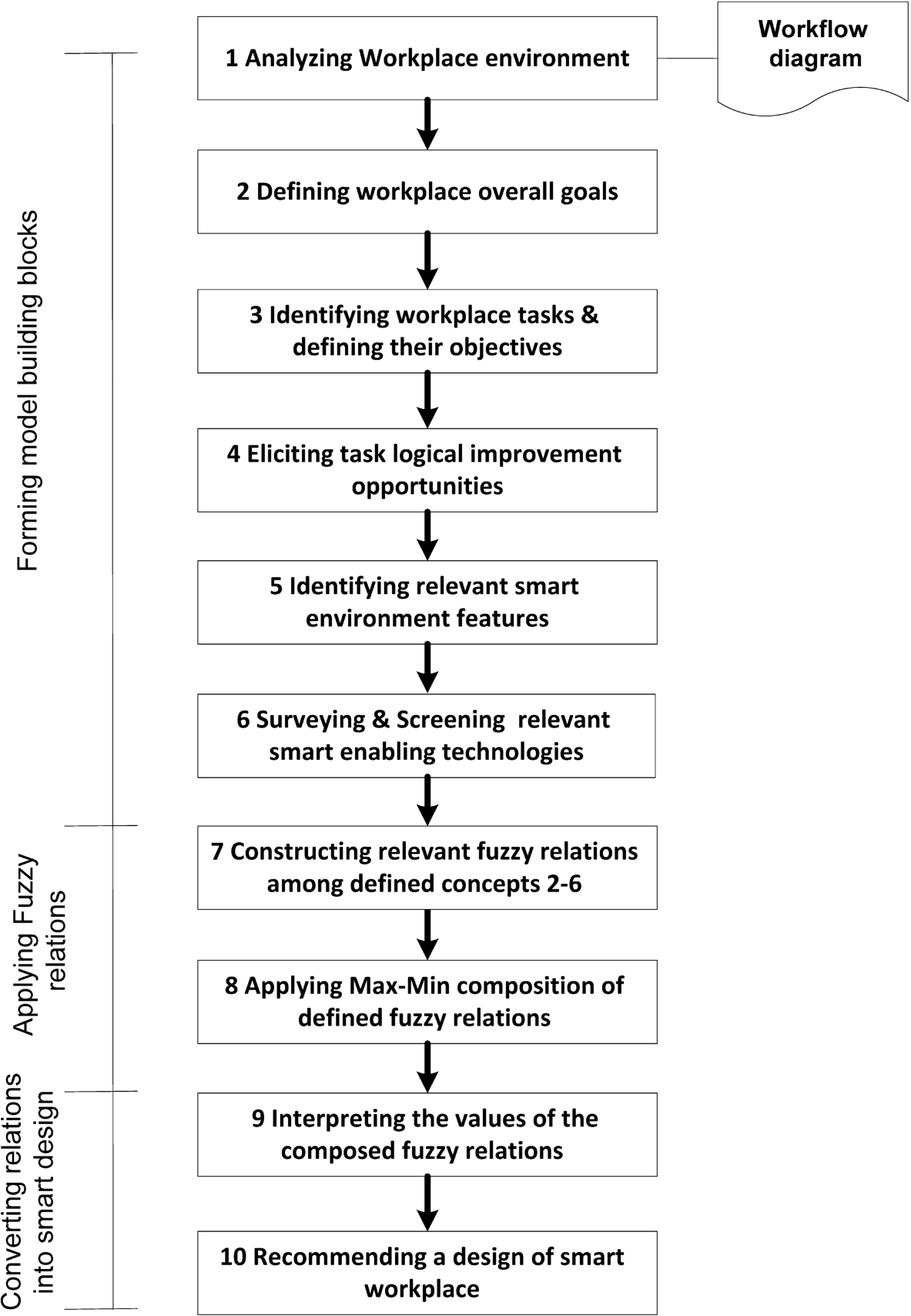
The smart workplace design methodology.
Step 1: The components, tasks and functions of the workplace environment are studied. A physical model and workflow diagram can be used for documenting the analysis of the workplace. A workflow diagram visualizes how tasks will flow between resources (i.e., machines or people) and what conditions allow the workflow sequence to move forward. Workflow can be illustrated or described with a flowchart, or it can be depicted through real-life objects using graphics.
Step 2: The overall goal(s) of the workplace are defined and stated in this step by the workplace engineers. The result is the set of overall workplace goals,
Note that workplace goals might not have equal priorities or weights. In such cases, multi-criterion decision-making techniques such as the Analytical Hierarchy Process [69] can be used to determine goal weights and to help solve the conflict. In the case of different weights, the smart technologies positively affecting the highest priority goals should consequently receive the highest implementation priorities. In the case of a goals conflict, trade-off and compromising solutions are possible guided with estimated weights. However, in this article, our focus is on the proposed methodology, which primarily aims to determine the positive effect of the smart enabling technologies on each workplace goal. The same applies for task objectives.
Step 3: Based on studying the workflow prepared in step 1, tasks are identified, and their objectives are clearly stated by the workplace engineers. The result is the set of
Step 4: The logical improvement opportunities pertaining to every task are brainstormed or elicited by the team participants and are listed for every task as a set of meaningful improvement options or chances, without reference to particular smart hardware or software enabling technologies. The result is the set of improvement opportunities for the
Step 5: In our model, we adopt the identified 8 smart characteristics consisting of the set
Step 6: The smart-workplace-design project team should review the capabilities of various state-of-the-art smart enabling technologies with respect to each task and screen them to identify a set of relevant technologies for a given task under consideration to undergo more-detailed investigation. An intuitive and logical method for screening based on expert judgment will be used. However, screening techniques, particularly the fuzzy screening approach by Yager [86], can be used efficiently to determine an initial set of smart enabling technologies relevant to tasks. Because of space limitations, we focus on demonstrating the complete design methodology. The result is the set of candidate, relevant, smart enabling technologies for the
Step 7: Given five defined sets,
Step 8: Given four constructed fuzzy relations among the five sets of the model building blocks, we now apply the Max–Min composition operator hierarchically as explained in the previous section and Fig. 2.
Step 9: Apply the positive effect threshold to pinpoint the most significantly affecting smart enabling technologies on the workplace goals. Now, the goal-satisfying technologies are revealed and adopted for each investigated
Step 10: The interpreted final fuzzy matrices between workplace goals and smart technologies are be translated into a physical goals-based smart workplace design, which could be expressed through actually demonstrating deployment of the most effective technologies on each task work station or zone.
The above was a systematic description of the proposed methodology enabling a goal-based smart workplace design. The Section 4 includes an illustrative example in which we demonstrate an application of the proposed methodology, and we show how to guide the decision process.
In this example, we demonstrate the application of the proposed methodology to show how to guide the decision to adopt and invest in the smart enabling technologies for each workplace task and to attain a goal-based smart workplace design.
Given a manufacturing centre composed from the following objects as an instance of a typical workplace for one worker in the manufacturing environment (see Fig. 4):
Computer Numerical Control (CNC) machining centre that conducts metal cutting processes for incoming work parts.
A computer that controls the cutting tool movement through a CNC part programme.
Input Mobile Shelf, containing incoming work parts downstream.
Output Mobile Shelf, receiving processed work parts coming off the machining centre.
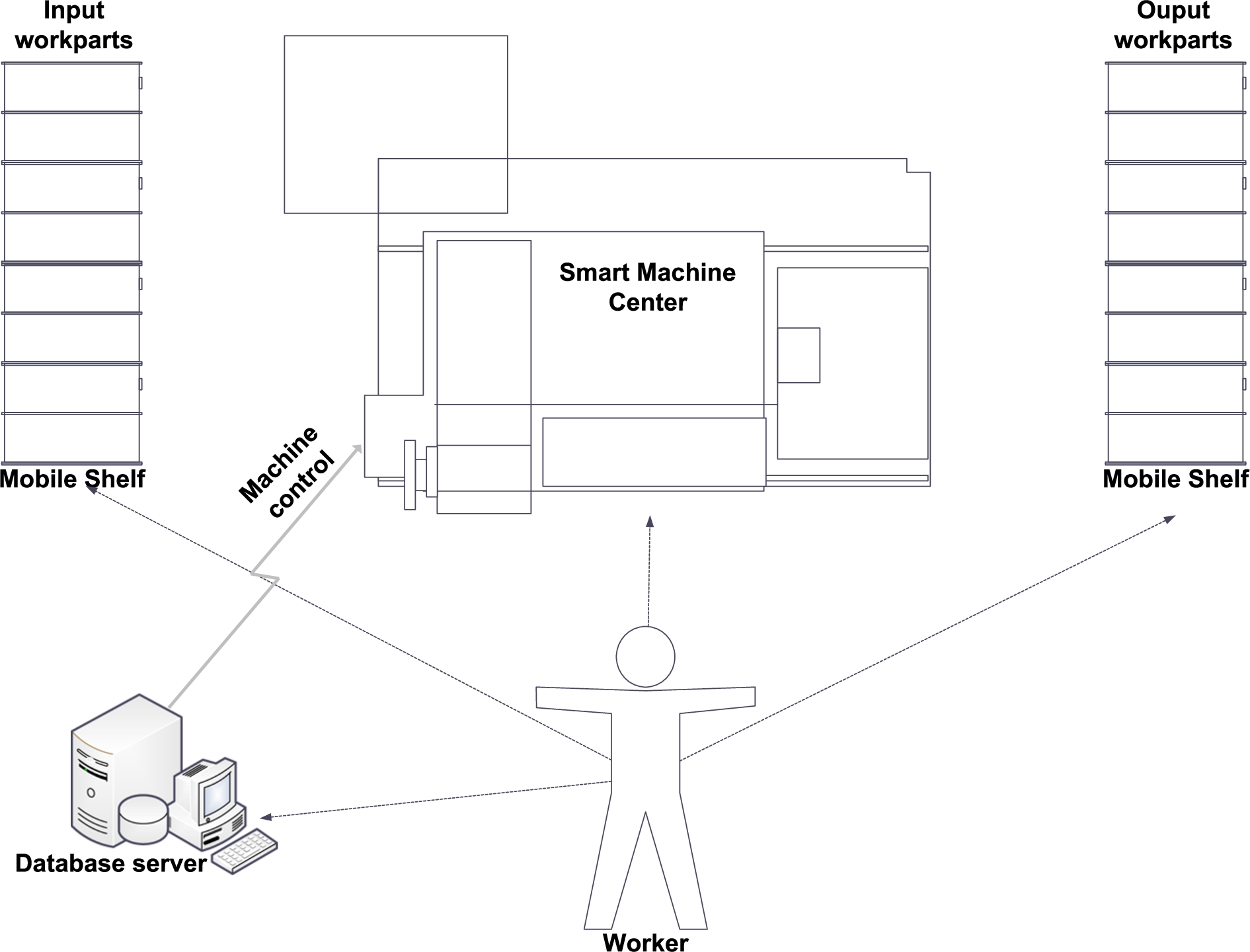
Manufacturing workplace including machining centre for metal cutting of work parts.
The proposed methodology is applied as follows:
Step 1 (Workflow analysis): the analysis of the machining centre workflow is depicted in the flowchart in Fig. 5. As the flow chart indicates, at the beginning, a new work part is loaded onto the machine if the machine is empty. If the work part has a different or new design, a machine setup is needed; a CNC part programme is loaded to the computer. Then, the machine is switched on to start processing or manufacture. When the processing finishes, the work part should be unloaded to the output mobile shelf. If there remains no new work part waiting at the input shelf, then the machine is switched off.
Step 2 (Defining workplace goals): suppose the workplace engineer, worker or supervisor has identified two workplace goals:
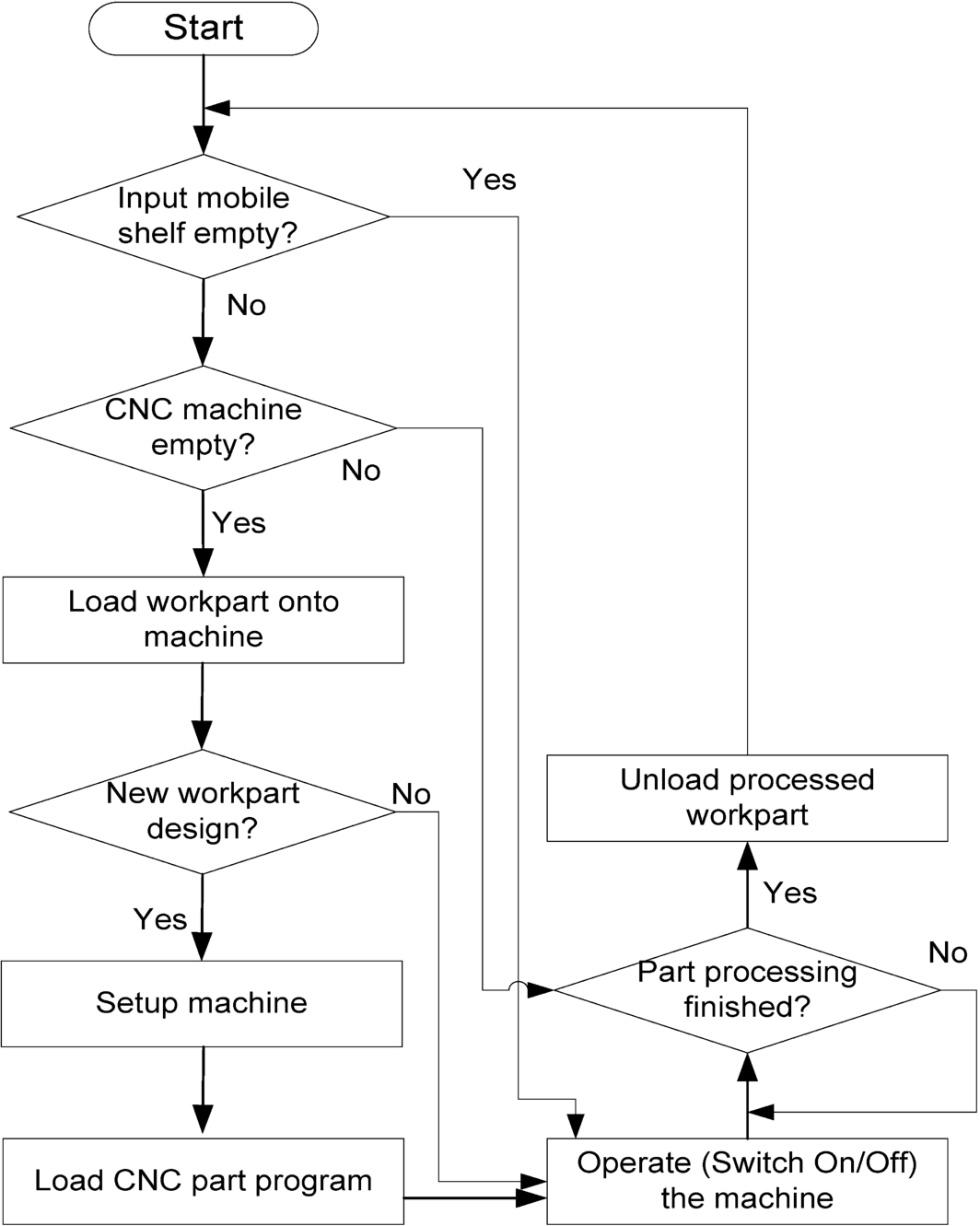
Flowchart depicting workflow in the machining centre.
Step 3 (Identifying workplace tasks and task objectives): based on the analysis of the workflow, the following five tasks (
Loading work part onto the machine: loading work part from the mobile shelf onto the machine is another non-value adding task; thus, its time should be minimized.
Operating the CNC machine (switching on/off): the performance of this task is repeatable, and the minimization of the CNC machine operation and shutdown is desirable.
Machine setup: a type of non-value-added activity involving manual worker activity to fix and adjust the work part on the machine head. The activity is therefore undesirable and should be minimized. In addition, worker safety is significant in this task activity.
Loading CNC part programme: this task is performed to load the CNC part programme to the computer control that will direct the cutting tool to cut the required profile within the work part. Again, this activity is a non-value adding task type; its main goal should be to minimize the average CNC programme loading time.
Unloading processed work part: unloading work part onto the output shelf is an activity that also is non-value adding; thus, its time also should be minimized.
Task objectives are also defined by the participating workplace engineer, worker and supervisor. Suppose that task objectives are as follows:
Task #1 (Loading work part onto the machine) (
Task #2 (Operating the CNC machine) (
Task #3 (Machine setup) (
Task #4 (Loading CNC part programme) (
Task #5 (Unloading processed work part) (
Step 4 (Eliciting improvement opportunities): In this step, logical improvement opportunities are brainstormed by a smart workplace design team (without reference to specific smart technologies). Suppose that for each of the five tasks the following improvement opportunities have been identified:
Task #1 (Loading work part onto the machine) (
Task #2 (Operating the CNC machine) (
Task #3 (Machine setup) (
Task #4 (Loading CNC part programme) (
Task #5 (Unloading processed work part) (
Step 5 (Identifying relevant smart environment characteristics): In this step, suppose the workplace engineers, decision analysts and smart environment experts have considered all smart environment characteristics from the set
Step 6 (Screening smart enabling technologies): In this step, the surveyed smart enabling technologies are screened to identify the initially relevant set of candidate smart enabling technologies for each task. This screening can be achieved through investigating the elicited task potential improvement opportunities, task description and objectives. Suppose that the participating smart environment expert, decision analysts and workplace engineers have identified the following sets of candidate smart enabling technologies for each task as relevant to the task’s improvement opportunities and work context, with associated justification:
Task #1 (Loading work part onto the machine) (
Rationale for initial technologies nomination task 1:
The RFID tag attached to work parts together with deployed RFID readers, including placing them at the mobile shelf, can be used to detect arrival of work parts with information about locations in the mobile shelf, in addition to processing information. It also enables monitoring of the shelf status.
The industrial robot could substitute for the worker in manipulating the work part onto the machine head, with improved speed and accuracy.
The wireless LAN is necessary for enabling electronic communication between RFID readers and Central computer. ZigBee is widely utilized, performs efficiently and is license free.
The smartphone by the worker could be used to receive the exact location of each work part on the mobile shelf to accelerate the loading task and enable computer integration.
Task #2 (Operating the CNC machine) (
Rationale for initial technologies nomination task 2:
The machine centre could be equipped with a speech recognition interface to enable worker direct speech command to switch the machine on/off.
As an alternative to the machine speech-recognition interface, the worker can send speech commands to a central computer to be processed via a speech-recognition-engine agent, which in turn directs the central computer to switch the machine on/off.
The worker can use the smartphone control agent to communicate and to switch the machine on/off directly.
The wireless LAN (ZigBee) is necessary for enabling electronic communication between the Central computer and machine.
Task #3 (Machine setup) (
Rationale for initial technologies nomination task 3:
The industrial manipulating robot can accelerate the work part adjustment in the machine fixture, which also contributes to minimizing setup time.
The RFID tagging for work parts will enable processing their information by an intelligent sequencing agent to enable efficient or optimal sequencing to minimize changeover or number of setups needed.
The intelligent sequencing agent will enable efficient sequencing to minimize changeover or number of setups needed.
The video camera could be used to monitor the work-part-fixing action to detect hazardous anomalies and to enhance worker safety. An image processing technique can provide analysis of video images captured.
The worker smartphone can receive the minimum setup processing sequences by the central computer via wireless LAN.
The wireless LAN is necessary for enabling electronic communication between RFID readers, Central computer and the worker smartphone.
Task #4 (Loading CNC part programme) (
Rationale for initial technologies nomination task 4:
The RFID tag attached to work parts together with deployed RFID readers enable detection of work part arrivals.
The intelligent sequencing agent is responsible for sequencing work parts for minimum changeover in setup and CNC programme changes and for automatic programme loading and retrieval.
The wireless LAN (ZigBee) is necessary for enabling electronic communication between the Central computer, RFID readers and the machine.
Task #5 (Unloading work part) (
Rationale for initial technologies nomination task 5:
The RFID tag attached to work parts together with deployed RFID readers including placing them at the mobile shelf can be used to enable tracking finished processing of work parts.
The industrial robot could substitute for the worker in manipulating the work part from the machine onto the output mobile shelf to accelerate the task and enable computer integration.
The Pressure sensor will detect information on occupied and empty locations on the output shelf and send them to the central computer.
The worker’s smartphone can receive the map of output shelf empty locations from the central computer.
The wireless LAN (ZigBee) is necessary for enabling electronic communication between the Central computer, RFID readers, pressure sensor, smartphone and the machine.
Step 7 (Constructing fuzzy relation matrices): now, having identified all sets’ elements of the model building blocks, the next step is to construct four relation matrices as explained in Section 3. The participating decision analyst or the expert uses the positive effect relation membership scale in Table 4 to assign the memberships values of all 4 relation matrices (see Fig. 2).
Because of limited space, we present hereinafter only details of the computational steps of fuzzy relations assignment and compositions performed for task #1. However, we also present the finally composed Smart enabling technologies – workplace goals relation matrices of other tasks.
Constructing Fuzzy relations matrices for task #1 (Loading Work part onto the machine): The decision analyst and the smart enabling technologies expert could participate in assigning positive effect relation membership using the scale defined in Table 4. Suppose that the judgments and assignments on the four fuzzy relations were as follows:
Here, for instance, the decision analyst believes that the first task objective
The above relation expresses the positive effect relation membership for the elicited improvement opportunities on the task objectives goals.
The above matrix quantifies the positive effect of the smart environment characteristics on each of the elicited improvement opportunities for task 1.
The magnitudes of the positive effect relation for the candidate smart enabling technologies for tasks 1 on the smart environment are assigned in the matrix above.
Step 8: Applying Max–Min composition of the defined fuzzy relations: In this section, we utilize the Max–Min composition operator (Equation (9)) to compose the assessed fuzzy positive effect relations to obtain the target overall relation among workplace goals and the smart enabling technologies. We detail the computations of task #1 as follows:
Max–Min composition of a relation among workplace goals and improvement opportunities:
Max–Min composition of the relation among improvement opportunities and smart enabling technologies:
Max–Min composition of the final target relation among the workplace goals and the smart enabling technologies:
The above matrix provides an expression of the overall positive effect relation among the overall workplace goals and smart enabling technologies. The other final relations for the other tasks are as follows:
Step 9: Analysis and interpretation of the results: Examining the obtained final fuzzy relation matrices and based on the Threshold of Significant Positive Effect (TSPE), we can interpret the attained results. This interpretation can be done for each task as follows:
Task #1: The final relation for positive effect of the smart enabling technologies on the workplace goal has indicated that the following technologies satisfied the established threshold (TSPE):
The above technologies are judged to “Extremely” positively affect the realization of the first workplace goal. However, the Industrial robot technology (
Task #2: The final relation for positive effect of the smart enabling technologies on the workplace goal has indicated that all of the candidate smart technologies have been revealed to “Extremely” satisfy the established threshold (TSPE) for the two workplace goals:
Task #3: The final relation for positive effect of the smart enabling technologies on the workplace goal indicates that the following technologies satisfy the established threshold (TSPE) for the two workplace goals:
However, the Industrial robot technology (
Task #4: The final relation for positive effect of the smart enabling technologies on the workplace goal has indicated that the following technologies satisfy the established threshold (TSPE):
The above technologies are judged to have an “Extremely” positive effect on the realization of the first workplace goal and to have a “Highly” positive effect on the second workplace goal.
Task #5: The final relation for positive effect of the smart enabling technologies on the workplace goal has indicated that the following technologies satisfy the established threshold (TSPE) for only the first workplace goal:
However, the Industrial robot technology (
The above-mentioned smart enabling technologies, which attained significant effect relations to the workplace goals, are deemed the promising smart enabling technologies that should be adopted in the final design of the smart workplace.
Step 10: Recommending a smart workplace design: Now, the consolidated design of the smart workplace can be realized through deploying the promising smart enabling technologies that realized the TSPE on the workplace goals. These promising technologies can be deployed in the workplace as follows:
An RFID tag will be attached to every work part to enable tracking the mobile shelf locations and processing information. Two RFID readers will be deployed at the input mobile shelf to enable detection and identification of arrivals and departures of the work parts. Communication between the readers and central computer will be via wireless LAN (ZigBee).
The Smartphone will be used by the worker to receive the exact location of each work part on the mobile shelf to accelerate the loading task. The worker can use the smartphone control agent to monitor and switch the machine on/off. Additionally, the worker smartphone can receive the minimum setups processing sequence of work parts from the central computer via Wireless LAN. Moreover, the worker’s smartphone can receive a map of output shelf empty locations from the central computer sent from pressure sensors deployed in the output shelf.
An intelligent sequencing agent residing at the central computer will receive the processing information from the RFID reader via Wireless LAN and will enable efficient sequencing to minimize changeover or number of setups needed.
The video camera will be used to monitor the work part setup (fixing) action to detect hazardous anomalies to enhance worker safety. An image processing technique can provide analysis of video images captured.
Pressure sensors can be attached under the input and output mobile shelf to track empty/full statuses and to communicate them to the central computer.
The machine centre could be equipped with a Speech recognition interface to enable worker direct speech commands to switch the machine on/off. Alternatively, and more easily, the worker can send speech commands to the central computer via a Speech recognition engine agent, which in turn directs the central computer to switch the machine on/off.
The Wireless LAN (ZigBee) is a necessary backbone of the proposed design for enabling electronic communication between the central computer, RFID readers, smartphone, pressure sensors and the machine.
The example does not really eliminate other technologies from consideration. In practice, there could be many other goals such as for example: manufacture quality products, save energy during manufacture, minimise cost of production, reduce wear and tear on machinery, make better products than the competition, etc. The illustrative example should serve as a workable simplification of a more complex problem.
We proposed a methodology that structures conceptual relationships among workplace overall goals and task goals together with the smart enabling technologies and their embodied smart characteristics. The proposed methodology combines assessment and design in one paradigm that enables treating ill-structuredness, subjectivity and inexactness of the smart environment design problem.
The merit of the proposed methodology over our previous research attempts lies in enhanced objectivity, more in-depth detailed workplace and task analysis, consideration of overall goals and task objectives and their relationships and adding improvement opportunities as a logical connecting loop between goals and technologies. This loop contributes to enhancing the understandability, comprehensiveness, structuredness and logic of the proposed methodology. All of these aspects lead to a more realistic goal-based smart workplace design.
In the proposed methodology, we have presented the fundamental building blocks of the underpinning model and the conceptual relationships among them. We also presented the procedural steps of the proposed methodology for designing a goal-based workplace. However, such a design is not a mechanical process. The presented fundamental building blocks are typical but rather general concepts. Experts with a good knowledge of the specific application domain must judge and match them to that application domain. They must identify and select those specific components of the model that are appropriate for the given workplace and evaluate their relationships. For instance, the goals of one workplace can be oriented to increased productivity, whereas the goal of another workplace is safety; or the wireless network would be appropriate in a noiseless environment in contrast to a noisy environment with electrical interference, where the wired network would be preferred. The proposed methodology has no ambition to become a universal detailed manual encompassing all specific workplaces because each of them is unique in some sense. However, this methodology can be a framework and a powerful instrument in the hands of smart environment experts or decision analysts.
Future studies can consider other important factors such as the average cost of these smart enabling technologies and the optimization of conflicting goals. Employing the methodology in various actual settings will bring deeper experience about its cost effectivness or easiness to implement. This remains an open question to be investigated in the future.
More significantly, the proposed methodology could be generalized to develop a systematic methodology for designing smart environments. The methodology could be augmented with additional modelling tools to visualize the smart design based on the outcome of the proposed methodology.
Footnotes
Acknowledgements
This study was supported by the project DEPIES – Decision Processes in Intelligent Environments, funded by the Czech Science Foundation, Czech Republic.