






Abstract
Dynamic, networked service-oriented systems, like those found in manufacturing, logistics or transportation, require efficient communication of capabilities of their services to enable on-the-fly integrations as a result of changing requirements. Previously, in a case of a manufacturing services network, we have shown the manufacturing service capability (MSC) information communication can be enhanced by introducing a reference MSC ontology – a formal, OWL DL domain-specific ontology. However, consistent and quality development of reference ontology for a large and evolving domain such as manufacturing is a challenge. Therefore, we propose to utilize the notion of OWL ontology design patterns (ODPs) to develop such reference ontology. However, despite the existence of rich design patterns for information modeling in general, there has been no documentation detailing the principles for development of domain-specific ODPs for domain-specific semantic models. This survey paper fills this void by providing a survey and systematic synthesis of applicable principles for domain-specific ODP development in an investigation of the prior works in data modeling, object-oriented software analysis and ontology modeling design patterns. The paper discusses applicability of the revealed principles in regards to requirements of MSC domain-specific ODPs. Although the paper is concerned with the MSC domain, the findings apply to any domain-specific ODP development. Further research is identified to operationalize principles towards domain-specific ODP development.
Keywords
Introduction
Dynamic, networked service-oriented systems, including those found in manufacturing, logistics or transportation, increasingly require efficient communication of their capabilities and on-the-fly integrations as a result of changing requirements. For example, dynamic production networks depend on the efficiency of supply chain assemblies and reconfigurations, which, in turn, depend on the efficient communication of manufacturing service capabilities (MSC) and matchmaking between manufacturing customers’ needs and suppliers’ capabilities. MSC information communication and matchmaking includes information about both quantitative and qualitative properties of the services, such as the ability or capacity of production processes and resources, expertise, certifications or digital information processing ability.
Presently, the communication of MSC information happens on the Web and is based on various proprietary and syntactic MSC vocabularies and folksonomies. The matchmaking between available capabilities of manufacturing service providers and requirements of manufacturing service customers is syntactic- and text-based, and is very limited because of the semantic ambiguities, poor expressivity and cross-integration issues of various proprietary MSC information models and vocabularies (Kulvatunyou et al., 2013).
Semantic enrichment using a reference ontology1
A reference ontology is a shared, formal and computer-interpretable specification of a particular domain conceptualizations (Uschold & Gruninger, 1996).
While OWL DL can provide these benefits, developing a consistent and quality reference ontology in OWL DL remains a challenge, especially for a large and dynamically evolving domain such as manufacturing. However, use of OWL ontology design patterns (ODPs, in short), tailored to specific domain requirements, carries the promise to significantly ease ontology development, evolution and mapping (Kulvatunyou et al., 2015). We expect such ODPs to take form of reusable templates – structural and parameterized forms that modelers instantiate and populate with terms from domain-specific vocabulary. The ODPs would allow capture of recurring contents and structures of the domain information models in a uniform and consistent way.
Design patterns have emerged as engineering artifacts in many engineering disciplines, most notably in software engineering. According to Fowler (1997), “a pattern is an idea that has been useful in one practical context and will probably be useful in others”. Or, according to Gamma et al. (1995), “a design pattern systematically names, motivates, and explains a general design that addresses a recurring design problem … it describes the problem, the solution, when to apply the solution, and its consequences”. Because of the enormous success of design patterns in software engineering, researchers began using the idea for ontology engineering and introduced ontology design patterns (ODPs) as “best practice” modeling solution in OWL (W3C, 2005; Aranguren et al., 2008). ODPs can capture foundational and core domain concepts to provide reusable solutions “for solving design problems for the domain classes and properties that populate an ontology” (Gangemi, 2005).
However, despite the existence of rich design patterns, there has been no clear documentation detailing the principles for development of domain-specific design patterns that are tailored to requirements of a specific domain. So far, the efforts of researcher and engineers have been focused on synthesizing collections of design patterns, not on synthesizing and structuring the design pattern development principles. Hence, this survey paper provides a systematic synthesis of applicable principles for domain-specific ODP development and, in addition, discusses the applicability of these principles from the perspective of MSC domain-specific requirements. We survey relevant results across related work areas, including data modeling, object-oriented software analysis information models and ontology-modeling design patterns.2
Design patterns, such as Gamma et al. (1995) patterns, that are concerned with architectural, operational and implementation aspects of software systems are not of interest to this research. Only works in design patterns relevant to information modeling are taken into analysis.
The paper is organized as follows. Section 2 discusses notable semantic modeling challenges that may be mitigated by using domain-specific ODPs. The perspective of the discussion is MSC information modeling specific, but the challenges apply to other domains, too. Then, Section 3 clarifies a notion of ODP and provides a summary of requirements of ODPs for domain-specific information using the MSC information as an example. Section 4 then discusses the state of the art – in particular it provides a survey into relevant results across related work areas, including data modeling, object-oriented software analysis information models and ontology-modeling design patterns, to derive principles for information modeling design patterns development. Here, we introduce a methodological grid based on four dimensions to analyze and discuss the state of the art. The dimensions are: (1) typology, (2) vertical–horizontal variability, (3) design principles and (4) representation of design patterns. Section 5 synthesizes the identified and derived principles to design-pattern development and outlines general principles for development of ODPs for the domain-specific information. Finally, Section 6 provides conclusion and future research directions.
As noted, our approach is to develop a reference MSC ontology where MSC terms and their semantics are formally encoded using OWL – whether as OWL classes, properties or individuals. Let us discuss some of the challenges and related issues that ontology developers may encounter during the semantic modeling of domain-specific information.
First of all, the ontology developer may use alternative solutions for capturing domain knowledge in an ontology using OWL DL. A very simple example of that would be modeling of descriptive features (or, qualities, attributes or modifiers) of things captured as ontology concepts (Rector, 2005). There are at least two approaches for modeling the descriptive features: (#1) as individuals whose enumeration make up the parent class representing the feature; (#2) as disjoint classes which exhaustively partition the parent class representing the feature (Rector, 2005). However, using both approaches to address essentially the same kind of requirement in a particular ontology may end-up in inconsistent design throughout the ontology. The ontology that has the inconsistent design may be problematic for the further evolution, refactoring, and even querying.
Then, the ontology developer may encounter insufficient expressiveness of the OWL DL to naturally capture certain requirements, which then would require workarounds, if even possible. For instance, in OWL, a property is always a binary relation. It links two individuals or an individual and a value. However, there could be cases where an n-ary relation, which links an individual to more than just one individual or value, is more appropriate. N-ary relations are not natively supported in OWL DL; however, there are alternative workarounds such as ones proposed in Hayes and Welty (2006).
Further, the ontology developer doing mapping between different ontologies can produce complex and less manageable mappings, unless ontology design is uniform and consistent within and across the ontologies. For instance, if the above mentioned “features” are modeled using approach (#1), then mappings will refer to instances (e.g., by
In addition, development of a reference ontology for a large and dynamically evolving information domain is not a one-time process. Such reference ontology continues to evolve as new requirements and new knowledge emerge. Therefore, when it comes to the ontology evolution, not carefully managed changes in an ontology may produce hard-to-debug inconsistencies in already captured knowledge, invalid ontology mappings, or a need for a complete remapping. What is needed is an ontology engineering approach where concepts and their relationships are uniformly and consistently designed as ontology requirements evolve over long periods of time.
Use of domain-specific ontology design patterns (ODPs)
An example of a domain-specific ODP
Applying different approaches for modeling essentially the same situation in a specific context and domain may result in heterogeneous domain-specific ontologies that can become unsuitable for mapping, querying, debugging and maintaining. One possible solution to mitigate the issues is to establish an evolving library of domain-specific ODPs, which would be used and strictly adhered to in the reference ontology development. When the same ODPs are applied to different ontologies, the ontologies become more similar in terms of design, comparison and mapping.
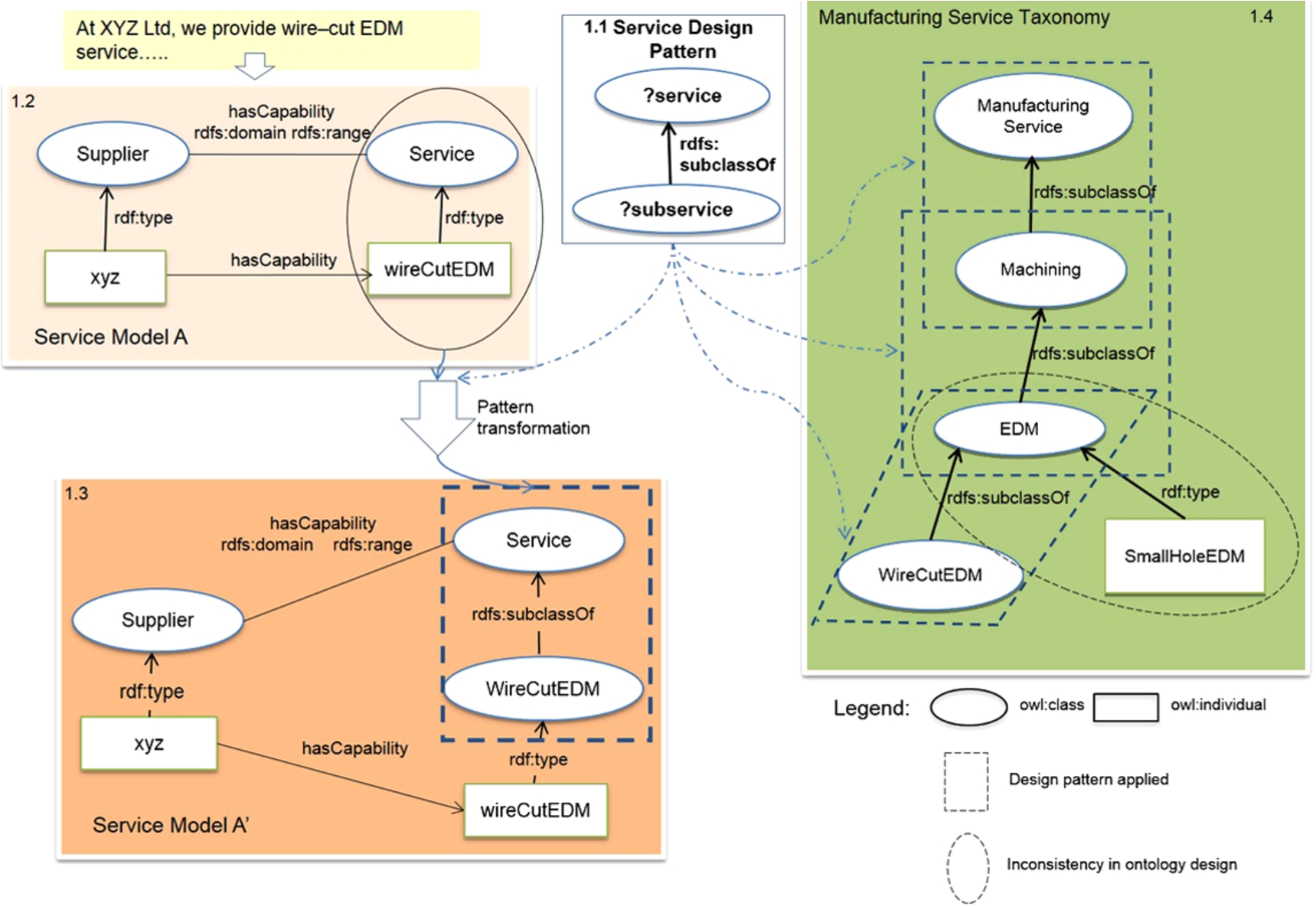
Application of an ODP in semantic modeling of MSC information. (Colors are visible in the online version of the article; http://dx.doi.org/10.3233/AO-150140.)
Figure 1 illustrates the idea of domain-specific ODPs on an example of one hypothetical MSC model and Manufacturing Service taxonomy, which is a backbone of MSC reference ontology. In particular, in rectangle 1.1, the figure shows a Service Design Pattern3
Disclaimer: Service Design Pattern is a hypothetical ODP, for illustration purpose only. It is not proposed here as the best modeling practice to model taxonomy of manufacturing services, but rather to illustrate the idea of domain-specific ODP library and its application for semantic modeling of domain-specific information.
A manufacturing process whereby a desired shape is obtained using electrical discharges (sparks). Source: en.wikipedia.org/wiki/Electrical_discharge_machining.
The manufacturing service taxonomy (rectangle 1.4 of Fig. 1) illustrates the case of three conformant examples of the ODP application and one non-conformant example (
Currently available ODPs are those published at the ODP portal (http://ontologydesignpatterns.org/), which was established under NeOn European FP7 project (Presutti et al., 2008), then ODPs in the Manchester (2009) and W3C (2005) libraries. However, those currently available ODPs are not complete references for designing domain-specific ontologies, and not necessarily adaptable to specific requirements of domain-specific information communication such as MSC information communication.
Obviously, domain-specific ODPs need to be created before the domain-specific ontology development begins. The domain-specific ODPs then may evolve and new ODPs may emerge as the domain expands and the new knowledge to be captured in the ontology emerges. To establish domain-specific ODPs two things are essential: requirements that ODPs have to satisfy and design principles for their development. Below, we provide general requirements that the MSC ODPs have to satisfy, while in Section 5 we discuss possible principles for the development of MSC ODPs for the requirements.
Requirements of domain-specific ODPs may come from three different but complementary sources: the reference ontology requirements (source S1), the information communication requirements (source S2), and the required characteristics of domain-specific ODPs (source S3).
In particular, ontology requirements can be functional or nonfunctional (Gomez-Perez et al., 2003) and ODP requirements coming from the reference ontology can be categorized in a similar way, either as functional or nonfunctional. The functional requirements are intended, content-related uses of the ontology (or, of an ontology design pattern) such as retrieval, inference and validation of domain knowledge or domain information. The nonfunctional requirements are characteristics of the ontology (or, of an ontology design pattern) such as computational efficiency, clarity, reusability, etc.
The functional requirements, whether in case of an ontology or an ODP, can be expressed as competency questions (CQs, for short),5
CQ technique (Gruninger & Fox, 1994) is a way to specify ontology information retrieval requirements as natural or machine-language questions that the ontology must be able to answer. Ontology design pattern-level functional requirements can be specified using the CQ technique as well (Suarez-Figueroa et al., 2012). While some researchers refer to CQs as only questions about concepts (De Nicola et al., 2009), CQs can be about any aspect of ontology (or, ontology design pattern) content including ontology instances.
MSC ODP requirements
Requirements’ source 1 – functional: The functional requirements coming from the reference MSC ontology are retrieval, inference and validation requirements. These requirements may be related either to MSC concepts in the reference ontology, actual MSC descriptions in a model that is linked to the reference ontology, or both. An information-retrieval CQ related to actual MSC descriptions is, “Which suppliers have a Wire EDM Process with capability up to 30-degree taper cuts?” Whereas, an information-retrieval CQ related to a MSC concept would be, “What is the maximum degree taper cut in a wire EDM Process?” Information-retrieval CQs often require inference over the MSC information. For example, “Which suppliers have an EDM Service?” implicitly requires that suppliers having different kinds of EDM services be included in the answer. In Suarez-Figueroa et al. (2012) the authors actually propose explicit specification of reasoning (inference) requirements. Importantly to note is that their notion of competency question requirements is very similar to our notion of the retrieval requirements, if not the same. For example “Which suppliers have an EDM Service and specializations of EDM Service” and “What are the generalization and specializations of a given manufacturing service?” are CQs that more explicitly specify the inference requirement. Finally, CQs oriented to validation ask if MSC ontology contains sufficient and valid axioms to ensure correct and complete definitions of MSC information. Validation requirements can be contextual statements as proposed in Suarez-Figueroa et al. (2012). Figure 2 presents an illustrative set of CQs for a reference MSC ontology.6
It is important to note that there is not an a priori relationship between CQs and design patterns. That is, one or more design pattern(s) might be needed to enable a single CQ. For example, there could be one MSC ontology design pattern for capturing a business party such as supplier, and another one for capturing a manufacturing service such as an EDM service. Then, both these ontology design patterns may be needed to support “Which suppliers have an EDM capability?” CQ. If CQ is “What type of ownership a manufacturer’s business is?” only the MSC ontology design pattern for capturing a business party might be needed. Discussion of how to identify all needed MSC ontology design patterns is out of scope of this paper.
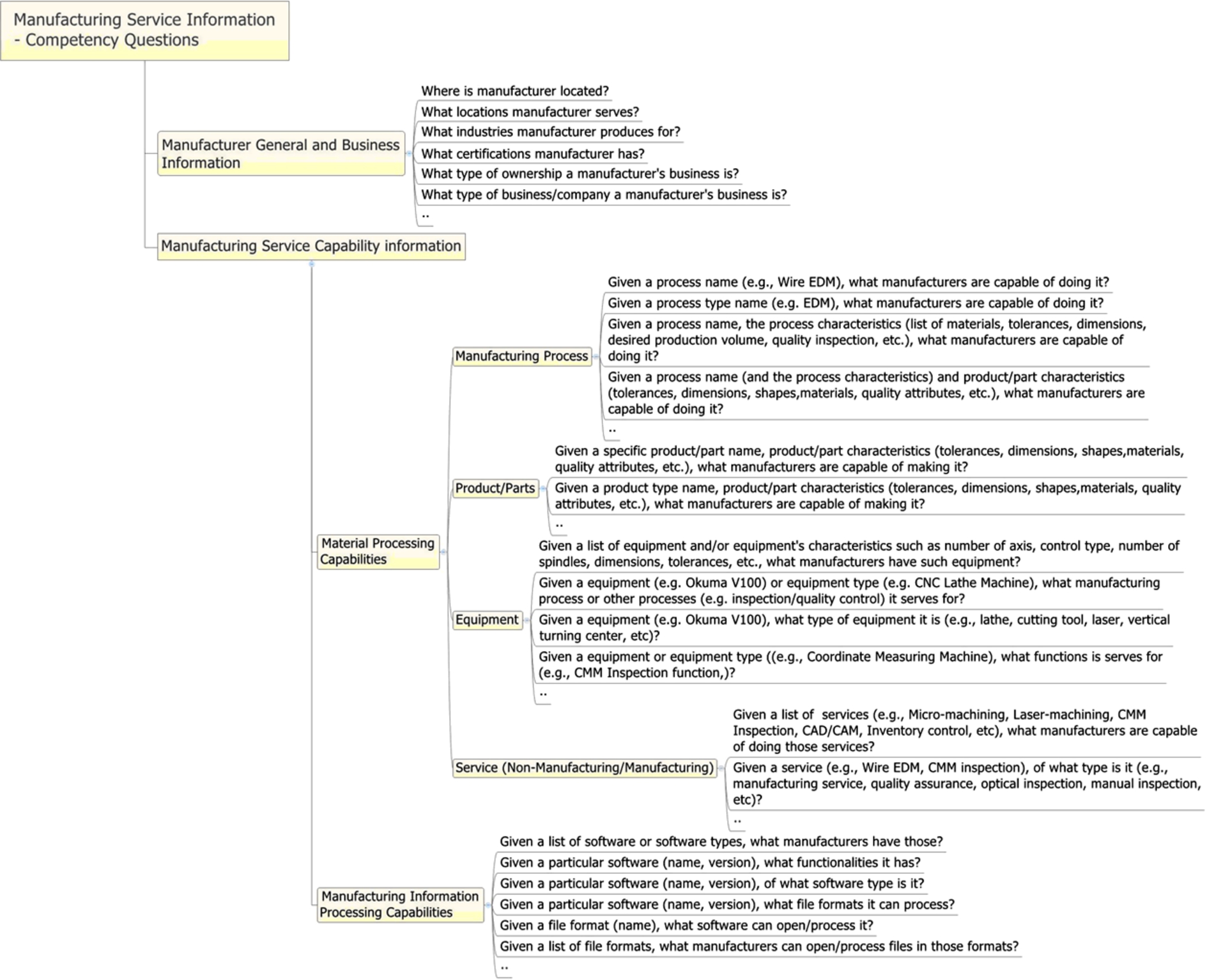
CQs for MSC information. The CQs are grouped around central information concepts in MSC domain (illustrated using a rectangle). (Colors are visible in the online version of the article; http://dx.doi.org/10.3233/AO-150140.)
Requirements’ source 1 – nonfunctional: The nonfunctional requirements coming from the reference MSC ontology include the requirement of uniformity and consistency in MSC ontology design, as pointed out before. This requirement could be described more specifically as a requirement to consistently use established ODPs throughout the reference MSC ontology. Another nonfunctional requirement associated to reference MSC ontology is a computational efficiency on ontology reasoning tasks.
Requirements’ source 2: Successful MSC information communication requires a mapping between proprietary MSC models and the reference MSC ontology. Such mappings achieve reconciliation of naming, structural, and semantic differences in a heterogeneous MSC information sharing environment. An important requirement in the reconciliation is to have computationally efficient and straightforward ontology mappings. A requirement for computational efficiency of ontology reasoning tasks such as MSC information retrieval/inference is also an MSC information communication requirement.
Requirements’ source 3: MSC ODPs have to be reusable in different but essentially the same modeling situation. They have to also be understandable to end-users who use ODPs for modeling, such as ontology developers.
This section is a survey of existing works in design patterns and principles to their development. In particular, the section discusses (1) typology, (2) variability, (3) design principles and (4) representation of design patterns for a variety of information modeling approaches. The typology refers to a classification of design patterns according to their application – whether they are solutions to conceptual, logical or structural models, or just a syntactic sugar. The variability can be vertical or horizontal, as we will explain in Section 4.1.2. Design principles refer to any principle used or proposed for developing design patterns or for identification of design patterns. The representation refers to the current means for documenting design patterns and making them available for end-users. In addition to these four dimensions, a brief discussion of the applicability of existing design patterns to semantic modeling of domain-specific information is given.
Data modeling patterns
Data modeling patterns are reusable data models that can be used “to develop high-quality data models in short amounts of time” (Silverston & Agnew, 2011). They are “profound, recurring modeling fragments that provide a proven solution for some modeling problem” (Blaha, 2010). Note, a data model here means the entity–relationship model introduced in Chen (1976). The data modeling patterns considered here are from Hay (1996), Silverston (2001a), Silverston (2001b), Silverston and Agnew (2011) and Blaha (2010), which we have found to be the most relevant in this field of our interest.
Typology of data modeling patterns
We found three different types of data modeling patterns in the considered literature – logical patterns, physical patterns and structural patterns.
Logical patterns are reusable models that capture domain entities and their relationships, devoid of their physical implementation details. They are called logical because they are patterns for logical data models. On the other side, physical patterns are implementations of logical patterns in a target platform technology; they are parts of physical data model. For one logical pattern, there could be many different corresponding physical patterns depending on target platform, data manipulation and access strategies. For instance, Hay’s patterns are all pure logical patterns, with no concerns of physical implementations, while Silverston’s and Blaha’s patterns encompass both logical and physical aspects. We will mention some of their patterns in Section 4.1.2.
Structural patterns are not concerned with capturing entities’ content, as opposed to the logical and their physical patterns; but rather with the structural organization of the entities. Structural patterns, as those in Silverston and Agnew (2011), are patterns for creating hierarchical relationships, aggregation (sets) of entities, or categories and classification of entities, and graphs. They have a basis in topology and graph theory (Blaha, 2010). For example, Blaha’s ‘Hardcoded Tree’ pattern is a structural pattern for capturing organization of hierarchies whose levels and type sequences do not change frequently over time. Or, the ‘Directed Graph’ pattern for capturing structures such as map of flights between airports, or a collection of equipment in the manufacturing plant (Blaha, 2010). Hay (1996) also provides structural patterns to model hierarchies, classification or categories of entities. The structural patterns can be logical, devoid of actual implementation details, or physical, addressing actual implementation details in a target platform.
Vertical–horizontal variability in data modeling patterns
Based on the terminology in Verelst (2004), we define horizontal and vertical variability of design patterns as follows. Horizontal variability is the possibility of organizing the design patterns into two general groups: universally applicable (or, cross-domain) and domain-specific (e.g. for manufacturing information modeling or health-care information modeling), without having a specialization relation between the universally applicable and domain-specific ones. On another side, the vertical variability is further specialization of the universally-applicable or domain-specific design patterns. E.g. the design patterns for manufacturing information modeling may be specialized into the discrete manufacturing and process manufacturing information modeling patterns. Therefore, the design patterns vertically laid are specializations of the design patterns horizontally laid and, in a more formal way, could be linked to them using the subsumption (is-a) relationship. A domain-specific design pattern may or may not be a vertical variation of a universally-applicable design pattern.
For example, in Hay (1996), universal data modeling patterns are Parties, Organizations or Products; while Structure and Fluid Path, Flow or Process are not specializations of the universal patterns but rather specific patterns for process manufacturing industry. Those patterns are horizontally laid. Many of Hay’s data modeling patterns capturing universal concepts (e.g. Party), can be specialized into subtypes (e.g., Employee), which can be viewed as their vertical variability and patterns at a lower level of generalization.
Similarly to Hay’s, Silverston’s patterns also span from universal to domain-specific. Silverston’s universal data modeling patterns are similar to Hay’s (e.g., Parties, Products, Parts or Product Category). Silverston (2001b) provides domain-specific data modeling patterns for data models for discrete manufacturing. For instance, Part Substitution, Inventory Item Configuration, Production Runs or Production Run Types. Silverston also provides for capturing both universal concepts (e.g. Party) and their vertical specializations (e.g., ShipToParty, ShipFromParty specialization of Party). In Silverston and Agnew (2011), the authors provided highly generalized data modeling patterns, such as Declarative Role or Contextual Role, which provide for modeling of any entity roles.
Blaha’s (2010) patterns are also at different levels of generalization. For example, his Item-ItemDescription is a pattern highly generalized to provide models that capture data of some item and that item description, regardless of what the item is. For example, Aircraft with ‘tailNumber’ attribute, is an item, and AircraftDescription with attributes ‘manufacturer’ and ‘models’, is the item description. Blaha’s patterns, which he calls archetypes, are all universal and generalized data concepts. The archetypes may be applied or specialized for particular domains. For instance, the archetypes are Actor, Address, Position, Product or Part. Additionally to the archetypes, Blaha introduces “canonical model patterns” as ready-to-use complete data models for specific purposes.
Design principles for data modeling patterns
The preceding data modeling patterns are empirically grounded, which means derived from the accumulated practical experience in resolving recurring data modeling tasks. Their design and development principles are not clearly documented; however, by analyzing their documentation, we derived several pattern design principles, as discussed next.
A model size principle (DP1)7
DP stands for a derived principle. We assign to each derived design principle a unique id to enhance their traceability between this and next section of the paper.
A normalization principle (DP2) that asks for certain normalization form of data modeling patterns. One of the earliest such normalization forms, the Third Normal Form (3NF), was developed in Codd (1972) for relational databases’ schemas. 3NF principle is very specific to the relation database modeling and its application ensures referential integrity in the database and no data duplication. In short, 3NF suggest that the non-primary attributes of a database table should be dependent on the primary key only, and that every non-primary attribute of the table should be dependent on the whole of a primary key when the primary key consists of two or more attributes. In Silverston (2001a), the author argued that data modeling patterns should also be developed with the normalization principle in mind, by applying 3NF normalization. In this same paper, the author describes an important related principle, called a no-derive attribute principle (DP3). This associated principle keeps data model patterns devoid of attributes that can be derived from other attributes. Importantly, the normalization does not necessarily apply to physical data model patterns since these patterns may be de-normalized to meet performances in accessing and updating the data. Logical data model patterns are typically normalized into 3NF.
A generalization principle (DP4) that seems to be a prominent design principle for generalized data modeling patterns in Silverston and Agnew (2011). This principle recognizes that wide variety of information requirements can be captured in the same data structure. Sometimes this principle is called an abstraction (DP5). Specifically, Blaha (2010) pointed out an applicability and abstraction as characteristic of his archetypes. The archetypes are universally applicable concepts, not domain-specific concepts. Certainly, the wider applicability implies higher abstraction in data modeling patterns.
The DP1–DP5 principles address mainly the functional aspects of design patterns, and so, determine the conceptual coverage of a data modeling pattern.
Further, Blaha highlights several anti-patterns that should be avoided in data modeling for relational databases. Those anti-patterns include symmetric relationships, ambiguous naming and descriptions of entities, disconnected-isolated entities/properties or multiple inheritances. Blaha’s avoidance of anti-patterns principle (DP6) can be seen as a general principle where each specific anti-pattern recommendation is a specific principle in patterns design.
On the other side, nonfunctional requirements are determined with operational aspects such as physical implementation concerns, computational performance or maintainability of data modeling patterns. Depending on specific nonfunctional requirements specific we found out that techniques such as indexing policies, de-normalization of tables, or table partitioning strategies, are typically applied. For physical data model patterns, the invariability of a database schema to additional, new, logical entities may be a requirement, which can be met by a generic table structure for storage of a variety of entities. So, such observation may be interpreted also as the generalization principles. The intended purpose of data can determine the design of patterns. For example, if data are going to be used for analytical purposes, physical data model patterns should provide for that purpose. An example of such a pattern is a STAR schema (Silverston, 2001a) that binds data to different analytical dimensions. This may be a design principle formulated as – adhere to a structure designed to meet required operational aspects (DP7).
Data modeling patterns are frequently represented using graphical diagrams and textual descriptions. Hay and Silverston used Case*Method (Barker, 1990) data modeling notation. Blaha used both UML (Unified Modeling Language) and IDEF1X (Integration Definition for Information Modeling) notations. Additionally to the graphical representation, Silverston provided computer-processable representations of his patterns via SQL scripts to allow their use and adoption for building the data or database models. For example, one can use SQL representation of data modeling patterns and utilize them by importing scripts into CASE tool for adoption and further refinement. Case*Method, UML or IDEF1X notation suffice for logical data model patterns. However, SQL representation is necessary for physical data model patterns. That is because UML and IDEF1X to SQL mapping might not be one-to-one. Hence, additional implementation concerns need to be considered when using data modeling patterns captured in UML or IDEF1X.
Applicability to semantic modeling of the domain-specific information
Data modeling patterns are design patterns provided primarily for design of E-R (relational database) models. Those patterns contain details such as primary keys, foreign keys, alternative keys and associative entities for capturing many-to-many relationships between entities. Having such details, it is questionable if those design patterns can provide for reference ontology development, even if available in OWL representation. Relational models and OWL ontologies are significantly different since OWL ontologies can capture both the content and semantics of entities.
Assuming the data modeling patterns translated into OWL, they could serve as some starting, but likely distant, point in capturing semantics of domain-specific information. For instance, Hay’s Geographic Location pattern encompassing party and location entities, if implemented in OWL, may provide for ‘Where is manufacturer located?’ or ‘What locations a manufacturer serves?’, in a case of MSC domain. Composition of Blaha’s Actor and Location patterns could provide for that purpose as well. Terminologically, there are many matching concepts in the data modeling patterns to concepts in MSC domain. For instance, Part, Product, Product Category, Location, Unit of Measure, Measure, Process, Condition, Asset/Equipment Type, Material or Material Type. But many concepts might be missing.
Certainly, additional effort would be needed to re-design the data modeling patterns from relational database viewpoint to OWL DL perspective. In particular, Blomqvist (2010) has developed several ODPs by translating some of Hay’s and Silverston’s patterns into OWL DL. A one-to-one translation approach was applied where an entity/property in a data model pattern was mapped to a concept/property in OWL. Then, patterns were reviewed with help of domain experts and updated where necessary since the patterns inherently assumed a data modeling paradigm not easily translatable into the DL paradigm (Blomqvist, 2010). Nevertheless, even if potentially applicable data modeling patterns are provided in OWL DL form, their further adaptation (e.g., specialization, extension, simplification) would be needed to meet the domain-specific information requirements.
Software analysis model patterns
In general, software development patterns are a means to enhance software quality, flexibility and maintainability, and to reduce development time. Different types of software development patterns are proposed for different phases of software development process. Software analysis patterns support the software analysis phase that is concerned with development of application-specific conceptual models such as object-oriented domain models. Software design patterns, such as Gamma et al. (1995) design patterns, support the software design phase that is concerned with architectural, operational and implementation aspects of software systems. Implementation patterns, as particular programming language idioms, support the low-level software coding. In particular, our interest is in software analysis (object-oriented) model patterns. Software analysis patterns or analysis model patterns, are “groups of concepts that represent a common structure in modeling” (Fowler, 1997) that can be used to build software analysis models, which are in fact information models, but object-oriented. Software design patterns and software implementation patterns are not applicable for information or conceptual modeling, hence, excluded from the further discussion. Software analysis model patterns taken here into the discussion are from Coad (1992), Fowler (1997) and Arlow and Neustadt (2004), which we have found to be the most representative in this field of our interest.
Typology of software analysis model patterns
The analysis patterns proposed in Coad (1992), Fowler (1997) and Arlow and Neustadt (2004) are of similar nature to the data modeling patterns, which we discussed in Section 4.1, in the sense that they provide also for the essentially the same purpose, which is information or conceptual modeling. Therefore, we identified conceptual analysis model patterns and structural analysis model patterns as two different types of software analysis model patterns.
Specifically, conceptual analysis model patterns, such as Fowler’s or Arlow’s Party, or Coad’s Item-ItemDescription pattern, provide for capturing business concepts and their properties. Structural analysis model patterns provide for structural organization of data, such as hierarchical organization, or n-ary relationships (e.g. Fowler’s Organization Hierarchy pattern, Arlow’s N-ary relationship).
Conceptual analysis model patterns and structural analysis model patterns are of similar purpose and scope to the logical data model patterns and structural data modeling patterns, respectively. However, they differ in a modeling paradigm. Data modeling patterns are influenced by the relational modeling paradigm, while software analysis patterns are influenced by the object-oriented modeling paradigm.
We note that Arlow and Neustadt (2004) have introduced archetypes and archetype patterns as software analysis patterns. According to Arlow and Neustadt, an archetype is defined as “a primordial thing or circumstance that recurs consistently and is thought to be a single universal concept”. An archetype pattern is explained as collaboration between archetypes that occurs consistently and universally in business contexts. For instance, their Party archetype pattern is a composition of several archetypes including Party, Organization and Address archetypes. An archetype pattern notion is essentially the same as software analysis pattern notion, with the difference that archetype patterns are always concerned with Arlow and Neustadt’s archetypical concepts.
Vertical–horizontal variability in software analysis model patterns
Similarly to data modeling patterns, software analysis patterns may vary vertically and horizontally. For instance, Fowler’s (1997) analysis patterns are organized by domains where patterns emerged from domains such as Accountability, Observation and Measurements, Inventory and Accounting, Planning, and Trading. This organization does not imply that all the Fowler’s patterns are domain-specific. Some are universally applicable (e.g., Party, Organization, Observation, Measurement, Atomic Unit, Compound Unit), while others are applicable to particular domains only (e.g., Accounts, Transactions or Balance Sheet for an accounting domain). Fowler provides a number of specializations of his universally-applicable patterns. Examples include observations and measurements specialized for corporate finances.
Archetypes and archetype patterns in Arlow and Neustadt (2004) capture universal business concepts such as Party, Organization, Address, Money, Order, Product, Communication, Responsibility or Product Catalog archetypes/patterns. There are domain-specific archetype patterns such as Customer Relationship Management archetype pattern. According to Arlow and Neustadt (2004), their archetypes and archetype patterns may be specialized or extended to adapt to specific context. For example, EmailAddress or GeographicAddress archetypes are specializations of Address archetype. Hence, the vertical–horizontal variability is very often present in the collection of software analysis patterns.
Notably, software analysis patterns are often abstractions. As such, they can capture abstract concepts that have no real-world counterparts. For instance, Coad’s Item-ItemDescription analysis pattern is an abstraction of things that share the same description (metadata). Structural software analysis patterns are generally abstractions of structural concepts.
Design principles for software analysis model patterns
To the best of our knowledge, the analyzed object-oriented software analysis model patterns are also empirically grounded. That is, they are not provided within a structured methodology having an explicit set of pattern design principles. Similarly to data modeling patterns, conceptual coverage of software analysis model patterns reveals supported functional requirements. Software analysis patterns in Coad (1992), Fowler (1997) and Arlow and Neustadt (2004) seem unconcerned with run-time and implementation requirements such as operational performance or memory storage requirements, which are of great concern to data modeling patterns.
In particular, Coad (1992) does not provide design principles for his patterns explicitly. Rather, he emphasizes the reoccurrence as the main characteristic of his patterns. Coad points out that a pattern is a recurring structure of classes and objects that applies again and again in different object-oriented analysis and design efforts. Coad’s observation is that patterns in object-oriented analysis may be found by identifying recurring structures in software analysis models and observing those lowest-level building components and their relationships to establish higher-level components for their further reusability in modeling. The reoccurrence is more a pattern identification principle, than a pattern design principle. However, to us, it could be considered as a design principle if paraphrased into a rule saying that patterns should encompass only the concepts that reoccur in a particular domain or across domains and attributes of those concepts as well as relationships between the concepts (DP8).
Next, according to Fowler, the software analysis model patterns are discovered “by looking at what happens in day-to-day development, rather than by academic invention”. However, from Fowler’s work we derived two design principles. He suggests that software analysis model patterns should be the simplest model possible, devoid of any flexibility if flexibility is unlikely to be utilized (DP9). This principle can be called as a minimal conceptual coverage or minimal model size (same as the DP1). In particular to the model size, all Fowler’s analysis patterns encompass more than single concept, but no more than a few concepts (DP10). Another of Fowler’s suggestions is a sufficient abstraction of a pattern (DP11), to provide for applicability of patterns in different contexts. These two Fowler principles come as no surprise as aimed to patterns which serve as only a starting point in modeling.
In Arlow and Neustadt (2004), the authors argued that there are four essential characteristics of the business archetypes and archetype patterns as software analysis model patterns: (1) universality – consistent occurrence in business domains and systems, (2) pervasiveness – occurrence in both the business and software domain, (3) deep history – a long time existence and (4) self-evidence to domain experts. For us, these four characteristics reveal a design principle saying particularly that patterns should capture universal, recurring concept in some domain (DP12). The universal and recurring concepts in some domain are naturally self-evident to the domain experts, so we do not consider the ‘self-evidence’ as an additional principle, but as intrinsic to the DP12 principle. The pervasiveness, to us, should be contemplated as the pattern design principle. Further, Arlow and Neustadt emphasize the principle of variation (DP13) in archetypes. This means that archetypes have invariant and variant parts, which allow them to achieve applicability in different contexts that may require different models of the same thing. Arlow and Neustadt incorporated the convergent engineering approach (Taylor, 1995) in creation of archetype patterns. This approach proposes business modeling by means of object-oriented modeling to ease conversion of business models into object-oriented software systems. In the convergent engineering, business modeling begins with the identification of business elements and their subclasses and ends by establishing relationships between business elements to capture how they work together. According to Arlow and Neustadt, archetypes and archetype patterns are identified from practical experience or informal domain knowledge, and built by generalizing recurring concepts in existing software analysis models (DP14). Therefore, Arlow and Neustadt also use the generalization as a pattern design principle.
Several characteristics of software patterns are summarized in Winn and Calder (2002) and we contemplate them as possible candidates for design principles. First, a characteristic that underpins all others is that a software pattern is generative. This means that it can have a number of concrete and different instances. Further, a software pattern (c1) implies an artifact, which means that patterns are building components for software models, (c2) bridges many levels of abstraction, from concrete to abstract artifacts, to provide for ease of problem understanding and problem solving, (c3) is both functional and nonfunctional,8
Nonfunctional here do not necessarily encompass technical or implementation aspect, but rather a general discussion of pattern’s pros-cons that could help for the adoption or adaption of that pattern in different contexts.
Although patterns for the software design phase such as those offered by Gamma et al. (1995) are not our primary interest, it is worth mentioning principles for their design. A profound requirement in software design patterns is a reusable and flexible design of software implementations. In the object-oriented programming paradigm, the reusability and flexibility is achieved by applying the encapsulation abstraction, inheritance, delegation of responsibilities by object compositions, and polymorphism principles. Software design patterns for object-oriented software are results of applying those principles. The encapsulation (DP17) and again abstraction are principle applicable to software analysis patterns as well.
Software analysis model patterns are also represented graphically and textually. For the object-oriented analysis model patterns, naturally, object-oriented notations are used. Coad (1992) used his own graphical notation to represent object-oriented analysis model patterns. Fowler (1997) used Martin’s and Odell’s (1994) notation for object-oriented models but later switched to UML. Arlow and Neustadt (2004) used UML9
UML is the de facto standard graphical modeling language for representing software patterns (www.uml.org).
Computer-processable representations of the software analysis model patterns we investigated are not provided, to the best of our knowledge. However, Arlow and Neustadt proposed a component-based modeling approach based on the MDA (Model Driven Architecture) to use their archetypes and archetype patterns as parameterized and reconfigurable components for conceptual modeling. By following MDA principles, business archetypes and archetype patterns should be captured as models in UML, and serializable into XML Metadata Interchange (XMI) format to allow their use in different UML modeling tools. Using UML tools, the parameterized components can be further re-configured by adding new details, excluding optional elements, and combining components together into more comprehensive models. Then they may be instantiated in two ways – isomorphic or homomorphic – by defining MDA-based model-to-model transformations. An isomorphic instantiation creates one class for each archetype, while homomorphic instantiation creates more than one class for each archetype. Arlow and Neustadt define this feature as a pleomorphism, which is an adaptation of an archetype pattern into different forms that meet different specific requirements. More importantly, a pleomorph always adheres to the semantics of its base archetype pattern. A base archetype pattern describes the common semantics across all its pleomorphs.
As stated earlier, discussion of applicability of the software development patterns for semantic modeling of domain-specific information such as MSC information makes sense only for the software analysis model patterns. For the software analysis model patterns, their representation in an ontology language such as OWL DL is needed if we want to use them for semantic modeling of domain-specific information. However, even if provided in OWL DL, their further adaption could be needed to meet specific requirements of a specific domains, such as the requirements from Table 1 in case of the MSC domain. Only a few of the software analysis patterns could be adapted to capture some of the MSC information, assuming their OWL representation. For instance, Fowler’s Unit, Quantity, Measurement and Observation patterns in OWL representation could provide for ‘What is the hole diameter size?’ or ‘What is the hole diameter size tolerance?’ or ‘What are typical production runs?’ CQs. Possibly applicable are patterns from Arlow and Neustadt (2004) library for capturing measure units, quantities (measurements), and general concepts such as party, address, organization, product or product catalog.
Ontology design patterns
Ontology design patterns (ODP, for short) are reusable “modeling solutions that encode best modeling practices” for recurring ontology design problems (Suarez-Figueroa et al., 2012). “ODPs are ready-made modeling solutions for creating and maintaining ontologies; they help in creating rich and rigorous ontologies with less effort” (Manchester ODP Library, 2009). ODPs for OWL ontologies started to emerge practically as soon as OWL gained wider interest. Currently, there are few libraries of OWL ODPs: The W3C Semantic Web Best Practices and Deployment Working Group ODPs (W3C, 2005); The Manchester ODP Library (2009) built on work in Aranguren et al. (2008); and the ODP Portal (http://ontologydesignpatterns.org/) built upon results from NeOn European FP7 project (Presutti et al., 2008).
Prior to ODPs, the Semantic Patterns (Staab et al., 2001) for modeling on Semantic Web were introduced. The semantic patterns such as Locally inverse relation, Part-whole or Local range restrictions from Staab et al. (2001) are commonalities of different semantic modeling languages for Semantic Web. In other words, the semantic patterns are a means to communicate machine-processable semantic structures at an epistemological level of representation to provide for their reusability across different Semantic Web ontology languages. Similar to ODPs is Knowledge Patterns work (Clark et al., 2000) and the Reusable Components (Clark & Porter, 1997), which are explained below.
Typology of ontology design patterns
According to the ODP classification provided in Suarez-Figueroa et al. (2012) and Presutti et al. (2008), ODPs can be grouped into six different types, each addressing different aspects in ontology development. The Structural and Content ODPs are among those types of most interest to the ontology design, hence, to our discussion.
Structural and Content ODPs
Structural ODPs include Logical and Architectural ODPs. According to Suarez-Figueroa et al. (2012), Logical ODPs are compositions of logical constructs of an ontology language. They are useful in solving certain design problems when the ontology language does not directly support certain logical constructs. For instance, N-ary Relationship ODP is a Logical ODP for capturing n-ary relations using OWL, which allows only binary properties. Architectural ODPs are compositions of Logical ODPs and define the overall shape of an ontology such as taxonomical organization.10
Blomqvist (2010) in her ODP typology propose Architectural patterns too, in addition to Application, Design and Syntactic patterns. That typology is focused on the applicable levels of granularity of patterns with respect to the levels of structural abstraction of ontology.
A design pattern signature is a graph representation of the design pattern with nodes and edges either named or not. A signature is a non-empty signature when all nodes and edges in the graph representation of design pattern are named; otherwise, a signature is an empty, when none of the nodes and edges are named, or a partly-empty signature when some of nodes or edges are left unnamed.
Content, sometimes called Conceptual, ODPs are ontology components that capture foundational, core, or domain-specific concepts and their features. As such, they can provide ready-to-use and reusable ontology components for modeling and capturing ontology content. Content ODPs are explicitly bound to a vocabulary for a specific or universal domain. Their signature is non-empty. For example, Place ODP, PeriodicInterval ODP or Person ODP from the ODP Portal are typical examples of a Content ODP. Content ODPs may be instantiations of Logical ODPs or a composition of other Content ODPs. The idea of Content ODPs was introduced first in Gangemi (2005). Content ODPs are currently provided in the ODP Portal only.
Other four types of ODPs
Besides Structural and Content ODPs, there are four other types of ODPs: Correspondence, Reasoning, Presentation and Lexico-syntactic. These types are of lesser importance to our discussion. Correspondence ODPs include Re-engineering and Alignment ODPs. The former provides solutions for transformation of relation database or XML schemas into ontologies; the latter provides solutions for creating semantic associations between ontologies. Reasoning ODPs, such as Normalization ODP in Manchester ODP Library (2009), can potentially enhance reasoning tasks. Presentation ODPs propose naming conventions for ontology elements to enhance usability and readability of the ontology from a human perspective. Lexico-syntactic ODPs or Syntactic patterns in Blomqvist (2010), are patterns of linguistic structures that are automatically translatable into corresponding ontology elements. In particular, Lexico-syntactic and Re-engineering ODPs are not of interest to requirements in semantic modeling of MSC information. Reasoning ODPs are defined as common reasoning tasks such as classification and inference, not as reusable components for capturing ontology content. Presentation ODPs are important from a human perspective, but not essential either for achieving the consistency in ontology design or simplifying ontology development activities. Alignment ODPs are not design patterns for capturing ontology content, but rather mapping constructs for mapping between two or more ontologies.
Knowledge patterns vs. ODPs
Knowledge Patterns from Clark et al. (2000) and Reusable Components from Clark and Porter (1997) are predecessors of Content and Structural ODPs. The Component Library (CLIB) introduced by Clark and Porter (1997) is a library of generalized Reusable Components that capture foundational concepts that can be used to construct knowledge-based systems. According to Clark and Porter, a Reusable Component “encapsulates a coherent system of concepts and their relationships”. It can be composed with other reusable components and instantiated by binding its signature to objects in the target domain. A Knowledge Pattern (Clark et al., 2000) is a template that one can populate using a specific domain vocabulary and instantiate it into axioms representing a certain theory. In conclusion, Knowledge Pattern and Reusable Component notions are similar to the ODP notions, with the difference in formal representation. Reusable Components are implemented in a language called KM (Eilerts, 1994).
Content ODPs also may vary both vertically and horizontally. For instance, the ODP Portal provides both universally applicable and domain-specific Content ODPs. In fact, the ODP Portal organizes Content ODPs according to the domain applicability. For example, Transition ODP, which represents basic knowledge about transitions, that include events, states, processes and objects, is assigned to the manufacturing domain. In the portal, some of Content ODPs are vertical specializations and extensions of universally applicable or domain-specific Content ODPs. For instance, Person ODP is specialization of Agent ODP. Specialization means specializing some of the ODP elements, either classes or attributes. Any Content ODP can be further adapted and specialized to any specific context if needed. There are no restrictions in their use. In Gangemi (2005), the Content ODPs are classified into foundational and core ODPs, depending whether a Content ODP captures a foundational (universal) or a core (domain) concept. Structural ODPs, including Logical ODPs, in the analyzed libraries are all abstractions, devoid of any specific domain vocabulary; hence, universally applicable and with no vertical specialization.
Design principles for ODPs
According to Blomqvist (2009), there are at least two different approaches for constructing ODPs.
The first approach is to extract ODPs from existing ontologies or similar sources such as legacy libraries of reusable components. In fact, many of Content ODPs published in the ODP Portal are extracted from the DOLCE (Masolo et al., 2004) foundational ontology. In Gangemi and Chaudhri (2009), the authors reported the creation of Content ODPs by translating CLIB components into OWL representations. Blomqvist (2010) reported on the creation of Content ODPs by translating the software analysis patterns from Fowler (1997) and data modeling patterns from Hay (1996) and Silverston (2001a) into OWL DL representations.
The second approach is to develop principles of good design and construct ODPs that reflect them. This approach is of interest to our research. Currently, such good design principles do not exist (Hammar, 2011b). Below, we provide ODP design criteria and characteristics that we extracted from the following papers: Clark and Porter (1997), Clark et al. (2000), Aranguren (2005), Gangemi (2005), D’Antonio et al. (2007), Presutti et al. (2008), Blomqvist (2010), Hammar (2011a) and Hammar (2014). We have considered those criteria and characteristics as possible principles for the ODP design and development. Let us highlight the main findings.
In Clark and Porter (1997) and Clark et al. (2000), the authors had characterized the Reusable Components and Knowledge Patterns as highly abstract theories (the abstraction principle – DP18), which capture a small number of concepts (DP19). In D’Antonio et al. (2007), the OPAL ontology design patterns are also characterized as abstraction (DP20) and, thus, provided as parameterized templates (DP21). Certainly, the abstraction, as we have discussed before for data modeling and software analysis patterns, may be adopted to be an ODP design principle. It means that an ODP captures a concept that is super-categorical for all subordinate concepts. The number of concepts, or the size of the model, is also selected before as the design principle, and may be adopted to be an ODP design principle too.
In Aranguren (2005), ODPs, or more specifically, Manchester’s Logical ODPs, are also characterized as abstractions that hide OWL DL complexity (DP22) and provide for efficient reasoning. Each Manchester’s Logical ODP encompasses a few number of abstract concepts and structural–logical relationships; however, precise guide or quantification of the number of encompassed concepts is not given in Aranguren (2005). Hiding OWL complexity may also be an ODP design principle, although a very generalized one, while the efficient reasoning is more a requirement.
Presutti et al. (2008) summarized characteristics of Content ODPs as follows (c1) requirements covering components, (c2) computational component, (c3) small, autonomous components for better diagrammatical visualization, (c4) hierarchical components based on specialization or generalization, (c5) cognitively relevant components that are intuitive and compact, catching relevant, “core” notions of a domain, (c6) linguistically relevant components that match linguistic patterns called frames from repositories such as FrameNet,12
(c7) reasoning relevant components that allow some form of inference and (c8) best practices components based on reusability in actual situations. Only some of these characteristics we considered as ODP design principles. In particular, the characteristic (c3) “small, autonomous” (DP23) and (c5) “intuitive and compact … catching relevant, core notions” (DP24) indicate a design principle regarding the size and conceptual coverage of the ODP. The (c4) “hierarchical” characteristic is a general principle that emphasizes the vertical–horizontal variability of an ODP. For us, the rest of them (the characteristics (c1), (c2), (c6), (c7) and (c8)) more tell about what the Content ODP is, than how to be designed or developed.In addition to these characteristics, the authors also discuss anti-pattern characteristics that describe what a Content ODP should not be. For example, Content ODPs should not be a single isolated class or list of unrelated classes. They also should not be a single property with neither range nor domain defined, or list of such properties. The anti-pattern characteristics may be adopted to be ODP design principles (we refer to all them using id DP25), as there are very precise in saying what should be avoided in an ODP implementation. OWL representation pitfalls summarized in Rector et al. (2005), such as absence of “closure axiom” to close off the possibility of further additions for a given property, are similar and can be contemplated as anti-pattern recommendations as well.
In Gangemi (2005), intuitive and compact visualization of Content ODP is pointed out as an essential ODP design principle. A Content ODP “requires a critical size, so that its diagrammatical visualization is aesthetically acceptable and easily memorizable” (DP26).
In Blomqvist (2010), the author mentioned that granularity, sometimes called conceptual coverage should be such that the ODP encompasses only concepts which are needed for one specific modeling problem, but with a small number of concepts so that all aspects can be visualized at the same time. We adapt this as a design principle (DP27). The author goes on to say that an ODP follows OWL modeling best practices such as specifying inverse properties, adding comments, applying naming conventions – also this statement can be considered as a ODP design principle (DP28).
In Hammar (2011a), the author describes results of his work in developing a quality model for evaluating ODPs and emphasizes criteria including understandability, modifiability, minimal size, feasibility, completeness, expandability, performance, testability, ease of applicability, and documentation availability. The mentioned criteria are very general and as such they represent ODP requirements more than design principles to ODP development. From this work, we only take out a minimal size while at the same time being feasible complete ODP design principle (DP29), as which we already derived in works in data model and software analysis model patterns.
Finally, Hammar (2014) recently studied effects of ODP design decisions on reasoning performances. From the literature review, Hammar in his work (2014) has identified several performance-affecting indicators, grouped into language expressivity profile indicators, inheritance hierarchy structural indicators, and indicators related to the logical axioms employed in an ontology. Upon the experimentations with effects that indicators may have on the reasoning performances, he provided several recommendations to the ODP design: (1) avoid the use of multi-parent classes (DP30); (2) limit the number of property domain and range definitions to the minimum required by the ODP requirements (DP31); (3) use appropriate OWL 2 profiles to enhance performances (DP32); (4) avoid designs that give a high count of ingoing/ongoing edges per node (DP33); (5) limit the use of class restrictions, such as enumerations, property restrictions, intersections, unions, or complements to the minimum required by the ODP requirements (DP34); (6) avoid developing ODPs that cause a deep subsumption hierarchy (DP35); (7) limit the use of existential quantication axioms to the minimum required by the ODP requirements (DP36); (8) rewrite general concept inclusion axioms into property restrictions if possible (DP37). All of them are very concrete recommendation for development of ODPs and therefore, we contemplate them as ODP design principles.
ODPs are usually represented with graphical diagrams and textual descriptions. More specifically, Content and Structural ODPs in the ODP Portal, then the W3C ODPs and Manchester ODPs, are represented using UML or UML-like diagrams accompanied with textual descriptions. Those textual descriptions are usually structured into several parts such as the ODP name/title, functional specifications, implementation notes, consequences or side-effects, a source of the ODP, list of related ODPs, etc. The ODP Portal in most cases uses CQs to document the functional specification of their ODPs. The CQs are given informally using natural-language, which is probably not the best approach considering needs for ODP’s search and retrieval.
Computer-processable representations of ODPs are not as rare as computer-processable representations of data model and software analysis model patterns. For instance, Content ODPs in the ODP Portal are provided as reusable building blocks as “small” OWL ontologies. The building blocks can be directly imported or copied into other OWL ontologies, and then adapted to meet needed requirements. To that end, there is a NeOn Toolkit (2012) for search, retrieval and specialization of the Content ODPs available from the ODP Portal. However, ODPs may be provided in other forms too, not necessarily as “small” OWL ontologies. For instance, D’Antonio et al. (2007) have introduced BusinessActor, BusinessObject, BusinessProcess, ComplexAttribute and AtomicAttribute ODPs as parametrized templates. D’Antonio et al.’s ODPs are foundational enablers of their OPAL (Object–Process–Actor Modeling Language) framework for modeling business ontologies.
The main difference between ODPs as parameterized templates vs. ODPs as building blocks is how they are used in an ontology development. The ODPs as parameterized templates must be first populated with values and then, if needed, instantiated or transformed into OWL. Whereas ODPs as building blocks are very small-scale OWL ontologies that can be imported or copied directly into an OWL ontology. The parameterized-template approach seems more flexible than the building-block approach. Moreover, for some types of ODPs, it is the only meaningful approach. While Content ODPs can take either the parameterized template or building block form, the Logical ODPs are not bound to any concrete domain terminology. Thus, logical ODPs are more appropriate in the parameterized template form. In fact, Co-Ode (Collaborative Open Ontology Development Environment) (2009) project provided all Manchester’s Logical ODPs as parameterized templates as well as the parameterized template editor plugin for Protégé ontology management tool. That plugin uses OPPL, an Ontology Pre-Processing Language (Egana et al., 2008), which is an abstract formalism for manipulating OWL ontologies at the level of graph patterns. A graph pattern is any recurring structure in an OWL graph, a notion different from the ODP notion.
Applicability to semantic modeling of domain-specific information
Good practices in using OWL or solutions to OWL limitations, such as Structural and Logical ODPs, may be applicable to semantic modeling of domain-specific information such as MSC information. However, the applicability will certainly depend on concrete domain-specific information requirements. As stated earlier, there is no available library of Content ODPs that could sufficiently cover the requirements of the reference MSC ontology. In particular, by reviewing specifications of the Content ODPs in the ODP Portal and CQs they claim to support, no satisfied coverage for functional requirements of reference MSC ontology was found. In the ODP Portal, only one Content ODP is categorized as specific to the manufacturing. That is a Transition ODP, which however, provides for capturing concepts not within the scope of MSC information. From that portal only those Content ODPs that provide for capturing structural organization of data such is a Bag ODP or Collection ODP, or for capturing a general concept such as Party ODP, Location ODP are potentially applicable in the specific field of our interest.
Summary of findings for domain-specific ODPs development
This section summarizes the analysis results of the paper. In particular, Sections 5.1–5.3 summarize desired design pattern characteristics, while Section 5.4 summarizes design pattern development principles that can be drawn from these characteristics. Section 5.5 generalizes the design pattern development principles, again from MSC domain-specific information perspective, but they apply also in other similar domains.
Typology of design patterns
We observed that the design patterns13
The data modeling, software analysis and ontology design patterns are hereafter collectively named as design patterns. They differ only in the information modeling paradigm in which they are used, but are essentiality the same notions.
First, conceptual design patterns capture universal or domain-specific concepts to provide components for building conceptual models of a concrete domain of interest. The conceptual design patterns can be means for capturing either information content or domain knowledge, or both, depending on the application needs. Typical examples of conceptual design patterns for capturing domain knowledge and information content are Content ODPs in Gangemi (2005) or Content ODPs in the ODP Portal. On the other side, logical and physical data model patterns such as Silverston’s (2001a, 2001b) or Blaha’s (2010) are examples of conceptual design patterns for capturing information content only. The conceptual design patterns can be often abstracted into structural design patterns, which are discussed next as design patterns that, in contrast to the conceptual ones, have empty or highly abstracted signature (which is a non-empty or partly empty signature with nodes and edges named using meta-level terms). A conceptual design pattern may be an instantiation either of a single structural design pattern or of the composition of several structural design patterns.
Second, structural design patterns capture structural concepts and structural relations between universal or domain-specific concepts such as hierarchical parent–child structures, taxonomies, aggregations, collections, ordered lists, bags, binary and n-ary relationship, and that capture logical structures which rely on logical relationships such as equivalence or disjointness. A typical example of a structural design pattern is N-ary Relationship from Hayes and Welty (2006), which is also an RDF and OWL language-specific pattern. Another example would be a design pattern for capturing an ordered list (for example, in RDF or in ER language). The structural design pattern is not bound to any specific- or general-domain vocabulary; it has an empty or highly abstracted signature, and always captures either structural concepts, structural relations or logical structures.
Third, language-specific implementation recommendations are syntactic patterns that are either ‘best practice’, ‘syntactic sugar’ or only ‘available practice’ in a concrete language for actual implementation of information or conceptual models. The design patterns as language-specific implementation recommendation are not modeling components that deal with domain concepts or their structural–logical relationships; they have no associated domain-semantics. Simply, those are encoding conventions that recommended how to encode models in a best way allowed by the constructs of the implementation language. Indeed, there can be a language-specific implementation recommendation for modeling certain structural–logical relationships, but we consider those recommendation as the structural design patterns (e.g. Hayes and Welty’s N-ary relationship). A typical example of the design patterns as language-specific implementation recommendation is a SynonymOrEquivalence ODP from the ODP Portal. The SynonymOrEquivalence ODP suggests that two OWL classes (e.g., C1, C2) when identical and inside the same OWL ontology, should be merged into one OWL class having labels C1 and C2, rather than having two OWL classes and equivalence relationship among them. Hence, SynonymOrEquivalence ODP has no associated domain-semantic and is not capturing neither a structural nor logical relationship, therefore, is the OWL language-specific implementation recommendation only. Another examples are W3C’s Value Partition ODP (Rector, 2005 and Manchester’s Good Practices ODP (2009) such as a Closure ODP.
This three-type typology is a simplification of several typologies that other researchers introduced before. Our intuition is that such simplification might be very practical in organizing a library of MSC domain-specific ODPs.
The vertical–horizontal variability is most noticeable for the conceptual design patterns, because general concepts may be specialized within and across different domains. On the other side, a structural design pattern typically has vertical variations only, since it represents general structural concepts not bound to specific domains. Implementation design patterns, viewed as encoding rules, have no vertical and horizontal variability. The main reason for applying the vertical–horizontal variability is to enhance reusability of design patterns within and across domains. The vertical–horizontal variability may also be useful in accomplishing centrally manageable design patterns. If, for example, the design patterns are organized into a taxonomy that has either horizontal or vertical specializations, these specializations will be allowed to also propagate down to the design pattern variations. Although it may be useful for organizing the design patterns, the variability may lead to complexity of relationships between design patterns. Our conclusion is that the vertical variability can be useful as a development principle to enable change management and reusability of domain-specific ODPs. However, the horizontal variability is not typical for domain-specific ODPs, as domain-specific ODPs may be very specific to the domain, which may impede cross-domain reusability.
Representation of design patterns
Design patterns can be represented using both graphical and textual description means, as discussed before in more details. Currently, UML is widely used for graphical representation of information models, and it is an appropriate notation to represent design patterns as well. MDA tools may provide serialized UML representations of design patterns to allow for their management and transformation into different languages. In particular, UML is well-suited for graphical illustration of the conceptual and structural design patterns, but not for the language-specific implementation recommendation. The design patterns as language-specific implementation recommendations are rather represented using textual descriptions.
Textual descriptions of design patterns typically state requirements that a design pattern satisfies, and provide a design pattern how-to guide. In a case of conceptual design patterns and functional requirements, competency questions (CQs) are typically provided, as in the ODP Portal. However, a limitation is that CQs are currently provided informally, using a natural-language form. In contrast to that, a formal representation of CQs, if available, would likely enhance the reuse of design patterns.
As we have seen from earlier discussion, design patterns are typically provided either as parameterized templates or as building blocks. In particular, conceptual design patterns can be provided in both of these ways, while structural design patterns are always parameterized templates. As a parameterized template, a design pattern is a class of possible contents with similar abstractions and of the same structure. To be applied, the template has to be instantiated and its parameters have to be populated with concrete values e.g., with domain-specific terms. On the other side, a design pattern as a building block is not parameterized; but rather, it can be directly imported or copied into a conceptual model, and then specialized, modified and linked to other artifacts in that model.
In conclusion, domain-specific ODPs for semantic modeling of domain-specific information should be provided as parameterized templates. The reason is that they truly ensure modeling consistency rather than the building block approach which allows components to be arbitrarily altered.
Identified specific principles for design patterns’ development
Derived specific principles in design pattern development
Derived specific principles in design pattern development
We note that principles used to develop design patterns for one modeling paradigm may or may not be applicable to another modeling paradigm. For instance, Silverston’s principle of no-derive attribute for data modeling patterns could be translated into a principle of no-inferable attribute/relation for ontology design patterns. Some principles, such as a minimal coverage (Fowler, 1997), may indeed be inapplicable for ontology design patterns, when consistency in ontology design is a requirement. The minimal coverage principle enables that design patterns serve as a starting point in modeling, which then may be freely adapted to specific additional requirements. Hence, having ontology design patterns developed according to the minimal coverage principle could easily lead into inconsistent design of ontology, unless ‘free’ adaptation is restricted. The third column in Table 2 indicates principles that we think are potentially applicable to development of domain-specific ODPs.
To establish a library of domain-specific ODPs as reusable components for semantic modeling of domain-specific information, the identification of needed ODPs will be a first step, followed by the actual development of the ODPs by applying development principles.
General principles to domain-specific ODP development: A MSC perspective
General principles to domain-specific ODP development: A MSC perspective
Once the needed ODPs are identified, they should be developed according to certain principles. Possible principles for development of domain-specific MSC ODPs are summarized in Table 3 and discussed below. Table 3 is an adaptation of principles summarized in Table 2 to satisfy requirements identified in Table 1. In particular, it relates the MSC ODP requirements from Table 1 with a general principle (GP) introduced here. Where appropriate, we point to more specific Table 2 principles as possible approaches to the general principles.
GP1. The scope or conceptual coverage of a single MSC ODP should include more than one, isolated concept or property. It should also include associated attributes and essential relationships of that concept. Otherwise, it is too trivial and it does not solve any modeling situation in semantic modeling of MSC information. Furthermore, it does not satisfy any of the established requirements. On the other side, a MSC ODP should not involve many concepts and properties, since that may impair its visualization, clarity and operational aspects.
GP2. The encoding conventions suggest the use of same OWL DL constructs, in a same way and order, for capturing essentially the same requirements. The encoding conventions may include some of existing OWL best practices reported in the ODP Portal at ontologydesignpatterns.org, in Manchester ODP Library (2009), in W3C (2005) or Rector et al. (2005). The encoding conventions should be such that any undesired inferences are prevented, since they may affect performances and correctness of MSC information retrieval. Defining the encoding conventions is a process of striking an optimal balance between the functional requirements, on one side, and nonfunctional requirements, on the other. The encoding conventions may employ only certain OWL syntactic subset to satisfy computational efficiency of MSC information communication, as discussed next.
GP3. To address computational efficiency of OWL DL reasoners, OWL 2 specification has introduced three different OWL DL Profiles (W3C OWL WG, 2012). These profiles are OWL syntactic subsets that trade off different aspects of OWL’s expressive power in return for computational benefits. For instance, OWL 2 EL profile enables polynomial time algorithms for all the standard reasoning tasks on very large ontologies. However, it places restrictions on use of OWL constructs that are not supported in OWL 2 EL. An MSC ODP should employ certain OWL syntactic subsets such as OWL 2 EL to get desired computational benefits. In addition to OWL itself, the computational efficiency may depend on the chosen DL reasoner. Existing DL reasoners differ in performances because of different implementation algorithms (Dentler et al., 2011). However, consideration of the efficiency of a particular DL reasoner might be beyond the ODP design, unless a requirement asks for a particular reasoner. Related to the computational efficiency are undesirable inferences, which should be clearly identified and disabled by the encoding conventions. For instance, it could be decided that certain OWL object properties should be defined without domain and range axioms. This happens in cases where a type of instances related with those properties will be explicitly asserted, so there is no undesirable type inference. It can also happen in cases where instances related with those properties may be inferred to potentially causing conflict with the instance declaration itself.
GP4. One specific approach for this general principle was demonstrated in Kulvatunyou et al. (2015). In particular, two solutions for capturing range values such as Length Range or Width Range were demonstrated. First solution is a ‘
GP5. The abstraction and parameterization are profound principles to the reusability. In practice, this principle is very simple and means that an MSC ODP should be developed as a parameterized template (i.e. parameterized component). To be applied, the parameterized component has to be instantiated and parameters have to be populated with concrete values, e.g., MSC terms such as ‘
GP6. End-users need to understand an MSC ODP, so it should be clearly documented with self-describing names. For example, a MSC ODP for capturing machining services such as EDM or CNC should be named specifically as a ‘
Semantic modeling of the domain-specific information in OWL DL faces challenges in consistent and quality development and evolution of a reference ontology of the domain. The domain-specific ODPs are envisioned as reusable components that may ease the reference ontology development and evolution while ensuring the consistency and uniformity of its design. However, as our review of the literature revealed, there is a lack of structured methodology and measurable criteria and principles for developing the domain-specific ODPs. In addition, there is a lack of methods for measuring quality of ODPs. To that end, this paper analyzed the literature, derived and summarized possible principles for development of the domain-specific ODPs and put them into an applied, MSC information perspective.
As a next step, concrete and specific design principles need to be created to refine and make operational the general principles. For example, a specific design principle may be to encompass more than one and less than ten concepts in a single ODP, to avoid inverse object properties and avoid universal restrictions, or to avoid domain and range axioms on properties to avoid complex types of inferences. Also, as future work, such design principles need to be validated. Finding and validating the specific design principles that address the domain-specific ODP requirements, such as the ones presented in this paper, is an especially challenging research task. We see that an experimentation using functional requirements as test cases and measurement of computational efficiency of an ODP is likely to be an only feasible way to identify and validate clear design principles for such requirements.
Disclaimer
Certain commercial software products are identified in this paper. These products were used only for demonstration purposes. This use does not imply approval or endorsement by NIST, nor does it imply these products are necessarily the best available for the purpose.