







Abstract
This paper establishes an asymptotic expansion for a second order differential equation with a small diffusion coefficient, which generalizes the configurational probability diffusion equation of the Rigid Dumbbell Model (RDM) of diluted polymer solutions theory for fast shear flows. This is a singular perturbation problem with turning point.
Keywords
Introduction
The study of polymer fluid models – and of the resulting constitutive equations, be they viscoelastic or non-Newtonian in nature – is an effervescing activity due to tremendously important industrial applications. In particular, the models accounting for the dominant molecular interactions – although more complex compared to those originating from continuum physics – are increasingly used for predicting experimentally observed flow patterns. One such a model is called the “Rigid Dumbbell Model (RDM)”. It is the idealization of the real polymer chain in the form of an inflexible dumbbell with the chain mass concentrated at its extremities. It is remarkable that such a simple model answers many wants of polymer scientists despite of being a crude rendition of reality; its generalization consists of a concatenation of freely articulated rigid segments (basically a multibead-rod chain).
The RDM belongs to the realm of kinetical theories [3], which means it is made-up of a configurational probability diffusion equation and a corresponding constitutive equation/law needed to be inserted into the system of momentum balance equations. Given its performances in modeling the rheological behavior of dilute polymer solutions, it has been put to test in a variety of flow situations, including that of fast shear flows because the later are very common in processing technologies of complex liquids.
In this paper the object of our study is the configurational probability diffusion equation which in spherical coordinates
In the above
In [14] an intuitive attempt to solve (1.1) for arbitrary shear rates has been carried-out by Stewart and Sorensen, assuming the solution may be expressible with the help of an eigenfunction expansion of spherical harmonics. No formal existence/uniqueness proofs do appear in [14] and, based on a seemingly convergence of the corresponding numerical algorithm, they positively concluded on the convergence of the corresponding series. Later, using educated physical intuition and guesswork, Öttinger conjectured in [13] that, for high shear rates (i.e. for
the position of the rod dumbbells is “concentrated” in a region for which
a further simplification is obtained by setting
Assuming the boundary conditions
No convergence results are given in [13] either, however the numerical results for the viscometric functions (steady state viscosity and first and second normal stress differences) are found to be in very good agreement with those of [14]. This compatibility indicates that the heuristic assumptions
Before proceeding further let us observe that:
the coefficient of the first l.h.s. term in (1.2) vanishes for
although an explicit solution for the time independent version of (1.2) is readily obtainable, it is not convenient at all for establishing the asymptotic behavior for
From here on, we shall denote
However, because it is more appealing from a mathematical prospective and for sake of generality, our goal is to solve a more general problem which we introduce in (2.3), (2.4) and (2.5) below; then the solution for (1.2) and the result in [13] will emerge as a particular cases. We shall obtain a rigorous asymptotic expansion for
To the best of our knowledge, this paper is the first to solve a turning point problem having periodic (not Dirichlet) boundary conditions and with the requirement that the integral of its solution be a given number.
A survey of previously published results shows that most works on – say – equations of the type
The paper is organized as follows: In Section 2 we state the problem studied in this paper, we rapidly prove by an elementary calculation the existence and uniqueness of a solution
The problem under scrutiny
To begin with, we introduce the mathematical problem.
Let
We also assume the following expansion of the function a around
for any
for any
Find the asymptotic behavior for
Now, straightforward step by step integration leads to an explicit solution
Next one gets
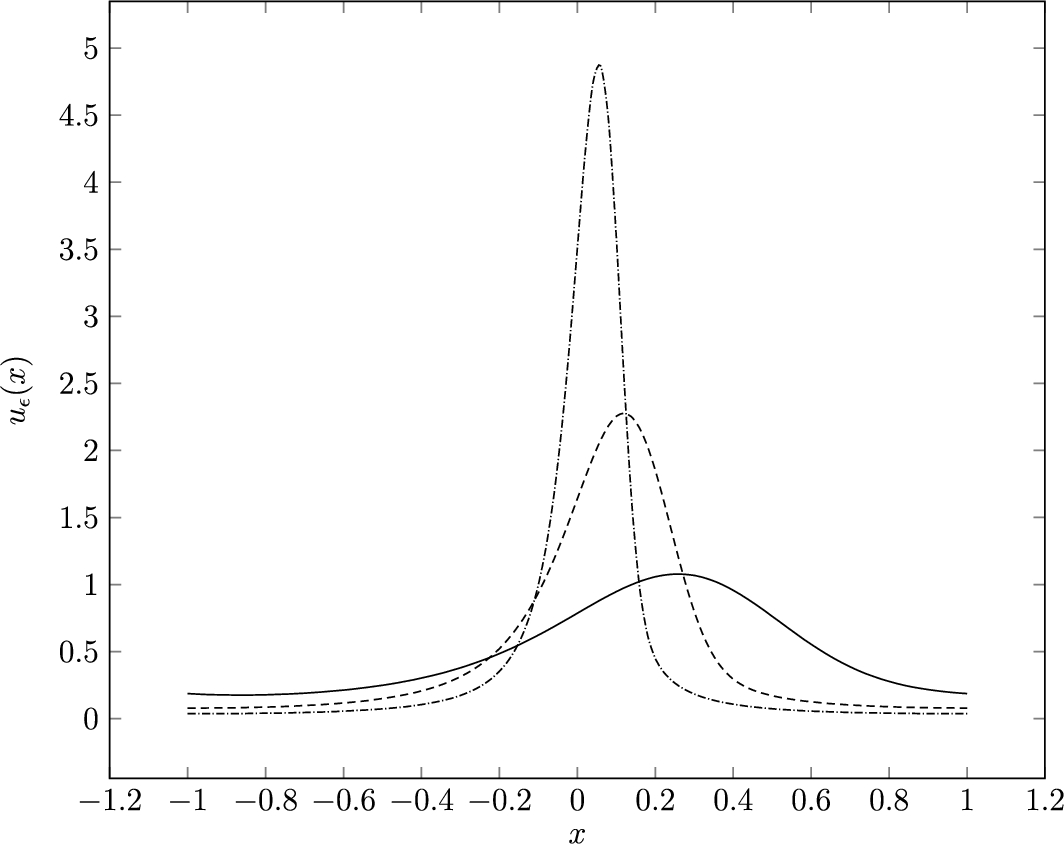
Observe that the real number 0 is a rank one eigenvalue to the differential operator
Although an explicit solution is obtained in (2.7), it is not an easy undertaking to use this result to get the asymptotic behavior of
Let
The stages we go through are listed below:
We prove that
Next, we prove that if we have a function
Let the function
The space
Now we prove the following statement:
The operator
Let
A calculation along the lines of that leading to equation (2.7) proves the invertibility of
From (3.5) we infer there exists
From the estimates
Next, integrate (3.8) on Ω, then using the periodicity property (3.6) gives
Now, with the help of the below estimate:
Equations (3.8), (3.11), (3.14) imply
Using now (3.7) and the Poincaré inequality leads to (3.4). □
If we consider a function
In practice it is difficult to construct a function
We first take-on to built a function
To do that we first consider for any
Equating same order in ϵ terms leads to
The boundary conditions in
The next rank equation
As a consequence we can prove the following statement:
For any
The proof is recursive: for
Upon multiplying both sides by
Consider now a cut-off function
Suppose that
We clearly have that
On the other hand, denoting
Lemma 3.2 will be applied with
Define
Next we list several useful notations:
For
For any
We now study the behavior of
For any
Step 1:
Remark that for
We first prove that there exists
Observe there exists
Let now
Step 2: Let first
Let now
We are now in a position allowing to obtain the behavior of
Let
Moreover, the function
Let first
Using (4.6) one gets:
Next,
The last one reads:
Let the following numbers be defined recursively as:
Next, multiply equation (4.9) with
Observe that
Next, assume
We now must focus on finding convenient solutions
We choose the solution of (4.14) given by
Hence
Clearly
The following Lemma gives a polynomial approximation for
Let
Moreover the function
The proof is by recurrence w.r.t. m. The result is obvious for Let Invoking the fact that Next, invoking the recurrence hypothesis, we obtain for Henceforth, for Using now (4.22), (4.23) and Lemma 4.2 leads to the result. Consider next The rest of the proof is identical to the (precedent) case where The above Lemma gives us the behavior of
This Section goal is to produce an approximation
The functions introduced above have the following patterns:
The function
Let us set
In the above, the
We now carry out the change of variable
For any function
The above entails that
In (5.3) above, both members in the r.h.s. must be of same order in ϵ. As
Next, making use of (5.1) and (2.1) into (5.3) gives:
From above one gathers:
Invoking the definitions of At this stage it is important to observe that the quantity
Consider now
Define now, for any
We also define:
Next, thanks to the equality
Moreover one has that
We now introduce the approximation
Next, we introduce the error functions related to approximating
Next,
Clearly
On one hand, from Lemma 4.3, for any
We also deduce from Remark 4.1 that for any
On the other, one has
We shall later define
In the following we undertake to make explicit
Invoking (5.12) one gets
Next, using (5.9),
We get for
The above can be re-written as
As we need all functions
Next, we search for
Equating same order terms, it follows that:
In solving (5.24)–(5.26) above, we shall set all integration constants equal to 0. Next, we shall recursively construct a sequence
For any
We easily see that the degree is unique. Moreover, if
We now prove the following result:
Assume that
Observe, for
However,
Next, we proceed recursively on j; we assume that
We then have
Summing (5.29) and (5.17) and capitalizing on the linearity of
We next undertake to proving the following Lemma:
Assume that
From (5.14) we get
Next, from (5.15) and for any Consequently there exist Next, assume It follows that
Invoking (5.33) and (5.34) it now results that
Equations (5.35) and (5.36) eventually give the stated result. □
Out of a concern for clarity and to ease the reading we recall here that, for any
We now define
Now from (5.30) we have
We have the following results:
The periodicity defect of
With (5.37) in mind, we actually have to estimate:
Recall that From Lemma 4.3 it is clear that On the other hand, from (5.22) we have
We have
More precisely, we have the following estimate:
We have
From Lemma 4.3 we deduce that for large enough for We have
for Since for We then deduce from (5.40), (5.41), (5.43) and (5.44) that
On the other hand from the definition (5.22) of
Now we are able to give an approximation
We define for any
We now give the main result of this paper which allows to obtain an approximation of the solution up to any prescribed (desired) error:
(Main Result).
For any
We use Lemma 3.2 with
We deduce from the above theorem the following consequence: Under the hypothesis of Theorem
5.1
we have
It suffices to observe, using Lemma 4.3, that for any It is well known that
A simple theoretical case
We begin with a very simple case for this problem, for which
One has
Notice one actually controls the approximation error for
We easily find that
An important case of practical relevance
As announced in Section 1, an important case for the applications is when
Take again
Observe that
Next,
Therefore,
We now focus on
Thus:
It is important, at this stage, to notice that our
Next,
From (5.20) we deduce
It is not necessary to compute
Given that (see (5.10))
Now we can calculate the
Consequently
The last term in need be calculated is
The problem of non-Newtonian fluids fast flows is both an utterly important one in view of the large number of industrial applications and a challenging one, in particular when the fluid constitutive equation derives from a kinetical (molecular description) theory. In the later case, one first has to solve the configurational probability diffusion equation for large velocity gradients, i.e. to obtain an asymptotic solution valid for this particular flows. This probability is the key ingredient to calculating the corresponding stress tensor as (generally) a second order moment. For the Rigid Dumbbell Model (RDM) type of polymer chains, in [13] Öttinger used educated, skillful intuition to conjecture the solution of the configurational probability equation must exhibit a particular pattern: it has to be “concentrated” in the neighborhood of a preferred angle. Consequently he derived an analytical expression assigned to describe the solution.
In this paper we rigorously solved the problem by obtaining an asymptotic solution to the corresponding equation that is of a turning-point type. The techniques used in doing so are expected to apply to a wide variety of turning point type mathematical physics problems, in particular to those where asymptotic solutions are the main focus.
Footnotes
Acknowledgements
The authors are grateful to the Referee for useful comments on the originally submitted manuscript.