






Abstract
BACKGROUND:
The use of a new bio-impedance spectroscopy device (Body Composition Monitor, BCM) in the field of dialysis became possible in Japan. However, it is unknown whether the data obtained using this apparatus are indicative for Japanese dialysis patients.
OBJECTIVE:
To compare individual fluid status in healthy Japanese using the BCM device with the data obtained from healthy Caucasians.
METHODS:
A total of 219 volunteers (female vs. male, 150 vs. 69; mean age, 68.8 ± 8.4 years; mean BMI, 22.6 ± 2.9 kg/m2) were enrolled. The measurement was performed by the end of the morning before exercise.
RESULTS:
Mean over-hydration (OH) level was 0.7 ± 0.8 L. Nearly 80% of subjects had values equivalent to the standard values of healthy Caucasians (−1.1∼1.1 L). Age had a weak positive correlation to OH. The fat tissue index levels were slightly lower in Japanese than in Caucasians. On the other hand, the levels of lean tissue index and ECW/ICW (E/I) ratio did not differ between Japanese and Caucasians. E/I ratio showed a good correlation with OH level.
CONCLUSION:
Fluid status of healthy Japanese was equivalent to the standard value of Caucasians. Although validity of using parameters from healthy Caucasians in healthy Japanese population was considered to be confirmed, validity of use in Japanese dialysis patients should be evaluated further using the parameters from healthy Caucasians.
Introduction
Assessment of body fluid overload in dialysis patients is clinically important; however, objective methods that evaluate fluid overload are limited. Recently, the use of a new bio-impedance spectroscopy device (Body Composition Monitor, BCM; Fresenius Medical Care Japan K.K., Tokyo, Japan) in the field of dialysis became possible in Japan. BCM is the first device that determines individual fluid status and shows the hydration state in the unit of L. Output parameters, such as extracellular water (ECW), intracellular water (ICW), total body water (TBW), and lean tissue mass (LTM), have been validated against the gold standard reference methods in various studies [1,2]. BCM has already been used in dialysis patients in foreign countries and is expected as a device that provides a new index of body fluid management in such patients [3–6].
However, it is unknown whether the data obtained using this apparatus are indicative for Japanese dialysis patients because this device calculates several output parameters based on data provided from healthy Caucasians. To adapt this device to Japanese dialysis patients, it is necessary to clarify whether data from healthy Caucasians are equal to those from healthy Japanese. In this study, we investigated individual fluid status in healthy Japanese using the BCM device and compared it with the data obtained from healthy Caucasians.
Subjects and methods
Subjects
The subjects were healthy volunteers who attended a gym (Medical Fitness Fiore, associated with Koga Ekimae Clinic) for their health and were 50 years or older. All participants gave their written informed consent prior to study inclusion. Those with a history of cerebral infarction, acute myocardial infarction, and renal failure or with a possibility of being pregnant were excluded from this study. A total of 219 volunteers (female vs. male, 150 vs. 69; mean age, 68.8 ± 8.4 SD years; mean height, 156.8 ± 8.2 cm; mean BMI, 22.6 ± 2.9 kg/m2) were enrolled.
This study was approved by the local ethical committees at Koga General Hospital and the University of Miyazaki.
Methods
After measurements of their weight and blood pressure, the subjects were inspected after 30-minute decubitus rest. All tests were conducted by the end of the morning before exercise. The measurement was performed by placing electrodes on one hand and one foot in the BCM and entering individual height and weight data into the machine.
Statistical analysis
All continuous variables are expressed as mean ± standard deviation (SD). Comparisons between two groups were made using Student’s t-test after confirmation of normal distributions for all variables. Pearson’s product moment correlation was used to determine correlations of the degree of over-hydration (OH) with other variables. P-values < 0.05 were considered statistically significant in all calculations.
Results
Figure 1 shows a histogram of OH in healthy volunteers. The mean OH level was 0.7 ± 0.8 L. The level did not differ between females and males (0.7 ± 0.6 vs. 0.6 ± 1.0 L, n.s.). A total of 167 (76.3%) out of 219 had values equivalent to the standard values of healthy Caucasian subjects in foreign countries (−1.1∼1.1 L) (brochure of the product).
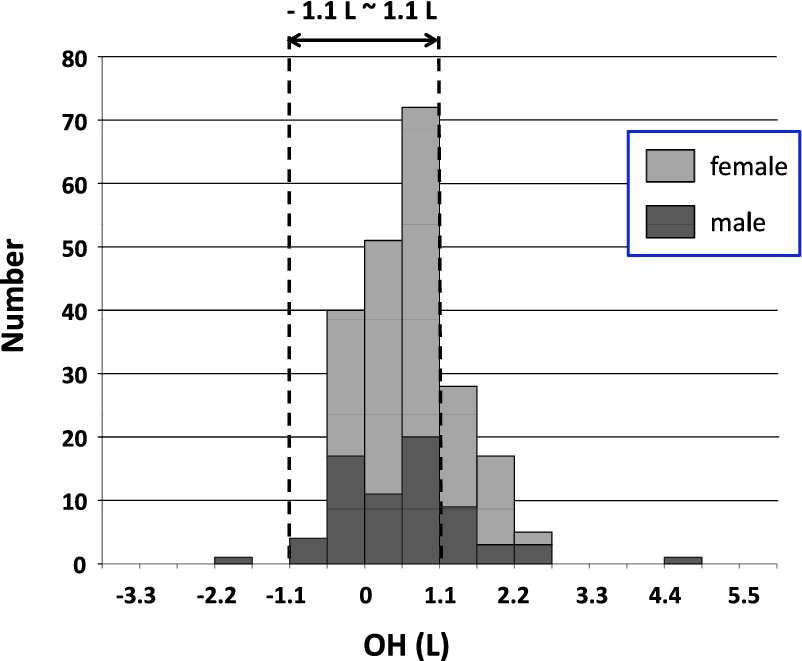
Distribution of over-hydration (OH) in healthy Japanese subjects. (Colors are visible in the online version of the article;
The correlations of OH and body weight, BMI, and age in healthy subjects are shown in Table 1. Body weight and BMI were not significantly correlated to OH in all subjects, but age had a weak positive correlation to OH in females and all subjects. On the other hand, lean tissue index (LTI) and fat tissue index (FTI) tended to be slightly decreased and increased, respectively, with age, but the correlations were not significant (
Corelations between OH and body weight, BMI, or age
Table 2 shows the mean levels and reference ranges of several output parameters in the present study and the brochure of the product, respectively. The levels of LTI in both females and males did not differ, but the FTI levels were slightly lower in Japanese than in Caucasians. The E/I levels of both sexes did not differ between healthy Japanese and Caucasian subjects.
Comparison of LTI, FTI, and E/I from BCM between healthy Japanese and Caucasians
Notes: LTI – lean tissue index; FTI – fat tissue index; E/I – extracellular water/intracellular water; BCM – body composition monitor.
Mean age – 68.8 ± 8.4 years old.
Age – around 70 years old.
As shown in Fig. 2, ECW/ICW ratio (E/I) showed a good correlation with OH level (
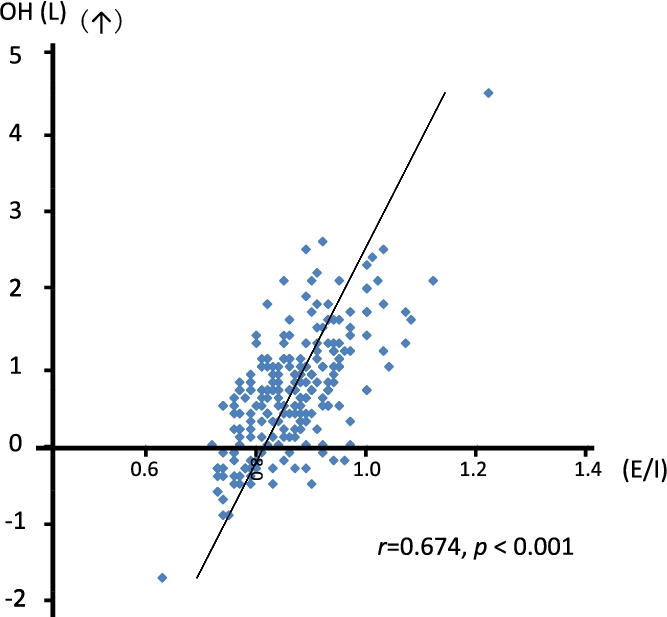
Correlation between over-hydration (OH) and ECW/ICW (E/I) ratio. (Colors are visible in the online version of the article;
This study revealed that the fluid status of nearly 80% of healthy Japanese subjects was equivalent to the standard value of healthy subjects in foreign countries (−1.1∼1.1 L). According to the brochure of the product (Fresenius Medical Care Japan), the reference value of OH is determined by excluding values lower than the 10th percentile and higher than the 90th percentile for data collected from healthy Caucasian subjects. As such, the use of this device was thought to be equally suitable for the Japanese. However, there may be a small difference in OH level among ethnic groups and subjects, and OH levels may be affected by the time of measurement and the contents of the diet (especially sodium intake), among others. In our subjects, the 10th and 90th percentile OH values of the collected data were −0.3 and 1.7 L, respectively. The present study demonstrated that age had a weak positive correlation to OH. The group targeted in the brochure of the product is all age groups, whereas our subjects were older than 50 years. This may be one of the reasons why our subjects showed slightly higher OH levels than the targeted group.
BCM is a new device analyzing the body composition of dialysis patients using bio-impedance spectroscopy techniques. While a high-frequency current passes through the total body water, a low-frequency current cannot penetrate the cell membranes. As described in the brochure of the product, this device performs measurements at 50 frequencies over the range from 5 to 1000 kHz to determine the electrical resistance of TBW and ECW. ECW, ICW, and TBW are determined from the obtained impedance data following the model of Moissl et al. [7] and Chamney et al. [8], using normal population data as a reference. These output parameters provided by the BCM device have been validated against the gold standard reference methods in various studies [1,2]. Although currently available methods estimating fluid volume in dialysis patients include direct and indirect ones, the bio-impedance spectroscopy, one of the indirect methods, has some advantages compared with other techniques in its low costs and easy portability allowing bed-side measurements without the need for blood draws [2]. In addition, BCM has also another advantages expected for dialysis patients compared with previous devices using bio-impedance method. In dialysis patients, assessment of body fluid overload is clinically very important. BCM is the first device that determines individual fluid status (provides an estimated OH measured in liters in dialysis patients) and body composition in an easy and objective way. Therefore, the BCM machine has been recently used in dialysis patients and is expected to be a device that provides a new index of body fluid management in dialysis patients [3–6].
Recently, an association between body composition (such as high ECW, high FTI, and low LTI) and frailty among hemodialysis patients has been reported [9–11]. In the present study, there were not so large differences in LTI and E/I levels between healthy Japanese and Caucasian subjects. However, the level of FTI was slightly lower in Japanese than in Caucasians. This finding is the same as in previous reports [12–14], which showed that the degree of % body fat can vary among different ethnic groups. In the future, it will be necessary to investigate whether body composition data obtained using the BCM device is related to survival and frailty in Japanese hemodialysis patients.
Interestingly, the OH level had a highly positive correlation to E/I in the present study. Considering the movement of water in the body during a short time, ECW may increase or decrease rapidly compared with ICW. We will have to confirm whether the relationship between OH and E/I is shown in patients with dialysis and other diseases.
Conclusion
In this study, validity of using parameters from healthy Caucasians in healthy Japanese population was confirmed. In the future, validity of use in Japanese dialysis patients should be evaluated using the parameters from healthy Caucasians.
Footnotes
Acknowledgements
The authors thank Shinichi Hayashi and Akira Iwasaki of Medical Fitness Fiore, who kindly cooperated in the BCM measurement.
Conflict of interest
None declared.