







Abstract
Understanding how a helmet protects the head, especially the soft brain tissues, is the prerequisite for improving helmet design. Intracranial pressure and stresses/strains in the brain tissues are the direct indicators of traumatic brain injury and they can be used to measure helmet performance. In this study, the effects of helmet design parameters such as the helmet shell stiffness, liner compliance and thickness on the brain injury indicators were investigated by virtual impact tests. A finite element head model (FEHM) was first constructed from medical images; a personally-fitted helmet made of composite material and foam was virtually prototyped using geometric information extracted from the FEHM; a helmet-head finite element model was then assembled. Virtual impact tests were conducted using the resulting helmet-head model. The obtained results suggested that, if the helmet shell already has adequate strength to resist excessive deformation and fracture, further increasing shell stiffness and strength would not considerably reduce intracranial pressure and brain strains; to reach the maximum protection with the available materials, the key is to effectively use the second stage in the stress-strain history of the liner foam material.
Keywords
Introduction
Sports-related head injury has become a major public concern as the injured are mostly children and adolescents. Based on a study conducted by the American Association of Neurological Surgeons [1], there were about 450,000 sports-related head injuries treated by U.S. hospital emergency rooms in 2009, and there was an increase of 95,000 cases compared with the previous year. The actual number may be even higher, as many mild head injuries were not covered in the study. The major contributors to sports-related head injuries include cycling, football, baseball and softball. In Canada, ice hockey is a main source of head injuries [2], accounting for almost half of all traumatic brain injuries among Canadian children and teenagers. Much effort has been devoted to rule changes and enforcement, safety education for players and coaches, equipment improvement and innovation. In the following, the discussion is focused on helmet protection against the most critical impact that may lead to a closed-head injury. Although various new protective helmets have been adopted, incidence of sports-related closed-head injuries has not been considerably reduced [3,4]. Questions have been raised about the efficacy of helmet in preventing closed-head injuries [4–6]. Indeed, in principle, a helmet can only provide limited protection considering the diversity in types of collision and the potentially large magnitude of impact forces occurring in sports. However, a sport helmet should be designed with the state-of-the-art materials and manufacturing techniques to provide the maximum protection.
To explore the potential in improving the protection of sport helmets, it is necessary to examine how a helmet protects the head, the mechanical causes of different head injuries and issues in the current practice of helmet design and testing. A sport helmet provides protection to the head mainly by: 1) reducing the level of stress concentration at the impact site; 2) absorbing a portion of the mechanical energy induced by impact; 3) increasing the duration of the impact impulse transmitted to the head; 4) changing the pattern and energy level of mechanical wave induced by the impact. In a sport helmet, the components that provide main protection are the shell and the liner. The relatively stiff shell is used to resist penetration and dissipate the impact pressure onto a larger area of the skull. Plastic deformation of the shell is able to absorb a large portion of the impact energy. The relatively soft liner is used to further absorb the remaining impact energy and to increase the duration of the pressure impulse. Based on dynamics, for a given mechanical impulse, if the duration of the impulse is increased, the peak value of the impact force to the head will be reduced. The rest of the mechanical energy is transmitted into the brain tissues as mechanical wave and oscillation, which is believed the main cause leading to brain contusion [7]. The pattern and energy level of the mechanical wave are mainly determined by the mechanical properties of the shell and the liner materials.
Head injuries can be roughly classified into two categories [8,9]: open (or penetrating) and closed (or non-penetrating), mainly characterized by the status of skull integrity. Open-head injuries are often reported in military battle field, violence and car accidents. Head injuries occurring in sports are mostly closed-head injuries. For example concussion is a typical closed-head injury. Helmets have been proved being more effective in preventing open than closed-head injuries [4], as the two categories of head injuries have different mechanical causes. Open-head injury is mainly caused by stress concentration in the skull induced by sharp objects, resulting in skull fracture. While a closed-head injury is usually caused by a blunt object and involves mechanical mechanisms that are much more complicated than those in an open-head injury. For example, excessive shear strain [10], negative intracranial pressure [11], brain tissue oscillation and mechanical wave propagation [12,13] are involved in closed-head injuries. Therefore, the principle adopted in the design of helmets for preventing open and closed-head injuries should be different. To prevent open-head injury, the helmet shell is required to have adequate strength to resist penetration. While to prevent closed-head injury, the mechanical energy transmitted to the soft brain tissues is required to be below their injury threshold. As the brain tissues are much more vulnerable to injury than the skull, the impact magnitude that can cause close head injury is much lower than that for open-head injury.
Currently sport helmets are mainly tested by physical experiments using dummies and cadavers [14–16]. The testing methods are useful in examining the strength of helmet, but not able to provide feedback information about the intracranial pressure and stress/strain level in the brain tissues. Closed-head injury may have already occurred far before the helmet reaches its ultimate strength. Epidemic head injury data collected from hospital emergency rooms, coaches and injured athletes have been used in studying the effectiveness of sport helmets in preventing closed-head injuries, but they are not helpful for designing a specific helmet. To understand how helmet design parameters such as helmet shell stiffness, liner compliance and thickness affect the intracranial pressure and brain strains induced by impact force, a helmet-head finite element model is constructed in this study and it is used in parametric studies.
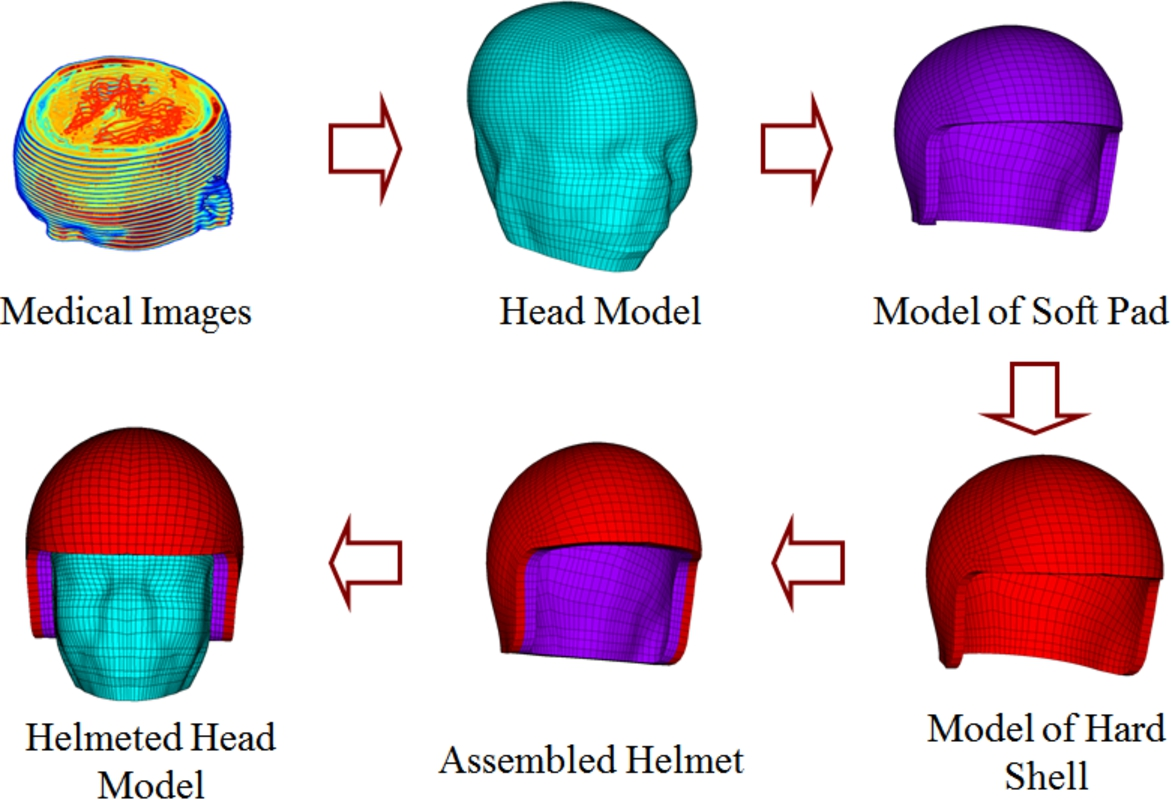
Sport helmet design procedure.
The process of constructing the helmet-head finite element model is illustrated in Fig. 1. The construction starts with a stack of medical images of the head. A FEHM is constructed from the medical images. Depending on the resolution of the medical images, various intracranial anatomic structures can be included in the FEHM, for example, the white and grey matter, ventricles, cerebral stem, blood vessels and even axons. To design the geometry of the liner pad, the outermost surface of the FEHM is extracted and then uniformly expanded outward so that a comfortable tolerance space between the head and the pad is inserted. The surface is then further expanded outward by the thicknesses of the pad and then the thickness of the shell, to obtain the inner and outer surfaces of the pad and the shell. The finite element model of the helmet is obtained by putting together the pad and the shell. The helmet-head finite element model is then assembled. A face-to face friction-sliding contact model is adopted to describe the interaction of helmet components at the shell-pad and the pad-head interface. The augmented Lagrange method is used in incorporating the constraint equations considering the large deformation of the foam [17]. Different friction coefficients are taken at the two interfaces. The friction coefficients have wide variations. The friction between the shell and the pad is dependent on the material properties of shell and pad, whether or not an adhesive is applied, and the type of the adhesive, etc. In vivo pad-head friction coefficient is not available and it is dependent on a number of factors such as the fitness between the head and the pad and the amount of hairs. The friction coefficients used in this study were estimated from experiments using headform [18,19]. A large friction coefficient (0.8) was adopted at the shell-pad interface to prevent the foam pad sliding out of the shell; a small friction coefficient (0.2) was used at the pad-head interface to allow possible relative sliding between the pad and the head.
Finite element head model (FEHM)
In this study, a non-segmentation FEHM was constructed from quantitative computed tomography (QCT) scans using the procedure described in [20]. The QCT scans used in this study were obtained, under a human research ethics approval, from the Great-West Life PET/CT Centre, which is a local health science research centre. The head of the anonymous subject (a 56 years male) was scanned using the CT portion of a Biograph 16 PET/CT system (Siemens Medical Solutions, Knoxville, TN). The non-segmentation FEHM [20] is different from the segmentation FEHMs [8,21–24] in two aspects. In a segmentation FEHM, a set of HU thresholds are used to segment the different tissues in the head and a geometric model is constructed. Due to complexities in the head interior anatomical structures, the resulting geometrical model is usually very complicated and the quality of the generated finite element mesh is usually poor. In the non-segmentation FEHM, HU thresholds are only used to determine the material model adopted at a specific location. The geometric model of the head is constructed from the outmost surface of the head, which is extracted from QCT images. As interfaces of interior tissues are not represented in the geometric model, the geometric model is much simpler and the finite element mesh also has higher quality. Material properties are also assigned in a different way. In a segmentation FEHM, each tissue component is treated as a homogeneous material [25]. Inhomogeneity of head tissues is thus not fully represented. In the non-segmentation FEHM, head tissues are treated as pointwise inhomogeneous material and material properties are assigned based on tissue HU values using empirical functions [20]. Peak stress and strain induced by impact force are used to measure the performance of a helmet design, and inhomogeneity of brain tissues affects the stress and strain distributions produced by the impact force. The non-segmentation FEHM fully considers the inhomogeneity and is able to more accurately predict the stresses and strains than the conventional segmentation-based FEHM, therefore, it was adopted in this study.
Although the non-segmentation FEHM is in principle able to represent all small anatomical structures of the head, in this preliminary study the head is only distinguished into three anatomical components, i.e. the skull, the brain tissues and the cerebrospinal fluid, mainly due to the limited resolution of the QCT images and the lack of material properties for the small anatomical components. The skull is represented by a linear-elastic material. The cerebrospinal fluid is simulated as uniform inviscid fluid with intracranial pressure [25]. The brain tissues are described as a viscoelastic material [26]. The range of HU values and the corresponding mass density, elasticity modulus, Poisson’s ratio of the three types of head tissues are listed in Table 1. In Table 1,
HU range, mass density and elasticity modulus of head tissues
HU range, mass density and elasticity modulus of head tissues
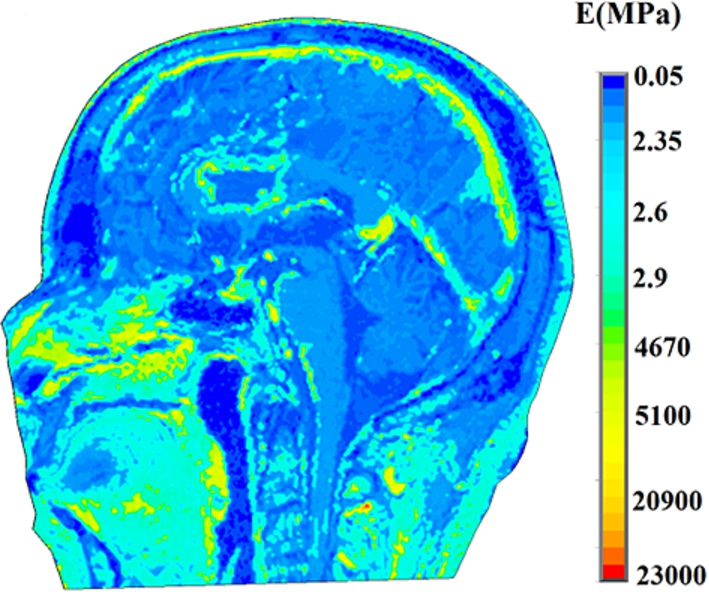
Elasticity modulus distribution over the middle sagittal plane.
The distribution of head tissue moduli over the middle sagittal plane is displayed in Fig. 2, where for the viscoelastic brain tissues the instantaneous elasticity modulus is shown. It can be seen that pointwise inhomogeneity of head tissues is fully represented in the non-segmentation FEHM.
Helmets consisting of a composite shell and lined with foam pad have a number of advantages. Composites have large strength-to-weight ratios and can thus reduce helmet weight; foam liners are able to absorb a large amount of mechanical energy in impact. Composites with different types of fibre, matrix and variable fibre-matrix ratios offer many choices in helmet design to meet diverse shell-stiffness requirements in different sports. Therefore, in this study, the type of composite helmet lined with foam pad is investigated. There are a number of composites and foams available in the market for manufacturing sport helmets. To investigate the efficacy of helmets made of different materials in protecting the head, three types of commonly used fibre-reinforced polyester and three types of polystyrene foam having different densities were used in our parametric study. All the composites have five plies (0/90/0/90/0) and are considered as linear orthotropic material. The material properties of composites listed in Table 2 were obtained from [31] and used in the parametric studies described later in this paper.
Mechanical properties of fibre reinforced composites [31]
Mechanical properties of fibre reinforced composites [31]
The foam liner in a helmet mainly sustain compressive stress and strain. The compressive stress-strain relations of various foams are usually determined by experiments [32,33]. A typical compressive stress-strain curve of foam has three stages: a linear-elastic stage occurring at very low stress level, followed by a linear-plastic stage where large plastic deformation occurs with very little increase in stress, and in the last stage there is very small deformation and the stress increases sharply. The second stage is very important for the helmet to provide effective protection, as the mechanical energy is mostly absorbed during this stage. It is desired that this stage is fully used to absorb a large amount of mechanical energy and also to increase the time for the impact force to transmit to the head. Foam mechanical properties are mainly related to its initial density. The foams used in this study are polystyrene foams. The mechanical properties listed in Table 3 were retrieved from the experiments reported in [32,33] and they were used in the parametric studies to be described later.
The intracranial pressure and stresses/strains induced by an impact to the head are direct indicators of brain injury risk and injury severity [7,30,34]. They are important feedback information required for improving helmet design. But, they are very difficult to obtain by experiments. The following virtual impact test was proposed to predict the brain-injury indicators. The helmet-head model constructed by the procedure described in Fig. 1 was used in the virtual impact test. The finite element model consists of 183,431 eight-node solid elements, including 168,562 solid elements for the head, 8,142 solid elements for the foam pad and 6,637 solid-shell elements for the composite shell. There are 1,312 contact elements at the pad-head interface, and 2,036 contact elements at the shell-pad interface. The virtual impact test was basically a computer simulation of the cadaver head-impact experiments reported by Nahum et al. [35]. The schematic setup of the test including the model, the applied impact force and the constraint conditions are shown in Fig. 3. The impact force shown in Fig. 4 was applied onto the head or helmet-head model at the centre of the forehead and constraint conditions were applied to the neck [20]. The time history of the impact force was retrieved from [35]. By a finite element analysis of the above model using the commercial software ANSYS, the intracranial pressure and stress/strain distributions in the head were obtained. The above virtual impact test with the non-helmeted head model was validated by experiment results in the previous study [20].
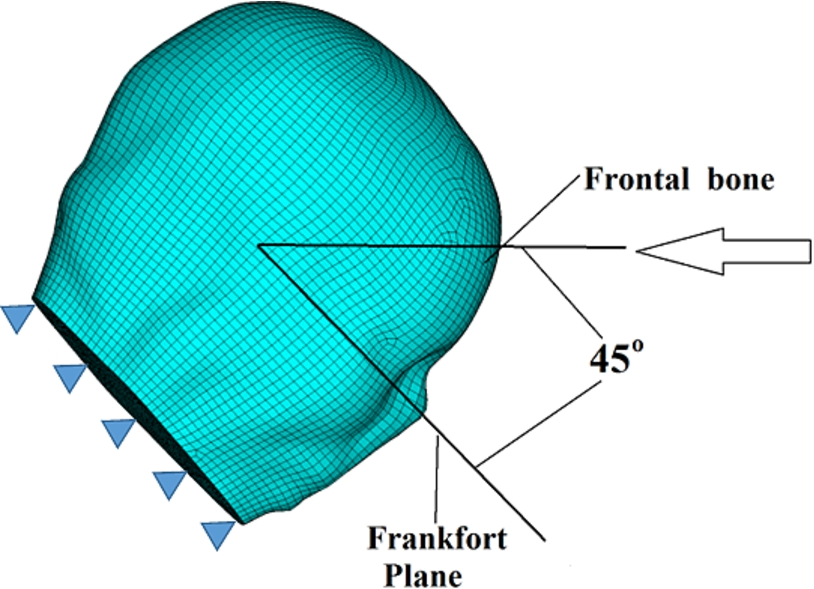
The schematic setup of virtual impact tests [18].
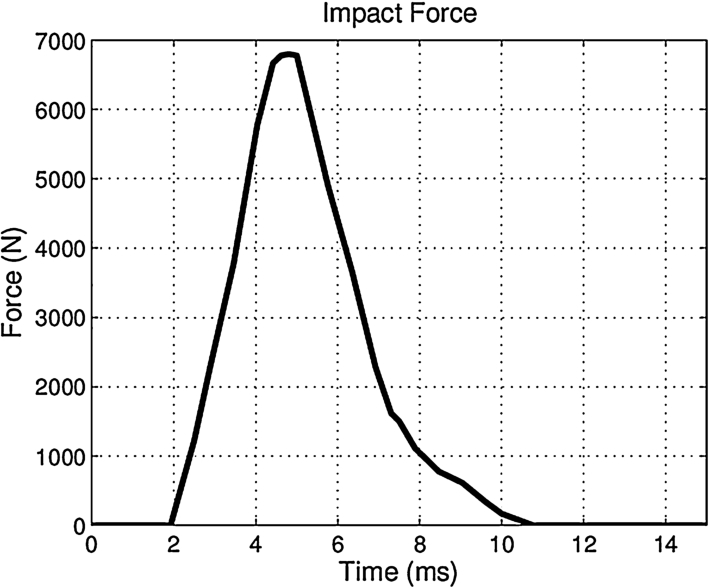
Impact force used in cadaver head impact test [35].
Parametric studies were conducted to investigate the following effects: Helmeted vs. non-helmeted; Shell stiffness; Foam compliance (density); Foam thickness.
In the parametric studies, only one of the above parameters was changed.
The simulated intracranial pressure together with the experimental results [35] are shown in Fig. 5, where the helmet in the helmeted head model had a carbon reinforced polyester shell and a foam liner that has a density of 80 Kg/m3 and a thickness of 10 mm. Relative reductions in the intracranial pressure at the coup and contrecoup side by the helmet are provided in Table 4. Relative reductions in the maximum peak effective strain and the maximum peak shear strain are given in Table 5. For the non-helmeted model, there exist considerable differences between the simulated and experiment-measured intracranial pressure. The cadaveric subject used in the experiment and the subject used in the simulation were not the same. The differences in the head geometric shape, dimensions and cranium cortical bone thickness may affected the intracranial pressure. Nevertheless, the results confirmed that the use of helmet can greatly reduce the intracranial pressure and the brain-tissue strains induced by impact. The intracranial pressure at the coup and contrecoup site was reduced by
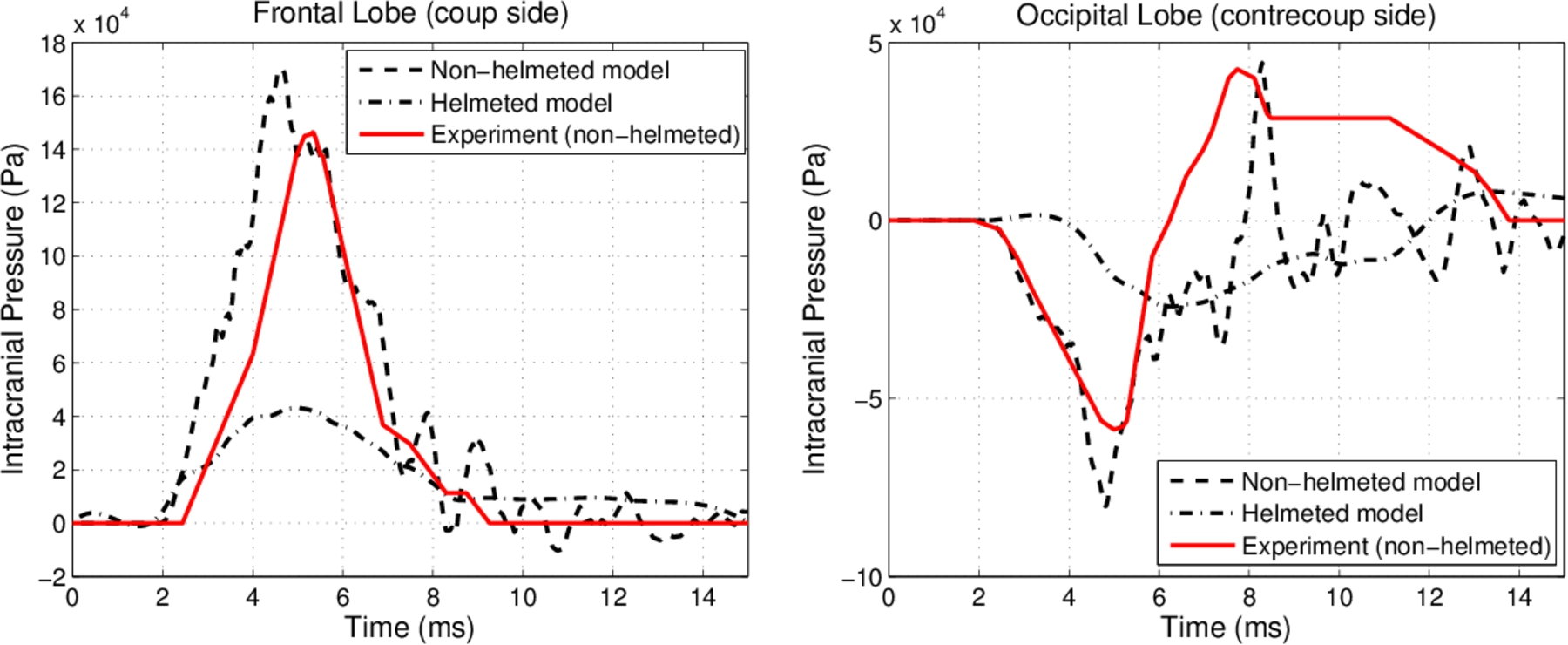
Intracranial pressure: non-helmeted, helmeted and experimental.
Relative reduction (%) in intracranial pressure by helmet
Relative reduction (%) in intracranial strains by helmet
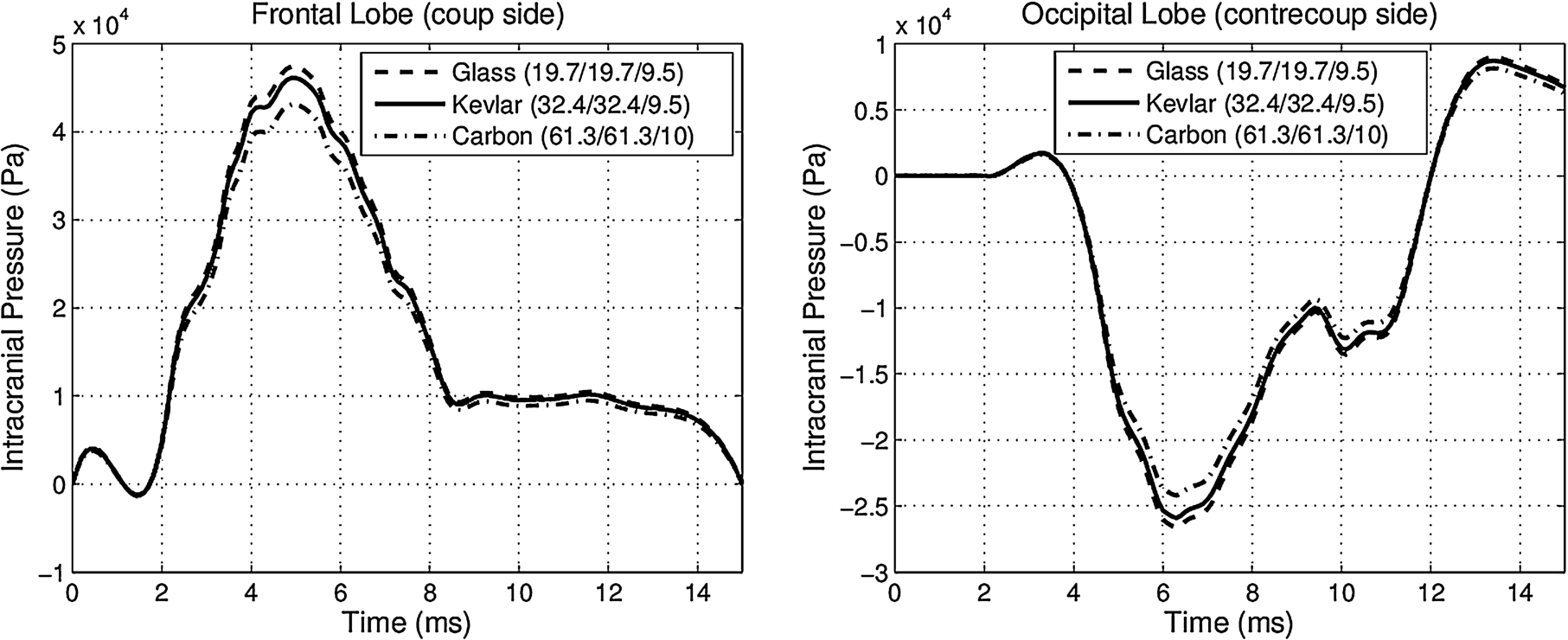
Effect of shell stiffness on intracranial pressure.
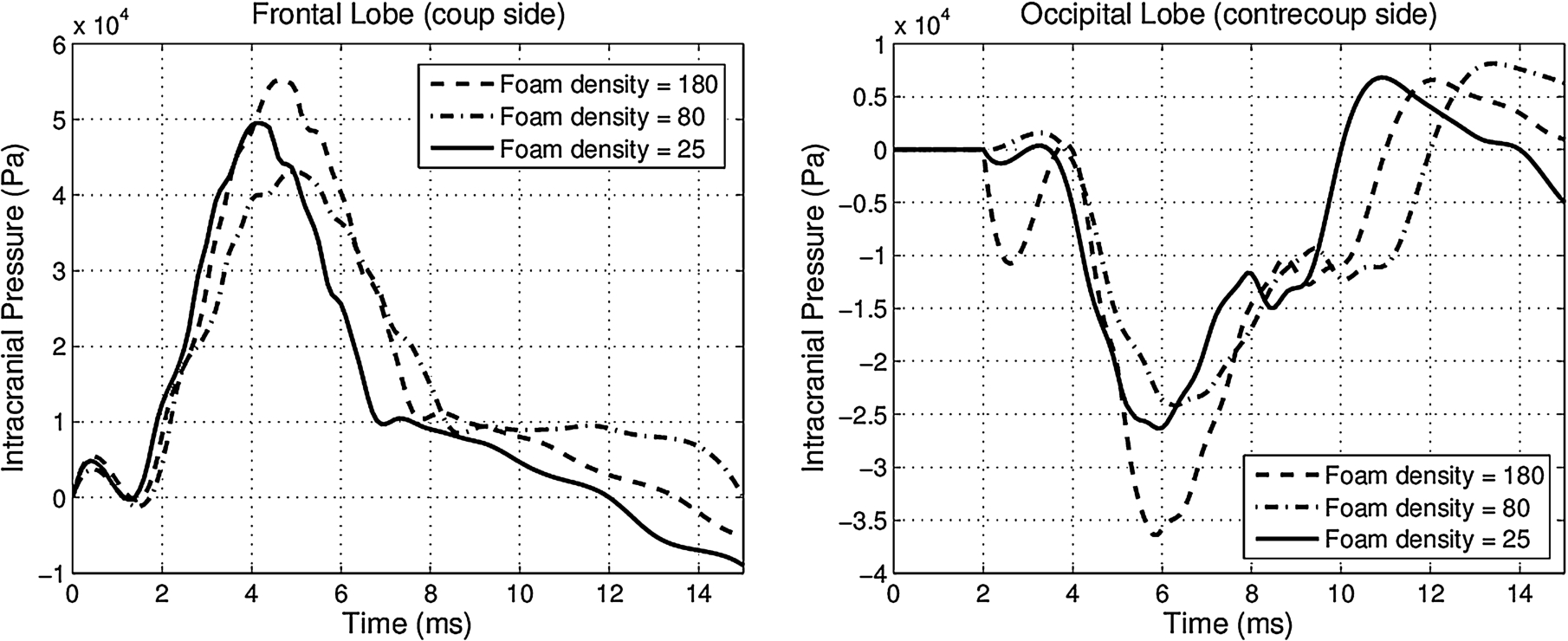
Effect of foam compliance (density) on intracranial pressure.
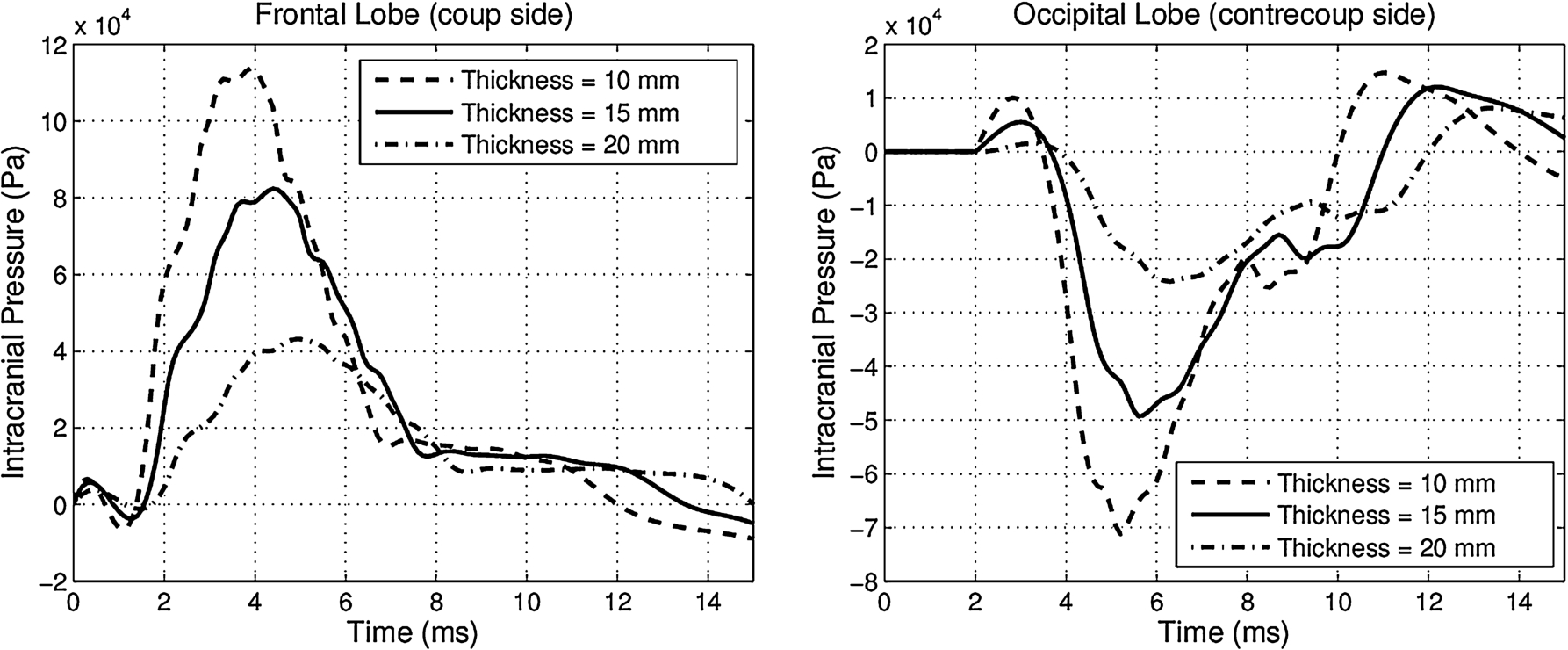
Effect of foam thickness on intracranial pressure.
Results of parametric studies are presented in Figs 6–8 and Tables 6–8. The parametric study results shed some lights into how helmet design can be improved to more effectively prevent closed head injuries. In the parametric studies, the helmet shell was assumed to have adequate strength to resist penetration, so that fracture would not occur in the shell composite. Effects of shell stiffness on the intracranial pressure and the maximum peak effective strain in brain tissue are shown in Fig. 6 and Table 6, where the helmet consists of the foam pad that has a density of 80 kg/m3 and a thickness of 10 mm. The results suggested that if a helmet shell has enough strength to prevent penetration and fracture, increasing shell stiffness is not helpful to further reduce intracranial pressure and brain strains. A very stiff shell that has high elastic strength does not deform plastically and therefore cannot absorb large amount of mechanical energy. Due to its much higher plastic stiffness compared to the liner, allowing partial plastic deformation in the shell would absorb a large portion of the mechanical energy, so that the total mechanical energy transmitted to the liner and the head would be greatly reduced. Therefore, in the design of sport helmet, a proper stiffness and elastic strength should be selected for the shell so that a large portion of the impact-induced mechanical energy can be consumed by its plastic deformation in a critical impact.
Effect of shell stiffness on strain in brain tissue
Effect of foam compliance (density) on strain in brain tissue
Effect of liner foam thickness on strain in brain tissue
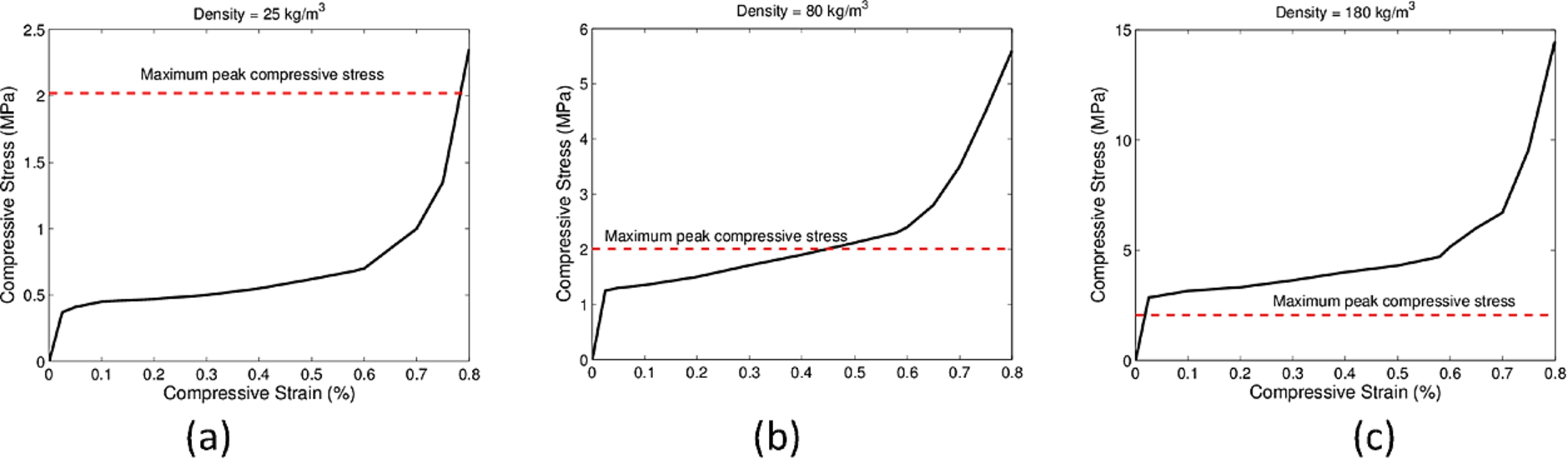
The stage in the foam stress-strain history where the maximum peak compressive stress occurred in the foams of different density.
Effects of foam compliance (density) on the intracranial pressure and the maximum peak effective strain in brain tissue are presented in Fig. 7 and Table 7, where the helmet is made from carbon reinforced polyester and polystyrene foam of thickness 10 mm. The results indicated that the selection of a proper compliance (or stiffness) for the liner foam is critical to reduce intracranial pressure and brain strains. The three polystyrene foams used in the parametric studies have quite different compliance due to their densities. The foam of density 25 kg/m3 is the softest one, and the one of 180 kg/m3 is the hardest one. The foam that has density of 80 kg/m3 is in the middle but had the best performance in reducing intracranial pressure and brain strains. The reason can be well explained by the stress-strain relations of the three foams and the stage where the maximum peak compressive stresses (the third principal stress) occurred, see Fig. 9. All the stress-strain histories in Fig. 9 can be roughly split into three stages. In the first stage, the stress and strain have a linear relationship; the second stage is characterized by a large increase of strain produced by a small stress elevation; the third stage is featured by small strain change and large stress increase. The maximum peak compressive stresses occurred in the three cases are very similar, they are in scope of
Influences of foam pad thickness on the intracranial pressure and the maximum peak effective strain in brain tissue are provided in Fig. 8 and Table 8, where the helmet is composed of carbon-reinforced polyester shell and polystyrene foam that has a density of 80 kg/m3. The results showed that by increasing foam thickness, intracranial pressure and brain strains can always be reduced. A thicker foam is able to absorb more mechanical energy compared to a thinner foam and at the same time can increase the duration of the mechanical impulse transmitted to the head, and thus reduce the peak force transmitted to the head. Obviously, there is an upper limit for liner thickness that is determined by the sizes of the helmet.
The results from the virtual impact tests suggest that if the helmet shell already has adequate strength to resist excessive deformation and fracture, further increasing shell stiffness and strength would not considerably reduce intracranial pressure and brain strains. To the contrary, a too stiff shell of high strength would not help absorb mechanical energy, as no plastic deformation would occur during a critical impact. Fully making use of the second stage of foam stress-strain curve is one effective way to maximally consume impact-induced mechanical energy. Increasing foam thickness is another effective but it is limited by the helmet size.
Footnotes
Acknowledgement
The reported research was supported by the Research Manitoba, Canada, which is gratefully acknowledged.
Conflict of interest
The authors have no conflict of interest to report.