







Abstract
BACKGROUND:
Age-related hyperkyphosis causes deleterious effects on health, physical function, and quality of life. Recently, health care providers recognized it as a major health concern.
OBJECTIVE:
To identify the effect of corrective exercise strategy on hyperkyphosis and compare it with that of conventional exercise.
METHODS:
Subjects were randomly categorized into two groups. Each group comprised 30 subjects. Group A received the corrective exercise strategy, and group B received conventional exercises for 8 weeks of the study duration (15 repetitions of each exercise for three sessions/day for a total duration of 45 min and 4 days/week. Pre- and post-interventional hyperkyphosis were analyzed according to posture number using the Posture Pro 8 postural analysis software. In addition, pectoralis minor flexibility was assessed using the ruler scale method in centimeters.
RESULTS:
Both groups showed highly significant postural alteration and changes in pectoralis minor muscle length (
CONCLUSIONS:
The corrective exercise strategy seems to promote scapular stability and produce a more upright posture of the upper thoracic spine.
Keywords
Introduction
Objectives
This study aims (1) to identify whether the corrective exercise strategy improves hyperkyphosis according to the posture number value obtained using a posture analysis software and (2) to determine whether the corrective exercise strategy improves secondary outcome measures of pectoralis minor flexibility using muscle length testing in subjects with hyper-kyphosis.
Background of the study
An abnormal forward curvature of the thoracic spine is a common progressive deformity of the spine, and it affects up to 50% of older adults due to aging [1]. Hyperkyphosis can cause lower walking speeds, difficulty in climbing stairs, impaired balance, and greater risk of falls, fractures, and mortality in community dwelling women as age increases [2]. Age-related hyperkyphosis causes delirious effect on health, physical function, and quality of life. Recently, health care providers started to recognize it as a major health concern [3]. Poor posture, decreased physical activity, and spinal muscle exercise are other commonly cited potential causes of age-related hyperkyphosis, which can be improved with appropriate exercise [4]. Current treatment options include exercise and bracing. Spinal orthoses were reported to reduce excessive kyphosis and improve spinal extensor muscle strength and physical performance. However, they have only been tested in women with underlying spinal osteoporosis [5].
We reported a case of a 94-year-old male who was enrolled in the same corrective exercise strategy program that targets hyperkyphosis with pectoralis minor tightness. This case resulted in significant improvements in kyphotic posture and pectoralis minor flexibility. Further, this corrective exercise strategy should be carried out in middle-aged population in which hyperkyphosis commonly occurs.
In this study, we compared the effects of corrective exercise strategy and conventional exercises on subjects with hyperkyphosis.
Methods
After obtaining an institutional ethical committee clearance, the subjects were recruited from the outpatient musculoskeletal physiotherapy department of Mohamed Sathak AJ College of Physiotherapy. This study is a single-blinded randomized control trial that compared a corrective exercise strategy with a conventional exercise. Subjects were randomized (30 subjects in each group) in equal proportions into intervention and control groups using random numbering methods and stratified according to age and sex. Intervention assignments were made prior to the study and placed sequentially in sealed, opaque envelopes with stratum-specific sequential ID numbers. Consenting subjects who met the study eligibility criteria were assigned the next available ID number for the age and sex stratum by the investigator in a sealed envelope. The envelope was opened at the end of their baseline study visit. The date and time at which each envelope was opened were recorded in a log along with the subject ID to ensure the integrity of the randomization. Subjects with pain in the upper back region, Cobb’s angle 50
Outcome measures
Postural deviation of subjects with hyperkyphosis was determined according to posture number using Posture Pro 8 analysis software. The subjects were requested to stand erect, and sagittal plane images were captured by a camera at 1.5-m distance from the subjects. These photogrammetry images were incorporated into Posture Pro 8 Postural Analysis software to obtain the posture number value of the subject’s earlobe, shoulder tip, and the greater trochanter of the hip joint.
Comparison of pre and post-test mean 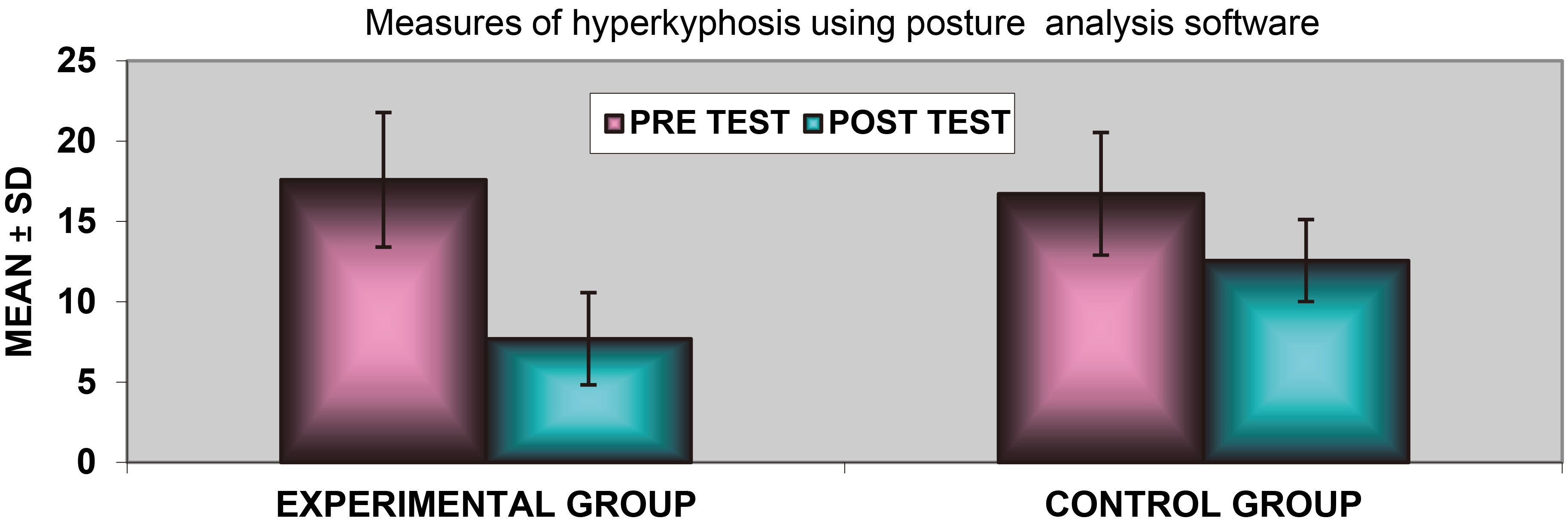
Comparison of pre- and post-mean 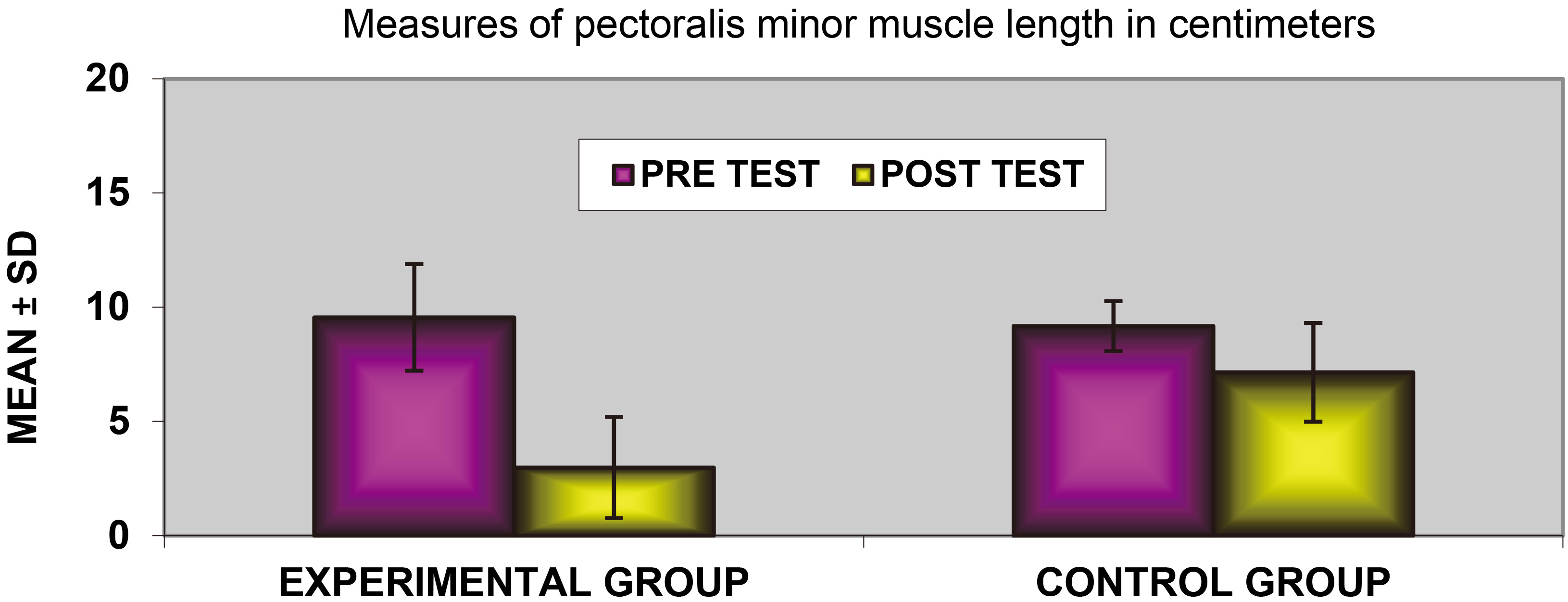
Pectoralis minor muscle flexibility was assessed using muscle length test method and ruler scale method in centimeters. In this method, the subjects were lying in the supine position, and the linear distance from the treatment table to the posterior aspect of the acromion process was measured [7].
Pre- and post-test values of hyperkyphotic subjects of both groups using posture numbering method in the postural analysis software
NS – Not significant
Pre- and post-test values of pectoralis minor flexibility of all subjects using muscle length testing method
NS – Not significant
Both groups showed postural alteration (Table 1 and Fig. 1) and changes in pectoralis minor muscle length (Table 2 and Fig. 2) of both groups showed highly significant changes (
Discussion
The primary focus of this study is to compare the effects of corrective exercise strategy with conventional exercise in subjects with hyperkyphosis. Key findings reveal that the corrective exercise strategy shows significantly greater improvement than the conventional exercise regime. Highlights of the corrective exercise strategy were mainly the kinematic linkage of the shoulder and cervical muscle along with routine back extensor strengthening exercise.
Postural education and assessments are a part of physical therapy education and clinical practice. The importance of normal upright posture was proposed since the early 1900s when it was discussed as a state of balance that requires minimal muscular effort to keep up [8]. Excessive thoracic kyphosis may be due to a kinematic association with a range of musculoskeletal complaints including shoulder and cervical pains [9]. Sinaki and Mikkelsen suggests that the forces applied to the spine during exercise can affect the occurrence of subsequent vertebral compression fractures in women with prior fracture [10]. In a randomized trial to test the effectiveness of prone trunk extension exercises in 60 healthy postmenopausal women, the angle of kyphosis and back extension strength improved among women with severe kyphosis and significant weakness of the spinal extensor muscles at baseline, suggesting that hyperkyphosis may be modified by spinal extensor muscle strengthening exercises [11]. Three case reports suggest that myofascial, spinal, and scapular mobilization techniques improve postural alignment in patients with hyperkyphosis [12]. A number of studies have shown a reasonable correlation between radiographical findings and marker placement. Using photography as a form of scientific assessment appears possible given that the anatomical landmarks are selected well [13]. Postural assessment through photography is a simple method that allows the investigator to define the alignment of body segments quantitatively. The purpose of this study is to quantitatively assess the postural alignment of several body segments while standing through anterior, posterior, and lateral views [14]. Protracted shoulder was associated with shorter pectoralis minor muscle, which is one of the causes of hyperkyphosis [15]. Based on the theories of muscle imbalance, clinicians postulate that strengthening of the posterior scapular stabilizers combined with stretching of the pectoral muscles can correct posture and muscular imbalance and alter scapula–humeral rhythm [16]. Our objective is to give evidence of the efficacy of a corrective exercise strategy on hyperkyphosis and pectoralis muscle flexibility. Exercise trials have often used lower extremity strengthening exercise to improve physical function in older adults. In contrast, we focus on the kinematic linkage of the cervical, scapular, and thoracic spine. This approach to improving hyperkyphosis could represent a fundamental paradigm shift in exercise intervention strategies. However, our study has some limitations; we recruited middle-aged population and excluded people the young and the old age groups. Therefore, the results of this study cannot be generalized to older, weaker individuals of
Conclusion
The corrective exercise strategy used seems to better promote scapular stability and may also produce a more upright posture of the upper thoracic spine than conventional exercises in patients with hyperkyphosis. Our results may offer new insights into the effects of corrective exercise using postural analysis software and pectoralis muscle length testing, which are important patient outcome measures. However, a successful exercise strategy could aid physicians in individualized clinical decision making.
Conflict of interest
The authors have no conflict of interest to declare.
Footnotes
Acknowledgments
We would like to thank our management for their motivation and encouragement to promote research and upgrade an evidence-based practice in physiotherapy department.