







Abstract
BACKGROUND AND OBJECTIVE:
The purpose of this study is to determine whether patients, classified by their treating consultant in rehabilitation medicine as avoider or persister, show differences in a large set of detailed outcomes of actual, objectively measured daily physical behaviour.
METHODS:
In this explorative cross-sectional study, 16 patients were included; 9 patients were categorized as avoider and 7 patients as persister. Subjects wore the VitaMove activity monitor, a high-end accelerometry-based device that allowed automatic detection of a large set of body postures and motions. Physical behaviour was assessed in detail by total duration of body postures and motions as percentages of 24 hours, as well as by the number of sit-to-stand transfers, overall activity level, walking speed, and the distribution of bouts of physical activity and sedentary behaviour. Differences between groups were tested with the Mann Whitney U test.
RESULTS:
There were no significant differences between groups in any of the physical behaviour outcomes.
CONCLUSIONS:
Our study showed that activity-related behavioural style categorization by consultants in rehabilitation medicine is not expressed in objectively measured detailed outcomes of daily physical behaviour.
Keywords
Introduction
Chronic low back pain (CLBP) is a major public health problem with a high impact on daily life functioning [1]. Interdisciplinary rehabilitation treatment therefore generally aims at reducing limitations in daily life functioning of this patient group [2]. Since not all patients seem to benefit from the same approach [2], tailoring treatment to individual patient’s coping strategies may increase effectiveness [3]. Valid classification systems to create subgroups lack, however.
In recent years, research has increasingly focused on avoidance and persistence behaviour as two maladaptive activity-related behavioural styles in patients with CLBP. Avoidance behaviour is assumed to be a result of catastrophizing thoughts about pain and the development of fear of movement. Eventually, this will lead to lower levels of daily life functioning. Such avoidance behaviour has been confirmed in patients with pain [4]. In persistence behaviour, other mechanisms are thought to explain a patient’s disability level. Although persons with a persistence behavioural style perceive themselves as disabled, it is assumed that they continue their activities despite their pain. These patients will therefore have a daily life activity level similar to people without pain or other impairments [5, 6].
A relatively small number of studies has focused on (disentangling the nature of) the relationship between the constructs avoidance and/or persistence on the one hand, and physical activity levels/daily functioning outcome measures on the other hand. For example, Huijnen and colleagues found that patients’ self-reported daily life activity levels were significantly higher in ‘persisters’ compared to ‘avoiders’, whereas such a difference was not present when daily life activity levels were objectively measured with a simple accelerometer device [7]. It was also found that persisters, in comparison to avoiders, reported a longer daily uptime (defined as the period between getting up and going to sleep), using an objective as well as a self-reported outcome measure [7, 8]. Andrews et al. have studied the relationship between an individual’s self-reported activity-related behavioural style and patterns of both pain and objectively measured physical activity [9]. They did not find a significant association between avoidance behaviour and lower daily life activity levels, nor was there a significant association between persistence behaviour and higher daily life activity levels. There was some evidence, however, that individuals who were classified as ‘excessive’ persister (i.e. high self-reported level of persistence combined with low level of avoidance) are more likely to engage in daily life activity in a way that exacerbates pain complaints. Overall, the existing evidence appears to be inconclusive.
This may be related to discrepancies between self-reported/perceived activity levels and actual daily life activity levels: simply because it is difficult to assess one’s own or another person’s physical activity levels findings are not easily interpretable [10]. It has been shown that experienced physicians both under- and overestimated the level of objectively measured daily activity levels in several rehabilitation patient groups, including a significant underestimation in patients with chronic benign pain [11].
The inconclusiveness may also be related to the questionable ability of simple monitoring devices to validly measure avoidance and (excessive) persistence behaviour, as pointed out by Andrews et al. [12]. It might be that maladaptive styles of patients are reflected in other aspects of people’s physical behaviour than the overall daily life activity level, which is the main outcome of most simple monitoring devices [6]. For example, avoiders might avoid specific feared activities or postures, but may continue to perform other non-feared activities. As a result, maladaptive styles may not be expressed in e.g. a decline in the overall daily life activity level, but might become overt in other physical behaviour outcomes, such as the distribution of activities and postures over time. So far, actual physical behaviour of patients with CLBP has not been analysed in more detail in studies aiming to identify differences between avoiders and persisters; for this, a more advanced and high-end accelerometer device is required. The high-end monitoring device VitaMove provides detailed outcomes on types, intensity and patterns of physical behaviour, and therefore allows a more in depth evaluation of whether avoiders and persisters differ in their actual daily life behaviour [13, 14, 15].
Therefore, the aim of this explorative study was to evaluate whether patients with CLBP categorized as avoider or persister by consultants in rehabilitation medicine show differences in detailed outcomes of actual, objectively measured daily physical behaviour.
Methods
Participants
Consultants in rehabilitation medicine with ample expertise in chronic pain treatment from Maastricht University Medical Centre, Rijndam Rehabilitation Centre Rotterdam, and Top-Care Health Services/CIRAN assessed patients diagnosed with CLBP for eligibility to participate in this cross-sectional study. Inclusion criteria were: a) low back pain: pain localized below the scapulae and above the gluteal folds for longer than six months [16]; b) age between 18 and 65 years. Exclusion criteria were: a) low back pain attributable to a recognizable, known specific pathology (e.g. infection, tumour, osteoporosis, fracture, structural deformity, inflammatory disorder, radicular syndrome or cauda equina syndrome) [17]; b) pregnancy; c) wearing a pacemaker or ICD device (i.e. safety measure related to activity monitoring); d) serious psychiatric disorders; e) non-fluency in Dutch. The Medical Ethics Committee of Rotterdam, The Netherlands, approved the study (METC-2011-378).
Study procedure
Prior to enrolment, all subjects received verbal and written information about the study. After the subjects agreed to participate, written informed consent was obtained, and subjects completed a set of self-reported measures on disability, activity-related strategies, fear of movement, habitual physical activity level, pain intensity level, and depressed mood. Also, an appointment was made to visit the hospital’s human performance laboratory to have a short training session on using the activity monitoring device. Participants left the university hospital with the monitoring device, and wore it for preferably 5 days during daytime. After the measurement period, the device was returned to the university hospital for automated analyses.
Classification of patients as ‘avoider’ or ‘persister’ regarding their activity related behaviour style was done by a consultant in rehabilitation medicine. The consultant discussed a number of specific persistence and avoidance statements with participants. These statements were based on different dimensions of avoidance and persistence behaviour and were derived from a study of Kindermans et al. [18]. In that study, it was found that activity avoidance and excessive persistence (i.e. doing too much, not respecting one’s physical limits and experiencing a rebound effect of over-activity) were the only dimensions of avoidance and persistence behaviour associated with a higher disability level. The 13 items from the Behavioral Responses to Illness Questionnaire (BRIQ) and 20 items from the Patterns of Activity Measure-Pain (POAM-P) loading on these factors in the study of Kindermans et al., were used as statements during the consultation to support clinical judgement of the consultant in rehabilitation medicine to classify patients as avoider or persister. Not all of these 33 statements had to be discussed, however. Classification was finished as soon as the expert consultant in rehabilitation medicine was convinced about which activity-related behaviour style the patient used.
Main outcome measure: Actual physical behaviour
Actual physical behaviour was measured using the advanced high-end VitaMove activity monitor (2M Engineering, Veldhoven, The Netherlands; see Fig. 1). This Activity monitor consists of three body-fixed accelerometer units (Freescale MMA7260Q, Denver, USA). The VitaMove sensor units (one attached to each thigh, one to the sternum part of the trunk, using elastic belts) are wirelessly connected. Acceleration signals were continuously sampled with 128 Hz, and stored on micro SD memory cards. The recorders were ideally worn during waking hours on at least 5 consecutive days (and preferably including 1 weekend day). Patients were instructed to continue their normal daily life activities, but recorders had to be de-attached during swimming, bathing and sleeping.
Adult person wearing a VitaMove activity monitor (2M Engineering, Veldhoven, The Netherlands).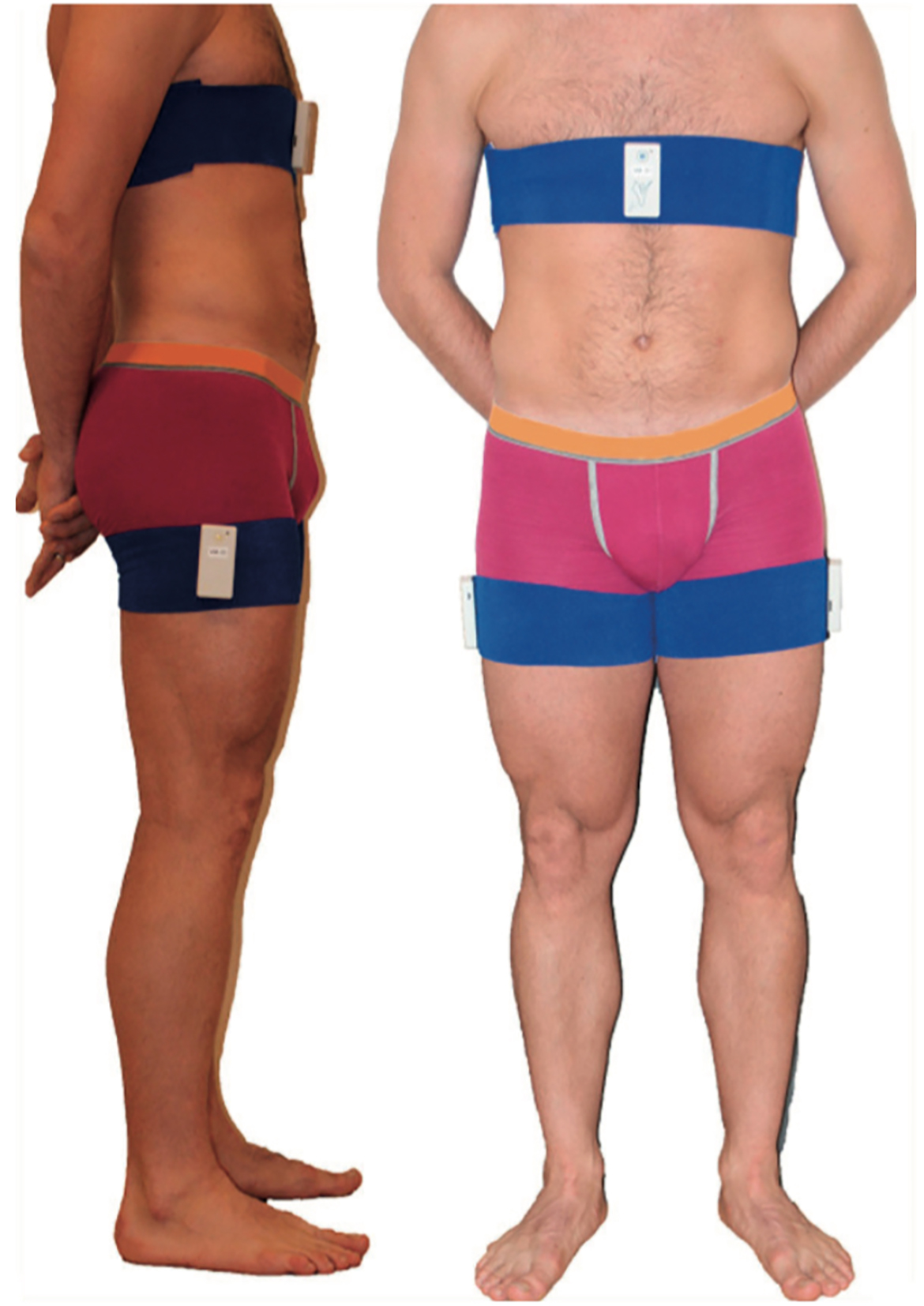
After the measurement period, data were uploaded to a PC, for analysis with VitaScore Software (Vita- Score BV, Gemert, The Netherlands). This analysis software allowed a one-second detection of a large set of body postures (e.g. lying, sitting, standing), body motions (e.g. walking, running, cycling, non-cyclic movements), and body transitions (e.g. sit-to-stand). Body postures and motions with a duration
From the raw signals the start and end of the wear period was determined. Subsequently, from the VitaScore analyses the following physical behaviour outcomes were calculated over all days and averaged:
The total duration – expressed as % of 24 hours – of the composite measure of the duration of all body motions and standing (expressing physical activity) The total duration (as % of 24 hours) of the composite measure of the duration of sitting and lying (expressing daytime sedentary behaviour) The duration – expressed as % of 24 hours – of each body posture and motion Number of sit-to-stand transitions Mean motility of all activities expressed in g (1 g The mean motility during walking periods, expressed in g (1 g
Subsequently, the VitaScore body posture and motion output signal was exported for distribution analyses using a custom-made MatLab algorithm. Binary (0/1) 1-second time resolution signals were created, expressing bouts (i.e. a time period of a defined activity category) of the physical behaviour domains physical activity (body motions and standing), and sedentary behaviour (sitting and lying). Based on these bout signals several distribution outcomes were calculated [13, 14, 26]. The analyses resulted in the following outcome variables, calculated for both physical behaviour domains separately:
Number of bouts; The number of bouts of uninterrupted physical activity or sedentary behaviour Median bout length; The median duration (sec) of bouts Covariance of Variation of bout length; Expresses the variance in bout length Fragmentation; The number of (physical activity or sedentary) bouts are divided by the total duration. A higher score represents a more fragmented behaviour, i.e. consisting of more bouts of a shorter length W-index; Is the total time of bouts above the median bout length divided by the total duration of physical activity or sedentary behaviour. The W-index will be higher in case there is a larger contribution of longer bouts in the total time
First, demographic (gender, age, education level, ethnic information, work status) and pain-related information (duration of complaints) was obtained, after which fear of movement/(re)injury was assessed with the Dutch version of the Tampa Scale for Kinesiophobia (TSK). The Dutch version has been reported to be reliable and valid [27, 28]. Patients were asked to rate their mean pain level perceived in the past week on a 0 to 10 point scale. The level of depression was determined by the Beck Depression Inventory II (BDI-II) [29]. The questionnaire has good psychometric properties and is a valid questionnaire to measure the severity of depression in patients with chronic pain [30, 31].
Self-reported habitual approach to activity
Patterns of Activity Measure-Pain (POAM-P)
The patients’ degree of avoidance and persistence behaviour was measured with the POAM-P [32]. The POAM-P is a 30-item self-report questionnaire, deve- loped to measure three activity patterns in patients with chronic pain, namely avoidance (10 items), overdoing (10 items) and pacing (10 items) [18, 32]. Since the focus of the current study is on an avoidant versus persistent activity-related strategy, only the results of the subscales avoidance and overdoing were used.
Characteristics of the study population of patients with CLBP
Characteristics of the study population of patients with CLBP
Data are represented by medians (interquartile ranges).
The BRIQ is a 21-item self-report questionnaire originally developed to measure behavioural responses of patients in an acute phase of illness [33]. The questionnaire comprises four subscales, but in the present study, only ‘all-or-nothing behaviour’ and ‘limiting behaviour’ are selected, as these subscales measure behavioural persistence and avoidance behaviour, respectively. Psychometric properties of the BRIQ are satisfactory [33]. For the study of Kindermans et al., the BRIQ was translated into Dutch and the back translation was approved by the original authors [34].
Disability
Low back pain related disability was assessed using the Quebec Back Pain Disability Scale (QBPDS). The original as well as the Dutch version of the QBPDS are valid and reliable [35, 36].
Habitual physical activity in daily life
The level of daily life activities during the last year was measured with the Baecke Physical Activity Questionnaire (BPAQ) [37]. The reliability of the BPAQ in patients with LBP appears to be sufficient [38].
Statistical analysis
Descriptive statistics were used for the relevant cha- racteristics of the activity-related styles and the outcome variables used. To evaluate whether the actual, objectively assessed, characteristics of activity-related behaviour are different between avoiders and persisters the Mann Whitney U test was used. In this analysis, alpha was set at 0.05. The analysis was performed using IBM SPSS Statistics for Windows, version 22 (IBM Corp, Armonk, NY, USA).
Results
Sixteen patients with CLBP (8 females) participated in this study. Eleven patients were included from Maastricht University Medical Centre, one from Rijndam Rehabilitation, and four patients from CIRAN. No significant differences in activity-related behavioural style, gender and age were present between the inclusion locations. However, patients included in Maastricht felt significantly more disabled measured with the QBPDS (
Overall, 70 measurement days were included in the VitaScore analyses. Due to the criteria used for the analyses, the number of days analysed for one patient was limited to two days. For 2 participants 3 days were analysed, for 3 patients 4 days were analysed, for 10 persons 5 days were analysed, and 22 out of the 70 days were weekend days. The mean length of the measurement day was 14.01 hours (SD
Actual physical behaviour outcomes for the two groups (as measured with VitaMove)
Actual physical behaviour outcomes for the two groups (as measured with VitaMove)
Table 1 presents characteristics of the avoiders and persisters. Nine patients were classified as avoider and seven patients were classified as persister. No significant differences were found on age, gender and work status between avoiders and persisters. Similarly, no significant differences between these groups were found on other parameters, although avoiders, compared to the persister group, showed a higher median score on fear of movement (42.0 vs 36.0), more avoidance behaviour as measured with the POAM-P (25.0 vs 16.0) and a lower score on overdoing (22.0 vs 30.0). Also no significant differences were found in the disability level or the self-reported daily life activity level.
Actual daily life activities of avoiders and persisters
Table 2 presents the median scores and interquartile ranges of the activity monitor data for avoiders and persisters. No significant differences in percentages sedentary or body motions were found between avoiders and persisters. Also no significant differences in distribution outcomes for the two different constructs of physical behaviour were found.
To check the validity of the results, two types of post-hoc analyses were performed in which the Mann Whitney U test was repeated. The first post-hoc analyses focused on differences between avoiders and persisters when data of specific days were analysed; weekend days and week days (avoiders
Discussion
This study had an explorative character, and aimed to evaluate whether patients displaying avoidance and persistence behavioural styles present differences in objectively measured actual physical behaviour. We were not able to confirm that patients classified as avoider or persister differ in their actual physical behaviour. Patients scored similarly on all VitaMove quantitative and qualitative outcomes, as well as on all distribution outcomes. The innovative aspect of this study was that physical behaviour was measured in detail and was expressed in a broad set of outcome measures for actual physical behaviour. Nevertheless, no differences were found. This is in line with other studies evaluating actual daily activity levels with relatively simple accelerometer devices [7, 9]. The finding that persisters have a longer daily uptime – both reported and objectively measured [7, 8] – was not confirmed by the wear time data in our study, however.
More detailed and in depth analysis of the quantity and distribution of body postures and movements thus also did not reveal differences between patients categorized as avoider or persister. Literature indicates that differences between activity-related behavioural styles might indeed be more strongly expressed in self-reported outcomes [7, 8, 39]. However, in the present study also no significant differences in self-reported physical activities in daily life or the patient’s disability level were found between both subgroups. This was also the case in the study of Hasenbring et al., where no differences in self-reported daily life activity levels between both styles were found in 24 patients [39]. This may be related to insufficient statistical power, because in a previous study in a larger group of 79 patients, a significant difference for self-reported daily life activity level between avoiders and persisters has been found [7].
Another explanation for the absence of differences between groups might be related to the categorization of patients. In our study, the classification was done by a consultant in rehabilitation medicine. The consultant discussed a number of specific persistence and avoidance statements derived from the POAM-P and BRIQ questionnaires. Selection of statements was based on a study of Kindermans [18]. That study showed that although two types of avoidance behaviour (pain avoidance and activity avoidance) and three types of persistence behaviour (task-contingent persistence, pain-contingent persistence, and excessive persistence) could be distinguished, only excessive persistence and activity avoidance appeared to be related to a higher level of disability [18]. Only questions of excessive persistence and activity avoidance were used as statement and discussed by the consultant in rehabilitation medicine to decide whether a patient was either persister or avoider. Patients classified as persister can therefore be seen as an excessive persister, whereas patients classified as avoider can be seen as an activity avoider. It should, however, be taken into account that the validity and reliability of this method is still unknown. In a study of Esteve et al. the types of activity-related behaviour distinguished by Kindermans et al. to develop the Activity Pattern Scale (APS) were also used and provided evidence that this instrument is valid and reliable to assess activity patterns [40]. This finding supports the classification method used in our study.
Although the samples of avoiders and persisters were relatively small and the median scores seemed different between both styles, it is remarkable that the subscale of overdoing and avoidance of the POAM-P as well as the BRIQ subscales “all or nothing behaviour” and “limiting behaviour” showed no significant differences between both subgroups in our study. Several other studies used the POAM-P [7], the Physical Activity Relations Questionnaire (PARQ) [8, 9] and the Avoidance Endurance Questionnaire (AEQ) [41] to classify patients in subgroups. The activity-related styles measured in these questionnaires measure different constructs of persistence behaviour. However, excessive persistence, as identified in the study of Kindermans et al., as a maladaptive style, was not considered as a unique and only style. The different questionnaires contain questions of the different types of persistence behaviour. Therefore, in the present study only the statements of the maladaptive avoidance and persistence styles were used to classify patients in avoider or persister. However, as discussed earlier, no differences between avoiders and persisters could be found in neither detailed outcomes of actual physical behaviour nor in the self-reported daily life activity level. Differences in results between studies may depend on the method or instruments used to categorize patients in subgroups based on their activity-related behavioural style.
Besides the issue of categorizing patients, other explanations for not confirming our assumption that avoiders and persisters differ in detailed objectively measured physical behaviour may be related to the way the detailed VitaMove outcome measures were measured and calculated. For instance, several factors, such as weather and seasonality, will influence the physical behaviour outcomes. These might have led to increased variability in outcomes, but given the random order of measurements, no systematic effect on the data can be expected. Furthermore, differences might become overt by including data of specific days, such as weekend and weekdays, and work and non-work days. The post-hoc analyses we performed (comparing smaller persister and avoider subgroups), however, did not indicate that the effect of these factors was significant and did not result in other conclusions. We agree with Andrews et al. [12] that objective monitoring devices should be used in concordance with self-reported outcome for now. Both types of outcome measures have advantages and disadvantages related to validity and bias.
The most important limitation of our study was that only sixteen patients were included. Therefore, we have to be careful with interpreting the results because of the small sample and the impact on statistical power. More research is needed with a larger sample to replicate our findings and to make individually tailored treatment based on individual patient’s coping strategies possible.
Conclusion
Based on the results presented here it can be concluded that patients classified by consultants in rehabilitation medicine as avoider or persister do not differ in detailed aspects of actual physical behaviour as assessed by objective accelerometry. For clinical practice, it seems important to realize that although patients present a certain activity-related behavioural style, this may not necessarily be reflected in their actual daily life activities.
Footnotes
Acknowledgments
This study was financially supported by Erasmus MC Pijnfonds. The authors also would like to thank Loes Swaan (Rijndam Rehabiliation), Malou Fanchamps (Erasmus MC), Bart Pepels (Maastricht University), Marco van Woensel, Jan Joosten, Joost Volmer, Jan Jochijms and Fons van Bergen (Top-Care Health Services/CIRAN).
Conflict of interest
The authors have no conflicts of interest relevant to this work.