







Abstract
BACKGROUND:
Recent technologies, such as the iPod, are often equipped with an accelerometer and magnetometer, which, through software applications, can perform various inclinometric functions. These applications have the potential to measure and quantify range of motion (ROM).
OBJECTIVE:
The purpose of this study was to estimate the iPod “Gyroscope” application intra- and inter-rater reliability as well as its criterion validity in healthy participants lumbar ROM assessment.
METHODS:
The sample consisted of 29 healthy participants. For the estimation of intra- and inter-reliability, two examiners measured the lumbar ROM of each participant twice using the iPod. To estimate the criterion validity, the measures were compared to those obtained with the Back Range of Motion Device (BROM; lateral flexion) and the double inclinometer (flexion and extension). Reliability and validity were then established using the intraclass correlation coefficient (ICC).
RESULTS:
We observed a moderate to high intra-rater reliability (ICCs
CONCLUSION:
Our results provide evidence that the iPod “Gyroscope” application can be used to assess lumbar ROM for all movements.
Keywords
Introduction
Low back pain (LBP) is a major health problem in Western populations [1]. It is responsible for important societal costs such as medical consultation [2], work absenteeism and decreased productivity [3, 4]. With a lifetime prevalence of 84%, it is the most important musculoskeletal disorder which often affects workers who need to perform heavy lifting, including lumbar flexion or trunk rotation [5, 6].
Impairments and limitations related to LBP are multiple and include decreased joint range of motion (ROM) [7]. ROM measurement is an integral part of the physiotherapy assessment since it is used as an objective outcome measure to quantify deficits and their improvements over time, to establish a diagnosis of functional performance, to provide information for prognosis, and also to prepare an individualized intervention plan [8, 9, 10].
Several instruments and/or measurement techniques are used to assess lumbar ROM, such as: the Schoeber and modified Schoeber technique [11, 12], the finger-to-ground distance using a measuring tape [13], the Back Range of Motion Device (BROM) [14], the universal goniometer [15], or the inclinometer (simple, electronic, or double inclinometer). The BROM has a high reliability for the measurement of lumbar and lateral flexion (ICC
Most recent electronic devices, such as the iPod, are equipped with an accelerometer and a magnetometer, along with applications that enable these devices to measure different angles using the inclinometry functions. The iPod is easy to use and is accessible to most clinicians; it can be used to obtain objective clinical data, such as ROM of the lumbar spine. Kolber et al. [26] concluded that the “iHandy” iPhone application had high reliability (ICC: 0.82–0.96) and high validity (ICC: 0.86–0.96) for lumbar, thoracolumbar, and thoracolumbar lateral flexion as well as thoracolumbar extension when compared to a gravity-based bubble inclinometer. The “goniometer software” application was also shown to be reliable (ICC: 0.81–0.92) and valid (
Considering the current state of the literature and the availability of electronic devices [29], we aimed to provide evidence of intra-rater and inter-rater reliability as well as criterion validity of the measurement of lumbar ROM (flexion, extension, and lateral flexion) using the iPod “Gyroscope” application on healthy participants.
Methodology
Study design
A correlational design (analytical observational study) was used to determine the iPod’s reliability through intra- and inter-rater consistency. Regarding the instrument criterion validation, we used the BROM (for lateral flexion) and the double inclinometer (for flexion and extension movements) as gold standards.
Selection and description of participants
The sample included 29 healthy volunteers (11 men and 18 women) aged between 19 and 34 years old (mean: 21.6
Convenience sampling was used, in which participants were recruited from volunteers within the authors’ network and received no financial compensation. The study was approved by the Université de Sherbrooke Hospital Ethics Review board (project #10-199). All subjects read the protocol and provided written consent prior to participation.
Validity estimates of the instruments used as gold standards
Validity estimates of the instruments used as gold standards
iPod application
The iPod 5th generation was used for this study. Its dimensions are 123.4 mm (height)
The angle measurement application “Gyroscope” by Acrossair (
Back Range of Motion Device (BROM)
The BROM was used as a gold standard for the measurement of lateral flexion movements. This instrument has a gravitational inclinometer at its center and measures movements in the frontal plane. This tool was chosen as a gold standard considering its high validity (Table 1) documented for lateral flexion movements [16, 17].
Double inclinometer
The double inclinometry technique was used as the gold standard to measure movements in the sagittal plane (lumbar flexion and extension). This device has a gravitational inclinometer that allows measuring the angles from the horizontal axis (model DC-360; Acumar
Procedures
Selection of examiners for the reliability study
Five physiotherapy students received three hours of training to properly use and manipulate the iPod, the BROM, and the double inclinometer. Preliminary tests were conducted on four healthy volunteers in order to select the two evaluators (among the five students) with the highest intra-rater reliability (ICCs
Selection of examiners for the validity study
Of the two chosen examiners, the one with the best intra-rater reliability was selected to take measurements with the gold standard tool. This was done to decrease the risk of information (evaluation) bias.
Data collection procedures
Data was collected between October 1
Measurement of the range of motion of the lumbar spine in the sagittal plane: (1) starting position, (2) flexion end position, (3) extension end position.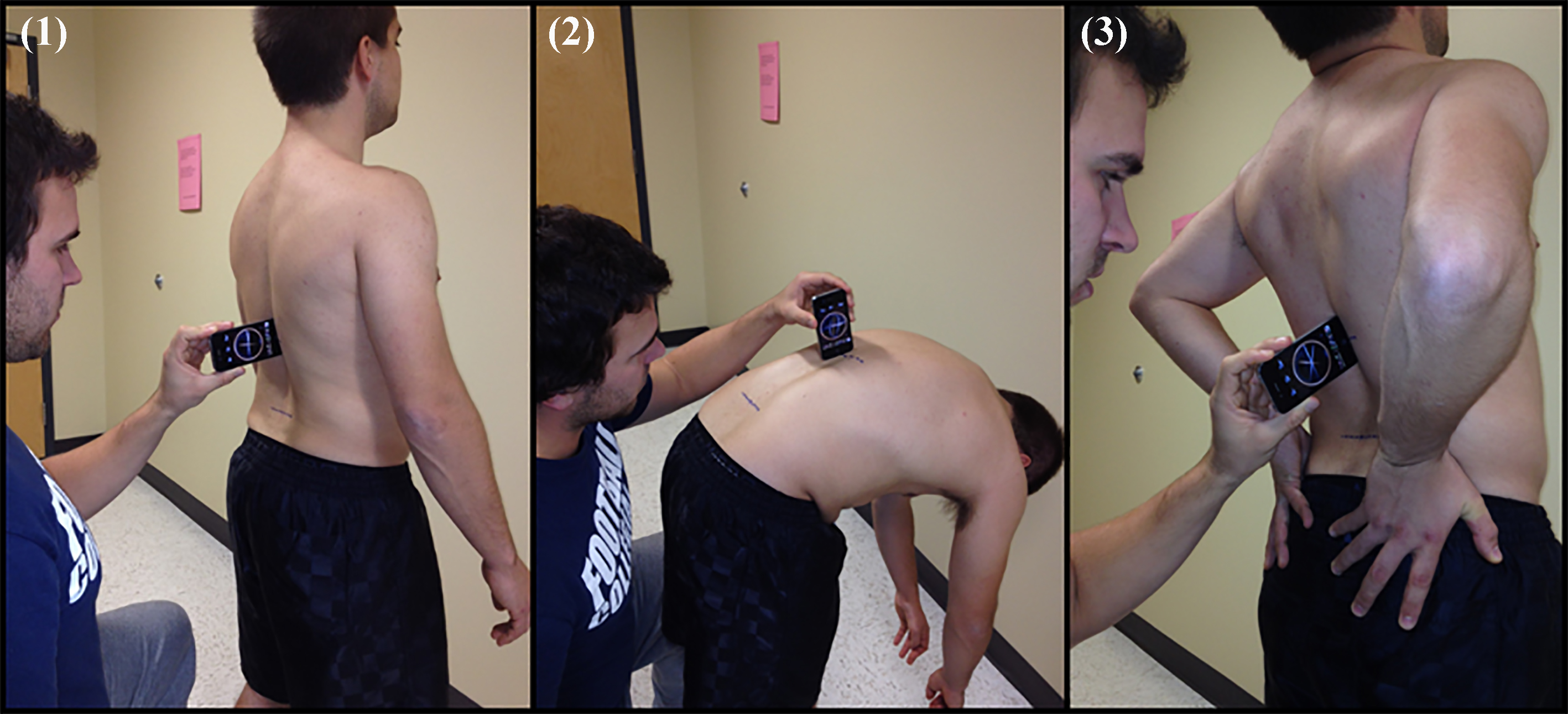
Measurement of the range of motion of the lumbar spine in the frontal plane: (1) starting position, (2) left lateral flexion end position, (3) right lateral flexion end position.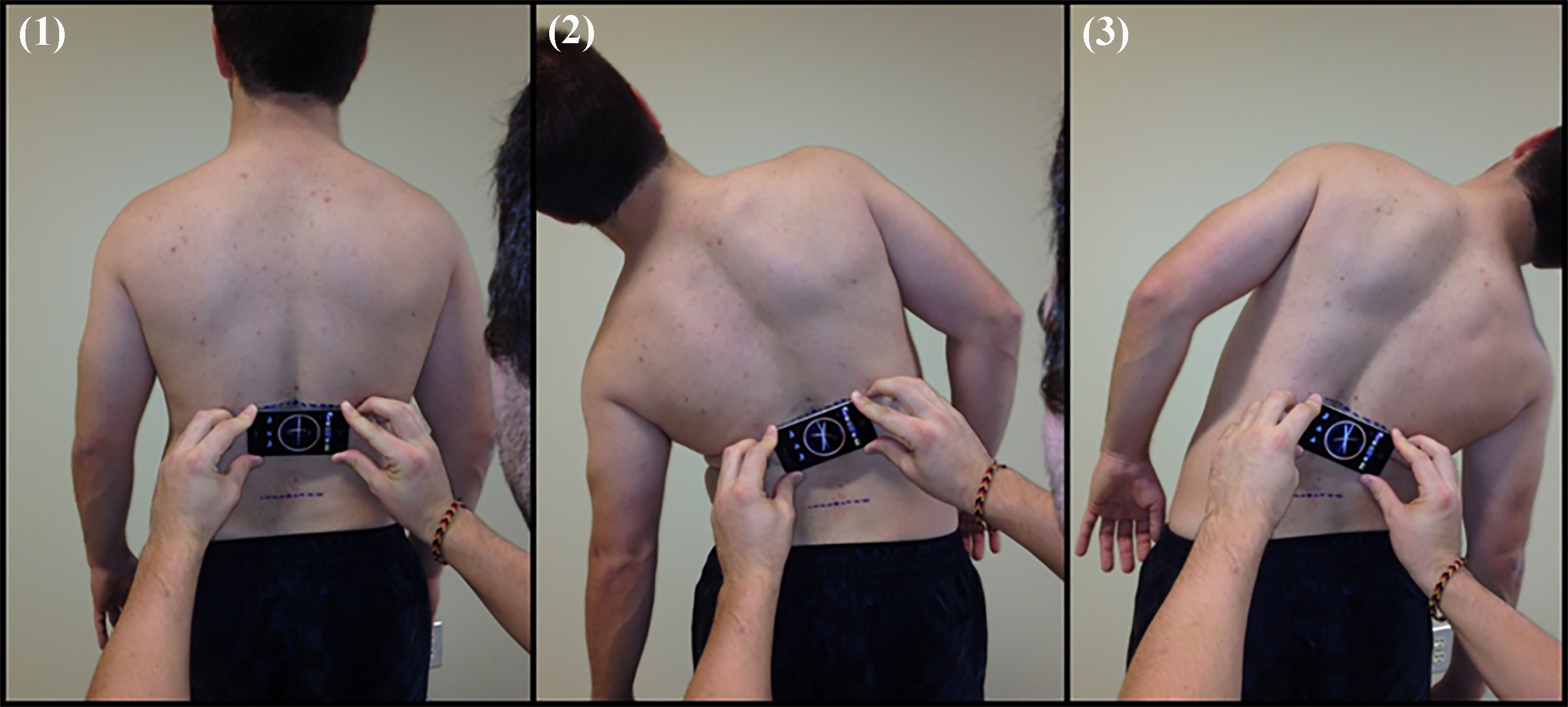
Each session lasted approximately one hour and involved two to four participants, each participant was evaluated one at a time. An observer noted the measures (angles) verbally given by each evaluator. The participants had to perform full active movements of lumbar flexion, extension, and lateral flexion and were instructed to go as far as possible for each movement. The measurements of lumbar flexion and extension were taken by positioning the base of the iPod on the T12 spinous process, then on the S1 spinous process (Fig. 1). Measurements of right and left lateral flexion were taken by positioning the side edge of the iPod directly below the horizontal line drawn at the T12 spinous process (Fig. 2). The iPod was held tightly in place by the evaluator during the movement. Each movement was observed by the evaluator and corrected if any substitution occurred. The examiner made sure the device was positioned correctly through the movements and during the session. The order in which each movement was evaluated was randomly chosen by the observer in order to minimize a potential recall bias from the examiner. For the movements in the sagittal plane, ROM measurement was obtained by subtracting the T12-S1 angle measurements between the initial and final positions. The movements in the frontal plane were also obtained by calculating the angle difference between the initial and final positions of T12-S1. These calculations were based on the dual inclinometer and BROM protocols.
Each experimental session involved 3–4 patients at a time, where both examiners and observers entered two different rooms; each assessing all lumbar movements with the iPod. The examiners and observers then changed rooms clockwise until they had taken two measures of each movement for every participant. This allowed us to gather estimates of both intra- and inter-rater reliability.
Validity study procedure
The selected evaluator performed a third round of movements assessment with each participant, this time using the BROM (lateral flexion) and double inclinometer (flexion/extension). Measures of validity were always taken last in order to minimize a potential information bias.
Sample size
In order to observe a minimal correlation of 0.65 and with a Cronbach alpha below 0.05, a minimum of 24 subjects were required.
Reference values for the interpretation of the ICCs
Reference values for the interpretation of the ICCs
Intra-rater reliability in measurement of lumbar range of motion with iPod
To determine the intra- and inter-rater reliability of the instruments, the averages of intra-class correlation coefficients (ICC) were used for each movement more specifically, using a model 3 ICC (“two-way mixed model with measures of consistency”). The ICC is a statistical measure designed to quantify the importance and direction of association between the two variables. The values can vary between
ICCs were also used to calculate the validity. ICCs are in this case more accurate than Pearson’s correlation coefficient because they take into consideration certain bias such as systematic errors. For instance, if one examiner always measures 5
The level of significance was
Results
Intra-rater reliability
The results of the intra-rater reliability are presented in Table 3. Rater 1 obtained the highest ICCs ranging from 0.76 to 0.89 (
Inter-rater reliability
The results of inter-rater reliability are presented in Table 4. They were obtained by comparing the average of the range values for all movements between the two evaluators. The inter-rater reliability ICCs ranged from 0.72–0.89 (
Inter-rater reliability in measurement of lumbar range of motion with iPod
Inter-rater reliability in measurement of lumbar range of motion with iPod
Criterion validity of the iPod when compared to dual inclinometer and BROM
The validity results are shown in Table 5. By comparing the values obtained by the iPod and the values obtained with the gold standards (BROM and double inclinometer), we observed that the validity was high for all movements, with ICCs ranging from 0.65 to 0.89 (
Discussion
The objective of this study was to determine estimates of intra and inter-rater reliability as well as criterion validity of the iPod “Gyroscope” application for the measurement of lumbar ROM in healthy participants. The validity was determined by comparing the iPod’s measurements with the ones obtained by a dual inclinometer (flexion/extension) and the BROM device (lateral flexions).
Reliability findings
We found moderate to high intra-rater reliability for all movements. Similar results were observed by Kolber et al. [26] using the iPhone’s iHandy application, for flexion (ICC: 0.88) and lateral flexions (ICC: 0.82–0.84). They observed higher intra-rater reliability for extension (ICC: 0.80). However, they measured the thoracolumbar extension and lateral flexions, which is difficult to compare with our findings, as we measured isolated lumbar movements. Another study by Pourahmadi et al. [28] reported ICC scores slightly higher than ours using the “TiltMeter” application for the movement of flexion (ICC: 0.92) and extension (ICC: 0.91–0.92). These results could be explained by the fact that the evaluators in the later study were experienced clinicians whereas in our study, they were two novice physical therapy students. However, as all estimates of intra-rater reliability remain high (ICC
Inter-rater reliability estimates were found to be moderate for flexion and high for extension and lateral flexions. In comparison, Kolber et al. [26] (ICC: 0.88) and Pourahmadi et al. [28] (ICC: 0.89) observed higher inter-rater reliability for flexion and similar ICCs for the other movements. The difference between their results and ours could be explained by the fact that inter-rater reliability is affected by intra-rater reliability. Considering that evaluator #2 intra-rater reliability scores were in the “moderate” range, this may have had a direct impact on inter-rater reliability.
Validity findings
Lumbar ROM measurements with the iPod “Gyroscope” application were comparable (high validity) to those obtained with the gold standards for lateral flexion (ICCs
Strengths and limitations
Strengths
First, regarding the evaluators, the selection was based on their ability to use the device; those two who showed the highest intra-rater reliability scores during the preliminary tests were selected for reliability analysis. The same principle was used for validity analysis, where only one evaluator (highest intra-rater reliability score) took all measurements. This aspect made it possible to reduce sources of error occurring from the evaluator (a potential information bias). In addition, the iPod measurements were taken in a random order to minimize the examiners’ recall bias. In addition, the gold standard measurements with the dual inclinometer and the BROM, were taken following the two turns with the iPods – again to reduce the evaluators’ potential information bias (evaluators did not know the “real” ROM while taking measurements with the iPod). Finally, the evaluators were instructed to collect data in a random order and to obtain the raw angles for each measurement, as the final ROM value had to be calculated a posteriori to control for potential recall bias.
Second, regarding the participants, bias and errors were minimized as all participants received the same instructions before each measurement. In addition, the observers ensured the quality of the movements by alerting the examiner for any compensations. Also, participants performed a short “warm-up” session before measurements were taken – this allowed them to practice what was expected of them and prevented a gain in joint ROM after several repetitions. Clearly, efforts were made to isolate sources of error coming from the instrument tested.
Limitations
First, the collection was done only on healthy and young participants, which decreases the external validity of the study. Furthermore, the use of the dual inclinometer was cumbersome in high lumbar extension amplitude as well as in short-statured participants since both inclinometers came into contact at end-range.
Second, although many similar devices are equipped with a gyroscope, we wonder if our findings could apply to other types/brands of smartphones? Recently, Wellmon et al. [34] reported that Apple iPhones, LG Android phones, and Samsung SIII Android phones, all with different types of gyroscope, had very good concurrent validity (a mean difference of
Implications for practice
The use of mobile devices by healthcare professionals to enhance communication and information gathering (i.e. diagnosis, measurements) is clearly documented. Mobile applications can allow healthcare professionals to better obtain, manage, and use the clinical data they acquire [35]. Although our findings support that the iPod has sufficient reliability and validity to lead towards its clinical use, it would be important, prior to adoption, to improve instrument positioning and further examine instrument properties to use it with participants who experience low back pain.
Conclusion
This study supports the use of the “Gyroscope” application for the measurement of lumbar ROM for flexion, extension, and lateral flexion in healthy people. The iPod is an accessible device, easy to use, reliable, and valid. It presents a good potential for clinical use to objectify ROM deficits. Yet, as we provided evidence of validity via healthy subjects, it would be relevant to obtain estimation of reliability, validity, trueness, and minimal detection changes on participants experiencing low back pain.
Footnotes
Conflict of interest
None to report.