







Abstract
BACKGROUND:
Juvenile spinal osteochondrosis (JSO) affects vertebral endplates and may cause intervertebral discs alterations. The condition is typically related to pain, and weakness and shortening of trunk muscles. Sling suspension therapy (SST) has been shown to reduce lumbar pain effectively. It is, however, unclear whether SST is superior to other treatment methods in reducing pain, correcting posture, and activating trunk stabilizers in JSO.
OBJECTIVE:
In this study, we intended to compare the effectiveness of two different exercise modalities; Sling Suspension Therapy and Gym Ball Exercise in the treatment of JSO in adolescent girls.
METHODS:
A randomised controlled single centre clinical trial was carried out in an inpatient rehabilitation unit at a sanatorium. Forty adolescent girls (age 16.3
RESULTS:
Both groups demonstrated significant improvement in all measured outcomes. SST was more effective in reducing pain (
CONCLUSIONS:
Sling suspension therapy is more effective compared with Gym ball exercises in the treatment of juvenile spinal osteochondrosis in adolescent girls in terms of back pain, posture and endurance of trunk muscles.
Introduction
Anthropometric characteristics of subjects
Anthropometric characteristics of subjects
Juvenile spinal osteochondrosis (JSO) is a disorder characterized by osteochondrosis of vertebral epiphyses in childhood. In 1921, Scheuermann first described juvenile osteochondrosis affecting vertebral bodies [1]. The disease most commonly affects intervertebral discs. There might be several reasons, but the exact etiology of this disorder is unknown. The clinical picture of JSO is characterized by moderate pain, kyphotic posture, and limitations of spinal mobility [2]. It has been found that most patients with spinal osteochondrosis do not need surgical treatment, and the main aims of treatment are to reduce morbidity and decrease the duration of symptoms with supervised symptomatic conservative treatment [3]. Treatment depends on the severity of dystrophic processes and as a whole is aimed to slow down degenerative changes. Early accurate diagnosis and appropriate management will lead to improved prognosis [4]. Conservative treatment includes ice, electrotherapy, acupuncture, reloading taping techniques, soft tissue massage, and exercise [1]. Patients are advised to perform spinal strengthening exercises [4]. These exercises could be performed on stable and unstable surfaces and involve various methods and equipment.
One of the main tasks in the treatment of JSO related back pain is training of trunk stabilizing muscles [5]. This might be achieved by using Sling suspension therapy (SST) [6]. Another commonly used option in the treatment of JSO is a Gym ball, also known as Swiss ball, core training programmes that are popular trends in physiotherapy [7]. Both exercise modes are used in the treatment of back pain and muscle training in adolescents with JSO, but to the best of the authors’ knowledge, no study has compared SST with GBE in this population. Therefore, the purpose of this clinical trial was to compare the effectiveness of Sling suspension therapy to Gym ball exercise programme in patients with JSO in terms of back pain, endurance of trunk muscles, and standing posture.
This is a randomised controlled single centre clinical trial (ClinicalTrials.gov Identifier: NCT03851367). Ethical approval was granted by a local bioethics committee (BEK-KIN(M)-2016-7). All participants and their representatives were informed in detail of the purpose and procedure of the study and they signed an informed consent form. The study was conducted in accordance with the Declaration of Helsinki Ethical Principles and Good Clinical Practices.
Subjects
Subjects were recruited from an inpatient rehabilitation department, specializing in the treatment of children and adolescents with degenerative disorders. The inclusion criteria were JSO diagnosis confirmed by a medical doctor (according to ICD-10 Version: 2016 – M 42.0), female, age 16–17 years, back pain for at least 12 weeks and subjects who had not received treatment specific to this condition, within the last 3 months. Exclusion criteria were severe postural or skeletal abnormalities and traumas, neuromuscular disorders, neuropathic pain. To avoid sex-specific differences in the tempo of maturation of bones [8], boys were excluded from the study.
Forty adolescent girls who were diagnosed with JSO were randomly assigned into two groups: Group 1 Sling Suspension Therapy (SST,
Procedures
All subjects from both groups participated in a 3-week individual physiotherapy programme supervised by senior physiotherapist consisting of 15 sessions 30 minutes each for back pain management, posture improvement, and trunk muscles strengthening exercise.
The SST program consisted of open and closed kinetic chain exercises aiming to stabilize and activate trunk muscles using single and multi-point suspension [9].
The other group performed GBE: inclined press-up, upper body roll-out, single-leg hold, and quadruped exercise with a contralateral arm and leg raise. Gym balls used in this study were in sizes of 45–55 cm according to the height of the subjects.
Both interventions aimed to activate weak trunk muscles, relieve pain and muscle spasm, prevent deformities, reduce stress across the joints, and enable relaxation. One of the most important aspects during each intervention was to maintain correct body mechanics and posture, i.e., the relationship of the head, shoulders, spine, hips, knees and ankles to each other. Exercises using different positions and planes were used to make these interventions not only effective but also interesting and variable. Balance pads, and palm dumbbell weights (0.5 or 1 kg) were also used during procedure. Physical load was increased gradually up to the limit when the patient could not maintain correct body alignment or felt pain; each set of exercises was followed by a 1-minute rest.
Outcome measures
Back pain in subjects was evaluated using the Visual Analog Scale (VAS) [10]. The participants were asked to report the ‘current’ pain intensity. A higher score indicates greater pain intensity: no pain (0–4 mm), mild pain (5–44 mm), moderate pain (45–74 mm), and severe pain (75– 100 mm).
Endurance of trunk muscles was tested as suggested by McGill [11] and the duration was recorded in seconds.
Trunk extensors were tested in the prone position with the upper body cantilevered out over the end of a test bench and with pelvis, knees, and hips secured (Fig. 1A). The upper limbs were held across the chest with the hands resting on the opposite shoulders. The subject was asked to hold the isometric posture at the level of the bench as long as possible. Failure occurred when the upper body dropped from the horizontal position.
Testing positions for muscle endurance: A – trunk extensors; B – trunk flexors; C – lateral trunk musculature.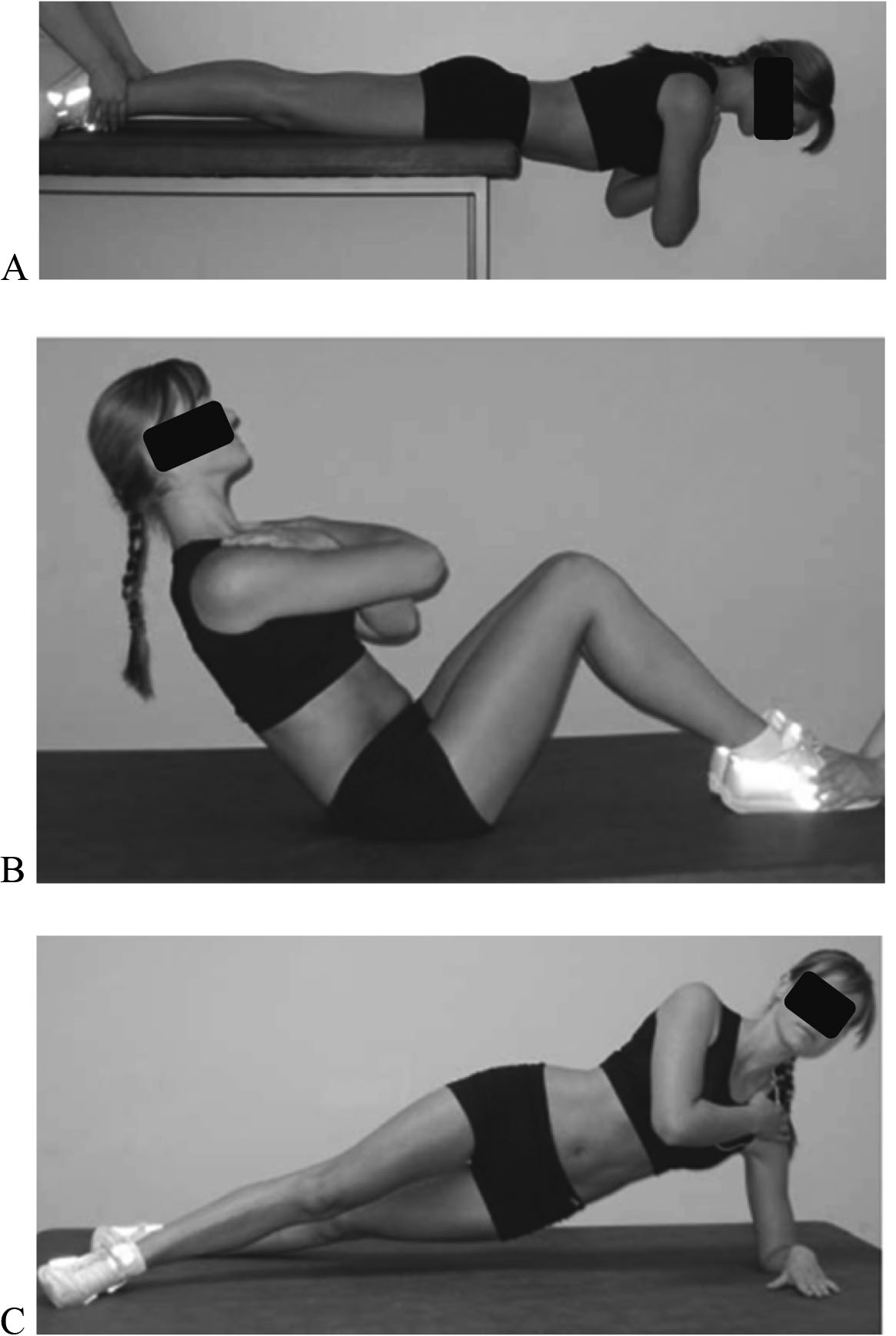
Trunk flexors were tested in a sit-up position with the back at 60
Lateral trunk musculature was tested with the person lying in full side – bridge position. Lower limbs were extended, and the top foot was placed in front of the lower foot for support (Fig. 1C). The subjects supported themselves on one elbow and on their feet while lifting their hips off the floor to create a straight line along their body length. The uninvolved arm was held across the chest with the hand placed on the opposite shoulder. The subject was asked to hold the isometric posture as long as possible. Failure was determined when the participant could no longer maintain this position.
Outcome measures before and after intervention
Posture evaluation chart.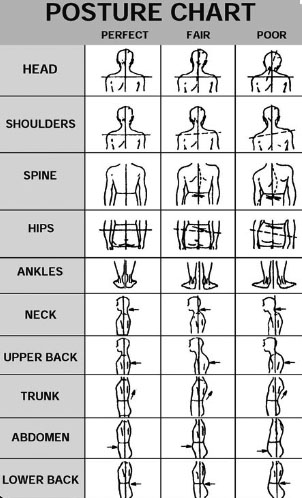
Posture was evaluated by a commonly used clinical assessment technique – the New York Posture Rating Chart (Fig. 2) [12]. In an attempt to minimize the data collection error and avoid bias in measurements, one experienced examiner evaluated all the study participants’ postures both in pre- and post-intervention assessment. The examiner was blind to the scope of the study and to the group that the subjects belonged to. For positioning, the subjects were instructed to stand comfortably barefooted in a normal standing position in front of a posture evaluation grid (160
All recordings were performed at baseline and after the 3-week intervention period by the same assessor.
All analyses were performed using SPSS version 19 for Windows. Quantitative variables were expressed as mean
Results
Forty adolescent girls participated in the study, and their mean age was 16.3
The back pain decreased after both types of intervention (
SST and GBE had a great impact on the endurance of trunk musculature, which increased significantly (
We also compared alignment of different body segments between the groups and found that after both interventions most of the body segments improved their alignment (Table 3); however, comparison of the groups after interventions demonstrated that only two body segments (shoulders and spine) in the SST group had better alignment when compared with the GBE group (shoulders
Evaluation of posture in respect to every body segment before and after intervention
Evaluation of posture in respect to every body segment before and after intervention
The purpose of this study was to analyse and compare the changes in back pain, endurance of trunk muscles, and posture, by applying two different exercise modalities to adolescent girls with juvenile spinal osteochondrosis (JSO) in an inpatient rehabilitation unit. One study group received physiotherapy sessions using Sling suspension therapy other exercised on Gym balls. The groups matched for age, height, weight, and BMI as well as measures of back pain, posture, and endurance of trunk muscles before intervention.
Scheuermann’s disease is a deformity of the spine that develops prior to puberty and becomes most prominent during the adolescent growth spurt [14], thus to avoid sex differences in growth spurt timing, we excluded males from the study.
Back pain was a symptom of JSO in all 40 participants. As pain relief is one of the most important factors in the rehabilitation process [14], it ought to be stated that both interventions helped to reduce it significantly from moderate to mild. Pain decrease was more evident in the SST group (
Chronic pain frequently leads to abnormal posture [16], which can be defined as an imbalance between muscle groups. The analysis of our pre-intervention posture evaluation showed that more than half of the evaluated body segments were not in correct alignment. Increased thoracic kyphosis occurs in a great number of cases [1] and it was visible in evaluating posture of shoulders in our study. After both interventions, the total posture score increased in both groups (
We used static endurance tests in this study, because these are considered as safe and reliable core stability related measurements [19]. In a study of Carter et al. [20], the results of a 10-week core stability Gym ball exercise programme applied twice a week for 30 minutes showed significant improvement in back muscle endurance test. Although our study lasted for three weeks, we found significant improvement in trunk muscle endurance. The results of our study were in line with the previous research revealing significant improvements in back endurance tests in addition to decreased lower back pain [21].
Various rehabilitation and exercise programs have been developed to increase lower back muscle strength and correct imbalanced muscle strength in patients with back pain [22]. Our study demonstrated an increase of trunk muscle endurance related to a decrease of back pain.
It ought to be noted that to date there are no publications in the literature comparing the effect of Sling suspension therapy and Gym ball exercise programmes. SST has been shown to improve functional movement patterns more effectively than traditional exercise by creating a challenging and pain free environment for movement retraining [17]. In our study SST had a greater effect on measured outcomes compared to GBE. Benefits of Gym ball core training exercises that facilitate spinal stability and balance have often been emphasized by researchers in the development of strength and endurance, flexibility, and neuromuscular control as a cost effective and enjoyable way to treat and prevent back pain [21, 23, 24]. However, literature is scarce in regard to SST training.
Rehabilitation is recommended to relieve pain and improve posture by reducing kyphosis [14]. In our study, we were not able to take accurate measures, e.g. by imaging, of the angle of kyphosis, but relied on a widely used clinical observational measurement of the whole spinal posture [12]. These results therefore, may be useful for the clinicians when monitoring the effects of their intervention in everyday rehabilitation practice, where the support of X-ray and other imaging are not available and justified [25].
The small number of subjects in the groups and the short follow-up period can be considered as the main limitations of the study, but the intensity of the interventions seems to compensate for that factor to achieve statistically significant results.
Conclusion
The findings of this study may be helpful for daily clinical rehabilitation practice in order to develop effective and attractive treatment programs for adolescents with juvenile spinal osteochondrosis. The present study showed that Sling suspension therapy is more effective than Gym ball exercises in the treatment of juvenile spinal osteochondrosis in adolescent girls in terms of back pain, posture and endurance of the trunk muscles.
Footnotes
Conflict of interest
No commercial party having a direct financial interest in the results of this research has or will confer a benefit upon the authors or upon any organization with which the authors are associated. The authors have no conflict of interest to report.