





Abstract
BACKGROUND:
Impairment in both the motor and cognitive aspects of postural control is a critical issue in patients with chronic low back pain (CLBP) who experience high pain anxiety (HPA).
OBJECTIVE:
This study aimed to compare the effects of cathodal and anodal transcranial direct current stimulation (c-tDCS and a-tDCS) over the dorsolateral prefrontal cortex (DLPFC) on postural control during cognitive postural tasks in CLBP patients with HPA.
METHODS:
This study included 66 patients randomly assigned to three groups: DLPFC a-tDCS, DLPFC c-tDCS, and sham tDCS. All groups received 20 minutes of tDCS, but the stimulation was gradually turned off in the sham group. Postural stability indices were assessed using the Biodex Balance System.
RESULTS:
Both the a-tDCS and c-tDCS groups showed a significant reduction in most postural stability indices at static and dynamic levels after the interventions (immediately, 24 hours, and one-week follow-up) during the cognitive postural task (
CONCLUSION:
Based on the results, both a-tDCS and c-tDCS over the DLPFC had positive effects on postural control during cognitive postural tasks in CLBP patients with HPA.
Keywords
Introduction
Chronic low back pain (LBP) is a prevalent and costly musculoskeletal disorder in today’s society, affecting at least 70–80% of people at some point in their lives [1, 2]. Pain-related anxiety and the resulting impairment in cognitive and postural aspects of movement are common problems in patients with chronic low back pain (CLBP) [3, 4, 5]. Patients with higher pain-induced anxiety display deficits in adapting their posture to environmental challenges during cognitive-postural dual tasks [6]. Posture control during standing and walking relies heavily on cognitive functions and the visual, vestibular, and somatosensory systems [7, 8]. Pain-induced anxiety has been shown to affect both the motor and cognitive aspects of postural control in CLBP patients [5]. Impaired postural control affects task performance and increases postural impairment in CLBP patients with pain-induced anxiety [9, 10]. Gradually, postural impairments can lead to dysfunction of the postural muscles, increase the frequency of acute exacerbations of LBP, and ultimately increase the risk of falls [16].
The dorsolateral prefrontal cortex (DLPFC) is a primary brain region involved in the cognitive aspects of motor tasks [11], attention [12], and the ability to perform cognitive-motor dual tasks [13, 14]. Additionally, neuroimaging studies have suggested that the DLPFC is involved in the control of standing and walking [15]. Evidence indicates that functional and structural changes in certain areas of the cerebral cortex, such as the DLPFC [13, 14], are leading causes of postural disturbances following pain-induced anxiety in CLBP patients.
Recently, transcranial direct current stimulation (tDCS) has emerged as a promising non-invasive method to address cognitive-motor deficits and limitations in postural control. This procedure is painless and has minimal or no side effects [16, 17]. TDCS can modulate cortical functions and facilitate neuroplasticity [18]. Several studies have shown the potential benefits of anodal tDCS (a-tDCS) over the DLPFC in improving postural control during dual tasks and cognitive functions [16, 17, 19, 20, 21]. Some studies have found that a single session of a-tDCS over the DLPFC can immediately enhance neural activity in this region and improve the allocation of cognitive resources during walking and standing under cognitive dual-task conditions in healthy young and older adults [22, 23, 24, 25]. Other studies have suggested that a-tDCS over the DLPFC may reduce the costs associated with dual tasks by improving the allocation of cognitive resources [26, 27]. On the other hand, some studies have shown that cathodal tDCS (c-tDCS) over the DLPFC can significantly reduce fear and modulate fear memory more effectively than a-tDCS [28, 29, 30]. However, many studies have reported impaired cognitive processing in chronic pain patients following pain-induced anxiety [31, 32]. Additionally, the literature has indicated that pain-induced anxiety affects both the motor and cognitive aspects of postural control in CLBP patients [14, 33, 34]. Therefore, c-tDCS over the DLPFC may help reduce the excitability of this region, potentially disrupting the consolidation phase of anxiety memory [29, 30, 35]. Thus, the main objective of this study was to compare the effects of a single-session c-tDCS and a-tDCS over the DLPFC on postural control during cognitive-postural dual tasks in CLBP patients with HPA.
Materials and methods
The Human Ethics Committee of the National Institute for Medical Research Development (NIMAD) approved this randomized, double-blinded, sham-controlled study (IR.NIMAD.REC.1398, 251). The study was registered as a clinical trial on the Iranian Registry of Clinical Trials (IRCT20151228025732N46). In addition, the ethical standards laid down by the Declaration of Helsinki were followed in this study. All participants completed the informed consent form before enrolment.
The inclusion criteria were participants who had suffered from LBP for more than six weeks or recurrent LBP with at least three episodes over the past 12 months, a pain score of less than three out of ten on a visual analogue scale (VAS) on the assessment day [36], pain-related anxiety with a score more than 30 on the Pain Anxiety Symptoms Scale (PASS) [37], aged 20–45 and right-handed. On the other hand, the exclusion criteria were any history of neurological diseases, any history of psychological illnesses, the presence of any signs of radiculopathy or root lumbar spinal cord involvement, structural deformities in the spine or the lower extremities, and any abnormalities in the vestibular system [38, 39].
Flow diagram of participant’s eligibility assessment.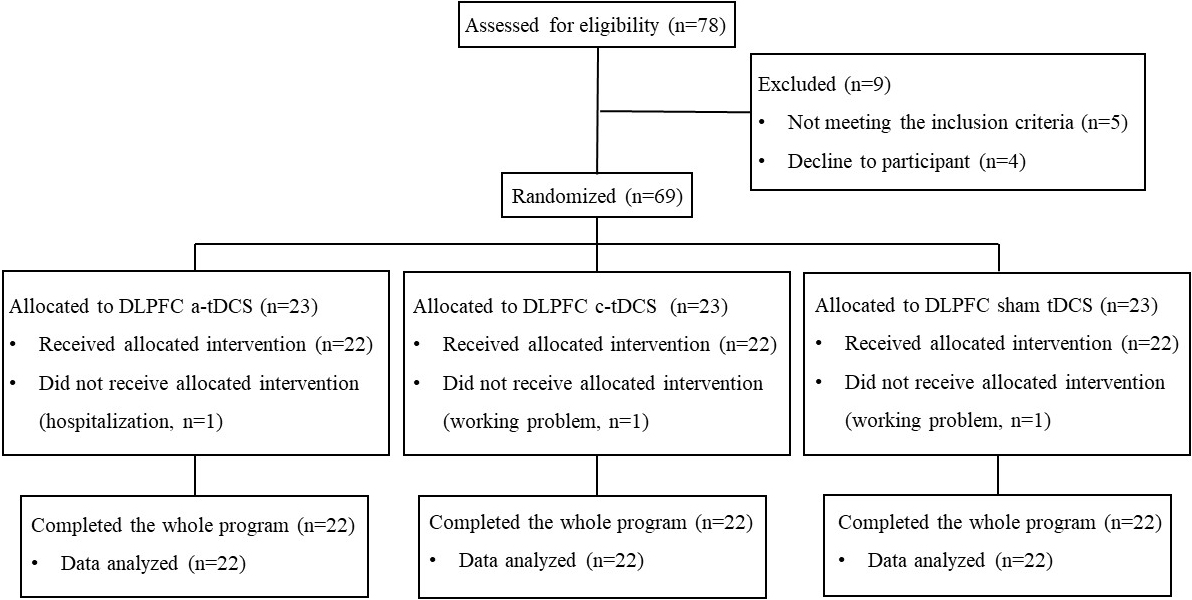
Based on 78 CLBP patients with high pain-related anxiety, 69 patients met the inclusion and exclusion criteria and were randomly assigned to three groups. Three patients were unable to complete their allocated interventions due to personal reasons. Therefore, the data were only analysed for 66 participants (
The sample size of the present study was calculated using Cohen’s table, based on the effect size determined by the data from the first 20 patients. This sample size allowed for assessing the effects of DLPFC a-tDCS and c-tDCS on postural stability indices during dual cognitive-postural tasks with a 95% confidence interval (CI) and a power of 80%. This statistical table summarizes the relationship between the effect size, degree of freedom, power, and the required sample size. The groups included: 1. a-tDCS over DLPFC, 2. c-tDCS over DLPFC, and 3. sham tDCS over DLPFC. In this study, one researcher administered the tDCS applications, and another researcher, blinded to the treatment allocations, assessed the outcome measures. All participants were also blinded to the nature of the experimental conditions (sham and active applications of tDCS) and the grouping.
A tDCS device (Model Neurostim2; Medinateb Company, Iran) was applied using large electrodes (5
The primary outcome measures were indices of postural stability in static and dynamic conditions. The Biodex Balance System (BBS) (302–950 model; Biodex Medical Systems, Inc., USA) was used to assess postural stability. This reliable device has one static and 12 dynamic stability levels to assess static and dynamic balance indices [46, 47]. Based on a pilot study, static levels 4 and 7 of BBS were determined as stable, low, and high instability testing conditions, respectively. First, participants were asked to perform postural standing tasks on different levels of BBS. In this condition, the participants stood with both feet on static and two dynamic levels of BBS (7 and 4) under open and closed eyes conditions. The static and dynamic postural stability index data (including anterior-posterior stability index (APSI) and medial-lateral stability index (MLSI)) were recorded after each test [48]. The outcome measures were evaluated before, immediately, 24 hours, and one week after the interventions.
Demographic data and baseline values for the participants in DLPFC a-tDCS, DLPFC c-tDCS and sham groups (Mean
SD: Standard Deviation, APSI: Anterior-posterior stability index, MLSI: Medial-lateral stability index, OSI: Overall stability index, S: Static, L7: Level 7 of Biodex Balance System, L4: Level4 of Biodex Balance System.
The auditory Stroop task (AST), as a cognitive task, was used during the postural task to provide the dual-task condition [49]. The AST consisted of “high” or “low” pitch words presented by a speaker in either a high or low pitch during 30-second tests. The test concluded with either congruent (e.g., the word “high” spoken in a high pitch) or incongruent (e.g., the word “high” spoken in a low pitch). During the AST, participants were asked to respond verbally by identifying the pitch of the voice, not the spoken word, as quickly and accurately as possible [49]. The AST program was written by a programmer to execute in the MATLAB software (R2018b; Mathworks, USA). The error rate (ER) (amount of errors/number of auditory signals) and the average reaction time (RT) were recorded during each trial. RT was calculated from the time difference between the onset of the auditory stimulus heard from a headphone and the onset of the participant’s verbal response [50]. Words were presented for 500 ms, and the participants had to answer quickly. The interval between the two consecutive stimuli was randomly set between 2000 to 3000 ms. Therefore, participants could not anticipate the initiation of stimuli. All reactions with response delays over 3000 ms were not recorded because they exceeded the interval between the two stimuli [49]. All participants were given 5 minutes of rest after each test [48]. Verbal responses to the auditory stimuli were recorded through a microphone attached to the laptop system (A4TECH). Then, the RT and ER of each response were calculated using MATLAB software in Microsoft Office Excel 2016 to check the learning phase during tests in all groups [48, 49].
All participants were checked for any side effects of the a-tDCS or c-tDCS during the interventions. The existence and severity of possible side effects, such as tingling, burning, and itching sensations under electrodes during or after the intervention, were determined by a questionnaire [51]. The questionnaire contained rating and numeric analogue scales (e.g., 0
SPSS software version 22 was used to analyze the data. The normality of data distribution for tested variables was assessed by a Kolmogorov-Smirnov test. The one-way Analysis of Variance (ANOVA) was used to assess the baseline values among the groups. A general linear mixed model repeated measure three-way ANOVA was used to assess the main effects of group (active a-tDCS, active c-tDCS, and sham a-tDCS), time (before, immediately, 24 hours, and one week after intervention), and dynamicity (static and dynamic) and their interactions on the postural stability indices.
The demographic details and baseline data for each group are shown in Table 1. As can be seen, there are no significant differences among the groups in variables such as age, gender, body mass index, RT, ER, and baseline postural stability indices in both static and dynamic levels of seven and four of the BBS in open and closed eyes conditions (
ANOVA results for the effects of DLPFC a-tDCS, DLPFC c-tDCS and sham tDCS on postural stability indices during different time of assessment in static and dynamic postural tasks at open and closed eyes conditions
ANOVA results for the effects of DLPFC a-tDCS, DLPFC c-tDCS and sham tDCS on postural stability indices during different time of assessment in static and dynamic postural tasks at open and closed eyes conditions
APSI: Anterior-posterior stability index, MLSI: Medial-lateral stability index, OSI: Overall stability index.
The mixed model repeated measure ANOVA showed significant group
The comparison of anterior-posterior stability indices (APSI) (Mean 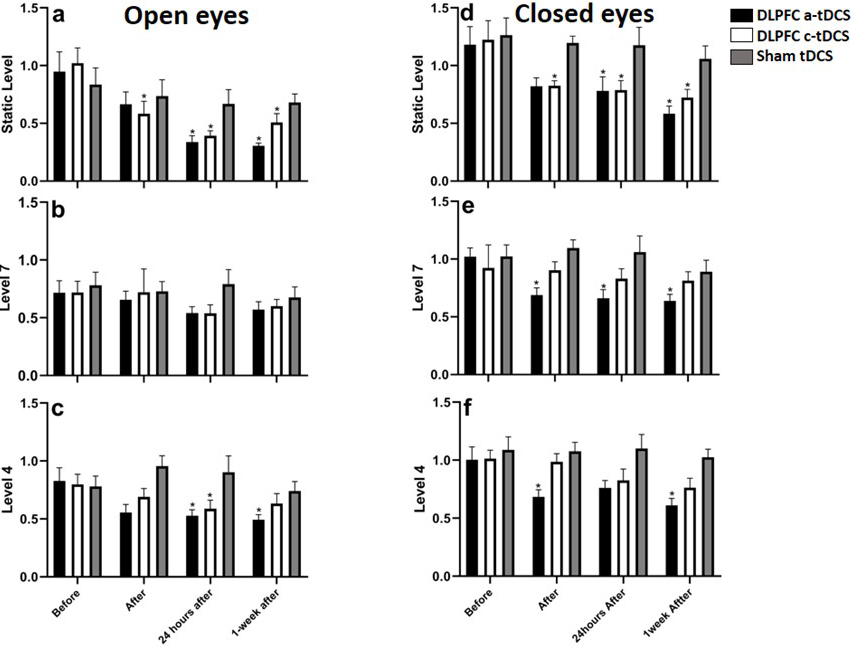
The comparison of mediolateral stability indices (MLSI) (Mean 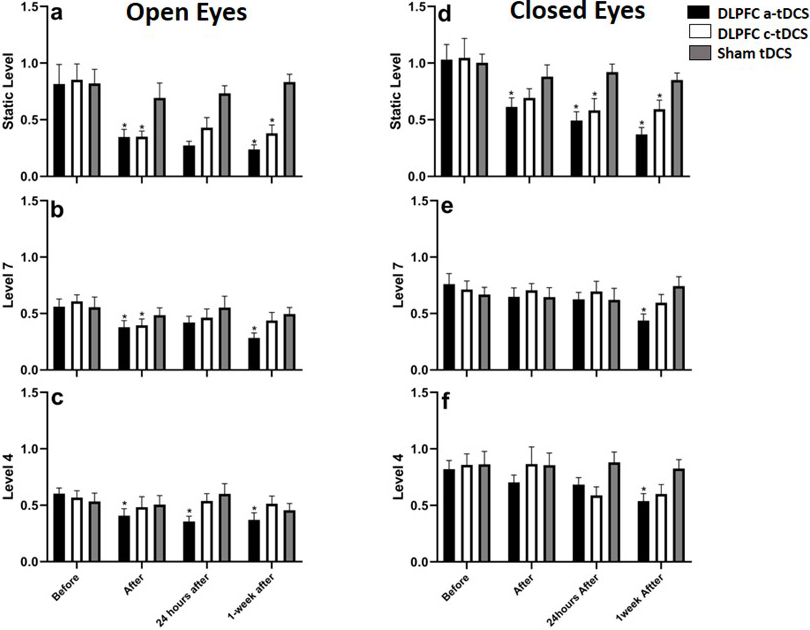
The comparison of overall stability indices (OSI) (Mean 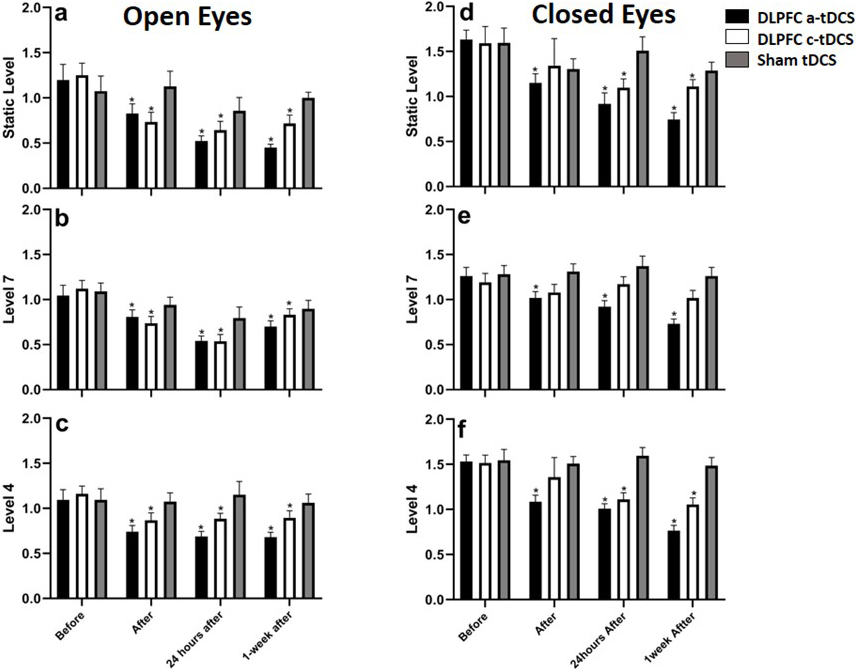
Pair-wise comparison analysis among DLPFC a-tDCS, DLPFC c-tDCS and sham tDCS groups on postural stability indices in static and dynamic postural tasks at open and closed eyes conditions
SD: Standard Deviation, APSI: Anterior-posterior stability index, MLSI: Medial-lateral stability index, OSI: Overall stability index, S: Static, L7: Level 7 of Biodex Balance System, L4: Level 4 of Biodex Balance System, T1: before the intervention, T2: immediately after the intervention, T3: 24 hours after the intervention, T4: one-week after the intervention.
Post hoc analyses using Bonferroni correction indicated a significant reduction in most postural stability indices at both static and dynamic levels in both open and closed eyes conditions in a-tDCS and c-tDCS groups after interventions (immediately, 24 hours and one-week follow-up) (Figs 2, 3, and 4,
All participants completed the interventions with minimal side effects. Itching was a common side effect of a-tDCS (anodal electrode: 2.6
There was a significant decrease in the postural stability indices at most static and dynamic levels of BBS during both open and closed eyes conditions, immediately, 24 hours, and one-week follow-up in both the a-tDCS and c-tDCS groups compared to the sham tDCS group. Additionally, the efficacy of a-tDCS was observed to be greater than that of c-tDCS in improving postural stability during dual cognitive postural tasks in CLBP with HPA.
The current study hypothesized that a single session of c-tDCS and a-tDCS could improve postural control during cognitive-postural dual tasks compared to sham tDCS in CLBP patients with HPA. The results confirmed this hypothesis and showed the efficacy of DLPFC tDCS compared to sham tDCS in decreasing the postural stability indices during dual cognitive postural tasks. Although there are no similar studies on this specific group of patients in the literature, the findings of the current study align with similar studies conducted on other patient groups [1, 41, 42, 52, 53]. For example, Lattari et al. found a therapeutic effect of a single session of 20-minute 2 mA a-tDCS over the left DLPFC on balance and functional mobility in patients with Parkinson’s [52]. Schneider et al. also evaluated the effects of three sessions of a-tDCS over the DLPFC and M1 simultaneously on the motor cognitive functions in healthy older adults. They found that tDCS delivered during walking performance decreased the dual-task cost of walking in older adults when they were tested immediately after stimulation. These results support the idea of state-dependent impact of neuro-modulation, which can lead to more optimal neuro-rehabilitation. The results also indicated the positive effect of a-tDCS on postural stability during dual cognitive postural tasks in CLBP patients with HPA.
The current study also showed a significant reduction in postural stability indices after c-tDCS compared to sham tDCS, which can be attributed to homeostatic mechanisms that reverse the effects of applying anodal or c-tDCS [54]. While some studies have shown deterioration in postural stability indices following the application of c-tDCS on some behavioral tasks [55, 56, 57, 58], others have reported improvements in the outcomes of complex cognitive-motor tasks [59, 60, 61]. Reis et al. showed that the cathodal-inhibitory effects (deterioration of behavioral outcomes) can be reversed during cognitive functions compared to motor training alone [61]. Some other studies on healthy individuals have indicated improvements in postural stability indices during postural tasks after applying c-tDCS [62, 63, 64]. Complex cognitive tasks such as postural balance require broader cortical networks, including bilateral interactions. Therefore, both a-tDCS and c-tDCS may improve stability indices in complex cognitive-motor tasks like postural balance [65].
Both a-tDCS and c-tDCS can positively affect postural control during dual cognitive postural tasks, but the efficacy of a-tDCS is significantly greater than that of c-tDCS. Cognitive postural tasks involving complex cognitive networks and bilateral interactions appear to require broader cortical networks [66]. In these complex cognitive-motor conditions, both c-tDCS and a-tDCS may prompt high activations of the target regions [67]. Overall, the effects of tDCS may depend on factors such as the stimulation area [68], the type of task [69], the intensity of stimulation [70], and the condition of the participants (presence of fear or anxiety) [71].
There were some limitations to this pilot study. The first limitation was the single-session intervention; therefore, future studies should plan multiple-session interventions to assess the long-term effects of interventions on postural control in CLBP patients with HPA. Second, the impact of DLPFC tDCS was evaluated in this study, but the effects of tDCS on postural control during cognitive postural tasks should be compared among different brain regions such as the DLPFC, cerebellum, primary motor cortex, and posterior parietal cortex. Another limitation was the lack of cortical activity assessment during and after interventions. Future studies should use methods like transcranial magnetic stimulation and electroencephalography (TMS-EEG) to assess the excitability of the DLPFC and reveal the mechanisms of brain action and cortical changes.
Conclusion
Based on the results, there were therapeutic effects of both a-tDCS and c-tDCS of DLPFC, with more efficacy of a-tDCS on static and dynamic postural control during dual cognitive postural tasks in CLBP patients with HPA. Then, the application of both DLPFC a-tDCS and c-tDCS, especially DLPFC a-tDCS, is suggested for therapists to improve the postural stability in CLBP patients with HPA.
Author contributions
Mona Masoudi: Investigation, Data Collection, Writing – Original Draft. Fatemeh Ehsani: Conceptualization & Methodology, Data Analysis, Review & Editing Supervision. Mona Ramezani: Data Collection, Writing – Original Draft. Rozita Hedayati: Data Collection, Writing – Original Draft. Shapour Jaberzadeh: Conceptualization & Methodology, Review and Editing.
Data availability
The data that support the findings of this study are available from the corresponding author upon reasonable request.
Ethical approval
The study was approved by the Human Ethics Committee of the National Institute for Medical Research Development (NIMAD) (IR.NIMAD.REC.1398, 251) and registered as a clinical trial on the Iranian Registry of Clinical Trials (registration number IRCT2015 1228025732N46). Informed consent was obtained from all participants prior to enrolment.
Supplementary data
The supplementary files are available to download from http://dx.doi.org/10.3233/BMR-230229.
Footnotes
Acknowledgments
The authors would like to thank the National Institute for Medical Research Development (NIMAD) for their cooperation and for providing the facilities and funding for this work.
Conflict of interest
The authors declare no conflicts of interest related to this study.