






Abstract
BACKGROUND:
Patients with Parkinson’s disease frequently experience problems with balance and gait.
OBJECTIVE:
This study examined the influences of regular ankle isokinetic muscle strength training on muscle strength and balance ability amongst elderly women with mild Parkinson’s disease.
METHODS:
A total of 55 elderly women with mild Parkinson’s disease were randomly divided into the experimental group (
RESULTS:
After 16 weeks of training in the experimental group, the peak torque (PT) of ankle (average of the left and right sides) dorsiflexion, plantarflexion, eversion and inversion, and the standing balance index revealed that the left and right stability and overall stability indexes significantly increased by 25.9%, 43.5%, 62.7%, 82.8%, 37.1% and 32.2%, respectively (
CONCLUSION:
This study determined that ankle isokinetic muscle strength training improved ankle dorsiflexion, plantarflexion, eversion and inversion muscle strength, and balance ability amongst elderly women with mild Parkinson’s disease. However, it did not improve stability in the anterior and posterior directions. Ankle inversion muscle strength is more likely to affect overall balance.
Introduction
Age-related decline in postural control is an important sign of falling risk amongst the elderly [1]. Postural control is measured through balancing ability [2], muscle strength [3] and neuromuscular responses [4], along with proprioceptive [5], visual [6] and vestibular [7] functions. Improved lower limb joint muscle strength prevents falling [8, 9] in older adults, and resistance training can improve lower limb muscle strength [10, 11, 12]. The ankle is close to the ground, and surrounding forces affect its stability [13, 14]. In addition, the ankles exert stronger effects on human postural control than the hips [15]. Enhancing the dorsiflexion, plantarflexion, eversion and inversion strength of the ankle joint can reduce the occurrence of falls [9]. On the basis of a randomised controlled experiment, 6 months of isokinetic muscle strength training on the knee joint improved one-leg standing time and knee proprioception [16]. Moreover, 4 weeks of isokinetic muscle strength training on the ankle improved balance ability and ankle strength amongst young adults [17]. Parkinson’s disease is a neurodegenerative disorder that causes damage to the basal ganglia and other regions of the brain. Patients with Parkinson’s disease frequently experience problems with balance and gait [18]. The primary reason for poor balance in Parkinson’s disease is damage to the basal ganglia, which affects the regulation of muscle tone and movement. This condition leads to symptoms, such as muscle stiffness, tremors and difficulty in moving [19]. Previous studies have shown that the decline in lower limb muscle strength in patients with Parkinson’s disease can affect their daily mobility [20, 21], and these patients can delay the decline in their muscle strength caused by the disease through strength training. The training method generally uses fixed-load resistance, such as dumbbells [22, 23]. Isokinetic muscle strength training allows the subject’s joints to exert greater resistance at each movement angle during movement. Compared with traditional strength training, isokinetic muscle strength training exhibits certain advantages in improving joint strength [24]. Strengthening the ankle can help improve the stability and strength of the ankle joint, helping prevent falls caused by ankle instability. However, the effects of isokinetic muscle strength training of the ankle on the balance ability of elderly patients with mild Parkinson’s disease remain to be clarified. For example, whether training improves balance ability in the left and right directions or the front and rear directions is still unclear.
The current study used an isokinetic force instrument to examine elderly women with mild Parkinson’s disease who underwent training in ankle dorsiflexion, plantarflexion, eversion and inversion to elucidate the effects of regular ankle isokinetic muscle strength training on the balance ability and muscle strength of the elderly. This study investigated how targeted ankle isokinetic muscle strength training affects the dorsiflexion, plantarflexion, eversion and inversion strength of the ankle joint and balance in elderly women with mild Parkinson’s disease to develop measures for preventing falls amongst the elderly. This study hypothesised that ankle isokinetic muscle strength training will improve muscle strength and balance in this population.
Materials and methods
Study design
A randomised trial was conducted. Ethical approval was obtained by the Ethics Committee and approved by Chengdu University of Traditional Chinese Medicine (No. 202206). All participants provided written informed consent before testing.
Participants
This study cohort included older women with mild Parkinson’s disease who were recruited from the Neurology Department of Chengdu Sport Hospital, Chengdu, China. This study complied with the Declaration of Helsinki. Inclusion criteria were as follows: (1) aged 60–70 years old; (2) clinical diagnosis of idiopathic mild Parkinson’s disease (mild Parkinson is characterised by the following symptoms: resting tremor, which refers to slight tremors in the hands or feet, typically more pronounced at rest; bradykinesia, which means movements become slow but does not affect daily life; muscle rigidity, which means muscle stiffness but does not affect daily activities; postural instability, which refers to slight problems with body posture but does not affect balance) [25]; (3) willingness to exercise in the near future and (4) cognitive level as assessed by the Mini-Mental Status Examination score of
Participant selection flow diagram.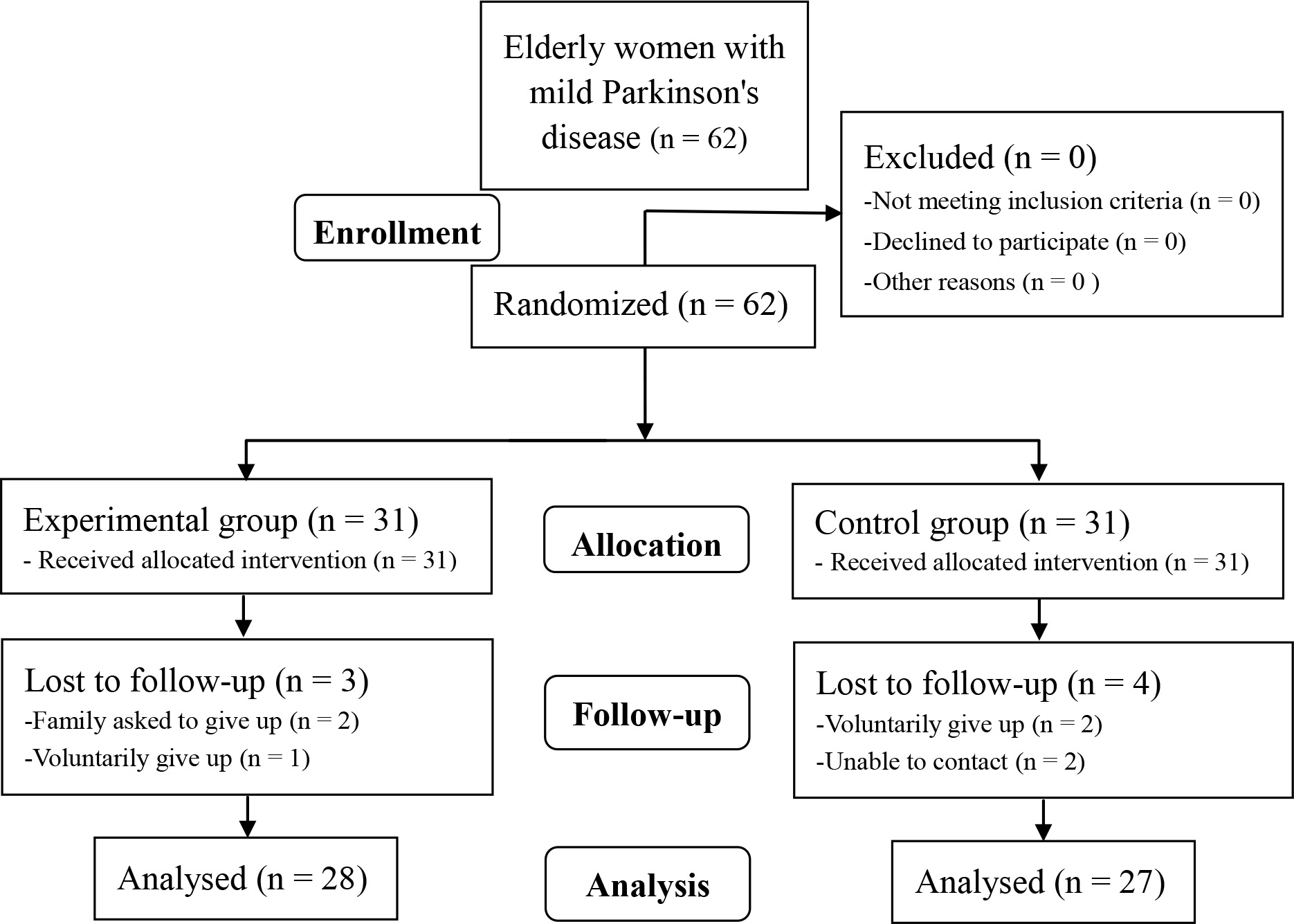
This study considered a two-group and pretest–posttest experimental design, with a sample dropout rate of approximately 15% based on the previous results of muscle strength training performed in elderly subjects [15]. G-power software was used for calculation, with an effect size of 0.3, a power of 0.8 and an
The participants in the experimental group performed ankle (left and right sides) isokinetic muscle strength training (concentric contraction), including dorsiflexion, plantarflexion, eversion and inversion, by using the IsoMed 2000 dynamometer system made in Germany. On the basis of the reference to the angular velocity (30∘/s) of the isokinetic muscle strength test of the ankle amongst the elderly [26], and the number of sets and repetitions of isokinetic muscle strength training [27], the isokinetic muscle strength training programme used in this study was as follows: the angle speed of each exercise was 30∘/s, the action was performed 10 times in each set and 3 sets of actions were performed with a 1 min break between sets. The whole study period lasted for 16 weeks, and exercise was performed 4 times a week for 20 min each session. The control group maintained their usual lifestyle without changes. No other training was performed to increase the balance or muscle strength of the ankles. Following the study of Cheng et al. [28], the participants were called or interviewed every 2 weeks to investigate their physical status.
At baseline and 16 weeks, the participants in both groups performed a test with three data collection periods, during which participant extensions were performed at 30∘/s by using the ankle (all test indicators were processed on the average of the left and right ankles). Then, peak torque (PT) was measured during dorsiflexion, plantarflexion, eversion and inversion. We used PT, which is the maximum torque output value of the relevant muscle contraction when the joints are undergoing movement, as an isokinetic test index. The unit of measure for PT is Nm. Thus, PT represents the maximum force of muscles or muscle groups [29, 30].
Balance ability test
Basic information of the study participants
Basic information of the study participants
Within-group and between-group comparisons. Note: Isokinetic strength test, the left and right ankle values are averaged; MLSI: Medial-lateral stability index; APSI: Anterior-posterior stability index; OSI: Overall stability index.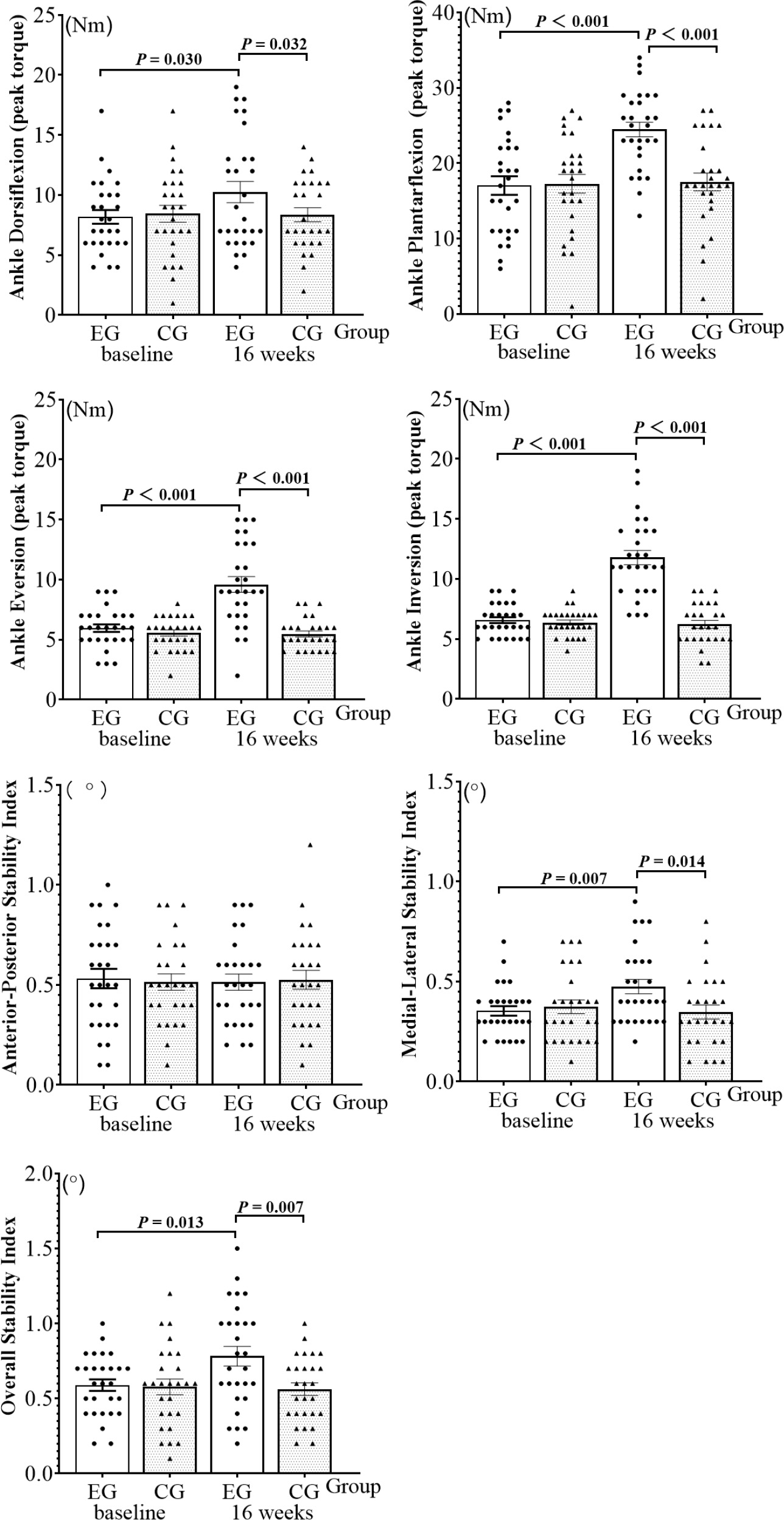
This study used the Biodex-SD (Biodex Medical Systems, Shirley, NY, USA) balance testing system to measure the balance ability of all participants whilst standing on both feet. After the tester pressed the start button, the participants were asked to stand on both feet and maintain their balance. Test time was 20 s, and the test was conducted three times. A 1 min break was given between tests. Then, we calculated the average value of the three results for analysis. The medial–lateral stability index (MLSI), anterior–posterior stability index (APSI) and overall stability index (OSI) were measured during one-legged standing on the dominant leg by using the software. The unit of measure was degrees. The higher the stability index, the better the stability of a participant [31].
SPSS 19.0 was used to calculate the mean
Results
This study found no significant differences between the two groups in terms of age, height or weight (
The comparison of baseline data between groups showed no statistically significant difference among dorsiflexion PT (
After 16 weeks, a univariate linear regression model was gradually established with the PT of ankle dorsiflexion, plantarflexion, eversion and inversion, MLSI and APSI as dependent variables and OSI as independent variable. By contrast, other models were excluded. A linear regression relationship was found between the PT of ankle inversion and OSI. The variable PT of ankle inversion (
Discussion
This study examined the influences of regular ankle isokinetic muscle strength training on muscle strength and balance ability amongst elderly patients with mild Parkinson’s disease. The results confirmed the study’s hypothesis, suggesting that ankle isokinetic muscle strength training will improve muscle strength and balance amongst elderly patients with mild Parkinson’s disease.
The results revealed that after regular ankle isokinetic strength training, the strength measures of elderly patients with mild Parkinson’s disease (dorsiflexion, plantarflexion, eversion and inversion) significantly improved. Moreover, the left and right stability and overall stability indexes were remarkably improved. Increased balance ability may be related to the promotion of strength and proprioception, and strength training exercises can activate the proprioceptive function, provide feedback for the joints, enhance stimulation of the mechanoreceptors (e.g. muscle spindles, Golgi tendon organs and Ruffini nerve endings) and improve body balance [32, 33]. The current study concluded that increased muscle strength around the ankle joint helped the participants increase their balance ability.
Few studies have used isokinetic muscle strength training to train elderly patients with mild Parkinson’s disease. An experimental group (haemophilic and non-haemophilic participants) underwent 6-week isokinetic muscle strength training in [16]. The results revealed that one-legged standing time and knee proprioception significantly improved in the experimental group compared with those in the control group [16]. In addition, young participants underwent 4-week ankle isokinetic muscle strength training in [17]. The results indicated that balance ability and ankle muscular strength in the experimental group significantly improved after the intervention [17]. A study of the lower limb joint strength and walking posture of elderly individuals with and without a history of falls revealed that the dorsiflexion strength of participants with a fall history was significantly decreased. Thus, the researcher proposed that the risk of falling can be reduced by increasing the movement and strength of the ankles [34]. Furthermore, 4 weeks of ankle isokinetic muscle strength training increased ankle joint torque and balance ability in the contralateral lower extremity of healthy young individuals [35]. On the basis of previous studies, the current study examined whether ankle isokinetic muscle strength training can improve balance in elderly patients with mild Parkinson’s disease. This study found that ankle isokinetic muscle strength training influenced the muscles around the ankles, suggesting that balance was indirectly improved.
The APSI of the participants exhibited slight changes in the balance ability test, although these changes were insignificant. In their daily lives, the anterior and posterior stability of the elderly is required in activities, such as walking and jogging. Improving anterior and posterior stability may be difficult. Left and right stability is likely to be used less frequently by the elderly in their daily lives [5, 36]. Thus, when anterior and posterior destabilisation occurs, the elderly may need to perform various steps to regain balance [37]. The first step is performed to regain anterior and posterior stability, followed by the restoration of stability in the anterior and posterior directions [38]. However, the aforementioned phenomenon does not occur in younger individuals. Holliday et al. [39] reported that impaired left and right stability can result in falls. Postural control is an important factor in maintaining balance and stability, and its impairment is a common problem amongst patients with mild Parkinson’s disease. Previous studies have suggested that the anterior–posterior and medial–lateral directions can be affected in mild Parkinson’s disease [40, 41], but specific effects may vary. Patients with mild Parkinson’s disease experience difficulty in controlling their posture in the anterior–posterior direction, particularly when standing or walking. This condition may be due to the decline in muscle strength and proprioception in the lower extremities, affecting the ability to maintain balance and stability [40]. Another study suggested that patients with mild Parkinson’s disease may have problems with postural control in the medial–lateral direction, particularly when turning or changing directions. This condition may be due to the decline in the ability to control the movement of the trunk and limbs, affecting the ability to maintain balance and stability [41].
In addition, a univariate linear regression model was gradually established after 16 weeks with the PT of ankle dorsiflexion, plantarflexion, eversion and inversion, MLSI and APSI as dependent variables and OSI as independent variable. The current study suggests that ankle inversion muscle strength is more likely to affect overall balance. We analysed the possible reasons. In daily life activities (e.g. walking, going up and down stairs), the ankles undergo a large amount of dorsiflexion and plantarflexion movements (compared with eversion and inversion). Therefore, the dorsiflexion and plantarflexion muscles will receive more exercise. These muscles are located in the front or back of the lower legs and will affect balance ability in the front and back directions. However, ankle eversion and inversion are not easily exercised. The current study found that isokinetic muscle strength training of the ankles increased eversion and inversion muscle strength more (62.7% and 82.8% versus 25.9% and 43.5%). Regression analysis indicated that ankle inversion muscle strength is more likely to affect overall balance. This result may be related to the largest increase in muscle strength (i.e. an increase of 82.8%). The muscles used in ankle inversion play an important role in maintaining ankle stability and balance control. When the strength of these muscles is insufficient, the ankle is prone to inward rotation, which may lead to ankle instability and loss of balance [42]. The studies presented above indicate the importance of medial–lateral stability control amongst elderly patients with mild Parkinson’s disease. The current study further illustrates the importance of ankle isokinetic muscle strength training, demonstrating a significant improvement in MLSI after such training.
The current study exhibited several limitations that should be considered. The experimental conditions were limited. We did not measure changes in proprioceptive or neuromuscular responses, further demonstrating the importance of ankle isokinetic muscle strength training for postural control in older adults with mild Parkinson’s disease.
Conclusions
The 16-week ankle isokinetic muscle strength training (dorsiflexion, plantarflexion, eversion and inversion) improved the ankle strength and standing balance ability of elderly women with mild Parkinson’s disease. However, it did not improve stability in the anterior and posterior directions. Ankle inversion muscle strength affects overall balance.
Ethical approval
Ethical approval was obtained by the Ethics Committee and approved by Chengdu University of Traditional Chinese Medicine (No. 202206).
Funding
This research was funded by a grant from the Key Projects of Humanities and Social Science of Sichuan Provincial Department of Education (Effect of ankle isokinetic muscle strength training on muscle and balance in older women with mild Parkinson’s disease, 21SA020).
Informed consent
Before the assessment, all participants received the same detailed information about the testing procedure. All participants signed the informed consent form.
Author contributions
Conceptualization and design: H. X., X. H. L.; Data Collection: H. X., X. H. L.; Interpretation: H. X., X. H. L.; Writing - original draft: H. X., X. H. L. All authors read and approved the final version of the manuscript.
Footnotes
Acknowledgments
The study cohort included older women with mild Parkinson’s disease who were recruited from the Neurology Department of Chengdu Sport Hospital. Thanks to the subjects who participated in the experiment.
Conflict of interest
No conflicts of interest have been reported by the authors or by any individuals in control of the content of this article.