







Abstract
BACKGROUND:
Toe function is characterised by the strength and dexterity of toe motion. However, previous studies have mostly focused on the importance of toe strength.
OBJECTIVE:
This study aimed to investigate the relationships between flexion strength and dexterity of the toes and physical performance.
METHODS:
Twenty healthy participants were included in this study. The flexion force of each toe was measured using a digital force gauge, and the toe dexterity was evaluated using the marble pick-up and rock-paper-scissors tests. These parameters were statistically analysed in relation to physical performance, including repeated side step and balance ability, which was evaluated using centre of pressure (COP) data during single-leg standing, tiptoe standing, and single-leg drop-jumping.
RESULTS:
A significant correlation was found between the first toe flexion force and the total trajectory length of the COP during one-leg standing and between the time required for marble pick-up and the rock-paper-scissors score and the COP during single-leg drop-jumping.
CONCLUSION:
The results underscore the importance of flexion strength and dexterity of the toes in human physical performance and the necessity for the evaluation and improvement of both functions.
Introduction
Measurement of each toe flexion force. The subjects’ feet were positioned on a custom-made table so that the entire toe distal to the metatarsophalangeal joint protruded from the table. Toe flexion force was measured by assessing tension using a digital force gauge during individual toe flexion.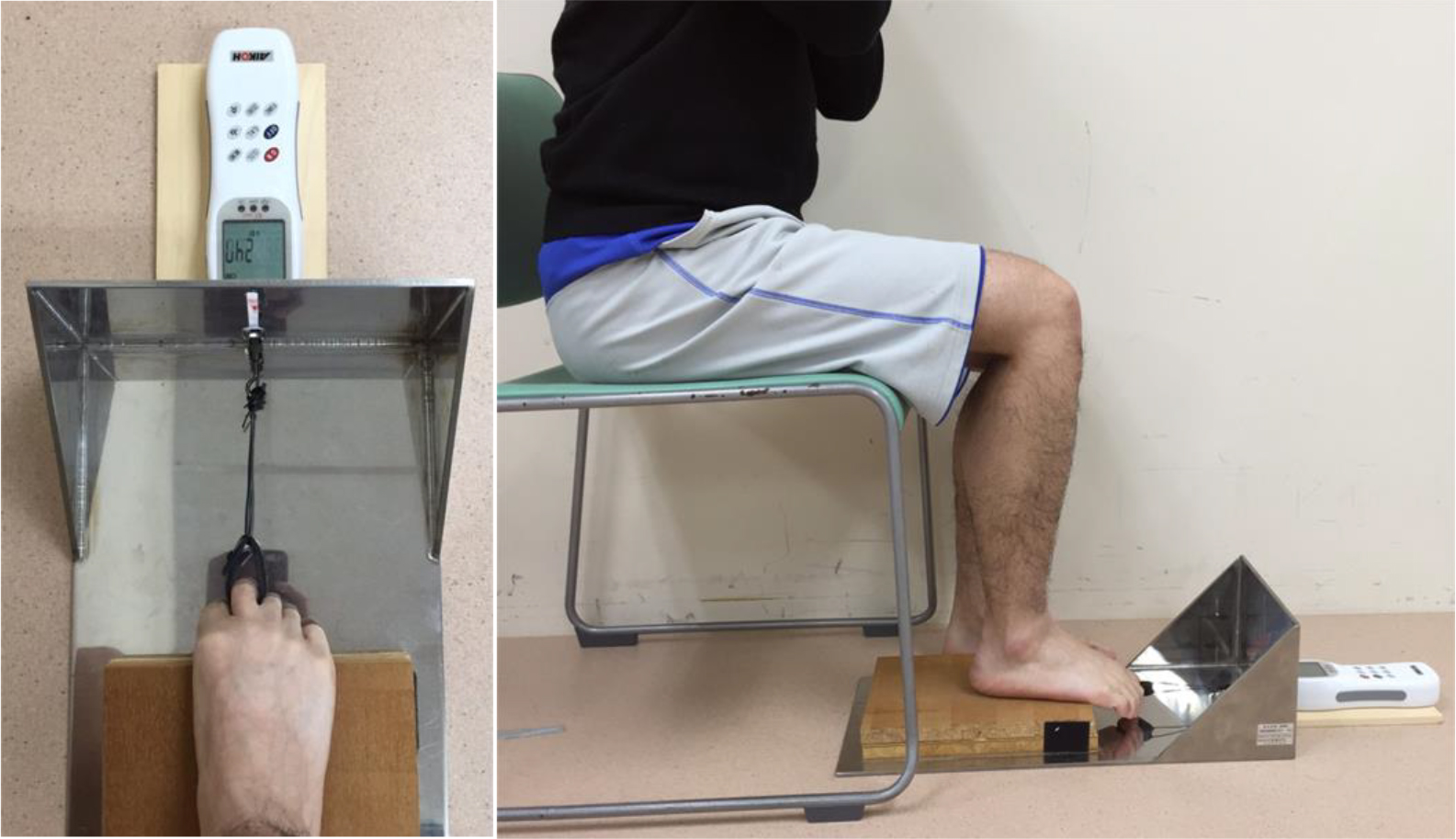
The importance of toe function has long been recognised, and recent studies have demonstrated a relationship among toe function, various human motions, and sports performance. The toes are in contact for approximately three-quarters of the stance phase of gait [1], and toe flexion strength is correlated with walking speed, periods of single-limb support phase, and stride length [2]. The importance of toe strength has also been reported in studies regarding balance [3], and jumping, steps or dashing abilities [4, 5, 6]. Van der Merwe et al. [7] reviewed risk factors and prophylactic interventions for anterior cruciate ligament ruptures and lateral ankle sprains. Both injuries primarily occur during unbalanced single-leg decelerations. In movements with compromised lower body stability and substantial ground reaction forces, external moments around the knee or ankle may surpass injury thresholds, leading to soft tissue injuries in the joints. Closed kinetic chain manoeuvres such as jump landings, stops, and directional changes involve at least one foot in contact with the ground. The foot’s stability and orientation significantly influence the centre of pressure, impacting moments and forces on the lower limb. Therefore, the foot and toe muscles are likely contributors to factors influencing the risk of lower limb injuries. For the elderly, falls are a significant issue, and one third of all falls result in serious injury [8]. The decreased force-producing capacity of the toe flexor muscles, as observed in older adults, may play a role in at least two aspects of functional decline that increase the likelihood of falls. These include diminished balance control in dynamic circumstances and a reduced ability to generate propulsive power [3].
Toe function is characterised by the strength and dexterity of toe motion. The ability to move the toes is important when responding to changes in actions or ground surfaces. Insufficient information is available regarding toe dexterity in relation to human locomotion and physical performance. Nagamoto et al. [9] demonstrated that baseball players with disabled throwing shoulders or elbows have high rates of impaired foot function and floating toes. Toe dexterity was evaluated using the foot rock-paper-scissors test. This study aimed to investigate the relationships between the flexion strength and dexterity of the toes and physical performance.
Participants
This study included 20 healthy male university students (mean age, 21.3
Scoring of rock-paper-scissors test
Scoring of rock-paper-scissors test
Rock: folding the toes; paper: spreading the toes out; scissors: opposite motion of the first and lesser toes, namely flexion of the first toe and extension of the lesser toes or extension of the first toe and flexion of the lesser toes (two positions).
The flexion force of each toe was measured using a digital force gauge (RZ-50, Aikoh Engineering Co., Ltd, Osaka, Japan) with a range of 0.1–500 N (Fig. 1) [10]. The intra-rater reliability of this measurement, assessed by intraclass correlation coefficients (ICC 1.1) for each toe measurement was confirmed to be 0.95 or higher. The subjects’ feet were placed on a custom-made table, and a Velcro cuff connected to the digital force gauge by a metal wire was placed around each toe. Subjects sat with their hips and knees at 90∘ flexion and neutral positioning of the ankle and were instructed to maximally flex their toes. The maximal flexion force was recorded three times for each toe and the mean value was calculated. The values were normalised by dividing the flexion force by the participant’s body weight.
Evaluation of toe dexterity
The active motion of the toe was evaluated using the marble pick-up and the rock-paper-scissors tests. The marble pick-up has been used both as a toe exercise and as an assessment tool for toe function [3, 11]. During the marble pick-up test, 20 marbles were placed within a plastic box (20 cm
The foot rock-paper-scissors test required folding the toes, spreading the toes out, and the opposite motion of the first and lesser toes. The performance of these motions was scored using a modified system (highest score: 9) (Table 1) [12].
Physical performance
Repeated side steps: This agility test required participants to move laterally across three lines as quickly as possible [6]. Three parallel lines were set 1 m apart and the participants stepped sideways from one line to another. The participants were instructed to cross the lines 10 times and the required time was measured. This test was repeated three times and the shortest time was used for the analyses.
Balance ability: The centre of pressure (COP), assessed during both stance and dynamic motion, has been utilized to evaluate balance ability [13, 14]. A force plate (Kistler 9281E, Winterthur, Switzerland; sampling rate, 100 Hz) was used to collect data regarding COP. The total trajectory length of the COP (cm) and perimeter area of the COP (cm2) were measured during single-leg standing, tiptoe standing, and single-leg drop-jumping with barefoot. During the balance tests, the participants were required to stand on a force plate with their eyes open. Single leg standing with the dominant leg was maintained for 20 s with the opposite hip flexed at 0∘ and the opposite knee flexed at 90∘. During tiptoe standing, the participants placed their feet shoulder-width apart and raised their heels maximally for 20 s. Each participant performed three non-consecutive trials, and the mean values of the COP parameters were calculated. During single-leg drop jumping, the participants dropped down onto a single leg on the force plate from a 20 cm high box and maintained the landing position for five seconds with their upper extremities on their trunk. Only trials in which the upper extremities remained on the trunk and the non-dominant leg did not touch the floor were considered successful. Three successful trials were recorded and the mean values of the COP parameters were calculated.
Statistical analysis
Quantitative variables are presented as mean
Results
Toe flexion force
The normalised first toe flexion force was significantly larger than the flexion forces of the other toes (Fig. 2).
Number of participants for each score of the rock-paper-scissors test
Number of participants for each score of the rock-paper-scissors test
The mean time to complete the marble pick-up test was 43.9
Physical performance
The mean time required to perform the repeated side step test was 4.0
Correlation between normalized toe flexion force and physical performance
Flexion force of each toe. The flexion force of the first toe was significantly greater than those of the other toes. The forces were normalized by division by the participant’s body weight. *P < 0.05.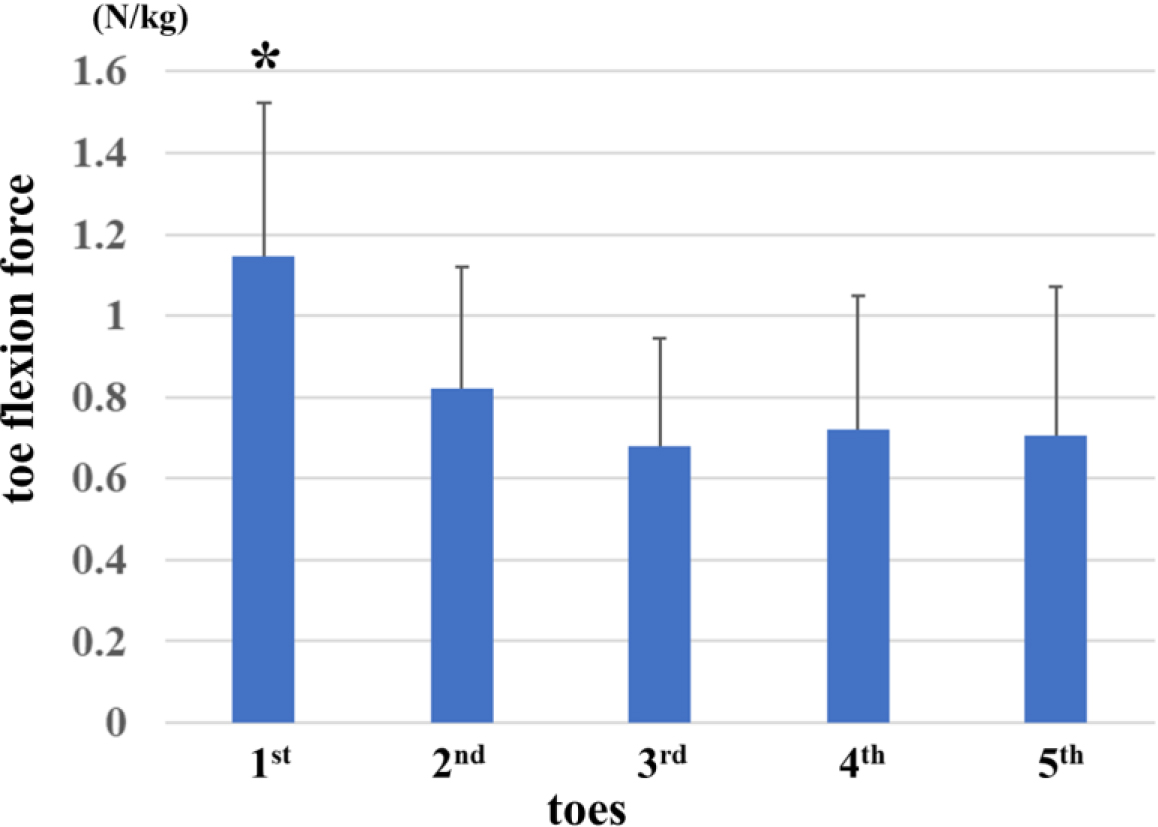
Correlation between the first toe flexion force and the total trajectory length of the centre of pressure (COP) during one-leg standing. (correlation coefficient 0.46, 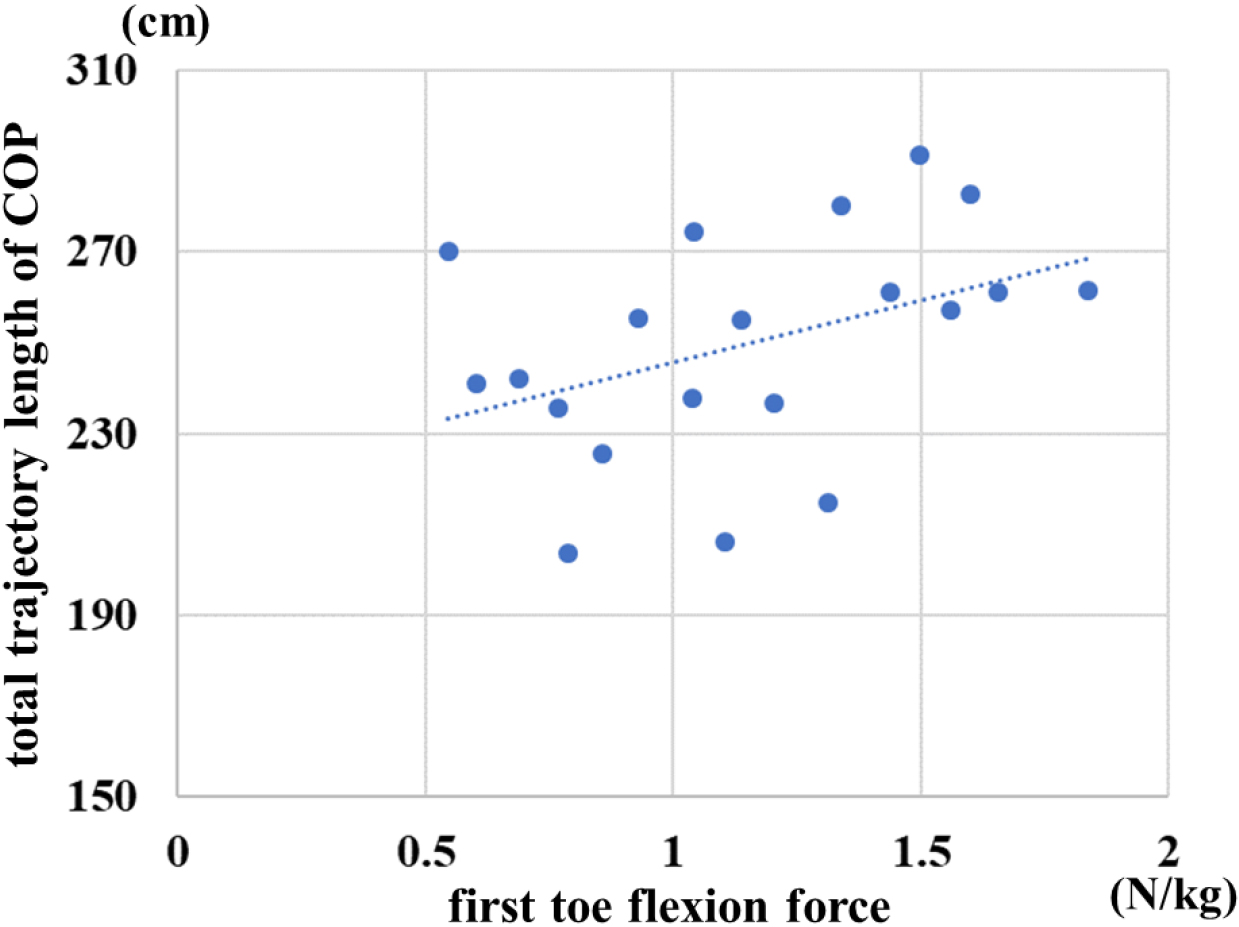
A significant relationship was observed between the first toe flexion force and the total trajectory length of the COP during one-leg standing (correlation coefficient 0.46,
Correlation between toe dexterity and physical performance. The time required for the marble pick-up test using lateral three toes and the total trajectory length of the centre of pressure (COP) during barefoot, single-leg drop-jumping are correlated (correlation coefficient 0.41, 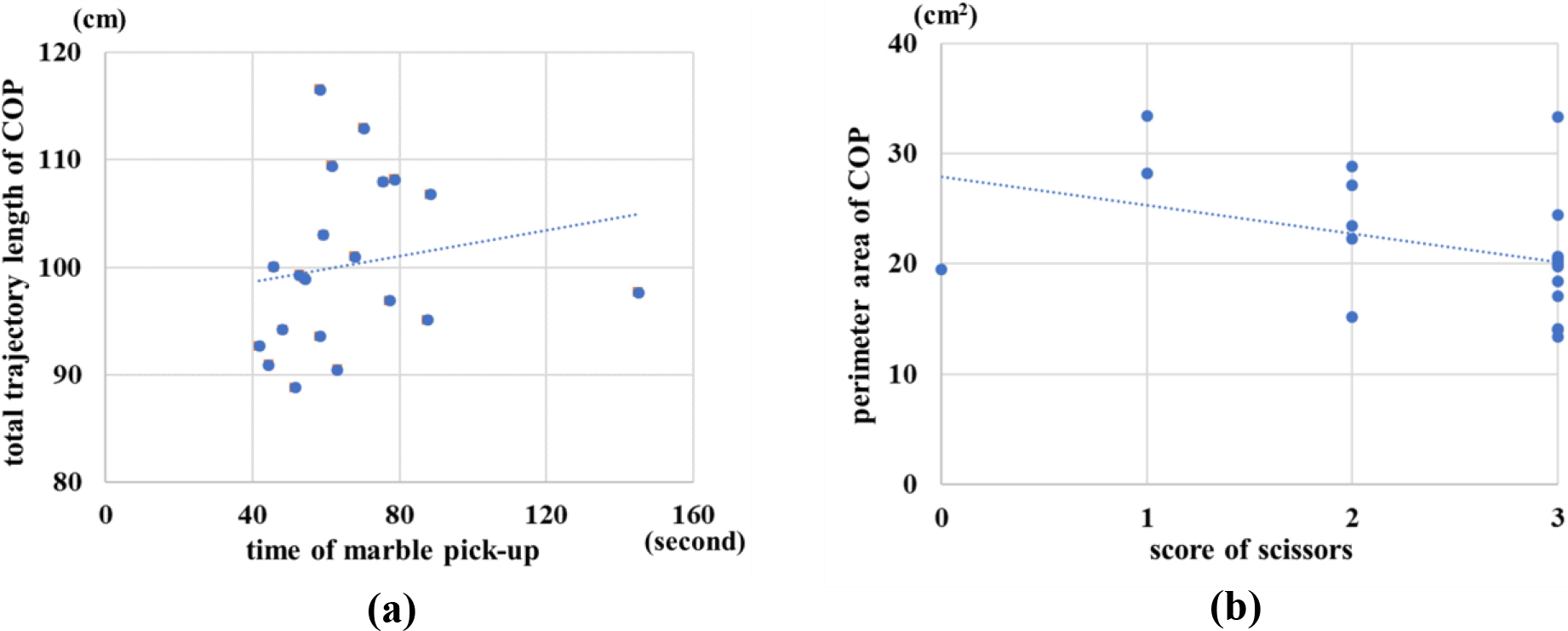
A significant relationship was observed between the marble pick-up time when three toes were used and the total trajectory length of the COP during barefoot, single-leg drop-jumping (correlation coefficient 0.41,
Discussion
In this study, the relationships between toe flexion force and dexterity and physical performance (repeated side steps and balance ability) were evaluated. The flexion force of each toe was measured and compared, and the first toe force was significantly greater than that of the other toes. The time required for the repeated side step test was not correlated with the flexion force or dexterity of the toes. However, a significant correlation was observed between the first toe flexion force and the total trajectory length of the COP during one-leg standing. The first toe is long and powerful, and the results of this study highlight the importance of first toe strength for balance ability during one-leg standing.
Few previous studies have evaluated the relationships between toe dexterity and physical performance [9, 12]. This study revealed a significant correlation between the time required for the marble pick-up test using the lateral three toes and COP during single-leg drop-jumping and the scissors score and COP during single-leg drop-jumping. The marble pick-up test using the lateral three toes was more difficult than that using all of the toes. The time required to perform the marble pick-up with three toes was positively correlated with the balance ability during single-leg drop-jumping. Amaha et al. [11] used the marble pick-up test to evaluate the effects of an 8-week toe functional exercise, including towel gathering, and curling and spreading out of all toes. Rodriguez et al. [15] added the marble pick-up exercise for foot muscle training to the experimental group, and an improvement in pronated foot posture was observed after 9-weeks of training. We believe that the marble pick-up is useful for both as an assessment tool and as a toe exercise for toe function.
During the rock-paper-scissors test, scissors is made by performing opposite motions of the first toe and lesser toes; for example, flexion of the first toe and extension of the lesser toes or extension of the first toe and flexion of the lesser toes. The flexor hallucis longus (FHL) and intrinsic muscles are attached to the first toe. The FHL has tendinous slips to the lesser toes. The proportion of the FHL that branches to the second and third toes is high (40–64%) and that extending to the second toe is 8–41% [16, 17]. Hirota et al. [10, 18] reported a test that can be used to assess the number of FHL tendinous slips in individuals (FHL branch test) and used to the test to confirm that the flexion strength of toes lacking FHL branching is significantly lower than that of toes with FHL branching. When the FHL contracts, the first toe and other toes to which the FHL branches flex simultaneously. Scissoring is a complex motion that requires cooperation between the flexor and extensor muscles of the toes. In this study, the scissors score positively correlated with the balance ability during single-leg drop-jumping.
Incomplete or weak flexion of the lateral lesser toes is occasionally observed in clinical settings when all toes are in active flexion. This may indicate dysfunction of the flexor digitorum longus (FDL). We believe that the marble pick-up test using the lateral three toes reflects the function of the FDL and the intrinsic muscles including the flexor digitorum brevis (FDB) and quadratus plantae (QP). Scissors (when the first toe is extended and the lesser toes are flexed) should also reflect the function of the FDL as contraction of the FHL due to the first toe extension does not affect the flexion of the lesser toes greatly. Garth and Miller [19] introduced a toe position of active extension of the first toe and flexion of the lesser toes (scissors position in the current study) and categorized the muscle function in three groups according to the toe flexion pattern (intrinsic positive, intrinsic negative, and extrinsic dominant). The marble pick-up test using the lateral three toes and the scissors score are useful tests to evaluate toe dexterity, FDL function, and intrinsic foot muscle function.
Kelly et al. [14] compared the activation patterns of plantar intrinsic foot muscles between double- and single-leg stances. The single-leg stance results in greater electromyographic activity in the abductor hallucis, FDB, and QP. Ridge et al. [20] studied intrinsic and extrinsic foot muscle activation during six standing postures (single- and double-limb stand, squat, and heel raise). Similar to Kelly et al., they found that intrinsic foot muscle activity increased as loading and postural demands increased. Concerning toe flexion strength, we did not observe a significant correlation between the strength of the lesser toes and balance ability. Previous studies have identified toe flexion strength as a crucial factor in determining balance ability [3, 14, 20]. This discrepancy may arise from variations in the measurement methods of toe flexion strength. Earlier researchers measured toe flexor strength collectively for all toes. In contrast, our study highlights the importance of the first toe in balance ability when evaluating the flexor strength of individual toes.
Conclusions
This study demonstrated that toe flexion strength and dexterity are significantly correlated with balance ability. The strength of the first toe was a key function for balance during one-leg standing. Toe strength has been the focus of toe function evaluations. This study underscored the importance of toe dexterity in human physical performance. The marble pick-up using lateral toes and rock-paper-scissors tests are useful tools with which to evaluate balance ability, and increasing the dexterity of the toes may enhance balance ability. Further studies are needed to investigate the relationships between toe dexterity and various physical performances and methods to improve toe dexterity, including marble pick-up and rock-paper-scissors.
Author contributions
All listed authors made valuable contributions to the development of this manuscript. Conception: KW, YA, KH; Data collection: YA, KH, TT, HM; Interpretation or analysis of data: KW, YA, KH, TT, HM; Preparation of the manuscript: KW, YA; Revision for important intellectual content: KW, AT; Supervision: AT.
Ethical approval
The study was approved by the ethics review board of Sapporo Medical University (28-2-23) and conducted in accordance with the Declaration of Helsinki.
Funding
This research did not receive any specific grant from funding agencies in the public, commercial, or not-for-profit sectors.
Informed consent
An informed consent form was included at the beginning of the survey, which presented the necessary information and recorded the participant’s willingness to participate in the study. Written consent was obtained through participants’ signatures on the consent form.
Footnotes
Acknowledgments
We would like to thank Editage (www.editage.com) for English language editing.
Conflict of interest
None to report.