







Abstract
This special issue on race relations and racial inequity in Library and Information Science (LIS) is a response a recent wave of advocacy, activism, and protests. Its explicit purpose is to address the lack of research on race and inequity within our field. The purpose of this contribution to the issue is to substantiate that statement by performing a bibliometric analysis of the last 40 years of LIS scholarship to quantify the amount of attention given to race and racial inequality over that period. We find that despite an important increase in BIPOC-related research in LIS, the numbers remain quite low with approximately 2% of LIS publications containing terms related to racial inequality and BIPOC communities, and this research also tends to be less cited than the average LIS papers in the same area. We also find that this research is present in several areas of the field, although unevenly distributed across them. The trends presented in this paper may help when discussing sensitive issues regarding systematic discrimination, help create and sustain momentum towards change, and address the persistent lack of diverse perspectives and approaches across LIS scholarship and practice.
Introduction
As the summer of 2020 began amidst lockdowns and strict public health orders, a new and powerful wave of anti-Black racism advocacy, activism, and protests also swept across the world. Millions took to the streets in support of Black Lives Matter and to stand against the seemingly never-ending acts of police brutality against Black communities (Buchanan et al., 2020). For some, these protests brought a shocking realization of the growing crisis of inequity and a strong desire to better understand the roots of anti-racism protests. Through mass media and social media, Black communities shared their daily experiences with police, societal discrimination, and the pronounced socioeconomic and health inequities that left many unable to protect themselves and their families throughout the COVID-19 pandemic. The converging crises of the global pandemic and the rise in anti-racism protests concretely demonstrated that Black, Indigenous, and People of Color (BIPOC) face pronounced structural and material challenges in every measure of community health, well-being, and social support.
This special issue on race relations and racial inequity in Library and Information Science (LIS) is a response to this powerful wave of advocacy, activism, and protests. Its explicit purpose is to address the lack of research on race and inequity within our field. The purpose of this contribution to the issue is to substantiate that statement by performing a bibliometric analysis of the last 40 years of LIS scholarship to quantify the amount of attention given to questions of racial inequity experienced by BIPOC over that period.
Situating race: Researcher subjectivity with an anti-oppression framework
For many racialized groups, a key facet of their experiences with marginalization and social exclusion centers around how their race and culture are framed as markers of difference (Kumasi, 2019). Critical Race Theory (CRT) shows that race is a powerful social construct that results in a hierarchical ordering of social, cultural, political, and economic privileges based on skin color (Delgado & Stefancic, 2013). While there is no biological basis for differences ascribed to corporeal variations since skin color has no more significance than hair or eye color, race does impact lives. However, CRT and anti-racism frameworks both make it explicitly clear that it is the power and privilege ascribed to whiteness in systems of knowledge and social structures that make race important as an analytical focus (Dei, 2014).
It is important to be forthcoming that the crux of the problem investigated in this study is that there is a lack of racialized perspectives in LIS coupled with a need to center the lived experience of oppression; however, most members of the research team enjoy many of the troubled privileges such as being white, highly educated, and middle-class. This work is not an attempt to speak authoritatively about race in an already overwhelmingly white field. Rather, the spirit of this work is to examine the relationships of power and privilege tacit in LIS research and literature as opposed to speaking on behalf of racialized groups. As a field in which a reported 87% of the workforce identify as white (Schmidt, 2019), there is a strong need for LIS to undertake work collectively to examine how cultural, social, and political biases are present or manifest in the research literature. To that end, this work responds to ongoing calls from racialized LIS scholars for all members of the LIS community to take a direct and actionable approach to examine racial injustice and inequity found in LIS scholarship and practice (Cooke & Sweeney, 2017; Espinal, 2001; Espinal et al., 2018; Kumasi, 2019; Gibson et al., 2017; Gibson et al., 2020). Further, it follows the approach of other members of LIS research and professional communities who have examined potential racial inequities from the privileged position of whiteness to demonstrate that racial justice work focused on systemic reform is not the sole responsibility of racialized communities who are already impacted by its effects (Agosto et al., 2020; Schlesslman-Tarango, 2017; Schmidt, 2019).
Literature review
Racialized and critical LIS scholars have identified a strong need to adopt a more critically focused social justice approach and research agenda amid continuing struggles to reflect and include racialized communities in LIS research and practice (Espinal, 2001; Espinal et al., 2018; Hathcock, 2015; Honma, 2005; Hudson, 2017a; Hudson, 2017b; Gibson et al., 2017; Gibson et al., 2020; Matthews, 2020; Pawley, 2006; Schlesslman-Tarango, 2017; Schmidt, 2019). These scholars note a significant lack of research that examines the efficacy of current LIS approaches to foster equity and social justice. As a result, social justice is cyclically approached through unproblematized narratives that most often work to further entrench patterns of white normativity (Espinal, 2001; Espinal et al., 2018; Honma, 2005; Matthews, 2020; Pawley, 2006; Schlesslman-Tarango, 2017; Schmidt, 2019).
These critiques are underpinned by a wide and compelling body of work by librarians of color that demonstrate that there is a long history of inequity in employment and troubling interpersonal experiences across LIS (Brook et al., 2015; Chou et al., 2018; Espinal, 2001; Espinal et al., 2018; Gonzalez-Smith et al., 2014; Hankins & Juárez, 2015; Hathcock, 2015; Hathcock & Sendala, 2017; Jackson et al., 2012; VanScoy & Bright, 2019). Critical library scholars particularly draw attention to diversity and inclusivity narratives as problematic add-ons to existing library frameworks and practices as opposed to centering the structural forms of marginalization and exclusion that are inherent to library spaces and practices (Espinal, 2001; Espinal et al., 2018; Hudson, 2017a; Hudson, 2017b; Gibson et al., 2017; Gibson et al., 2020). This results in a sustained lack of response to systemic marginalization and inattention on confronting and centering race as an organizing force in LIS that is supported by continually returning to narratives around neutrality (Caidi et al., 2017; Gibson et al., 2017; Gibson et al., 2020; Gohr, 2017; Honma, 2005; Hudson, 2017a; Hudson, 2017b; Pagowsky & Wallace, 2015; Schmidt, 2019; Schlesselman-Tarango, 2017).
There is a growing body of scholarship that locates larger societal practices of racial and cultural marginalization as the cause of the significant lack of diverse perspectives and approaches across LIS scholarship and practice. Adler (2017) and Olson (2001) show that uncritical approaches to whiteness as non-racial have been central to library cataloging and organization. Others reveal how the structural and material forces of racial inequity impact program and collection development in various library settings (Bowers et al., 2017; Cooke et al., 2016; Cooke & Sweeney, 2017; Hughes-Hassel & Agosto, 2010; Kumasi & Hughes-Hassell, 2017; Kumasi, 2012; Kumasi, 2019). This results in ineffective and often exclusionary library responses to exclusion and social justice (Caidi et al., 2017; Gibson et al., 2017; Gibson et al., 2020; Gohr, 2017; Honma, 2005; Hudson, 2017a; Hudson, 2017b; Pagowsky & Wallace, 2015; Schmidt, 2019; Schlesselman-Tarango, 2017). Many locate these problems as arising from a lack of scholarly research and attention on structural forces of race and social injustice in the library school curriculum (Cooke & Sweeney, 2017; Cooke et al., 2016; Pawley, 2006).
LIS is a meta field (Bates, 2015) that covers a broad range of research areas with ties to different disciplines. Little is known about the distribution of BIPOC-related research in the field across its different research areas. Using bibliometric analysis, this paper aims to provide empirical evidence of the extent of English/Anglophone LIS scholarship that includes race and/or racial inequity as an area of focus. More specifically, we aim to: a) identify how the share of BIPOC-related research in LIS evolved during the 1980–2020 period; b) analyze how the research is distributed across the subareas in the field; and, c) identify the knowledge base of the research. The research generated from this project is, to our knowledge, the first attempt to quantify and map out this body of literature. We hope our work here will provide LIS scholars with an opportunity to appreciate and reflect on the research pathways that we have collectively developed over time, and to identify the gaps still to bridge, and continue to make meaningful progress towards a community of respect and inclusion and a more robust and engaged field.
Data and methods
LIS publications
Using a relational database version of Clarivate Analytics’ Web of Science hosted by the Observatoire des sciences et des technologies (OST), the research team collected all research articles and reviews published within the last 40 years (1980–2020)1
The choice of the year 1980 is not arbitrary but due to the coverage of the Web of Science relational database hosted at the Observatoire des sciences et des technology (OST).
To identify relevant publications, we began by compiling a list of terms related to BIPOC communities and racial injustice. This decision was driven by the idea that all scholarship that discusses BIPOC communities or sub-communities can be considered to address BIPOC-relevant issues, whether directly or indirectly. The final list of terms used in this study was informed by several glossaries found on the Web that cover a broad range of concepts relating to diversity, inclusion, and racial inequity.2
Racial Equity Tools (
We searched for each term from our list in the title, abstract, and keyword fields of the collected LIS literature to identify the publications that mention terms related to racial inequality or BIPOC. Several members of the research team then manually validated the results to eliminate false positives. The research team discussed the cases of disagreement to reach a consensus.
The results of the analysis are presented in four sections. First, is the number and share of racial inequality-related research publications that we were able to identify. We then situated that scholarship within a global map of LIS research. A similar map was created for the critical race-related research which identifies different research areas within that set. Finally, we compare the distribution of citations and references across disciplines of LIS research and our set of critical race-related research.
Trend in BIPOC-related research in LIS
Overall, we retrieved 639 publications mentioning one of our terms. The number of articles found with terms from different categories is presented in Table 1.
Number of articles retrieved for each category of terms
Number of articles retrieved for each category of terms
Figure 1 shows the evolution of the number of BIPOC-related articles over the last three decades in the LIS journals indexed in Web of Science. While the attention to race and racial inequality in LIS has been surging since the turn of the millennium, the overall numbers remain quite low with a peak of 60 publications in 2019.
Number of LIS publications mentioning BIPOC terms, 1980–2020.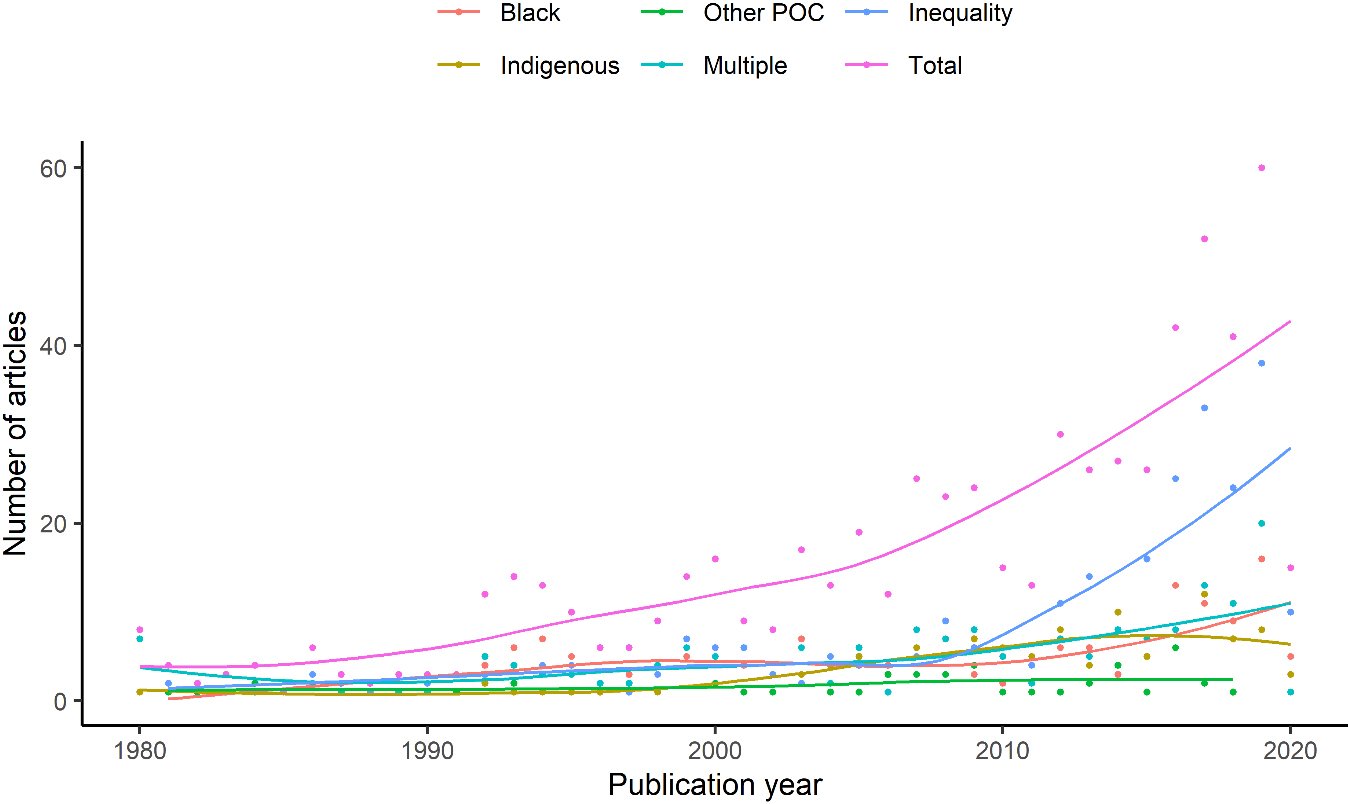
It should be noted that Web of Science records did not include the publication abstracts until 1991. This may be contributing to the jump in numbers in the beginning of the 90s, so the numbers presented here should be interpreted with caution. Since the data was collected during the second half of 2020, the drop observed in some categories may likely be because 2020 publications were not fully indexed in the Web of Science database at the time of data collection. For this reason, and because the entire LIS research output is also increasing over time, we present the same data in relative terms in Fig. 2, which shows the share of LIS articles that mention terms from our list. The figure shows that race and racial inequality is increasing not only in absolute terms but also in relative terms, suggesting that there is indeed a surge of attention to those topics within our field.
Share of LIS publications mentioning BIPOC terms, 1980–2020.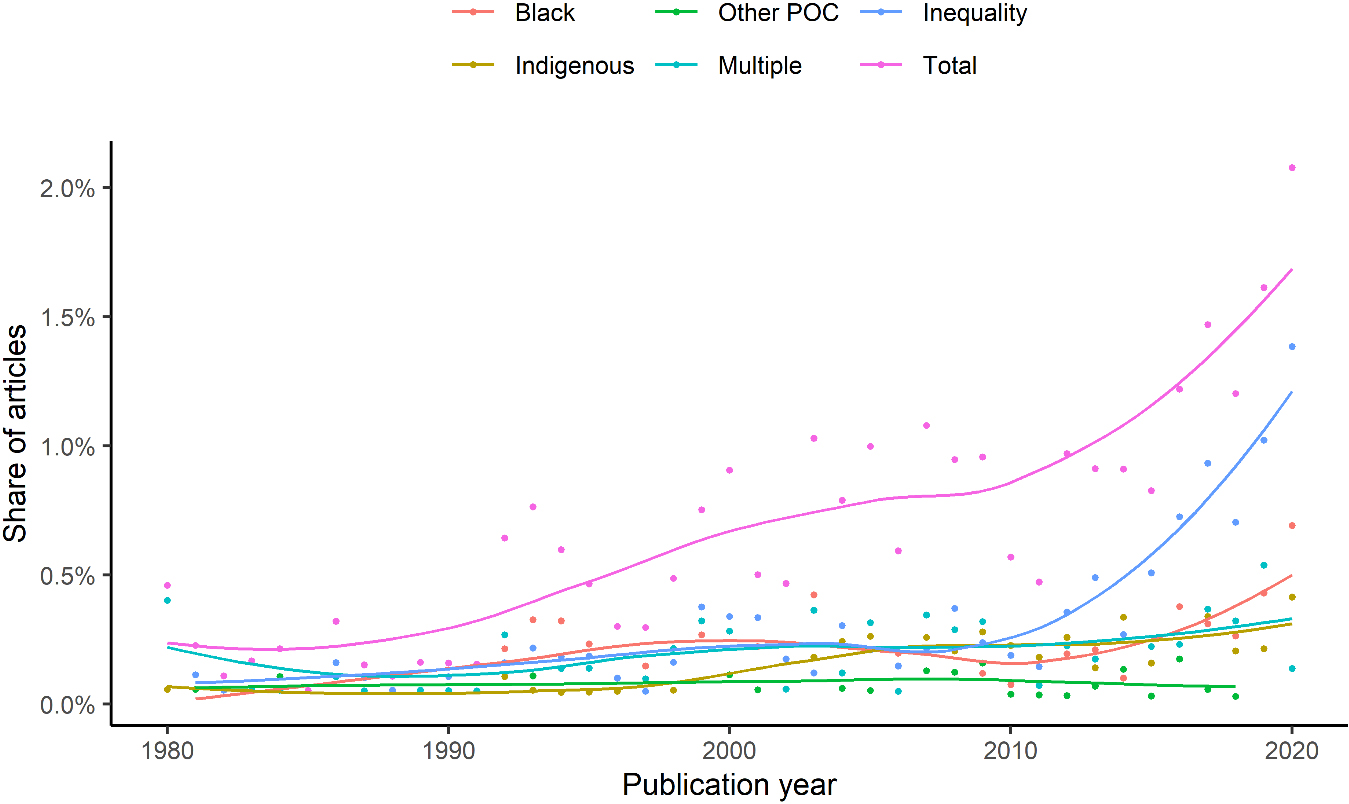
In terms of the specific groups mentioned within the full body of LIS literature examined in this study, research relevant to Black and Indigenous people is dominant. While the share of articles mentioning Black people has been increasing since the 1980s and has seen a particularly sharp increase since 2010, the share of research relevant to Indigenous populations has only been increasing since the 2000s.
This part of the analysis aims to position BIPOC-related research within the broader LIS context to identify areas where this scholarship is being developed, as well as where it may be lacking. To achieve this, a citation network of all LIS publications in the Web of Science was constructed. This data was then used to identify and map communities and distinct research areas within the field using the Louvain community detection algorithm (Blondel et al., 2008). This model extracts subgroups from the larger network of data using optimized modularity to find similarities within the data based on the higher quantity of interactions between certain nodes that differentiates it as a group from the larger set of data. This method minimizes computation time (Blondel et al., 2010), which allows for the generation of current data quickly, and provides an optimal number of groups and their composition based on shared characteristics/commonalities rather than a hierarchical method. The network and research areas are presented in Fig. 3.
Giant component of the LIS publication network.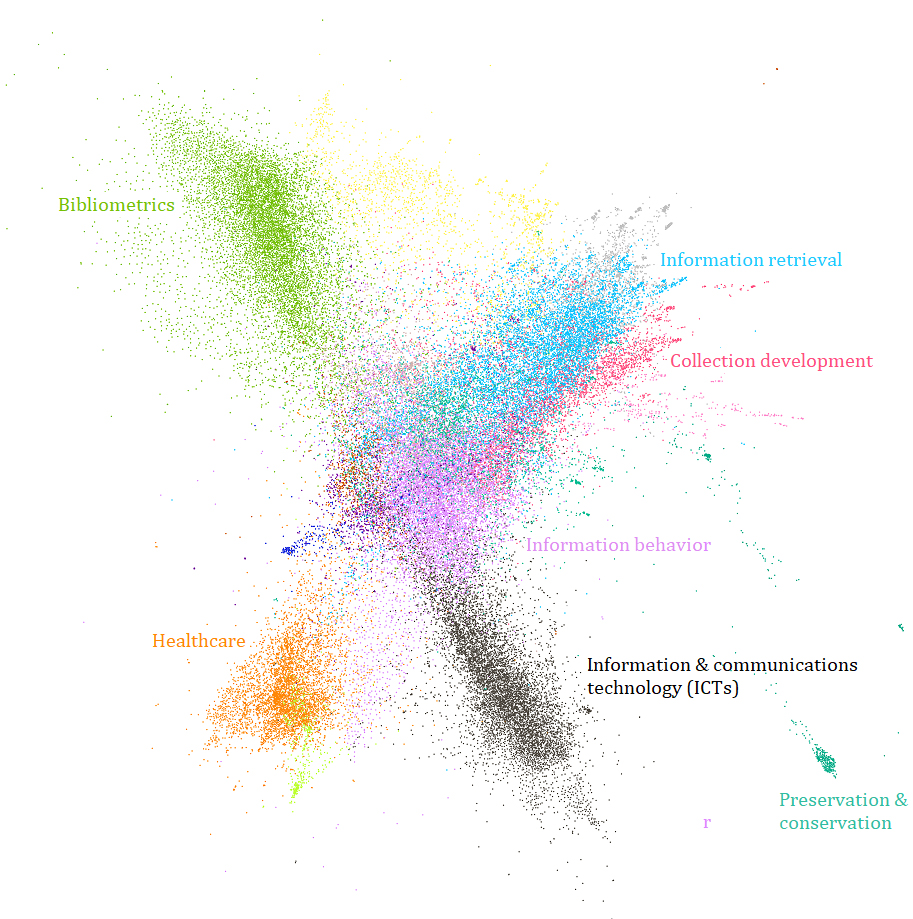
Table 2 shows the raw and relative frequency of BIPOC-related publications in each of the LIS research areas identified in our network. The labels were created by the research team based on the list of terms presented in the table. We see that the papers are concentrated in a few areas whereas a lack of BIPOC-related research can be observed in other groups. We note that while the ICTs group has the third highest number of BIPOC-related publications (
The last column of the table reports on the average relative citation (ARC) of the BIPOC-related publications. A value lower than 1 (highlighted with shades of red) indicates that these publications receive fewer citations than other publications in the same group, and a value above 1 (highlighted with shades of green) indicates that they tend to be more cited than the group average. The results show that in most cases, the citation rates of BIPOC-related research tend to be lower than other research in similar areas of the field, with librarianship and information retrieval being the exception.
Most frequent words in the publications’ abstracts, number of publications, and number and share of BIPOC publications in each of the LIS publications clusters
The BIPOC-related articles were then isolated and the steps from the previous process repeated to construct the citation network and identify communities to provide an overview of this body of literature and its interconnectedness. Excluding the isolated nodes in the network leaves a giant component of 398 publications (Fig. 4). The Louvain community detection algorithm originally divided this network into 9 communities represented by the different colors in the network.
Giant component of the citation network of BIPOC-related research in LIS.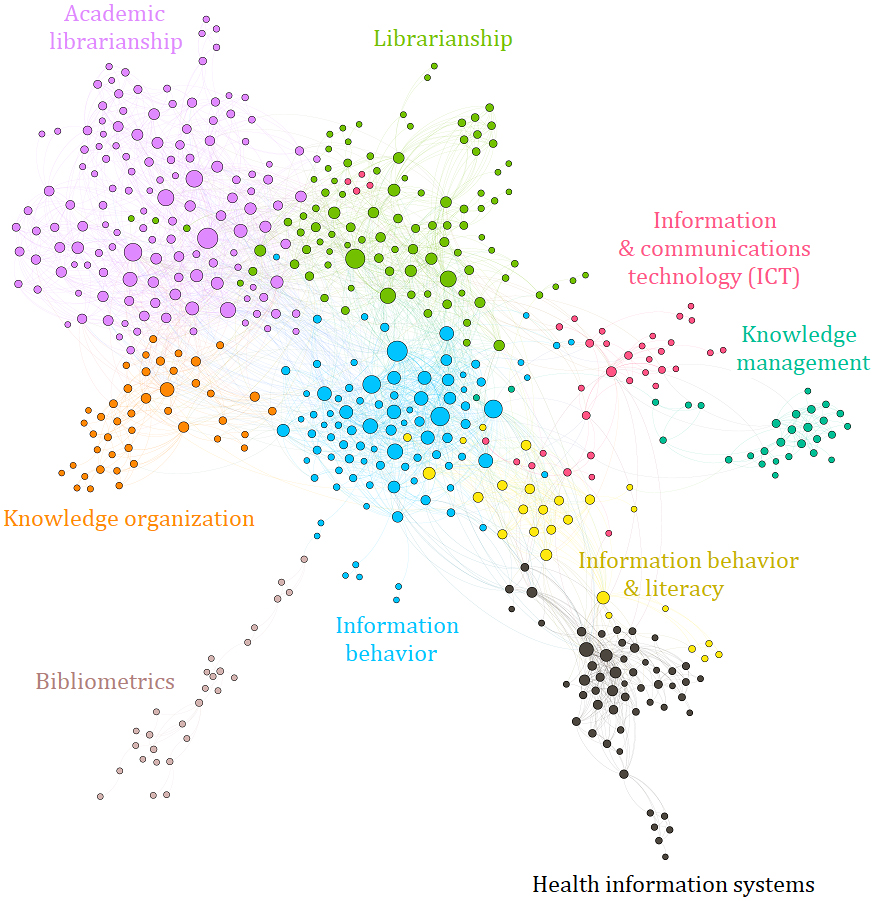
Extracting the top five most cited publications from each of the communities shows the topics of most relevance and how discussions within these subfields around racial inequality and radicalized issues are presented within the specific communities (see Table 3). Although an in-depth look at the publications is beyond the scope of this study and would provide more insight on the various topics, timelines, and issues most circulated within these groups, it is worth noting the diversity amongst the publications within as well as between the communities that can be observed from a cursory glance at the data.
Top five most cited BIPOC-related papers in each community
In this last section of our analysis, we present the relationship between the BIPOC-related scholarship within the LIS field and other NSF disciplines. Through an investigation of the associated disciplines of referenced and cited publications in LIS, we begin to see which fields LIS tends to build upon. Figure 5 shows the distribution of references made in LIS to publications across the NSF disciplines for the entire set of publications used in this study. Similarly, the second graph highlights the distribution across the NSF disciplines of citations received by LIS publications overall and BIPOC-related LIS research. This data highlights the insularity of the profession, yet where disciplinary crossover does exist, it tends to favor health, medicine, engineering and technology, and the social sciences over natural sciences, humanities, and fine arts.
Distribution of references (left) and citations (right) of LIS and BIPOC-related research across disciplines.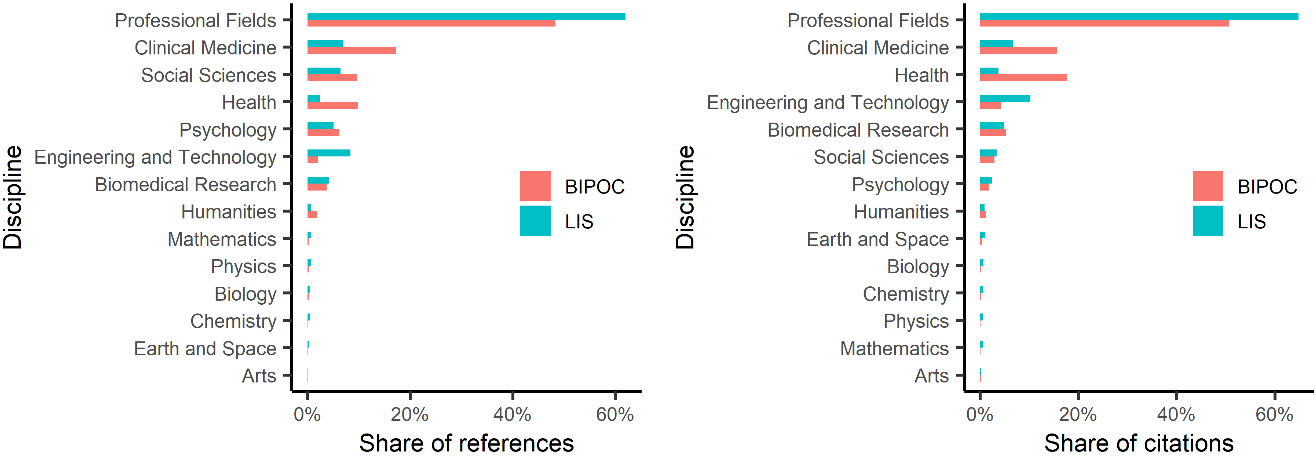
Distribution of references (left) and citations (right) of LIS and BIPOC-related research across professional fields.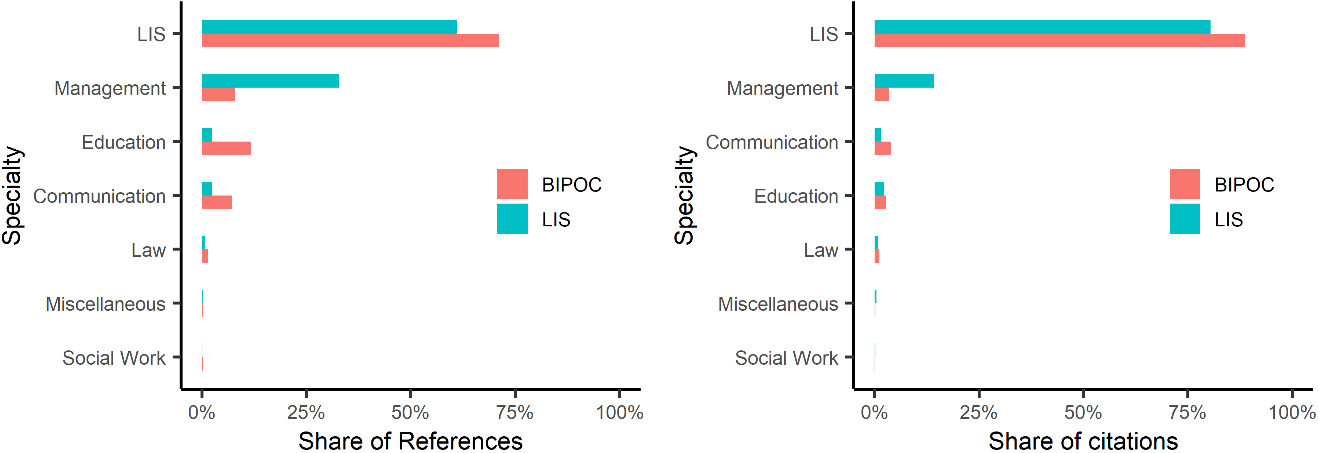
Figure 6 focuses on the Professional Fields category of NSF, which includes LIS along with five other specialties and a miscellaneous group. We see that LIS scholarship draws predominantly from within, with some crossover into the disciplines that are closest in nature and content, such as management and education. Within that set of specialities, the references and citations of the subset of BIPOC-related research are more concentrated within LIS than the average LIS publication.
While BIPOC-related research has, at its peak, accounted for only 2% of all LIS articles published within a given year, we are nonetheless witnessing a surge in the consideration of race in LIS research. The yearly output of BIPOC-relevant articles has more than doubled in both raw and relative terms since the 1990s. This upward trend shows no signs of slowing, as a record number of BIPOC-related articles have been published in LIS every year since 2016. There is no cause for celebration yet, however, as the overall share of BIPOC-relevant research in LIS remains low enough to suggest that considerations of race and racial inequity have been largely ignored by the field. Noting the trends presented in this paper may be helpful when discussing sensitive issues regarding systematic discrimination, but they are only truly valuable when they can be used to maintain and create momentum towards change and address the persistent lack of diverse perspectives and approaches across LIS scholarship and practice.
Within the field of LIS, the concern for race is increasing most in the areas of information literacy, librarianship, knowledge organization, and information behavior, respectively. Information literacy and librarianship are “frontline” research areas that often relate directly to public service among diverse populations, and this proximity could partly explain their greater focus on social equity and inclusion compared to other LIS research areas. Similarly, knowledge organization and information behavior may have an increased focus on diversity compared to other areas of LIS due to the growing awareness and appreciation of ways of knowing outside of a Eurocentric or Western perspective, calls to decolonize traditional classification systems, and greater integration of Indigenous Knowledge in academia and governmental policies.
Consideration of race is found to be minimal or nonexistent in the research areas of information retrieval, social media analytics, scholarly publishing, and health information systems. Except for scholarly publishing, these research areas can be considered more technical than social and thus may be more likely to focus on race-agnostic information systems. At the same time, the lack of racial consideration within these areas is indicative of an uncritical approach to the status quo that further marginalizes BIPOC perspectives through their exclusion in these areas and perpetuates the privilege of whiteness in systems of knowledge and social structures (Dei, 2014).
BIPOC-related research was found to receive a lower rate of citation on average than other research in the same field, with the notable exceptions of healthcare and information retrieval. In these two areas, BIPOC-related publications were found to be more cited on average than non-BIPOC publications (see Table 2). BIPOC-related publications were proportionally citing and cited by Health research more often than the average LIS publication, and the BIPOC-relevant publications were also less likely to cite or be cited by other LIS research (See Fig. 5). This tendency to cite from non-LIS fields in BIPOC-relevant research is a likely consequence of the lack of race-related research in LIS, prompting LIS scholars to move beyond their field when it comes to discussing or citing race.
Limitations
Some limitations of this study should be acknowledged. The citation indexes of the Web of Science that were used in this study have limited coverage of scholarly journals, especially in the social sciences and humanities (Mongeon & Paul-Hus, 2016). The main citation indices of the Web of Science are also limited in regards to the types of documents they include, and more specifically in their lack of coverage of books, which remain an important mode of knowledge dissemination in humanities and, to a lesser extent, in the social sciences. We mitigate these limitations by largely focusing on proportions rather than raw publication or citation counts in the presentation and interpretation of our results.
Further research
In future research, we will seek to address the limitation incurred by the Web of Science’s limited coverage by aggregating data from a wider variety of sources to ensure a more comprehensive coverage of the literature in the field, including books. Furthermore, by focusing on the important issues related to racial inequality, our analysis is by design leaving out other areas of the broader social justice realm, and it will thus be interesting to include other forms of social inequality in the next steps of this work. It will also be useful to extend the analysis to other disciplines so that we can gain insights on the attention given to race in different fields, which will provide some benchmark to better situate the LIS field in this research area.
Footnotes
Appendix 1. List of terms
Group
Terms
Black
African American; Anti-Black; Black; Black Lives Matter; Black American; Black canadian
Indigenous
Anti-Indigenous; Indigeneity; Indigenous People; Native; American Indian; Inuit; Metis; Indiginising; Indiginizing; Two-Spirit; First Nation; Cherokee; Aboriginal; Navajo; Choctaw; Blackfeet; Muscogee; Iroquois; Mik’maq
Other POC
Asian; Latino; Latina; Latinx
Multiple
BAME; BIPOC; Biracial; BME; communities of color; communities of color; community of colour; community of color; Diaspora; Minority; Mixed Race; Multiethnic; Multiracial; POC; people of color; person of color; person of colour; persons of color; persons of colour; people of colour; Visible Minorities; Visible Minority; multi-race; BIOPC; coloured people; colored people
Inequality
Active-racism; Anti-Racism; Anti-Racist; Anti-Racist Ideas; Assimilationist; Color Blindness; Colour blindness; colour brave; color brave; Covert Racism; Critical Race Theory; Cultural Appropriation; Cultural Racism; Decolonization; Ethnic Diversity; Individual Racism; Institutional Racism; Internalized Racism; Interpersonal Racism; Passive Racism; (Racial) Profiling; Race; Race Relations; Racial and Ethnic Identity; Racial Equity; Racial Healing; Racial Identiy Development Theory; Racial Inequity; Racial Justice; Racial Reconciliation; Racialization; Racialized Minority; Racism; Racist; Racist Ideas; Racist Policies; Reverse Racism; Settler Colonialism; Structural Racialization; Structural Racism; White fragility; White Privilege; White Supremacy; Whiteness; Racial Profiling; systemic racism