







Abstract
Chatbots have experienced significant growth over the past decade, with a proliferation of new applications across various domains. Previous studies also demonstrate the trend of new technologies, especially artificial intelligence, being adopted in libraries. The purpose of this study is to determine the current research priorities and findings in the field of chatbots in libraries. A systematic literature review was performed utilising the PRISMA checklist and the databases Scopus and Web of Science, identifying 5734 records. Upon conducting the first screening, abstract screening, full-text assessment, and quality assessments guided by the CASP appraisal checklist, 19 papers were deemed suitable for inclusion in the review. The results of the review indicate that the majority of the existing studies were empirical in nature (primarily adopting qualitative methods) and technology reviews with a focus on reviewing the implementation and maintenance, design, evaluation, characteristics, and application of chatbots. The chatbots of interest were mainly text-based and guided chatbots, with closed-source tools with access portals mostly built on library web pages or integrated with social software. The research findings primarily concerned the development models and necessary tools and technologies, the application of chatbots in libraries. Our systematic review also suggests that studies on chatbots in libraries are still in the early stages.
Introduction
Chatbots, also known as conversational agents, are software applications that use natural language to interact with humans (Rapp et al., 2021). In the last decade, chatbots have been widely used in various fields (Grudin & Jacques, 2019), as is demonstrated by the increasing literature on the topic (Adamopoulou & Moussiades, 2020). The growing applications of chatbots are particularly evident in three sectors: education, healthcare, and customer service (Adamopoulou & Moussiades, 2020; Følstad et al., 2021). The use of chatbots has also been discussed more extensively by researchers, specifically in the context of libraries (Sanji et al., 2022), where the introduction of chatbots began in the mid-2000s by libraries in Germany (Sanji et al., 2022). While there is considerable interest in the application of chatbots in libraries (Allison, 2012; Panda & Rupak, 2022), researchers highlight the potential concerns of the practice, including costs, sustainability, inclusivity, and technical limitations (Rubin et al., 2010; Mckie et al., 2019). As of now, no systematic approach has been developed to bring together the growing body of literature on library chatbots.
A systematic review on this topic could help researchers, information professionals, and library staff identify current research priorities and trends, contexts in which chatbots have been deployed, and findings from existing studies. In this paper, we attempt to answer the following research questions, which focus on different perspectives of the extant literature:
RQ1: What are the different application contexts of the chatbots that have been deployed within libraries? RQ2: What are the characteristics (interactions, types, platforms, tools, accessibility) of the chatbots that have been deployed within libraries? RQ3: What approaches have been adopted in library chatbot research, and what areas still require further investigation?
The history of chatbots
The first chatbot, named ELIZA, was created in 1966 and used to simulate a psychotherapist communicating with patients who had a certain level of communication ability (Weizenbaum, 1966). Artificial intelligence was first applied to a chatbot called Jabberwacky in 1988 (Jabberwacky, n.d.). In 1995, the online chatbot ALICE was created. It used the newly developed Artificial Intelligence Markup Language (AIML) (Wallace, 2009). Since then, the AIML metadata scheme has been widely adopted by the large open-source user community under the stewardship of the ALICE AI Foundation as an important language for developing chatbots (Vincze, 2017). In 2010, Apple developed Siri (Siri, n.d.). Thereafter, personal voice assistants have emerged widely, such as Google Assistant (Google Assistant, your own personal Google, n.d.), Microsoft Cortana (Cortana – Your personal productivity assistant, n.d.), and Amazon Alexa (Digital Trends, 2021). Chatbots began to emerge in large numbers in 2014 (Grudin & Jacques, 2019). After 2016, research on chatbots began to increase at a rapid rate (Adamopoulou & Moussiades, 2020). These chatbots are typically structured as a user interface component, a user message analysis component, a conversation management component, a backend, and a response generation component (Adamopoulou & Moussiades, 2020). Chatbots can be developed by using pattern-matching approaches (employing rule-based methods to identify the most appropriate pre-written responses stored in databases) and machine learning approaches (to understand the context of conversations to respond with automatically generated text). The development of chatbots using machine learning approaches involves techniques such as natural language processing (NLP), natural language understanding (NLU), natural language generation (NLG), artificial neural networks, and recurrent neural networks (Adamopoulou & Moussiades, 2020).
Different types of chatbots
The economic promise of an automated agent, available 24x7, serving the needs of user communities with limited (human) intervention is a considerable prospect. As a result, chatbots have been explored in a range of application domains. Chatbots enable round-the-clock engagement, resolving service requests more efficiently, particularly without risks of potentially stressed or unfriendly human employees (Luo et al., 2019). With the wide range of applications, chatbots can be categorised in a number of ways. Based on the types of services provided, chatbots can be divided into two broad categories: task-oriented, designed to provide services related to specific content in a domain; and chit-chat bots, designed to engage in conversations with users (Baez et al., 2021). Rubin et al. (2010) reported on the application of chatbots for assistive functions (e.g., assisting people with disabilities) and social functions (e.g., virtual world enhancement and game support, virtual social partners). Nißen et al. (2022) concluded that there are three types of chatbots that are mutually exclusive in terms of their design characteristics: temporary supporters (short-term, one-off), temporary advisors (medium-term), and persistent partners (permanent interaction with users and interdependence). It is also important to note that chatbot conversation styles also differ from human conversations – when communicating with chatbots, users typically communicate for longer, sending short messages with a stricter vocabulary (Hill et al., 2015). It is also important to note that disclosure of chatbot identities to users can have a range of impacts on customer retention – for example, for services with high criticality, chatbot disclosure can have a negative impact on retention. However, for failure to handle a service issue, disclosing chatbot identity can have a positive effect (Mozafari et al., 2021). Despite the range of application contexts, several chatbots suffer from unclear purpose, insufficient usability and meaningless responses (Brandtzaeg & Følstad, 2017).
The technological advancements in library
Librarians are often considered to be early adopters of new service technologies (Larson, 2018). Fraser-Arnott (2022) analysed the mission statements of 80 public libraries and found that the mission of public libraries can be summarised in seven areas: community building, cultural and recreation, educational and learning, equitable access, positive impact, information, and stewardship. Martzoukou (2020) noted that following the COVID-19 pandemic, the new mission of academic libraries is to help online learners have the ability to access rich information and be digitally competent enough to help them overcome the digital divide and inequalities. In addition, she mentioned the role of academic libraries in supporting students from different backgrounds and cultures in overcoming socio-cultural barriers. Cox (2021) noted that with the changing social factors in higher education, equality, diversity, and inclusion in academic libraries must also be emphasised. Shuva (2022) reported that the main barriers to the use of public libraries were lack of time and unfamiliarity with the services. Based on the context of the library’s mission and the changing external environment, some studies highlight the important impact of new technologies on libraries. Iglesias (2013) pointed out the inevitability of library automation. A number of recent studies suggest that most library stakeholders welcome technological innovations in libraries (Harisanty et al., 2022; Lembinen, 2021; Larson, 2018).
A number of concerns have also been raised about the use of technology in libraries, given the fact that the potential impact of AI is only partially explored (Cox, 2021; Cox et al., 2019; Saunders, 2015). For example, the threat to the jobs of library staff; concerns about the security and privacy of the data demanded by AI; concerns about the transparency and understandability of collection decisions arising from pre-filtering bubbles and bias in data services; the new digital literacy issues demanded by the application of AI; the difficulty of meeting user expectations for AI applications with the capacity of libraries; and concerns about the possible involvement of commercial companies to make AI a marketable tool.
Use of chatbots in libraries
Rubin et al. (2010) analysed the applications of chatbots in four areas: education, information, assistive (e.g., for people with disabilities), and social, deriving the potential for chatbots in libraries, including automated virtual reference librarians, virtual reader’s advisory service providers, social software hosts, and virtual book club hosts. Research suggests that deploying chatbots in libraries can have a range of benefits, such as providing reference services, personalised library resource suggestions, interacting with users from a variety of languages, cultures and regions, linking with other virtual assistants to coordinate tasks and so on (Sanji et al., 2022; Bagchi, 2020). Data recorded by chatbots can also help us understand the needs of library users (Kane, 2019). Academic library chatbots can also integrate with online learning management systems to improve the academic research experience for students (Mckie & Narayan, 2019). One of the main benefits of such systems is the always-available nature of chatbots, easing workload of librarians (McNeal & Newyear, 2013). Despite these benefits, research also highlights the limitations of chatbots in libraries. Panda and Chakravarty (2022) highlighted the limitations of library chatbots in interacting with users from different languages and cultural communities. Rubin et al. (2010) also pointed out the practical cost issues, system limitations, and language complexity issues, as well as issues related to user readiness and acceptance, which need to be faced when adopting chatbots. These reasons also had an impact on the slow progress of the adoption of chatbots in libraries (Rubin et al., 2010; Allison, 2012). Rubin et al. (2010) found that as of early 2010, none of the 20 largest libraries in Canada had applied chatbots. Up to 2012, Allison (2012) had identified ten chatbots on the web that were deployed in libraries. With the widespread use of chatbots across different industries, they have become increasingly popular in libraries. Nevertheless, there is still a need for a comprehensive approach to consolidate the growing body of literature on library chatbots and to provide guidance for both research and practical use of chatbots in libraries.
Methodology
This research employed a systematic literature review to explore the literature on chatbot adoption within libraries. We adopted the PRISMA (Preferred Reporting Items for Systematic Reviews and Meta-Analyses) 2020 checklist (Page et al., 2021) as a guide for conducting our systematic literature review. We describe the search strategy and inclusion and exclusion criteria, and detail the process of first screening, abstract screening, and full-text assessment. In this section, we also provide a quality assessment of the articles included in this review and describe the process of grouping and coding individual studies into outcome syntheses. For the full-text assessment, we cited the SPIDER tool (Cooke et al., 2012) as an inclusion criterion and coded the articles. For the quality assessment, we used the CASP (Critical Appraisal Skills Program) appraisal checklist (Singh, 2013) to assess each study. Figure 1 describes the PRISMA flow diagram that was employed to conduct the systematic review.
PRISMA flow diagram (Page et al., 2020).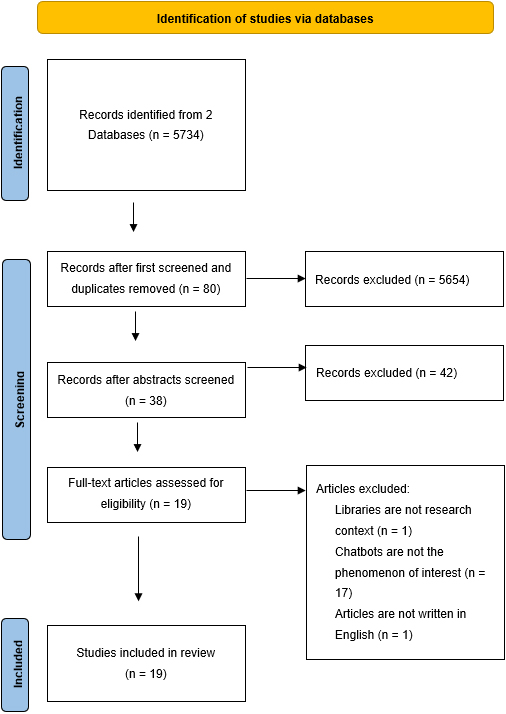
In order to identify relevant research on chatbots in libraries in the current study, chatbots and libraries were defined as two key concepts. We started with an unscreened exploratory search. In a university library search engine, we combined “chatbot” and “library” as keywords. A quick review of the results confirmed that the two keywords were valid. A brainstorming was then conducted on the basis of these two keywords, especially with regard to the concept of “chatbot”. Through brainstorming and exploratory searches, the following keywords were included in the search terms: “Chatbots”, “Chatterbots”, “Conversational agents”, “Conversational interfaces”, “Conversational UI” and “Talkbots”. In summary, the following terms and connectives were used for the search in this research: (chatbot* OR chatterbot* OR (conversational agent*) OR (conversational interface*) OR (conversational ui) OR talkbot*) AND library*.
Selection criteria
We define the following inclusion criteria for screening the literature:
Relevant articles must use chatbots and libraries as two key concepts. The library must receive emphasis in the articles as the context for the research. Libraries mentioned in these articles can include both academic and public libraries. In the concept of chatbots, we include all the interactive programs that can understand and communicate with the natural language input by the users. There are no restrictions on how users can input natural language: it can be text or voice. As well, there is no restriction on how the programs can respond to natural language: again, it can be text or voice, or even images; it can chat with users in natural language, or it can reply with pre-defined answers or directions. There are also no restrictions on the platform on which the chatbots can be deployed: it can be based on a web portal interface or mobile device software, or even a physical bot placed in a library (Embodied Conversational Agents). Relevant articles must be written in English. This research includes literature published between 2013 and 2022. In the early 2010s, conversational agent technology became familiar to the public (Rapp et al., 2021). And in 2014, chatbots began to be deployed in larger numbers (Grudin & Jacques, 2019). This paper, therefore, limits the timeframe of the study to the last decade, which, we believe, is a reasonable range of time for the technology to begin to come to the attention of people.
Two databases (Web of Science and Scopus) were searched in this paper. We entered the query string mentioned above into each of the two databases: ALL
The first screening was based on the same inclusion criteria as described above, focusing on whether the literature was written in English and whether it included the concepts of libraries and chatbots. After the first screening and removal of duplicates, a total of 80 records were included.
Abstract screening
The second screening was carried out by browsing the abstracts of the 80 articles identified in the first screening. We excluded literature that did not focus on libraries as the primary research setting. We also excluded literature that did not focus on chatbots as the main subject of discussion. We also excluded literature that focuses on early prototypes and incomplete implementations of chatbots, which lacked in offering meaningful dialogues. Thirty-eight articles were included through the abstract screening, and a total of 42 articles were excluded.
Full-text assessment
We conducted a full-text assessment and analysis of the 38 articles that had been screened by abstracts. At this stage, we read all 38 articles and coded them individually using the SPIDER tool (Cooke et al., 2012). A more detailed set of inclusion criteria based on the SPIDER tool has been written according to the topics discussed in this review. After a full-text assessment, we excluded a total of 19 articles, eventually retaining 19 articles.
SPIDER tool (Adapted from Cooke et al., (2012))
SPIDER tool (Adapted from Cooke et al., (2012))
We chose the CASP appraisal checklist to conduct a quality assessment. Each article was read carefully and assessed against the CASP checklist regarding research questions, research methods and design, research outcomes, research impact and significance, and ethics. The results of the CASP assessment for the 19 articles are presented in Table 2.
CASP assessment (Adapted from Critical Appraisal Skills Programme (2022))
CASP assessment (Adapted from Critical Appraisal Skills Programme (2022))
Overall, two papers were literature review studies, seven papers were technology reviews, one paper used quantitative research methods and one paper used a combination of qualitative and quantitative methods. The remaining eight papers used qualitative research, and in these studies, qualitative research was the method by which the research objectives could be properly achieved. Of the 19 studies, 12 did not collect data from human subjects, nor did they use human data. Questions relating to the assessment of the recruitment strategies of participants and the relationships between researchers and participants were therefore not applicable to these studies.
Of the seven studies that collected data on human participants, two did not specify the process and criteria for recruiting participants and were based on case studies in which data were collected from relevant stakeholders. The participants in one article were users of the case study chatbot and library staff (McNeal & Newyear, 2013), and the participants in the other article were users of the case study chatbot (Griol et al., 2015). From the results of the study, the selection of participants in both pieces of literature achieved the objectives of data collection (to study users’ and employees’ reactions to the chatbot (McNeal & Newyear, 2013), and to evaluate the chatbot proposed by the study (Griol et al., 2015). Therefore, we also consider all seven papers as adopting an appropriate strategy for recruiting participants.
In six articles, the authors did not specify the relationship between the researchers and the participants. They did not reflect on the possible biases brought about by the researcher’s own role, nor did they consider how to respond to the events that occurred in the study. This does affect the quality assessment of these articles, but after analysing the research design and study results, we believe that the risk of bias and occurrence in these studies is low and therefore the impact of the deficiencies in this section is acceptable. In summary, after assessing for this question, we have also included all these studies.
In terms of ethical issues, only one of all the papers involved in this review makes explicit reference to ethical considerations. However, as noted above, there were a total of 12 articles that neither collected nor used human participant data. Therefore, we believe that the ethical risk of these studies is low and did not need to be assessed for ethical issues. The remaining six articles did not provide detailed information on ethical review processes, but we found that these articles still provided sufficient information to state that their research was confidential, consensual, responsible, and respectful of privacy.
Among the papers identified, nine studies were conducted in Asian countries (2 in India, 1 each in Bahrain, Pakistan, Korea, Taiwan, Iran and Thailand), six in the United States, four in Europe (2 in Italy, 1 each in Spain and Ukraine), and one in Australia. Among the papers identified, only three were published before 2019 (1 each in 2013, 2015 and 2017), indicating the increased attention to the topic. Of the twelve studies published after 2019 (2019 – 4; 2020 – 4; 2021 – 1; 2022 – 3), six mentioned the Covid-19 pandemic, four of which used it as the context to conduct their research. These studies considered the implementation of chatbots in libraries as a solution for coping with the pandemic. A majority (47%,
Purpose and methodologies
Objectives of studies
Objectives of studies
A broad range of objectives and aims motivated the papers identified – Table 3 presents a summary of these studies. Over half of the chatbots addressed the integration of the library with other departments of their parent institutions. More than half of the studies aimed to investigate how chatbots can be used to improve information provision, reference services, and digital services in libraries. Three papers aimed to discuss the creation and management of chatbots. A small number of studies aimed to explore the application, error-handling strategies, and gender characteristics of chatbots. A range of papers highlighted the broader process of creating and managing chatbots as well as sharing error-handling strategies. Many such papers also discussed the perspective of librarians.
Ten papers were empirical studies using quantitative, qualitative or mixed methods, 2 reviews and 7 were technology reviews.
Table 5 summarises the range of methodologies employed in these studies.
One paper used a quantitative method, using a Wizard of Oz method (Lin et al., 2021). One paper used mixed methods, which involved the analysis of questionnaire responses and case study (Thalaya & Puritat, 2022). Six articles used a case study approach, specifically discussing a chatbot that had been deployed in a library, providing a detailed analysis of the chatbot’s features and applications. Two papers used the narrative review as a research method (Nawaz & Saldeen, 2020; Sanji et al., 2022). Seven papers were technology reviews, addressing the applications or solutions for chatbots based on a discussion of technical details.
Considering the objectives of the studies reported in the papers, we explored the research questions into technical and social perspectives. Technical aspects involved the implementation and maintenance, and design of chatbots, while social aspects involved the different application contexts, characteristics and evaluation strategies for chatbots. We describe these different perspectives in Table 5.
84% (
Three papers included only social questions as research questions. Ali et al. (2020) researched the perspectives of Pakistani academic librarians on artificial intelligence and chatbots. Lin et al. (2021) investigated how different error handling strategies of voice chatbots affect the interaction behaviour and performance of older users. Brown (2022) critically discussed whether and how current academic library chatbots express gender characteristics.
Again, 84% (
Overall, six studies collected data from human participants using a variety of
| Paper types | Methods | Data collection instruments | Number of studies | References |
|---|---|---|---|---|
| Empirical | Quantitative ( |
Experiments | 1 | Lin et al., 2021 |
| research | Qualitative ( |
Case studies | 6 | McNeal and Newyear, 2013; Vincze, 2017; Mckie and Narayan, 2019; |
| Kane, 2019; Panda and Chakravarty, 2022; Ehrenpreis and DeLooper, | ||||
| 2022 | ||||
| Interviews | 1 | Ali et al., 2020 | ||
| Document analysis | 1 | Brown, 2022 | ||
| Mixed methods ( |
Case study and questionnaires | 1 | Thalaya and Puritat, 2022 | |
| Narrative review | 2 | Nawaz and Saldeen, 2020; Sanji et al., 2022 | ||
| Technology review | 7 | Griol et al., 2015; Sorna Shanthi et al., 2019; Anelli et al., 2019; Bagchi, | ||
| 2020; Park et al., 2020; Yavorska et al., 2020; Rodriguez and Mune, 2021 | ||||
Objectives and focus of identified studies. Please note that some papers had multiple areas of focus
approaches such as, interviews (Ali et al., 2020), experiments (Lin et al., 2021), and questionnaires (Thalaya & Puritat, 2022). Two technology reviews recruited human participants to evaluate their chatbot model through experiments and/or questionnaires (Griol et al., 2015; Rodriguez & Mune, 2021). Five of the six papers reported on sample sizes, of which, Kane (2019) reported on the volume of text analysed (10,341 sentences spread over 2,786 conversations). Sample sizes of the remaining four papers ranged from 10 to 472. Two articles reported the age of the sample, one from 22 to 54 (Griol et al., 2015) and one from 60 to 75 (Lin et al., 2021). Only Griol et al. (2015) reported the gender of the participants (12 male and 13 female). The papers identified in our review studied stakeholders in two main groups: library staff and users. The findings from the studies of users are mainly concerned with user behaviour (preferred characteristics, expressed emotions, and type of consultation) and their satisfaction with the chatbots (Thalaya & Puritat, 2022; Griol et al., 2015; Rodriguez & Mune, 2021; Lin et al., 2021; Kane, 2019; Ehrenpreis & DeLooper, 2022). The studies of librarians focused on their attitudes and concerns about chatbots, such as increased workload associated with managing and maintaining the chatbot, demand on users’ digital literacy, layoffs of staff, and distrust of the technplogies (McNeal & Newyear, 2013; Vincze, 2017; McNeal & Newyear, 2013; Ali et al., 2020).
Our results suggest that fifteen studies mentioned the use of specific chatbots while the others discussed the broader concept of chatbots. Two types of chatbots were identified, namely guided chatbot and FAQ chatbot. According to Mckie and Narayan (2019), a guided chatbot responds to the context of the conversations and asks the user questions; while a FAQ chatbot responds without understanding the context of the conversation and does not retain previous conversations with the users. Eight of the papers surveyed discussed guided chatbots (McNeal & Newyear, 2013; Vincze, 2017; Sorna Shanthi et al., 2019; Mckie & Narayan, 2019; Anelli et al., 2019; Nawaz & Saldeen, 2020; Bagchi, 2020; Park et al., 2020), while four discussed the use of FAQ chatbots (Griol et al., 2015; Rodriguez & Mune, 2021; Panda & Chakravarty, 2022; Thalaya & Puritat, 2022). The remaining three papers did not specify the type of chatbot being studied (Kane, 2019; Yavorska et al., 2020; Ehrenpreis & DeLooper, 2022). A majority of the studies (ten) involved the study of text chatbots, three studies involved the study of combined interactions (text and voice), and two studies reported on voice-only chatbots. The type of chatbot wasn’t clear in the remaining two studies. Table 6 presents the different interaction mechanisms of chatbots that were studied in the identified papers.
Types of interaction mechanisms of chatbots. Note: some chatbots have multiple interaction mechanisms depending on access paths
Types of interaction mechanisms of chatbots. Note: some chatbots have multiple interaction mechanisms depending on access paths
For the fifteen papers discussing specific chatbots, we present the implementation and development of the chatbots from three perspectives – the type of approach (pattern matching or machine learning) used by the study, the type of platform (open-source or closed platform) and the type of access mechanism (library website, social network, mobile app etc.) (Table 7).
47% (
As can be noted from Table 7, almost half of the articles discussed using closed-source platforms for developing chatbots. The most frequently mentioned closed source platform was Dialogflow, discussed in four studies, used to process the chatbot conversations, analyse user queries and create responses (Sorna Shanthi et al., 2019; Anelli et al., 2019). Closed-source platforms mentioned in the papers are danbee.ai and Engati (Panda & Chakravarty, 2022; Park et al., 2020). Open-source platforms noted in the studies identified were Pandorabots (Vincze, 2017), Program-O (Kane, 2019), and Rasa Stack (Bagchi, 2020).
Nearly half of the articles discussed web portals for chatbots, possibly due to their flexibility (Kane, 2019). McNeal and Newyear (2013) discussed the different configurations of the chatbot arranged on the library catalogue page, help page, and home page. Mckie and Narayan (2019) suggested the potential of embedding
Range of implementation for chatbots – categorised by development approaches, platforms and access mechanisms
Range of implementation for chatbots – categorised by development approaches, platforms and access mechanisms
academic library chatbots into other school departmental web pages (e.g., online learning management systems such as Canvas and Blackboard). Rodriguez and Mune (2021) discussed used Kommunicate as a publishing support platform to develop a web-based conversational user interface (CUI). A third of the papers discussed accessing chatbots via social software. It is worth noting that, except for one paper that does not specify a platform for chatbot development (Yavorska et al., 2020), the chatbots in the other four papers that discussed the use of social software as a front-end user interface were all developed using closed-source platforms (Sorna Shanthi et al., 2019; Park et al., 2020; Panda & Chakravarty, 2022; Thalaya & Puritat, 2022). Panda and Chakravarty (2022) noted that the closed-source platform Engati can be easily integrated with various social software. Griol et al. (2015) proposed a prototype of an Android-based chatbot mobile application. McNeal and Newyear (2013) introduced the portals for the chatbot to be placed at the library’s indoor information kiosk and computer desktops, as well as the access via QR code scanning with a mobile phone. The chatbot proposed by Anelli et al. (2019) was able to be accessed through the Italian Google Assistant.
In this paper, we conducted a systematic literature review in the field of library chatbots. We analysed the following: the application contexts (e.g., region and year of publication, context, and objectives), the characteristics of chatbots (e.g., interactions, types, development approaches, and access portals), and the research approaches adopted in the current literature (research methods, key questions).
Our findings suggest that overall research on chatbots in libraries is still in its early stages, although there is an emerging upward trend in a wide range of countries. This is consistent with the findings of Bohle (2018), who argued that chatbots play an increasingly significant role in user interactions within libraries. The review has reported positive impacts of the use of chatbots in libraries, including improved user satisfaction, increased speed of interaction, increased self-efficacy for users, and support for reference services for library staff. Despite these benefits, concerns around job security, additional workload, and distrust towards chatbots’ abilities still persist.
Our review also sheds light on the growing use of chatbots in the wide range or library types where they have been deployed and studied. The analysis revealed that a majority of the chatbots were deployed within academic libraries to help students and academics find information and format references, with a few in general libraries and a minority in public libraries. This indicates that academic libraries are leading the way in the adoption of chatbots, perhaps because of the high demand for information services among students and faculty (Cox et al., 2019). However, the evaluation of the effectiveness of said chatbots remains lacking, especially from the perspectives of multiple stakeholders. This also accords with a recent study by Kaushal and Rajan (2022), who highlight the importance of incorporating different library stakeholders when studying chatbot adoption in libraries. Our review also highlights the potential of chatbots to support libraries in meeting the information needs of their users and overcoming the challenges posed by the Covid-19 pandemic. The findings of Huang and Kao (2021) align with the notion that chatbot services have been extensively utilised as a means of addressing the limitations brought about by the pandemic.
Furthermore, our review highlights the prevalence of text-only chatbots with pattern-matching approaches, the use of closed-source platforms for development, and the most common method of deployment which is through library webpages. These findings can be useful for libraries looking to implement chatbots in their services. As the use of chatbots continues to evolve, it will be interesting to see how machine learning approaches and innovative ways of interaction are incorporated in into the development of chatbots in libraries (Bagchi, 2020). Additionally, we identified two main research angles for library chatbots: namely, social and technical. However, most empirical studies in our review are small-scale qualitative studies, while the remaining studies are technology reviews.
Conclusions
The systematic literature review we conducted highlights the increasing use of chatbots in libraries, particularly academic libraries. Although there has been significant growth in this field, research is still in its infancy, with most studies being empirical and qualitative in nature, and focusing primarily on implementation, maintenance, design, evaluation, and applications. The chatbots of interest were primarily text-based and developed on closed-source platforms, integrated with library web pages or social software. We recommend that future research in this area focus on developing a stronger theoretical foundation and testing chatbots with large populations of participants. It is also necessary to explore the use of chatbots in public libraries for diverse users, which has been limited to date. This research has some limitations to be noted. To begin with, the data was gathered from only two databases, Scopus and Web of Science. Furthermore, the publication covers the years between 2013 and 2022 only, prior to the advent of ChatGPT. It would be intriguing to examine the proliferation of open source chatbots in the future.
Footnotes
Acknowledgments
We extend our gratitude to the anonymous reviewers for their invaluable feedback on this paper.