







Abstract
The Internet of Things (smart things) is used in many sectors and applications due to recent technological advances. One of such application is in the transportation system, which is of primary use for the users to move from one place to another place. The smart devices which were embedded in vehicles are useful for the passengers to solve his/her query, wherein future vehicles will be fully automated to the advanced stage, i.e. future cars with driverless feature. These autonomous cars will help people a lot to reduce their time and increases their productivity in their respective (associated) business. In today’s generation and in the near future, privacy preserving and trust will be a major concern among users and autonomous vehicles and hence, this paper will be able to provide clarity for the same. Many attempts in previous decade have provided many efficient mechanisms, but they all work only with vehicles along with a driver. However, these mechanisms are not valid and useful for future vehicles. In this paper, we will use deep learning techniques for building trust using recommender systems and Blockchain technology for privacy preserving. We also maintain a certain level of trust via maintaining the highest level of privacy among users living in a particular environment. In this research, we developed a framework that could offer maximum trust or reliable communication to users over the road network. With this, we also preserve privacy of users during traveling, i.e., without revealing identity of respective users from Trusted Third Parties or even Location Based Service in reaching a destination. Thus, Deep Learning based Blockchain Solution (DLBS) is illustrated for providing an efficient recommendation system.
Keywords
Introduction
Today, due to recent development in technology, transportation has become easier to access for every individual. Taking a look down the memory lane, vehicles have changed tremendously. With several benefits in vehicles or Vehicular Adhoc Network (VANET), several issues like security, privacy and trust also arise. We deal with privacy and security by using the concept of Blockchain to secure the decentralized systems as this guarantee the resilience of the system to save the users from malicious attackers [1]. We choose deep learning algorithms instead of the traditional machine learning algorithms because of its capability for achieving more accuracy and also because it offers a smarter insight for the problems. This work discusses about vehicles in detail, and how VANET provides dynamic, reliable, and offers multiple services for the infrastructure of the road.
Vehicular Ad hoc Network models.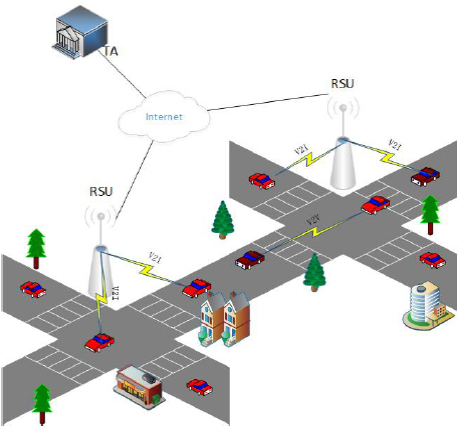
Smart Transportation System/Vehicles of Tomorrow/ Future Vehicles/Autonomous Vehicles: The self-ruling car has been well recognized in the past decade and newer versions are getting implemented day by day. However, the importance of these autonomous vehicles has remained a significant challenge. The first level is that these autonomous cars are equipped with a series of sensors that configure tons of data in real time which should be analyzed for the decisions to be taken at the right time. Thus, the architecture of the self-driving vehicles must consider the volume, speed, quality, heterogeneity and the real-time nature of the data [2]. It is worth noting that different auto manufacturers leverage onboard sensor and actuator technologies for di fferent types of optimized applications. However, at the deep end of the design it should be able to function autonomously [3]. Basically, the autonomous vehicles require features that will enable the vehicle to foresee, decide, and move safely and reliably according to some plan. In the following section, we give a brief description of some of the most fundamental autonomous car design characteristics.
Vehicular Ad hoc Network (VANET)
VANETs are the wireless chain of connections in which the junctions/nodes are firmly attached on the roads (see Fig. 1). It is highly dynamic, reliable, and offers multiple services, but with limited access to the network infrastructure. The Vehicular Ad hoc Network is divided into four categories, which are described as follows
Warning Propagation Message: When there is an emergency situation and a message have to be sent to the vehicles in the surrounding to avoid more congestion or traffic and to avoid collisions, a routing algorithm is required to send a warning message to the required place [4]. Vehicle to Vehicle Group Communication: In the Vehicle to Vehicle Group communication domain, only vehicles that share the same characteristics are allowed to communicate using Vehicle to Vehicle Group Communication. Beaconing: The messages which when sent in a timely order, the beacon communicates with all vehicles which are in the neighborhood and include RSUs. These communications include the basic physics quantities which are velocity, speed and acceleration of the sending vehicle. Infrastructure to the Vehicle Warning: The improvement of traffic flow and to increase the safety on the roads, warning messages are broadcasted from the infrastructure via the remote switching units to all vehicles in its surrounding when a possible collision is detected, especially when it is located in the curve route, intersections, or with a narrow road.
Note that the Dedicated Short Range Communication (DSRC), WAVE, and IEEE 802.11p are used to designate the full standard of communication protocol to deal with VANETs. Figure 2 explains VANET applications in detail.
Vehicle applications types.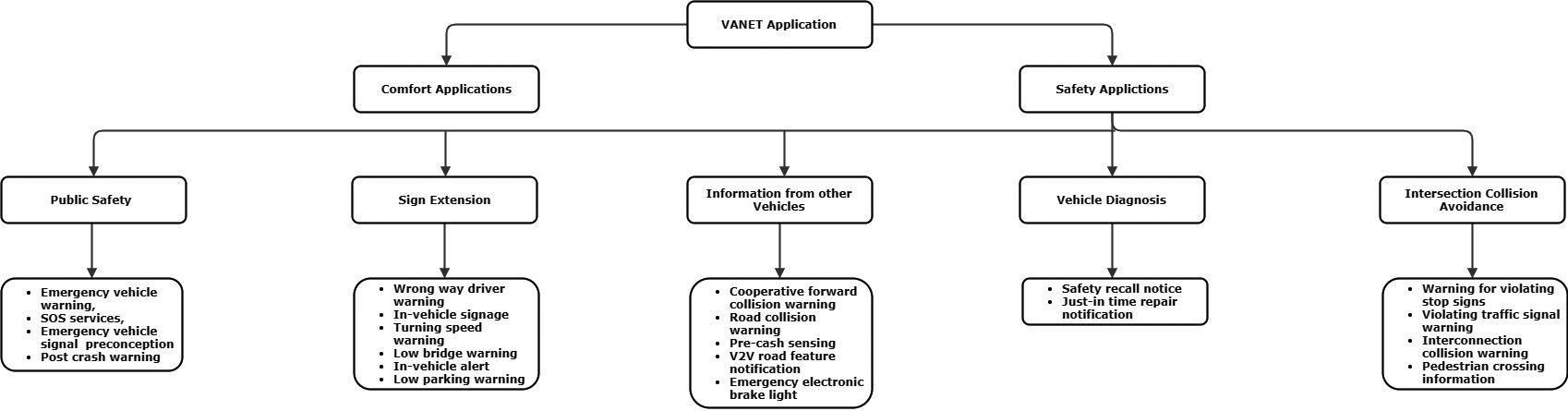
Hence, the remaining flow of this paper is as follows: Section 2 discuses about Blockchain technology and its evolution. Section 3 discusses our motivation behind writing this work. In Section 3, popular issues have been listed out in future vehicles, (i.e., Vehicles of Tomorrow). Further, Section 4 discuses several recommender systems in current. Section 5 discusses popular issue mitigated with future vehicles. Then, Section 6 discusses negative impacts of vehicles in our modern life. Further, Section 7 discusses several privacy and trust mechanism in current related to Vehicular Ad hoc Network. Section 8 discusses our proposed method or algorithms (using Blockchain technology and deep learning). Section 9 discusses the simulation results of our proposed algorithms. To conclude with work, Section 10 briefly discusses it with including several future enhancements. Note that in this work we will use words like ‘Smart Transportation System’, ‘Vehicles of Tomorrow’, ‘Future Vehicles’ and ‘Autonomous Vehicles’ interchangeably.
Blockchain is a fundamental technology of the Bitcoin emergence in 2008. It is a widespread public ledger which is implemented using the Proof of Work (PoW) algorithm which is encrypted using Merkel trees and hash functions. The above-mentioned features of Blockchain make it a worthy tool for establishing a desirable trust model in VANETs. The broadcasted communications of authorities are written into the fixed and unforgeable ledger, which can be verified and audited by every entity in the network. However, the privacy of nodes was not considered at the time of Bitcoin’s original design. By reviewing the ledger, the transactions made with any public key is traceable to a real identity. Blockchain is the technology behind Bitcoin. It is the spine of the Bitcoin system. Blockchain is the technology used in Bitcoin, it is a public distributed database holding encrypted ledgers of everyone in world of Blockchain. Bitcoin Blockchain has a distributed ledger. The ledger is public, hence making it available for everyone to access. Transactions are unchangeable which implies that it cannot be hacked. The concept of double spending is restricted because of the fundamental idea of Blockchain and the best part of using such a crypto currency is that the transaction fee is zero or very minimal in comparison with third parties such as banks and digital transfer systems [5]. Note that Bitcoin is the first decentralized digital currency that came into the market and was introduced in 2009. Bitcoin uses cryptography to control its creation and management of bitcoin is restricted, created and held electronically in a peer to peer open ledger called the Blockchain. Ledger is produced by people by people using software that solves mathematical problem. There are 3 types of Blockchain which can be included here as:
Public: Public Blockchains have ledgers which is open to everyone on the internet and it can be verified by anyone. Private: Private Blockchains is people specific which states that only selected people will be able to verify and make changes. Consortium: This is organization specific, where only a specific group of people will be allowed to make changes and verify.
Private and public key cryptography: Private key cryptography involves two different keys, public and private. One key is purposely kept private, while the other is provided to the other party (or often the public). If you use a private key to encrypt then the public key can decrypt and vice versa. This is called asymmetric encryption (or public key cryptography).
Blockchain transaction: The entire transactions are loaded with information on time of the transaction, date of the transaction, participants involved and amount of every single transaction. Each node in the network owns an entire copy of the Blockchain. Transactions are then cross checked by the miners after solving complex math puzzles and maintain the ledger. The mathematical principle ensures that the nodes are automatically and continuously agreed to the current state of the ledger and every transaction in it. If anyone attempts to corrupt a transaction, the nodes will not arrive at a consensus and hence will refuse to incorporate the transaction in the block chain. For Blockchain, there are many nutshells available. The use of phones, mathematics, to create a secure, distributed ledger, which enable transactions, without the need for, third, parties. Moreover, various use cases for Blockchain are banking, payments and transfers, healthcare, low enforcement, voting, internet of things, online music, and real estate. Some of them are discussed here as:
Banking: Blockchain could cut up to $20 billion in middle-man costs per year.
Hacking into banking ledgers becomes close to impossible. Solves the double spending problem. Reduces bank crises by a large extent. Payment and transfer: Blockchains transfers are on top in terms of security, currently bitcoin runs on no fixed transaction fees, no bank account required and anonymity is maintained. Voting: The basic concept behind elections is the requirement to authenticate the thieves. The voters identity and to cross check the tallies. Blockchain is the medium counting votes without voter-fraud lost records or foul – play. It is used to increase the voter turnout. Blockchain Demo Ethereum: Blockchain Demo Ethereum is a Blockchain based distributing open source platform. It is publicly built for the ledgers. It invokes agreements through scripting functionality,
In summary, Blockchain consists of a digital ledger in which the details of transactions are stored securely. It is an enhancement of a peer to peer network in which data privacy and security is provided to all users although the blocks do not trust each other. The data in the blocks are encrypted and are stored in such a way that stability of the system is ensured. The system consists of decentralized blocks of records to which financial considerations are applied so as to make the system protected by discords and errors. Every block in a Blockchain is connected to the block immediately before it and immediately after it. Thus, it becomes increasingly difficult to access a particular, singular data from a ledger as the information within a block will have to be altered along with the blocks connected to it. Along with this, Blockchain also has some additional qualities which enhance its security of data. The data in a Blockchain is sealed cryptographically. The members of a Blockchain network use their private keys to access secure data from the chain. If some data in the Blockchain is tampered with, the network gains knowledge instantly. This prevents further loss of data and information. The Blockchain is distributed and is refreshed or updated regularly. Since it is not centralized, these systems do not consist of a particular point of failure and thus cannot be altered by a single device.
Vehicular Ad-hoc NETworks (VANETs) is an incipient technology which aims to improve road safety by preventing and hence, reducing traffic accidents. Today’s vehicles are enabled with updated technologies like smart things and sensors making use of internet which results towards autonomous vehicles [6]. These smart things run specifically making use of numerous protocols and sensors and actuators. In future vehicles, sensors provide a mechanism for maintaining the conditions of unbearable traffic, road and vehicles. These have resulted in problems of the past and for the future. But we may receive (possibilities are high) many attacks on the smart transportation in near future namely timing, linking, Sybil, new comer, and bogus attacks [7]. The attacker’s aim is to understand the driver’s exact location traces, i.e., and come to the conclusion with the data regarding travelled where and when. Saving human lives over the road network during congestion or occurring accident along the highway is the primary goal and hence the paper below will be able to provide more clarity. Traffic control, traffic safety entertainment and driver assistance are some other aims of today’s researchers in future vehicles. Future vehicles need to respond to users efficiently and solve user’s queries in minimum time to avoid future risks and accidents. We also need to provide maximum safety to passengers during travelling to maintain mortality rate. We aim at help more people or passengers to find optimal route during congestion and accidents along the highway. Hence, this section discusses our primary goal/main motivation behind writing this article. Now, next section will discuss several critical and existing open issues in future vehicles.
Recommender system
Machine learning and artificial intelligence have developed drastically, such that, it is currently being used in day to day activities to make life more convenient for people. The smart recommendation function presents users with helpful information from the data present around us in the internet. This function is entirely governed by the recommendation algorithm. The productivity and efficiency of this function is dependent on the algorithm. There are two commonly implemented algorithms, which can be discussed here as:
Content based methods: In this type of a recommender system, the algorithm is based on the information that the using party provides. This information provided, can be explicit or implicit. For example, the feedback that a user provides is explicit data. On the other hand, accessing a particular website or viewing a link out of interest is the implicit data provided. This acquired information and data is used by the recommender algorithm to make certain predictions. The more data fed to the algorithm, the more precise the predictions will be making the whole process efficient. It is directly proportional. The notions that are used in this system are “Inverse Document Frequency (IDF)” and “Term Frequency (TF)” [8]. The TF is basically the number of times a word occurs in a record. IDF is the reverse of the record frequency by considering the entire collection of records. For example, if we look up ‘The importance of Big-Data’ on a web browser, it is assured that ‘the’ will occur more often than ‘Big-Data’. But, the importance of ‘the’ is lesser. Thus, these notions are used to fairly determine the importance and value of different words in a record. Collaborative filtering methods: In this type of recommender system, the algorithm is entirely based on the history of the user party’s searches. The actions made in the past are analyzed and a recommendation is delivered [9]. A user’s likes and dislikes are recognized and relevant data is formed. There are two types of collaborative filtering namely user based and item-based filtering. In simple terms, user based filtering is basically checking how similar the required users are compared with other users. This algorithm checks for users who are in close proximity with the required users and compares their interests and differences. Using this data collected, the system makes predictions. This method does not depend upon the context and is found to be more efficient in terms of accuracy while being compared with content-based methods. But there will be increased cost to find the users in close proximity and there is always a dilemma regarding which user to select. On other side, item based filtering is basically checking the similarity of the objects liked by the user party and it is compared to the other objects. Calculations are done to check how similar the objects are and they are used to get a result which enables predictions to be made. The most common calculation methods are, cosine based and correlation-based similarity calculation. Finally, regression charts are plotted and analyzed along with weighted sum charts to be able to get a clear idea on the predictions that need to be made. The calculation of the similarity of the objects are made firsthand thus eliminating the need for proximity user search.
Hence, this section discusses recommender systems like content based, and collaborative filtering methods. Now next section will discuss popular issues in future vehicles (in detail).
In the previous years, many issues with respect to security, trust and privacy are mitigated. Also, many attempts have been made by experts or scientific community for preserving privacy, and maintaining security, etc. But, due to mobility feature of vehicles (also decentralization), these issues are difficult to solve. In general, the following issues are rectified with respect to security, privacy and trust.
The first and foremost issue is the absence of a driver which leads to unreliability and hence the control over the car is reduced by great ranges. The need of a driver warning is of great significance. In vehicle signage: it regulates the warnings using the signals which carry necessary messages to deliver the required information about the infrastructure and structure of the car. Turning speed warning: this warning is used for over speeding which cannot be turned off by the driver at any given point as he has no control over it. Audible alerts are sent out when the car crosses the speeds above 80 kph and there is continuous audible warning beyond speed of 120 kph. There are also other warnings which warn the driver when they are approaching a curve or an exit on the road or highway too quickly when the speed is not reduced.
For building trust among users and trusted authorities or service provider, we need the following components need to be maintained. Some are discussed below:
Privacy: The information (identity or location related) which we do not want to share with others.
Location tracking: It is of vital importance to know the exact and correct route to get to the right location [10]. The presence of a robot and his generic routes might not be the most viable solution to the passenger as it may lead to a dead end. Identity revealing: Without an authenticated measure, drivers will be concerned about the identity which may be revealed which result in disrupting the whole vehicle system and damaging the vehicle requirements which run the vehicle in an authorized manner. Control: It means how each user is able to access some resources or information.
Low bridge warning: it is generally used when there is low-clearance on the bridge and it requires very little driver input. The device will provide low bridge clearance alert which is very vital. Based on the vehicle profile even if a route hasn’t been calculated, it can be approximately predicted which gives the driver and the passenger a vivid idea on the route. Height restriction is made mandatory and warning signs are provided for the same. In vehicle alert: Vehicles receive messages from the nearby emergency vehicles approaching them from all directions which gives the vehicles nearby to change the directions so as to avoid collision and to save time. It uses GPS to warn the drivers if they are speeding in the direction of the emergency vehicle. Low parking warning: this warning indicates if the brake fluid is low or the parking brake is engaged and if something is wrong with the anti-lock braking system. Parking sensors are the proximity sensors for road vehicles designed to alert the driver of obstacles while parking. These systems use electromagnetism.
Authentication: Authentication is “the process or action of verifying the identity of a user or process”. This verification can be done through cryptography and bio-metric and many other mechanisms. But in this smart era, securing a process, network or system has a series of critical issues against malicious attackers. Here, our aim is to authenticate user to avail location-based services with a lightweight authentication (having less time in authentication) mechanism.
Safety: The first and foremost safety issue is about the reliability of the transportation system and what happens if the automated system goes out of control? Hence, to resolve the same we make use of an emergency vehicle warning which is made use of uncontrollable situations, because after all they are not driven by human beings and they are prone to accidents. SOS services is of utmost importance as it is an international Morse code for extreme situations, a person of authority, i.e., police officers, coast guards and even pilots respond at the sight of this. The users’ location with an emergency message and time is sent to the required person and these devices are installed with high pitch siren to alert people nearby.
Signal preemption allows the vehicles in emergency to disrupt the normal signal cycle in order to get quicker and to be safer under these conditions. A signal preemption system decreases the emergency vehicle response time. Collision avoidance system cars add another layer of security with car crash sensor which detects accidents by using the post-collision braking technology which further notifies the control system that dispatches help.
The VANETs (Vehicular Ad-hoc Network) are classifies broadly into five types: Availability, Data integrity, Non-repudiation, Authentication and Confidentiality. They are described below:
Identity privacy preservation: When the messages are sent by the vehicles, the attacker should not be able to obtain the true identity of the vehicle, only the TA (Trusted Authority) should be given the authority to identify it. Traceability: The Trusted Authority should be able to identify and track when a malicious sent is sent and who it is sent by. Non-repudiation: Through this property, when a message is sent by the vehicle, it cannot be denied. Unlinkability: The message should not be interpreted by the attacker. Resistant to continuous disruption: VANETS should be able to identify the real identity of the attacker and should cease the behavior of the malicious attacker. Modification of passwords: The possessor of the vehicle must be allowed to change his password. Resistance to ordinary attacks: Attacks such as replay, ordinary, modification and impersonation should be resisted by the CPPA scheme.
Unlinkability: The vehicles are expected to be able to communicate with each other so as to minimize accidents and collisions, with the recent road infrastructure so as to enhance driving experience and to improve communication in Vehicular Ad-hoc Networks (VANETs) which can be used to track movement of vehicles [11]. Anonymity: Drivers in automobile industry with black window slides rarely stop at a four way stop intersection. Conditional anonymity means that legal vehicles can use anonymity to protect privacy but the vehicles which misuse this power will be tracked. De-correlation of location points: The location of the vehicle is found using iterating the closest point which calculates the rotation which is helpful for the spatial de-correlation in GPS, which improves the accuracy by a major amount.
Hence, this section discusses several issues raised with future vehicles. Now next section will discuss negative impacts of automobiles in modern day life/smart era/21
Vehicles are generally used for transportation purposes, whether it is people moving from one location to another or shifting of goods using this. Vehicular is in trend nowadays as it has made a drastic impact on peoples’ lives and has made their lives so much simpler but analogically quoting, like ‘Every coin has two sides’, similarly, ‘the Vehicular Ad-hoc Network’ has its downfalls [12]. Few of them are listed below as:
Expense: The first and foremost Negative impacts of automobiles in Smart Era. The automobiles are a profligate waste of money and fuel. More than 80 cents of money is spent on gasoline which is squandered by the inherent inefficiencies of the modern internal combustion engine. Deaths and injuries: The second issue is a dramatic increase in the rate of accidental death due to the carelessness of people and the total disregard of his/her lives and the others lives. Cardiovascular disease and a rise in obesity is due to the ignorance of their health and avoiding health and overseeing vehicles. Urban sprawl: The problem with urban environments is that they are auto oriented. The beginning of the sub-urbanization process has given rise to the invention of the vehicles which has evolved into the automobile industry. Congestion: The most obvious reason in the present era is traffic. In a nation like India, more people result in more vehicles. More fundamentally, is car congestion a problem to be solved. Walkable city life is increasingly attractive to both young people and old people to reduce congestion. Pollution: Major contributors to pollution include NO2, CO and other toxic gases. These give rise to air pollution and make living around these areas difficult. Others: To maintain directions for the users of the vehicle by providing the use of maps for self-driving cars is essential.
Cyber-security will be an essential issue, generally fully self-driving cars will ultimately need to adopt the following key tasks:
The need to understand the environment which surrounds them. To understand why the people, they encounter on a daily basis on the road are behaving the way they are. To decide how to respond (thumb rule – left-hand rule/right-hand rule which indicates four directions) to complex situations. To learn how to communicate with other people. There is a long way to go to achieve these features in future vehicles. Hence, this section discusses several critical issues in current transportation systems/vehicles.
For that, we have provided security, privacy, and trust requirements in this section. Now, next section will discuss several existing mechanisms to avoid above discussed attacks/issues.
Qualitative comparison of works
Security is a human right and the need for this to be provided is present in all situations to client/user/system in this smart era (to electronic frameworks). On another side, privacy is required to be maintained for communicated or collected data (data in motion and data at rest). Privacy and security have different meaning but they are inseparably related. Security can both be an ally and an enemy to privacy. Though privacy and security seem to complement each other, privacy has a socialistic perspective while security has a technical approach. The relationship between them is that the security technologies might provide mechanisms by which privacy can be ensured. Privacy and security are two integrated issues (important) in the deployment of every technology (require with data, i.e., data need to be secured and confidentially during data transfer) or network. Security is the degree of confrontation or protective nature from destruction, valuable goods, humans, nation, institution, etc. On the contrary, privacy refers to “masking oneself from others”, i.e., securing your personal details, location, etc. from illegal access or rather, privacy refers to the certain information which everyone would like to keep in incognito mode of theirs. For example, in a Vehicular Ad-hoc Network, user’s privacy is important while communicating with other users and also with infrastructure, a user always worry about their personal data and their location. Moreover, these issues trust issue also comes into picture in computing environment, but this article is more focused towards security and privacy issue only. The difference between privacy and security have been discussed (in detail). Note that difference between security and privacy can be found.
Hence, this section discusses several existing mechanisms for building trust and privacy preserving via Table 1. Now, next section will discuss raised problem in todays and future vehicles in a concise manner.
Proposed solution
In the following section, we are discussing about Blockchain based deep learning solution which can provide trust using the recommender process and the results obtained are passed on to the next user and it continues like a chain and the trust and the security are maintained by the ‘n’ users who cross check and validate the information using ‘n-1’ users, if the information is not matched, an alert is sent to the next user. It is used to build direct trust between users. The proposed algorithm is used to compute two-way computation trust.
Problem definition
Our main aim in this work is to reduce the waiting time of vehicle users over the road network (during travelling). In this process, many vehicles are moving in both (or many) directions.
Main problems which were raised are:
Location Based Services (LBSs): The service which provides road side services to user based on demand and with collecting personal of vehicle users. But these location-based services may reveal this information to other users or sell to malicious users. Trusted Third Party (TTP): Each and every information is circulated to neighbor vehicles and central authority (Trusted Third Party, i.e., TTP), based on verification and matching of the responses, trust is built among users/vehicles users.
But what if central authority reveals this collected personal information to other vehicles users or other unknown users. In summary, we need to provide reliable and secure communication between vehicles overt the road network, especially nearby receiving location-based services by many users, i.e., without affecting their personal privacy/leaking their privacy [13]. Hence, this section discusses problem crating via location-based service provider and certified authority in detail (as discussing scenarios). Now, next section will provide our proposed solution to solve such problems/attacks in todays and future vehicles.
For VANETS, an effective trust model must satisfy the following criteria:
Transparency: It is extremely important that authorities are transparent because properties such as registration, maintenance of network and arbitration will become hoax. Conditional anonymity: Vehicle to vehicle and vehicle to infrastructure communications should be made anonymous so as to prevent the piracy of identity. Efficiency: The authenticity and trustworthiness of a vehicle can be proved only if the system is efficiently maintained. Robustness: The model should be resistant against attackers who aim at disabling the whole system [14].
For building trust, we require recommendation of many others uses about other users. This kind of trust is called as indirect trust. In this trust mainly entities participate which includes user 1 (about whom we need recommendation), user 2 (who will give recommendation bout other user 1) and certified authority for verifying any discrepancy/solving any grievances.
Certificate updation process.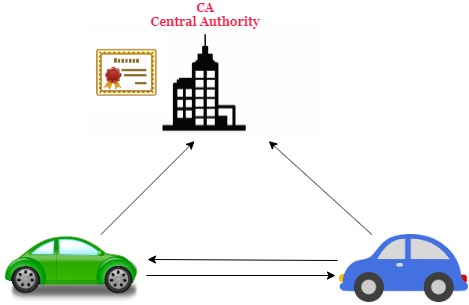
Proposed vehicular network trust model.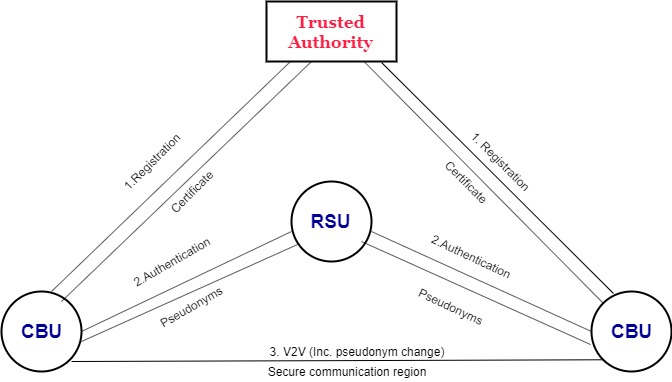
Autonomous vehicles.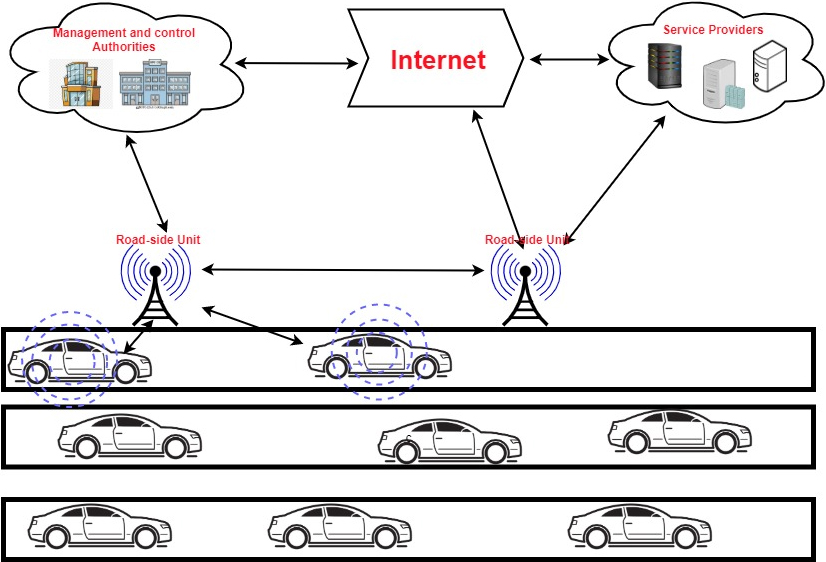
ns
/* Calculate direct trust of client,
S
discounting
/* Calculate indirect trust of client,
/* calculate direct trust of server,
discounting
/* Calculate indirect trust of server,
/* make trusted connection */
Hence, Fig. 3 provides certificate updation process among moving vehicles over the road network. Further using Algorithm 1 (two-way computation), we build trust (direct, not indirect) among vehicle user.
Registration process will be done with OBU and TA. The following procedure is used to establish trust among the entities:
Communication overhead in parking offers retrieval phase versus the number of parking offers per cell.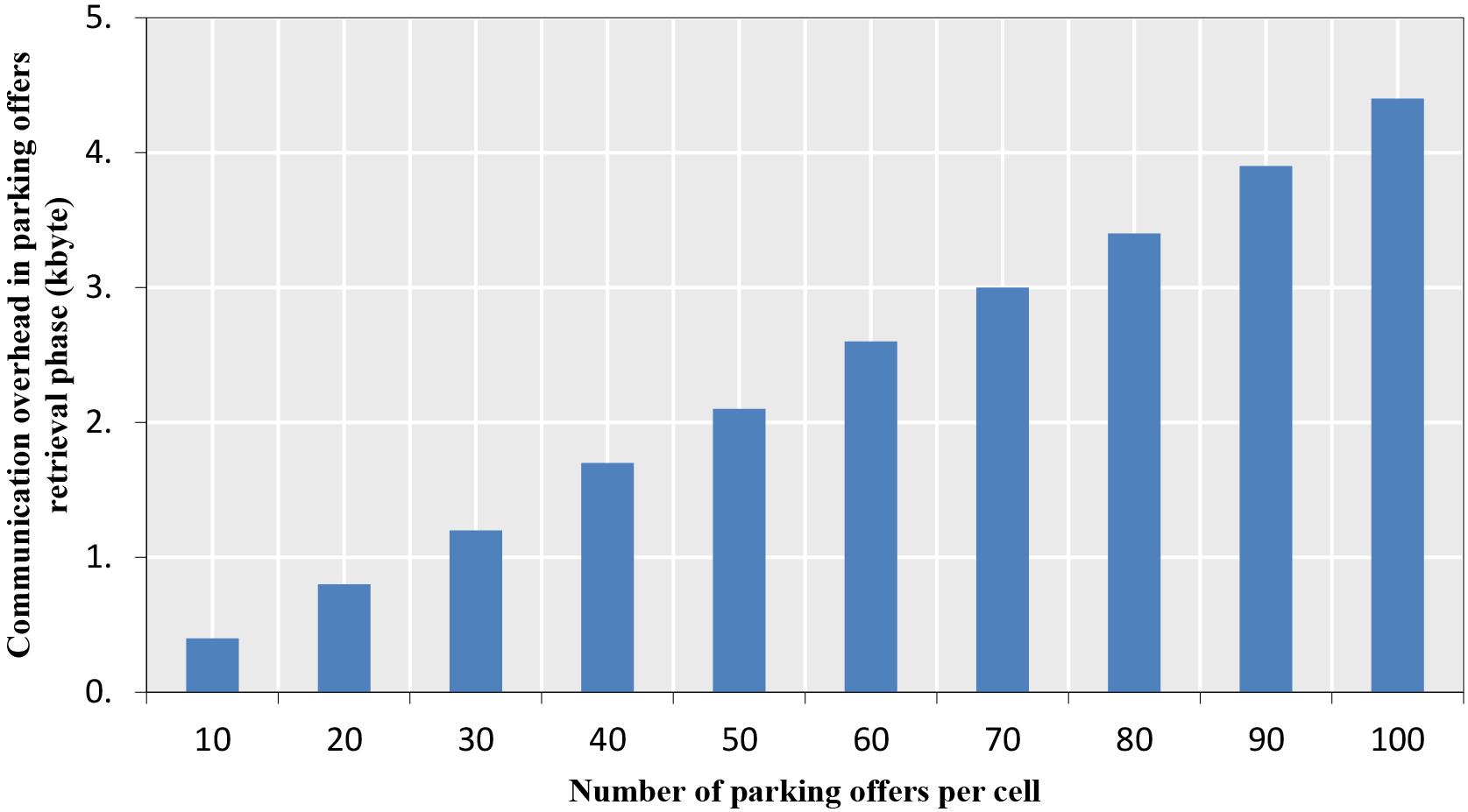
The trusted authority must be initially contacted so that the vehicle can register in the vehicular network. The vehicle must enroll to the road side units when it enters a particular region so as to maintain authentication. If it is successful, the RSU will issue a set of instructions for the vehicle for anonymous communication [15]. Our proposed solution process for building trust and communication of Autonomous Vehicles with RSU/trusted party can be found in Figs 4 and 5. To maintain safe driving and to save time by knowing the routes in advance, the vehicles communicate with other vehicles in the neighborhood.
RSU is used to send signals to vehicles and anonymize information to CA. Then the same vehicle shares this anonymized information with other vehicles to preserve their privacy.
Trust maintained based on privacy preservation
The beginning and the end of their trips are established by time and location specific keys. A copy of their trips report with various accuracy levels which are encrypted with different keys are updated to the database. The trips database is queried by the traffic authorities and they reconstruct by encrypting and decrypting the shares with the help of the keys [16]. The highest accuracy report is used if several reports are present.
Hence, this section discusses our proposed method/ algorithm to build trust and preserving privacy in autonomous vehicles. For that, we have discussed our proposed in various figures for user’s understanding. Now, next section will discuss simulation results for proposed algorithm.
The analysis done through the performance proposed that our schemes aims at better performance and aims at reducing overhead computations and communication and has made an exceptional change in the current VANETS. Our aim is to reduce the operation time of RSU and TA and to create a balance in the delay time. Here in this section, two situations arises: a) When a vehicles is moving over the road network and required parking with leaking his/her private information, and b) when a vehicle provide carpooling services to many user from one route to another route then at destination point he/she may require parking without leaking his/her personal information. Note that in second case driver also need to preserve his/her against passengers and preserve passenger’s privacy also (with building trust).
Data set and parameters used
Data set and parameters used
Attack possibility on total number of devices (OBU) (during parking/moving over the road).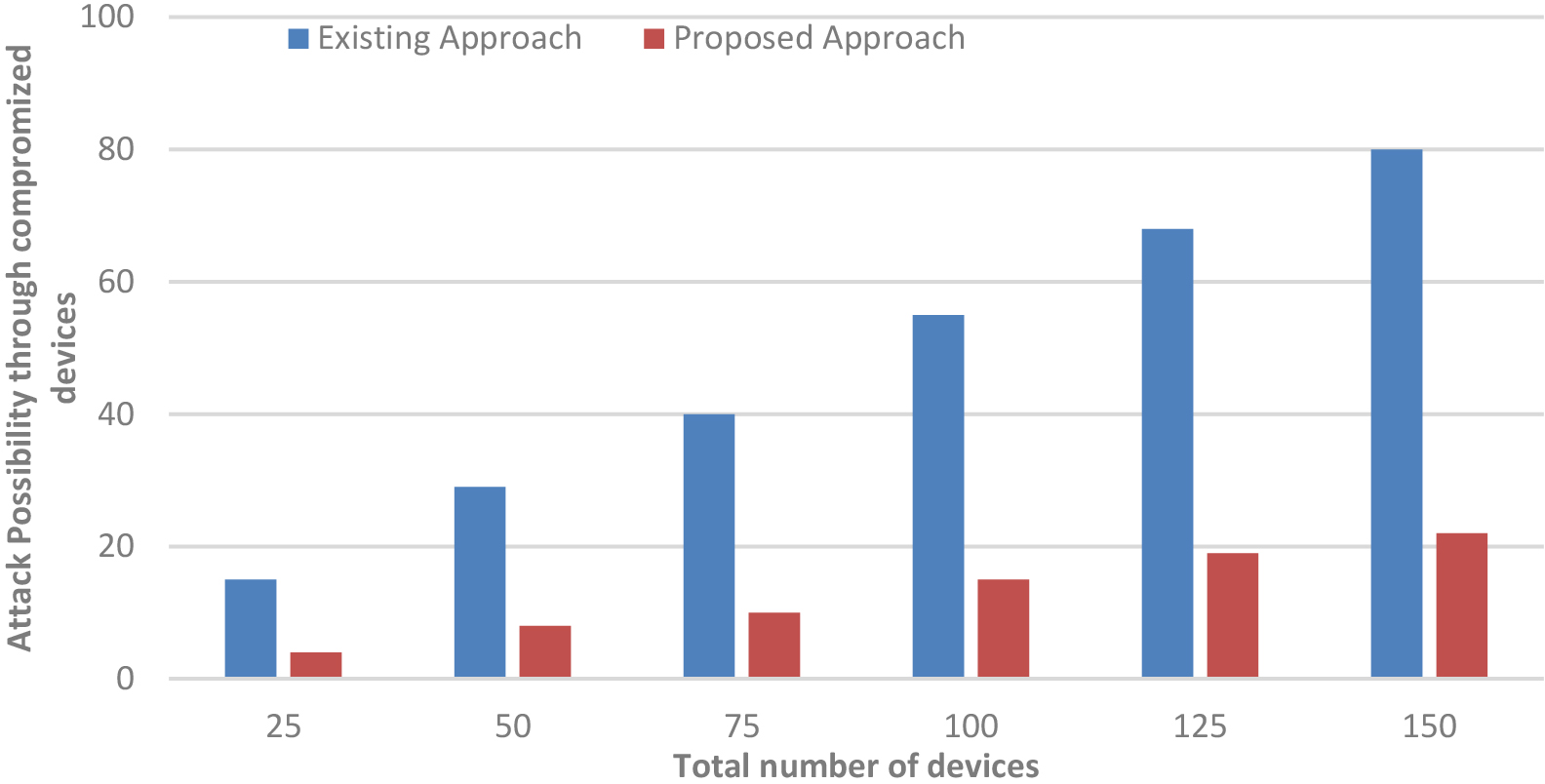
Here, Table 2 includes used data sets and simulation parameters for our proposed work. Figure 6 discuss about our experimental setup.
Hence, Fig. 6 provides less communication overhead during parking. Similarly, Fig. 7 provides lesser attack possibility on OBU devices or vehicles during moving or parking a vehicle in an area [17]. With comparing our result with existing work, we see that we receive lesser number of attacks on vehicles (which require parking over the street or road). This section discusses simulation results of our proposed work/model a and we find that we receive efficient results in terms of building trust unit recommendation (via deep learning) and preserving privacy of users (using Blockchain technology). Now, next section will conclude this work in brief with incorporating/providing few research gaps with respect to future vehicles.
To conclude with, this paper focuses on the subject of trust and privacy in VANETs. In order to put an end to the dispersal of fake messages from inner vehicles and simultaneously to protect the identity of vehicles, we use a Deep Learning based Blockchain Solution (DLBS) which is suggested for the trust management in VANETs [18]. Two Blockchains ‘CerBC’ and ‘RevBC’, makes the undertaking of authorities transparent for all the structure in VANETs. The validation of the existence and absenteeism shows the unnamed authentication with high efficiency. Public keys act as pseudonyms in V2I (Vehicle to Infrastructure) and V2V (Vehicle to Vehicle) communications to protect the identity privacy of vehicles [19]. Moreover, all the telecasted messages are noted down in MesBC as tenacious proof for assessing individual vehicle’s reputation. A reputation assessing algorithm is structured to restrain the issuance of fake messages and vehicles to disclose misbehaviors. Lastly, we examine the security and validity of Deep Learning based Blockchain Solution (DLBS) and assess the presentation of the unnamed authentication. The result shows that DLBS comes up with a successful trust model of VANETs with lucidity, dependent, invisibility, ability and firmness. In future vehicles, sensors will take part as an essential role for ITS (Intelligent Transportation System) in the time ahead. Their utilization helps the development of a broad variety of applications for traffic safety, traffic control entertainment and driver assistance. The sensors provide the mechanism to data accession connected to the vehicular context (like road conditions, traffic and vehicle conditions) that can be unified with the present transportation systems to reduce some of the issues that occurred and the present transportation system is suffering [20]. Note that Tyagi et al. presents literature review for preserving privacy in [21], also have preserved vehicle user against Sybil attacks in [22]. Tyagi et al. also have raised several issues in various computing platforms in [23].
In the near future, future vehicles will sense accidents or any raised problems over the road and will send information to nearest authority to solve the same issue/problem in minimum time. Such services will provide a good experience and will make people life’easier to live. The usage of analytical and statistical ideas demonstrates the actual potential of consolidating sensors in ITS. This consolidation is a favorable research area that will expand the development of a broad range of next generation smart applications focusing at betterment of the safety and traffic control of the present and the future transportation systems.
Footnotes
Conflict of interest
We, the authors declare that we have no competing interests.
Authors contribution
All authors have contributed equally in this work. Amit Kumar Tyagi has analysed, and approved the final manuscript.