







Abstract
The conceptual categories ‘person’ ‘citizen’ and ‘moral-agent’ are re-analyzed in a way that integrates perspectives, takes into account interactivity and makes helpful use of models or diagrams. The primary-qualities of these three categories are duly emphasized. Various aspects of the concept of a for-profit corporation are then also described and depicted (e.g. fiction, aggregate and real-entity) but with careful references to the logical (set-like) distinction between a corporation per se and its human members jointly or severally. The much-debated composite notions of corporate-personhood, corporate-citizenship and corporate-moral-agency are then re-analyzed, including their intentionality aspects, but with reference to their respective ‘primary qualities’. There follows a discussion of the apparent motives of the participants in the continuing debate about corporate-personhood, citizenship and moral-agency when they themselves emphasize selected qualities of the corporation.

Introduction
The processes of thinking about any problem, or the methods used to analyze that problem, are themselves often described as ‘strategic’ when they involve: (i) a careful identification of the most relevant or primary components of the problem, (ii) an attempt to integrate various perspectives, (iii) a proper consideration of interactivity amongst the components of the problem, including interactions between the analysts themselves and the problematic system, as well as (iv) making appropriate use of conceptual models (i.e. figures or diagrams). In business contexts, this type of thinking or analysis is often applied to the situation and circumstances of an organization or a firm, as in ‘strategic’ macro-environmental and competitive analysis. However, within a broad spirit of pragmatic inquiry, one might also analyze abstract ideas and the very meanings of phrases in a similarly ‘strategic’ way [1–5].
The four ideas of person, citizen, moral-agent and for-profit corporation (FPC) are all good candidates for this type of analysis. Debates about the meanings and scope of these words and their compound phrases such as ‘corporate-personhood’ have been active and vigorous for more than century [6]. In these debates, the FPC itself has been conceptualized in quite a variety of distinctive ways, usually for well-specified reasons that are in turn amenable to further discussion and critique [7–9]. The resulting plural forms of the FPC have included not only fiction, association, aggregation and real-entity, but also person, citizen and moral-agent (not to mention other forms and formalizations such as organism, brain, maximizer, optimizer and satisficer).
Structure
In the following section of the article, the normal English usages of the terms ‘person’ ‘citizen’ and ‘moral-agent’ (P/C/MA) are described, with particular reference to their primary qualities (PQs). The various distinctive concepts of the FPC are then discussed (e.g. fiction, aggregate, group, or real-entity, etc.) but always with a steady eye upon the logical set-like distinction between a corporation per se and its human members, whether severally or jointly (i.e. as a group-agent). The specific but controversial ideas of the FPC as a P/C/MA are duly re-examined with systematic and careful reference to all of these identified PQs. Then (in section 4) the particular concepts of corporate and collective intentionality are re-examined, since these are related to P/C/MA in quite complex ways. This ‘strategic’ analysis of abstract categories concludes with some indications of the likely motives of observer-analysts and commentators themselves when they chose to emphasize particular qualities of the FPC.
Categories
Under normal usage, the conceptual-linguistic categories ‘person’, ‘citizen’ and
‘moral-agent’ each has some primary qualities (PQs). These are the
qualities that are most-obvious for that category, such as a person having a character; but
any of those ‘obvious’ PQs can nonetheless be ignored for well-specified technical or
contextually-determined purposes. The categories ‘person’ and ‘citizen’ evidently share some
PQs that are both invariant across almost all contexts and reasonably stable over time, such
as (a) being human (whether conscious or unconscious), and (b) having some distinctive legal
and political status that in turn implies some rights. There are also some other PQs that
differ between these two categories, as follows (refer to Fig. 1). For a ‘person’ the PQs are having: (a) a
persona (i.e. psychological traces in others’ minds and societies),
and (b) a character or a propensity to behave in certain ways [10]. (ii) For
‘citizen’ they are having: (a) state-conferred identity and duties
1
, and (b) some virtues, to the extent that the citizen
accepts those duties, and (c) a sense of (possibly reciprocated) solidarity with other
citizens [11].
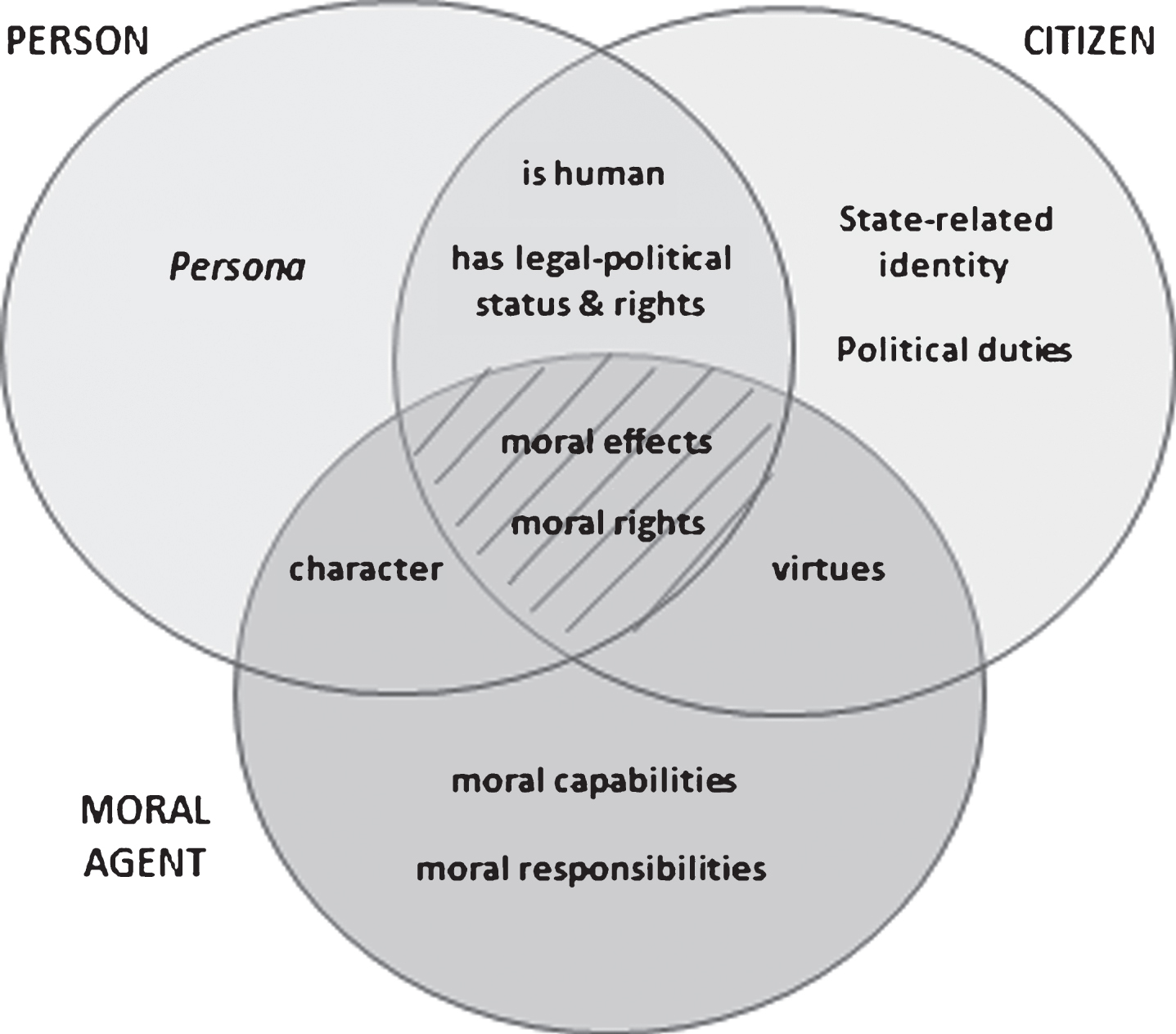
The primary qualities of three categories.
The PQs of person and citizen can also be thought of as aspects of the referents (e.g. having a character is an aspect of, or a partial-description of, what it means to be a person). Like aspects of a snowy mountain, any observer or explorer knows that all the aspects are always there, but only one is currently being described or viewed. The category ‘moral’ (by itself) is, however, somewhat different in this respect, because routine or normal usage encompasses or entails several distinctive forms of moral reasoning, indeed entire branches of moral-philosophy, that in turn reflect distinctive value-priorities and modes of reasoning, with some sort of competitive debate about their primacy. Nonetheless, forms that emphasize caring and respect for others, or justice or the golden rule are without doubt more-obviously-moral; so these (care, respect, etc.) do count as the primary qualities of ‘moral’. One can also of course describe, explain and justify several less-obvious or secondary-qualities of ‘moral’ such as self-love, or unconstrained utility-maximization, or granting to others the freedom to make agreements.
The compound phrase ‘moral-agent’ belongs to yet another type of category, because under normal or proper usage this phrase can refer to any of several levels of agency (Fig. 2). The lowest level is (i) that an agent (such as an FPC) has potential moral-effects on its surroundings (refer to Appendix 1); the next level is (ii) its possession of moral-rights, then (iii) its capabilities for moral reasoning, then (iv) its moral-responsibilities or duties. Arguably, the capacity for moral-imagination is the next and highest level of moral-agency 2 . Each such level has its distinctive PQs. In particular, as the referent ‘level’ of moral-agency increases, so too does the implied (or assumed or required) level of self-awareness, consciousness, intentionality or purposefulness of that agent.
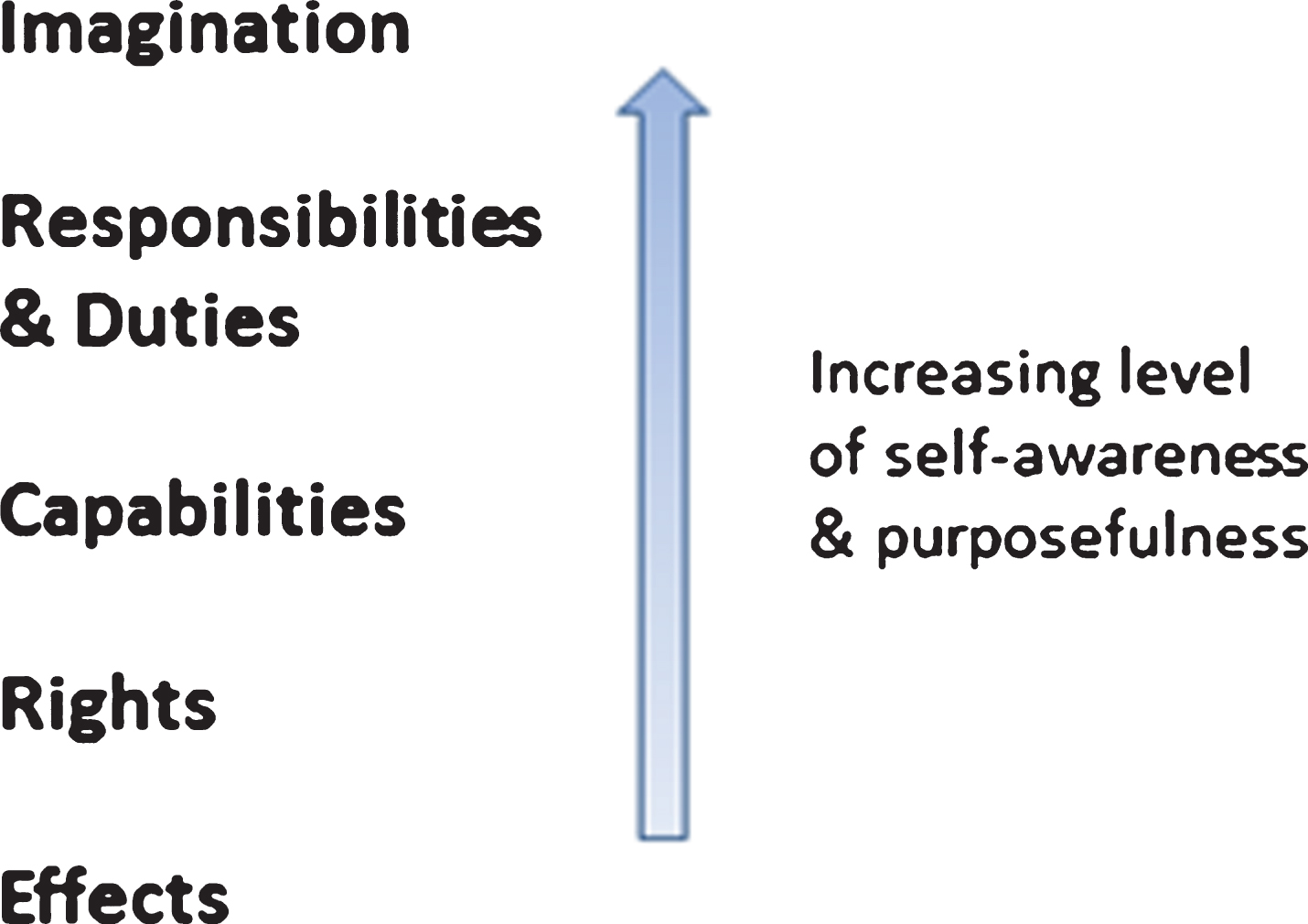
The primary qualities of moral-agency.
The abstract category ‘for-profit corporation’ (FPC) also has several aspects, each with
its primary qualities. For example, when a corporation is viewed as a legal fiction its PQ
becomes its legal standing as a party to contracts. If instead it is viewed as an
aggregation or an association (a different aspect) then its PQs are a group of humans, who
in traditional terms are engaged in some enterprise, together with the web or
nexus of relations that bind them together. If, finally, the FPC is
viewed as a real-entity, as in many discussions of strategic management,
meso-level business-ethics and law, then its PQs are
its identity, its apparent or real intentionality and its life-like
qualities. Each of these aspects can be briefly described and depicted as follows: Fiction or
concession: Under the legal-fiction aspect, which is also known as the
‘artificial’ theory, or the concession-theory when the implied concession from the
state is being emphasized, the FPC has a single PQ, namely its technical legal
standing as a party to contracts (as distinct from its members jointly or
severally). This is depicted in Fig. 3 where the mathematical set notation has been
deployed to refer to the FPC itself (‘it’, the set). In the figure, the notation is
visually prominent because this is a primary quality (PQ). The
circles in the figure then represent its human members, whilst the arrows represent
legal contracts between ‘it’ and various humans and other corporations. Finally, the
dotted lines represent informal associations (i.e. the human members associating for
a common purpose). Aggregation and association: When the FPC is then viewed as
an aggregation, the idea of group of human members, primarily managers who also
might be shareholders, comes to the fore. This group can be viewed either (a)
jointly, that is as an aggregated entity (depicted by the shaded oval in the figure)
or else (b) as several human members that simply have their group membership in
common (the dark circles). If the group (jointly or severally) is then viewed as an
‘association’ then the associative relationships amongst members come to the fore,
as depicted by the dark lines in the lower part of Fig. 4. If the FPC is then viewed as a
nexus of contracts it is the contractual nature of these
relations that comes to the fore, parts of which are represented by the darker
arrows in Fig. 4. These
contracts, in turn, can be formal and legal, complete or incomplete, informal and
associative or based upon other forms of power. Real entity: In many other contexts, including
legal deliberations [12] the FPC is viewed
as a real entity that interacts with ‘its’ environment. The justification for taking
this view is pragmatic in both the common-practical and the technical-philosophical
senses. At the level of practice, one can point to the objectives, plans and ethics
of the corporation, whether real or reified. At a more technical
level, philosophical pragmatism justifies the real-entity view by arguing that any
such entity is ultimately ‘constituted’ (i.e. made into a real thing) by precisely
the nexus of its internal and external relationships. Furthermore,
the FPC itself and its members, variously defined, are all embedded in a
nexus of mutually-constitutive dynamic relationships [1], which has also been described as the
‘ontological-glue’ [13] that renders the
FPC real: as real, that is, as anything else.
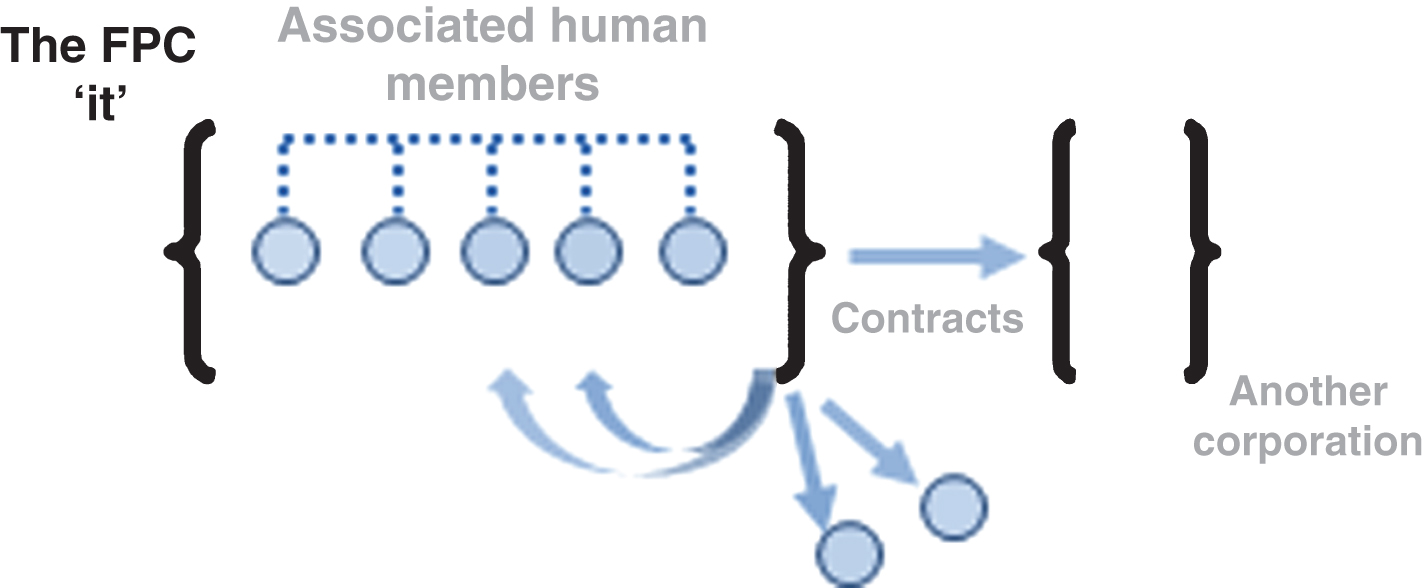
The fiction aspect of the FPC.
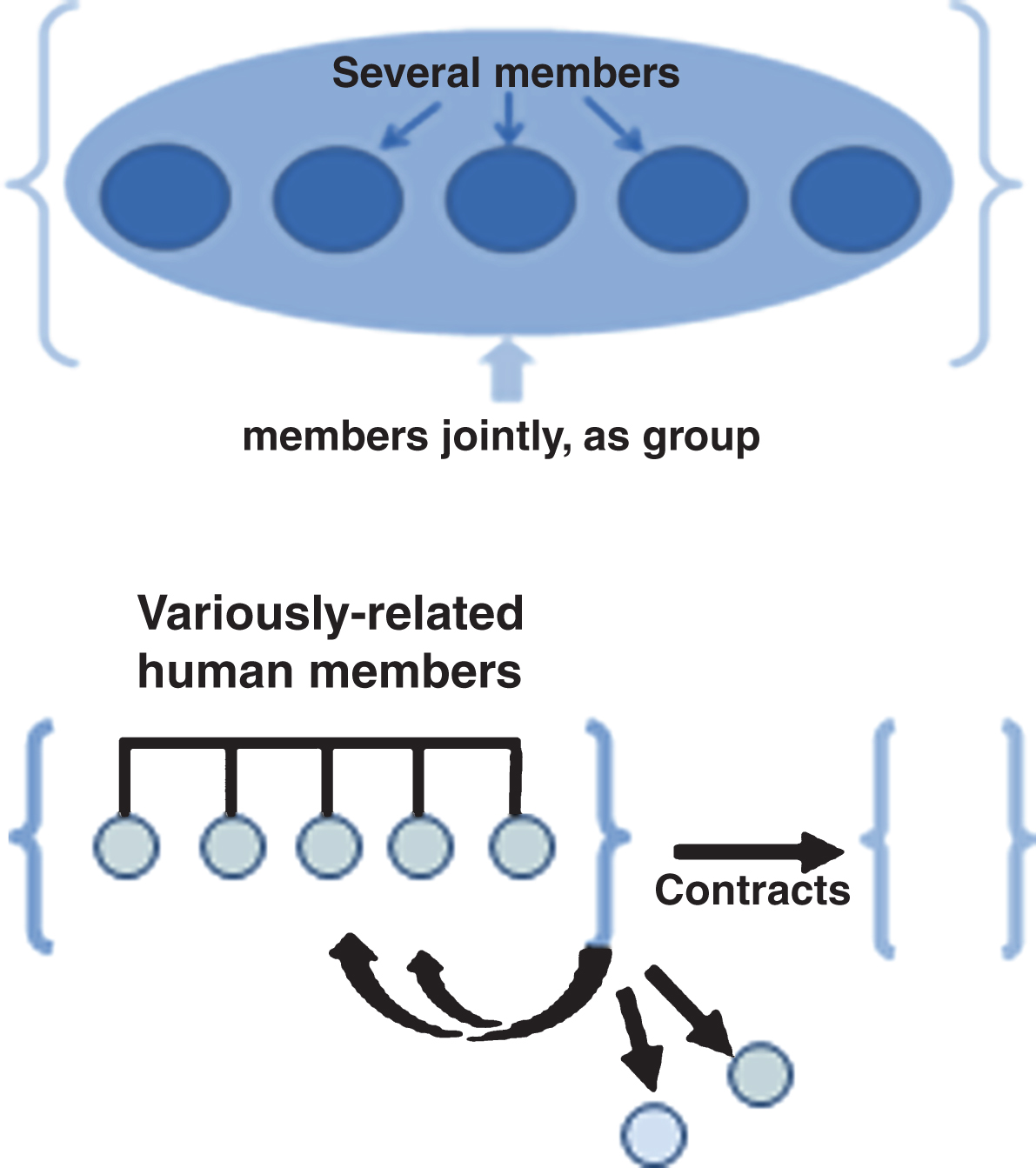
The aggregation and association aspects.
It is obvious that all of these aspects of an FPC (in Figs. 4 and 5) are gross simplifications of the real ‘situation and circumstances’ that constitute a corporation, because any real-real-entity corporation such as Microsoft or Exxon-Mobil is something far more complicated (refer to Appendix 2). Its boundaries are quite ambiguous and its internal and external stakeholders (jointly and severally) are another important but inevitably contested part of the relevant ‘constitutive’ nexus.
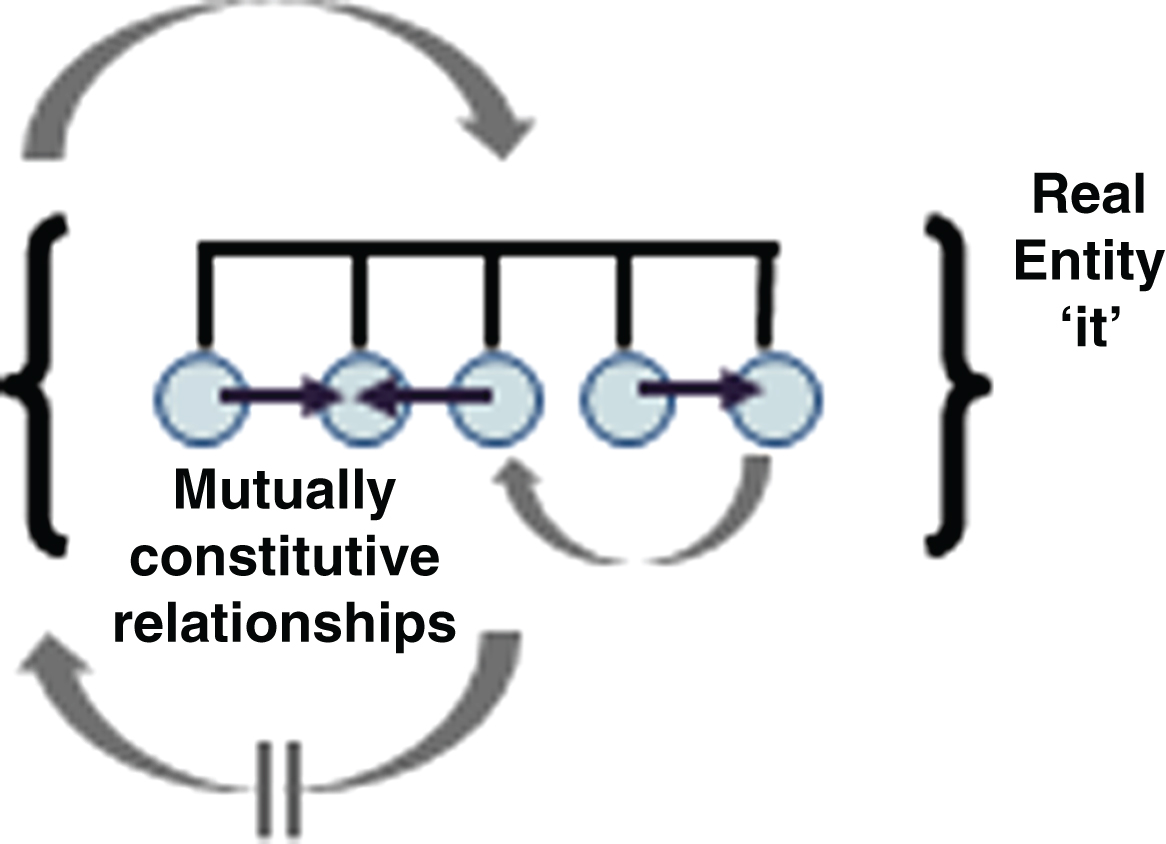
The real-entity aspect with its pragmatic support.
The blunt question of whether an FPC is or is not a person (or a citizen, or a moral-agent) can now be answered with systematic reference to the three main aspects of the FPC (above) and the extent to which their corresponding PQs are shared with the PQs of P/C/MA (Table 1). Perhaps the most obvious starting point (Table 1 row 1) is that the primary quality of ‘being human’, which is common to person and citizen, is not possessed by any aspect of a FPC (Fig. 6). The fiction (or artificial or concession) view can also be dealt with quite quickly. The only PQs of the ‘fiction’ aspect that are also PQs of P/C/MA are (i) the legal-political status or the intrinsic rights of the FPC and (ii) its possession of a state-related (legal) identity. Fictional entities themselves cannot have real moral-effects, nor capabilities, responsibilities or rights (although the state-concession that grants this legal status does have very significant effects).
The primary qualities of P/C/MA shared with the aspects of the FPC
The primary qualities of P/C/MA shared with the aspects of the FPC
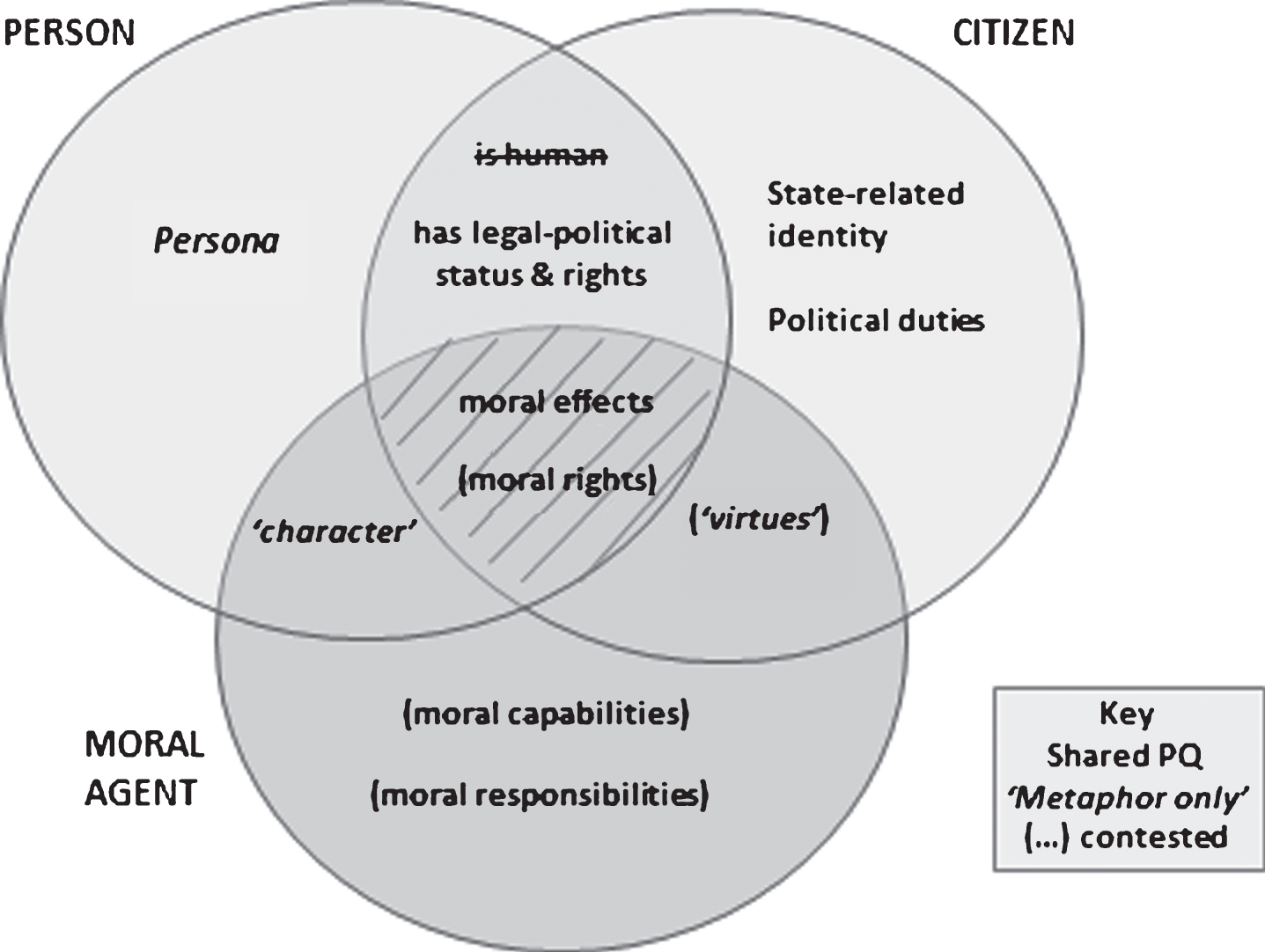
The primary qualities of P/C/MA shared with the aggregate and real-entity aspects.
It turns out that the aggregate/association and real-entity aspects of the FPC can be fully combined for the present purpose of comparing their PQs (see Table 1 columns 2 & 3) because each of the PQs of P/C/MA apply either to both, or else to neither. For example it is obvious that any structured group of humans or any real corporation has moral-effects (refer to Appendix 1 and Table 1 row 4). With regard to political duties (Table 1 row 5) the real-entity, or arguably the group of associated managers, jointly and severally, has some fiduciary duties to shareholders (that might include themselves) as well as contested duties of reciprocation to the state (for the concession) and duties-to-aid people or external stakeholders in need [14].
The situation with respect to moral-capabilities and moral-responsibilities is more complicated (rows 6 & 7). Firstly, there is the distinction (in section 2 above) between the primary and less-obvious (i.e. moral-foundation-of-capitalism) forms of moral-reasoning. Hence the entries in rows 6 & 7 of Table 1 are split in two. Then one encounters the question of the extent and nature of the ‘moral’ capabilities of human-groups in general. It is uncontested (hence the ‘Y’ in the table) that groups of humans that function within a system of shareholder capitalism are indeed capable of and actually display those less-obvious forms of moral reasoning. However, the capability of any such a group in a corporate context (or indeed any human group) to engage in the more obvious forms of moral reasoning involving justice, care and the golden-rule is less obvious (hence the ‘(Y)’ in the table) and indeed has often been contested [15–17].
The next level of moral-agency has also been contested: this is the idea of the moral-rights of the real-entity FPCs and of human groups in general, analogous to but distinct from the human-rights of their several members [18, 19]. For example it has been argued that the group/real-entity FPC does have a quasi-moral right to be protected from being disbanded or dissolved, either by a private takeover that some have likened to murder of the FPC, or by the state in contravention of the members’ legal-moral right of association.
Next, with regard to persona (row 9) it is relatively uncontroversial to say that any real-entity FPC creates ‘psychological traces in other minds’; indeed this is a principal objective of the marketing function. The existence of a group persona in this context (i.e. of a group of senior-layer managers) on the other hand is much more doubtful, as the identities of managers change and they often operate behind the veil, so to speak. Finally, the idea that the group or real-entity possesses a real-character (as a PQ) is once again controversial: ‘character’ is intertwined with the moral virtues, but the latter seem to be almost exclusively-human [10]. Nonetheless an obvious metaphor does exists (‘M’ in row 10) between the character of a human and the culture of a corporation [20] and that metaphor can be stretched-at-will, so to speak, to refer to human-like virtues such as the moral-integrity of the FPC.
Some perceived aspects of the corporation with their primary qualities and viewer purposes
The present strategic analysis of abstract ideas can be extended to include the much debated concepts of corporate and collective intentionality. Many contributions to the 20th century debate [21–24] not to mention classical 18th century works such as those of Rousseau have considered the relationship between human intentions (which is a very significant category in law), group intentions (i.e. their intentions jointly as the will-of-all or severally as the will-of-each) and the objectives or goals of the FPC (its intentions as a real-entity).
It seems fair to say that many written contributions within several academic disciplines have been somewhat ambiguous with respect to these distinctions, especially as regards human-groups in general as distinct from senior-management groups and real-entity FPCs [9]. Once again, a diagram or conceptual model might help to clarify the matter. In Fig. 7 (above), the red and blue sectors of the circles depict the personal value-laden political-leanings of each human member of an FPC. The blue shading represents the value-priorities of wealth and efficiency, with negative-freedom from state regimes that are in turn associated with intentional profit-seeking; the red shading then represents left-leaning priorities of care and various aspects of justice, and so on. When any observer (reader) views Fig. 7 the blue value-priorities empirically dominate; put differently, the blueness is a primary quality of the FPC. Also, the senior-layer of managers (jointly and severally) is very appropriately shown in the figure as having a larger effect on that overall primary impression. The dashed arrows within each smaller circle then depict the typical changes in each of the lower-level members’ value-priorities that are often induced over time by the typical power dynamics within an FPC whenever the members are in their corporate role, or when they are ‘persons in their corporate aspect’ as Phillips [22] put it (cf. Appendix 1). These power dynamics include inter-personal influences and top-down expectations of loyalty. Indeed, they might have been precisely what Barker [21] had in mind when he wrote some time ago of “a pulsation of a common purpose that surges, as it were, from above, into the mind and behavior of members” (1950, p61; cited in [25] p9).
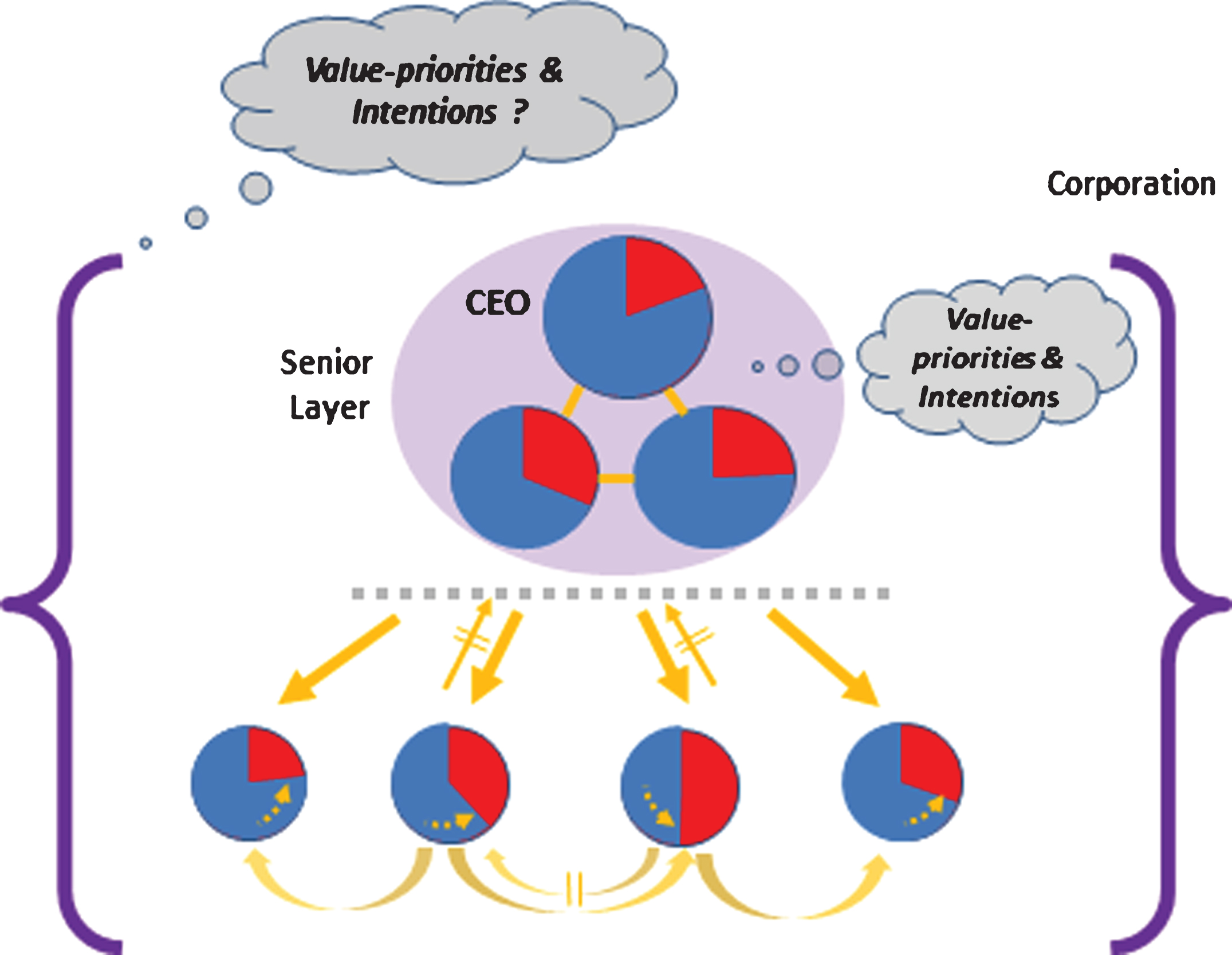
Corporate intentions with the internal dynamics.
Another way of interpreting Fig. 7 is
to say that the overall blueish appearance represents the value-priorities
embodied in an aggregated temporary and role-specific will-of-each. The
classical concept of a ‘will-of-all’ or a general will of the FPC might then refer to either
the: entire
group (or aggregation); their intention, as depicted by the shaded
oval in Fig. 4 (in section 2
above), or senior-layer;
(their intention), as depicted by the shaded circle and
thinking-symbol in the current Fig. 7, or set
(it) that is, the real-entity FPC itself (a reference depicted in
Fig. 7 by the thinking-symbol
attached to the set-markers).
The latter interpretation, whereby a mere symbol (a piece of syntax) is endowed with real
intentions and purposes might seem quite absurd; indeed it is essentially this idea that has
variously been dismissed as untenable, or bunk; or as loose or woolly thinking [26–29]. Nonetheless,
even the strongest critic usually concedes that the idea might be useful in some contexts
(e.g. in strategic analysis and meso-level business ethics) so long as it
is well understood that it is merely one of the following literary devices: a
metaphor, or a way of speaking [30]), an
ascription, or a motivated-description that overtly serves a
special purpose of the speaker or writer and that is intended to be understood as such
[22], a projection, as in the ‘principal of moral
projection’ [31], whereby the quality of
being moral is explicitly assumed to originate in the mind of an observer, or in the
eye-of-the-beholder, a
licensed-description, something to be adopted or deemed as proper
by legal authorities because it is justified in this technical context by selected
philosophical arguments (as in French’s thesis [32]), a
personification, in the sense that the corporation is replaced by a
powerful or charismatic person, the CEO, so that its intention is
understood to be that of the CEO [33], an
identification, whereby the corporation is ‘identified with’ an
entire senior layer of managers whose intention (jointly or severally) is then assumed
to represent the intention of the FPC as depicted in Fig. 7 and in the legal principles of
representation and identification [6, 22].
All such literary devices aside, intuitions and arguments nonetheless persist that the intention of a real-entity FPC might yet be fully real: that is, as real as any human (or animal) intention or indeed any other thing that (presumably) exists in a ‘real’ world outside the minds of observers. Indeed, the notion of FPC-intention is entirely taken for granted (and thought of or treated as fully real) in much of the mainstream theory and discourse surrounding ‘strategic-management’ and meso-level business-ethics. As with the FPC itself (refer to Fig. 5 in section 2 above) these arguments about ‘its real intentions’ all rely upon the important idea of mutual-constitution: not only the members and the FPC (it); but also of their various intentions. Under philosophical pragmatism any real-entity FPC can indeed be a proper locus of intentionality and purposefulness; however, as with all human intentions (not to mention those of animals, artificial agents or indeed a real-entity FPC itself) that intentionality and purposefulness always remain to some extent in the eye-of-the-beholder.
This brings us directly to the final aspect of the present strategic analysis of corporate personhood; that is, the diverse purposes and value-priorities of the observers and debate participants themselves. So far, at least 12 distinctive concepts or aspects of the FPC have been mentioned and these are duly listed in Table 2 (left column). Each aspect renders particular qualities as primary, as listed in column 2; but each aspect also appears to express particular inquirer-purposes (column 3). For person, citizen and ‘moral agent’ (rows 1–4) the PQs and their apparent inquirer-purposes have already been discussed. For example, an FPC can be viewed as an ideal (Hellenic) citizen (row 2) if an observer wishes to assert that ‘it’ should exhibit virtues and engage in state-related CSR. Similarly, to say that it ‘is’ a moral-agent (in the more-obvious sense involving justice and care) is to advocate for a stakeholder model of management or legislated variant of capitalism. The ‘fiction’ concept (row 5) was originally constructed as a legal technicality; but to subsequently assert that the FPC ‘is’ a fiction and nothing more is to effectively absolve it of its social responsibilities, except perhaps the duty of reciprocation associated with the political concession (cf. row 10). Next, to say that an FPC is merely a group of humans associating for a common purpose (row 6) is to emphasize and hence indirectly endorse the more general moral-political rights of association and autonomy (i.e. negative freedom from the state as a value-priority). Similarly, the idea of the FPC as a nexus of contracts (row 7) was quickly developed into a line of economic inquiry, namely new institutional and transaction cost economics, although any sustained emphasis on the principal-agent relationship has the side-effect of making the human members almost invisible and thus serves to advance a broader (neo-liberal) political project.
Turning now to the real-(real-entity) FPC (Table 2 row 8), its PQs are many and complex (refer to Appendix 2) but the idea of the FPC as a ‘real-entity’ obviously remains useful. The distinctive notion of the corporation as a ‘set’ with members was introduced here (Fig. 3 above and Table 2 row 9) for the sole purpose of highlighting some common ambiguities in many previous contributions to the debates about P/C/MA [9] but the notion is also quite helpful when characterizing the real-(real-entity) FPC. Finally, the concession theory, with the ‘administrator of duty’ and the ‘property’ aspect of the firm or corporation all serve to promote awareness of a wider political context and the various contested responsibilities and duties of the FPC and its shareholders (rows 10, 11 & 12).
Other concepts
There are many other concepts of the corporation but these are either (i) obvious metaphors or similar literary devices as listed in section 4 (above), or else (ii) axiomatic and formal. For example, the corporation is sometimes said to be like an industrial-age machine [34]) or very much like an organism [35] or a brain [36]. Each asserted likeness then serves some politically-infused purpose. For example, an industrial-age machine cannot care; an organism is compelled to sustain itself (i.e. it is autopoietic); firms and entire economies need a central nervous system, and so on. Yet other concepts of the FPC are axiomatic formal definitions. These include utility-maximizer, satisficer and multi-criterion optimizer. Each such definition has been motivated primarily by a quest for the development of formal theories with their potential applications; yet the relevant meta-theories (i.e. their natural-language commentaries) are generally quite political. As noted by Herbert Simon [37] for example, whenever market-participants are defined as utility-maximizers and human managers are modelled as mere contracting agents, one generally finds an accompanying framework of natural-language ideas (i.e. an ideology) that can be used to justify a particular family of value-priorities.
Conclusion
This purpose of the present article was to conduct a ‘strategic’ analysis of the abstract ideas of personhood, citizenship and moral agency (P/C/MA) in relation to the various aspects or forms of the for-profit corporation (FPC). In practice, attempts to improve understandings of the situation and circumstances of an FPC often involve the use of conceptual models (diagrams) because these are almost always quite helpful, like the maps used to guide military strategies. When abstract ideas like ‘person’ themselves become the objects of model-based analysis, however, there is an inevitable sense of recursion: thoughts about thoughts. As one reviewer noted, for example, one might go on to engage in yet further debate about the possible meanings of compound phrases like ‘abstract idea’ and ‘conceptual-linguistic category’. Indeed, the organization-theorists Vergne & Wry have recently done exactly that, in a recent article in the Journal of Management Studies [38]. The reader or viewer of the present strategic analysis of ‘corporate personhood’ might simply reflect upon the extent to which the models and their descriptions have contributed to their own understandings, particularly with respect to “the constant conflations of categories in the (relevant) literature” and the resulting “slippery” quality of the various debates (to quote reviewers). Thousands of complicated and quite challenging articles have indeed been written about the P/C/MA of the FPC. The present article, in contrast, has set out just a few models and tables, with concise accompanying text. The pragmatic philosopher Charles Peirce argued in the 19th century that diagrams constitute an integral part of scientific inquiry. Modern journalists sometimes say, in similar vein, that a picture is worth 1000 words. When abstract ideas like corporate personhood, citizenship and moral-agency themselves become the objects of inquiry and investigation, that ratio might be even higher.
Footnotes
Appendix 1: Moral effects
In normal strategic analysis, or when making strategic decisions on behalf of an FPC, it is routine to (i) view the FPC as a real-entity situated within a competitive (industry) environment and macro-environment, (ii) to give consideration to the various factors and dynamics that are likely to affect the entity (Fig. 8), and (iii) to assume that the entity does indeed make a difference to its environments in many ways (Fig. 8) including the co-production and distribution of the various mixtures of the human-goods (e.g. wealth, health, pleasure, justice, freedoms, etc.). The latter are all moral-effects.
Another type of moral-effect operates inside the corporate entity (its internal environment as previously depicted in Fig. 7 in the main text). When a human-member takes on any corporate role (Fig. 9 below) they are immersed in a nexus of influences and exchanges that potentially affects their personal values and intentions [18] [23]. Karl Marx used the term ‘alienation’ in this context to refer to a likely loss of authenticity, whilst others [21] [39] have referred critically to the ‘corporatization’ of a person or their character. However in some cases, immersion in a (for-profit) corporate culture might have a good or positive and civilizing effect: for example where a human previously lacked a sense of belonging or moral-virtues such as self-control or loyalty [6]. Either way, the moral-effects of the FPC on any human PAC (person-in-their-corporate-aspect [22]) is quite likely to be carried over into the ‘non-corporate aspects’ and projects of that same person, as depicted by the nested circles in Fig. 9. Furthermore, this effect is reinforced to the extent that the entire macro-environment is ‘corporatized’ in the sense of being comprised of FPCs rather than other types of institution.
Appendix 2: The real-(real-entity) FPC
Figure 10 (below) depicts the typical complexity of any real-(real entity) FPC. The CEO, the managers and the employees are all internal human members. Those same humans might also be shareholders or board-members; however, in the latter role (or aspect) they are arguably outside the boundary. In the figure, the particular CEO is depicted (by the colored sectors) as being a board-member, but not a shareholder; another senior-manager is a shareholder but not on the board; whilst yet another is both a shareholder and a board-member. The existence of a senior-layer (of managers) is in turn a primary quality of any real FPC. This layer (in either the joint sense depicted by the pale oval, or else severally) has a legal fiduciary duty to all the shareholders; but sometimes (or arguably) to all other stakeholders (i.e. multi-fiduciary duties [40] or balanced interests [41]).
Several other humans, groups and corporations can be thought of as external stakeholders. These include external board-members, shareholders (who own the entity in various qualified senses) and bondholders; but also the customers, suppliers, NGO’s and various human communities and governments. Any of these stakeholders (humans or institution) can in turn also be shareholders; just as any of the human-stakeholders (including FPC employees) might be members of the board. To complete the picture, the FPC (i) owns assets (again in a qualified sense) but these generally include shares of other corporations, and it (ii) routinely exercises its intrinsic right to contract with selected internal and external stakeholders. Finally, (iii) it is part of a wider networked process of co-production, including the co-production of moral effects as described in Appendix 1.
According to Manville & Ober [ ] one of
the PQs of ‘citizenship’ is ‘having an obligation to play an active role in the society’s
governance’. This is a refinement of the PQ described here of ‘having state-conferred
duties’. They further wrote that ‘the practice of citizenship must grow out of the actions
and beliefs of the citizens themselves’, which is, in turn, similar to ‘having an
(authentic) state-related identity’. However, it should be noted that throughout their
2003 article Manville and Ober were advancing the idea that the managers and employees
of any FPC might be regarded as its ‘citizens’. The
present article, in contrast, refers only to the possibility that an FPC itself
(it) might act in a quasi-virtuous (or Hellenic)
citizen-like way. The latter usage of “corporate citizenship” can be found, for example,
in most contributions to the Journal of Corporate Citizenship and it is
quite similar to the normal meaning of corporate social responsibility (CSR).
] one of
the PQs of ‘citizenship’ is ‘having an obligation to play an active role in the society’s
governance’. This is a refinement of the PQ described here of ‘having state-conferred
duties’. They further wrote that ‘the practice of citizenship must grow out of the actions
and beliefs of the citizens themselves’, which is, in turn, similar to ‘having an
(authentic) state-related identity’. However, it should be noted that throughout their
2003 article Manville and Ober were advancing the idea that the managers and employees
of any FPC might be regarded as its ‘citizens’. The
present article, in contrast, refers only to the possibility that an FPC itself
(it) might act in a quasi-virtuous (or Hellenic)
citizen-like way. The latter usage of “corporate citizenship” can be found, for example,
in most contributions to the Journal of Corporate Citizenship and it is
quite similar to the normal meaning of corporate social responsibility (CSR).
‘Being human’ per se is arguably not a PQ of the category ‘moral-agent’
when one takes into account all the relevant states-of-being, levels of human development,
levels-of-agency and types of non-human moral-agent. For example, a human (person or
citizen) that is either unborn, unconscious or dead has some moral-effects and
moral-rights (as depicted in Fig. 1)
but no moral capabilities. The moral-agency of human children remains contested in several
respects [28]. In addition, there are many
non-human entities, such as animals and artificial agents [] that have contested rights and responsibilities.